Sunset aerial view of the Prophet's Mosque in Medina, Saudi Arabia.

MENA equity markets ended the fourth quarter of 2025 with a return of -4.3%, as measured by the S&P Pan Arab Composite (TR) Net Index, compared with a 4.3% gain for the MSCI Emerging Markets Index over the same period. For the year-to-date period ending December 31, MENA markets returned 4.1%, versus 30.6% for emerging markets (EM).

The region’s long US dollar and long oil exposure, combined with its under-representation in the AI theme, resulted in meaningful underperformance relative to MSCI EM Index in 2025. As regional specialists, we are not required to make allocation trade-offs between MENA and other EMs; however, we acknowledge that the bar for regional outperformance will remain high. The outlook for 2026 suggests a continuation of a weaker US dollar, lower oil prices and sustained capital flows toward AI-linked assets.

From our vantage point, we see a healthy opportunity set developing for the strategy as we enter 2026, driven by the following factors:

  • Following last year’s underperformance, MENA equity markets lost valuation premium relative to EM, and expectations heading into 2026 have been reset lower. As a result, valuation risk is limited, and we are seeing opportunities to select high-quality stocks that were caught up in broad market corrections – opportunities that have been scarce in recent years.
  • The region’s socioeconomic reform agenda remains one of the strongest structural investment themes across EM. These reforms should support non-linear profit pool growth in select industries, including financial services, technology, energy, infrastructure and real estate.
  • The recalibration of ambitious giga-projects in Saudi Arabia signals a more pragmatic approach to capital spending and resource allocation. This shift enhances policy credibility, which we view as essential for building investor confidence and ensuring sustainable public finances.
  • Capital market relevance continues to be a priority for regional governments. We believe this should translate into a broadly supportive market environment, characterized by investor-friendly policies and improved market investability.
  • Return dispersion across MENA markets – a theme we have discussed previously – remains pronounced. In 2025, the performance gap between Kuwait (the best-performing market) and Saudi Arabia (the weakest) reached a striking 34%. We continue to see sufficient idiosyncratic country-level drivers and market dynamics for dispersion to persist in 2026 and beyond. In addition, smaller markets such as Egypt, Oman and Morocco are experiencing a resurgence, positioning the strategy well to capitalize on these developments.

Entering 2026, the portfolio’s largest country overweights are Qatar and Egypt, where we favour the combination of attractive valuations, low investor positioning and visible growth. In Egypt, growth is already evident, while in Qatar we expect momentum to build later in the year as the country approaches its LNG windfall in 2027.

Conversely, we are underweight Kuwait and the UAE, having reduced exposure to financials in both markets due to valuation considerations and, in Kuwait’s case, lower confidence in policy support. In the UAE, we remain committed to our view that late-cycle opportunities in infrastructure and energy will outperform more cyclical segments such as financials and real estate, while acknowledging that this positioning did not perform as expected in 2025. In Saudi Arabia, the strategy remains modestly underweight; however, we retain strong bottom-up conviction in select opportunities across financial services, insurance and industrials.

We look forward to updating you on the strategy in our next letter.
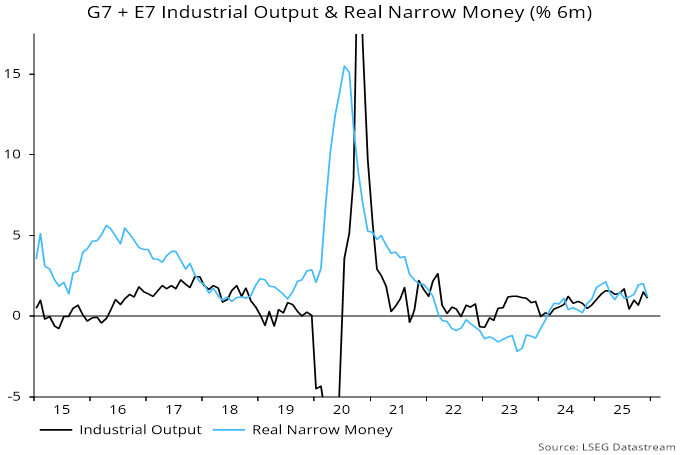
A January post noted the possibility that global six-month real narrow money momentum had crossed below industrial output growth in December, suggesting less favourable monetary conditions for markets. Recent dramatic sell-offs in some speculative assets could reflect such a shift.

The suggestion is still tentative: additional – but not yet complete – December data indicate that the two series converged rather than intersected – see chart 1.

Chart 1

Chart 1 showing G7 + E7 Industrial Output & Real Narrow Money (% 6m)

Will a cross-over be confirmed soon? Monetary prospects are uncertain but stronger January manufacturing PMI results suggest a rise in six-month industrial output momentum in early 2026.

In data since 1970, global equities outperformed US dollar cash significantly on average in months following a positive reading of the gap between real money and output momentum (by 12.0% annualised). (The calculation allows for reporting lags.)

By contrast, negative gaps were associated with average underperformance in the following month (of 5.5%).

Needless to say, these averages conceal frequent “misses” in both directions.

The six-month real money / output momentum gap was positive in most months in 2025. It was, however, negative in 2023 and much of 2024, when equities rallied strongly.

As previously discussed, the six-month gap was a misleading guide to “excess” money over this period because of a large monetary overhang from the money growth surge in 2020-21.

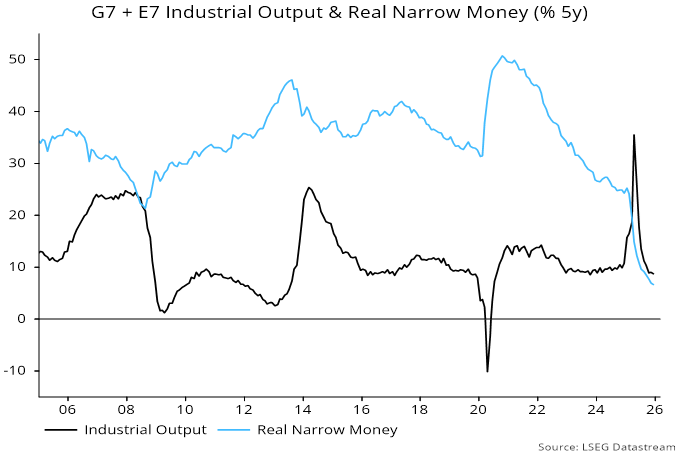
A simple way of illustrating this overhang is to compare five-year growth rates of real money and industrial output. Real money growth was still much higher in 2023 – chart 2.

Chart 2

Chart 2 showing G7 + E7 Industrial Output & Real Narrow Money (% 5y)

The five-year gap turned negative last year. It last closed in the early stages of the GFC bear market.

Back then, the six-month gap had been negative for more than a year. The closing of the five-year gap was followed by an acceleration of the market decline.

With the five-year gap already negative, a negative shift in the six-month gap could be reflected in more immediate market weakness than in 2007-08.

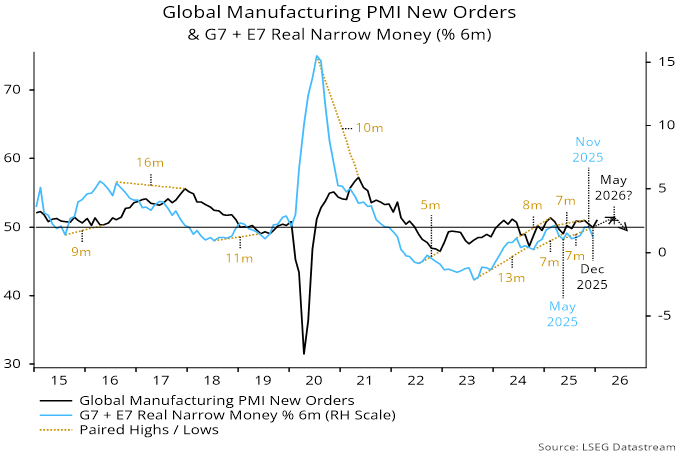
Global manufacturing PMI new orders recovered strongly in January following a November / December relapse. Both the fall and revival had been signalled by money trends: global six-month real narrow money momentum declined sharply in April / May 2025 but rebounded into November. The seven-month interval between a (revised) May low in real money momentum and the December PMI trough matches the lead time at the prior two turning points – see chart 1.

Chart 1

Chart 1 showing Global Manufacturing PMI New Orders & G7 + E7 Real Narrow Money (% 6m)

The rise in real narrow money momentum into November suggests that the PMI upswing will extend into Q2. As foreshadowed in a previous post, however, real money momentum declined sharply in December, retracing most of its May-November gain. Accordingly, the manufacturing bounce is expected to fizzle out in Q2, with renewed weakness into Q3.

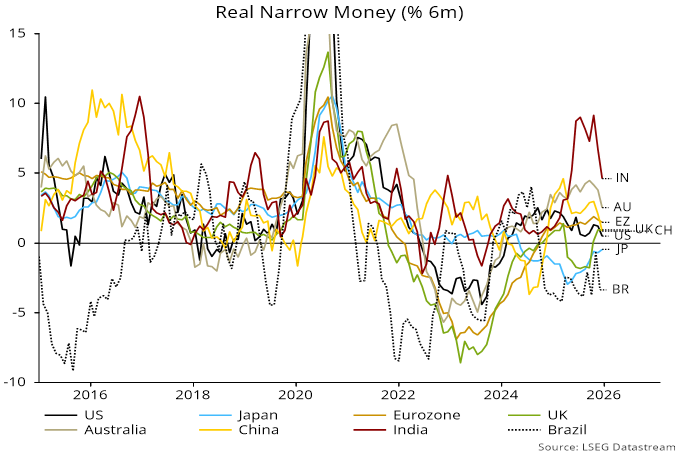
Real narrow money momentum has slowed across most major economies, though to varying degrees. China and India have contributed most to the global decline, although the Indian number remains strong – chart 2.

Chart 2

Chart 2 showing Real Narrow Money (% 6m)

The US series shown incorporates an adjustment for a suggested distortion to demand deposit data affecting the M1A measure used here. However, substituting the official M1 measure – unaffected by the mooted distortion – for M1A would give the same current reading.

Eurozone momentum remains above the US level while the UK has recovered from significant weakness in mid-2025, suggesting improving relative economic prospects. Still, both series have stalled at modest levels, cautioning against optimism.

Japanese real narrow money contraction continues to flag a policy mistake, while a faster decline in Brazil argues for urgent rate cuts. (The Brazil manufacturing PMI was the weakest in the global stable in January.)

Elsewhere, prior strength in Australian real narrow money momentum is consistent with recent upbeat economic news but a slowdown since September suggests that prospects were cooling before this week’s rate hike.

Eurozone and UK money trends have shown disappointingly small responses to policy easing, suggesting that rates remain in restrictive territory and casting doubt on hopes of stronger economic growth.

The preferred monetary aggregates here are “non-financial”, covering households and non-financial corporations. Money holdings of financial institutions are volatile and less informative about near-term economic prospects.

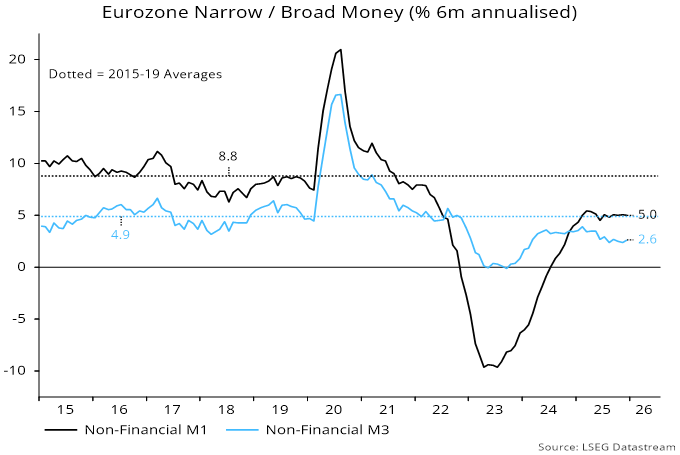
A recovery in six-month growth rates of Eurozone narrow and broad money stalled in early 2025 despite the ECB continuing to cut rates through June, with both well below pre-pandemic averages – see chart 1.

Chart 1

Chart 1 showing Eurozone Narrow / Broad Money (% 6m annualised)

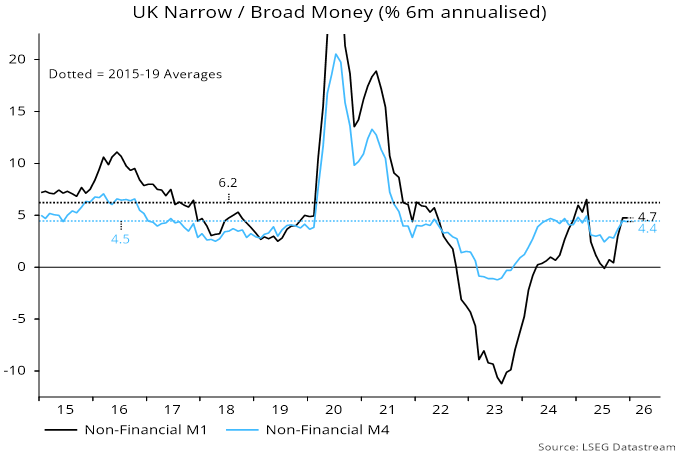
The UK profile is different. The laggardly pace of rate cuts appears to have contributed to a relapse in growth rates in H1 2025 but these recovered into November, moving sideways in December – chart 2.

Chart 2

Chart 2 showing UK Narrow / Broad Money (% 6m annualised)

While suggesting UK relative improvement, narrow money expansion remains beneath its pre-pandemic average (and the Eurozone level), with annual broad money growth a below-par 3.8% (versus 2.7% in the Eurozone).

One reason for the disappointing responses is that policy rate cuts have yet to translate into a decline in longer-term yields. Relatedly, UK QT has been a significant and unnecessary drag.

A hopeful scenario is that low inflation implied by weak broad money trends will allow longer-term yields to subside. Still, additional policy adjustment will likely also be required to generate a monetary response sufficient to warrant economic optimism.

Sergels Square, Stockholm, Sweden.

Retail brokers have benefited immensely from the impact of retail investors on financial markets since the onset of COVID. Robinhood is now a familiar name to most Americans, but virtually all the brokerages globally have benefited from the rising tide of retail investors’ enthusiasm for investing and trading. In this note, we examine some of the mega-trends that have helped European brokerages outperform the market since COVID emerged in 2020.

1. Retail participation and retail financial product availability.

Since the 2008 recession, retail investors have gained access to a multitude of new products like index ETFs, crypto, fractional shares, robo-advisors, IPOs and even private markets. This led to an explosive growth in retail investment, especially since 2020 and the dawn of COVID. Digital and mobile platforms, along with significantly reduced commission costs, have made it easier than ever for a younger demographic to access the markets. The vast majority of onboarded customers over the last decade have not lived through the trauma of the 2008 recession and see any market pullback as an opportunity to double down on their favourite stocks.

2. Increase in cross-border trading.

It is well documented that investors, including retail, have historically had a strong home bias in their asset allocations. But the US stock market outperformance since 2009, along with the disproportionate share of tech mega-cap attention, has led to consistent inflows into the US market. It has also created a larger level of familiarity with US companies that are more covered/discussed by pundits. All this has led to a higher level of cross-border trading in non-US brokerages that is typically much more lucrative as they usually pocket a large spread on foreign exchange transactions.

3. Digitalization and banks losing market share.

Over the last decade, brokerages have been able to consistently gain market share from large banks, thanks to a less-bloated corporate structure and a tech stack that could be built from scratch and not built on legacy bank structures. This has allowed them to be in a position to compete more aggressively on fees, transaction costs and overall value proposition as retail brokerage fees remain a minuscule proportion of mega-banks’ revenue and don’t garner a lot of attention from a strategic perspective.

4. Increase in share of income from NII.

Although net interest income (NII) has been declining for European brokers since the end of 2023, decreasing with the ECB rates, it remains at a more attractive level than pre-COVID and is expected to remain as such for the foreseeable future. Additionally, most brokers have been able to increase NII since 2023 thanks to client gains and account cash balance more than compensating for the lower rates.

Brokers have also been more efficient at increasing the spread between the amount they pay on deposit and the amount they get paid (known as net interest margin or NIM). Having managed deposit pass-through well on the way up and down, brokers are now better structurally positioned to benefit from deposit growth.

5. Benefit from macro volatility.

A key feature of brokerages’ stocks in a portfolio is their positive skew to market volatility. Because they make money from the number of trades, they are agnostic to market direction, as long as it causes participants to trade more. Just over the last year or so, events such as the US election, Liberation Day, the French budget and now the Venezuela situation have all been positive tailwinds mentioned by various brokerage CEOs.

It’s worth noting, however, that brokerages are not immune to long periods or volatility or market drawdown, all of which would lead customers to reduce their equity exposure.

We gained exposure to the retail brokerage space in one of our strategies through Nordnet (SAVE SS), a Swedish brokerage firm with a banking licence. It has exposure primarily to the Nordics with a top-two position in all markets and is slowly working on building a presence in Germany. It derives a bit more than half its revenue from commission and the rest from interest income.

Sweden is one of the countries with the highest savings rate globally, and financial literacy is also higher than the Europe average. Finland, Norway and Denmark also rank highly but are less penetrated and less competitive than Sweden. All have been a strong source of growth for Nordnet, which has consistently been among the top names in the space for customer satisfaction.

Given its diversified product offerings that include a full suite of investments, savings, pension and banking products, as well as its best-in-class technology platform (releases an update every 2.5 days on average and with a 99.9% platform uptime), Nordnet is able to maintain a customer acquisition cost of SEK790 – which is below the vast majority of peers – and its small social media platform has been able to generate a strong media presence and customer engagement.

Here is where Nordnet stands on the brokers mega-trends:

  1. Financialization: Sweden is one of the countries in Europe with high financial literacy. Other Nordic countries rank above average as well.
  2. Cross-border trading: Between 2022 and 2025, share of cross-border trading increased from 27% to 31.5% and is one of the primary contributors to the increase in income per transaction increasing from SEK31 to SEK39 over that same period.
  3. Digitalization and market share gains: Both Nordnet and its close competitor, Avanza, have gained tremendous market share over the last decade and now rank second and first respectively by trading activity. This is despite still being behind Sweden’s largest four banks on savings capital. They both rank top of their class on user experience surveys.
  4. Net interest income: NII was as low as 20% of overall revenue in 2021 and is now steadying at 42% of total revenue after peaking at 58% in 2023. We expect the share of NII to remain structurally higher than pre-COVID.
  5. Macro volatility: Nordnet benefited from large macro events such as the US election and Liberation Day. In Q2 2025, following Liberation Day, Nordnet reported a 22% year-over-year (YoY) increase in trading volume. As for the US election in 2024, it saw a 14% YoY increase in trading volume.

Despite the volatility of their operational performance, brokerage firms provide a unique type of exposure to a diversified portfolio, one that is very different to how you would think of typical insurance and bank financials. There are reasons to believe brokers will continue to outperform the overall market and will continue to look for opportunities to participate.

Exterior of a Sobeys grocery store; exterior of the office building at 145 Wellington Street West in Toronto, Ontario.

Crestpoint Real Estate Investments Ltd. (“Crestpoint”) announced today that it has acquired a portfolio consisting of 22 retail properties and two office assets.

The portfolio comprises ~1 million square feet across 22 well located retail properties, including 15 single-tenant sites and seven grocery/pharmacy anchored centres. With assets spanning Manitoba, Quebec, and – most significantly – Ontario, the portfolio provides broad geographic diversification and exposure to some of Canada’s most resilient retail markets. The portfolio is 100% leased and anchored by essential service retailers in grocery, pharmacy and home improvement, with nationally recognized tenants such as Shoppers Drug Mart, Sobeys, Walmart, Metro and RONA.

The portfolio includes two office assets, the first being a Class A building, 145 Wellington St. W., in Toronto’s financial core, located in close proximity to the subway. The building is tenanted by a diversified mix of federal government, non-profit, engineering and insurance occupiers, among others, providing exposure to both public-sector and high-quality private-sector tenants. Current rental rates remain below market levels, providing meaningful upside potential and supporting strong income growth over time. The second office asset is located in Markham, Ontario and is a fully occupied 75,000 square foot, single-tenant office building on a 3.5 acre site, conveniently located near Warden Avenue, Highway 407 and nearby commercial amenities.

Crestpoint is acquiring a 100% interest in this portfolio on behalf of the Crestpoint Opportunistic Real Estate Strategy (its closed-end fund).

This represents the fourth acquisition for the Crestpoint Opportunistic Real Estate Strategy, which closed on December 19, 2025, and already has over 70% of its committed equity deployed.

Photo of Michael Mortimore

In “‘We need to take Trump seriously’: Investors brace for a ‘multipolar world’ of fragmented trade deals,” Michael Mortimore talks to Benefits and Pensions Monitor about why investors must take today’s shift toward a multipolar world seriously as Trump‑driven tariff policies and fragmented trade dynamics reshape global markets.

“We need to take Trump seriously, in that he is absolutely committed to a reordering of global trade and what he sees as imbalances,” Michael said, adding that periodic retreats from aggressive tariff threats reflect concern over unintended consequences rather than a fundamental change of heart.

He also highlights how dollar weakness and changing market reactions are creating new opportunities for emerging markets.

“I think it is a little bit concerning that yields are popping on these announcements at the same time as the dollar falling but that’s how we’re used to markets, and that’s how we’re used to emerging markets behaving. If it’s relatively contained, then then this could be potentially very, very positive for non-dollar assets,” he said.

Read the full article.

US narrow money is growing slowly, casting doubt on expectations of economic strength. Broad money growth is faster but still within a normal range (and has been less informative about near-term economic prospects historically).

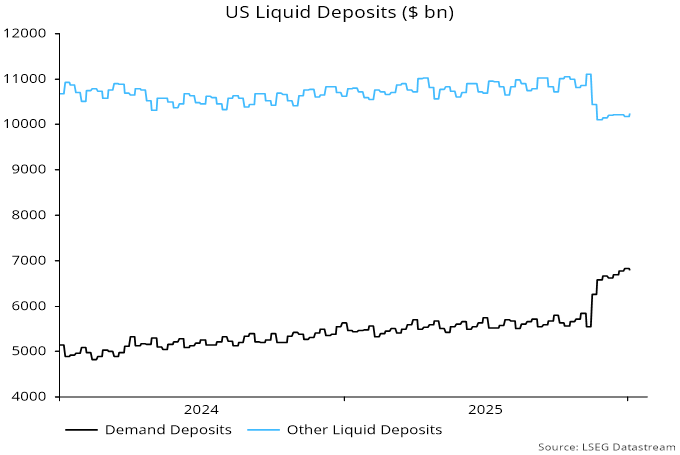
December numbers support the contention in a previous post that the Fed series for demand deposits has been distorted by the inclusion in mid-November of accounts previously classified as savings deposits. Weekly figures show a large jump over two weeks*, with a corresponding drop in “other liquid deposits”, which includes savings deposits. Demand deposits have since returned to weak expansion – see chart 1.

Chart 1

Chart 1 showing US Liquid Deposits ($ bn)

The distortion has affected the M1A narrow money measure calculated here, comprising currency in circulation and demand deposits. Similar reclassifications appear to have occurred in several months over 2020-22, following removal of reserve requirements in March 2020, which effectively equalised the treatment of demand and savings deposits. The procedure adopted then was to assume that monthly growth of demand deposits would have matched that of total liquid deposits in the absence of the distortion.

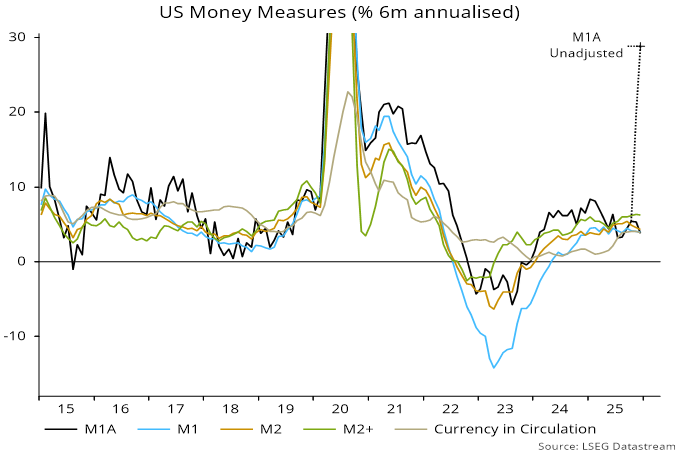
Applying the same adjustment now suggests “true” six-month growth of M1A of 3.8% annualised in December, down from 5.3% in November. This is very similar to growth rates of the official M1 and M2 measures, as well as currency in circulation (3.9%, 4.3% and 3.9% respectively) – chart 2.

Chart 2

Chart 2 showing US Money Measures (% 6m annualised)

A broader “M2+” aggregate rose by 6.2% annualised over the same period, reflecting strong expansion of institutional money funds. (Official M2 includes retail but not institutional money funds.) Still, this growth rate is within an acceptable range of a suggested 5% pa “target” – the average over 2015-19, a period of moderate economic growth and inflation quiescence.

*The inclusion would have occurred on a single day but weekly numbers are averages, so the impact of a mid-week change would be spread over two weeks.

Person standing on a snowy mountain cliff looking at the sunset on Mount Seymour, North Vancouver, BC, Canada.

This year’s Forecast begins with a synopsis of 2025 before delving into the secular themes shaping our outlook, and then examines the shorter-term cyclical factors affecting the economy, inflation and monetary policy. We assess market valuations and, considering these elements, establish our portfolio strategy.

Throughout the next year, updates to our forecasts will be highlighted in our quarterly newsletter Outlook.


Introduction

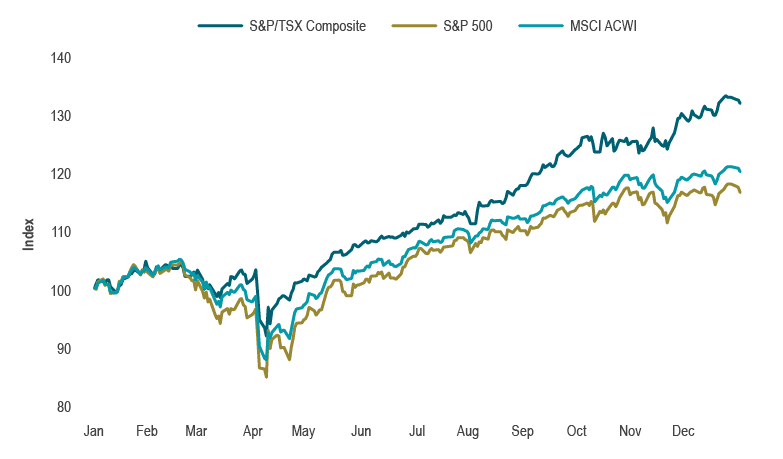
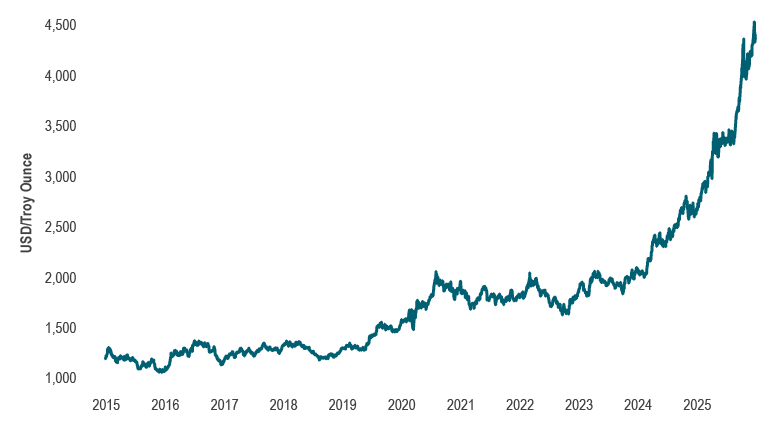
2025 was a year of shocks followed by resilience. Despite extreme policy uncertainty, equity markets delivered a third consecutive year of strong gains as investors looked through geopolitics and focused on earnings durability and AI-driven investment. Canadian equities outperformed, benefiting from relative policy stability, resilient growth and a surge in gold prices amid geopolitical and institutional uncertainty.

Entering 2026, markets face fewer immediate stresses than in prior years, but outcomes remain highly sensitive to policy, inflation and confidence. In the coming pages, we present our portfolio strategy and positioning, and discuss the long-term and cyclical shorter-term influences on markets.

Chart 1: Strong equity market gains in 2025 led by Canada
Total returns in local currency rebased at 01/01/2025 = 100
Line chart showing total equity market returns in local currency during 2025, rebased to 100 at the start of the year. The S&P/TSX Composite rises the most over the period, outperforming both the S&P 500 and the MSCI All Country World Index. All three indices end the year higher, indicating broad global equity gains, with Canadian equities leading.
Source: TMX, S&P Global, MSCI, Macrobond


Chart 2: Gold surged in 2025
Line chart showing the price of gold in U.S. dollars per troy ounce during 2025. Gold prices trend sharply higher over the year, reaching new highs by year-end, reflecting strong performance amid heightened geopolitical and policy uncertainty.
Source: CME group, Macrobond

2026 portfolio strategy and positioning

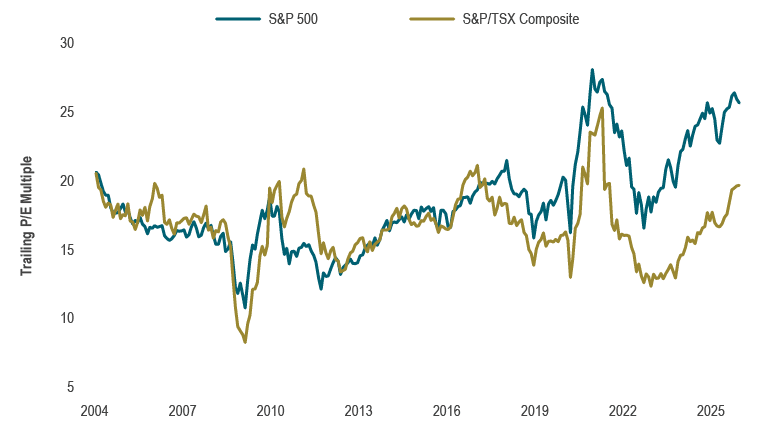
Equity markets begin 2026 with a favourable backdrop. Supportive monetary and fiscal policy as well as solid nominal growth underpin a positive environment for equities. Company earnings remain resilient, supported by healthy nominal growth and easing cost pressures. AI-driven investment continues to shape capital allocation across technology, industrials, energy infrastructure and utilities, while related productivity expectations remain a meaningful contributor to valuations. At the same time, high valuations in the United States temper upside potential, but represent better value in Canada and other non-US markets.

Bond markets reflect a balance between the moderating labour markets and longer-term inflation and fiscal concerns. Long-end yields remain bounded in a “higher-for-longer” range by persistent fiscal expansion, reconfiguration of global power structures and sustained investment needs. Policy easing is expected to continue early in the year, amid ongoing concerns around the central banks’ credibility in the face of stubborn underlying inflation.

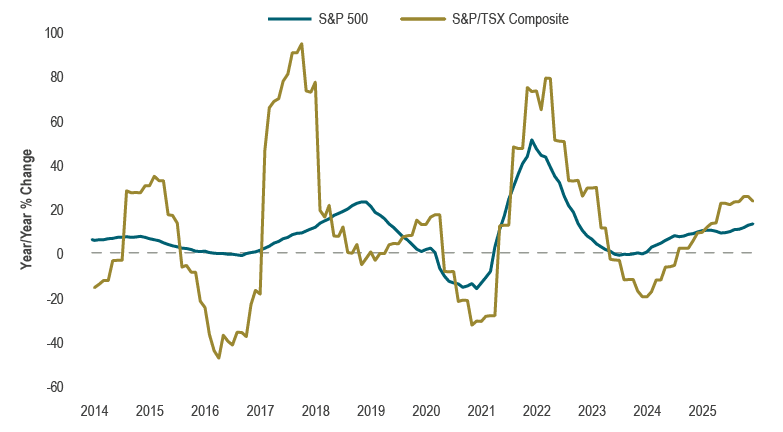
Chart 3: Earnings growth to remain solid
Trailing earnings growth
Line chart showing year-over-year trailing earnings growth for the S&P 500 and the S&P/TSX Composite. Both indices display positive earnings growth, with fluctuations over time but no sustained downturn, indicating resilient corporate profitability in both U.S. and Canadian equity markets.
Source: I/B/E/S, Bloomberg, Macrobond

Asset allocation

The macroeconomic environment favours a balanced approach that recognizes both the progress made on disinflation and the persistence of structural forces keeping long-term rates elevated. While policy easing supports risk assets, we hold a neutral allocation across equities and a modest underweight in fixed income. We prefer Canadian and emerging market equities relative to global equities.

Fundamental equity positioning

Our fundamental equity portfolios have added high-quality cyclical companies that will benefit from broadening economic growth, such as financials and autos. We increased infrastructure exposure to benefit from AI-related capex as well as deglobalization and protectionist policies. We also added to mid-cap gold producers given spot prices will support strong free cash flow generation over the year. We have reduced lower-growth and interest rate-sensitive companies given expectations of interest rate volatility.

Chart 4: Limited scope for further expansion
Line chart showing trailing price-to-earnings multiples for the S&P 500 and the S&P/TSX Composite. Valuations remain elevated, particularly for the S&P 500, while the Canadian market trades at lower multiples. The chart suggests limited potential for further valuation expansion, especially in the U.S. market.
Source: I/B/E/S, Bloomberg, Macrobond

Fixed income positioning

In fixed income portfolios, we are managing duration exposure tactically within the recent range in bond yields, as interest rates fluctuate alongside downside economic surprises and upside pressures on long-end yields. Long-term rates are expected to see upside pressure, a global trend. We maintain a yield curve steepening bias. Meanwhile, short-term rates in Canada, currently pricing in central bank rate hikes, should see limited upside from here.

The backdrop of easing inflation and stable demand supports credit fundamentals, and the strong profits, income and policy backdrop are likely to persist. However, the tightest spreads in over a decade, combined with asymmetric risk-reward dynamics, lead to a neutral overall exposure. Within credit, we prefer corporate bonds over provincials.

Secular themes shaping the outlook

Inflation: A higher, more volatile floor

Disinflation over the past two years reflects the unwinding of acute shocks, not a return to pre-2020 levels. Global trade networks are adapting to shorten supply chains, prioritize resilience and elevate geopolitical considerations over cost efficiency. Aging populations and reduced immigration imply a shrinking of working-age populations and tighter labour markets. Large-scale infrastructure renewal, defence modernization and expansion, coupled with energy transition investment, all reinforce upward pressure on costs. Persistent momentum in nominal GDP will anchor growth rates higher for wages, rents, earnings and government outlays. In this environment, maintaining confidence in central bank independence remains critical, as any erosion of the US Federal Reserve’s (the Fed) credibility would raise the long-term risk that inflation expectations become less firmly anchored. Inflation is likely to trend lower, but with a higher floor, greater volatility and an increased risk of resurgence if demand firms or policy eases prematurely.

AI and the productivity wildcard

AI is reshaping capital allocation, labour demand and corporate strategy, but its macro impact remains uneven. Near-term effects are capital intensive as adoption has accelerated, boosting investment in data centres, semiconductors and power infrastructure. To fund this buildout, companies are increasingly turning to credit issuance, both public and private. This reflects the scale of ambition but also introduces financial stability risks, should funding conditions tighten or expected returns fail to materialize. While early adopters remain confident in the displacement of routine cognitive roles, AI has not yet delivered on the promised broad productivity gains. Longer-term benefits depend on diffusion into enterprise processes, organizational redesign and workforce adaptation, which historically take time. A deeper question concerns the long-term social consequences, notably how the distributional and employment impacts will be managed. AI represents both a powerful growth opportunity and a source of uncertainty around labour displacement, inequality and financial stability.

Bigger government and fiscal dominance

Fiscal policy has shifted from cyclical support to a persistent structural force. Even as central banks have cut interest rates, politically entrenched deficits, industrial policies, defence spending and climate-related investments are creating a potent blend of policy support . This encourages growth and employment, reducing the likelihood of a downturn. However, it constrains monetary policy from deploying restrictive policy as debt service costs surge. This dynamic implies asymmetric responses to inflation, leaving the risk of inflation settling above target. Elevated bond issuance and debt-servicing sensitivity imply higher term premiums, wider yield ranges and greater volatility in long-term rates.

Geopolitics and a fragmented world

Globalization is giving way to regionalization and strategic alignment. Trade, capital flows and supply chains are increasingly shaped by security concerns rather than efficiency. Countries at the intersection of the realignments, such as Mexico, parts of Southeast Asia and Canada are positioned to benefit. However, this global reordering raises costs, complicates coordination and sustains higher risk premiums . As a result, global allocators are reassessing concentrated exposure to US dollar denominated assets. While the US dollar remains dominant, diversification across currencies, jurisdictions and real assets is gradually increasing.

Hyper-financialization and fragility

Financial markets now exert outsized influence on real economic outcomes. Consumption, hiring and investment are increasingly sensitive to asset prices, particularly equities. The concentration of wealth effects at the top of the income distribution has so far supported spending growth. However, this also introduces overall consumer vulnerability to a reversal in market confidence. This is particularly true in light of higher interest rates (punitive for borrowers and more rewarding for savers) as well as high inflation that is borne disproportionately by lower income earners . Financial market risks are compounded in private markets where leverage is higher, transparency is lower and liquidity is thinner. This can lead to valuation mismatches as refinancing pressures, particularly to fund the AI buildout, rise.

Cyclical outlook over the year

The United States: A mid-cycle expansion continues, with inflation risks

The United States enters 2026 in a mid-cycle expansion supported by fiscal stimulus, easing financial conditions and sustained AI-related capex. High-income consumers remain resilient, and credit availability is improving. However, labour markets are gradually softening, services inflation remains sticky and tariffs are beginning to pass through to prices. Inflation risks are asymmetric: renewed demand or overly accommodative policy could reaccelerate inflation and force a less dovish Fed than markets expect.

Europe: Gradual stabilization amid structural headwinds

Europe shows signs of gradual stabilization as fiscal flexibility increases and rate cuts ease financial conditions. Defence and infrastructure spending support activity, notably in Germany. However, political fragmentation with coalition governments and populism imply rising fiscal strains as there is no appetite for fiscal austerity. Trade pressures and energy transition costs will constrain growth across the region. Inflation is moderating, but wage dynamics from challenging demographics, combined with rising food and energy costs, all remain upside risks.

China: Managed moderation

China continues a path of controlled slowdown, with growth driven by manufacturing, exports and state-directed investment rather than consumption. The property-sector correction remains a key drag on household confidence. Inflation is persistently below target with pressure on the downside from weak pricing power and industrial capacity. Policy support is targeted, as authorities prioritize financial stability and do not want to reflate housing aggressively. External risks persist, especially with trade, but incremental easing and stabilization efforts should help reduce deflation risks into this year.

Canada: Renewed potential output growth

Canada weathered 2025 better than expected despite significant trade shocks and housing weakness. Household leverage, mortgage resets, slower population growth and subdued business sentiment remain constraints. Looking ahead, risks are easing. Fiscal spending on infrastructure, housing and defence provides a positive thrust, while contained inflation gives the Bank of Canada room to remain accommodative. Trade frictions may resume in light of the USMCA renegotiations, but Canada enters 2026 with improving labour dynamics and renewed potential output growth.

Conclusion

After three consecutive years of strong equity returns, the investment environment entering 2026 is shifting. Equity performance is increasingly expected to be driven by earnings growth rather than valuation expansion, against a macro backdrop that remains broadly supportive. Canada’s combination of commodity exposure, improving earnings momentum and relatively attractive valuations stands in contrast to the highly valued US market, while bond yields appear range bound as inflation and interest-rate pressures offset one another.

Beyond the near-term cycle, markets are being shaped by powerful secular forces. Geopolitical fragmentation, sustained large fiscal deficits and rapid AI-driven investment are reshaping growth, inflation and policy constraints. Inflation is easing, but is likely to remain more volatile than in the pre-pandemic era.

Man standing on the top of a high cliff during the sunset with raised hands.

We’re pleased to reflect on another year of meaningful growth and strategic advancement across our portfolio.

Transformative acquisitions

Decorative.

Oakcreek

In May 2025, Oakcreek Golf & Turf completed the acquisition of Pattlen Enterprises including L.L. Johnson in Denver, Colorado and Midwest Turf in Omaha, Nebraska.

This acquisition reinforces Oakcreek’s position as one of the largest, full-service distributors of Toro commercial turf equipment in North America.

Decorative.

Purity Life

In September 2025, Purity Life completed the acquisition of Horizon Distributors, PSC Natural Foods and Ontario Natural Food Company.

This acquisition further solidifies Purity Life’s leadership in the Canadian natural health, grocery and wellness distribution market, creating one of the country’s largest, full-service platforms with an unwavering commitment to excellent customer and vendor service.

Learn more about our portfolio.

New to Banyan and recent promotions

We’re excited to share the following promotions and additions to our firm as the depth and breadth of our team continues to grow:

Photo of Marat Altinbaev
Marat Altinbaev
promoted to Director
Photo of Alex Gelmych
Alex Gelmych
promoted to Senior Analyst
Photo of James Nash
James Nash
has joined as Analyst

Our success at Banyan is built on the talent, dedication, and leadership of our people.

Learn more about our team.

New investments

Our focus heading into 2026 remains the same. We are looking to make long-term equity investments alongside world-class management teams in businesses across North America with EBITDA of at least $5 million.

Do you have an opportunity in mind? Learn more about our investment criteria or connect with us today.