Photo of Bryce Walker.

We would like to announce that Bryce Walker has taken on the role of President and CEO of Connor, Clark & Lunn Funds Inc. (“CC&L Funds”) and has been named Ultimate Designated Person (“UDP”).

Tim Elliott is joining Connor, Clark & Lunn Investment Management Ltd. (“CC&L Investment Management”) in a role on its institutional client solutions team, effective July 1, 2025.

Bryce Walker joined CC&L Funds in 2012 as Vice President, Business Development, leading sales and service efforts in Western Canada. In 2018 he became Senior Vice President, Business Development, taking on the leadership of the sales and service teams across all of Canada.

Tim Elliott originally joined Connor, Clark & Lunn Financial Group Ltd. (“CC&L Financial Group”) in 2007 and founded CC&L Funds in 2012 with the aim of delivering unique and proven institutional investment strategies to the Canadian wealth management market through full-service investment dealers and the multi-family office channel. Since that time, the firm has grown rapidly in assets, strategies and people, to be recognized as a leader in the market for separately managed accounts (“SMAs”) and in liquid alternative and niche investment fund strategies.

“I’m very proud of the team and business that we have built at CC&L Funds in delivering unique, institutional-calibre investment solutions and in creating strong partnerships with some of the best Advisors and organizations in Canadian wealth management,” said Tim Elliott. “I’m really excited to be joining CC&L Investment Management at a time of rapid institutional growth for the firm, and also to see where Bryce and our terrific team can take the CC&L Funds business from here.”

“Tim and I have worked closely together for the past 12 years in building a business that is relatively unique in Canada, given our specialized approach in the wealth market, backed by one of Canada’s largest privately owned asset managers. I’m excited to lead the business forward through this next phase of growth and expansion,” said Bryce Walker.

This transition will support the strong growth for both CC&L Investment Management, particularly in the institutional market, and for CC&L Funds in Canadian wealth management, and is consistent with CC&L Financial Group’s long-term approach to succession planning.

About Connor, Clark & Lunn Funds Inc.

Connor, Clark & Lunn Funds Inc. partners with leading Canadian financial institutions and their investment advisors to deliver unique institutional investment strategies to individual investors through a select offering of funds, alternative investments and separately managed accounts.

By limiting the offering to a focused group of investment solutions, CC&L Funds is able to deliver unique and differentiated strategies designed to enhance traditional investor portfolios. For more information, please visit www.cclfundsinc.com.

About Connor, Clark & Lunn Investment Management Ltd.

Connor, Clark & Lunn Investment Management Ltd. is one of the largest independent partner-owned investment management firms in Canada with $78 billion in assets under management. Founded in 1982, CC&L Investment Management offers a diverse array of investment services including equity, fixed income, balanced and alternative solutions including portable alpha, market neutral and absolute return strategies. For more information, please visit cclinvest.cclgroup.com.

About Connor, Clark & Lunn Financial Group Ltd.

Connor, Clark & Lunn Financial Group Ltd. is an independently owned, multi-affiliate asset management firm that provides a broad range of traditional and alternative investment management solutions to institutional and individual investors. CC&L Financial Group brings significant scale and expertise to the delivery of non-investment management functions through the centralization of all operational and distribution functions, allowing talented investment managers to focus on what they do best. CC&L Financial Group’s affiliates manage over $142 billion in assets. For more information, please visit www.cclgroup.com.

Contact

Lisa Wilson
Manager, Product & Client Service
Connor, Clark & Lunn Funds Inc.
416-864-3120
[email protected]

Technician holding white hat safety hard hat.

Last week, we visited Federal Signal’s flagship manufacturing facility alongside a select group of investors. Touring the plant floor, seeing the latest innovations in action and engaging directly with the teams driving Federal Signal’s record-setting growth gave us invaluable insights that numbers alone can’t provide. This on-the-ground approach reflects our commitment to deep diligence and transparency – values that set us apart in the investment community.

Our group witnessed not only the impressive scale of production, but also the operational excellence and culture of continuous improvement that permeate every corner of the company. From the hum of new automated machinery to the pride in the eyes of long-tenured employees, the visit reaffirmed why Federal Signal remains a leader in its field and a valuable investment.

Decorative.
Vactor Manufacturing production plant in Streator, IL. Source: Global Alpha.

Decorative.
A truck outside the Vactor Manufacturing production plant. Source: Global Alpha.

Decorative.
Another section of the production plant, highlighting other brands produced by Federal Signal. Source: Global Alpha.

Decorative.
A specialized truck produced by Federal Signal. Source: Global Alpha.

Who is Federal Signal?

Federal Signal Corp. (FSS NY) makes specialized vehicles and equipment that help keep communities safe, clean and running smoothly. In simple terms, the company builds things like street sweepers, sewer-cleaning trucks, fire rescue vehicles and emergency warning systems. Their products are used by cities, governments and businesses to clean streets, manage waste, respond to emergencies and alert people to danger.

Federal Signal: A platform built for power and agility

Federal Signal’s story is one of transformation and resilience. Over the past decade, the company has built a powerful platform that combines organic growth, strategic acquisitions and a robust aftermarket business. Since 2016, net sales have grown at a compound annual rate of 13%, reaching a record $1.86 billion in 2024. The company’s ability to scale quickly has been critical in overcoming challenges and seizing new opportunities.

Inside the plant: Innovation, efficiency and teamwork

During our visit, we saw firsthand how Federal Signal’s operational strategies translate into real world results:

Production efficiency: The Streator, Illinois facility set a new record for unit production in 2024, thanks to improved supply chains and process enhancements.

Lean initiatives: The Federal Signal Operating System, including 80/20 programs and lean manufacturing, is driving efficiency, cost savings and reduced lead times across the organization.

Electrification and new product development: The company continues to invest in electrification, with new offerings like the fully electric Broom Bear street sweeper and Rugby Vari-Class dump platform.

Safety and security: The Safety and Security Systems Group (SSG) posted a 7% sales increase, with EBITDA margins rising by 170 basis points, reflecting strong demand for public safety equipment and operational discipline.

These achievements are not abstract – they are visible on the plant floor, in the streamlined workflows and in the pride of the workforce.

Strategic growth: M&A and aftermarket expansion

Federal Signal’s disciplined approach to mergers and acquisitions (M&A) has been a key driver of its growth. Since 2016, about half of top-line growth has come from M&A, with a focus on integrating and strengthening acquired businesses. The recent acquisition of Hog Technologies, a leader in road marking and water blasting equipment, expands Federal Signal’s reach into new geographies and end-markets, such as airports.

The company’s aftermarket business – parts, service, rentals and training – continues to expand, providing stable, recurring revenue and deeper customer relationships. This diversification of revenue streams helps buffer the company against economic cycles and positions it for long-term sustainability.

Positioned for the future: Resilience and opportunity

Federal Signal’s future is bright, supported by a robust backlog, a healthy M&A pipeline and a diversified customer base. The company is well-positioned to benefit from ongoing infrastructure investment, including federal stimulus funds and the bipartisan Infrastructure Bill, which are driving demand for essential equipment like sewer cleaners, street sweepers and safe digging trucks.

A key differentiator is Federal Signal’s ability to adapt – whether by bringing more production in-house, optimizing distribution or leveraging cross-selling opportunities among its brands. The company’s platform approach ensures that every new acquisition and product line strengthens the whole.

What sets Global Alpha apart: The value of being there

Our recent plant visit is more than a symbolic gesture – it’s a core part of our investment philosophy. By engaging directly with Federal Signal’s people and processes, we gain a nuanced understanding of the company’s strengths and opportunities that goes beyond financial statements. This hands-on diligence gives us – and our investors – confidence in the company’s trajectory and our decision-making.

In a world where many rely solely on remote analysis, our willingness to “walk the floor” sets us apart. It’s how we build conviction, spot emerging trends early and ensure we’re investing alongside the best teams in the business.

Conclusion: Moving forward together

Federal Signal’s journey is one of continuous growth, innovation and resilience. As we saw firsthand this week, the company’s success is driven by a powerful platform, a culture of excellence and a commitment to serving customers and communities.

We are excited to continue this journey with you – on the ground, in the field, and at the forefront of industry leadership. Thank you for your trust and partnership.

Businessman reviewing analytics data with futuristic AI projection images from a computer & tablet.

Artificial intelligence (AI) represents technological advancements that enable machines to emulate how our brains work, mimicking the way we receive data, solve problems and make decisions. AI is acknowledged as the latest general-purpose technology (GPT*), following previous innovations like the steam engine, electricity and the Information and Communication Technology (ICT) revolution. This article examines how AI is expected to contribute to economic productivity and its implications for the asset management industry.

GPT and the economy

The economic productivity benefits of a GPT unfold in three phases:

  1. Initial phase: During this phase, the technology is new and not widely adopted, resulting in minimal benefits.
  2. Growth phase: As technology improves, implementation costs decrease, and it becomes more widespread, leading to significant productivity gains.
  3. Maturity phase: The pace of improvements and rollouts slow, causing productivity gains to taper off.

Historically, it took several decades for GPT productivity gains to materialize. However, the timeframe for AI is shorter due to its software-based nature, allowing advancements to be deployed quickly and efficiently.

AI is anticipated to impact the economy in several ways:

  • Efficiency savings: AI will boost productivity through one-time efficiency savings, either by maximizing existing resources or performing tasks with fewer resources.
  • Human-AI collaboration: In some cases, AI will replace humans, while in others, it will help humans become more efficient in their jobs. Despite concerns about AI, 95% of workers recognize the value of working with AI.
  • Complementary innovations: The full benefit of AI is not likely to be realized until there are complementary innovations, like how the development of web browsers and search engines helped maximize the potential of the internet.

PwC forecasts that global GDP will be up to 14% higher in 2030 due to the adoption of AI, equivalent to an additional USD15.7 trillion. It is expected that over half of the gains will come from improved labour productivity. However, the economic benefits of AI will not be evenly distributed, with the United States anticipated to gain the fastest and possibly the most due to its substantial private and public investment in AI research and development and its large number of AI start-ups.

AI and equities

Equity managers can be broadly classified into two styles: fundamental and systematic (quantitative). Fundamental managers conduct in-depth research on individual companies, sometimes using AI tools to complement their analysis. In contrast, systematic managers have long advocated for the use of technology, using computer-driven models to analyze a large universe of stocks.

For example, technological advancements have enabled the Connor, Clark & Lunn Investment Management Quantitative Equity Team to enhance its investment process through increased computing power and greater availability of data. This has led to the team equally valuing their investment philosophy and technology philosophy, with portfolio managers collaborating closely with machine learning and other computing professionals in a fully collaborative environment.

As computers have become smarter and faster, the scope of analysis has expanded. The team has transitioned from using several fast individual machines to a large internal grid for parallel computing, located both in their office and in the cloud, allowing access to thousands of CPUs on demand in a cost-effective manner.

Data has always been central to equity investment management. Today the team can utilize significantly more data due to the increased sophistication of algorithms. The challenge for all asset managers is to narrow thousands of dataset candidates to the ones most likely to provide unique insights and then verify the selected data. This is where machine learning tools excel by transforming large and complex datasets and capturing non-linear relationships to reveal valuable information or organize unstructured data to better assess insights. Data sources are validated through multiple layers, including direct dialogue with data vendors, emphasizing the importance of both human and machine involvement in the process.

While greater availability of data and more powerful computing resources have elevated the systematic equity investment process, it still relies on the collaboration between humans and technology at this stage in the AI evolution.

AI and infrastructure

AI is significantly enhancing the efficiency of various infrastructure assets. There is also a need for substantial investment in the infrastructure network to support AI, including data centres, the electricity required to power them and fibre networks to connect them to users.

The demand for storage and computing power in data centres has surged. McKinsey estimates that global demand could quadruple by 2030. This presents challenges for powering data centres due to their huge appetite for energy. For instance, Microsoft has established a deal with Constellation Energy to supply power for its new data centre in Virginia, and Amazon has similar arrangements with Talen Energy Corporation.

There are many ways in which AI is contributing to enhancing the efficiency of infrastructure assets. For example, while a functioning elevator is important in an office building, it is critical in a hospital where it transports patients to life-saving surgeries. This type of infrastructure asset operates on an availability basis, meaning that if it is not working, deductions are taken from the revenue. AI is being used to predict when an elevator would benefit from early maintenance, thereby reducing potential income deductions due to non-working elevators and improving the return earned on the infrastructure asset.

At airports, AI models are being used to optimize staffing at security checkpoints to match the number of passengers at different times of the day, significantly reducing wait times. The time required to go through airport security will be further reduced when biometric AI technology to capture face-prints is more broadly introduced.

Risks of AI

While AI is making significant contributions in many areas, it is not without risks. A McKinsey survey found that nearly a quarter of respondents were most concerned about data inaccuracy, while cybersecurity was the second-ranked risk.

The concern with data inaccuracy is that “garbage in” implies “garbage out,” meaning we need to be wary of misinformation which occurs when AI unintentionally produces false information. An even bigger concern is disinformation, where unscrupulous people intentionally generate false information using AI. For asset managers, this underscores the importance of verifying any data source being used.

Opportunities and challenges of AI

The economic impact of AI is expected to materialize more rapidly than that of past GPTs, primarily because AI is software-based and can be deployed quickly and efficiently. As the volume of data continues to multiply, it will present both opportunities and challenges. AI is contributing to efficiencies in the asset management industry, particularly in certain segments of equities and infrastructure. However, its influence is expected to extend to many more asset classes over time. Staying abreast of technological advancements is crucial to avoid being left behind or, worse, being replaced by AI.

* Not to be confused with the “GPT” at the end of “ChatGPT” which, in that case, stands for Generative Pre-trained Transformer.

The directional signal from UK money growth is that annual core inflation – excluding policy distortions – will fall through end-2025. The level suggestion is that core will undershoot 2%. This suggestion is supported by recent exchange rate appreciation.

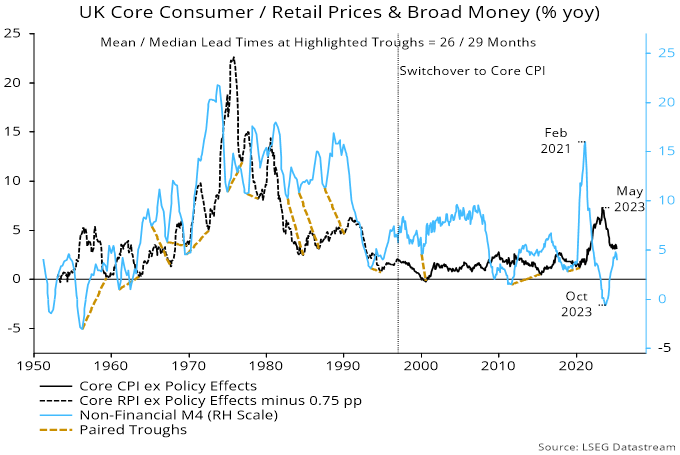
Turning points in annual broad money growth – as measured by non-financial M4 – have led turning points in core CPI or RPI inflation by a mean 26 months over the last c.70 years. Chart 1 highlights related troughs (gold dashed lines). (See a previous post for an equivalent chart highlighting peaks.)

Chart 1

Chart 1 showing UK Core Consumer / Retail Prices & Broad Money (% yoy)

The May 2023 core inflation peak occurred 27 months after a money growth peak.

Annual broad money momentum troughed at a 67-year low in October 2023. The mean 26-month lead suggests a core inflation low in December 2025. The median lag at troughs, however, was 29 months, so an inflation low may well occur later.

Core inflation fell sharply in H2 2023 and H1 2024 but has stalled since September. The expectation here is that May numbers released next week will show a decline, possibly to below 3%. (The core measure adjusts for the imposition of VAT on school fees and above-normal increases in water / sewerage charges and vehicle excise duty.)

Annual broad money growth averaged 4.2% in the 10 years to end-2019. Core inflation averaged 1.8% in the 10 years to February 2022 (i.e. allowing for a 26-month lag in the relationship).

Annual money growth moved slightly above 4.2% in late 2024 / early 2025 but dropped back to 3.9% in April. So the levels relationship of the 2010s suggests that core inflation will fall below 2%, with no significant rebound before 2027.

Historical variations in the lag between money growth and inflation – and in the levels relationship – often reflected the influence of the exchange rate.

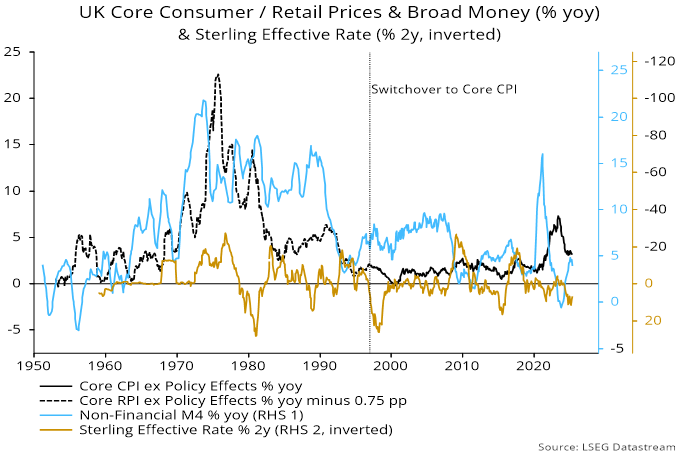
For example, an inflation decline into 2000 occurred earlier than suggested by monetary trends because of a strong disinflationary impact from a prior surge in the exchange rate: the effective rate rose by 26% in the two years to April 1998 – chart 2. This impact was fading by early 2000, contributing to an unusually short interval between lows in money growth and inflation (six months).

Chart 2

Chart 2 showing UK Core Consumer / Retail Prices & Broad Money (% yoy) & Sterling Effective Rate (% 2y, inverted)

Exchange rate considerations are aligned with the monetary message currently, with a 7% rise in the effective rate in the two years to May suggesting that import prices will remain under downward pressure into 2026.

Eurozone / UK money growth has weakened despite rate cuts, suggesting that central banks – particularly the MPC – have more work to do to sustain economic expansion and prevent inflation undershoots.

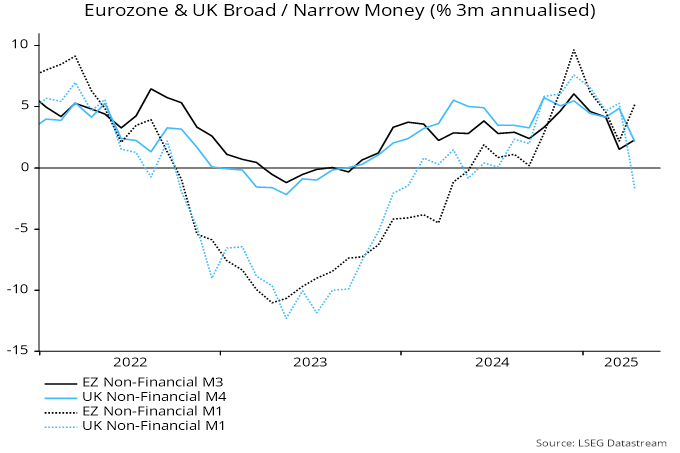
Preferred broad money aggregates – Eurozone non-financial M3 and UK non-financial M4 – grew by 2.3% and 2.1% annualised respectively in the three months to April, down from 4.6% and 4.4% in the prior three months – see chart 1.

Chart 1

Chart 1 showing Eurozone & UK Broad / Narrow Money (% 3m annualised)

Concern about the Eurozone slowdown is tempered by still-respectable narrow money growth – non-financial M1 rose by 5.2% annualised between January and April versus 6.2% in the prior three months.

UK non-financial M1, by contrast, contracted by 1.7% annualised in the latest three months, following 6.5% growth in the three months to January.

The slump in UK momentum was driven by a month-on-month fall of 1.0% (not annualised) in April, mostly due to the household component. This may have been related to the end of the stamp duty holiday on 31 March – a bunching of transactions and mortgage borrowing ahead of the deadline may have been associated with a temporary rise in demand for sight deposits, which reversed in April as activity normalised.

An additional possibility is that individuals who sold assets in anticipation of tax rises in the October Budget delayed reinvesting the proceeds until the start of the 2025-26 tax year.

Household broad money rose by 0.2% in April despite the big fall in sight deposits, reflecting a record £14.0 billion inflow to cash ISAs.

Still, the movement of money out of current accounts is a negative signal for the economy, suggesting low spending intentions and a preference for saving.

UK corporate broad money, meanwhile, resumed a decline in the latest three months, suggesting that firms remain under financial pressure to cut jobs and investment.

Strawberries and oranges displayed at a fruit stand in a market in London, England.

One of the greatest disruptions in recent years to the global grocery market has been the rising popularity of discount retailers like Lidl and Aldi. The two German-based supermarket chains have expanded rapidly, challenging the incumbent grocery players to rethink their strategies.

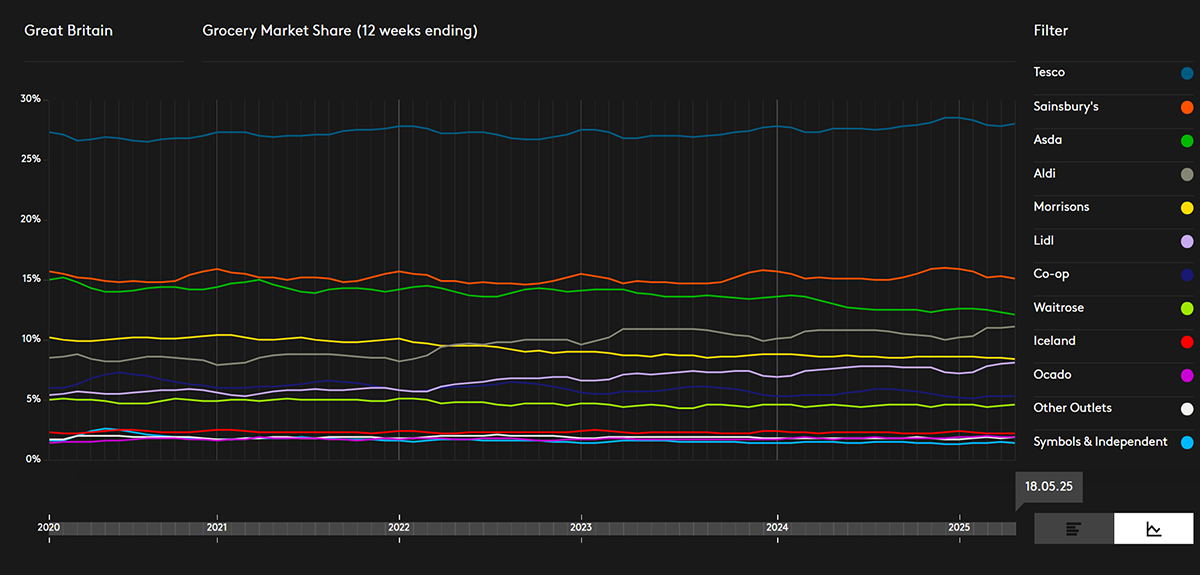
Lidl and Aldi have consistently taken market share in key markets. In the United States, Lidl and Aldi had a combined market share of 10% in 2024. It is a similar story in the UK where the two now account for around 18% of the grocery market, up from just 4% in 2008.

Line graph showing the percentage of market share for different grocers in Great Britain.

Source: Grocery Market Share – Kantar

The recipe for their massive success is well known: a low-cost business model that aims to offer customers high-quality products at lower prices compared to traditional grocery chains.

The Global Alpha team recently added B&M European Value Retail SA (BME LN) to the portfolio to gain exposure to the discount retailer trend. B&M is the UK’s leading variety goods value retailer. The main brand, B&M itself, offers grocery, fast-moving consumer goods (FMCG) and general merchandise in a variety of stores, located in out-of-town, suburban retail parks or, more recently, town centers.

B&M has a similar playbook to when Aldi and Lidl first entered the UK market, with an everyday-low-cost operating model leading to an everyday-low-price offering. Where B&M differs from Aldi and Lidl is that they offer a more targeted range of branded convenience grocery products such as shelf-stable food, soft drinks, confectionery and alcohol, in addition to FMCG categories such as toiletries and cleaning products.

Aldi and Lidl’s success has been built largely on the back of private-label products. Aldi stocks its stores with around 90% private-label products across all categories. B&M sells the well-known brands that families have been accustomed to using for years, sometimes generations, often at a 15% to 20% discount to the traditional grocer. B&M can do this as they have a disciplined approach to which stock keeping units (SKUs) they keep in store. By focusing on the top sellers, the volume demanded for a particular SKU creates buying power and more advantageous buying terms.

An easy way to visualize what B&M offers is to think of the middle aisles of a supermarket. B&M’s offering should be seen as complementary to, rather than a substitute for, a fresh grocery shop. Management has even communicated that some of their better performing stores are located next to an Aldi or Lidl; a customer will shop for fresh or frozen items in Aldi or Lidl, then completes the shopping in a B&M store.

In addition to the focused grocery offering, B&M offers higher-ticket general merchandise products that cover product categories such as homewares, electrical, gardening, toys and DIY. As customers wander the aisles, there is a “treasure hunt” browsing experience that often leads to impulse purchases. The general merchandise products are more aligned to seasonal trading patterns – the spring/summer seasons will see more garden and outdoor living products, whereas the autumn/winter seasons will see more toys and Christmas decorations.

The low-cost sourcing discipline is key to maintaining a price advantage over the competition. The reduced complexity of the supply chain helps keep costs low. Selling no fresh or frozen products means no need for refrigeration or freezers either on the shop floor or in storage areas. There is also less waste and the need to reduce prices to clear fresh produce approaching expiration date. B&M does not have an online or click-and-collect operation. As well as being historically lower profitability than offline purchases, it also adds a layer of complexity.

When shopping for groceries, a little bit of planning can go a long way. B&M has increasingly become a part of the weekly routine for budget-conscious shoppers. B&M will be a long-term beneficiary of the discount retailer trend and shows that growth can be found in “value.”

Like-for-like growth is typically highly profitable and the most desirable form of growth. B&M themselves state that 1% in LFL sales growth is the same as opening over seven new stores, but without the associated capex or increase in fixed costs. This can be achieved by taking a bigger share in existing catchment areas by offering a great value proposition. But B&M has a parallel growth strategy. The company expects to increase store numbers by at least 60% to reach no less than 1,200 B&M stores in the UK. This represents a decade-long growth runway at the current pace of openings. The new stores tend to be larger and often with a garden centre attached, so underlying sales are expected to grow ahead of the 60% increase in stores. More stores equal more volumes and, in turn, greater benefits to buying and productivity.

France is another avenue of growth. B&M entered the French market in 2018 via an acquisition, but all stores now operate under the B&M fascia. B&M currently operates 124 stores in France which has a population like that of the UK where B&M is targeting over 1,200 stores. Despite the upside potential in new stores, the pace of the rollout is slower than in the UK, opening around 10 new stores per year, due to a focus on profitable growth rather than rapid expansion.

The traditional top four UK grocers are not idly standing by while the discounters take market share. Asda was the first to come out and promise price cuts to be more competitive. Tesco PLC (TSCO LN), the market leader, expects a significant reduction in profitability owing to “a very competitive market.” J Sainsbury PLC (SBRY LN) then announced price cuts to compete with Tesco and Asda.

Price war or not, discount retailers are here to stay, and we believe B&M has a long cycle of growth ahead.

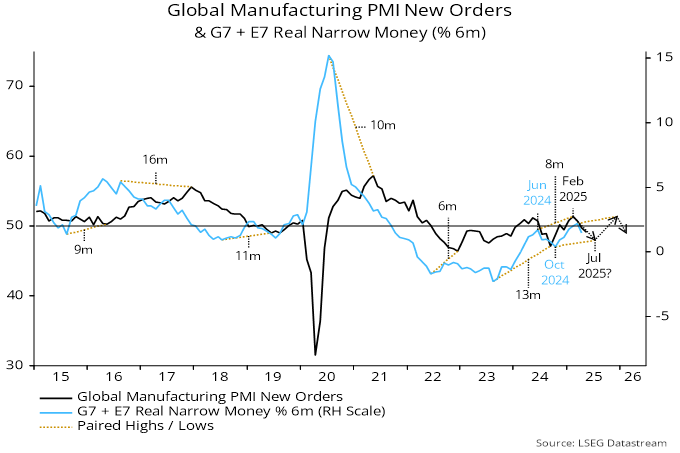
Global manufacturing PMI new orders – a timely coincident indicator of industrial momentum – fell for a third month in May. The decline from a February peak is consistent with a slowdown in global six-month real narrow money momentum between June and October 2024 – see chart 1.

Chart 1

Chart 1 showing Global Manufacturing PMI New Orders & G7 + E7 Real Narrow Money (% 6m)

The PMI fall started slightly earlier than had been expected here. The eight-month interval between the June peak in real money momentum and the February PMI peak compares with an average lag of 11 months at prior turning points since 2015.

Monetary considerations alone would suggest that the PMI will decline further into mid-year before recovering to another local high around end-2025 – the dotted arrows in the chart show a possible path.

The US trade policy shock, however, is likely to impart a negative skew to this profile, as recent demand front-loading reverses and spending decisions remain on hold until tariff uncertainty abates.

Accordingly, the current PMI decline could extend further than indicated with only a minor H2 recovery. Weak April money numbers, moreover, suggest darkening prospects for end-2025 – see previous post.

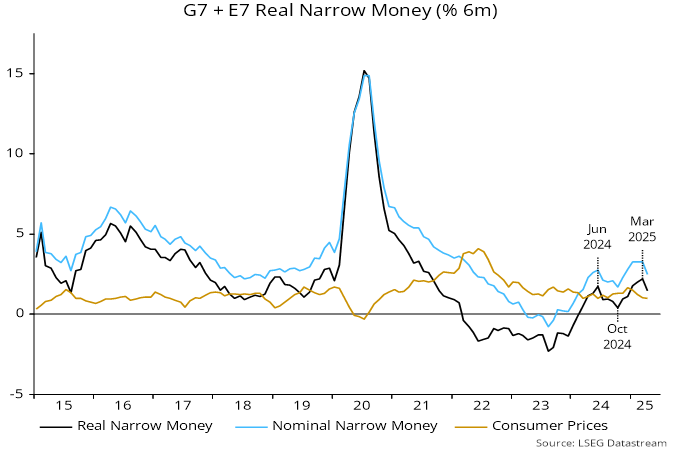
Global (i.e. G7 plus E7) six-month real narrow money momentum – a key leading indicator in the approach followed here – fell sharply in April, to its lowest level since December. The relapse douses hope generated by a pick-up into March, which suggested a bounce-back in the global economy later in 2025, assuming no further negative “shocks”.

The April fall was driven by a slowdown in nominal money growth to its weakest since November. Six-month consumer price momentum eased slightly further to match its 2024 low (2.0% annualised) – see chart 1.

Chart 1

Chart 1 showing G7 + E7 Real Narrow Money (% 6m)

To recap, a fall in real narrow money momentum between June and October 2024 was expected here to be reflected in a global economic slowdown in Q2 / Q3 2025, which the US trade policy shock will amplify.

Subsequent monetary reacceleration into March held out the hope of an economic recovery in late 2025, by which time negative tariff effects could be starting to fade.

The April money growth fall, however, suggests that a negative feedback loop is developing, with reduced confidence due to US policies resulting in increased risk aversion and a tightening of monetary conditions, despite most central banks remaining on an easing path.

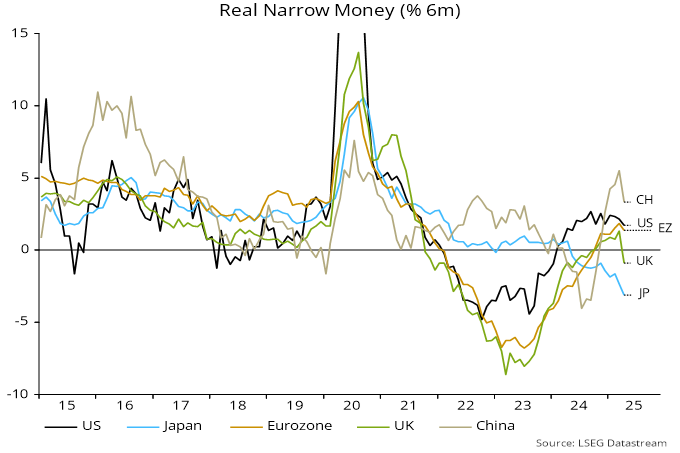
The April decline reflected falls across major economies, reinforcing the negative signal – chart 2.

Chart 2

Chart 2 showing Real Narrow Money (% 6m)

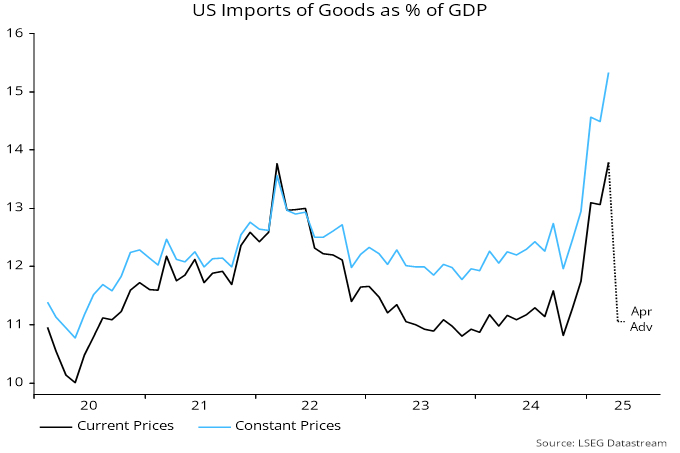
Economic momentum has been supported by demand front-loading but payback is arriving.

A surge in US goods imports boosted GDP in the rest of the world by 0.25-0.5% in Q1 but April advance numbers suggest a full reversal – chart 3.

Chart 3

Chart 3 showing US Imports of Goods as % of GDP

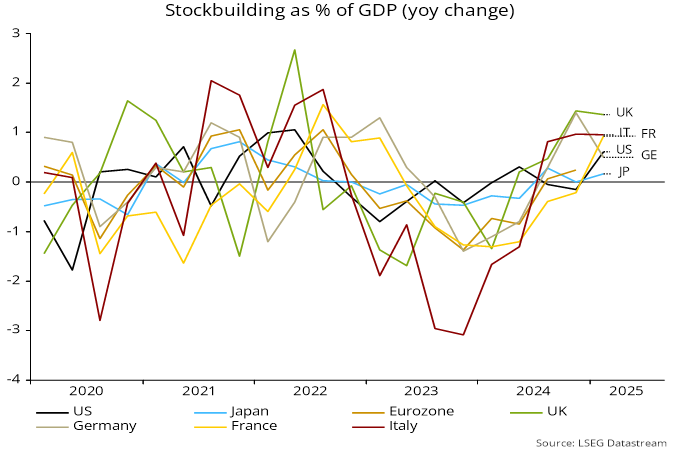
Inventory accumulation isn’t just a US story. Stockbuilding as a percentage of GDP rose similarly or by more in major European economies in the year to Q1 – chart 4.

Chart 4

Chart 4 showing Stockbuilding as % of GDP (yoy change)

Economic growth depends on the change in stockbuilding, so even a stabilisation at its recent pace would suggest a significant loss of output momentum.

European Union flags waving in front of European Commission.

Connor, Clark & Lunn Financial Group (“CC&L Financial Group”) announced the recent expansion of the Connor, Clark & Lunn UCITS ICAV with the addition of a global small cap equity strategy and a global equity strategy. The two strategies are sub-advised by the Quantitative Equity Team at Connor, Clark & Lunn Investment Management Ltd. (“CC&L Investment Management”).

The global small cap equity strategy and global equity strategy utilize CC&L Investment Management’s quantitative investment process. Both strategies seek to outperform their benchmarks, MSCI ACWI Small Cap Index (net) and MSCI ACWI Index (net) respectively, over a market cycle.

CC&L Investment Management is the oldest and largest affiliate of CC&L Financial Group, headquartered in Vancouver, Canada. Founded in 1982, the firm’s investment solutions include equities, fixed income and alternatives; including portable alpha, market neutral and absolute return strategies.

The Quantitative Equity Team’s (the “Q Team”) systematic investment strategies aim to add value through different market environments. The Q Team’s quantitative investment process is continuously evolving with new alpha insights and innovative technology solutions. The Q Team comprises 80 investment professionals and is co-headed by Jennifer Drake and Steven Huang. “We have been managing quantitative portfolios for over 20 years, continuously strengthening our process with the aim of delivering results for clients,” says Jennifer Drake. “We are excited to extend our platform and make more of our strategies available to European investors.”

About Connor, Clark & Lunn Investment Management Ltd.

Connor, Clark & Lunn Investment Management Ltd. (CC&L Investment Management) is one of the largest independent partner-owned investment management firms in Canada. Established over four decades ago, CC&L Investment Management offers a diverse array of investment strategies including equity, fixed income, balanced and alternative solutions including portable alpha, market neutral and absolute return strategies. CC&L Investment Management is an affiliated investment manager of Connor, Clark & Lunn Financial Group Ltd. with over US$54 billion AUM.

About Connor, Clark & Lunn Financial Group Ltd.

Connor, Clark & Lunn Financial Group Ltd. (CC&L Financial Group) is an independently owned, multi-affiliate asset management firm that provides, through its multi-affiliate structure, a broad range of traditional and alternative investment management solutions to institutional and individual investors. CC&L Financial Group brings significant scale and expertise to the delivery of non-investment management functions through the centralization of all operational and distribution functions, allowing talented investment managers, such as Connor, Clark & Lunn Investment Management Ltd., to focus on what they do best. CC&L Financial Group’s affiliates manage over US$99 billion in assets. For more information, please visit cclgroup.com.

The material is for informational purposes only and should not be regarded as a recommendation or an offer to buy or sell any product or service to which this information may relate. Certain products and services may not be available to all entities or persons.

###

An investment in the fund involves risk; principal loss is possible. There is no guarantee the fund’s investment objectives will be achieved. The value of equity and fixed income securities may decline significantly over short or extended periods of time. More information on these risk considerations, as well as information on other risks to which the fund is subject, such as concentration/non-diversification and investment strategy risks, are included in the fund’s prospectus.

This release does not constitute or contain an offer, solicitation, recommendation or investment advice with respect to the purchase of the fund described herein or any security. Prospective investors should carefully consider fund objectives, risks, charges, tax considerations and expenses and other relevant information before investing. For this and more information on the Connor, Clark & Lunn UCITS ICAV, please request a prospectus and read it carefully before you invest. Prospective investors should also consult their professional advisers as to the suitability of any investment in light of their particular circumstances and applicable citizenship, residence or domicile.

Shares of any UCITS sub-advised by CC&L Investment Management are only available for certain non-US persons in select transactions outside the United States, or, in limited circumstances, otherwise in transactions which are exempt from the registration requirements of the United States Securities Act of 1933, as amended in accordance with Regulation S and such other US laws as may be applicable. This communication is not directed at any US persons which are not eligible to invest in any UCITS product sub-advised by CC&L Investment Management.

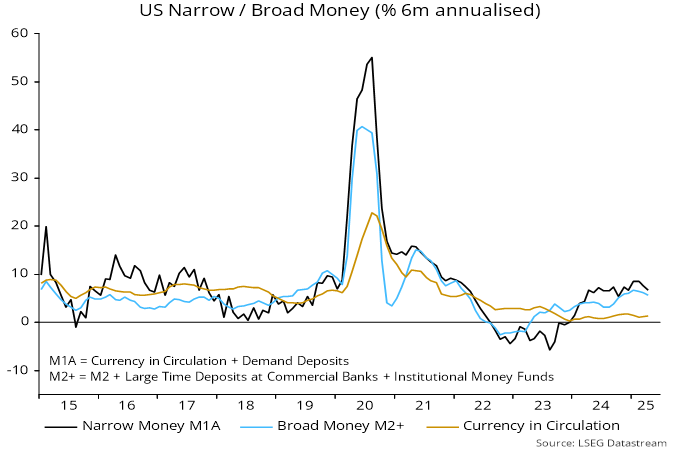
US money growth is slowing, suggesting less support for the economy and improving prospects for rate cuts.

Six-month growth of the preferred narrow and broad aggregates here fell to 6.6% and 5.6% annualised respectively in April, down from recent peaks of 8.6% and 6.7% – see chart 1.

Chart 1

Chart 1 showing US Narrow/Broad Money

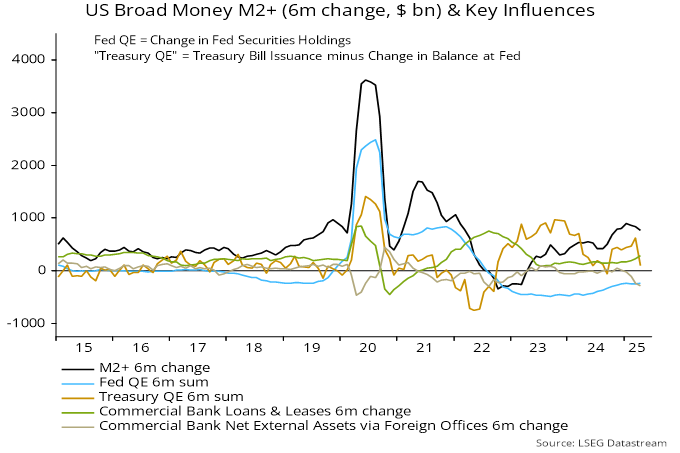
Chart 2 shows key influences on broad money expansion. Strength in late 2024 / early 2025 was driven by monetary deficit financing initiated by the Treasury (“Treasury QE”). The six-month running total of such financing, however, fell sharply in April, reflecting a recent reduction in the stock of Treasury bills coupled with a rebound last month in the Treasury’s cash balance at the Fed.

Chart 2

Chart 2 showing US Broad Money M2+ and Key Influences

Another significant contributor to the monetary slowdown has been a decline in commercial banks’ net external assets. Changes in such assets are the counterpart of the basic balance of payments position. This position has weakened as tariff front-running has boosted the trade deficit, while negative and chaotic policies have discouraged portfolio capital inflows.

Fed QT has remained a drag on broad money growth but the six-month impact is moderating, reflecting the April taper.

The monetary slowdown has also been mitigated by a pick-up in bank loan growth.

A consideration of prospects for these influences suggests that money growth will moderate further.

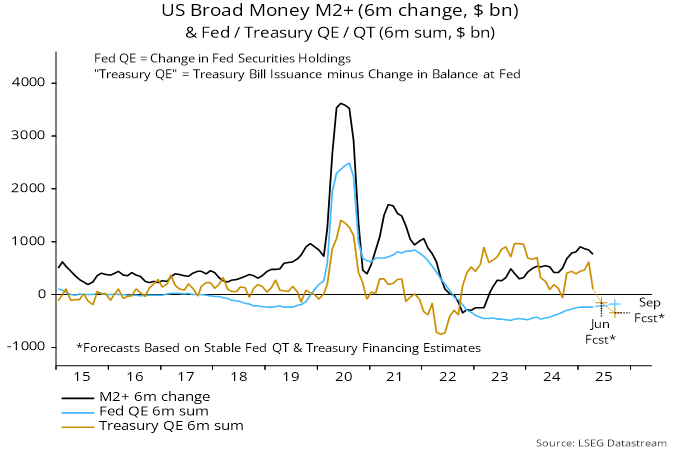
As previously discussed, the Treasury’s financing plans, based on a lifting of the debt ceiling, imply a sizeable negative impact in the six months to September as issuance resumes and the Treasury’s balance at the Fed is restored to its prior level – chart 3.

Chart 3

Chart 3 showing US Broad Money M2+ and Fed/Treasury QE/QT

The Fed could taper QT further to ease associated pressure on bank reserves but may not fully offset the Treasury drag.

The basic balance of payments may remain weak as foreign investors diversify away from US exposure.

The recent pick-up in bank loan growth, meanwhile, partly reflects tariff-related stockbuilding and may slow as this moderates. Acceleration was signalled by the Fed’s senior loan officer survey but corporate credit demand balances fell back in the latest (April) report.