The Chinese economy has slowed sharply but money trends are giving a modestly reassuring signal.

Six-month growth of industrial output and retail sales eased further in August, while fixed asset investment remained in deep contraction, following dramatic June / July weakness. Home sales also continued to slide – see chart 1.

Chart 1

Chart 1 showing Chinese Activity Indicators* (% 6m) *Own Seasonal Adjustment

Investment weakness has recently spread from the property sector to state-controlled spending and manufacturing, reflecting anti-“involution” policies.

August money numbers, however, argue against embracing economic pessimism, at least for now. Six-month growth of narrow money – as measured by the new M1 definition incorporating household demand deposits – rose modestly for a third month, following a sharp drop in April / May. Broad money momentum has also edged up, with both series comfortably within their ranges in recent years – chart 2.

Chart 2

Chart 2 showing China Nominal GDP* (% 2q) & Money / Social Financing* (% 6m) *Own Seasonal Adjustment

Sectoral details, meanwhile, indicate that the earlier drop in narrow money growth reflected a fall in demand deposits of government-related bodies (excluding central government), consistent with recent weakness in state-controlled investment. Growth of an alternative “private sector” measure comprising holdings of households and non-financial enterprises remains close to its recent high – chart 3.

Chart 3

Chart 3 showing China Narrow Money (% 6m)

The fall in demand deposits of government-related bodies, moreover, was balanced by a strong rise in central government (i.e. fiscal) deposits, suggesting yet-to-be-deployed firepower. Six-month growth of an expanded measure including such deposits has also remained solid.

The message of supportive monetary / financing conditions is reinforced by survey evidence – the corporate financing index from the Cheung Kong Graduate School of Business survey is above its long-run average – as well as recent yield curve steepening.

Despite the April / May slowdown, six-month narrow money momentum has remained above nominal economic growth, with the “excess” providing fuel for the rally in equities.

Creek Street in Ketchikan, Alaska.

According to Morningstar, global sustainable funds attracted an estimated net USD4.9 billion in Q2 2025. With 72 new sustainable funds launched in just one quarter, total assets in global sustainable strategies have now reached USD3.5 trillion.

Sustainable investing is booming – and getting harder to navigate.

Quarterly global sustainable fund assets (USD billion)
Graph comparing quarterly global sustainable fund assets in billions of USD between Europe, the United States and the rest of the world.
Source: Morningstar Direct. Data as of June 2025.

To differentiate themselves, funds increasingly segment by theme – from “climate leaders” and “net-zero transition” to “socially responsible” and “impact” strategies. The United Nations Sustainable Development Goals (UN SDGs) have become the most common reference point for defining what is “sustainable.” But as SDG labels become more common, investors face a critical challenge: How can you tell the difference between real contribution and clever branding?

The answer lies in applying core principles borrowed from the field of impact investing – even when the investment strategy itself isn’t “impact” by design. Three key concepts help sharpen the lens and assess sustainable outcomes in the real world:

  • Intentionality: Are the investee companies actively seeking to contribute to a positive social or environmental outcome through their core business or are the outcomes unintended?
  • Additionality: Would these outcomes have happened without the companies’ products or services? This helps determine the companies’ real contribution.
  • Measurability: Are there clear metrics to track and report how the outcomes affect the end beneficiary?

Take a firm that installs solar panels only to offset its own energy use – essentially fixing a problem of its own making. While this could be marketed as a “sustainable outcome” by many, this is risk management: no additionality, no broader SDG contribution and no real benefit beyond the company’s operations.

At the aggregate level, thinking like an impact investor can sharpen how equity investors assess credibility of sustainability claims. A useful tool is a theory of change – a framework that maps how a company’s core activities lead to specific outputs (e.g. products or services), which in turn generate measurable outcomes. Applying this lens helps investors move beyond marketing language to identify businesses whose growth is directly tied to delivering credible, positive, real-world outcomes alongside financial performance.

At Global Alpha, our Sustainable Global Small Cap Strategy applies these principles as a framework – not to make impact investments, but to ensure that the companies we invest in generate credible, positive contributions to the SDGs through the sale of their products and services. Our aim remains financial performance, which we do by delivering real-world, positive outcomes, as evidenced in our 2024 Sustainable Global Small Cap Annual Report.

Portfolio spotlight: The North West Company

The North West Company Inc. (NWC CN) is a leading retailer serving remote and underserved communities in Canada, Alaska, the Caribbean and the Pacific. In regions where reliable access to goods and services is limited, NWC delivers food, household essentials and health products – often as the sole provider.

NWC’s impact begins with its extensive distribution network, retail infrastructure and partnerships with governments and organizations focused on food security. Through 230 stores and over 7,000 employees – 44% of which are from Indigenous groups – it delivers affordable, high-quality goods, supports local employment and invests in community initiatives.

Its business model demonstrates:

  • Intentionality: NWC’s core strategy targets underserved and rural communities.
  • Additionality: In many locations, it operates where no comparable services exist.
  • Measurability: Metrics include the number of communities served and local employment created.

The below theory of change showcases how NWC’s activities aim to increase access to essential goods across 190 communities, reduce disparities in access to services and enhance economic self-sufficiency, directly contributing to SDG 11 – Sustainable Cities and Communities.

Example of the theory of change for NWC, illustrating the input, activities, outputs, outcomes and the UN SDG impacted.
Source: 2024 Sustainable Global Small Cap Annual Report

NWC exemplifies how small caps can deliver meaningful real-world outcomes in addition to financial returns – and why thoughtful sustainability analysis matters.

Riverstart Construction

Connor, Clark & Lunn Infrastructure (CC&L Infrastructure) is pleased to announce the recent closing of more than US$200 million in bank financing with a syndicate of international institutions, including CIBC, MUFG, Desjardins Group, and SuMi TRUST, across its portfolio of US renewable power projects.

The portfolio, which was acquired in 2021 alongside Régime de Rentes du Mouvement Desjardins and Desjardins Financial Security Life Assurance Company, both part of Desjardins Group, represents more than 560 megawatts (MW) of installed capacity. This includes a 200 MW solar project in Indiana, as well as four wind farms located in Indiana, Wisconsin, Oklahoma, and Ohio with an aggregate installed capacity of more than 360 MW. Each asset is fully contracted through long-term power purchase agreements with high-quality offtakers, and the portfolio provides geographically diversified exposure to three distinct US electricity markets.

“The completion of this refinancing marks a notable achievement by our asset management team,” said Moira Turnbull-Fox, Head of Asset Management for CC&L Infrastructure. “It demonstrates our proactive approach to financial optimization and value creation. By leveraging the strength of our existing assets and relationships, we have successfully secured an attractive financing package that is accretive to value. These efforts align with our disciplined investment strategy, ensuring long-term value for our investors.”

CC&L Infrastructure owns more than two gigawatts of gross renewable power capacity globally, diversified across a variety of energy markets, contract counterparties, regulatory jurisdictions and technologies (i.e. wind, solar and hydro). In aggregate, CC&L Infrastructure has closed over $5 billion in renewable power debt financings in recent years.

National Bank of Canada Capital Markets served as financial advisor to CC&L Infrastructure on the financing, Torys LLP acted as borrower’s counsel, and Winston & Strawn LLP acted as lender’s counsel.

About Connor, Clark & Lunn Infrastructure

CC&L Infrastructure invests in middle-market infrastructure assets with attractive risk-return characteristics, long lives and the potential to generate stable cash flows. To date, CC&L Infrastructure has accumulated approximately $7 billion in assets under management diversified across a variety of geographies, sectors and asset types, with more than 100 underlying facilities across 35 individual investments. CC&L Infrastructure is a part of Connor, Clark & Lunn Financial Group Ltd., a multi-boutique asset management firm.

About Connor, Clark & Lunn Financial Group Ltd.

Connor, Clark & Lunn Financial Group Ltd. (CC&L Financial Group) is an independently owned, multi-affiliate asset management firm that provides a broad range of traditional and alternative investment management solutions to institutional and individual investors. CC&L Financial Group brings significant scale and expertise to the delivery of non-investment management functions through the centralization of all operational and distribution functions, allowing talented investment managers to focus on what they do best. CC&L Financial Group’s affiliates manage over $154 billion in assets. For more information, please visit cclgroup.com.

Contact:

Kaitlin Blainey
Managing Director
Connor, Clark & Lunn Infrastructure
(416) 216-8047
[email protected]

Eurozone money trends have been giving a downbeat signal for economic prospects. Incoming evidence is consistent with a loss of momentum.

Eurozone GDP rose by only 0.8% at an annualised rate during H1 excluding distorted Irish numbers – see chart 1. Growth was dependent on an increase in stockbuilding, to an above-average level as a percentage of GDP – chart 2.

Chart 1

Chart 1 showing Eurozone GDP (% qoq)

Chart 2

Chart 2 showing Eurozone Stockbuilding as % of GDP

Rises in bond yields and the euro exchange rate have tightened monetary conditions, offsetting ECB rate cuts. Six-month Eurozone real narrow money momentum peaked in March, although the subsequent reversal has been modest – chart 3.

Chart 3

Chart 3 showing Germany Ifo Manufacturing Business Expectations & Eurozone / Germany Real Narrow Money (% 6m)

German Ifo manufacturing business expectations – closely correlated with Eurozone / German manufacturing PMIs – reached a two-year high in July, consistent with earlier monetary acceleration. Expectations moved sideways in August, with the March peak in real money momentum suggesting an inflection weaker soon.

Other evidence supports this forecast. The one-month change in the OECD’s German leading index also anticipates turning points in Ifo expectations and has eased since May – chart 4.

Chart 4

Chart 4 showing Germany Ifo Manufacturing Business Expectations & OECD Leading Index (% mom)

European cyclical sector equities often start to lag as business surveys inflect weaker and have given back some outperformance since mid-August – chart 5.

Chart 5

Chart 5 showing Germany Ifo Manufacturing Business Expectations & MSCI Europe Cyclical Sectors ex Tech* Relative to Defensive Sectors ex Energy *Tech = IT & Communication Services

The Sentix and ZEW surveys of financial analysts correlate with Ifo results, with Sentix September numbers already available and showing a second monthly decline – chart 6.

Chart 6

Chart 6 showing Germany Ifo Manufacturing Business Expectations & Sentix / ZEW Economic Expectations* *Fitted Values of Regression of Ifo on Sentix / ZEW (sa)

The slowdown in Eurozone / German real money momentum is not yet alarming and may prove temporary, particularly if bond yields and the euro subside. Still, the ECB’s move to the sidelines was premature, with near-term data likely to bolster the case for further easing.

Skyline of downtown Vancouver, BC, Canada.

This summer, markets have looked calm. Bond yields have been range-bound, interest rate and equity market volatility collapsed, credit spreads tightened and stock markets are again reaching their all-time highs. For many investors, it has felt like the tariff-induced storm had finally passed. But calm waters can be misleading. Beneath the surface, powerful undercurrents are shaping the outlook.

Bond markets are behaving as though disinflation is a sure thing and that rate cuts are guaranteed. Yet upstream pressures are bubbling again – producer prices, tariffs and unit labour costs all hint at inflation that may not go quietly. The risk lies not in what we see today, but in what the market may be ignoring.

Rates are trapped in a box

Interest rates are caught in a tug-of-war. On one side, politics, fiscal strategy and the general state of the US economy all limit how high yields can go. That is, the US Treasury’s preference for short-term bill issuance (rather than long-term bonds), the ever-present risk of financial repression tools like yield curve control (a monetary policy tool that targets interest rates at specific points of the yield curve) and the fragility of housing and consumer demand (where even modestly higher yields could tip them into deeper weakness) all act as a ceiling. On the other side, yields are also unlikely to decline significantly. Rising fiscal spending (see Chart 1) and persistent government deficits have led to a continuous supply of bonds, while elevated term premia (the extra compensation investors demand for holding a longer-term bond) keep longer maturities resistant to downward movement. Additionally, producer price indices are rising once again, and labour costs remain elevated. Together, these forces explain why yields can swing within a range but are unlikely to break out decisively in either direction.

Chart 1: US spending set to soar
A stacked bar chart showing US federal spending from 1980 through forecasts to 2035. Spending rises steadily over time, with a sharp spike in 2020 from pandemic support. Components include mandatory outlays (largest share), defense, discretionary non-defense, and net interest. Forecasts show continued growth, with net interest rising rapidly as a share of spending.
Source: US Congressional Budget Office, Macrobond

Recent statements from the US Federal Reserve (Fed) have reflected a cautiously dovish stance, supportive of easier monetary policy. During the Jackson Hole Economic Symposium in late August, Fed Chair Powell indicated a dovish position in the near term regarding employment, while reaffirming the Fed’s commitment to the 2% inflation target. Market participants interpreted these remarks as a signal for potential rate cuts. In reality, while rate reductions are indeed anticipated as soon as September, unless there is a significant deterioration in labour market data, the inflation threshold will keep the easing path confined.

Calm at the wrong time

Markets are treating today’s calm as though it was permanent. Yet, underlying pressures tell a different story. Core producer prices are up 3.7% over last year, nearing the upper end of the range since 2022. The wages and salaries component of the employment cost index at 3.6% y/y remains well above its 25-year average. Direct tariff impacts on consumers have so far been muted by businesses working off previous inventory accumulation. Most recently, the independence of the US central bank appears to be under question, which has historically been associated with higher long-term inflation. Meanwhile, the MOVE index, which tracks bond market volatility, sits near cycle lows (see Chart 2), indicating a classic sign of complacency. History shows that moments of calm often precede periods of turbulence. If inflation re-emerges, today’s quiet will prove fragile.

Chart 2: Collapsing bond market volatility since April
A line chart of the MOVE Index (US Treasury market volatility) from January 2023 to July 2025. Volatility peaked sharply in early 2023 above 190 basis points, then trended downward with fluctuations. Volatility spiked again in April 2025, but has steadily declined, reaching near 70 bps by July 2025.
Source: ICE BofAML, Macrobond

The great disconnect: payrolls vs. profits

The most striking disconnect is between the labour market and corporate earnings. Employment growth is slowing, with downward revisions a consistent theme. In the US, job growth has slowed dramatically, averaging just 35K per month over May–July, the weakest stretch since the pandemic. Meanwhile, continuing jobless claims are on the rise (see Chart 3). Firms are maintaining a “no hire, no fire” stance, meaning that they are holding onto staff but are reluctant to add new employees. Despite that, corporate America is reporting resilient results. Margins, revenues and earnings in the most recent corporate earnings season have come in stronger than expected. Productivity gains, leaner operations and early adoption of AI may be helping. However, we believe this gap is unsustainable. If the labour market weakens further, demand will eventually soften and profits will be at risk. This question of whether earnings can remain resilient while the jobs picture fades will determine the next leg of market direction.

Chart 3: Rising continuing claims suggest difficulty finding jobs
A line chart of US continuing jobless claims from January 2023 to July 2025. Claims rose from about 1.55 million in early 2023 to nearly 2 million by mid-2025. The series shows periods of stabilization but an overall upward trend, suggesting more persistent unemployment.
Source: US Department of Labor, Macrobond

Capital markets

Economic momentum softened through the summer, but equity markets weathered the weak July jobs report and tariff uncertainty well. In August, both the S&P 500 and S&P/TSX Composite reached record highs, with the VIX falling to its lowest level since March. Year to date, US equities are up in the high single-digits, while Canadian, European and emerging markets have posted stronger double-digit gains.

Other asset classes have experienced less favourable performance. WTI crude oil’s June rebound quickly reversed, and crude prices remain negative year to date. The US dollar index maintained stability through the summer but remains negative on a year-to-date basis.

Bond yields continue to stay within established boundaries due to fluctuating market narratives and consistent policies from central banks. Indeed, both the Fed (4.25–4.50%) and the Bank of Canada (2.75%) held policy rates steady during the summer. Canadian corporate spreads tightened to pre-crisis levels in June and July before widening modestly in mid-August alongside a surge in issuance. The FTSE Canada Universe Bond Index is negative thus far in the third quarter and only slightly positive for the year to date.

Portfolio strategy

For investors, the current environment requires a selective approach.

Balanced portfolios have moved back to market weight in equities, reflecting decreased recession probabilities toward the end of the second quarter. Recent data has indicated a gradual economic softening instead of a significant downturn, which has reduced the degree of downside risk. At the same time, equities are being kept afloat by strong earnings. That disconnect still warrants some caution, but the adjustment acknowledges that downside risks are not as acute as earlier in the year. In fundamental equity portfolios, the emphasis is on quality. High-quality businesses with durable earnings growth remain core holdings. As the likelihood of a deep downturn has diminished, exposure to traditional defensive areas of the market has been pared back and selective positions in quality cyclical companies have been added where valuations are attractive.

In fixed income portfolios, the strategy remains cautious. With rates expected to stay range-bound, duration is managed tactically. The shape of the yield curve matters more than the outright level. Short-term rates will be anchored by monetary policy, while longer-term rates will be pressured by fiscal supply, leading to steeper yield curves. In credit, fundamentals are still supportive but credit spreads are too tight to offer much reward, warranting a neutral position.

Cameron SmithConnor, Clark & Lunn Private Capital Ltd. (CC&L Private Capital) is pleased to announce that Cameron Smith is joining its leadership team as a Managing Director, Sales Management effective September 2, 2025.

In his new role, Cameron will oversee the firm’s growth and client engagement efforts. Cameron joins CC&L Private Capital with extensive experience, having spent the past five years at Nicola Wealth as Vice President, Advisory Services, and before then in leadership and advisory roles with MD Financial Management.

With nearly two decades of experience in the financial services industry, Cameron possesses extensive knowledge and expertise in delivering wealth management services to high-net-worth clients. Cameron holds the CFP®, CIM® and FCSI® designations. “We are thrilled to welcome Cameron to our firm,” said Jeff Guise, Managing Director, Chief Investment Officer at CC&L Private Capital. “His character, leadership and industry knowledge will be invaluable attributes to CC&L Private Capital as we continue to serve our clients and enhance our offering.”

“I am honoured to join CC&L Private Capital,” said Cameron. “The firm’s investment philosophy and governance are best-in-class, and I am proud to be part of a team with some of the most dedicated Wealth Advisors in the country. I believe the firm is poised for further growth, and I look forward to contributing to that success.”

CC&L Private Capital provides expert wealth management advice to high-net-worth families, foundations, and Indigenous communities across the country. With over $18 billion in assets under management, it is one of Canada’s largest independent and privately held investment managers, and is part of the broader Connor, Clark & Lunn Financial Group.

Purity Life

Banyan is pleased to share that Purity Life Health Products has completed the acquisition of the assets of Horizon Grocery + Wellness, PSC Natural Foods and Ontario Natural Food Company. The news of the acquisition was shared in the following press release:

Purity Life Health Products LP (“Purity Life”) is excited to announce the acquisition of the assets of Horizon Distributors Ltd. (“Horizon”), PSC Natural Foods Ltd. (“PSC”) and Ontario Natural Food Company Inc. (“ONFC”). The merger will create one of Canada’s leading full-service distributors of organic and natural grocery and wellness products. By bringing its core wellness offering together with the market-leading positions of Horizon, PSC and ONFC in the grocery sector, Purity Life can expand and further strengthen its high-quality service to both retail and vendor partners across Canada.

Matthew James, President and CEO of Purity Life emphasized the significance of this partnership: “Together with Horizon, PSC and ONFC, Purity Life is proud to build a 100% Canadian-owned, full-service distributor – delivering natural and organic grocery and wellness products with our #EasyToDoBusinessWith commitment across every category and retail channel in Canada.”

The combined company will operate under the Purity Life brand going forward through two distinct divisions: Purity Life Grocery and Purity Life Wellness. Terri Newell, CEO of Horizon, will lead Purity Life’s Grocery division.

“The combination with Purity Life is an ideal path forward for Horizon, PSC and ONFC,” Ronald Francisco, President and majority shareholder of Horizon, PSC and ONFC, said, sharing his perspective. “The companies share similar values and are focused on serving customers and vendor partners with excellence while being an employer of choice. Together, the companies are a strong complement and will create a leading distributor to progress the organic and natural grocery and wellness industry in Canada.”

Jeff Wigle, Managing Director and Group Head of Banyan Capital Partners, the majority owner of Purity Life added “I first met Ron shortly after we partnered with Matthew to acquire Purity Life in 2012, and since then I have continued to admire what he has built at Horizon, PSC and ONFC. These companies have deep roots and strong connections across Canada’s natural food industry, and we are thrilled to bring that legacy into the Purity Life family. I look forward to welcoming Ron, Terri and their talented teams as we continue to grow and strengthen our business together.”

This transaction will allow Purity Life to strengthen its service offering to all stakeholders in the natural health products industry in Canada, creating a nationalized distribution platform for grocery and wellness products while allowing Purity Life to continue to service its customers and vendors with the highest possible quality.

About Purity Life Health Products LP

Purity Life provides full-service national distribution across Canada, supporting both brands and retailers with expert category management, dependable logistics solutions and more. Founded in 1984, Purity Life has grown to be Canada’s leading supplier of natural health products, offering over 12,000 natural health products from more than 400 leading brands.

About Horizon Distributors Ltd.

Founded in 1976 and based in Burnaby, British Columbia, Horizon Distributors is Western Canada’s leading distributor of organic and natural food products across the dry, chilled and frozen grocery categories, in addition to natural personal care and nutritional health supplements.

About PSC Natural Foods Ltd.

PSC Natural Foods, based in Victoria, British Columbia, is a distributor of organic and natural foods, having served the Vancouver Island community since 1978.

About Ontario Natural Food Company Inc.

Ontario Natural Food Company, based in Mississauga, Ontario, has distributed a diverse selection of organic and natural food items throughout Eastern Canada since it was established in 1976.

About Banyan Capital Partners

Banyan Capital Partners is a private equity firm focusing on investments in middle‐market businesses across North America. Banyan is an affiliate of Connor, Clark & Lunn Financial Group (CC&L Financial Group), a multi‐ boutique asset management firm that provides a broad range of distinct and independently managed investment products and services to individual and institutional investors. CC&L Financial Group and its affiliated companies collectively manage over $154 billion.
 

Media contact

Matthew James
President & CEO
Purity Life Health Products LP
#EasyToDoBusinessWith
[email protected]
519-851-4045

Top down view of LNG (Liquified Natural Gas) tanker anchored in small gas terminal island.

The explosion of cloud computing and especially AI training requires enormous amounts of power. A single, large data centre can use as much electricity as a mid-sized city. The Southeast United States (Georgia, Virginia, Texas) is seeing the heaviest concentration of new projects, but it’s spreading nationwide. Hence, utilities in the United States have more than doubled their planned gas turbine installations for 2030 – from about 25 GW at the end of 2021 to over 45 GW by the end of 2024 with nearly 100 GW of new gas-fired capacity in pre-construction.

The US Energy Information Administration (EIA) reports that US marketed natural gas production in 2024 averaged about 113 billion cubic feet per day (Bcf/d).

Gas demand increase

The production of 100 GW of energy requires about 2.3 Bcf/day of natural gas – this adds a 2% bump to national gas requirements. A larger increase in gas demand, however, comes from liquified natural gas (LNG) exports. By 2028, US LNG export capacity is forecast to nearly double, increasing from around 11.6 Bcf/d to 24.4 Bcf/d, thanks to approximately ten LNG infrastructure projects under construction.

Pushed by international buyers, gas demand will increase in the fall of 2025 as the Golden Pass LNG terminal, located in Sabine Pass, Texas, comes on-line with an approximate transportation total of 2.57 Bcf/d of natural gas. This adds to the large Plaquemines project in Louisiana at 2.6 Bcf/day that began in 2024, and LNG Canada’s new Kitimat facility with capacity of 1.1 Bcf/day.

Key growing importers of LNG remain Europe at 14.4 Bcf/day and China at 9.5 Bcf/day.

It is sensible to form a positive opinion on natural gas prices in the midterm as we fill up these new, large LNG terminals. US gas inventory is not very big so it can show volatility in the short term. Due to high turnover of inventory, seasonal weather conditions impact short-term pricing of gas demand, causing more price fluctuation.

Because LNG is becoming such an important demand driver, competing electricity-producing energy technologies do not represent short- or mid-term risk to natural gas demand. For example, US lithium-ion battery capacity stands at a mere 26 GW.

However, the future does include other technologies. We recently met a nuclear power company with a project cost estimated at $3 million per megawatt for nuclear fission – we await their final feasibility with anticipation. And as we have written in the past, we remain positive on geothermal energy. Recent developments continue to drive down costs to make geothermal anywhere a reality.

We remain exposed to natural gas producers who will profit from the incumbent LNG export demand.

Gulfport Energy Corp. (GPOR US)

Gulfport Energy is an independent exploration and production company, primarily operating in Eastern Ohio’s Utica and Marcellus Shales in the Appalachian Basin.

The Marcellus Shale is the largest gas field in the USA and stands out as it combines huge scale, low costs, proximity to markets and strong infrastructure. It is often described as the “workhorse” of US gas supply. Although the Haynesville Shale is closer to Louisiana LNG facilities, the Mountain Valley Pipeline (2Bcf/day) which started in 2024, is opening up important markets to Marcellus operators. The Marcellus field is especially suited for higher priced areas in the Northeast which include many high-tech hubs and data centre activity.

Gulfport Energy foresees excess EPS growth in 2026 as strong cash flows support share buybacks. Breakeven under USD2/Mcf suggests strong resilience to price volatility.

Advantage Energy Ltd. (AAV CN)

Advantage Energy is the lowest-cost producer in Western Canada. Advantage Energy’s Montney Shale gas basin (Alberta side) has some of the lowest supply costs in North America. It regularly reports supply costs in the CAD1.00–1.20 per Mcf range, which means they can stay profitable even in weak gas markets where others struggle.

Advantage Energy does not just sell raw natural gas. The company is also invested in natural gas liquids (NGLs) production, which gives uplift when gas prices are soft.

In addition, Advantage Energy created and owns a cleantech arm, Entropy Inc., that is working on post-combustion carbon capture and solvent tech. This gives the company an ESG angle and potential new revenue stream.

Market access and hedging

Many Western Canadian producers get stuck selling into AECO, often at a discount versus Henry Hub in the United States. Advantage Energy has firm transport and hedges that give it access to the Chicago, Dawn and US Midwest hubs, narrowing basis differentials and cushioning cash flow volatility.

Subsea 7 SA (SUBC NO)

As gas exports reach ports of Europe, an entire infrastructure is being built.

Subsea 7 is a global leader in laying subsea pipelines for oil and gas, including natural gas export lines that run from offshore fields back to shore or to floating facilities. Their fleet includes specialized vessels that can handle gas export pipelines from deepwater fields, flowlines, umbilicals and risers.

If a big offshore gas project needs its subsea network built and tied back to shore or an LNG hub, Subsea 7 is often one of the short-list contractors called in to lay those pipes.

Subsea 7 also serves other growing energy segments such as offshore wind, carbon capture and hydrogen.

Clean Energy Fuels Corp. (CLNE US)

Clean Energy is North America’s largest provider of natural gas and renewable natural gas for transportation, operating over 600 fueling stations across the United States and Canada. Clean Energy has forged meaningful alliances with heavyweights like TotalEnergies, BP, Walmart, Amazon, UPS and others, enhancing both market access and credibility.

The company is set to grow rapidly as the transportation industry adopts a novel natural gas truck engine that will use a natural gas instead of diesel.

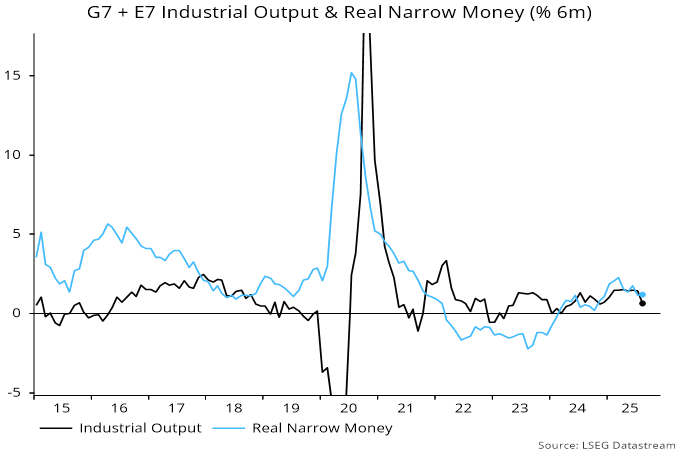
Global six-month real narrow money momentum – a key leading indicator in the forecasting approach used here – is estimated to have fallen to its lowest since November / December in July, based on monetary data for countries with a combined 88% weight.

The resumption of a decline from a March peak reflected both a slowdown in nominal money growth and a small rise in six-month CPI momentum (which, however, remains slightly below its 2015-19 average) – see chart 1.

Chart 1

Chart 1 showing G7 + E7 Real Narrow Money (% 6m)

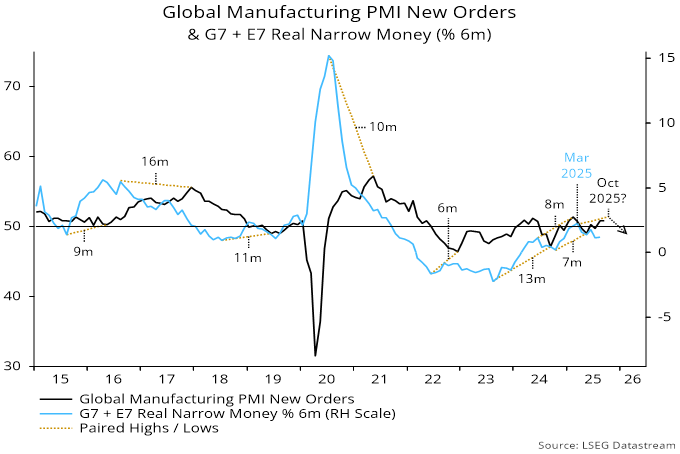
A rise in real money growth between October 2024 and March suggested that the global economy would regain momentum in H2 2025 after a weak start to the year. Tariff effects cloud interpretation but PMI results are consistent with this forecast, with August DM flash numbers reading across to a rise in global manufacturing PMI new orders to a six-month high – chart 2.

Chart 2

Chart 2 showing Global Manufacturing PMI New Orders & G7 + E7 National Business Survey Indicator

An alternative indicator calculated here using national survey data has been lagging the PMI but may also have increased in August. US regional Fed manufacturing surveys are pointing to stronger ISM results.

Still, the slowdown in real money momentum since March suggests that survey strength, if confirmed, will prove short-lived, with another inflection weaker before year-end – chart 3.

Chart 3

Chart 3 showing Global Manufacturing PMI New Orders & G7 + E7 Real Narrow Money (% 6m)

The July decline in global real money momentum mainly reflected a US fall to its lowest since March last year – chart 4. US money growth may have been supported in H1 by a run-down of the Treasury’s cash balance at the Fed. With the debt ceiling now raised, the balance stabilised in July and has increased in August, with financing plans targeting a further rise, i.e. Treasury cash-raising may drain money from private accounts.

Chart 4

Chart 4 showing Real Narrow Money (% 6m)

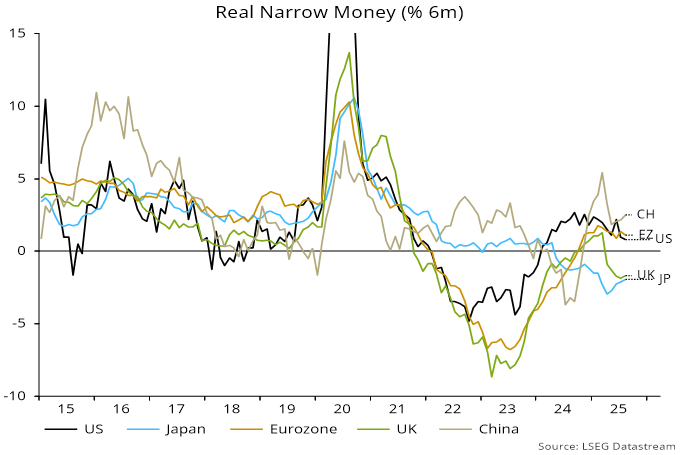
Real money momentum rose slightly in China and the Eurozone but remains below recent peaks, with Japan little changed in negative territory and UK July numbers yet to be released.

The Bank of England’s QT programme has been fiscally expensive, is contributing to worrying monetary weakness and wasn’t required on operational grounds.

The Bank estimates that cumulative QT to date has raised 10-year gilt yields by 15-25 bp, up from 10-20 bp a year ago. Gross gilt issuance in 2025-26 is projected by the DMO at £299 bn. Assuming a 20 bp yield impact across the curve, the implied boost to the annual interest cost of the issued gilts is £600 mn.

To emphasise, this is a repeating cost locked in for the life of the securities.

QT started in February 2022. Gross gilt issuance in 2022-23, 2023-24 and 2024-25 combined was £686 bn. Assuming a smaller 15 bp yield impact of QT in those years, the implied extra interest cost on those gilts is £1.0 bn pa.

So the total boost to the interest bill to date could be £1.6 bn pa.

QT could continue through the end of 2026-27. It will have to stop when bank reserves, currently £674 bn, fall into the “preferred minimum range”, previously assessed by the Bank to lie between £345bn and £490bn. Reserves are being reduced by repayments under the term funding scheme as well as by QT. Still, QT could continue at its current pace for another 18 months before reserves reach the middle of the target range.

The yield boost, presumably, will persist at least until the flow of QT is halted. So there could be an additional QT interest bill of £500 mn pa from gilts issued in 2026-27, pushing the total above £2 bn pa.

QT involves the public sector selling additional gilts across the maturity spectrum to repay bank reserves, which earn Bank rate. With the curve disinverting, this currently involves a net interest loss, to be added to the numbers above.

Furthermore, active QT crystallises valuation losses, requiring additional gilt issuance to finance an increased Treasury grant to the Bank.

What were / are the justifications for QT to balance against these fiscal costs?

A “monetarist” argument is that QT was necessary to correct an “excess” stock of money left over from the 2020-21 fiscal / QE splurge.

However, annual broad money growth – as measured by non-financial M4 – had already fallen back to about 5% when QT began in early 2022, subsequently turning negative in 2023.

The previous monetary excess has by now passed fully into prices / activity (mostly the former). The ratio of broad money to nominal GDP has fallen below its end-2019 level and is further beneath its pre-pandemic trend (noted in the May and August Monetary Policy Reports).

Current money trends, moreover, are worryingly weak: non-financial M4 rose at a 3.0% annualised pace in the six months to June, below the 4-5% pa judged here to be consistent with medium-term achievement of the 2% inflation target. (This judgement assumes potential GDP expansion of c.1.5% pa and a 1% pa trend fall in velocity.)

An alternative debt management argument is that QT was / is necessary to reduce the sensitivity of government finances to future changes in Bank rate. According to this view, QE was a reckless policy because it dramatically shortened the maturity of public sector debt (by replacing gilt liabilities with bank reserves), resulting in enormous losses when Bank rate was subsequently raised significantly.

The issue is whether a desirable reduction in the future volatility of interest costs warrants incurring an additional fiscal loss now. It would, obviously, be preferable to undertake a maturity extension when gilts are in a bull market, not a grinding bear.

The Bank’s justification for QT is that a reduction in its balance sheet has been necessary to free up headroom to respond to future economic / financial emergencies. This is unconvincing for several reasons.

First, repayments under the term funding scheme have reduced the balance sheet significantly, with £80 bn of loans still outstanding – see chart 1.

Chart 1

Chart 1 showing UK BoE Balance Sheet (£ bn)

Secondly, the balance sheet would have shrunk considerably relative to nominal GDP and public sector debt even without QT. The asset purchase facility has fallen from 37% of GDP at end-2021 to 20% currently. It would be at 30% if the stock of asset purchases had been maintained at its maximum.

More importantly, the concept of “headroom” as applied to a central bank balance sheet is dubious, and the Bank was far from reaching any form of constraint even when the balance sheet was at its peak.

The maximum Bank share of the stock of gilts was 41%, compared with a 53% peak in the Bank of Japan’s share of outstanding JGBs. Should their holdings of government securities become excessive, central banks have unlimited capacity to lend against private collateral, with appropriate haircuts.

The QE / QT experience raises uncomfortable questions about Bank independence and accountability. Should the MPC attempt to balance monetary policy and operational goals against possible fiscal costs of its actions? If not, who bears responsibility when large losses are incurred?