Cycle analysis suggests economic and market weakness in 2026-27. A recent monetary slowdown is consistent with this perspective but needs to extend to confirm a negative scenario.

Global (i.e. G7 plus E7) six-month real narrow money momentum moved sideways in August, following a March-July fall. The previous low in real money momentum in October 2024 was reflected in a low in global manufacturing PMI new orders in May. Accordingly, the monetary slowdown since March could be mirrored by a peak and reversal in PMI new orders from around October – see chart 1.

Chart 1
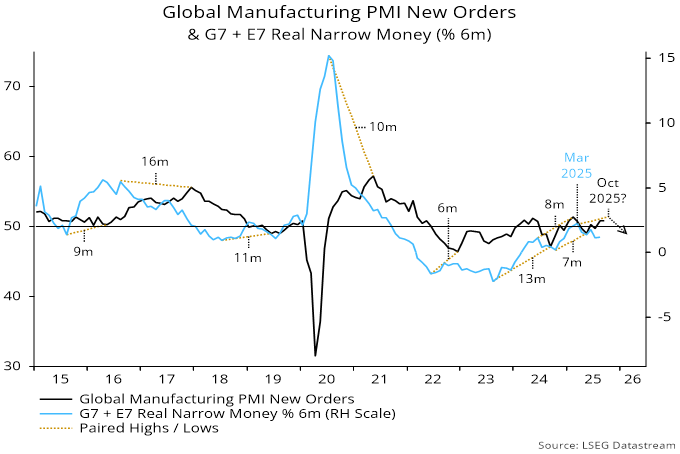
Chart 1 showing Global Manufacturing PMI New Orders & G7 + E7 Real Narrow Money (% 6m)

The fall in real money momentum has been modest but an expected economic slowdown could become more serious than others in recent years, for two reasons. First, the stockbuilding and housing cycles have entered time windows to begin downswings. Secondly, labour markets are showing signs of weakness for the first time since the pandemic recession, raising the risk of self-reinforcing negative dynamics.

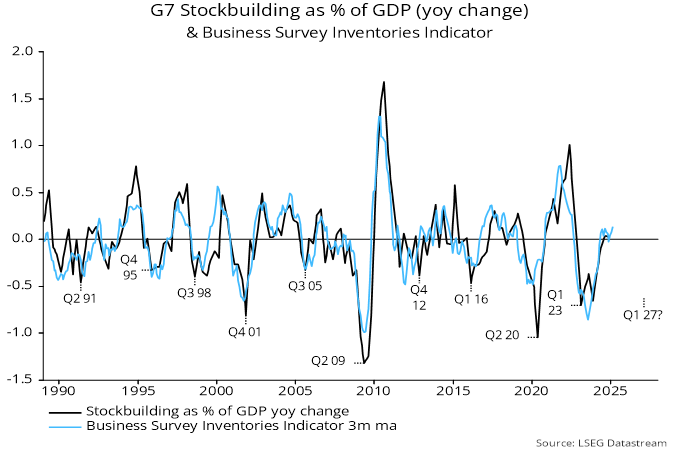
The working assumption here has been that the stockbuilding cycle will reach another low in Q1 2027, implying a four-year current cycle versus a 3.5-year historical average. Recent G7 national accounts stockbuilding data as well as an indicator based on business surveys are consistent with the cycle being at or near a peak – chart 2.

Chart 2
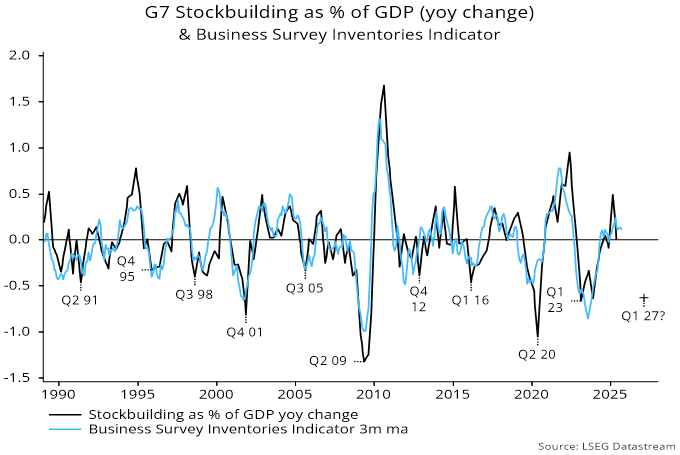
Chart 2 showing G7 Stockbuilding as % of GDP (yoy change) & Business Survey Inventories Indicator

The housing cycle bottomed in 2009 and has ranged between 15 and 25 years historically, averaging 18 years. The pandemic-related money growth surge of 2020-21 appears to have resulted in the current cycle peaking early, in 2022. G7 housing starts or permits have been range-bound since early 2023 but rising unemployment could be the trigger for a break lower.  China has been leading in the current cycle and starts are still falling – chart 3.

Chart 3
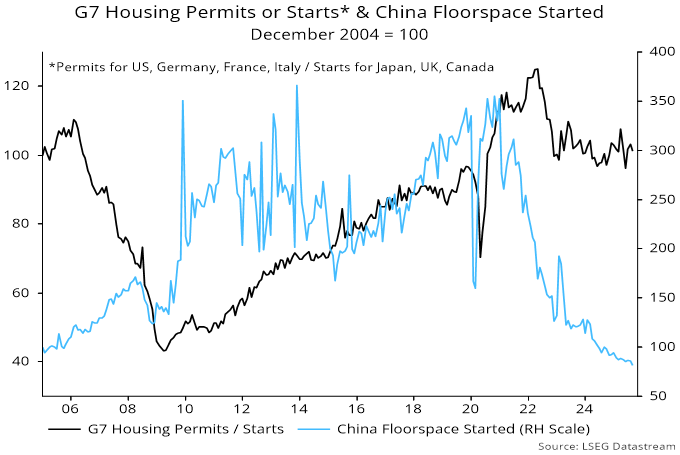
Chart 3 showing G7 Housing Permits or Starts* & China Floorspace Started December 2004 = 100 *Permits for US, Germany, France, Italy / Starts for Japan, UK, Canada

The suggestion that unemployment is on a rising trend is supported by consumer surveys, with a composite G7 indicator of negativity recently reaching a four-year high – chart 4.

Chart 4
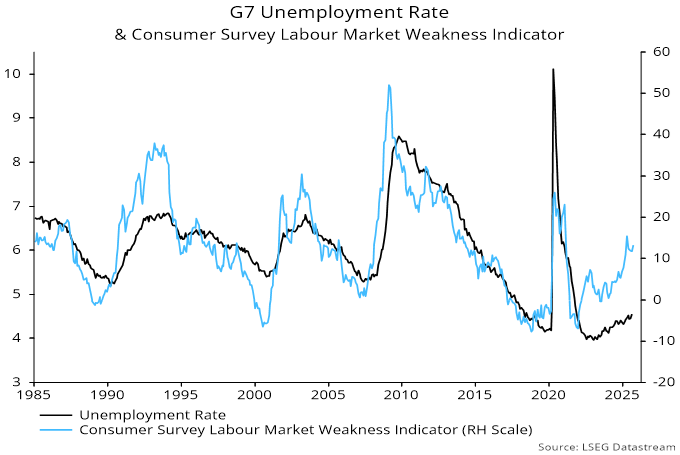
Chart 4 showing G7 Unemployment Rate & Consumer Survey Labour Market Weakness Indicator

Monetary policy easing, if sufficiently dramatic, could short-circuit negative cyclical dynamics. A dramatic move could occur conventionally if additional evidence of labour market weakness is accompanied by a downside inflation surprise, or unconventionally if the Trump administration succeeds in gaining control of the Fed. A large cut in US rates would magnify US dollar weakness, forcing other central banks to follow.

Inflation prospects are judged here to be favourable, at least through early 2027. G7 annual broad money growth remains subdued (4.3% in August versus a 2015-19 average of 4.5%), while stockbuilding cycle downswings are usually associated with weakness in commodity prices – chart 5.

Chart 5
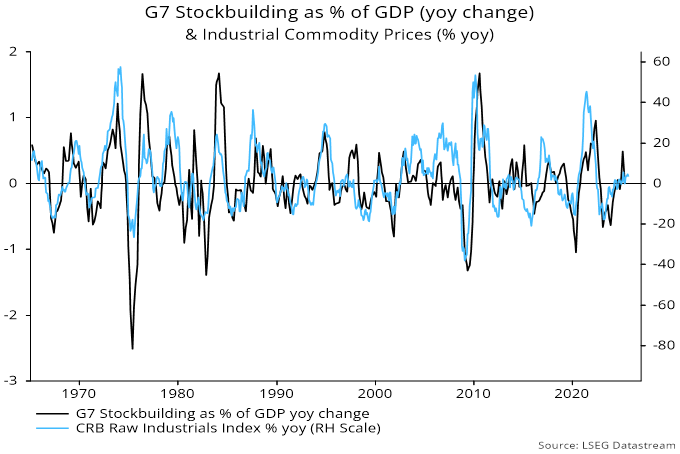
Chart 5 showing G7 Stockbuilding as % of GDP (yoy change) & Industrial Commodity Prices (% yoy)

Near-term US inflation numbers, however, will continue to reflect tariff effects. Elsewhere, central bankers focused on fighting the last war may be slow to respond to favourable surprises. As an example of hawkish bias, the ECB has gone on hold despite forecasting below-target inflation.

The alternative route to a large near-term fall in rates – a take-over of the Fed by the executive branch – still seems far-fetched, with the administration lacking scope to push through personnel changes on the necessary scale.

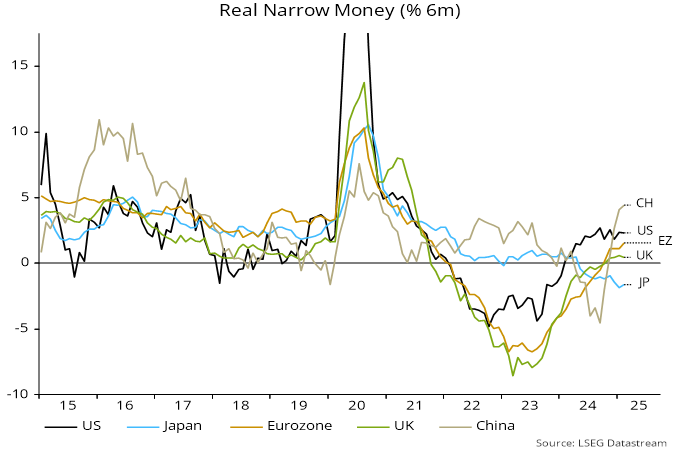
Among major economies, six-month real narrow money momentum is weakest in Japan and the UK, suggesting over-restrictive monetary policies and downside economic risk. Momentum is similar in the US and Eurozone but the US has slipped to a 17-month low, while a Eurozone recovery has stalled since Q1 – chart 6.

Chart 6
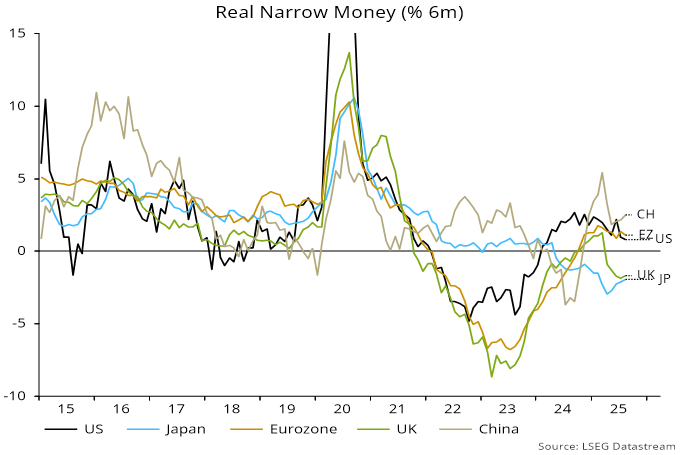
Chart 6 showing Real Narrow Money (% 6m)

The Eurozone story seems to be that higher bond yields triggered by fiscal loosening along with a stronger euro have offset ECB easing. Optimists argue that German fiscal stimulus is only now arriving but the impact could be balanced by an early stockbuilding downswing – the stockbuilding share of GDP rose by 0.7 pp in the year to Q2 and is above its long-run average.

The recent decline in global six-month real narrow money momentum has been driven by the G7 component. Chinese momentum fell back in April-May but has recovered since, giving a modestly favourable signal for economic prospects.

The assumption of a Q1 2027 trough implies that the current stockbuilding cycle has entered its final 18 months. The 18-month windows before previous lows were usually negative for risk assets and marked by credit events or “crises” – chart 7. The possibility of simultaneous housing cycle weakness, as well outsized gains in the upswing phase of the current cycle, suggests greater-than-normal downside.

Chart 7
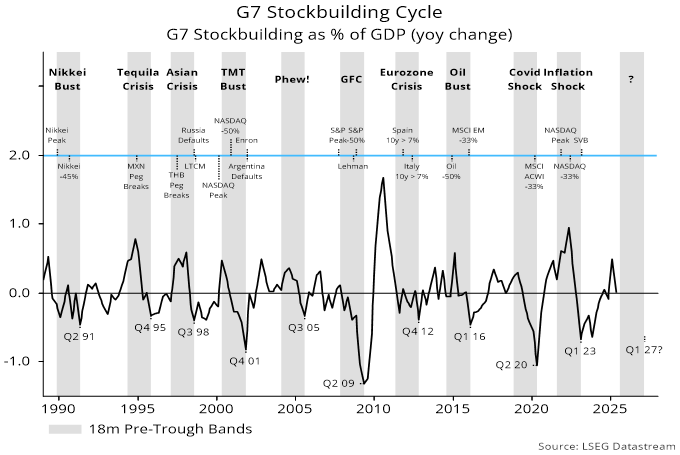
Chart 7 showing G7 Stockbuilding Cycle G7 Stockbuilding as % of GDP (yoy change)

These 18-month windows were usually associated with cyclical equity market sectors underperforming defensives, following outperformance during the upswing (unusually strong in the current cycle). Stylewise, there was a weak tendency for quality to outperform, while momentum lagged its upswing gains significantly. The recent drawdown in relative performance of the MSCI EAFE Quality index versus MSCI EAFE was exceeded in magnitude and duration only in the early 1980s – chart 8.

Chart 8
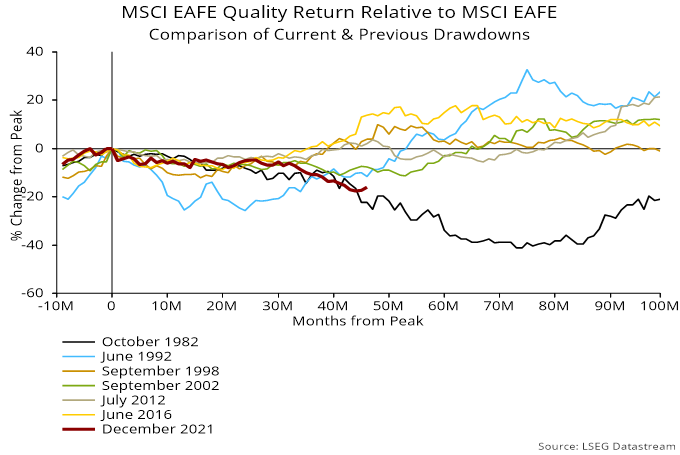
Chart 8 showing MSCI EAFE Quality Return Relative to MSCI EAFE Comparison of Current & Previous Drawdowns

Six-month growth rates of global real narrow money and industrial output have been tracking closely with a small monetary excess on the latest readings – chart 9. The strength of markets appears to reflect a rise in the financial velocity of money more than ample liquidity, suggesting reversibility in the event of a cyclical deterioration in sentiment.

Chart 9
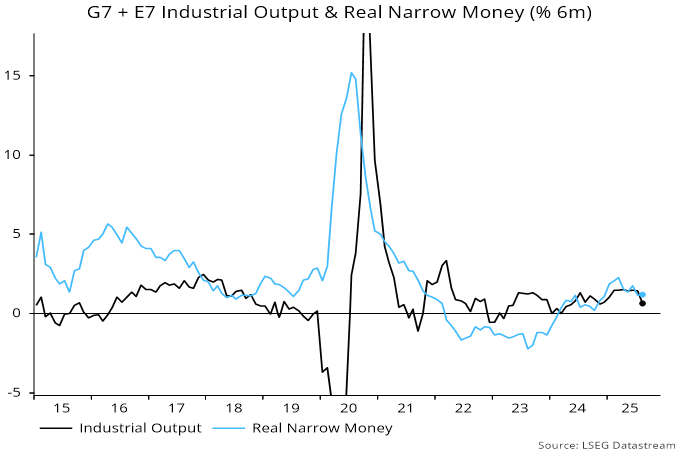
Chart 9 showing G7 + E7 Industrial Output & Real Narrow Money (% 6m)

The two monetary conditions historically favouring EM equities – E7 real money growth above the G7 level and global real money growth above industrial output expansion – are currently in place, suggesting EM outperformance in the event of a near-term further rise in markets.
The Kondratyev cycle describes a tendency for global inflation – or the price level in earlier centuries – to reach major peaks / troughs every 54 years on average.

The highest peaks in global inflation in the first and second halves of the last century occurred in 1919 and 1974 respectively, suggesting another peak in the late 2020s.

US-centric analysts often wrongly place the last peak in 1980, as US annual consumer price inflation reached a higher high in that year. This was not true of a GDP-weighted average of CPI inflation rates across major economies, nor of US producer price inflation, which also reached a maximum in 1974.

Cycle troughs typically occur about two-thirds of the way through the interval between peaks, i.e. about 36 years after one peak and 18 years before the next. The annual change in global / US consumer prices reached a low in negative territory in 2009, consistent with this pattern and further supporting the expectation of a late 2020s peak.

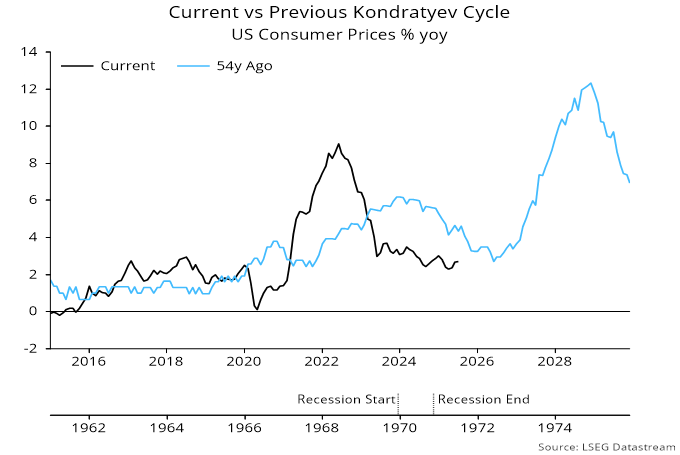
Numerous commentators have drawn a parallel between recent / current US inflation experience and the early 1970s. Annual CPI inflation reached a post-Korean war high in 1969, fell back into 1972, then embarked on a bigger climb into the 1974 peak. The suggestion is that the rise into 2022 is the analogue of the late 1960s increase and another, bigger upsurge will unfold in 2026-27 – see chart 1.

Chart 1

Chart 1 showing Current vs Previous Kondratyev Cycle
US Consumer Prices % yoy

Proponents of this view cite tariffs, large budget deficits and erosion of Fed independence as factors conducive to another inflation pick-up.

Current monetary trends, however, differ from the early 1970s, suggesting that such concerns are premature.

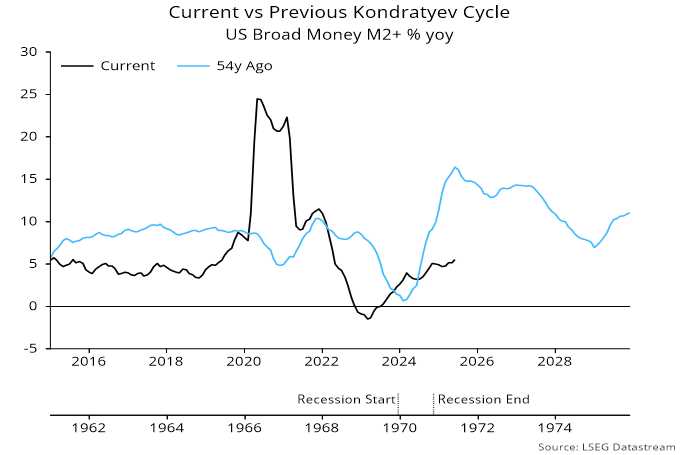
The 1967-69 inflation pick-up was preceded by a rise in annual broad money growth to above 10%. Fed rate hikes caused money growth to slump, pushing the economy into a recession in 1970. The Fed responded by fully reversing the increase in rates. Money growth surged into the mid-teens in 1971, laying the foundation for the 1972-74 inflation upswing – chart 2.

Chart 2

Chart 2 showing Current vs Previous Kondratyev Cycle
US Broad Money M2+ % yoy

Fed tightening in 2022-23 also caused money growth to slump but the economy avoided a recession, resulting in a much more muted policy reversal. Money growth has recovered but only to a “normal” level by historical standards.

The monetary conditions for a second inflation rise into the Kondratyev peak, therefore, have yet to fall into place.

How could this change? One possibility is that lagged effects of policy tightening and tariff damage result in a recession and / or significant labour market weakness, triggering panic Fed easing that pushes money growth up further – a delayed 1970 scenario.

Alternatively, the Trump administration could wrest control of the Fed and push rates lower regardless of economic conditions.

A third possibility is that the Treasury increases monetary financing of the deficit, for example by relying on issuance of bills – mostly bought by banks and money funds – rather than notes and bonds.

The Kondratyev cycle is global so another scenario is that the monetary impulse for higher inflation comes from outside the US, for example through a combination of reflation in China and a further surge in already strong Indian money growth.

Large inflation swings, in either direction, often occur when policy-makers, and economic agents generally, are facing the “wrong” way (as was the case in 2020). The final ascent into the Kondratyev peak may require a recession / deflation scare first.

A cyclical forecasting framework implies that current economic events will contain echoes of developments at the same stage of previous cycles.

Similarities should be more pronounced at around 18- and particularly 54-year frequencies, corresponding to average lengths of the housing and Kondratyev inflation cycles respectively.

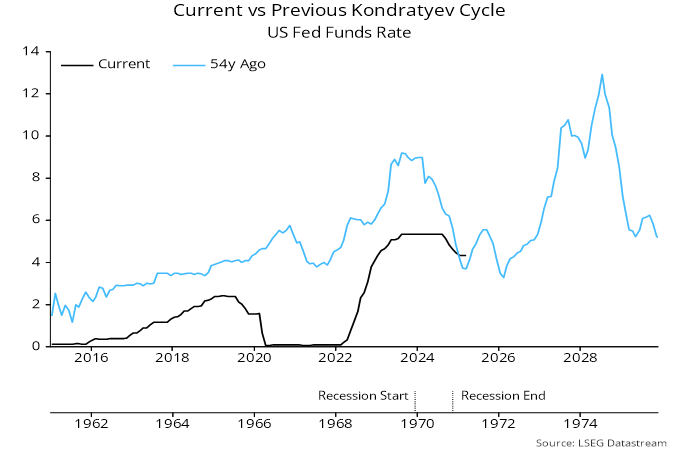
A previous post noted the similarity of Fed tightening episodes in 1967-69 and 2022-23. The Fed funds rate (month average) rose from peak to trough by 540 bp and 530 bp respectively, topping in August 1969 and August 2023, exactly 54 years later – see chart 1.

Chart 1

Current vs previous Kondratyev Cycle. US Fed funds rate.

The US economy entered a recession at the end of 1969. GDP was recovering by Q2 1970 but suffered a second hit from a prolonged auto strike.

The Fed cut rates much more aggressively than recently but reversed course temporarily from early 1971 as the economy rebounded strongly and inflation remained high. The current Fed pause has occurred at the same cycle time.

Inflation fell sharply into 1972, mirroring a big slowdown in broad money growth two years earlier. The Fed resumed easing later in 1971, with the funds rate reaching an ultimate low in February 1972.

A possible scenario is that President Trump’s tariff shock triggers the recession “missing” from the current cycle, causing the Fed to ease aggressively later in 2025, with rates and inflation falling to lows in 2026 corresponding to those reached in 1972.

US disruption to global economic relations is itself is strongly reminiscent of policy developments 54 years ago. In August 1971, President Nixon shocked trading partners by suspending convertibility of the dollar into gold within the Bretton Woods system while imposing a 10% tariff on imports.

The backdrop was a US balance of payments deficit and an accelerating loss of gold from US reserves. According to a Federal Reserve history of the period, President Nixon blamed the deficit “on unfair trading practices and other countries’ unwillingness to share the military burden of the Cold War”. Sound familiar?

The “Nixon shock” triggered a crisis, with global policy-makers fearing that “international monetary relations would collapse amid the uncertainty about exchange rates, the imminent spread of protectionism, and the looming prospects of a serious recession”.

The crisis was resolved, at least temporarily, by the December 1971 Smithsonian Agreement, involving trading partners agreeing to revalue their currencies against the dollar in return for the removal of tariffs. “The net effect was roughly a 10.7 percent average devaluation of the dollar against the other key currencies … Foreign nations also agreed to comply with Nixon’s request to lessen existing trade restrictions and to assume a greater share of the military burden.”

Could a revaluation of currencies against the dollar be part of a “deal” to end the current crisis, once President Trump comes to recognise that the economic costs of his high tariff policy greatly exceed any benefits?

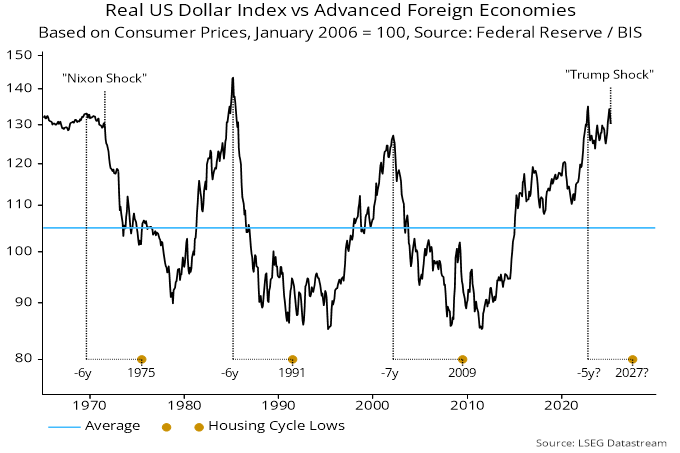
The Nixon shock occurred with the real trade-weighted value of the dollar at a similar premium to its long-run average to today. The shock accelerated a secular decline into and beyond the following housing cycle trough – chart 2.

Chart 2

Real US dollar index vs advanced foreign economies. Based on consumer prices, January 2006 = 100, Source: Federal Reserve / BIS.

Global money growth has picked up since late 2024 but remains subdued, while the stock of money is no longer in excess relative to nominal economic activity and asset prices. The monetary backdrop, therefore, appears insufficiently supportive to offset economic / market damage from US-led tariff hikes.

Prospective tariff effects, meanwhile, require a revision to the previous forecast here of a downside global inflation surprise in 2025 related to extreme monetary weakness in 2023. A price level boost this year is unlikely to yield second-round effects given disinflationary monetary conditions, so a near-term lift to annual inflation should reverse in 2026. The effect may be to extend the lag between the money growth low of 2023 and the associated inflation low from two to three years.

The elimination of a surplus stock of money has been mirrored by erosion of excess labour demand, with job openings / vacancy rates mostly now around or below pre-pandemic levels. Economic weakness, therefore, may be reflected in a rise in unemployment that eventually dominates central bank concerns about inflationary tariff effects, suggesting that current policy caution will give way to renewed easing later in 2025.

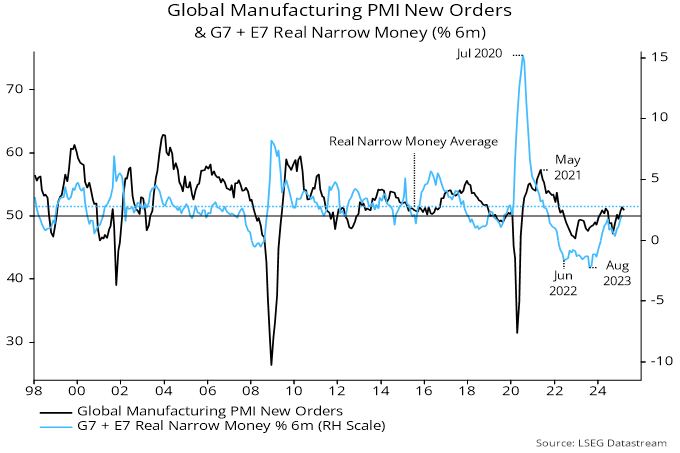
Global six-month real narrow money momentum – the key monetary leading indicator followed here – fell between June and October 2024 but has since rebounded, reaching a post-pandemic high in February. (The timing of the mid-2024 dip has changed slightly from previous posts, mainly reflecting annual revisions to seasonal adjustment factors for US monetary data.) Real money momentum, however, remains below its long-run average – see chart 1.

Chart 1

Chart 1 showing Global Manufacturing PMI New Orders & G7 + E7 Real Narrow Money (% 6m) Global six-month real narrow money momentum – the key monetary leading indicator followed here – fell between June and October 2024 but has since rebounded, reaching a post-pandemic high in February. (The timing of the mid-2024 dip has changed slightly from previous posts, mainly reflecting annual revisions to seasonal adjustment factors for US monetary data.) Real money momentum, however, remains below its long-run average – see chart 1.

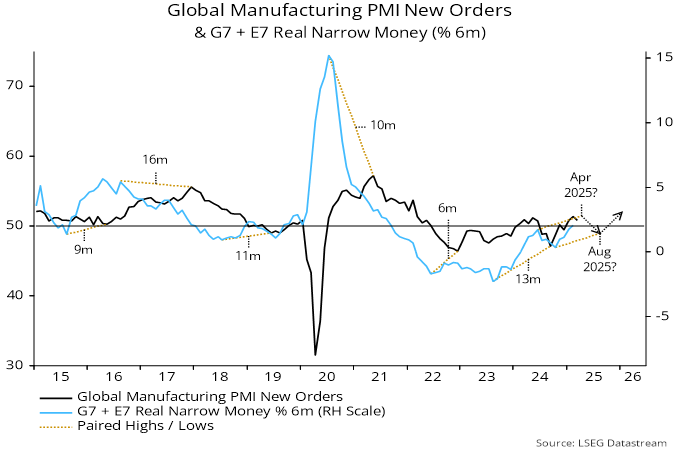
The lead time between real money momentum and manufacturing PMI new orders has averaged 10 months at the four most recent turning points. Based on this average, the 2024 real money slowdown and subsequent reacceleration suggest a PMI relapse in Q2 / Q3 followed by renewed strength in late 2025 – chart 2.

Chart 2

Chart 2 showing Global Manufacturing PMI New Orders & G7 + E7 Real Narrow Money (% 6m) The lead time between real money momentum and manufacturing PMI new orders has averaged 10 months at the four most recent turning points. Based on this average, the 2024 real money slowdown and subsequent reacceleration suggest a PMI relapse in Q2 / Q3 followed by renewed strength in late 2025 – chart 2.

Tariff effects – including payback for a front-loading of trade flows – are likely to magnify mid-year economic weakness and could push out or even abort a subsequent recovery: delayed central bank easing, a confidence hit to business / consumer credit demand and a near-term inflation lift could reverse the recent pick-up in real money momentum.

Previous posts, meanwhile, argued that stocks of (broad) money in the US, Japan and Eurozone are no longer higher than warranted by prevailing levels of nominal economic activity and asset prices, implying an absence of a monetary “cushion” against negative shocks. Excess money appears to be substantial in China but could remain frozen as US trade aggression and domestic policy caution sustain weak business / consumer confidence.

Chart 3 shows six-month real narrow money momentum in major economies. Chinese strength is a stand-out but may partly reflect payback for earlier weakness – momentum needs to remain solid to warrant continued (relative) optimism. A Eurozone recovery still leaves momentum lagging the US (where revised numbers show less of a recent slowdown), with the UK further behind. Japanese weakness is alarming, suggesting significant downside economic / inflation risk and consistent with recent lacklustre equity market performance.

Chart 3

Chart 3 showing Real Narrow Money (% 6m)

European economic optimism has been boosted by a relaxation of German fiscal rules and a wider drive to increase defence spending. This is significant for medium-term prospects but has limited relevance for the near-term economic outlook, which hinges on whether an uplift from monetary easing will prove sufficient to offset trade war damage.

The two flow indicators of global “excess” money followed here are giving a mixed message: six-month growth of real narrow money has crossed above that of industrial output (positive) but 12-month growth remains below a long-term moving average (negative). This combination was associated with global equities slightly underperforming US dollar cash on average historically.

From a cyclical perspective, a key issue is whether the US tariff war shock brings forward peaks and downswings in the stockbuilding and business investment cycles, which are scheduled to reach lows in 2026-27 and 2027 or later respectively. The previous baseline here was that upswings in the two cycles would extend into 2026, a scenario supported by the current monetary signal of a rebound in economic momentum in late 2025.

The next downswings in the two cycles are likely to coincide with a move of the 18-year housing cycle into another low. Triple downswings are usually associated with severe recessions and financial crises. Such a prospect is probably still two years or more away but the US policy shock may have closed off the possibility of a final boom leg to current upswings before a subsequent crash.

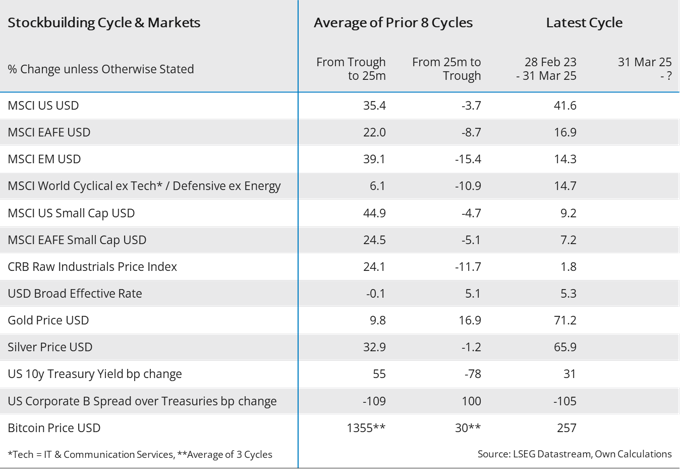
Table 1 updates a comparison of movements in various financial assets so far in the current stockbuilding upswing (which started in Q1 2023) with averages at the same stage of the previous eight cycles, along with changes over the remainder of those cycles. Three months ago, US equities, cyclical sectors, the US dollar and precious metals were performing much more strongly than average, suggesting downside risk. By contrast, EAFE / EM equities, small caps and industrial commodities appeared to have catch-up potential.

Table 1

Table 1 showing Stockbuilding Cycle & Markets Table 1 updates a comparison of movements in various financial assets so far in the current stockbuilding upswing (which started in Q1 2023) with averages at the same stage of the previous eight cycles, along with changes over the remainder of those cycles. Three months ago, US equities, cyclical sectors, the US dollar and precious metals were performing much more strongly than average, suggesting downside risk. By contrast, EAFE / EM equities, small caps and industrial commodities appeared to have catch-up potential.

Q1 moves corrected some of these anomalies, with the US market falling back, Chinese / European equities performing strongly, US cyclical sectors lagging, the dollar falling and industrial commodity prices recovering. Precious metals, however, became even more extended relative to history, while small cap performance has yet to pick up.

The updated table suggests potential for further strength in EM and to a lesser extent EAFE equities, along with industrial commodities. Cyclical sector underperformance and dollar weakness could extend, while gold / silver appear at high risk of a correction. The larger message, however, is that, even assuming a delayed peak, the stockbuilding cycle has entered the mid to late stage that has been unfavourable for risk assets historically.

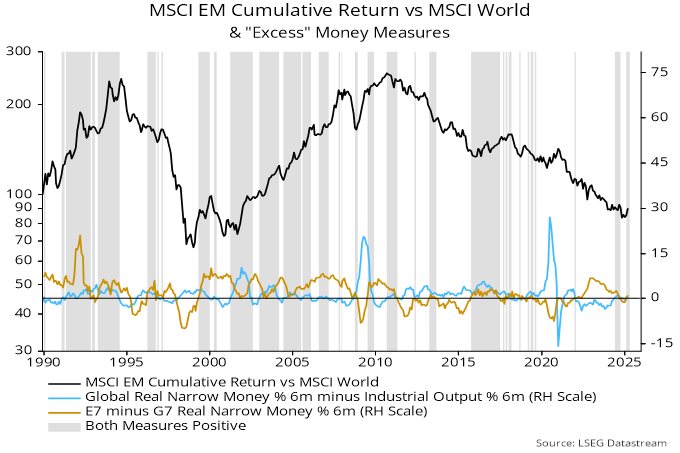
The suggestion of EM outperformance is supported by monetary considerations. Six-month real money momentum is stronger in the E7 large emerging economies than in the G7, while – as noted earlier – global real money is outpacing industrial output. EM equities beat DM on average historically when these two conditions were met, underperforming in other regimes – chart 4.

Chart 4

Chart 4 showing MSCI EM Cumulative Return vs MSCI World & "Excess" Money Measures

Recent outperformance of non-US equity markets may be a signal of the end of the bull market rather than a harbinger of broadening strength.

Previous analysis comparing returns in the current stockbuilding cycle with history suggested weaker prospects for risk assets, a reversal of US equity market / cyclical sector outperformance, a decline in the US dollar, stronger industrial commodity prices and a correction in precious metals. Several of these themes are playing out and appear to have potential to extend.

The stockbuilding cycle averages 3.5 years in length and last bottomed in Q1 2023, suggesting another low in H2 2026. The previous view here was that the current cycle would be longer than normal, to balance a shorter previous cycle (2.75 years) and to harmonise with the business investment cycle, which isn’t scheduled to bottom before 2027.

There is, however, anecdotal evidence of firms / importers stockpiling inputs / finished goods to avoid tariffs, raising the possibility of an earlier cycle peak and start to the downswing.

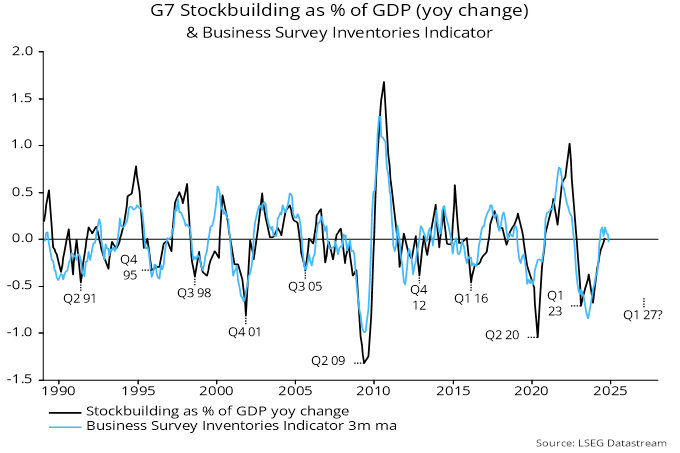
The cycle indicators followed here do not currently support this alternative scenario. The annual change in G7 stockbuilding, expressed as a percentage of GDP, is usually significantly positive at cycle peaks but stalled just above zero in Q4. A more timely indicator based on business surveys was little changed through February – see chart 1.

Chart 1

Chart 1 showing G7 Stockbuilding as % of GDP (yoy change) & Business Survey Inventories Indicator

The previous view – that a cycle peak is still several quarters away and a downswing will be delayed until 2026 – will, therefore, be maintained. This assessment is consistent with a recent rise in global six-month real narrow money growth, suggesting a recovery in economic momentum in late 2025 following Q2 / Q3 weakness – see previous post.

Risk assets typically rally strongly in the first half of a stockbuilding cycle, partially retracing gains in the run-up to the next trough. Table 1, reproduced from the earlier post, compares movements in the current cycle through end-2024 with averages at the same stage of the previous eight cycles, along with changes over the remainder of those cycles.

Table 1

Table 1 showing Stockbuilding Cycle & Markets. Risk assets typically rally strongly in the first half of a stockbuilding cycle, partially retracing gains in the run-up to the next trough. Table 1, reproduced from the earlier post, compares movements in the current cycle through end-2024 with averages at the same stage of the previous eight cycles, along with changes over the remainder of those cycles.

US equities, cyclical sectors, the US dollar and precious metals had outperformed relative to history, suggesting a stronger likelihood that they would lose ground between end-2024 and the next trough. Areas that had lagged and appeared to have catch-up potential included EAFE / EM equities, small caps and industrial commodities.

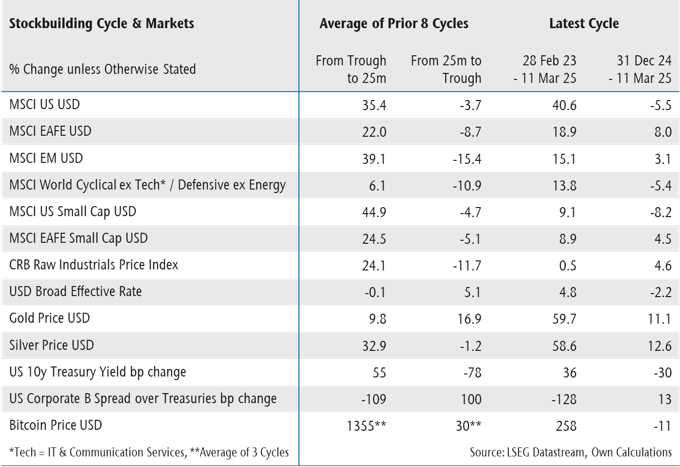
Table 2 updates the comparison through 11 March. The US market correction and rallies in Europe / China have narrowed the US / EAFE and US / EM performance gaps but they remain wide relative to history. Other moves in the “right” direction with apparent potential to extend include weakness in cyclical sectors, a decline in the US dollar and a rise in industrial commodity prices.

Table 2

Table 2 showing Stockbuilding Cycle & Markets. Table 2 updates the comparison through 11 March. The US market correction and rallies in Europe / China have narrowed the US / EAFE and US / EM performance gaps but they remain wide relative to history. Other moves in the “right” direction with apparent potential to extend include weakness in cyclical sectors, a decline in the US dollar and a rise in industrial commodity prices.

By contrast, there has been no correction of the “anomaly” of small cap underperformance, while unusual strength in precious metals has extended further.

The larger message is that, even assuming a delayed peak, the stockbuilding cycle has entered the mid to late stage that has been unfavourable for risk assets historically.

Monetary trends suggest that the global economy will remain soft in H1 2025, while inflation rates will fall further, undershooting targets. Cycle analysis holds out a prospect of economic reacceleration later in the year but risk assets might have limited further upside even in this scenario, although international / EM equities might regain relative performance.

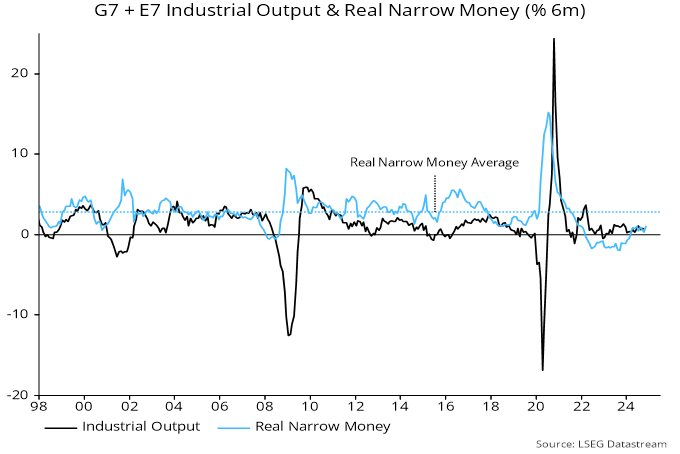
Global six-month real narrow money momentum recovered from a low in September 2023 into Q2 2024 but has since moved sideways at a weak level by historical standards – see chart 1. Based on a normal six to 12 month lead, this suggests below-trend economic growth through Q2 2025, at least.

Chart 1

Chart 1 showing G7 plus E7 Industrial Output and Real Narrow Money (% 6 months)

Economies exhibiting monetary weakness are at greater risk from negative policy or other shocks. As an example, a fizzling-out of a recovery in UK six-month real narrow money momentum in H1 2024 signalled an approaching growth stall but the Budget tax shock appears to have tipped the economy into contraction.

With job openings / vacancy rates back in pre-pandemic ranges, below-trend global growth is likely to be associated with greater deterioration in labour markets than in 2024. In economics parlance, a movement down the Beveridge curve may be approaching a gradient shift such that a further fall in vacancies will be associated with a significant unemployment rise.

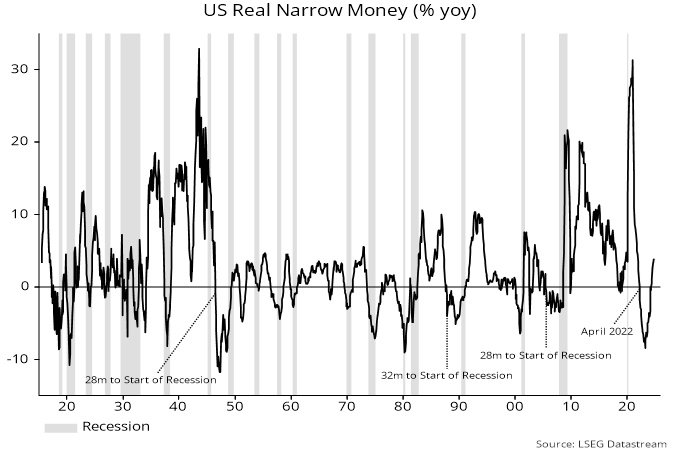
A further issue for monetary economists is the “false” US recession signal of 2022-23. Most annual contractions in US real narrow money historically were associated with recessions, and all on the scale of the 2023 decline – see chart 2. On three occasions (highlighted), however, the interval between the start of the contraction and the onset of recession was unusually long, i.e. up to 32 months.

Chart 2

Chart 2 showing US Real Narrow Money (% year over year)

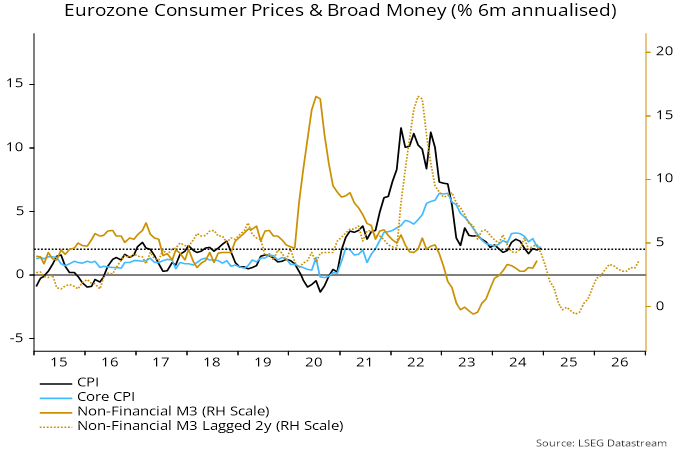
On inflation, the monetarist rule of thumb that price momentum follows the direction of broad money growth roughly two years earlier suggests a further slowdown into undershoot territory in H1 2025. Chart 3 shows the relationship for the Eurozone but the message of headline / core deceleration is the same for the US, Japan and the UK.

Chart 3

Chart 3 showing Eurozone Consumer Prices and Broad Money (% 6 month annualised)

Global PMI output price indices in manufacturing and services are close to 2015-19 averages, when headline / core inflation averages were below target.

Financial market prospects, on the “monetarist” view, depend on whether there is “excess” or “deficient” money relative to the economy’s needs. Two flow measures of global excess money were used here historically – the gap between six-month rates of change of real narrow money and industrial output, and the deviation of the annual change in real money from a slow moving average. A “safety first” approach of holding global equities only when both measures were positive would have outperformed buy-and-hold significantly over the long run.

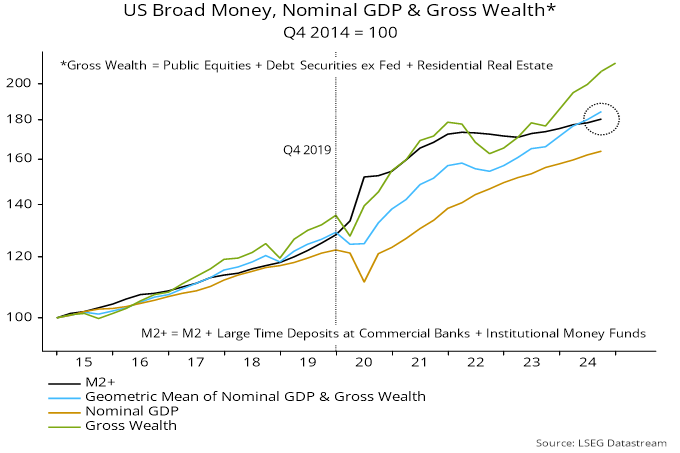
The flow measures, however, remained mixed / negative in 2023-24, understating the availability of money to boost markets because they failed to capture a stock overhang from the 2020-21 monetary surge. To assess whether this stock influence remains positive, the approach here has been to use a modified version of the quantity theory in which the money stock is compared with an average of nominal GDP and gross wealth.

Chart 4 shows that an average of US nominal GDP and gross wealth remained below the level implied by the money stock through mid-2024, consistent with a positive stock influence on asset prices / the economy. Equivalent analysis for Japan and the Eurozone shows the same. In all three cases, however, the nominal GDP / wealth average moved ahead of the money stock during H2 2024, implying that stock and flow indicators are now aligned in suggesting a neutral / negative backdrop.

Chart 4

Chart 4 showing US Borad Money, Nominal GDP and Gross Wealth

While monetary indicators suggest near-term softness, cycle analysis holds out a prospect of stronger economic performance later in 2025 and in 2026. A key consideration is that the stockbuilding and business investment cycles appear some way from reaching peaks, with the next lows unlikely before H2 2026 and 2027 respectively.

The last trough in the stockbuilding cycle is judged to have occurred in Q1 2023, with national accounts inventories data and business surveys suggesting that the upswing is around its mid-point – chart 5. The previous cycle was shorter than the 3.5 year average, so the current one could be longer, with a low as late as H1 2027. An associated downswing might not start until H1 2026.

Chart 5

Chart 5 showing G7 Stockbuilding as % of GDP (year over year change)

The 7-11 year business investment cycle appears to have bottomed in 2020, although a case could be made that this was a false low due to the pandemic, with the last genuine trough reached following a mild downswing in 2015-16. On the more plausible former view, the next low is scheduled for 2027 or later, implying potential for a 2026 boom.

The longer-term housing cycle, which bottomed in 2009 and has averaged 18 years, is in the time window for a peak but significant weakness could be delayed until H2 2026 or later.

Monetary and cycle signals could be reconciled if near-term economic weakness / favourable inflation news triggers faster monetary policy easing and a strong pick-up in money growth into mid-year.

Would such a scenario be associated with further significant gains in risk assets? The history of the stockbuilding cycle suggests not.

Risk assets typically rally strongly in the first half of a stockbuilding cycle, partially retracing gains in the run-up to the next trough. Table 1 compares movements so far in the current cycle with averages at the same stage of the previous eight cycles, along with changes over the remainder of those cycles. US equities, cyclical sectors and precious metals have outperformed relative to history, suggesting a stronger likelihood that they will lose ground between now and the next trough.

Table 1

Table 1 showing Stockbuilding Cycle and Markets

Areas that have lagged relative to history include EAFE / EM equities, small caps and industrial commodities, hinting at catch-up potential in the event of a delayed stockbuilding cycle peak and late (H1 2027) trough. This prospect would be enhanced by a reversal of unusual US dollar strength so far in the current cycle.

Still, any such catch-up might be a relative rather than absolute move against a backdrop of a maturing cycle upswing, a possible US market correction and neutral / negative excess money conditions.

The current stockbuilding cycle may be approaching its mid-point, which typically marks a shift from “risk-on” to a neutral or negative market environment.

The stockbuilding (or inventory or Kitchin) cycle is usually described as ranging between 3 and 5 years. The dating here suggests a normal band of 2.5 to 4.5 years, with an average of about 3.5.

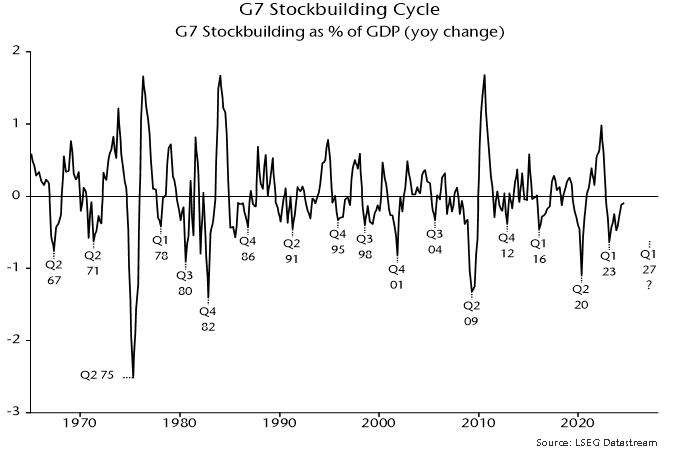
A key indicator used to inform judgements about cycle dates is the annual change in G7 stockbuilding, expressed as a percentage of GDP. Chart 1 shows a long history of this indicator, along with suggested cycle low dates.

Chart 1

Chart 1 showing G7 Stockbuilding Cycle G7 Stockbuilding as % of GDP (yoy change)

There were 16 complete cycles, measured from low to low, between Q2 1967 and Q1 2023, a period of 55.75 years. This implies an average cycle length of 3.5 years or 42 months.

The cycle described in a 1923 article by Joseph Kitchin averaged 40 months. Kitchin analysed data on bank clearings, commodity prices and interest rates and did not explicitly link his cycle with inventory fluctuations. His average was based on 9 cycles spanning 30 years, i.e. a smaller data set than shown in chart 1.

An average of about 3.5 years harmonises with the longer-term housing cycle, with an accepted average length of 18 years. Five stockbuilding cycles “nest” within each complete housing cycle, implying an average length of 3.6 years (43 months).

The most recent stockbuilding cycle trough is judged to have been reached in Q1 2023. Assuming a starting point in the middle of the quarter, November 2024 is month 21 of the current cycle.

The annual change in G7 stockbuilding was still negative in Q3 and usually becomes significantly positive at peaks, suggesting that the cycle remains an expansionary influence on economic momentum currently.

The cycle is as important for markets as the economy (as shown by Kitchin’s reliance on commodity price and interest rate data). The first half of the cycle (starting from a trough) is typically favourable for risk assets and cyclical exposure. Bear markets and crises have historically been concentrated in cycle downswings.

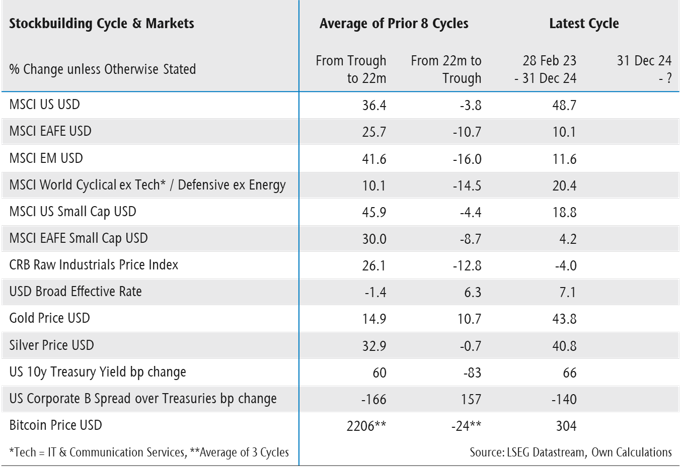
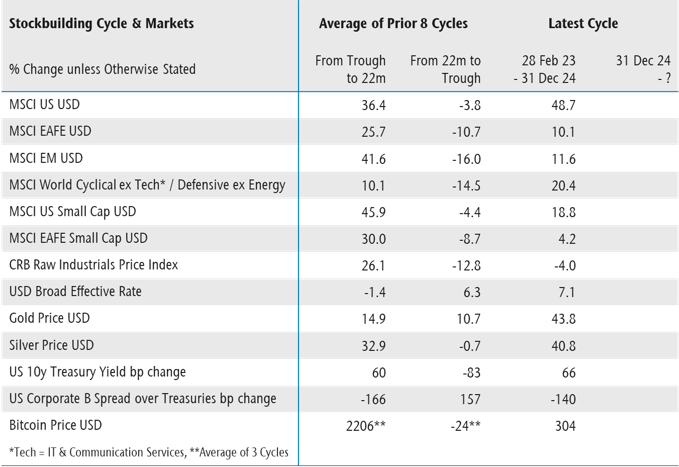
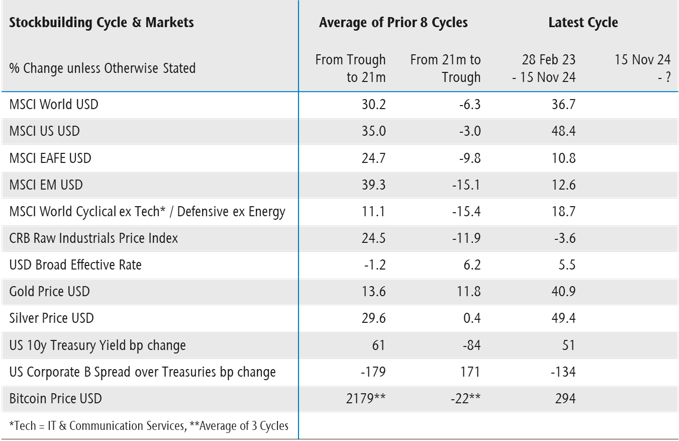
Table 1 compares movements in various assets since the Q1 2023 trough – third column – with average performance in the first 21 months of the prior 8 cycles (stretching back to the mid 1990s) – first column. The second column shows average performance over the remainder of those 8 cycles.

Table 1

Table 1 showing Stockbuilding Cycle & Markets Table 1 compares movements in various assets since the Q1 2023 trough – third column – with average performance in the first 21 months of the prior 8 cycles (stretching back to the mid 1990s) – first column. The second column shows average performance over the remainder of those 8 cycles.

The current cycle has so far largely conformed to the historical pattern, with strong performance of equities, cyclical sectors, precious metals and credit. The suggestion is that remaining upside potential is limited in these areas, with weakness likely over the next 1-2 years as a cycle downswing unfolds.

Could the current cycle prove to be longer than average, extending the risk-on phase? A longer cycle is plausible both because the previous one was short (2.75 years) and to align with the business investment cycle, for which the dating here implies a low in 2027 or later.

A delayed entry to the downswing phase could imply catch-up potential for areas that have lagged relative to history, including non-US / EM equities and commodities.

Cycle timings, however, could be affected by accelerated stockbuilding in anticipation of tariff wars, which could bring forward the cycle peak, although this would not necessarily imply an earlier trough.

The overall message is cautionary. A previous post argued that the “excess” money backdrop for markets is now neutral / negative in stock as well as flow terms. Cyclical considerations reinforce the monetary message.