The “monetarist” rule of thumb that monetary changes feed through to prices with a lag of about two years suggests that G7 consumer price inflation will fall steeply from early 2023. 

G7 headline annual CPI inflation, as calculated here*, moved back up to 7.6% in September, just below a June high of 7.7%. 

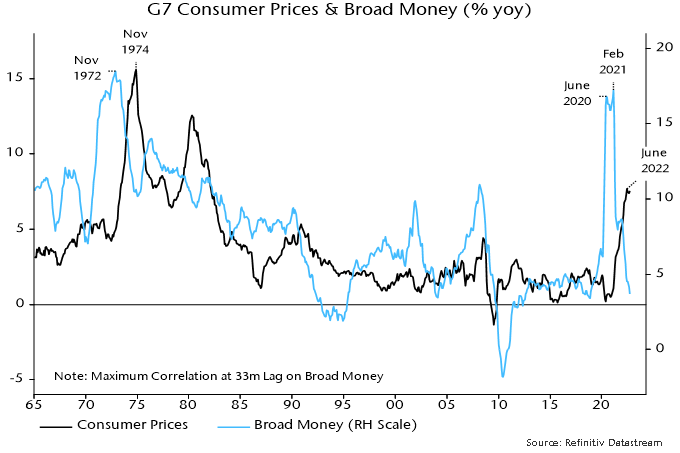
A QE-driven surge in G7 annual broad money growth in 2020-21 was similar in magnitude to a bank lending-driven surge in the early 1970s. A peak in money growth in November 1972 was followed by an inflation peak exactly two years later – see chart 1. 

Chart 1

Chart 1 showing G7 Consumer Prices & Broad Money (% yoy)

The 2020-21 money growth surge was largely complete by June 2020, although the final peak occurred in February 2021. The expectation here is that the June 2022 peak in CPI inflation will hold but the two-year norm suggests that a big fall will be delayed until after February 2023. 

Annual broad money growth collapsed from February 2021, falling much faster and further than after the 1972 peak. Then, money growth bottomed above 10% in 1975 and rebounded into 1976, remaining in double digits until 1980. Sustained strength allowed high inflation to become entrenched. 

Annual broad money growth is now below 4% (September estimate), with QT plans and a likely credit crunch suggesting further weakness. 

Money growth was relatively stable between 2013 and 2018, averaging 4.3% pa. CPI inflation averaged just 1.2% over 2015-20 (i.e. allowing for a two-year lag). Current monetary weakness suggests similar or lower inflation outturns in 2024. 

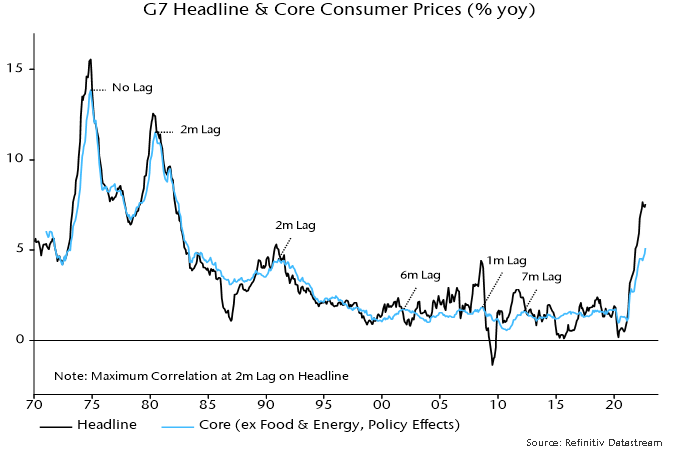
While headline probably peaked in June, core inflation continued to rise into September – chart 2. Core strength is feeding pessimism about inflation prospects, but shouldn’t. Contrary to popular mythology, core usually lags headline at turning points. Base effects boosted the G7 core annual rate over July-September but turn more favourable from October through next May (seasonally adjusted, the core index rose by an average 0.44% per month over October 2021-May 2022 versus 0.19% over July-September 2021). 

Chart 2

Chart 2 showing G7 Headline & Core Consumer Prices (% yoy)

*GDP-weighted, Japanese September CPI estimated from Tokyo data.

Recent dramatic tightening of UK credit conditions along with Bank of England plans for large-scale QT and a “significant” rate hike could tip current weak broad money growth over into contraction, in turn threatening a deflationary depression. 

To recap, the preferred broad measure here – non-financial M4, comprising sterling money holdings of households and private non-financial firms – grew at an annualised rate of just 0.8% in the three months to August. 

The Bank’s broad measure, M4ex, also includes money holdings of financial institutions, which may rise sharply in September / October, reflecting pension funds’ “dash for cash”. Any such strength is not expansionary / inflationary, increasing the importance of focusing on non-financial money measures. 

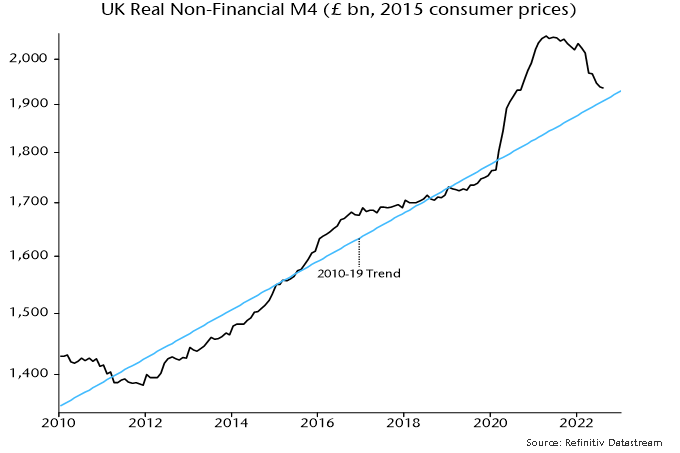
In real terms, non-financial M4 has retraced almost back to its pre-pandemic trend as the 2020-21 money surge has passed through to prices – see chart 1. There is no longer a monetary “excess” to support spending or sustain high inflation. 

Chart 1

Chart 1 showing UK Real Non-Financial M4 (£ bn, 2015 consumer prices)

Current monetary weakness will take time to be reflected in slower price momentum. Prices may continue to outpace nominal money expansion near term, sustaining the real-terms squeeze. 

How likely is it that nominal broad money will begin to contract? 

The “credit counterparts” analysis links movements in broad money to changes in four other components of the banking system’s balance sheet: lending to the public and private sectors, net overseas assets and non-deposit funding. 

Lending to the public sector includes QE / QT. The Bank plans to reduce its gilt holdings by £80 billion over the next 12 months, equivalent to 3.4% of non-financial M4. 

The monetary drag will be smaller to the extent that there is a compensating rise in commercial banks’ gilt holdings. Banks bought £13 billion of gilts in the year to August. Purchases reached a maximum 12-month rate of £50 billion in the wake of the GFC when banks were under strong regulatory pressure to boost their liquid assets. A plausible scenario is that banks will absorb between a third and a half of the QT supply, in which case lending to the public sector would have a contractionary impact on broad money of 1.7-2.2% over the next 12 months. 

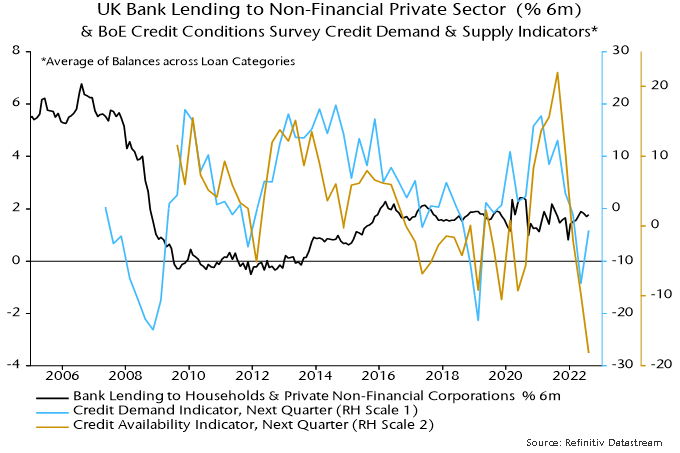
Bank lending to the private sector has been supporting broad money growth recently: lending to households and private non-financial firms expanded at a 3.1% annualised rate in the three months to August. The Bank’s Q3 credit conditions survey, released yesterday, signals weakness ahead: future credit demand balances remained soft while availability plunged – chart 2. 

Chart 2

Chart 2 showing UK Bank Lending to Non-Financial Private Sector (% 6m) & BoE Credit Conditions Survey Credit Demand & Supply Indicators* *Average of Balances across Loan Categories

The survey closed on 16 September so does not capture the further surge in market rates and spreads in the wake of the mini-Budget. 

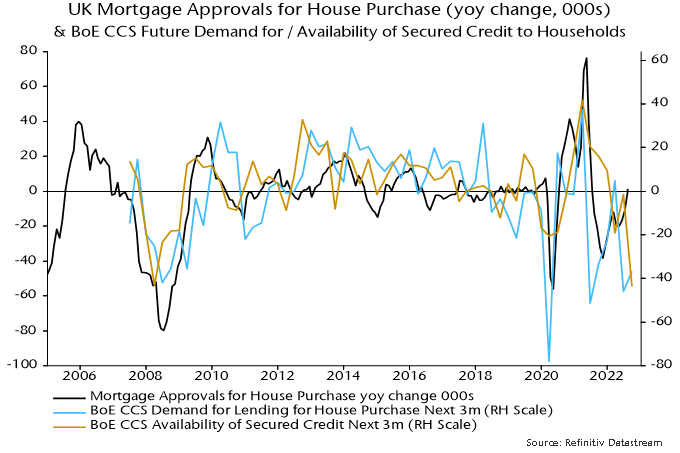
Residential mortgages account for 70% of the stock of lending to households and non-financial firms. The future demand and availability balances for secured credit to households last quarter were comparable with the lows reached at the depths of the GFC – before recent turmoil. Mortgage approvals could halve – chart 3.

Chart 3

Chart 3 showing UK Mortgage Approvals for House Purchase (yoy changes, 000s) & BoE CCS Future Demand for / Availability of Secured Credit to Households

Bank lending expansion, therefore, could plausibly grind to a halt, as it did in the wake of the GFC. The combined monetary impact of public and private sector lending would then become contractionary.

The other credit counterparts – banks’ net overseas assets and their non-deposit funding – are volatile and difficult to forecast but have had a combined contractionary impact over the last 12 months. The joint influence, however, tends to correlate inversely with lending to the private sector, so could become supportive as lending weakens. 

The “best case” scenario appears to be weak broad money expansion with a significant risk of contraction. 

The warranted policy response is to cancel QT and rate hikes. The Bank, instead, has boxed itself into a restrictive stance in a misguided effort to rebuild its shattered credibility and avoid a charge of “fiscal dominance”. 

The hope is that a government U-turn on the mini-Budget together with an easing of global interest rate pressures result in a reversal of recent market-driven credit tightening. A Bank policy shift is coming but may have to wait for evidence of sharply contracting economic activity.

Yashu Joshi

Global Alpha Capital Management is pleased to announce that Yashu Joshi has joined its client services team as Product Specialist.

In this role, Yashu will be responsible for maintaining the day-to-day relationship and investment strategy communication with the firm’s institutional clients and investment consultants. Yashu comes to Global Alpha with over nine years of client service, business development and due diligence experience working with institutional clients and consultants, including roles with Castle Hall Diligence and Fiera Capital. His most recent role was Vice President and Client Relationship Manager at Black Rock, where he was responsible for maintaining the day-to-day relationship with the firms’ Canadian institutional clients, prospects, and investment consultants. Yashu holds a Bachelor of Commerce degree majoring in Finance with a minor in Economics from Concordia University. We are excited to welcome Yashu to the Global Alpha team.

About Global Alpha Capital Management Ltd.

Global Alpha Capital Management Ltd. is an independent and privately owned investment management firm focused exclusively on global, international and emerging markets small cap portfolio management. We believe that portfolios built from the bottom up using a global thematic perspective and a risk-controlled, low turnover approach are key to generating consistent added value for clients over time.

Global Alpha is part of the Connor, Clark & Lunn Financial Group Ltd. (CC&L Financial Group), a multi-boutique investment management company whose affiliates collectively manage approximately $96 billion in financial assets. With large scale non-investment management support provided by CC&L Financial Group, we are uniquely focused on constructing the best global and international small cap portfolios that we can possibly deliver for our clients.

Lake Pichola with City Palace view in Udaipur, Rajasthan, India.

“It is far better to buy a wonderful company at a fair price than a fair company at a wonderful price.” 
– Warren Buffet

“Anticipate trend and benefit from it. Traders should go against human nature.”
– Ramesh Jhunjhunwala

We recently passed the year mark for our Emerging Markets Small Cap portfolio. In a tough environment, there have been markets that have outperformed the EM MSCI Small Cap Index in a substantial way, and we were able to outperform some of those markets. One interesting case has been India, where despite tough valuations, the market has behaved well. MSCI India has outperformed MSCI EM SC by over 23%, according to Bloomberg.  

Why does this happen? Why does a market that trades at 20.3 forward price-to-earnings (PE) vs 10.0 MSCI EM SC index (according to Bloomberg, October 5, 2022), massively outperform in this cloudy environment? Referring to the second quote by Ramesh1, when we are investing in India, we are thinking more long term. This is because we are able to find some of the top-quality companies among outstanding trends, which are well managed and are likely to overcome many cycles. India also conveys strong demographic tailwinds and is one of the few EM countries that is actively fostering investing and growth. Will we sometimes have to pay a higher than average index valuations? Probably yes, and that’s fair, because at Global Alpha, we like finding wonderful companies, generating cash flows, low debt and a good balance sheet at a fair price because it’s the core of our process. We are thinking more long term and it is our intention that our bottom-up selection process relates to companies with secular trends that are particularly interesting in the EM space. In the case of India, it is a good match because we can find multiple ideas with secular trends, where EPS growth is followed by stock price appreciation. 

India has been our best performing market both year-to-date (YTD), and since inception of the EM Small Cap portfolio. Although we have taken some profits, we continue to like good companies that present interesting investment opportunities. Moreover, the current administration is boosting capex spending, which benefits many sectors. According to Macquarie, the central government spending has increased 34% YTD, driven by spending on roads, railways and defence. Public Sector Undertakings (PSUs) have also increased their spending, and the trend should continue in the remaining part of the year. The private sector is also picking up, albeit not at the same pace, but increasing nonetheless. This has rarely happened in India in the last decade. Public sector spending is concentrated more on infrastructure, while the private sector focuses on renewables, automation and data centres. If we look at this in relative terms, we see some decoupling from India and the rest of the world. Considering the global recession, it’s hard to find countries in the EM space that are fostering investments and growth (Saudi Arabia is another case). As India is a domestic-oriented economy and has an enormous quantity of investment deficits (and opportunities) in different areas, the country can continue with policies that imply growth and investments. While we expect some slowdown in FY24, we anticipate that India should continue with short-mid-term growth that is higher than other countries. 

Flow-wise, foreign institutional investors are returning to India. There was a clear sell-off in this market from October 2021, with close to USD 20 billion of outflows, as noted in the CLSA report, Flowmeter: Breakdown of Foreign and domestic flows in India. The market didn’t reflect any major impact basically driven by strong domestic investors’ inflows.  In the last three months, we’ve seen foreign direct investment (FDI) coming again to the country, which still conveys strong domestic inflows support. South Africa, Taiwan and Korea have also experienced massive outflows this year. In the two last countries, this is largely explained by its tech-driven markets in a hawkish U.S. Federal Reserve (Fed) environment.  

All in all, the equation is not so complicated. Among EM Small Cap, Fed hikes have implied strong outflows in tech-related countries (USD 50 billion between Taiwan and South Korea, according to the CLSA report, Flowmeter: Breakdown of Foreign and domestic flows in India), as China maintains its own internal issues driven by zero Covid policies and the property sector. Some markets, such as Turkey, Chile and Brazil, have outperformed YTD mainly because of low valuations among a hawkish Fed. In the case of India, we think quality structural stories are likely to be favoured in this environment, in domestic oriented market focused economies, with structural demographic tailwinds.  We provide two stock examples that have been the key in our outperformance in the Indian market. 

Phoenix Mills (PML) 

Phoenix Mills is a leading Indian developer of large-format retail-led mixed use developments. Over the last few years, PML has spread its wings across Tier I, II and III cities in India by entering into joint ventures with established regional players and bringing in strategic investors to support the growth of its ongoing and future developments. It differentiates itself by its prime-location assets (currently eight shopping centres) across key cities like Mumbai, Chennai, Bangalore, Pune; steady cash flows; near-term execution visibility; and a healthy balance sheet. PML’s core vision is to create iconic city-centric, mixed-use developments with retail as the core and offices and hotels as complimentary assets, according a HSBC report published June 21, Buy: Growth beyond.  

One of PML’s main strengths is the quality of its partners. Phoenix has joint developments with Canadian Pension Plan Investment Board (CPPIB) and Government of Singapore Investment Corporation (GIC). Although both companies have huge investments around the world, it is worth noting that they chose Phoenix Mills as a strategic partner in India. We see the quality and yields of PML projects, a good track record, execution and quality of management as a key differentiator for them in order to establish long-term relationships. Moreover, these partners allow the company to expand their asset base notably with minimum debt requirements. Capex of projects under construction as of Q1FY23 accounted for INR 42 billion and the required corporate debt is only INR 3 billion; that is to say debt funding is at 8% of aggregate capex spends as of Q123, according to a Phoenix Mills presentation from September 2022.  

These partnerships are relevant because the company is poised to a strong growth phase, with most of the projects already defined and under construction. From FY22 to FY26, PML plans to increase 1.9 times its gross leasable area (GLA) of shopping centres, from 6.9 millions of square feet (msft) to 13.0 msft (75% consolidated revenues FY24E), and 3.6 times offices GLA, from 2.9 msft to 7.1 msft. Lastly, in its hotels business, the company intends to increase 1.7 times, from 588 keys to 988 keys. To fund this growth, the company has raised equity capital of INR 45 billion, where 75% comes from the capital infusion from its partners.  

PML is more than doubling in the next three to four years, with strong global worldwide partners and with almost no additional corporate debt. Currently, at a group level, PML has INR 22 billion of liquidity to fund future growth. The sound financial position of the company has resulted in some local credit rating agencies to upgrade the company. India Ratings and Research upgraded the company to AA- from A+, while maintaining a stable outlook.  

In recent months, during an interview, Shishir Shrivastava, Managing Director of Phoenix Mills, expanded more on qualities of the two partners, CPPIB and GIC . He mentioned three pillars worth noting in these comments in a HSBC report published June 21, Buy: Growth beyond

  • “They are long-term investors and bring vast experience and a global relationship, along with 
    design and costing product specification inputs.” 
  • “They are some of the biggest retail space owners worldwide and have seen how retail has 
    grown in various countries and thus have a lot to add from that experience.” 
  • “ESG is something Phoenix is learning from their global teams and expanding their 
    understanding. Overall, they are not silent financial partners.” 

In the shopping centre sector, once the group reaches 13.0 million square feet, its GLA should account for roughly 45% of expected GLA of listed companies in India (PML, Prestige, Oberoi, DLF and Brigade). Looking forward, PML has set a target to add approximately 1 million square feet of GLA each year post-FY26 and is looking for greenfield opportunities in various regions, including Kolkata, Surat, Chandigarh, and Hyderabad, among others). Funding would be either solely by PML or with joint venture partner, according to ICICI Securities. Thinking long term, a joint venture with GIC and/or CPPIB can be monetized, for example, by a REIT, or the company can judiciously unlock capital via lease rental discounting (LRD) to continue its expansion, as we see more room for consolidation in the industry. 

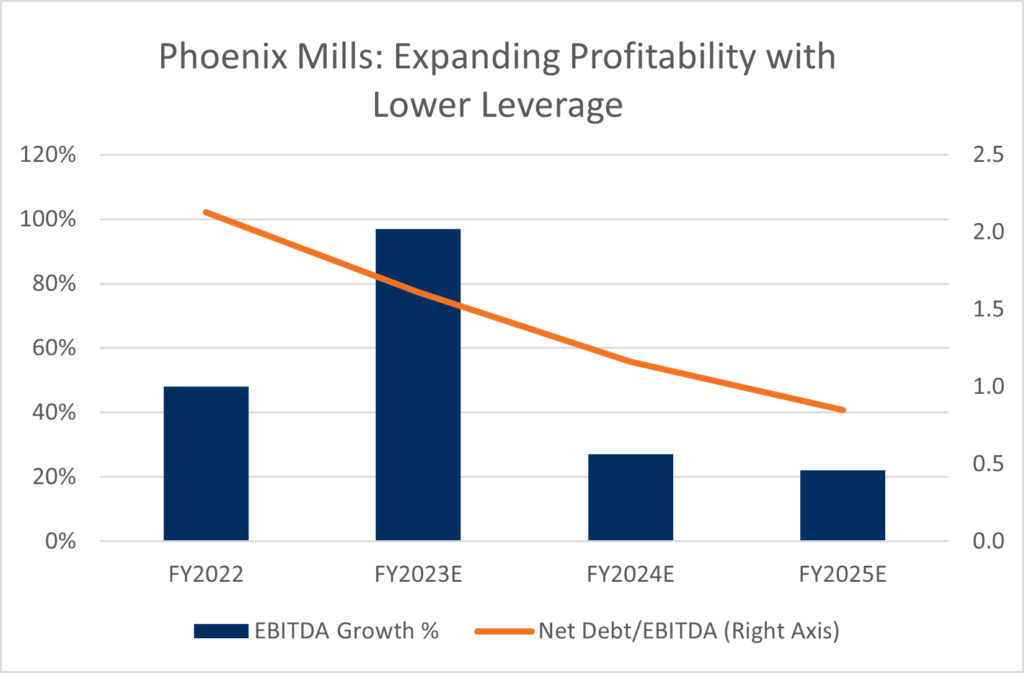
Chart 1 - Phoenix Mills: Expanding Profitability with Lower Leverage

City Union Bank

City Union Bank Limited is a mid-sized private-sector bank and is also one of the oldest private sector banks in India. The bank is focused on providing working capital finance to small manufacturers and traders with single-banker relationships; 50% of their loan portfolio goes to micro, small and medium enterprises (MSME) and 14% to agriculture. 

Driven by its improvement in asset quality and sustained economic recovery, the company revised its FY23 credit growth guidance upwards to 15-18% versus the previous 12-15%. We see this as sustainable with an expected loan book growth of 15-20% and an earnings growth of 20% over the next five years. One of the key competitive advantages for maintaining this is that management is conservative and focused in its core competency of SME lending without falling into the trap of lending to big corporates in risky sectors. 

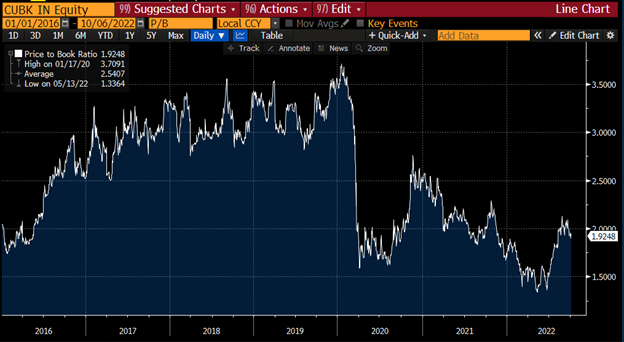
After successfully navigating Covid-led challenges, more significantly within its assessment range, CUBK will be embarking on a higher growth journey hereon. CUBK also enjoys positive tailwinds from increasing capex growth and the financial sector, as explained above. Return on assets should remain at levels of 1.5% (1.46% as of the second quarter), implying return on equity in the range of 15-16%. We think this level of profitability is sustainable for the future, and that’s why valuations are reasonable, both in relation to its history and to other Indian banks. The company has delivered those levels in the past, pre-Covid, which have been stronger than its peers among different business cycles. Net interest margins are steady at 4% and are likely to maintain in that range. Considering the higher proportion of the floating rate book (65% is EBLR linked), asset yields are likely to inch up Q2FY23 onwards. The entire external benchmark based lending rate (EBLR) book is repurchase agreement (repo) linked. With 61% of loan book in working capital loans, repricing is also possible in short intervals. 

Several factors give CUBK a key edge over peers and sustain its profitable expansion. The company has a core expertise in high yield SMEs, the company has also been building relationships with the local business community over the years. Additionally, around 99% of the loan book is secured, with high collateral values ensuring that historical loss given default (LGDs) have remained at 30%. CUBK also enjoys a better granular balance sheet on both the asset and liability side than its peers. Dependence on large corporate deposits is low and retail deposits as a percentage of total deposits is 75% (second highest behind the Federal Bank). On the asset side, there is high granularity, with the top 20 borrowers contributing just 5.72% of total assets. Lastly, the total addressable market maintains a big opportunity. Its long runway for growth as MSME’s lending needs are met by private sector banks that now have access to better data with the introduction of GST.  

Chart 2: City Union bank current trailing PBV and historical valuation

Chart 2: City Union bank current trailing PBV and historical valuation
Source: Bloomberg

[1] Ramesh Jhunjhunwala was a very well-known Indian investor who recently passed away. India’s Prime Minister Narendra Modi tweeted after his death: “Full of life, witty and insightful, he lives behind an indelible contribution to the financial world.”

Outdoor financial stock exchange display screen board.

Summary

  • September was a deeply negative month for stocks globally, with EM declines led in large part by very poor sentiment in China.
  • Cyclical consumer technology stocks in Korea and Taiwan were hit hard as signs emerge that global demand is waning.
  • For the portfolio, high quality and defensive names across healthcare, consumer staples and communications services held up over the period to post positive returns.
  • Hawkish central banks around the world are determined to kill inflation, even at risk deepening an oncoming recession and as signs emerge that inflation is peaking globally:
    • oil prices have been falling through the quarter;
    • metals prices are easing on soft economic numbers in China;
    • soft commodity prices are falling as grain exports by Ukraine resume; and
    • short term gas European gas prices fall despite war the escalating war in Ukraine and attacks on the Nordstream gas pipelines.
  • Our position for several month has been that inflation is set to collapse, led by rapidly declining liquidity from central banks.
  • Inflation expectations are anchored while global real money weakness suggests a recession through to Q2 2023.
  • Central banks are likely to ignore this and are unlikely to slow tightening unless some structural stresses emerge.
  • China remains attractive as modestly positive real money trends continue to suggest economic resilience relative to other majors.

Portfolio Activity

  • We continue to add to our China overweight.
  • Despite the negative sentiment, liquidity and economic data along with the potential for a gradual reopening could underpin one of the only bull markets for a major economy globally.

King dollar and the case for EM

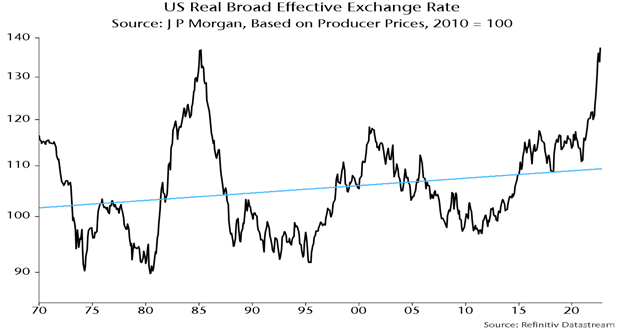
  • The dollar is hovering around 40-year highs – this is pressuring economies outside of the US. The Truss-Kwarteng mini-budget market revolt illustrates the fragility brought about by rapidly declining liquidity.

EM secular bears associated with USD overshoots

Chart 1 - US Real Broad Effective Exchange Rate
  • Our view is that sustained dollar weakness will not arrive until the Fed shifts to a neutral or easing policy bias, which we believe is likely to come sometime after Q1 2023.
  • Real narrow money numbers in emerging markets remain stronger than in developed markets, positioning them for relative recovery if USD strength abates.
  • Broadly speaking, EM economies did not (and in many could not) deploy the same level of fiscal and monetary stimulus as developed markets through the pandemic, maintained more orthodox monetary policy and today do not face the same problems with inflation.  
  • Indeed, with the exception of Turkey, monetary policy pursued by EM economies is at its most restrictive level for more than a decade.
  • CLSA noted during the month that emerging markets ex-China maintain a “weighted average real interest rate greater than 4ppt above developed economies” and have enough buffer to put tightening on hold before a Fed pause.
  • Also in favour of EM is the relative improvement in EPS growth which is converging with DM (having lagged over the past cycle), and with further room for DM earnings to correct to the downside as recession bites.
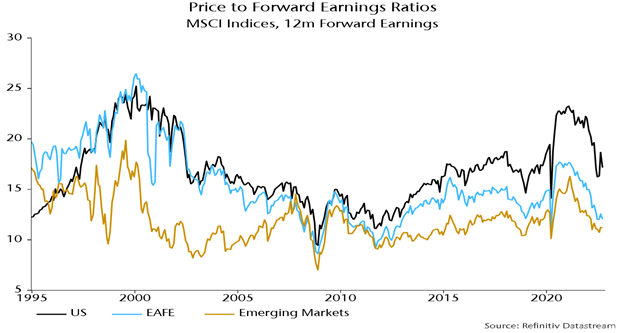
  • EM relative valuations are trading at distressed levels, with stocks looking particularly cheap in China as the Covid-zero gloom and a grinding property slump weighs on investors.

EM valuations below average (but not quite rock bottom)

Chart 2 - Price to Forward Earnings Ratios

Putin under pressure

  • Along with liquidity analysis our process also incorporates qualitative macro factors such as institutional quality and political risk. We believe that the ripple effects of the war in Ukraine reverberate globally and play a part in shaping the shaping the opportunity set of our investment universe.
  • The 22nd annual Shanghai Cooperation Summit in Uzbekistan’s Samarkand was held during the month, which was significant in a number of respects.
  • The Summit marked Xi Jinping’s first trip abroad since the beginning of the pandemic and a potential signal that China is taking the first very tentative steps to reopen.
  • It was particularly notable given the trip coincided with the war in Ukraine taking a surprise turn after a successful Ukrainian counter offensive to retake Kharkiv in the country’s east.
  • Putin now finds himself under extraordinary pressure, not just from hawkish right wing nationalists domestically, but also from other previously more sympathetic national leaders (and major buyers of Russia’s oil) in China’s Xi and India’s Modi.
  • At the outset of the Summit, Putin acknowledged China’s “concerns and questions” over Ukraine, suggesting Chinese discomfort with the trajectory of the Russian leader’s “special operation”. This is a far cry from the “no limits” partnership declared by Xi and Putin in February.
  • Indian Prime Minister Narendra Modi pulled no punches, telling Putin that “today’s era is not an era of war” with the Russian leader responding that “we will do our best to stop this as soon as possible.”
  • Russia’s leader looks more isolated and desperate, and a diminished partner.
  • Particularly so for China which is observing the conflict with interest and drawing lessons with an eye to Taiwan. 
  • In early April we wrote the following in a memo at the outbreak of war in Ukraine:

“The risk of a conflict between the West and China, particularly over Taiwan, was a low probability but rising. We believe that recent events actually slightly lower that risk. There are signs that China did not anticipate the full scope of Russia’s incursion in Ukraine (invasion vs. a “special operation” in the east), signalled by its shifting messaging and failing to evacuate Chinese citizens early in response to Russian moves leading up to the invasion. It is also likely that neither China nor Russia anticipated the strength and unity of the Western response. We believe that given the economic backlash that Russia is weathering, China has a clear picture of the risks associated with further deterioration in Sino-Western relations.”

  • Our view is that events in September support this assessment.
  • Indeed, while Sino-US tensions flared after Nancy Pelosi’s visit to Taiwan in August, Chinese officials over the past few weeks have toned down the public rhetoric and stressed that China will strive for peaceful reunification.
Large boardroom with a view and empty chairs.

One of the more intricate events that shareholders must assess is a change in CEO or senior management. Turnover is a reality even at the executive level: every year between 10 and 15% of corporations must appoint a new CEO, a number that is steadily increasing as investors become more actively engaged. The average tenure of an American CEO fell by half to an average of five years between 2000 and 2014. Multiple studies on the matter show how the lack of preparedness for a CEO change is costly to investors.

Despite all this, research shows that most boards are ill-prepared to deal with the transition. A survey of 140 public and private companies by Stanford researchers concluded that at least half of the CEOs surveyed were unable to name their successor, should the need arise now. Furthermore, four in ten companies had no one who could immediately replace the CEO internally. This challenge is compounded further by the changing employment landscape where role and employer changes are more frequent. The typical executive today is expected to work for more than five employers during their career, compared to fewer than three in the 1980s.

It is worth noting that the lack of a successor pipeline also means that underperforming CEOs are kept in their roles longer than they should. This creates a potential conflict of interest for CEOs, where there might be an incentive not to have a clear successor to give them leverage with the board. Given the packed governance agendas, this topic has taken a backseat, but can be just as impactful as any other governance issue.

So how does Global Alpha assess CEO changes within its portfolios? There is no one-size-fits-all approach. Understandably, it is difficult to create a policy that would account for all the factors, including the reason for the CEO’s departure, the state in which the departing CEO leaves the business, insider/founder ownership, etc. Nonetheless, Global Alpha’s idea of a successful succession scenario for its holdings includes but is not limited to the following characteristics:

  • The event is anticipated: The process taking place over a long period not only provides clarity and reassurance to investors, but also implies that this is not the result of a scandal or loss of confidence in the CEO.
  • There is a framework in place: CEO succession is (hopefully) not something that happens regularly. Nonetheless, there needs to be an existing framework that prepares potential successors, even if no transition is expected in the near future. Clear communication of the processes also helps setting expectations for the potential successors. It is estimated that only 50% of companies provide onboarding or transition support to new CEOs.
  • The successor(s) is internally groomed: External candidates are not necessarily worse, but are on average paid more disproportionately and do not benefit from the same knowledge transfer compared to a candidate who was groomed internally over multiple years. Trending upward, roughly 25% of companies looking for a CEO replacement hire externally.
  • The business strategy remains consistent: We invest in companies whose business model we believe in. Although we do not see issues with small shifts in tactics, the overall business strategy should be consistent.

One of the benefits of operating in the global small cap universe is that the CEOs of the companies we invest in are often also the founders. By having more “skin in the game” than an appointed CEO, they also have a vested interest in ensuring a successful transition for their own legacy. Additionally, founders often go on to be board members following the appointment of their successor, which is another way of ensuring that the knowledge and expertise are still available to the new management.

Loomis, a holding in our international and global strategies, is a recent case study in CEO transition. Headquartered in Sweden, the company offers cash management services and transit to banks and retailers. Patrick Andersson, its CEO since 2016, announced his resignation from the role in early 2022 along with his intent to quit within the next year. Within a month, the board was able to replace him with an internal candidate named Aritz Larrea who had been with the company since 2014 in various roles, such as President of Loomis US and Loomis Spain. In addition, Larrea was already a part of Loomis’ executive management team. Despite the abrupt nature of the CEO’s resignation, investors noted a strong internal pipeline, as well as a framework in place to ensure continuity, without having to either hire externally or resort to an interim CEO.

The monetary forecast of global recession in late 2022 / early 2023 appears to be playing out. The latest real money data hint at a bottoming out of economic momentum around end-Q1 2023 but there is no suggestion yet of a subsequent recovery. This message dovetails with cycle analysis, with the stockbuilding cycle now turning down and unlikely to enter another upswing until H2 2023 at the earliest. Global industrial output is expected to contract sharply over the next two quarters with labour market data turning decisively weaker. Below-average nominal money growth, meanwhile, continues to signal major inflation relief in 2023-24. The monetary backdrop has improved for high-quality bonds and may turn less hostile for equities by year-end. A possible strategy is to remain overweight defensive sectors but add to quality / growth exposure on confirmation of monetary improvement. Monetary trends are relatively favourable in China / Japan and Chinese “excess” money could shift from bonds to equities if pandemic policy eases.

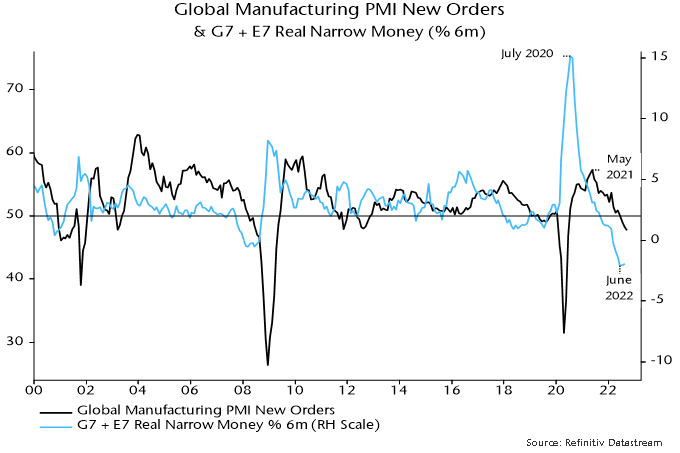
Global six-month real narrow money momentum remains significantly negative but appears to have bottomed in June, edging higher in July / August. Assuming that a June low is confirmed, the suggestion is that global industrial output momentum will bottom around March, based on an average nine-month lead at historical turning points. The global manufacturing PMI new orders index might reach a low a month or two earlier – see chart 1. 

Chart 1

Chart 1 showing Global Manufacturing PMI New Orders & G7 + E7 Real Narrow Money (% 6m)

The base case here is that real money momentum will recover into year-end because of a sharp slowdown in six-month consumer price inflation, which could fall by 1-2 percentage points based on current commodity price levels. 

The risk is that an inflation slowdown will be offset by a further weakening of nominal money growth in response to policy tightening. This is not guaranteed and, if it occurs, may be on a smaller scale than the inflation slowdown. Episodes of rising risk aversion are usually associated with an increase in the precautionary demand for money, reflected in a pick-up in narrow aggregates. This “dash for cash” is a negative coincident influence on markets and the economy but a subsequent release of the monetary buffer can drive recovery. (This process may explain a recent rebound in Eurozone three-month narrow money growth.) 

The baseline monetary scenario would suggest a sharp global recession through Q1 2023 followed by a stabilisation in Q2 and some form of recovery in H2. Lagging indicators such as labour market data would continue to deteriorate during H2. This scenario probably represents a best case. 

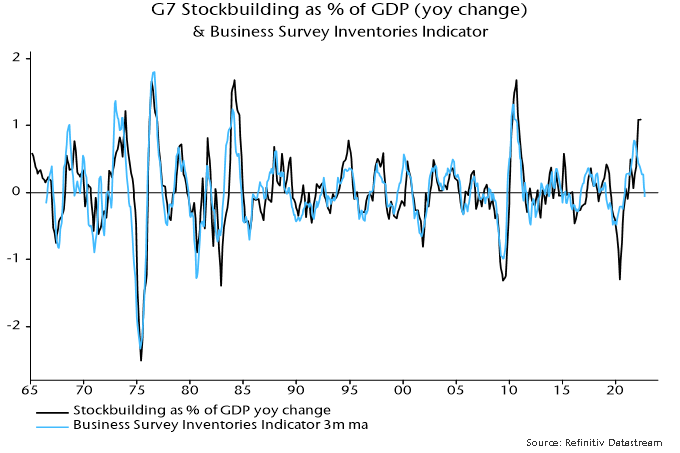
Similar timings with downside risk are suggested by cycle analysis. The stockbuilding cycle, which averages 3 1/3 years measured between lows, is very likely to have peaked in Q2 – the contribution of stockbuilding to G7 annual GDP growth was the highest since 2010 (a cycle peak year) and in the top 5% of historical readings. A business survey inventories indicator calculated here, which is more timely than the GDP stockbuilding data and leads slightly, plunged in July / August, strongly suggesting that a downswing is beginning – chart 2. 

Chart 2

Chart 2 showing G7 Stockbuilding as % of GDP (yoy change) & Business Survey Inventories Indicator

With the last cycle low in Q2 2020, the average cycle length of 3 1/3 years would suggest another trough in Q3 / Q4 2023. The previous cycle, however, was longer than average, raising the possibility of a compensating shorter cycle and an earlier low in Q2 2023. This would dovetail with the suggestion of the baseline monetary scenario of economic stabilisation in Q2 and a recovery later in 2023. 

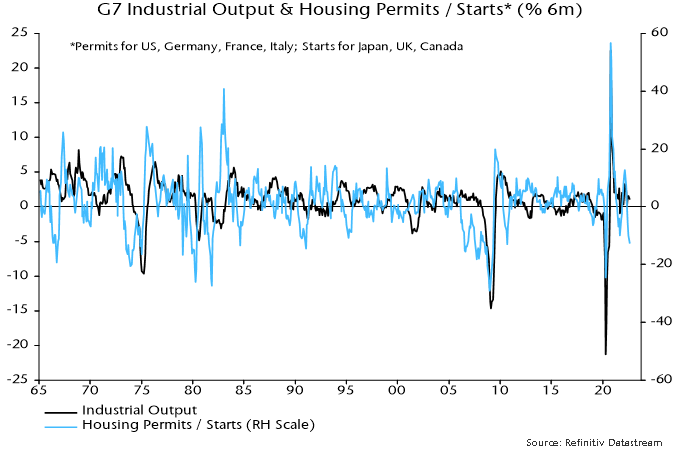
As with the monetary analysis, however, the risk is of a later trough and recovery. The concern from a cycle perspective is that the long-term housing cycle may be peaking early. This cycle has averaged 18 years historically and last bottomed in 2009, suggesting another trough around 2027. Weakness is typically confined to the last few years of the cycle but this was not always the case. This year’s interest rate shock may have brought forward the peak, if not shortened the cycle. Housing permits / starts – a long leading indicator – have fallen sharply and further weakness would suggest that a major top is in – chart 3. 

Chart 3

Chart 3 showing G7 Industrial Output Housing Permits / Starts* (% 6m) *Permits for US, Germany, France, Italy; Starts for Japan, UK, Canada

The risk, therefore, is that housing weakness and its lagged effects on the rest of the economy will offset any recovery impetus later in 2023 from a turnaround in the stockbuilding cycle. A rapid reversal in interest rates may be necessary to avert this scenario. 

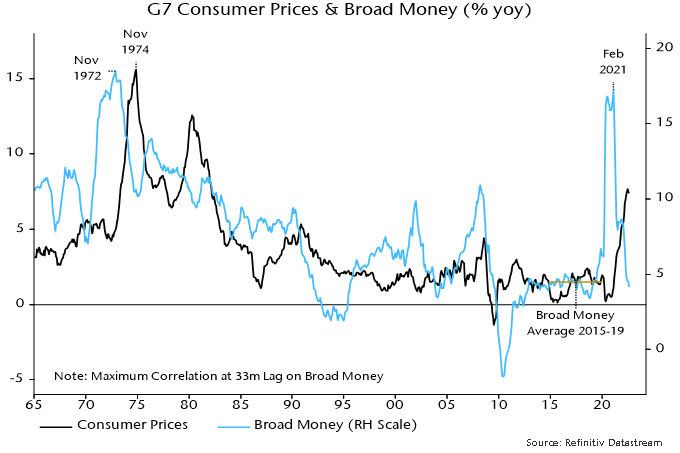
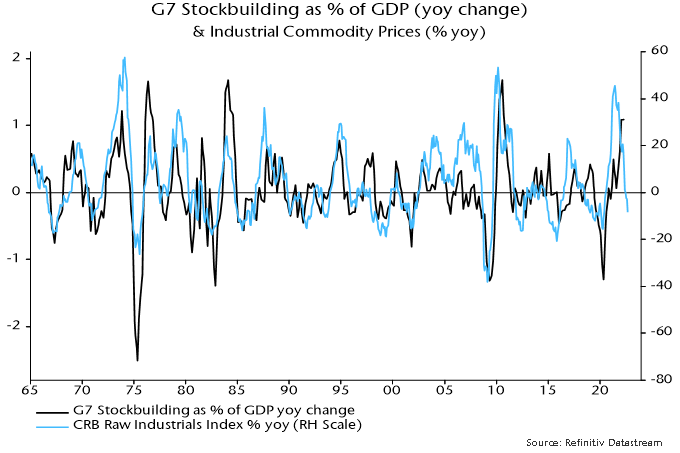
An unambiguous positive message from the monetary and cycle analysis is that inflation is likely to fall sharply in 2023 and return to target – or below – by 2024. G7 annual nominal broad money growth is below its pre-pandemic average, while the correlation of commodity prices with the stockbuilding cycle suggests further falls into a possible mid-2023 trough – charts 4 and 5. 

Chart 4

Chart 4 showing G7 Consumer Prices & Broad Money (% yoy)

Chart 5

Chart 5 showing G7 Stockbuilding as % of GDP (yoy change) & Industrial Commodity Prices (% yoy)

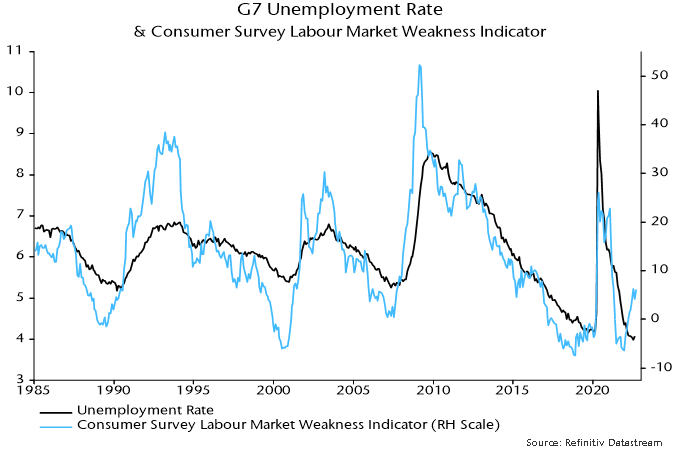
The weakness of nominal money trends argues that central banks have already overtightened policies but the timing and extent of a “pivot” will hinge on labour market data. The suggestion from consumer surveys is that a shift to weakness is imminent. The G7 indicator shown in chart 6 has moved up significantly from a December 2021 low and led unemployment by an average 6-7 months at previous major troughs. The recent unemployment rate low in July, therefore, may prove to be a significant turning point, with a rise of c.1 pp possible by H2 2023. 

Chart 6

Chart 6 showing G7 Unemployment Rate & Consumer Survey Labour Market Weakness Indicator

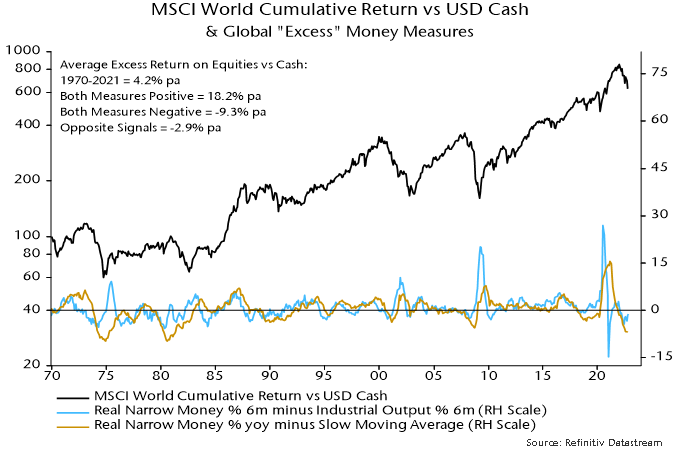
The view of market prospects here is informed by two measures of global “excess” money shown in chart 7 – the differential between six-month changes in real narrow money and industrial output and the deviation of the 12-month change in real money from a long-term average. Both measures remain negative currently, a condition historically associated with significant underperformance of global equities relative to US dollar cash. 

Chart 7

Chart 7 showing MSCI World Cumulative Return vs USD Cash & Global “Excess” Money Measures

The first measure, however, has recovered and – based on the above monetary / economic forecasts – may turn positive by year-end. A rise in this measure, even while still negative, has been associated with US Treasuries outperforming cash on average (a fall signalled underperformance).

The current large shortfall of 12-month real narrow money growth from its long-term average suggests that the second measure will remain negative until well into 2023. The possible combination of positive / negative readings for the first and second measures respectively has been associated with modest underperformance of equities on average, although this conceals significant variation. 

Sector / style performance under this combination has been significantly different from the “double negative” regime, with tech, quality and growth tending to outperform, along with non-energy defensive sectors. The best-performing individual sector was health care with financials the worst. Energy also underperformed. 

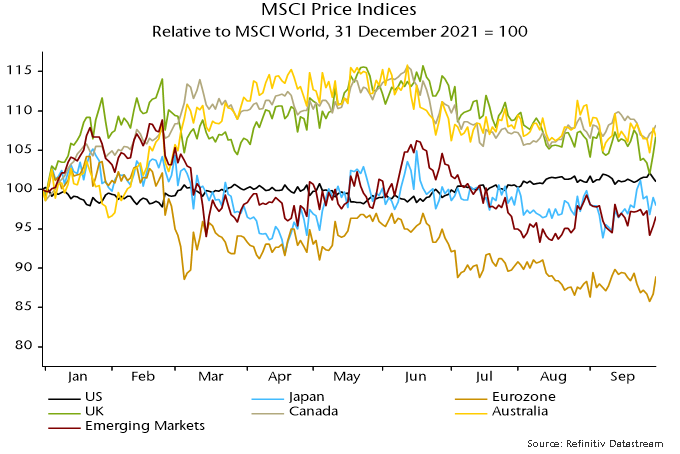
The Canadian, UK and Australian equity markets were the strongest year-to-date performers at end-Q3 – chart 8. In the case of the former two, however, sector weightings have been a key driver: both have higher-than-average exposure to financials and energy, with the UK also heavy in consumer staples – all outperforming sectors. 

Chart 8

Chart 8 showing MSCI Price Indices Relative to MSCI World, 31 December 2021 = 100

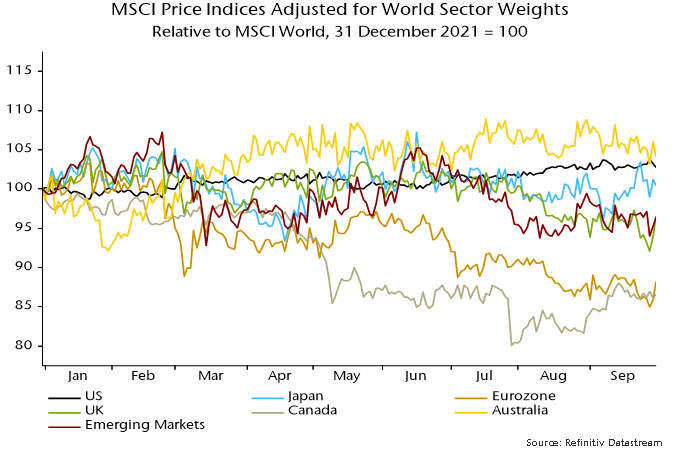
Chart 9 shows the results of recalculating performance using common (MSCI World) sector weights. Canada drops to bottom and the UK is also revealed as an underperformer. 

Chart 9

Chart 9 showing MSCI Price Indices Adjusted for World Sector Weights Relative to MSCI World, 31 December 2021 = 100

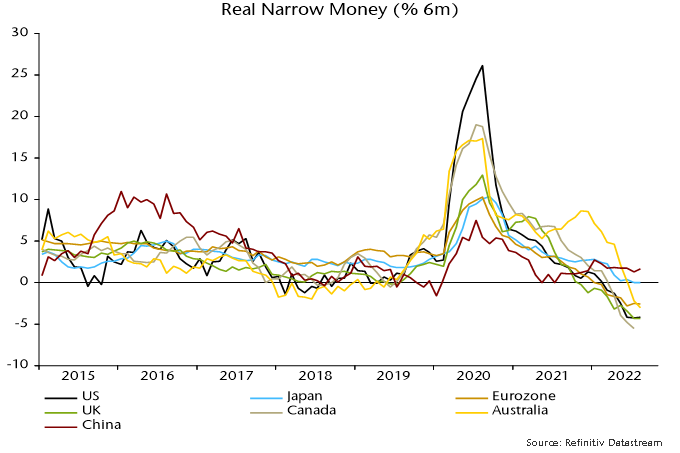
The top performance of Australia is consistent with strong real money growth earlier in the year – chart 10. This support, however, has now fallen away. 

Chart 10

Chart 10 showing Real Narrow Money (% 6m)

Real money trends are relatively favourable in China and, to a lesser extent, Japan. Chinese nominal money growth has picked up, partly reflecting money-financed fiscal expansion, while inflation momentum in both countries is weaker than elsewhere. With Chinese activity depressed by pandemic policy, “excess” money has been supporting government / corporate bonds and could flow into equities if and when economic conditions normalise. A large basic balance of payments surplus, meanwhile, has partially insulated the currency from unfavourable movements in interest rate differentials: the RMB index is currently around the middle of its YTD range and stronger than over 2016-late 2021.
Bank of England Chief Economist Huw Pill has suggested that fiscal policy easing in the mini-Budget and the reaction in markets warrant a “significant monetary policy response”. Why? 

UK monetary trends continue to weaken and are consistent with a medium-term return of inflation to target, if not below. 

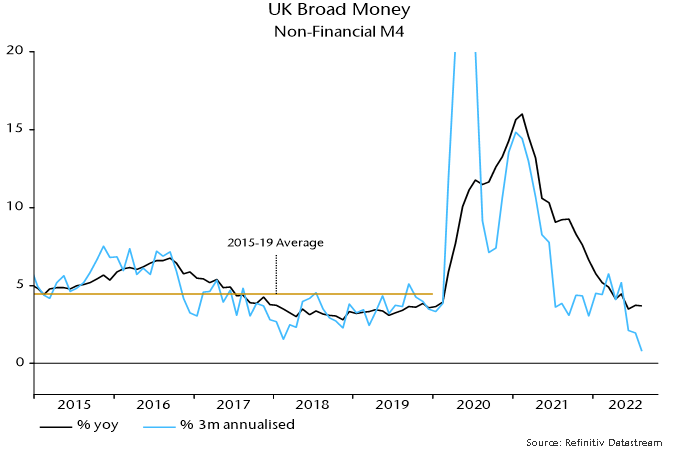
Annual growth of non-financial M4 – the preferred broad aggregate here, comprising holdings of households and private non-financial firms – was unchanged at 3.7% in August, below an average of 4.4% over 2015-19. The three-month rate of expansion fell further to just 0.8% annualised – see chart 1. 

Chart 1

Chart 1 showing UK Broad Money Non-Financial M4

Should the Bank tighten to offset the inflationary impact of exchange rate weakness? The “monetarist” view is that currency movements can delay or speed up the transmission of monetary changes to prices but have no longer-term inflation impact as long as money growth is stable. 

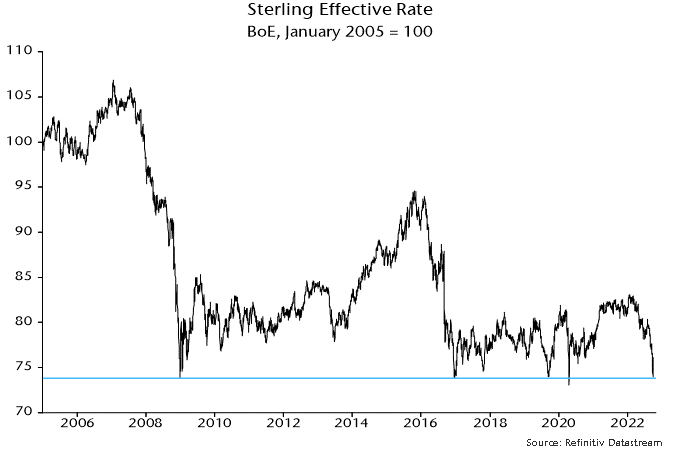
The sterling effective rate index was down by 10% on a year before at last week’s low point but the annual change reached -25% during the GFC and -19% after the Brexit referendum. The index hasn’t (yet) broken below its GFC low – chart 2. 

Chart 2

Chart 2 showing Sterling Effective Rate BoE, January 2005 = 100

The greater concern here is that increased government borrowing will be financed significantly through the banking system, resulting in another boost to money growth. This could occur via voluntary purchases of gilts by commercial banks in response to higher yields or because the Bank is forced to offer sustained support to a dysfunctional market. 

Such a scenario, however, is possible rather than likely. Any monetary boost from deficit financing could be offset or outweighed by a further weakening of private sector credit trends as banks pass on higher funding costs and widen spreads. 

The Bank would have made better recent decisions if it had paid attention to monetary trends: it wouldn’t have expanded QE in November 2020, would have raised rates earlier in 2021 and wouldn’t have embarked on QT. Current monetary weakness argues against policy tightening. The Bank may judge it necessary to hike rates to bolster its credibility, and that of the wider UK policy-making framework. Bank officials, however, should avoid inflating market expectations and be prepared to reverse increases if markets calm and – as seems likely – money trends remain soft.

Revised numbers confirm that US GDP fell by 0.6% (1.1% annualised) between Q4 2021 and Q2 2022*. Hours worked in the private sector economy, meanwhile, climbed 1.1% (2.2% annualised) over the same period. What explains this disconnect and how long can it continue? 

The ”explanation” here is that economy-wide productivity was pushed far above trend by the pandemic but has been normalising this year. The reversion to trend appears complete, suggesting that labour market data will reflect output weakness going forward.

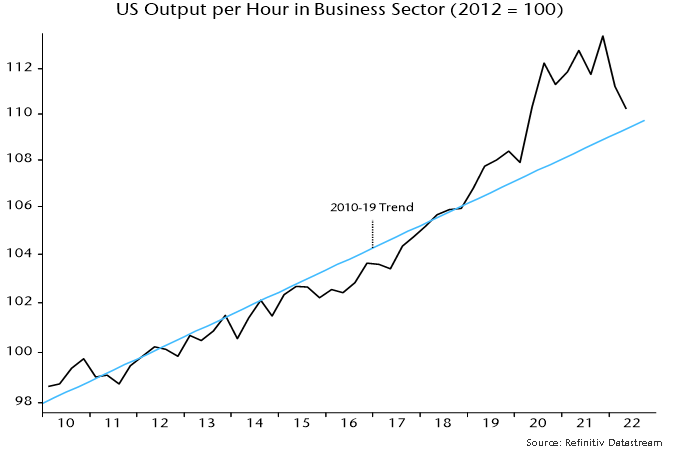
Output per hour in the business sector surged in the initial stages of the pandemic in Q2 / Q3 2000, opening up a gap of more than 4% with the prior trend – see chart 1.

Chart 1

Chart 1 showing US Output per Hour in Business Sector (2012 = 100)

Firms responded to economic contraction by laying off lower-productivity workers, boosting the average. Output returned to its pre-pandemic level in Q2 2021, requiring these jobs to be refilled. A fall in participation (due to age demographics) coupled with supply / demand mismatches slowed the rehiring process, resulting in output per hour remaining elevated until recently.

The deviation from trend had narrowed to below 1% as of Q2.

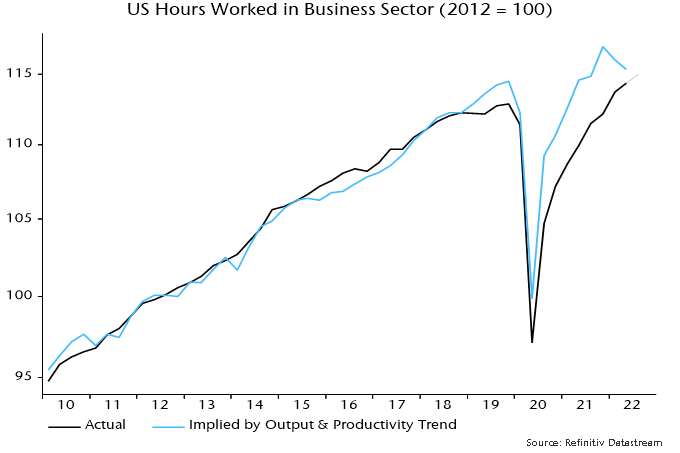
Another way of presenting the data is to compare actual hours worked in the business sector with the number implied by the current level of output, assuming that productivity had continued on its pre-pandemic path – chart 2.

Chart 2

Chart 2 showing US Hours Worked in Business Sector (2012 = 100)

A big deficit had opened up by Q2 2021 but strong employment growth and an output set-back have narrowed the gap. Monthly data through August suggest that hours worked rose solidly again in Q3 and may have converged with the output-warranted level.

With productivity back or close to trend, the GDP / employment divergence is likely ending.

The productivity trend implies that hours worked will fall if GDP rises by less than 0.2% (0.8% annualised) per quarter. Real narrow money has been contracting since January 2022, suggesting further GDP declines in Q4 / H1 2023. Labour market data may be poised for imminent deterioration.

*Gross domestic income – GDP measured from the income side – rose by 0.2% (0.4% annualised) over the same period.