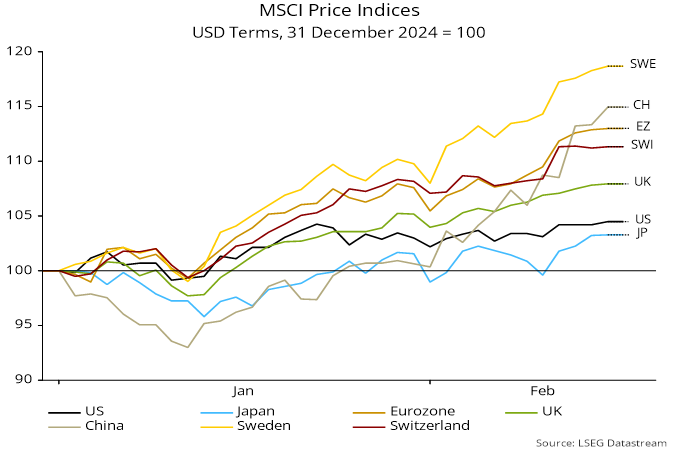
MSCI indices for continental Europe and China have outperformed year-to-date – see chart 1.

Chart 1

Chart 1 showing MSCI Price Indices USD Terms, 31 December 2024 = 100

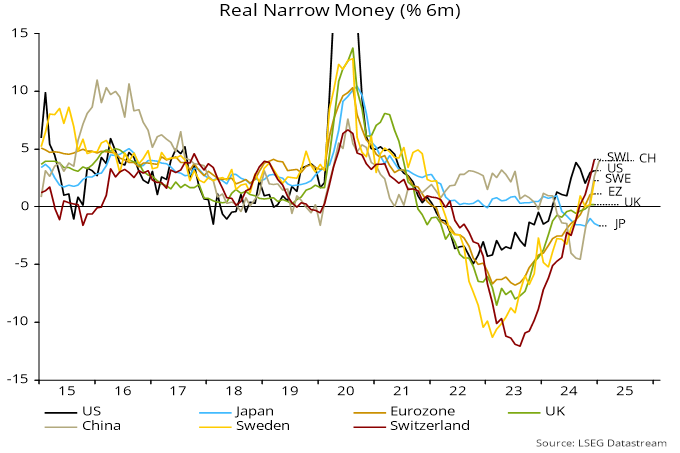
The pattern of returns echoes monetary trends: six-month real narrow money growth has picked up in China and continental Europe while moving sideways in the US, with Japan and the UK lagging – chart 2.

Chart 2

Chart 2 showing Real Narrow Money (% 6m)

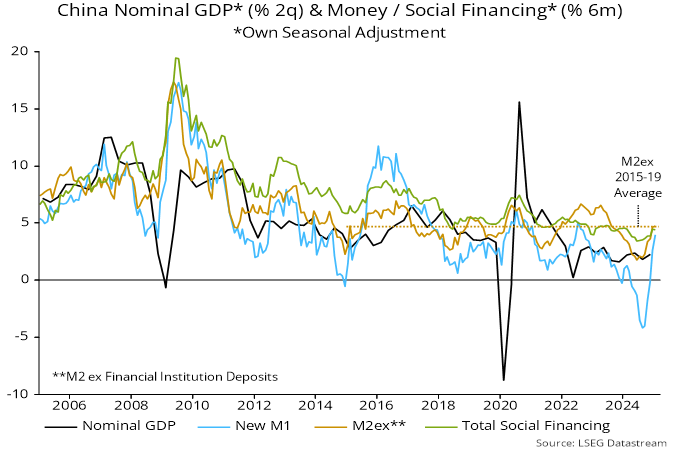
A previous post noted that Chinese money / credit numbers strengthened significantly in December. The pick-up was sustained in January: six-month growth rates of the narrow / broad monetary aggregates followed here rose further and are back around the middle of recent historical ranges – chart 3.

Chart 3

Chart 3 showing China Nominal GDP* (% 2q) & Money / Social Financing* (% 6m) *Own Seasonal Adjustment

The official M1 definition has been revised to include personal demand deposits, aligning it with international practice. The new measure is close to the “true M1” aggregate used here historically.

Annual growth of official M2 eased from 7.3% in December to 7.0% in January. The slowdown, however, reflected a fall in bank deposits held by non-bank financial institutions – movements in such deposits are less informative about economic prospects. Annual and six-month growth of non-financial M2 rose further in January.

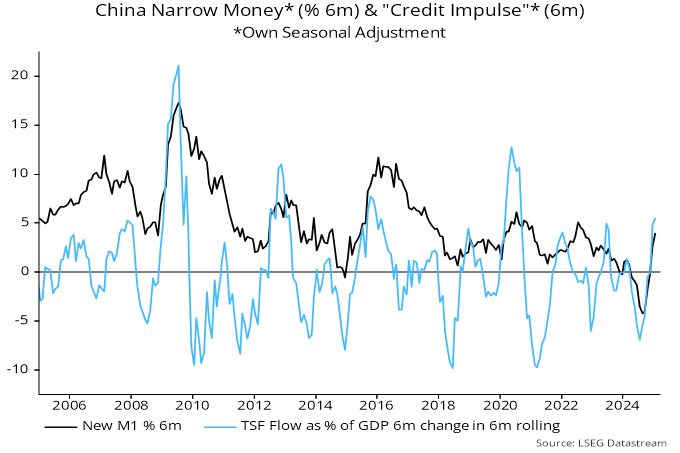
The sharp turnaround in six-month narrow money momentum has been mirrored by a “credit impulse” measure based on the six-month flow of total social financing – chart 4.

Chart 4

Chart 4 showing China Narrow Money* (% 6m) & "Credit Impulse"* (6m) *Own Seasonal Adjustment

The turnaround in money / credit momentum partly reflects the negative impact of regulatory changes last spring dropping out of six-month calculations. Seasonal adjustment is more uncertain in January / February because of New Year timing effects. Money / credit growth is not yet strong by historical standards.

Still, money trends warrant increased confidence that domestic demand growth will recover sufficiently to offset any loss of support from net exports due to trade conflict.

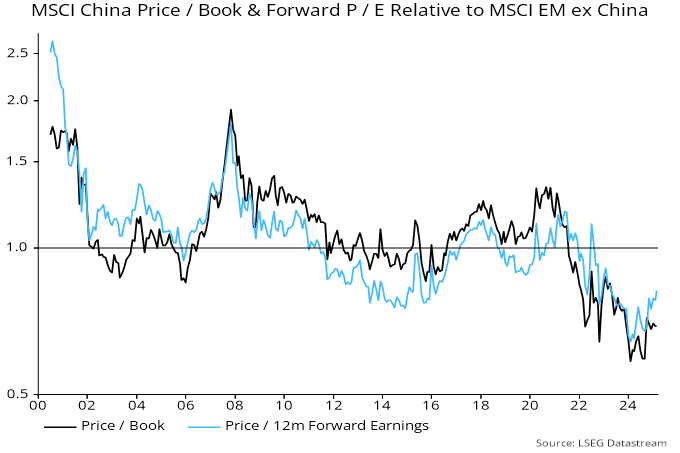
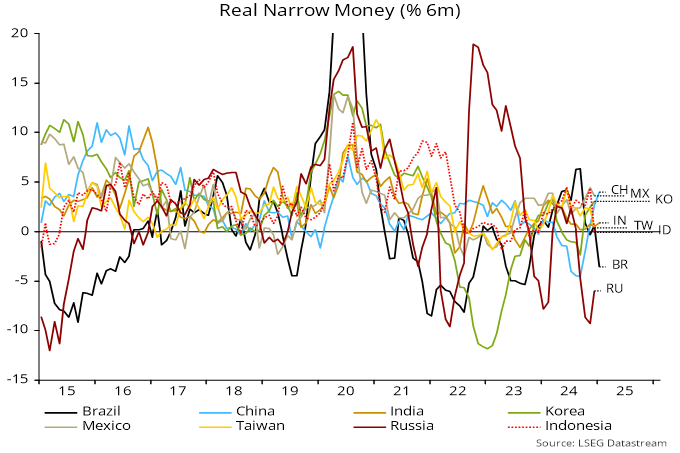
MSCI China remains on a steep valuation discount to the rest of EM despite recent outperformance – chart 5. Chinese six-month real narrow money momentum is now stronger than in most other EMs – chart 6.

Chart 5

Chart 5 showing MSCI China Price / Book & Forward P / E Relative to MSCI EM ex China

Chart 6

Chart 6 showing Real Narrow Money (% 6m)

Aerial view of Hoai river with boat traffic at night in Vietnam.

Much ink has been spilt recently on the falling fortunes of the Chinese economy. While the OG dragon of Asia struggles with the malaise of a weak economy and declining population, a smaller dragon in the neighbourhood has been making quiet economic strides earning the moniker “Ascending Dragon” owing to its geographical shape.

Vietnam is formally classified as a frontier market, but it looks and feels like an emerging market economy that has arrived. In 2024, we saw a parade of high-profile executives from Tim Cook to Jensen Huang announce billions of dollars’ worth of investments. Sure, it has challenges, with the coming threat of tariffs and the recent turmoil in the property and corporate bond market. But with a new leadership and the upcoming prospect of being upgraded to an emerging market, Vietnam could very well consolidate its position as ASEAN’s newest growth engine.

The story of Vietnam’s rise parallels to some extent the timeline of China’s rise. After the ravages of the Vietnam War with its GDP per capita stagnating at $300, the government decided to introduce the “Doi Moi” reforms in 1986 to reorient the economy from the existing soviet central planning model to a “socialist market oriented” economy. It’s easy to forget that until as recently as 1994, Vietnam was under a US-led trade embargo.

With the embargo lifted, tailwinds from globalization in the 1990s and early 2000s boosted the economy as it joined the ASEAN free trade zone in 1995 and the World Trade Organization in 2007. Investments in primary education and infrastructure to equip a young and restless population (now approaching 100 million) has paid off handsomely. The result has been an average GDP growth rate of 6.8%, far ahead of its ASEAN peers as seen below.

ASEAN-6: GDP growth
Line graph illustrating Vietnam's recorded and projected growth compared to other ASEAN countries.
Source: Oxford Economics

What makes Vietnam interesting in our opinion is its positioning as a neutral player in the current geopolitical climate. As key trading partners like the United States have looked to diversify their supply chain from China, Vietnam has received foreign direct investment (FDI) from both the United States and China while also receiving FDI from big players like Korea and Japan. Geographical proximity, its strategic maritime location and similar culture make it an easy choice for global companies to relocate their factories. The World Bank expects Vietnam to grow at 6.7% in 2025, making it the second fastest growing economy behind India.

It also expects to draw $25 billion in additional capital into the stock market by 2030 if it gets classified by the FTSE as an emerging market later this year. Vietnam took an important step in this direction last year when it eliminated “prefunding,” the practice of ensuring investors have sufficient funds before purchasing a security. In a market that is 90% retail driven, we expect institutional participation to lift trading multiples, leading to better liquidity and market efficiency. Finally, crossing the much higher hurdle of the MSCI’s criteria for emerging market classification (expected between 2026-28) means Vietnam would get the full attention it deserves as the ascendant dragon of Asia.

One of the holdings in our portfolio that is a beneficiary of the rise of the Vietnamese consumer is Phu Nhuan Jewelry JSC (PNJ VN). With over 400 stores, PNJ is the market leader in branded jewelry space in Vietnam. It caters to the mid- and high-end consumer, offering everything from gold bars to value-added jewelry and high-end watches. It has a longstanding relationship with traditional artisans, allowing it to manufacture up to 4 million pieces of jewelry every year making it fully vertically integrated.

The beauty of investing in emerging markets is seeing parallels in themes, customs and market dynamics across disparate markets. Similar to India, the Vietnamese consumer has a deep love for gold for reasons both material and spiritual. Besides bringing health and good luck, a history of war, foreign occupation and hyperinflation means gold remains top of mind as a store of value vs. the more recently introduced Vietnamese Dong. We also see similarities to India with regard to formalization of the economy with over 70% of the jewelry sector in Vietnam operating in the unorganized space, providing a long runway of growth for PNJ.

The Bank of England expects rises in regulated prices and taxes to push headline CPI inflation up to 3.5% by June but the forecast likely underestimates disinflationary pressure from monetary weakness.

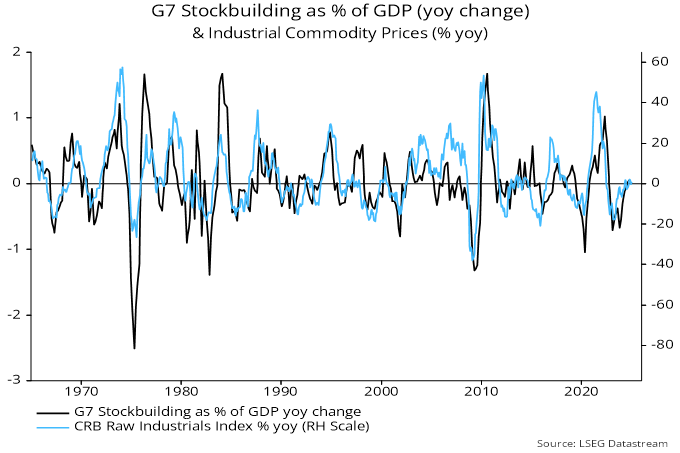
The near-term inflation outlook globally is subject to cross-currents. Earlier monetary weakness is bearing down on underlying pressures but the position of the stockbuilding cycle suggests a rise in commodity prices: the cycle appears to be mid-upswing and industrial commodity prices typically climb into the peak – see chart 1.

Chart 1

Chart 1 showing G7 Stockbuilding as % of GDP (yoy change) & Industrial Commodity Prices (% yoy)

Higher tariffs, meanwhile, will have a one-off direct impact on measured prices and indirect effects via increased costs and supply disruption.

The UK near-term inflation profile is being additionally boosted by the imposition of VAT on school fees and large rises in some regulated prices. The Bank of England estimates that changes in the energy price cap will lift annual CPI inflation by 0.6 pp between December 2024 and June 2025, with the VAT effect and rises in regulated prices – including an average 26% increase in water bills – adding a further 0.45 pp.

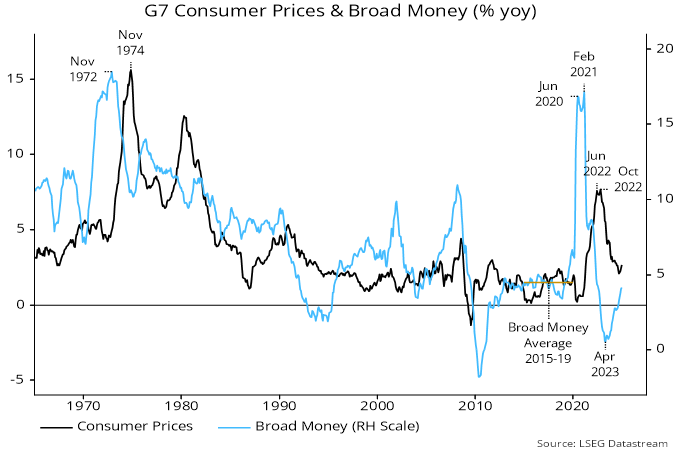
Central banks, including the MPC, worry that a near-term inflation bump due one-off influences will dislodge expectations and become embedded. Monetarists argue that ample money growth is required for such “second-round” effects to emerge. G7 annual broad money growth continues to recover but is currently still below its pre-pandemic (i.e. 2015-19) average, which was associated with below-target headline and core inflation averages – chart 2. The same is true in the UK.

Chart 2

Chart 2 showing G7 Consumer Prices & Broad Money (% yoy)

Coming UK inflation numbers will require careful interpretation. The conventional core rate – excluding energy, food, alcohol and tobacco – will overstate underlying pressures because of the above policy effects. A “true” core measure should, at a minimum, exclude the impact of the VAT change and rises in bus fares and water bills.

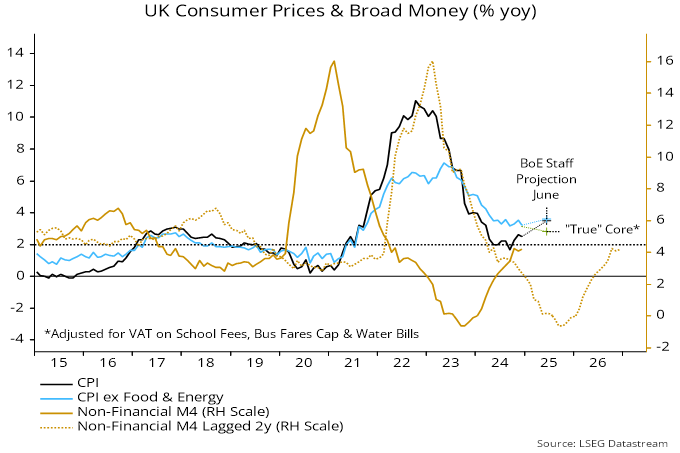
The Bank of England staff forecast implies a rise in the conventional core rate from 3.2% in December 2024 to 3.6% by June 2025. Calculations here suggest that this would be consistent with the above “true” core measure slowing from 3.2% to 2.8% over the same period – chart 3.

Chart 3

Chart 3 showing UK Consumer Prices & Broad Money (% yoy)

The monetarist rule of thumb of a roughly two-year lag between monetary and price developments suggests strong downward pressure on underlying inflation in 2025. “True” core inflation may fall by significantly more than the Bank expects.

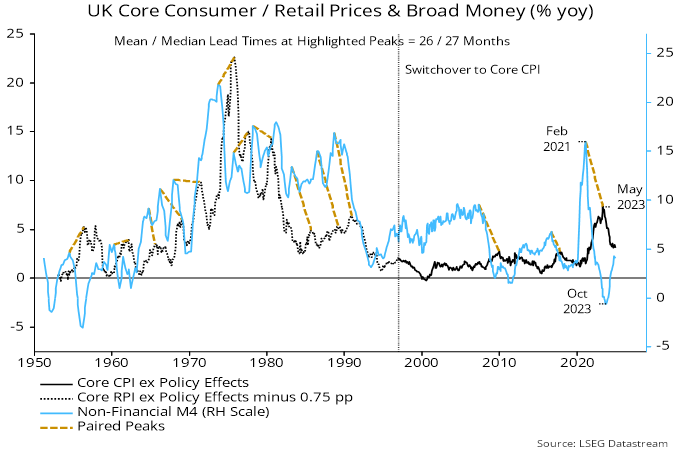
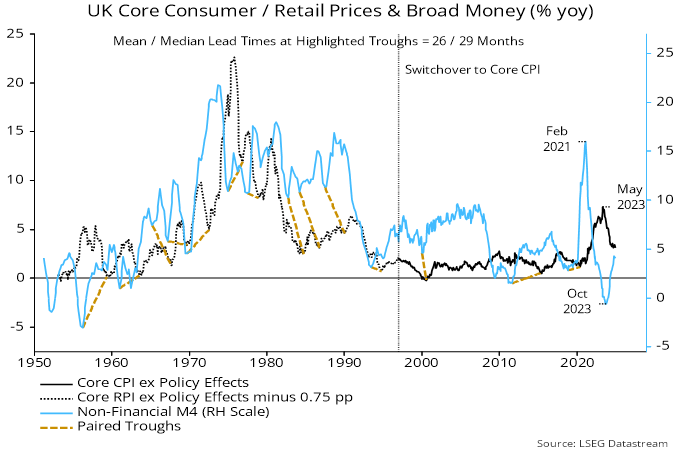
Charts 4 and 5 show a long-term history of annual broad money growth and an adjusted core inflation measure (based on RPI rather than CPI in earlier years), with related peaks and troughs highlighted. The mean and median lags at all the identified turning points were 26 and 28 months, i.e. slightly longer than posited by the rule of thumb. With broad money growth bottoming in October 2023, the suggestion is that a downtrend in underlying inflation will extend into late 2025 / early 2026.

Chart 4

Chart 4 showing UK Core Consumer / Retail Prices & Broad Money (% yoy) Mean / Median Lead Times at Highlighted Peaks = 26 / 27 Months

Chart 5

Chart 5 showing UK Core Consumer / Retail Prices & Broad Money (% yoy) Mean / Median Lead Times at Highlighted Troughs = 26 / 29 Months

The historical variability of the money growth / inflation lag in the UK mainly reflects the influence of the exchange rate. The favourable assessment of underlying inflation prospects above is conditional on avoidance of significant sterling depreciation.

Person using phone in a bright room full of colourful lights.

This month we dig into the frenzy over China’s DeepSeek and ask whether this has punctured the narrative of US tech supremacy.

Has DeepSeek just punctured the market narrative of American tech supremacy? We think that is a stretch, but the revelation of DeepSeek’s ability to innovate in AI with shocking efficiency is a reminder that there are only two contenders in this battle to build artificial general intelligence – China and the United States.

DeepSeek has unveiled two new models – DeepSeek-V3 and DeepSeek-R1, as well as instructions called R1 Zero – that deliver performance on offerings from OpenAI and Anthropic. These models have set off a media and market frenzy, both because they appear to match or exceed the capabilities of more famous systems, and because DeepSeek is offering API access at a fraction of the cost.

Highlights:

  1. DeepSeek uses a method called reinforcement learning. Essentially, the models are allowed to solve the problems themselves with few guidelines and limited example solutions. Remarkably, this was accomplished using only 8,000 math problems, whereas other research groups often need millions.
  2. DeepSeek has managed to compress memory usage, circumventing the need for loads of expensive GPUs.
  3. DeepSeek has shown that AI models can work remotely and on edge computing very effectively without needing the power of data centres.

Overall, DeepSeek demonstrated that you don’t have to invest massive amounts (exactly how much is debatable) of money, hardware or human oversight to build an AI that excels at difficult tasks. The arguments about how much money they spent to get here are irrelevant: by relying on focused reinforcement learning and efficiency-boosting techniques, DeepSeek proved that powerful models can be created with fewer resources.

All training steps and code have been shared so others can also try it and change things, making concerns over “censorship” entirely moot. The result was a model that can rival Anthropic and OpenAI, even when turned into a much smaller version that can be run locally on a pair of Mac Minis! (Which use ARM architecture: the M4 Pro uses TSMC 3nm, and runs at 80W.)

The team behind DeepSeek is open about its own limitations. First, the model is akin to a brilliant scientist but would struggle to write a poem as it lacks “creativity.” Second, it doesn’t deal with languages beyond English and Chinese very well. And third, it lacks the experience in building large-scale software projects.

Implications

Anyone who has followed this story is probably now aware of Jevons Paradox. Originating from the work of economist William Stanley Jevons in 1865, the observation suggests that as technological advancements make a resource more efficient to use, the overall consumption of that resource may increase rather than decrease. This paradox occurs because increased efficiency often lowers the cost of using the resource, leading to greater demand and, ultimately, higher total consumption.

Applying Jevons Paradox to AI tools, as these technologies become more efficient and cheaper, their usage is likely to grow significantly. Just as more-efficient cars led to wider adoption over horses, more-efficient and cost-effective AI models like DeepSeek’s will encourage broader usage across various industries. This greater adoption can drive further innovation, but it also means that the demand for AI resources, such as data and computing power, will continue to rise.

As a result, businesses and developers will need to consider the implications of widespread AI deployment, including potential increases in energy consumption and the need for sustainable practices in AI development and usage.

To summarise:

  1. Large language models (LLM) have become commoditized. For instance, Meta’s Llama (an LLM) is open-source and therefore free. The key takeaway here is that the cost and compute requirements to run these models could potentially be reduced significantly.
  2. The implication is that demand for AI infrastructure including computer chips, the semiconductor supply chain and power requirements (particularly for AI training) may be lower than first thought.
  3. However, as highlighted by Jevons Paradox, history shows that for most technological advancements, reduced costs are almost always offset by increased demand.

What does this mean for the stocks of different global tech leaders?

It’s still early days, but how could the broad adoption of DeepSeek models impact global tech leaders’ stock prices?

Type of tech company Stock impact
AI infrastructure and some semiconductor companies
Jevon’s paradox will likely spur more AI applications, with the end result potentially being greater demand for compute down the line. However, the market is questioning the margins of semiconductor players and infrastructure solution providers (i.e. cooling tech). We need to see the mix of LLMs vs. “distilled models” and, more importantly, inferencing vs. training. Training requires much less compute power than inferencing.
Unclear
Hyperscalers
On one hand, processing AI could become significantly cheaper which will reduce their cost/capex. On the other, their moat could be lowered if AI workloads can be run on less powerful data centres. Microsoft has already stated that it is prioritizing enterprise inference workload over AI training for its Azure business. That is why OpenAI went to Oracle/Softbank/Project Stargate for compute because Microsoft won’t sell them all the compute OpenAI demanded.
Neutral/unclear
Application-specific integrated circuit (ASIC) companies
Possibly beneficial for custom ASICs as chip architecture diversifies/specialises.
Neutral/unclear
Applications, such as software, with access to proprietary data
This is where I believe the most significant AI equity value will be created over time. Lowering AI costs is unlikely to negatively impact these companies. In fact, it could even be a positive development. The moat is in the access to data. Compute is a cost item.
Positive/unclear
Specialised edge computer chip companies Positive/unclear

In emerging markets, we believe major positions like Taiwan Semiconductor Manufacturing Company (TSMC), Mediatek and select niche names (in custom chip design and energy efficiency) remain well positioned for growth in overall demand for AI. We doubt that DeepSeek will change the demand for the highest performance chips running at the lowest possible power. In that regard, TSMC’s dominance in leading-edge production processes and advanced packaging solutions remain an intact competitive moat. We expect that their customer mix may change, but the demand for their capabilities will be resilient.

We are more cautious on data centre assemblers and memory, and see potential for an improving sentiment in software, with several high-quality names in the portfolio and on our watchlist in China, ASEAN and Latin America.

Image of wind turbines and a man holding an open laptop standing in front of a sunset/sunrise

2024 marked a year of record growth for CC&L Infrastructure across our portfolio, team and client base.

2024 Highlights

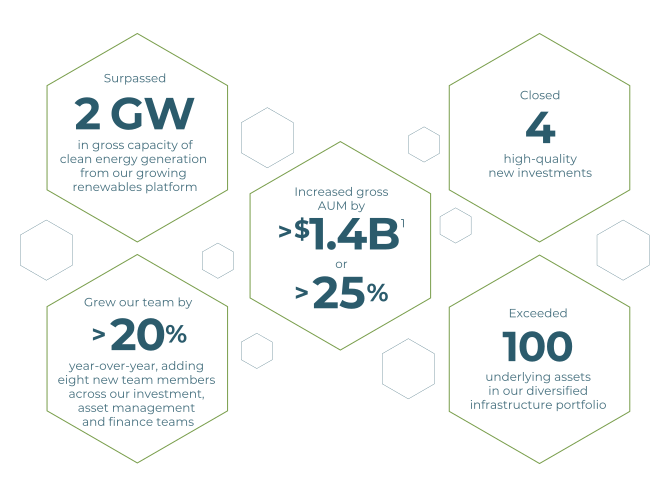
Graphical image of company stats for 2024. 1. Increased gross AUM by approximately one billion dollars or approximately twenty-four percent; 2. Closed four high-quality new investments; 3. Surpassed two GigaWatts in gross capacity of clean energy generation from our growing renewables platform; 4. Grew our team by over twenty percent year-over-year, adding eight new team members across our investment, asset management and finance teams; 5. Exceeded one hundred underlying assets in our diversified infrastructure portfolio.

An accelerated pace of deployment in new and existing sectors, further diversifying our infrastructure portfolio

CC&L Infrastructure deployed a record ~$600 million in 2024, all relating to opportunities sourced on a bilateral basis outside of broad auction processes. The new investments span the renewable energy, transportation and social infrastructure segments, and include our first investment in the student housing sector. The additions expanded the size of our infrastructure portfolio to over 100 assets, diversified across sectors and primarily located in North America.

Image of wind turbines at Sharp Hills wind farm

Sharp Hills Wind Farm

Located in southeastern Alberta, one of the largest onshore wind farms in Canada with approximately 300 MW of capacity, representing clean energy generation equivalent to the amount of power used by more than 160,000 Alberta homes.

Image of yellow school buses

Twin City Transportation

A premier provider of special education transportation services in Minnesota, this investment is an accretive addition to the broader Landmark Student Transportation platform, adding over 250 routes serviced by approximately 175 vehicles.

Image of wind turbine in a snowy landscape

Ontario Wind Assets

Two southern Ontario-based wind projects, Armow Wind and Grand Renewable Wind, together totaling approximately 330 MW in gross capacity and generating energy equivalent to the annual consumption of nearly 290,000 Ontarians.

Image of student housing buildings at University of Texas

Northside Student Housing

Four student housing facilities situated at the University of Texas at Dallas. Facilities were built between 2016 and 2021 and comprise ~1,200 units with the capacity to house >2,500 students. Northside’s long-term land leases with the university have an average of over 50 years remaining.

Disciplined investment strategy

CC&L Infrastructure seeks to invest in high-quality, North American middle-market infrastructure assets that deliver essential services and create value for stakeholders, including our clients, partners and the local communities in which our projects are located.

Image of solar panels in a solar farm

.

Our differentiated approach:

  • Open-ended structure provides investors with immediate access to a large, diverse portfolio of infrastructure assets
  • Established portfolio with a strong, nearly 15-year-long track record2
  • Highly contracted asset base with long durations and investment-grade offtakers3
  • Dedicated in-house asset management team with robust construction and operating experience provides strategic oversight to enhance performance

About CC&L Infrastructure

CC&L Infrastructure invests in middle-market infrastructure assets with attractive risk-return characteristics, long lives and the potential to generate stable cash flows. To date, CC&L Infrastructure has accumulated over $7 billion4 in assets under management diversified across a variety of geographies, sectors and asset types, with more than 100 underlying facilities across over 35 individual investments. CC&L Infrastructure is a part of Connor, Clark & Lunn Financial Group Ltd., a multi-boutique asset management firm whose affiliates collectively manage over $139 billion in assets.

For more information on Connor, Clark & Lunn Infrastructure’s strategy, portfolio and investment criteria, contact:

INVESTMENT ORIGINATION AND EXECUTION
Photo of Matt O'Brien

Matt O’Brien

President

T: +1 (416) 360-7382

E: [email protected]

Photo of Ryan Lapointe

Ryan Lapointe

Transportation

T: +1 (416) 216-3545

E: [email protected]

Photo of David Chatburn

David Chatburn

Energy

T: +1 (416) 862-6169

E: [email protected]

Photo of Eric Reidel

Eric Reidel

Energy

T: +1 (416) 862-6125

E: [email protected]

Photo of Andrew Parkes

Andrew Parkes

Digital

T: +1 (416) 956-9384

E: [email protected]


INVESTOR RELATIONS
Photo of Kaitlin Blainey

Kaitlin Blainey

Managing Director

T: +1 (416) 216-8047

E: [email protected]

Photo of Sonia Weiss

Sonja Weiss

Vice President

T: +1 (437)-561-6184

E: [email protected]


1. Represents growth in the mark-to-market value of capital invested by CC&L Infrastructure and its clients, including principal investments and co-investments, plus CC&L Infrastructure’s share of associated debt at December 31, 2024.

2. Performance history for the CC&L Infrastructure Strategy is that of the CC&L Infrastructure Composite, which comprises performance of the Private Client Infrastructure Pooled Fund series, CC&L Institutional Infrastructure Pooled Fund series and CC&L Taxable Institutional Infrastructure Pooled Fund series. The Composite has a creation date of March 2014 and inception date of September 2011.

3. Primarily 20-to-40-year contracts with government or other creditworthy counterparties. Many contracts also include beneficial features including take-or-pay arrangements and inflation linkages.

4. Represents the mark-to-market value of capital invested by CC&L Infrastructure and its clients, including principal investments and co-investments, plus CC&L Infrastructure’s share of associated debt at December 31, 2024.

Unless otherwise stated, all data is at December 31, 2024 and stated in Canadian dollars (CAD). Source: Connor, Clark & Lunn Financial Group Ltd. This material, including any attachments, is provided to you for your informational purposes only and is considered private and confidential. This material is intended for the use of the recipient only and no matter contained herein may be used, disseminated, distributed, reproduced or copied by any means, in whole or in part without express prior written consent of CC&L Infrastructure. Certain information contained herein is based on information obtained from third-party sources that CC&L Infrastructure considers to be reliable. While we consider such information to be reliable, CC&L Infrastructure makes no representation as to, and accepts no responsibility for, the accuracy, fairness or completeness of such information produced by third parties and contained herein. Past performance is not a guide to future performance, future returns are not guaranteed, and a loss of capital may occur. All opinions, estimates and projections contained in this material constitute CC&L Infrastructure’s judgment as of the date of this material, are subject to change without notice. This material has been prepared without regard to the particular individual financial circumstances and objectives of persons who receive it and nothing in this material constitutes legal, accounting, tax or individually tailored investment advice. As such, as you consider this material, you should consult with independent professionals in those areas regarding your individual circumstances. This information is not an offer to sell or a solicitation of an offer to buy any securities and is not to be used as a sales communication.

Adhesive note paper with "don't forget!" written on it clipped onto a rope using a clothespin.

There has been a shift from Canadian equities to global equities, coinciding with an emergence of dedicated global small cap allocations to further enhance portfolio diversification. Taken together these changes have resulted in Canadian small cap equities becoming a forgotten asset class. Despite the reduction to Canadian equity allocations, many investors have a significant dollar allocation to the asset class. This article discusses the merits of Canadian small cap equities and how investors can benefit from its potential contribution.

Background on Canadian Small Cap

As a general rule, small cap companies offer investors more room for growth, but also confer greater risk and volatility than large cap companies. The S&P/TSX Small Cap Index is a float adjusted and market capitalization (cap) weighted index, which was developed as a leading benchmark for those with small cap exposure in the Canadian equity market.

At the end of September 2024, there were 246 constituents in the index with a total market cap of CAD 279 billion. The mean market cap of the constituents was CAD 1.1 billion, but there was quite a range in the size of companies with the smallest being valued at CAD 97 million and the largest at CAD 4 billion. This compares to Royal Bank of Canada, the largest company in the S&P/TSX Composite Index, whose market cap was over CAD 170 billion.

The S&P/TSX Composite Index is concentrated in a small number of companies. The largest 10 companies comprised over 35% of the index at the end of September 2024 with Royal Bank of Canada alone representing 6.9% of the index. In contrast, the small cap index is more diversified with the top 10 companies comprising less than 15% of the index. The largest stock was Bausch Health Companies Inc., which represented 1.4% of the small cap index.

Small versus Large Cap Performance

Whether smaller or larger companies perform better varies over time based on the broader economic climate. Looking back over the last 40 years, a relative constant has been that small caps tend to decline more than large caps in bear markets but bounce back more strongly when sentiment changes. Two recent illustrations of this experience are the global financial crisis and the COVID-19 pandemic (Figure 1). In both periods small caps underperformed when the markets declined, but significantly outperformed large caps in the recovery stage.

Figure 1: Relative Performance of MSCI World Small Cap vs MSCI World*
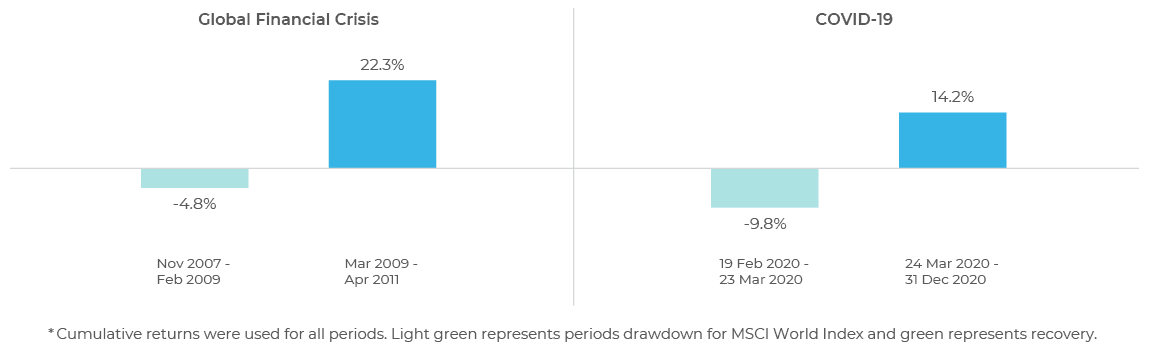
Chart comparing the relative performance of MSCI World Small Cap vs MSCI World during the Global financial crisis and COVID-19.
Source: MSCI, FTSE Russell & Thomson Reuters.

The extent of the small cap recovery in 2020, particularly Canadian small caps, is evident in Figure 2. It shows the Canadian small cap index was up over 80% in the last nine months of 2020, resulting in a full calendar return more than double that of the S&P/TSX Composite Index. There was a similar experience for global developed small cap versus large cap companies.

Figure 2: Index Returns During 2020 (in CAD)

Asset Class Market Index Q1 Return (%) 9 Months Ended December 31, 2020 (%) Calendar Year 2020 (%)
Canadian Equities S&P/TSX Composite -20.9 33.5 5.6
Canadian Small Cap Equities S&P/TSX Small Cap -38.1 82.4 12.9
Global Equities MSCI World -13.2 31.9 14.4
Global Small Cap Equities MSCI World Small Cap -23.1 48.1 13.9

Source: MSCI, FTSE Russell & Thomson Reuters.

Potential Benefits

While small cap stocks are generally more volatile, there are several benefits.

Growth opportunities: Smaller companies tend to have greater flexibility to respond to opportunity or adversity and their potential growth can continue much longer when they have a desired product or service. Large companies start small. If you can find the next generation of small companies that grow faster and graduate into a larger cap segment, the reward is significant. It is easy to forget that the market capitalization of Shopify, which is valued at over CAD 220 billion, was less than CAD 1.5 billion in June 2015 (Macrotrends.net). Smaller companies also tend to have a more focused line of business and higher insider ownership, resulting in greater alignment of interests between the owners and shareholders.

Sector Differences: The S&P/TSX Small Cap Index is not a microcosm of the larger S&P/TSX Composite Index. Therefore, investors can benefit from the different sector representation offered by the small cap index, which introduces opportunities that may not be present in the large cap segment of the market (Figure 3). For example, over the first nine months of 2024, the S&P/TSX Composite Index communications services sector declined 2.5%, while the S&P/TSX Small Cap Index communications services sector return was up 18% for the same period.

Smaller companies tend to have greater flexibility to respond to opportunity or adversity and their potential growth can continue much longer when they have a desired product or service.

Figure 3: Canadian Equity Sector Allocations

Sector S&P/TSX Composite Index (%) S&P/TSX Small Cap Index (%)
Energy 16.7 19.1
Materials 12.5 30.7
Industrials 13.0 12.0
Consumer Discretionary 3.4 3.4
Consumer Staples 4.1 2.9
Health Care 0.3 6.2
Financials 32.2 6.5
Information Technology 8.5 5.2
Communication Services 3.1 1.5
Utilities 4.0 1.5
Real Estate 2.3 10.8
Total 100.0 100.0

Source: MSCI, FTSE Russell & Thomson Reuters.

Less researched: Small cap companies are generally less researched by the external analyst community. The number of research analysts covering both large cap and small cap stocks has declined over the last 10 years, with the number covering smaller cap companies significantly less (Figure 4).

Figure 4: Analyst Coverage of TSX Companies
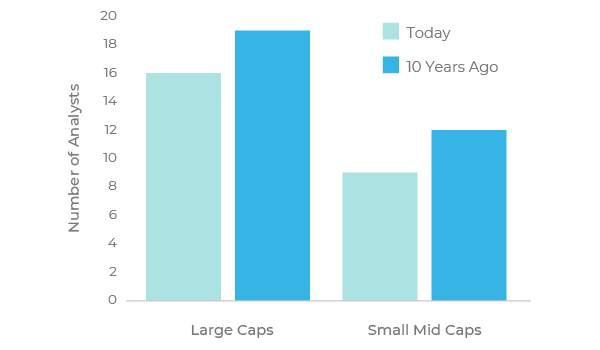
Bar chart illustrating the number of analysts covering large cap TSX companies vs. small mid cap TSX companies.
Source: Bloomberg

Often the research analysts covering small cap companies are less senior and experienced compared to their large cap analyst counterparts. These differences create greater opportunities for active managers to outperform the index benchmark by undertaking independent due diligence on these less researched companies, whose share price may not fully reflect their intrinsic value or growth prospects.

Collectively, active small cap equity managers have delivered significant added value above the small cap index. More than three quarters of the active managers delivered at least 1.9% per annum above the index for the 10-year period ended September 30, 2024. The median added value over the 10 years was 3.5% per annum (Figure 5).

Figure 5: Active Management Excess Returns
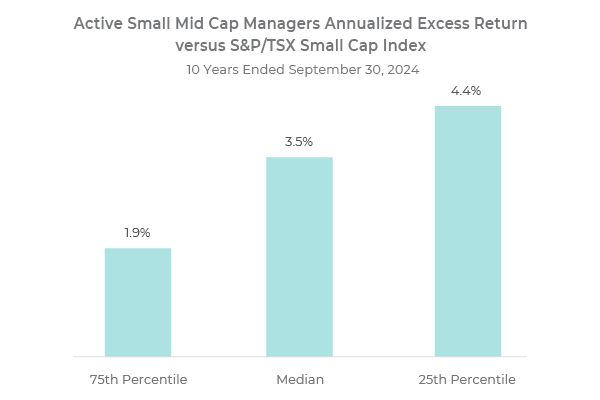
Bar chart illustrating the active small mid cap managers annualized excess return versus S&P/TSX small cap index.
Source: eVestment

Collectively, active small cap equity managers have delivered significant added value above the small cap index.

Case for Canadian Small Caps

Despite a general reduction in Canadian equity allocations, there are many institutional investors with a significant dollar allocation. By including Canadian small caps, investors can tap into a different type of market exposure, as well as the added value potential from active management.
Silhouette of a passenger waiting in an airport.

When the COVID-19 lockdowns happened, it was no surprise that travel-related stocks were among the hardest hit. However, as the world emerged from the pandemic, these stocks saw an impressive recovery as people were eager to start traveling again. With tourists armed with excess savings accumulated during the pandemic, tourism and business travel rebounded, filling planes, hotels and rental cars around the globe.

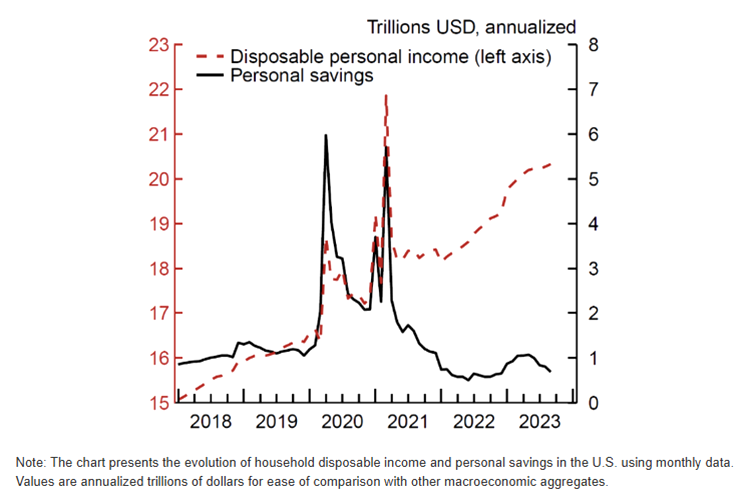
Now, fast forward to 2025, the post-pandemic recovery is behind us and the picture looks very different. Consumer spending data indicates a slowdown as higher interest rates and the potential return of inflation are putting a pinch on consumers. Even though personal savings are now back down below pre-pandemic levels, it’s important to focus on absolute wage growth, which remains strong in many regions. In other words, people are earning more, but also need to spend more just to maintain their lifestyles.

US disposable personal income and personal savings
Line chart comparing household disposable income and personal savings in the US.Source: The Fed – An update on Excess Savings in Selected Advanced Economies

With the weak outlook for consumer spending, the question arises: should we really be viewing all categories of discretionary spending the same way? In a market that’s constantly swayed by daily news and short-lived noise, it’s crucial to look past the temporary trends or “hype.” Instead, we should focus on identifying secular trends – those underlying shifts – that will remain resilient, no matter where we are in the economic cycle. From our perspective, travel and leisure is certainly an industry that will benefit from one of these secular shifts in the years to come.

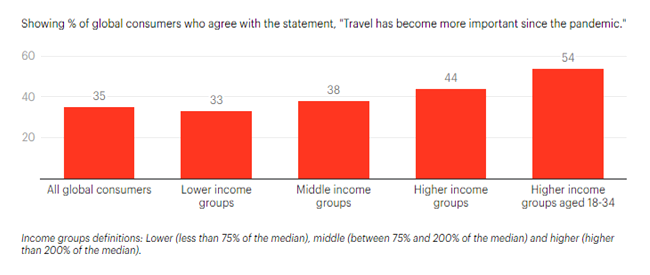
  • One trend we’ve been seeing is a shift from spending on goods to a growing preference for experiences. With wage growth remaining strong across developed markets, there comes a point where consumers naturally pivot – there’s only so much you can buy, but experiences, like travel, have no limits. That’s exactly what we’re seeing play out: higher-income groups in developed markets are showing a strong appetite for travel, and consumer surveys are backing this up with increasing indications of a preference for experiences over material goods.

Young affluents show stronger appetite for travel post-pandemic
Bar chart showing % of global consumers who agree with the statement, "Travel has become more important since the pandemic."
Source: Understanding affluent travel behaviors and aspirations

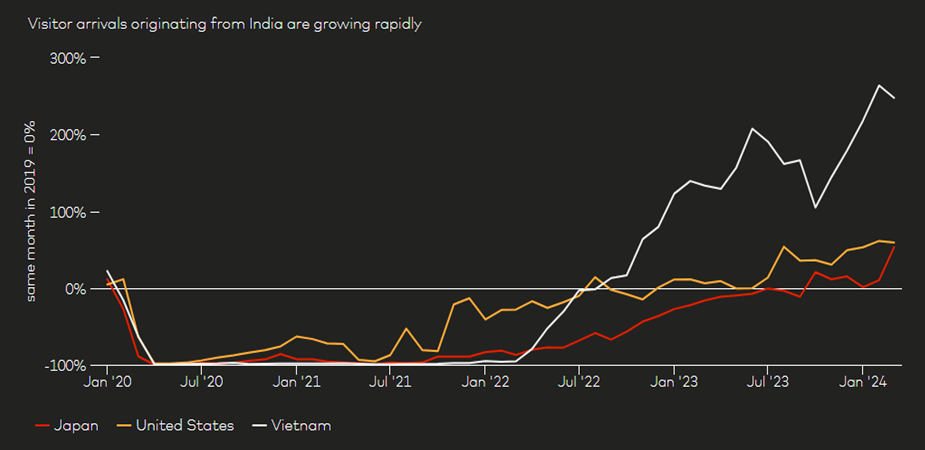
  • Another key tailwind for the resilience of travel, even in a weak consumer spending environment, is the rising demand from the emerging market middle class. As some emerging economies such as India, China, Korea, Mexico and Brazil continue to develop, their expanding middle class is increasingly seeking travel experiences, both domestic and international. The World Economic Forum estimates that by 2030, Asia – home to three of the world’s five most populous countries (India, China and Indonesia) – will have 3.5 billion people in its middle class, making up two-thirds of the global middle class. Furthermore, a travel survey by Skift found that these travelers plan to allocate an average of 23% of their income to travel in the next year, with 81% stating that it remains a priority despite economic challenges.

India: Change in passenger arrivals vs. 2019 levels, by destination country

Line graph showing that Japan, the United States and Vietnam are seeing increasing numbers of visitor arrivals originating from India.
Source: Travel Trends 2024: Breaking Boundaries

  • Greater mobility is another key tailwind for travel-related companies. With remote work still prevalent worldwide, we’re seeing the rise of a new generation of digital nomads – individuals who leverage flexible work arrangements to explore the world. This shift toward a “work from anywhere” model is reshaping travel patterns and creating lasting demand for the travel and leisure industry.

Given our strong conviction in travel and leisure, here are some of the key plays in our portfolios and why we hold them.

Founded in 1912 by Martin Sixt, and managed by the family since, Sixt SE (SIX2 DE) is one of the oldest car rental companies in the world. The company is headquartered in Germany and operates across more than 110 countries. It differentiates itself from competitors through its premium car offering, thanks to its German heritage and strong relationship with German carmakers. Its motto is “Don’t rent a car, rent THE car.”

After becoming a top two player in Europe, Sixt has expanded in the United States by prioritizing a presence in the busiest airports, which has yielded above average results, but has brought some challenges along with it. The key difference between the US and European car rental business models lies in the accounting of fleet ownership. In the United States, rental companies primarily assume the risk of lease or buyback agreements, meaning they bear the depreciation risk.

Sixt experienced that risk first-hand in early 2024 when the resale value of electric vehicles fell as much as 20% and the company had to book accelerated depreciation in its book which sent the stock price down close to 30% over Q2. We took that opportunity to initiate a position in this high-quality name as we expect the impact of depreciation to be short term in nature as the management has taken steps to accelerate the rotation of its fleet. We remain confident in the company’s ability to successfully execute its US expansion plans and take market share from competitors such as Hertz and Avis.

Founded in 1995, easyJet plc (EZJ UK) is one of Europe’s leading low-cost carriers (LCC), offering a pan-European point-to-point flight network at a cost advantage to legacy and charter airlines. With a strong brand recognition, the company has grown notable presence at capacity-strained airports. Unlike ultra-low-cost-carrier (ULCC) peers, easyJet differentiates itself by operating from major primary airports rather than secondary hubs, prioritizing customer experience and maintaining competitive, flexible service offerings that command significant brand loyalty from its passengers. easyJet also benefits from a streamlined cost structure and ability to rapidly adjust capacity to market conditions, giving them a competitive advantage in times of sector disruption. Additionally, the company is taking market share from traditional full-service carriers by extending its reach beyond standard short-haul flights through its easyJet Holidays business, tapping into the roughly $80 billion European package holiday market. easyJet’s focus on cost efficiency, network optimization, diversifying revenue streams and gaining market share from legacy carriers positions it as a long-term winner in European aviation.

Meliá Hotels International S.A. (MEL ES) is a leading global hospitality group founded in Spain in 1956. As the second-largest hotel group in Latin America and the third largest in Europe, Meliá has expanded to over 390 hotels across 40 countries with 63 new hotels in the pipeline. The company operates through a multi-brand portfolio spanning the premium, upscale and midscale segments. Meliá caters to a diversified mix of leisure and business travelers in key resort destinations across the Americas, Spain and EMEA. Their strategy to increasingly adopt an asset-light model – more than half of their portfolio consists of managed and franchise properties – reflects their focus on scalability and margin improvement. Meliá differentiates itself with a strong brand portfolio, a high Global Reputation Index score, and growing direct-to-consumer sales, which enhance margins and strengthen customer loyalty. With an established presence in high-growth markets, along with its ongoing upscale repositioning and expansion pipelines, the company is well positioned for continued growth.

Founded in Denver, Colorado, Samsonite International S.A. (SMSEY) is the world’s largest lifestyle bag and travel luggage company. Its broad, high-quality broad portfolio includes Samsonite, Tumi, American Tourister, Gregory, High Sierra, Kamiliant, eBags, Lipault and Hartmann, collectively sold in over 100 countries through more than 1200 company-owned stores. Samsonite’s business model is centered on brand management, product design, and marketing, with 95% of its manufacturing outsourced to a global network of around 1,500 third-party facilities.

Samsonite’s asset-light structure allows them to prioritize brand building and innovation, reflected in their eco-friendly collections and omnichannel expansion, including a fast-growing e-commerce segment. The company is well positioned compared to its peers thanks to its scale-driven brand power and global presence resulting in a strong 17% market share of a roughly $22 billion luggage market. Additionally, their focus on cost control and supply-chain diversification reduces tariff risk and further supports margins, strengthening their position to achieve sustainable long-term growth.

Aerial shot of a crowd of people walking in different directions.

Peter Muldowney, Senior Vice President and Head of Institutional and Multi-Asset Strategy speaks to Benefits and Pension Monitor. In the article entitled “The leading players in global equities,” Peter reminds readers that regardless of the asset class, diversification is key when trying to reach the intended result.

The forecast of global manufacturing acceleration into H1 2025 is playing out but lagged money trends suggest that the pick-up will stall over the spring / summer before resuming in late 2025. A trade war could turn a stall into a more serious set-back.

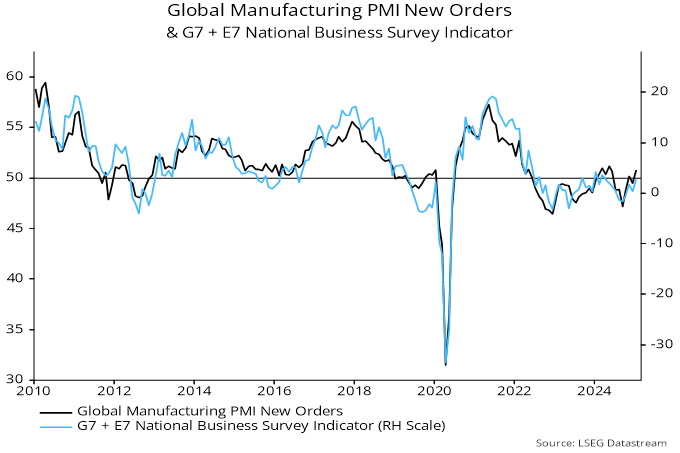
The global manufacturing PMI new orders index crossed back above the 50 level in January, reaching its highest level since May. An alternative indicator combining new orders or output expectations components of national business surveys (ISM for the US, Ifo for Germany, CBI for the UK etc) mirrored the PMI increase – see chart 1.

Chart 1

Chart 1 showing Global Manufacturing PMI New Orders & G7 + E7 National Business Survey Indicator

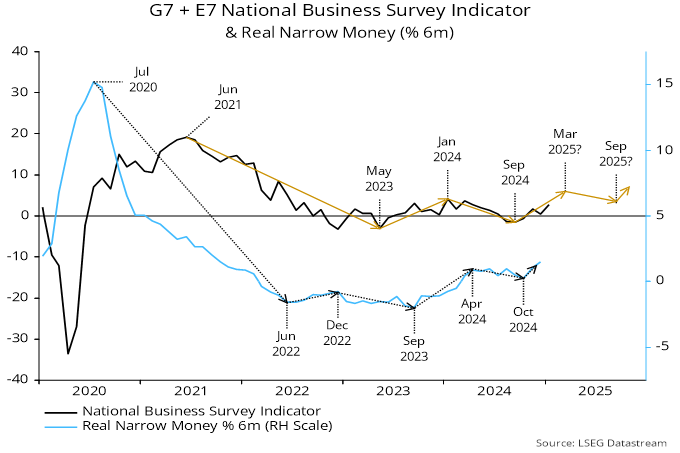
The forecast of a pick-up was based on a rise in global six-month real narrow money momentum from September 2023 through April 2024. Turning points in real money momentum have led survey turning points by 11-13 months in recent years. The survey lows in September 2024 arrived on schedule – chart 2.

Chart 2

Chart 2 showing G7 + E7 National Business Survey Indicator & Real Narrow Money (% 6m)

The leading relationship had been the basis for an earlier forecast of a “double dip” in the survey indicators into H2 2024.

The upswing in six-month month real narrow money momentum, however, stalled between April and October 2024, before resuming in November / December. Based on recent lead times, this suggests a local peak in PMI new orders / the alternative indicator around March 2025 and a minor fall through Q3.The latest money numbers are giving a positive signal for late 2025.

This profile, of course, takes no account of possible trade disruption from a US-led global tariff war, which could accentuate mid-year weakness and might also affect monetary prospects (to the extent that negative confidence effects cause households and firms to defer spending, reducing their demand to hold narrow money).

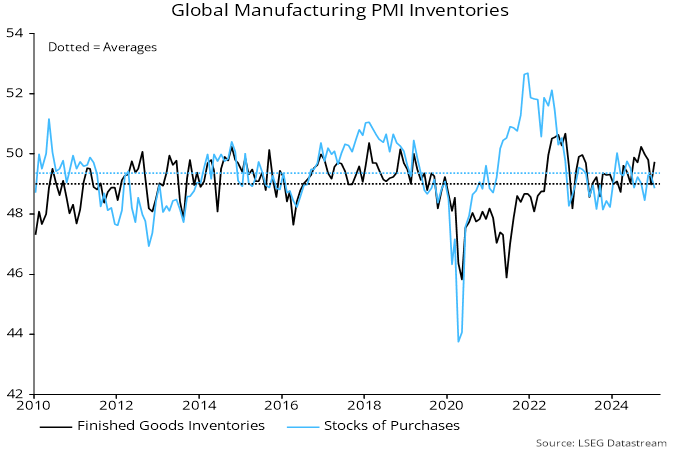
An alternative explanation for the recent manufacturing pick-up is that demand / production has been pulled forward as importers stockpile ahead of new or higher tariffs. Inventories components of business surveys, however, don’t currently suggest unusual behaviour – chart 3.

Chart 3

Chart 3 showing Global Manufacturing PMI Inventories

The forecast of a minor peak in global manufacturing momentum this spring could imply relief for US Treasuries.

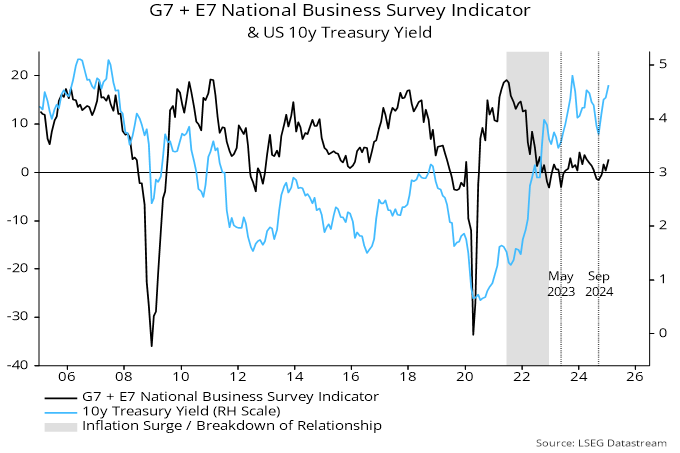
The low / stable inflation environment of the 2010s was associated with a strong positive correlation between Treasury yields and economic momentum. This broke down in 2021-22 as surging inflation became the dominant driver of yields – chart 4.

Chart 4

Chart 4 showing G7 + E7 National Business Survey Indicator & US 10y Treasury Yield

With inflation normalising, the 2010s relationship may be returning. Lows in the business survey indicator in May 2023 and September 2024 were reflected in nearby lows in Treasury yields.

An approaching local peak in the survey indicator coupled with expected further favourable inflation news could open up downside for yields into H2.

UK money trends remain relatively weak, arguing that the MPC bears significant responsibility for economic underperformance.

Narrow and broad money – as measured by non-financial M1 / M4 – rose by 0.4% and 0.3% respectively in December, below gains of 0.9% and 0.6% for equivalent Eurozone measures,

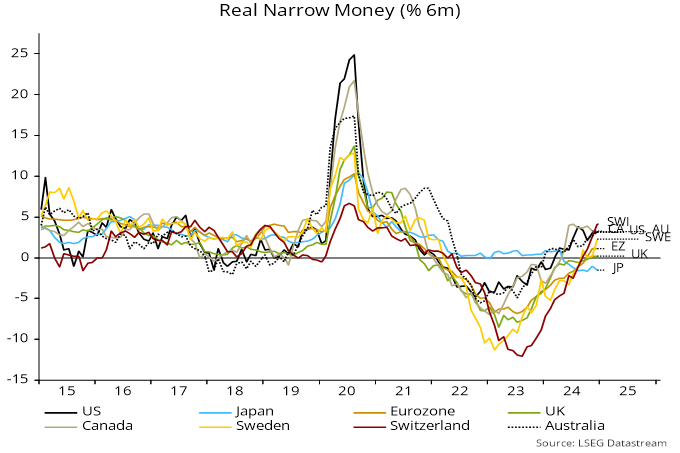
UK six-month real narrow money momentum was static and barely positive in December, in contrast to higher and rising momentum in the Eurozone, Sweden and Switzerland, where policy rates fell by 100-150 bp during 2024 versus the UK’s 50 bp – see chart 1.

Chart 1

Chart 1 showing Real Narrow Money (% 6m)

Six-month growth of (nominal) broad money is similar in the UK and Eurozone (4.1% and 4.0% annualised respectively) but the UK sectoral breakdown is unfavourable – the increase was entirely attributable to households, with corporate money holdings stagnant.

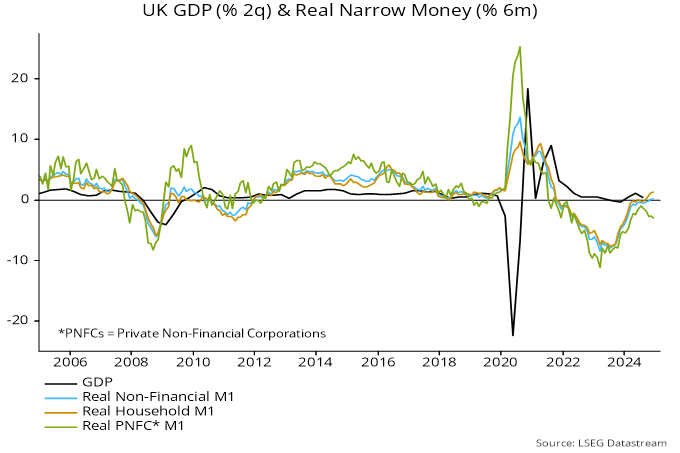
The narrow money decomposition is worse. Six-month momentum of corporate real narrow money remains negative and has weakened since July. Eurozone momentum, by contrast, turned positive in October, rising further into year-end – charts 2 and 3.

Chart 2

Chart 2 showing UK GDP (% 2q) & Real Narrow Money (% 6m)

Chart 3

Chart 3 showing Eurozone GDP (% 2q) & Real Narrow Money (% 6m)

Corporate money weakness suggests that companies were under financial pressure to retrench before the Budget national insurance raid.

The contention here is that household money holdings were boosted by asset sales in anticipation of possible tax changes in the Budget – see previous post. This effect may still be inflating six-month household and aggregate broad money growth.

Households, in any case, are unlikely to be in the mood to spend “excess” money holdings against a backdrop of corporate gloom and rising job losses – unless the MPC accelerates rate cuts.

The MPC’s inappropriately restrictive stance encompasses its QT operations as well as rate policy. The Bank of England’s gilt holdings fell by the equivalent of 3.2% of the broad money stock in the 12 months to December versus comparable reductions of 1.8% and 2.0% respectively in the US and Eurozone (i.e. in Fed holdings of Treasuries and Eurosystem holdings of Eurozone government securities).

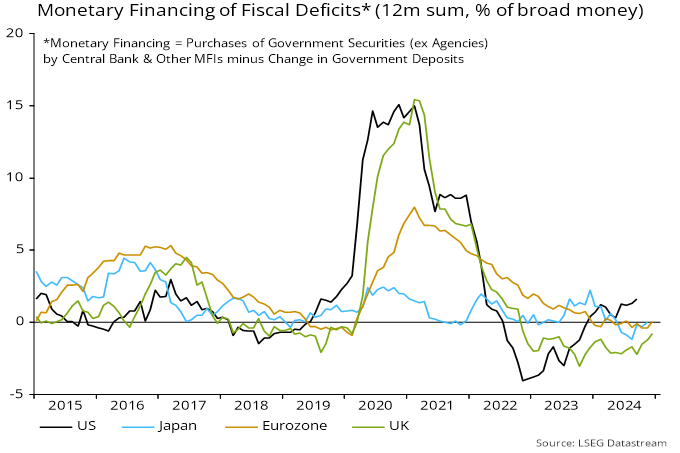
Monetary financing of the fiscal deficit (i.e. taking into account commercial banking system transactions in securities and changes in fiscal deposits as well as QE / QT) subtracted from broad money growth in the UK in the latest 12 months versus a neutral impact in the Eurozone / Japan and a significant positive contribution in the US – chart 4.

Chart 4

Chart 4 showing Monetary Financing of Fiscal Deficits* (12m sum, % of broad money) *Monetary Financing = Purchases of Government Securities (ex Agencies) by Central Bank & Other MFIs minus Change in Government Deposits