Alkaline batteries with focus on a single red battery in the middle.

One of the joys of investing in the world of small caps is discovering a company that has carved out a niche in the most unexpected of markets. Most of these companies go unnoticed as part of a larger value chain, their products often hidden from the eyes of the end consumer. The idea of a “hidden champion” toiling away in deliberate obscurity while quietly dominating a niche sector or technology was first highlighted by renowned management consultant Hermann Simon in his book – “Hidden Champions of the Twenty First Century.”

What is a hidden champion, one might ask? According to Simon, hidden champions have the following three attributes:

  1. They are in the top three of their chosen global niche.
  2. They generate revenue between $5 million and $5 billion.
  3. They maintain obscurity in terms of brand recognition (B2B in most cases).

Some of the attributes that define them are also what makes them successful. The key lessons we can take from observing hidden champions are:

  • Ambition: Despite their size, they set extremely ambitious goals. It is market leadership or bust. Goals are invariably long-term focused with decades in mind.
  • Specialization: Their preference is both extreme focus and depth of focus. They identify narrow markets and specialize in them.
  • Globalization: Their specialization is then unleashed on global markets. They aggressively hunt for new markets and prefer to serve those markets with their own subsidiaries instead of getting tied up with third parties.
  • Innovation: Scarcity of resources due to their small size means they need to be much more effective with R&D. Thinking outside the box means you need to innovate not just products, but processes as well.
  • Customer closeness: Large customers can be demanding and often want the lowest price. Hidden champions respond by engaging closely with customers. Providing advice and system integration services by closely engaging with customers creates stickiness and deep moats.
  • Financing: Most hidden champions are self-financed with ownership that is long-term oriented and conservative with capital allocation.
  • Culture: Culture is high performance with more work to go around than headcount. Turnover is low and managers tend to have long tenures.

Hidden champions tend to be everywhere in the world of small caps, including in emerging markets. In our emerging market small cap portfolio, we have a good representation of hidden champions serving a diversity of end markets. Take Hongfa Technology Co. Ltd. (600885 CH), a Chinese company which has carved out a niche in power relays and is the global leader with over 20% market share. Power relays are a crucial component of any electric equipment that is a part of modern life. They convert a low power input into a high power outcome. From home appliances to industrial equipment, alarms and automobiles, its relays form a ubiquitous part of our lives. As the world upgrades its power grids and AI drives higher power consumption, Hongfa’s high-voltage products should see enhanced demand in the coming years.

Similarly, we own a company in Korea called Vitzrocell Co. Ltd. (082920 KS) which is among the top three players globally in manufacturing primary batteries. Primary batteries have high energy densities, a low discharge rate (allowing them to run for 10 years and beyond) and a wide operational temperature range (-55°C–+85°C). This makes them ideal for use in harsh conditions that require extremely high reliability like oil and gas equipment, rockets and utility meters.

Finally, over in India, we own Suprajit Engineering Ltd. (SEL IN), which is the second largest global manufacturer of control cables and third largest manufacturer of halogen lamps. Suprajit makes over 15,000 types of control cables used in passenger vehicles, two- and three-wheelers and off-highway vehicles like tractors and recreational vehicles. Control cables, as the name suggests, transmit control signals to control equipment versus power cables that transmit high voltage power.

Suprajit is the textbook example of a hidden champion with their stated goal of being a leader in control cables, growing a global manufacturing footprint, deep relationships with leading OEMs and nimble, low-cost R&D efforts leveraging talent in India. With most of global manufacturing now located in emerging markets, we see a landscape littered with hidden champions waiting to be uncovered.


Canadian flag in front of Niagara Falls.

Fixed income investments are versatile, addressing a range of investor goals. Defined benefit pension plans use fixed income as an interest rate hedging tool, typically through longer duration securities, to match liability risk. For investors like endowments, foundations and First Nation trusts, who focus on generating absolute returns across different market environments, stable returns is generally the primary objective.

This article summarizes some of the discussion at a recent Strategic Exchange webinar on the outlook for fixed income and the range of strategies available to investors to manage the challenges in the current economic environment.

Broad range of strategies

Traditional fixed income assets, like government and corporate bonds, have long been core holdings for investors. Today, non-traditional fixed income investments are added to enhance core bond holdings (Figure 1).

Figure 1 – Range of fixed income strategies

Traditional fixed income Non-traditional fixed income
Government Universe High yield Private loans
Provincial Long Mortgages Absolute return
Corporate Strip bonds Emerging market credit

Bond yields generally indicate expected longer-term return. Yields have declined from the higher levels in 2024, suggesting there will be continued interest in non-traditional fixed income strategies to complement traditional strategies to enhance returns.

Tariffs, the economy and fixed income

President Trump’s “America First” agenda introduced tariffs to protect US industries and reduce trade deficits, causing global market volatility and sparking concerns about inflation and sustained high interest rates.

There is a wide range of possible outcomes from the tariffs. Weakening growth combined with sticky inflation are ingredients for stagflation. Central banks have little or no flexibility in this scenario. In the pre-COVID world, in anticipation of weakening growth or a weakening labour market, central banks could cut interest rates. However, they do not have the same luxury today, particularly considering sticky inflation.

TJ Sutter, Head of Fixed Income at Connor Clark & Lunn Investment Management, noted the tariff situation is fluid, and the Trump administration has sometimes backpedaled on their resolve. However, the concern is a lot of the potential damage to growth and inflation outlook is already done both in the United States and Canada with business confidence being low, uncertainty high, business investment and capital expenditure intentions stalling and, in some cases, falling off a cliff.

The uncertainty lies in whether the hard economic data will match the soft data of intentions and confidence. These indicators suggest a high probability of a further slowdown. Sutter noted that for his team, the current sentiment is the introduction of the tariffs indicate a recession probability range of 40% to 60% for both Canada and the United States.

Darren Ducharme, CEO of the fixed income specialist manager Baker Gilmore & Associates, noted the sharp rise in geopolitical risk and the associated uncertainty has made navigating markets, including fixed income, much more challenging. Volatility is likely to remain high, and the rise in headline risk will continue to make forecasting expected movements in fixed income markets challenging.

Ducharme emphasized that effective risk management is essential in this volatile environment. While market volatility offers opportunities for active managers, it is vital to appropriately size risk to withstand market turbulence.

Non-traditional fixed income strategies

Incorporating non-traditional fixed income strategies alongside core fixed income holdings can cater to different investor needs and market conditions.

Non-traditional fixed income strategies offer several advantages for portfolio diversification and returns, including:

  • Higher yield potential: These strategies often provide higher yields than traditional fixed income investments, making them attractive in low interest-rate environments.
  • Diversification: Investing in assets like mortgages, emerging market credit and absolute return strategies can reduce overall portfolio risk by adding exposure to various economic cycles and credit markets.
  • Flexibility: Absolute return strategies allow managers to adapt to changing market conditions and seek returns across various asset classes.
  • Inflation protection: Some non-traditional fixed income investments, like mortgages, offer better protection against inflation compared to traditional bonds.
  • Enhanced risk-adjusted returns: A multi-strategy solution balances interest rate risk with credit risk, improving long-term risk-adjusted returns.

Stay alert to risk

Fixed income investments are vital for diversified portfolios, offering an alternative stream of returns. Tariffs and rising geopolitical risks have heightened market volatility, making effective risk management more crucial. Traditional fixed income assets, like government and corporate bonds, remain core holdings for investors. Non-traditional fixed income strategies, including mortgages, emerging markets credit, private loans and absolute return strategies, offer valuable opportunities to enhance returns and diversify risk.

In these challenging times, investors should carefully size risk and consider incorporating a broad range of fixed income strategies to weather market turbulence. Leveraging non-traditional fixed income investments can help portfolios achieve better risk-adjusted returns and cater to diverse investor needs. Investors should remain vigilant and adaptable, ensuring their portfolios are well-positioned to thrive in the evolving economic landscape.

Person holding Canadian and American dollar bills.

President Trump introduced tariffs as part of his “America First” agenda to protect US industries and reduce trade deficits. These tariffs have led to volatility in global stock and currency markets, raising concerns about inflationary pressures and prolonged high interest rates. Additionally, there are questions about the US dollar’s role as the world’s reserve currency, which could affect its long-term stability. A weaker US dollar impacts Canadian investors’ foreign investments, depending on their currency hedging strategies.

This article reviews the longer-term relationship between the US dollar and Canadian dollar and places the recent currency volatility into perspective.

Historical perspective

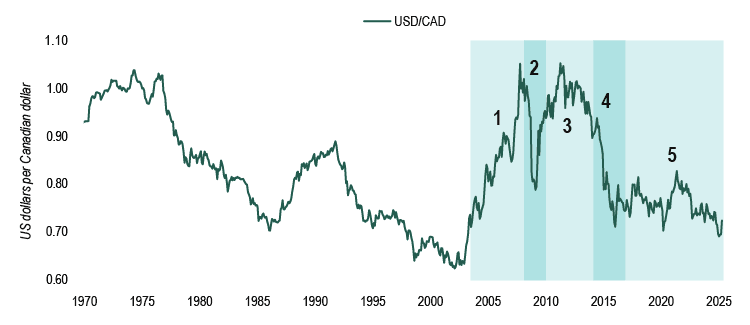
Figure 1 illustrates the historical exchange rates between the Canadian dollar and the US dollar from 1970 to the end of April 2025.

Figure 1 – Canadian-US exchange rates
SE_COMM_2025-05-09_Chart01Source: Bank of Canada

  1. Rise of the Canadian dollar
    The Canadian dollar experienced a long period of decline until the early 2000s when it began to rise, reaching parity with the US dollar in September 2007 for the first time in over 30 years. Several factors contributed to this surge:

    • Commodity boom: Canada is rich in natural resources, and the record-high prices for oil and other commodities played a significant role in strengthening the Canadian dollar.
    • Strong economy: A robust global economy boosted demand for Canadian exports, further driving up the currency.
    • US economic weakness: The United States was facing economic uncertainty, particularly with the subprime mortgage crisis, which weakened the US dollar relative to other currencies.
    • Interest rate differentials: The Bank of Canada maintained higher interest rates compared to the US Federal Reserve, making Canadian assets more attractive to investors.
  1. Sharp downturn
    In 2008, the Canadian dollar experienced a sharp downturn due to the global financial crisis. Investors moved their money into safe-haven assets like the US dollar, and oil prices plummeted from over USD140 per barrel to below USD40, which negatively impacted the value of the Canadian dollar.The financial crisis triggered a recession in Canada, leading to the Bank of Canada cutting interest rates to stimulate the economy, making Canadian assets less attractive to investors. By early 2009, the Canadian dollar had dropped to below 80 cents USD, a steep decline from its 2007 peak.
  1. Commodity-driven recovery
    In 2009, the Canadian dollar rebounded, largely due to the recovery in commodity prices and Canada’s more stable banking system compared to other countries. The Canadian dollar regained much of its lost value and reached parity with the US dollar again in early 2011.
  1. Short-lived recovery
    After 2011, the strength of the Canadian dollar was once again affected by commodity prices, with oil prices dropping from over USD100 per barrel to below USD30 by 2016. Concerns over European debt crises and slowing global growth also led investors to favour the US dollar. By 2016, the Canadian dollar had dropped to around 71 cents USD.
  1. Narrow trading range
    Since 2016, the Canadian dollar has traded within a relatively narrow range, despite the uncertainty associated with the COVID-19 pandemic, recent high levels of inflation and the volatility caused by tariffs.

Recent perspective

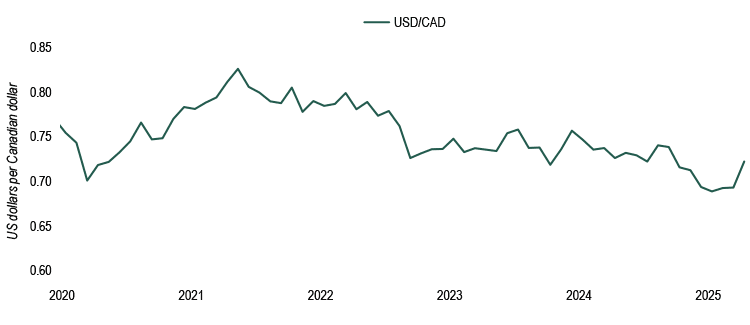
Figure 2 highlights the more recent history of Canadian-US exchange rates from 2020 to the end of April 2025. The introduction of tariffs initially caused the Canadian dollar to hit a low of around 69 cents USD, but it subsequently rebounded and finished April at a little over 72 cents.

Figure 2 – Canadian-US exchange rates
SE_COMM_2025-05-09_Chart02
Source: Bank of Canada

To date, the volatility is much less compared to past periods when the Canadian dollar reached parity with the US dollar. For the Canadian dollar to reach parity again, several things would need to happen:

  • Stronger Canadian economic growth compared to the United States.
  • Higher interest rates in Canada to attract investment.
  • Weaker US dollar due to inflation or economic downturns.
  • Increased demand for Canadian exports, especially oil and natural resources.

The current economic environment does not suggest a rapid rise in the Canadian dollar relative to the US dollar. For example, oil prices are significantly below previous peak levels, and the bigger concern today for Canada is a prolonged recession.

Conclusion

The Canadian dollar has experienced cycles of decline and recovery, influenced by commodity prices, economic conditions and interest rate differentials. Recent volatility has been impacted by President Trump’s tariffs but is much less significant compared to previous events. The current economic environment does not suggest a rapid rise in the Canadian dollar. Investors should continue to monitor the situation.

Taiwan city skyline and skyscrapers.

Currency intervention across Asia in recent weeks may be yet another signal that we are entering a new investment order. We have written to clients previously that a secular peak in the USD likely occurred at the end of 2022.

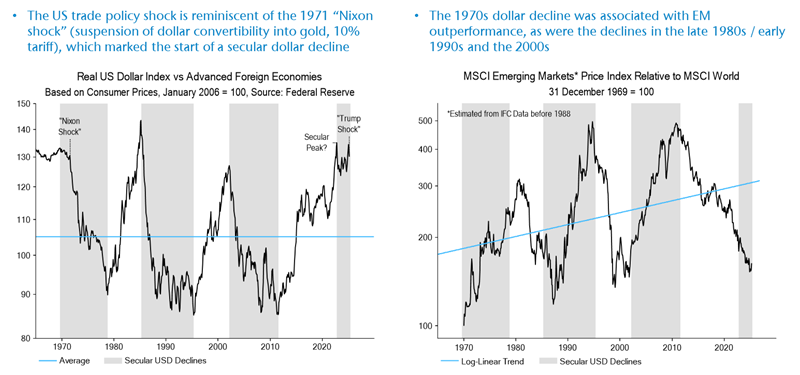
Looking back to previous peaks in the 1970s and 1980s under Nixon and Reagan respectively, the dollar provided a powerful signal to investors that the US economy was experiencing major distortions that would force policy intervention.

President Trump’s Liberation Day tariff shock is part of a broader play to reinvigorate the competitiveness of American manufacturing. Another key pillar of the strategy is the desire for a weaker dollar. We are now starting to see this play out in Asian currency markets.

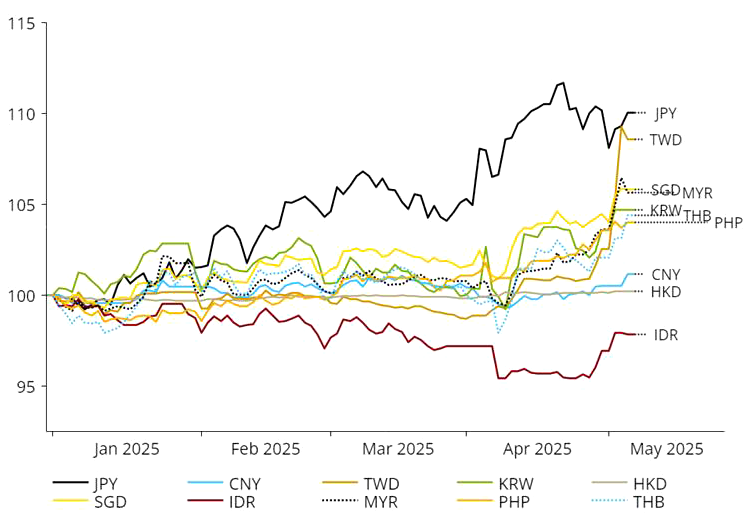
The most dramatic moves were in the Taiwan dollar, which surged by 9% over two trading days, reaching three-year highs and logging its sharpest daily gains since at least 1981.

East Asia currencies vs US dollar
31 December 2024 = 100
Graph showing the value of East Asia currencies versus the US Dollar over time since January 2025.Source: NS Partners and LSEG (May 2025)

Currency tremors may signal the start of a broader shift in global capital that could have big implications for which markets out- or underperform going forward. As the Financial Times reported in “The Coming Asian FX ‘avalanche’” (7th of May 2025) quoting Eurizon’s Stephen Jen:

“We have long warned about the ‘Avalanche’ risk for the dollar. There could be USD2.5 trillion worth of ‘snow’ in China and more from the likes of Taiwan, Malaysia and Korea, rising at a pace of USD500 billion a year – we conservatively guesstimate. Only a modest proportion of the very large trade surpluses these countries have earned have been repatriated back home, with the bulk of the export earnings being hoarded by exporters in USD deposits.

“Like in actual avalanches, ex-ante, many might dismiss the warnings, but ex-post, all would admit that it was an obvious risk. We are still waiting for more triggers, but we see the sharp sell-off in USDTWD this week from this Avalanche perspective. We predict there will likely be other sudden lurches lower in USDAsia in the coming quarters. Corrections in USDAsia could pacify the US, as Asia accounts for more than half of all US trade deficit, making this a fundamentally benign development, except for those caught long dollars.

“The overhang of liquid dollar holdings is just too large if the dollar weakens, the Fed cuts interest rates, and China stages a cyclical rebound. In other words, both the push and pull factors that kept the export earnings in dollars outside the home countries in the past years will potentially flip signs in the coming quarters. At the same time, many of those holding long-dollar exposures know very well that the dollar is over-valued.”

Emerging markets love a falling dollar, which is an environment we’ve not seen in over 13 years.

Two line graphs side by side. The first illustrates the similarity of the current US trade policy shock with the "Nixon Shock" of 1971. The second illustrates the outperformance of emerging markets at the same times as these policy "shocks."Source: LSEG Datastream

Historically, this has seen EM outperform DM, while the winners and losers within the asset class also rotate. For instance, while the strong dollar environment typically favoured EM exporters, a weak dollar would be a shot in the arm for domestic consumers.

Other markets which could surge are those which the United States permits to manage their currencies against a falling dollar by easing monetary policy. There are a number of other smaller EM economies with managed exchange rates which could enjoy surging liquidity that feeds bull markets in financial assets.

The cleanest example of this currency-liquidity transmission is the Hong Kong dollar peg. When the USD falls, the Hong Kong Monetary Authority intervenes to maintain the HKD peg by buying USD and selling HKD, increasing HKD supply. This surge in liquidity lowers interest rates, stimulates economic activity and can lead to higher asset prices (and inflationary pressures).

Our liquidity analysis should be a powerful tool for identifying the risks of both booms and busts if this trend continues.

It’s all about pricing power for the export winners

While exporter stock prices may pop in the coming months on better tariff news, currency dynamics could be important drivers of future outperformance. Let’s use Taiwan Semiconductor Manufacturing Company (TSMC) as an example at the stock level. The company has previously given clear guidance that every 1% of appreciation in the TWD against the USD is a 0.4 ppt hit to OPM. We roughly model this impact out below to illustrate the currency risk to earnings:

EPS Q1 25a Q2 25e Q3 25e Q4 25e 2025 Implied PE Implied share price with 17x Fr current
share px
Consensus 13.9 14.8 15.7 15.5 60.0 15.4 1019 11%
FX Impact (10%+) 13.9 13.7 12.7 12.1 52.4 17.5 891 -3%
FX Impact (15%+) 13.9 13.1 12.1 11.5 50.6 18.2 861 -6%
FX Impact (20%+) 13.9 12.5 11.5 10.9 48.8 18.8 830 -10%

If we assumed a further appreciation of TWD/USD to 25 – a 20% appreciation from where TSMC recently guided (when TWD/USD was 33) – the hit to TSMC’s EPS is around 23%.

If we apply a mid-cycle PE (17x) to the company and factor in the earnings hit from the currency shift, that would take us to a stock price of TWD830 from the TWD950 at the start of May.

Adding to the risk is the unpredictability of tariffs negotiations between the United States and Taiwan. Tariffs above 20% on Taiwan semiconductor exports could be a meaningful hit to earnings. Perhaps authorities in Taiwan are allowing the TWD to appreciate as part of a pitch to avoid tariffs.

Mitigating the risks is TSMC’s immense pricing power. We believe robust demand will persist for the leading-edge chips enabling AI where it has a monopoly status. This positions TSMC to pass through a significant portion of price increases to its customers.

However, players in the more commoditised segments of the semiconductor industry which lack the moats and pricing power will be more vulnerable to hits from tariffs and currencies.

UK monetary trends have been arguing for faster MPC easing. Labour market news is now reinforcing the message.

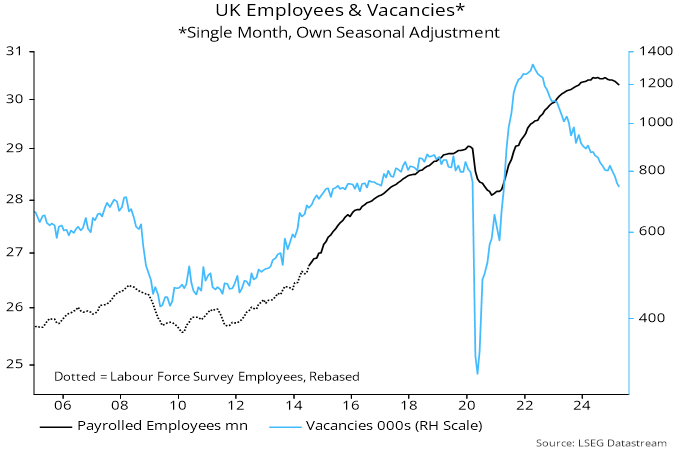
Employment developments appear notably weaker in the UK than in other major economies. The PAYE payrolled employees series fell by 0.09%, 0.15% and a provisional 0.11% in February, March and April respectively. These declines are the equivalent of falls in US non-farm payrolls of 140k, 240k and 170k.

US payrolls, of course, have risen respectably year-to-date, while Eurozone employment grew by 0.3% in Q1.

The February-April UK payrolls contraction followed a pick-up in the rate of decline of the official single-month vacancies series (seasonally adjusted here), which has fallen to its lowest level since 2016 – see chart 1.

Chart 1

Chart 1 showing UK Employees & Vacancies* *Single Month, Own Seasonal Adjustment

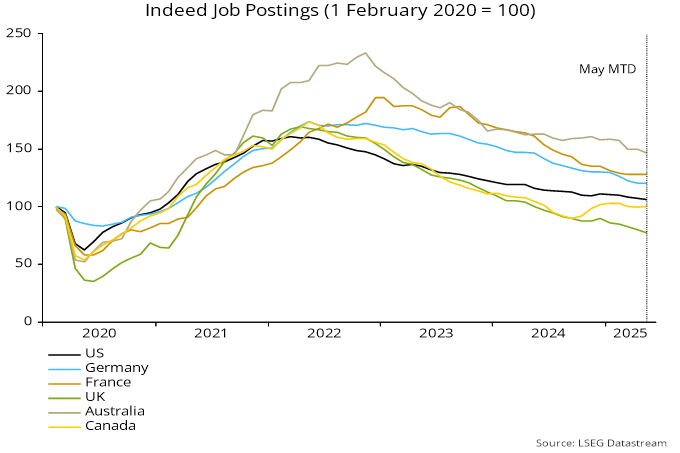
Indeed job postings numbers closely track the official vacancies series and have declined further so far in May – chart 2. The Indeed numbers have fallen by more in the UK than elsewhere, to a lower level relative to the pre-pandemic (February 2020) starting point – chart 3.

Chart 2

Chart 2 showing UK Vacancies* & Indeed Job Postings *Single Month, Own Seasonal Adjustment

Chart 3

Chart 3 showing Indeed Job Postings (1 February 2020 = 100)

UK underperformance may be partly attributable to government-imposed rises in labour costs, in the form of the increases in employer national insurance and the minimum wage, and prospectively via the Employment Rights Bill.

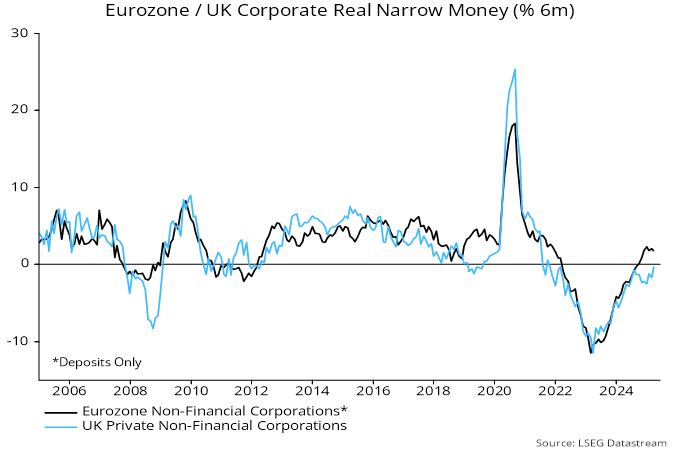
Pessimism here about employment prospects, however, also reflected weak corporate money trends. The six-month rate of change of real M1 holdings of non-financial corporations has remained negative, in contrast to a rise into solid positive territory in the Eurozone – chart 4.

Chart 4

Chart 4 showing Eurozone / UK Corporate Real Narrow Money (% 6m)

Relative money weakness suggested that UK firms were under greater financial pressure to cut costs than their Eurozone counterparts.

A hopeful sign is that UK six-month corporate real money momentum has recovered recently, narrowing the gap with the Eurozone. A key issue is whether this revival is sustained as the NI and minimum wage hikes take effect.

UK employment weakness appears at odds with Q1 GDP “strength”. The UK quarterly numbers, however, have been volatile and year-on-year growth of 1.3% in Q1 is little different from the Eurozone (1.2%).

Front-running of US tariffs temporarily boosted GDP in the rest of the world last quarter. US real imports rose by 10.8%, equivalent to 1.4% of US GDP, between Q4 and Q1. GDP in the rest of the world is 2.7 times the US level measured at current market prices and 5.8 times based on purchasing power parity. Depending on which divisor is used, the US imports increase implies a 0.25-0.5% lift to GDP elsewhere.

Three indicators that signalled the 2021-22 global inflation spike and reversal continue to suggest a favourable outlook.

G7 annual broad money growth led the rise and fall in annual consumer price inflation by about two years, consistent with the rule of thumb suggested by Friedman and Schwarz.

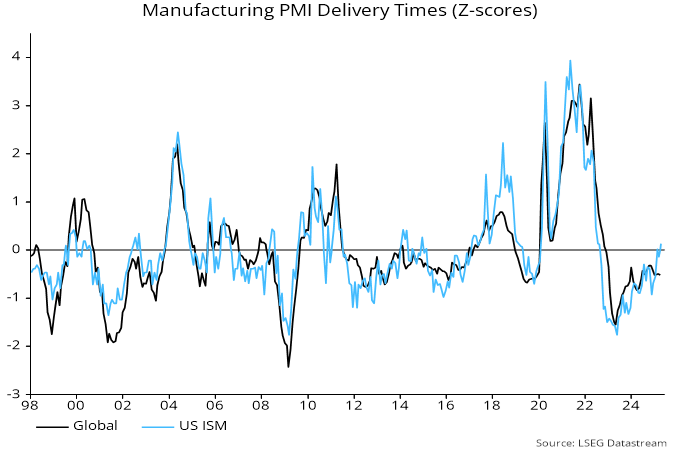
The global manufacturing PMI delivery times index – a measure of supply constraints / shortages – led by about a year.

The annual rate of change of commodity prices – as measured by the energy-heavy S&P GSCI – led by nine months.

Chart 1 overlays the three series, with respective leads applied, on G7 annual inflation.

Chart 1

Chart 1 showing G7 Consumer Prices (% yoy) & Three Leading Indicators (Broad Money, PMI Delivery Times & Commodity Prices)

The latest readings of all three are below their averages over 2015-19. Those averages were associated with average headline and core inflation of below 2% (i.e. allowing for the stated lead times).

Directionally, the suggested influence of the three indicators over their respective forecast horizons is down for commodity prices, sideways for delivery times and up for broad money growth. The latter recovery, however, is from extreme weakness.

In combination, the level and directional signals suggest that inflation will move down into early 2026, with limited recovery over the following year.

Tariffs may affect the profile but are unlikely to change the story. A mechanical boost to US prices in Q2 / Q3 will drop out of the annual inflation rate a year later. The effect may be to push out the inflation low from early 2026 to later in the year.

Tariffs could have a larger and more sustained impact by snarling up supply chains and disrupting production, resulting in delivery delays and shortages.

The global manufacturing PMI delivery times index currently remains below its long-run historical average, as well as its average over 2015-19 – chart 2.

Chart 2

Chart 2 showing Manufacturing PMI Delivery Times (Z-scores)

Delivery times have risen in the US but the ISM manufacturing supplier deliveries index is only back to its average.

Reduced exports to the US will increase excess supply in the rest of the world, depressing delivery times and pricing power, balancing upward pressure in the US.

Any tariff boost to inflation will persist over the medium term only if associated with a rise in broad money growth. This could occur if central banks ease policies excessively, because of actual or feared economic weakness, or perhaps to limit upward pressure on currencies. Alternatively, inflation worries could deter non-bank purchases of government debt, resulting in banks being required – voluntarily or otherwise – to fund a larger proportion of (wide) fiscal deficits, creating money in the process.

Such scenarios are plausible but the inflationary effects of any broad money acceleration would be unlikely to appear before 2027.

The two flags for Mexico and Brazil on textile cloth.

President Trump’s spree of tariffs has incited many global leaders to respond in kind by imposing their own tariffs on US exports. But not all leaders have been pulled into the tit-for-tat game. Mexico and Brazil’s economies depend on trading relationships with the United States and their leaders have employed different strategies with which to respond to Trump’s tariffs.

Mexico

The United States is Mexico’s largest trading partner by far. Mexico was the second-largest destination for US exports and the top source of US imports. In 2024, Mexico exported an estimated USD505.9 billion: over 80% of total Mexican goods exports were to the United States and over 40% of total Mexican goods imports were from the United States.

Mexico’s largest exports to the United States include vehicles and automotive parts, followed by electrical equipment like computer data processing units, as well as medical instruments and fruits and vegetables. Given the relationship between the countries, Mexican President Claudia Sheinbaum has a crucial part to play to reduce impacts.

President Trump threatened Mexico with tariffs if there was no increase in effort to reduce fentanyl trafficking. Mexico responded by placing 10,000 troops at the border to reduce drug trafficking and illegal entry, but did not react with reciprocal tariffs, unlike China and Canada. We believe this has played well given that the United States has not implemented any additional tariffs, whereas other countries received a range of 10% to 49%.

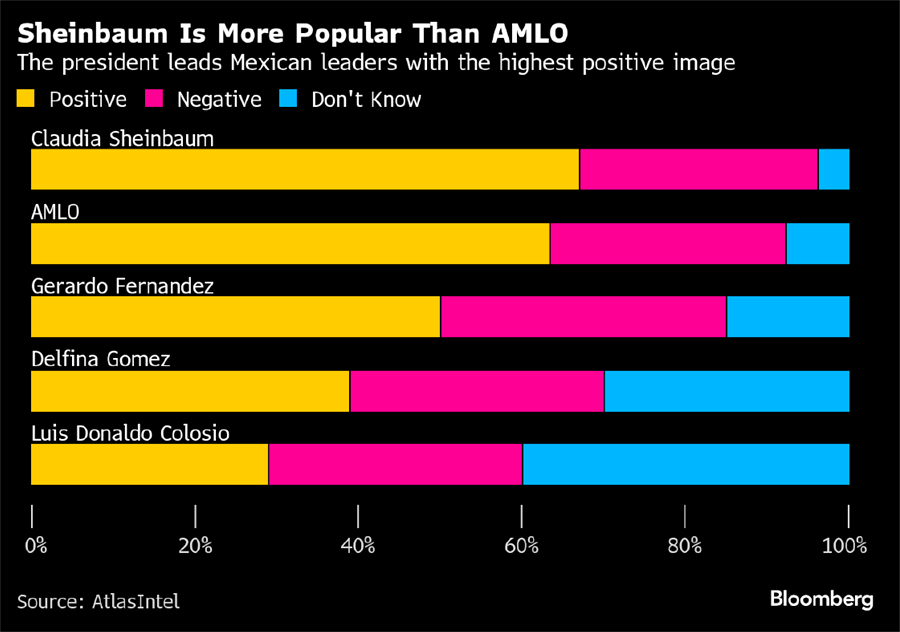
Sheinbaum is prioritizing a commercial relationship with the United States and Trump has adopted a warmer tone with Sheinbaum than with foreign leaders who have matched his confrontational style. This strategy has been received well not only by Trump, but by Mexico’s citizens – Sheinbaum’s popularity has surpassed that of previous Mexican leaders.

Bar graph illustrating the popularity of previous Mexican presidents, showing that President Sheinbaum is in the lead.

A company we like in Mexico is Bolsa Mexicana de Valores, S.A.B. de C.V. (BOLSAA MX). Bolsa is a Mexico-based stock exchange operator that functions as an integrated and organized market for equities, financial derivatives and OTC fixed-income instruments. It has access to custody, clearing and settlement of transactions and the sale of information.

The company generates over 50% of revenue through transaction fees. Bolsa should be seeing benefits, given the volatility of the market and the high volume of transactions as investors try to capitalize.

Brazil

The United States’ total goods traded with Brazil was an estimated USD92 billion in 2024, and imports from Brazil in 2024 totaled USD42.3 billion. Industrials comprised over three quarters of Brazilian exports to the United States. Key industrial products exported include crude oil, aircraft, coffee, cellulose and beef.

Brazilian President Luiz Inacio Lula da Silva (also known as “Lula”) has been in a tough spot. As the trade fight escalates between Brazil’s two largest trading partners, Lula does not want to have to choose between China or the United States. China has been Brazil’s largest trading partner for the last 15 years and this relationship has only grown.

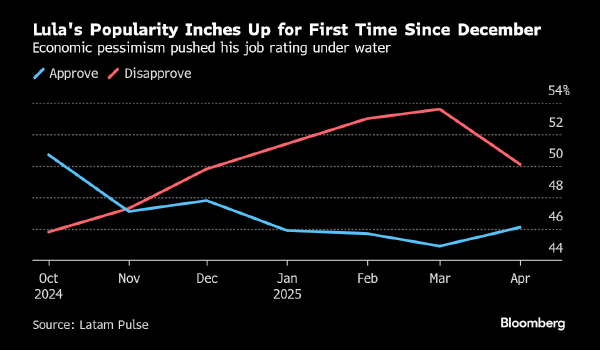
The United States has implemented just 10% tariffs on Brazil. Lula has not retaliated, which we believe has worked in his favour, and recent approval ratings reaffirm.

Line graph illustrating the popularity of Brazilian President Lula over time, showing that his approval ratings are recently rising.

A company we like in Brazil is Vivara Participações S.A. (VIVA3 SA). Vivara is the largest jewelry player in Brazil. The company sells jewelry, watches and luxury accessories under two different brands: Vivara and Life.

Vivara has unparalleled scale, doubling their store footprint since 2018 with 265 Vivara and 180 Life stores representing 20% market share. The next four jewelry players represent a total of 6%, and the remaining smaller players represent 74%. Vivara has built all its production steps vertically, manufacturing ~80% of products sold. Vivara’s main production facility is in the Free Economic Zone of Manaus where it benefits from certain business tax incentives. The company currently trades at a P/E ratio of 7x which is half the multiple that its global luxury jewelry peers trade at.

Nova Scotia's iconic Peggys Cove Lighthouse on a sunny day.

Listen to the latest episode of the East of Montreal podcast featuring Jeff Wigle, Managing Director and Group Head at Banyan Capital Partners, as he discusses our private equity strategy, experience investing in Atlantic Canada and Newcrete and his views of the current market.

Listen to the full episode of the East of Montreal podcast.

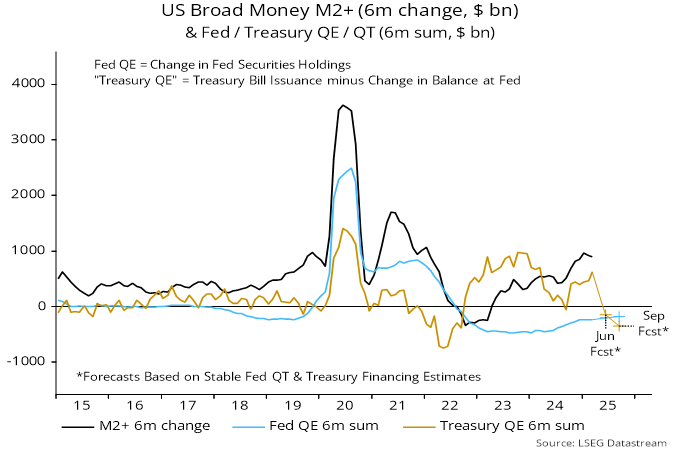
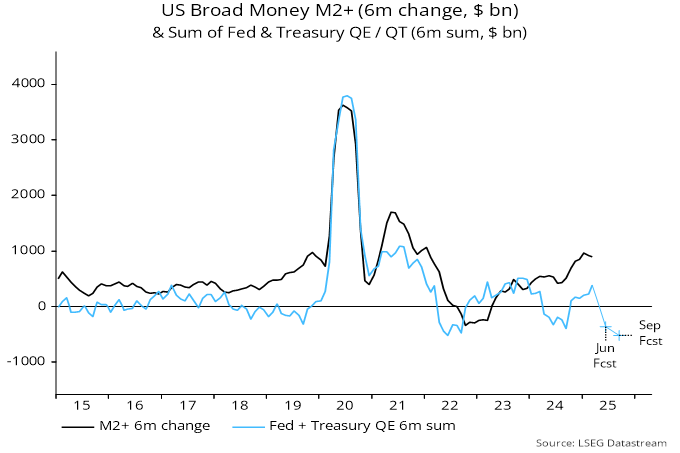
US broad – and probably narrow – money growth has been boosted recently by reduced issuance of Treasuries due to the debt ceiling constraint. The accompanying enforced run-down of the Treasury’s cash balance at the Fed has resulted in a resurgence of “Treasury QE”, a proxy for monetary deficit financing. This has more than offset (reduced) Fed QT – see charts 1 and 2.

Chart 1

Chart 1 showing US Broad Money M2+ (6m change, $ bn) & Fed / Treasury QE / QT (6m sum, $ bn)

Chart 2

Chart 2 showing US Broad Money M2+ (6m change, $ bn) & Sum of Fed & Treasury QE / QT (6m sum, $ bn)

Conditional on an early lifting of the debt ceiling, however, the Treasury’s financing estimates imply a dramatic reversal over the remainder of Q2 / Q3. The plans involve “catch-up” issuance to restore the Treasury balance to its prior level, with coupon debt – rather than bills – bearing most of the burden. (Coupon sales to non-banks contract the broad money stock; bills are more likely to be purchased by money funds and banks, implying a neutral monetary influence.)

The Fed could neutralise most of the negative Treasury impact by suspending QT. Still, the joint Fed / Treasury influence would swing from being significantly expansionary to neutral or slightly contractionary.

The suggested loss of money momentum could be offset by other factors. A similar swing in the joint influence in Q2 / Q3 2024 was associated with a minor slowdown in broad money as it coincided with a pick-up in bank lending growth.

Will a rebound in issuance put upward pressure on Treasury yields? Over 2010-19, Fed QE / QT – and the joint Fed / Treasury influence – was positively correlated (weakly) with the 10-year yield, i.e. the yield tended to rise when the Fed absorbed more supply and fall when it wound down purchases or ran down holdings.

A possible explanation is that the impact of the Fed’s actions on monetary trends and thereby economic prospects outweighed the direct yield impact of reduced or increased Treasury supply to the market. The suggested negative swing in the joint Fed / Treasury influence, therefore, could be associated with lower not higher yields.

Using smartphone & laptop to view gambling app.

Nobody is as opiniated as a fan of a particular sport team. This probably explains why there exist so many metrics for any given professional sport: to justify why your team is the better team. Despite multiple millions of data points now gathered per baseball game, no one seems to be replicating the success of the Moneyball story, but that doesn’t stop fans from spending hours upon hours analyzing data in an attempt to make a quick dollar from sports betting.

Sports betting was legalized in the United States in 2018 after the Supreme Court decision to strike down the Professional and Amateur Sports Protection Act (PASPA). Since then, 39 states have legalized sports betting, and that number is expected to reach 45 in the next two to three years. The US market therefore represents a large opportunity compared to the more mature international markets:

Modern sports betting is much more data-driven and real-time than it was just 10 years ago when the majority of bets were simply on which team would win. Now, more than half of bets are made during the games (in-play betting) and can be made on virtually anything from coin toss (NFL), first foul (NBA) or number of fights (NHL). This new breadth of betting requires robust data integrity and is therefore why industry stakeholders must rely on a single source of truth (read: data providers).

“Without data you’re just another person with an opinion.” – W. Edwards Deming, Statistician

The professional sports data-aggregation business is essentially a duopoly run by Sportradar Group AG (SRAD US) and Genius Sports Ltd. (GENI US), and Global Alpha is a shareholder of both. These two companies offer B2B data and technology solutions for the sports industry. The core of their business models is to hold streaming rights and exclusive data acquisition for specific sports leagues that are then sold to sportsbook operators like DraftKings and Flutter. They also offer solutions back to sports leagues, teams and broadcasters such as data analytics and insights, as well as augmented display and data overlay or even odds creation.

The lucrative reason for their existence is straightforward: the technology platforms used to collect, clean and aggregate live data require specific expertise that sports leagues do not possess and would be expensive to replicate; it is much easier for leagues to outsource to SportRadar and Genius Sports and benefit from the materially increased consumer engagement as well as royalties.

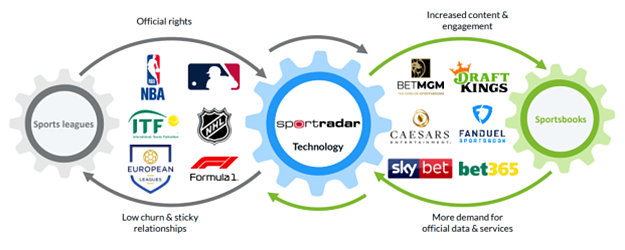
SportRadar was founded in 2001 and was one of the first online live sports statistics data collection websites. Its initial public offering (IPO) happened in 2021 and it owns rights to the NBA, NHL, MLB, F1 and the European Football League.

Illustration of Sportradar's relationships with sports leagues and sportsbooks.

Genius Sports is the new(er) kid in the industry, resulting from a merger of Betgenius and SportingPulse in 2016 to create a direct competitor to SportRadar. It owns data rights to NCAA, NASCAR, NFL, PGA Tour and European Basketball.

Illustration of Genius Sports' relationships with sports leagues, sports betting and broadcasters.

These two companies check many of the boxes we look for when investing:

  • The majority of revenue is steady, predictable and globally diversified.
  • A net cash position and resilient balance sheet allowing for flexibility and potential M&A.
  • A large growing market with catalysts for accelerated growth.
  • A competitive advantage that is unlikely to be challenged over our investment period.

Between the two companies, SportRadar and Genius Sports own the official rights to virtually all major western sports leagues. Furthermore, they have been developing other angles for partnering with leagues beyond just distribution of data and they’re progressing toward becoming their technology arms. Through their data aggregation and technology solutions, the US sports-betting players are poised to grow and with plans for future innovation, they look to be investments you could bet on.