The Chinese economy has bounced back since reopening but the pick-up has arguably been underwhelming. GDP grew at a 9.1% annualised rate in Q1, according to official data, but this partly represents payback for a weak Q4. Growth averaged an unexceptional (by Chinese standards) 5.7% over the two quarters. 

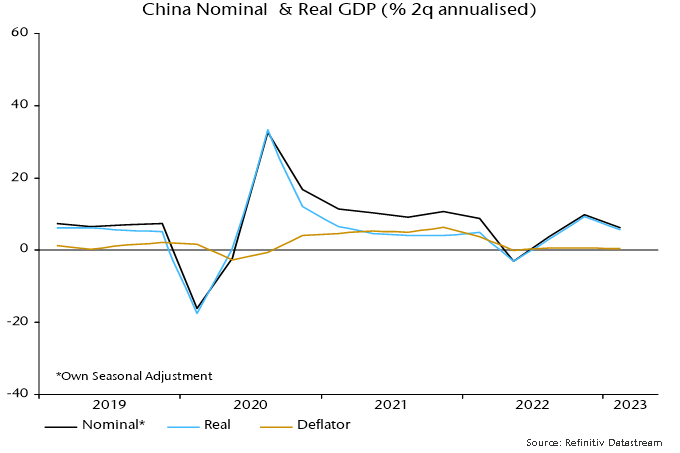
Inflationary pressures remain weak despite the activity rebound. Nominal GDP expansion was only marginally higher than real in Q4 / Q1 combined: the GDP deflator rose by just 0.4% annualised – see chart 1**. 

Chart 1

Chart 1 showing China Nominal & Real GDP (% 2q annualised)

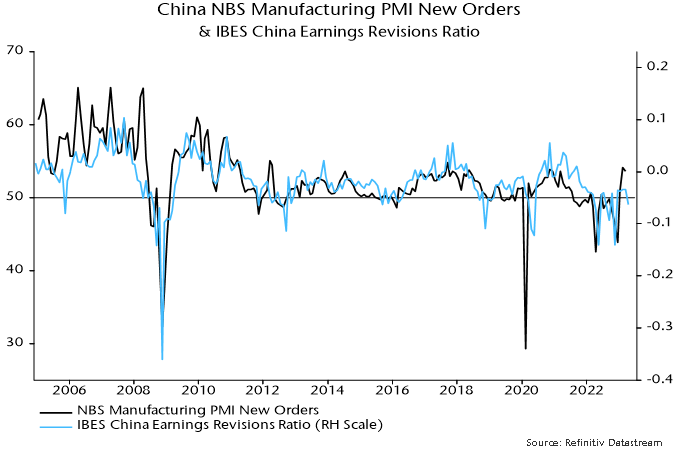
Muted nominal GDP growth has contributed to lacklustre profits, with the IBES China earnings revisions ratio diverging negatively from recent stronger official PMIs, questioning the sustainability of the latter – chart 2. 

Chart 2

Chart 2 showing China NBS Manufacturing PMI New Orders & IBES China Earnings Revisions Ratio

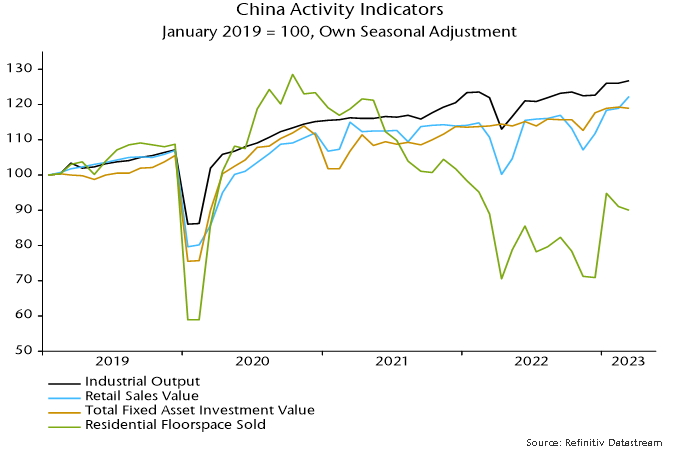
Monthly activity numbers for March were mixed and don’t suggest a pick-up in momentum at quarter-end. Retail sales were a bright spot but strength in industrial output, fixed asset investment and home sales has faded after an initial reopening bounce – chart 3. 

Chart 3

Chart 3 showing China Activity Indicators January 2019 = 100, Own Seasonal Adjustment

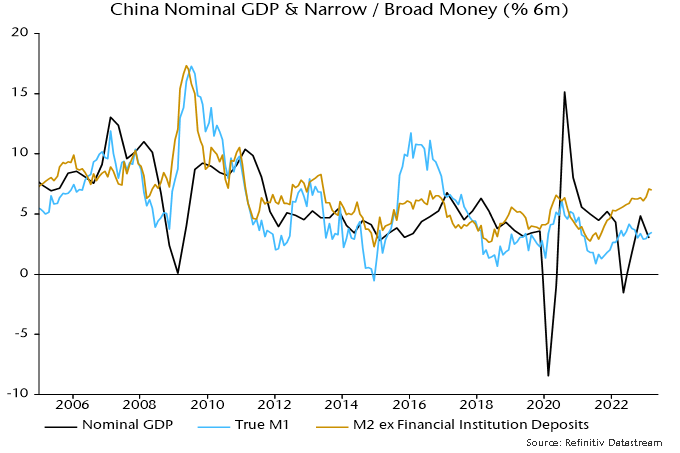
Moderate nominal GDP expansion is consistent with recent narrow money trends: six-month growth of true M1 (which corrects the official M1 measure to include household demand deposits) remains range-bound and slightly below its 2010s average – chart 4**. 

Chart 4

Chart 4 showing China Nominal GDP & Narrow / Broad Money (% 6m)

Broad money growth, as the chart shows, is significantly stronger. However, examination of the “credit counterparts” indicates that a rise since late 2021 has been driven mainly by banks switching to deposit funding and reducing other liabilities – domestic credit expansion has been stable. 

The judgement here is to place greater weight on narrow money trends, which currently suggest a moderate recovery that probably requires additional policy support to offset external headwinds. 

*Official unadjusted nominal GDP seasonally adjusted here; GDP deflator derived from comparison with official seasonally adjusted real GDP.

**March true M1 estimated pending release of demand deposits data.

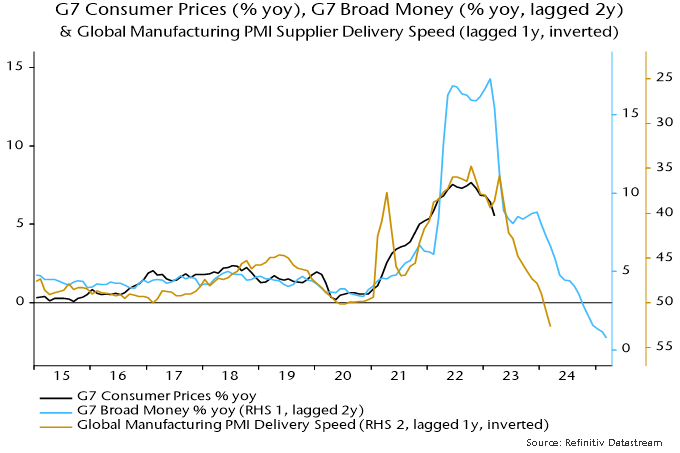
The “monetarist” forecast is that G7 inflation rates will fall dramatically into 2024, mirroring a collapse in nominal money growth in 2021-22.

G7 annual broad money growth returned to its pre-pandemic (2015-19) average of 4.5% in mid-2022. Based on the rule of thumb of a two-year lead, this suggests that annual inflation rates will be around pre-pandemic levels in mid-2024. More recent broad money stagnation signals a likely undershoot.

Pessimists argue that inflation will prove sticky because of high wage growth. Wages are a coincident element of the inflationary process. Low (but rising) wage growth didn’t prevent the 2021-22 inflation surge and high (but moderating) growth isn’t an obstacle to a substantial fall now.

The 2021-22 inflation surge was initially driven by excess demand for goods, due to a combination of covid-related supply disruption, associated precautionary overbuilding of inventories, a spending switch away from services and – most importantly – excessive monetary / fiscal stimulus.

Excess goods demand was reflected in a plunge in the global manufacturing PMI supplier delivery speed index to a record low. This plunge predated the inflation surge by about a year versus a two-year lead from money – see chart 1.

Chart 1

Chart 1 showing G7 Consumer Prices (% yoy), G7 Broad Money (% yoy, lagged 2y) & Global Manufacturing PMI Supplier Delivery Speed (lagged 1y, inverted)

The reverse process is now well-advanced, with supply normalising, firms running down excess inventories, the services spending share rebounding and monetary policies far into overrestrictive territory. The PMI delivery speed index is at its highest level since the depths of the 2008-09 recession, signalling substantial excess goods supply.

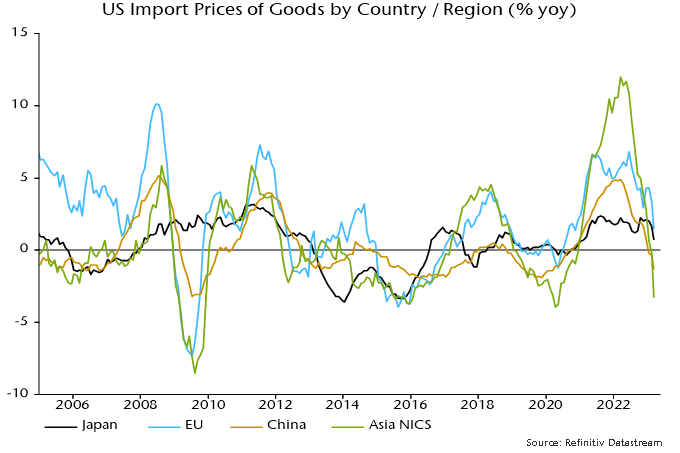
Global goods prices are heading into deflation. Chinese reopening has added to excess supply and Asian exporters are already lowering prices in the US – chart 2. Chinese producer prices are falling and the renminbi is competitive, with JP Morgan’s PPI-based real effective rate at its lowest level since 2011. Other Asian currencies are similarly weak.

Chart 2

Chart 2 showing US Import Prices of Goods by Country / Region (% yoy)

The global manufacturing PMI output price index lags and correlates negatively with the delivery speed index. It has plunged from 64 to 53 and is likely to cross below 50 soon. The current prices received balance in the US Philadelphia Fed manufacturing survey turned negative (equivalent to sub-50 in PMI terms) in April, the weakest reading since the 2020 recession.

Global goods deflation will squeeze profits and wage growth in that sector, with knock-on effects on services demand, pay pressures and pricing.

Central bankers are once again asleep at the wheel, pursuing procyclical polices that amplify economic volatility and impose unnecessary costs.

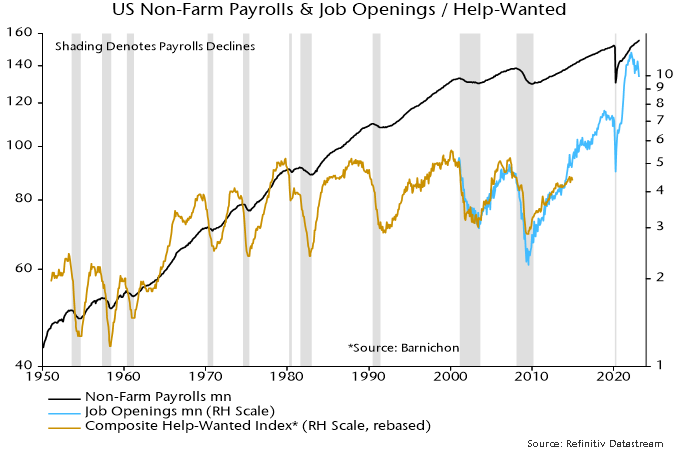
US February job openings were 17% below their March 2022 peak. Historically, a decline of this magnitude in vacancies – job openings or, for earlier years, help-wanted advertising – was always associated with a payrolls recession. 

Job openings numbers are available back to 2000. Regis Barnichon, now at the San Francisco Fed, constructed a proxy series – composite help-wanted advertising – for earlier decades. The Barnichon series adjusts historical data on newspaper advertising for a rising share of online job postings, modelled by an S-curve. 

The official and Barnichon series (which is no longer updated) can be spliced together to create a continuous vacancies series extending back to the early 1950s, a period encompassing 11 recessions involving sustained payrolls declines – see chart 1. 

Chart 1

Chart 1 showing US Non-Farm Payrolls & Job Openings / Help-Wanted

Every payrolls decline was preceded by a fall in vacancies but several vacancies declines were followed by slowdowns in payrolls rather than outright weakness (e.g. 1966). 

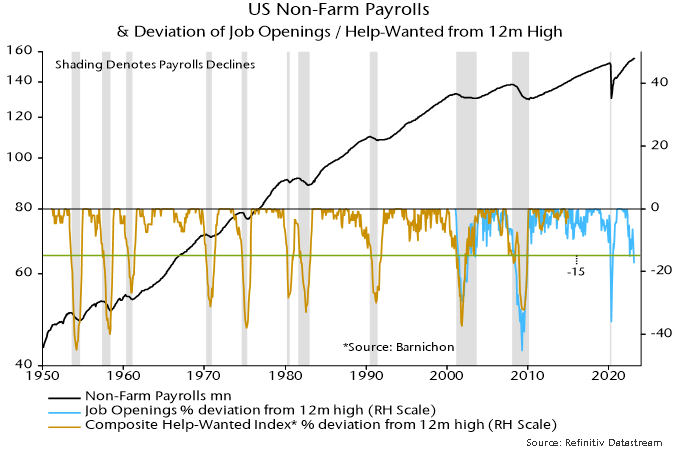
A sufficient condition for a payrolls recession was a fall of more than 15% in vacancies from their peak level in the latest 12 months – chart 2. This condition was met in February job openings numbers released last week. 

Chart 2

Chart 2 showing US Non-Farm Payrolls & Deviation of Job Openings / Help-Wanted from 12m High

Historically, the 15% threshold was reached around the time that payrolls started to decline. In six of the 11 cases, payrolls had already peaked, although this was not always known at the time. 

As an example, current data show a 1974 payrolls decline beginning in August, one month before the vacancies fall reached the 15% trigger. In real-time data, however, a payrolls peak was delayed until October.

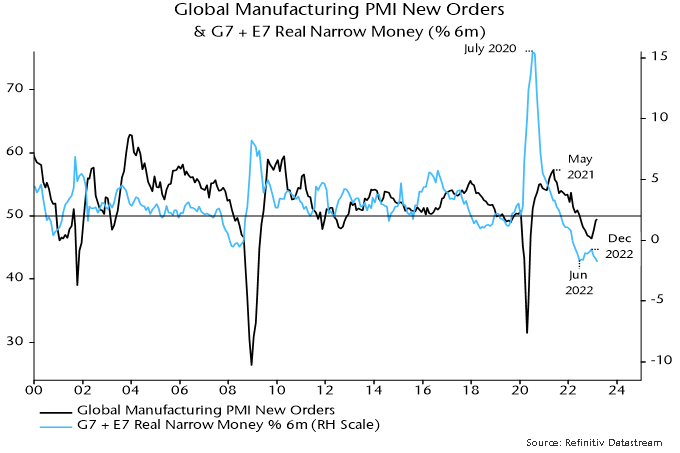
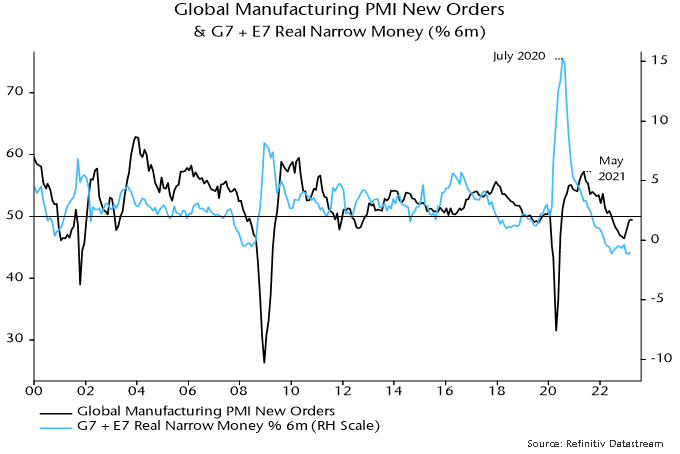
Partial information indicates that global (i.e. G7 plus E7) six-month real narrow money momentum fell for a third month in March, possibly breaching a low reached in June 2022. This increases confidence that a recent recovery in PMIs will reverse into H2. 

The June 2022 low in real narrow money momentum presaged a low in global manufacturing PMI new orders in December – see chart 1. Assuming the same six month lead, the roll-over in real money momentum since December 2022 implies a PMI decline from June. 

Chart 1

Chart 1 showing Global Manufacturing PMI New Orders & G7 + E7 Real Narrow Money (% 6m)

The fall could start earlier. The recovery in real money momentum between June and December 2022 was minor and driven entirely by a slowdown in six-month consumer price inflation. Momentum failed to break into positive territory. Credit tightening due to recent banking stresses may accelerate economic weakness. 

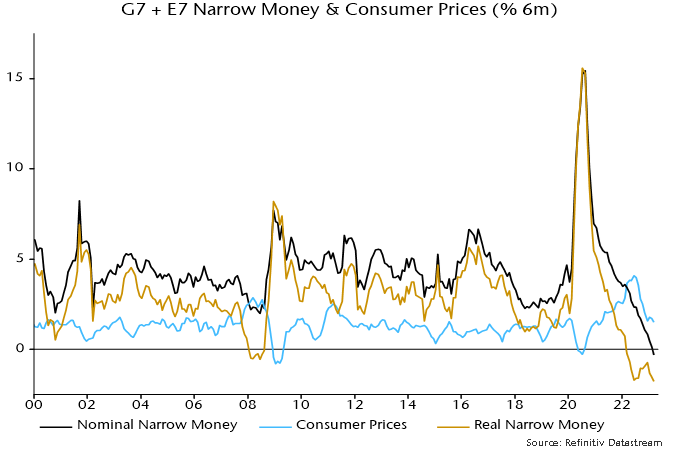
The renewed fall in global real money momentum since December reflects nominal money weakness rather than any inflation rebound: the six-month rate of change of nominal narrow money appears also now to be negative, a feat never achieved during the GFC – chart 2. 

Chart 2

Chart 2 showing G7 + E7 Narrow Money & Consumer Prices (% 6m)

Nominal money contraction is being driven the US and Europe, with momentum positive and stable in the E7 and Japan. 

Global real money momentum will be supported by a further inflation slowdown but a significant recovery is unlikely without a policy reversal that revives nominal money growth. As previously argued, recent reexpansion of the Fed’s balance sheet has no direct – or, probably, indirect – impact on money stock measures. 

The fall in global real money momentum has further delayed the expected cross-over above weakening industrial output momentum, suggesting fading the Q1 equity market rally and favouring defensive sectors, quality and yield.

Eurozone February monetary data were extraordinarily negative, suggesting that interest rates were already at a restrictive level before the 50 bp rate hikes in February / March. 

Economic sentiment has lifted in early 2023 in response to a collapsing gas price and China’s reopening but the impact of monetary restriction has yet to kick in. 

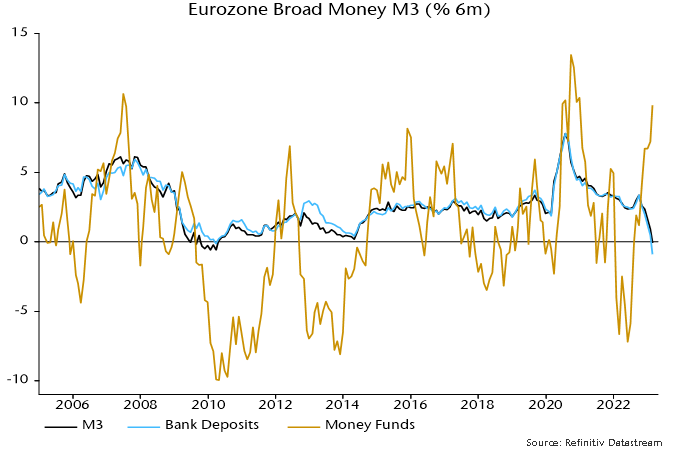
The headline M3 broad money measure was down again in February and has fallen in four of the last five months. The six-month rate of change turned negative and is the weakest since 2010 in the aftermath of the GFC – see chart 1. 

Chart 1

Chart 1 showing Eurozone Broad Money M3 (% 6m)

Bank deposits are contracting at a faster pace than then because of a portfolio switch into money market funds and short-term bank bonds. This switch has been motivated by relative yields but the banking crisis could give a further boost to money fund inflows. 

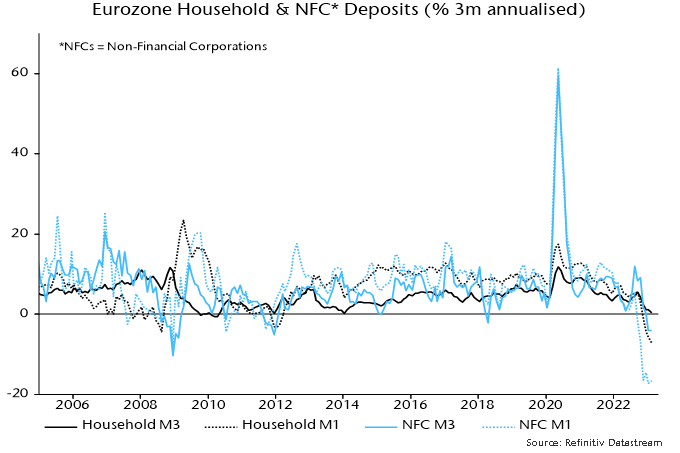
Corporate money trends are particularly alarming. Bank deposits of non-financial corporations contracted at a 4.0% annualised pace in the latest three months, with the overnight (M1) component down by 16.6% – chart 2. Household deposits fell in February and are barely up over three months, with a shift out of overnight accounts suggesting weak spending intentions. 

Chart 2

Chart 2 showing Eurozone Household & NFC* Deposits (% 3m annualised) *NFCs = Non-Financial Corporations

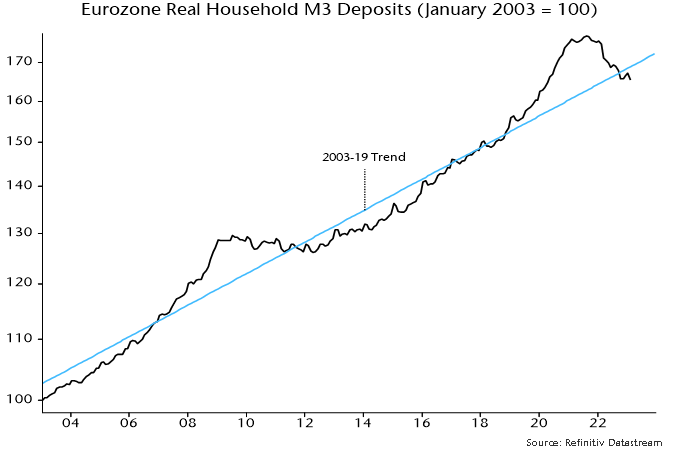
Talk of households still sitting on substantial spendable “excess” savings is suspect. Allowing for inflation erosion, household M3 deposits are below their pre-pandemic trend – chart 3. 

Chart 3

Chart 3 showing Eurozone Real Household M3 Deposits (January 2003 = 100)

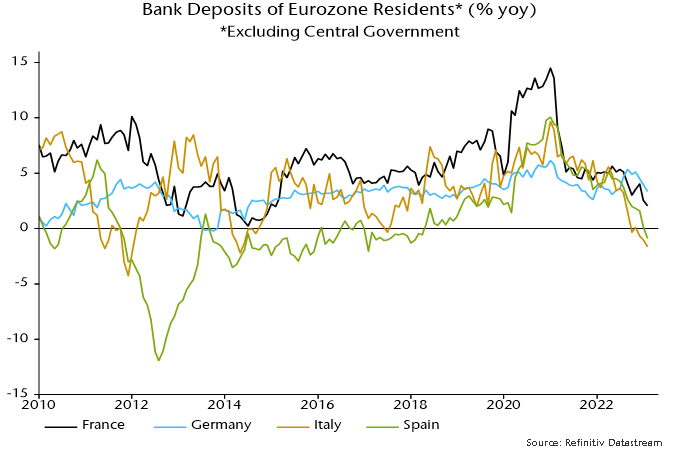
Country deposit data suggest that a core / periphery divergence is opening up, with Spain following Italy into year-on-year contraction – chart 4. 

Chart 4

Chart 4 showing Bank Deposits of Eurozone Residents* (% yoy) *Excluding Central Government

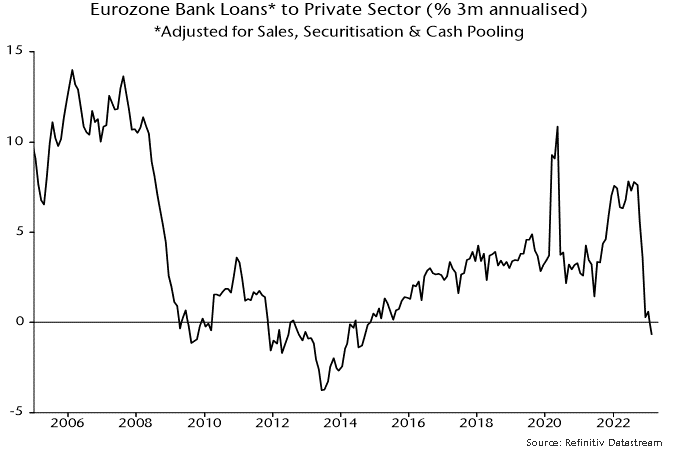
Monetary weakness partly reflects a collapse in credit growth: three-month loan momentum was running at an annualised 7.6% as recently as September but turned negative in February – chart 5. 

Chart 5

Chart 5 showing Eurozone Bank Loans* to Private Sector (% 3m annualised) *Adjusted for Sales, Securitisation & Cash Pooling

Corporations have been repaying short-term loans in size since November, consistent with a downswing in stockbuilding, which reached a record share of GDP in Q4. Numbers could bounce near term as firms draw down credit lines while they still can.

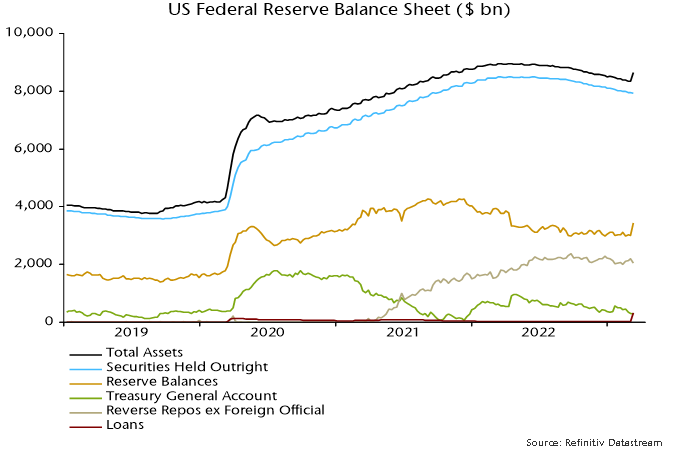
Lending by the Fed to depository institutions jumped from $15 billion to $318 billion between 8 and 15 March – see chart 1 (red line). The emergency loans – mostly via the discount window and via the FDIC rather than under the new Bank Term Funding Program – were the main driver of a $441 billion surge in banks’ reserves at the Fed. 

Chart 1 

Chart 1 showing US Federal Reserve Balance Sheet ($ bn)

These developments do not represent an easing of monetary conditions, except relative to a much tighter baseline that would have resulted from the Fed failing to accommodate increased demand for monetary base due to the banking crisis. 

  • Unlike QE, Fed lending to the banking system has no direct impact on money stock measures (i.e. money held by households and non-bank firms). (QE has an impact to the extent that securities are purchased from non-banks.) 
  • Unlike QE, the reserves rise is temporary and will reverse if the crisis abates and lending is repaid. 
  • The emergency / temporary nature of the lending / reserves rise implies no incentive for banks currently experiencing inflows to expand assets. (QE can have secondary monetary effects by encouraging lending / securities purchases.) 

Resolution of the crisis requires the authorities to arrest broad money contraction. A run-down of the Treasury’s cash balance at the Fed won’t be sufficient; QT needs to be suspended / reversed to offset a cutback in lending by troubled banks. Consideration should also be given to limiting the drain of deposits to money funds, e.g. by capping their access to Fed’s overnight reverse repo facility.

Markets are moving towards the view that the Fed will be forced to suspend or reverse interest rate hikes in response to the SVB crisis but a cessation of QT is a more important requirement for restoring banking system stability. 

QT also caused the 2019 repo rate crisis, which ended only after the Fed restarted securities purchases (Treasury bills) – portrayed, of course, as a “purely technical” measure rather than a return to QE. 

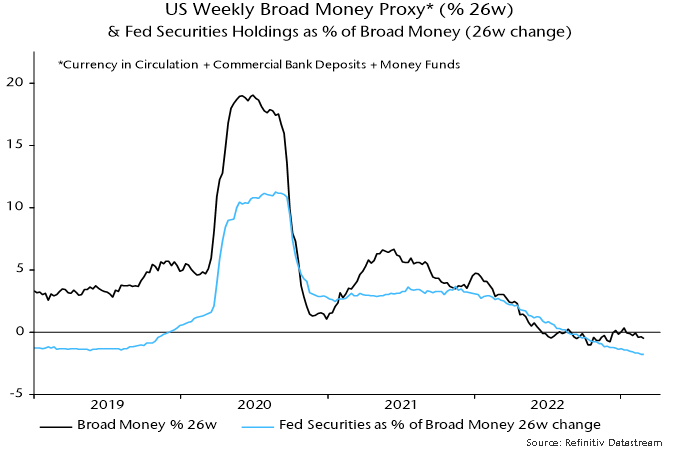
The US weekly broad money proxy calculated here has contracted since April 2022. Weakness initially reflected the US Treasury “overfunding” the federal deficit to rebuild its cash balance at the Fed. QT has been the driver more recently – see chart 1. 

Chart 1

Chart 1 showing US Weekly Broad Money Proxy* (% 26w) & Fed Securities Holdings as % of Broad Money (26w change) *Currency in Circulation + Commercial Bank Deposits + Money Funds

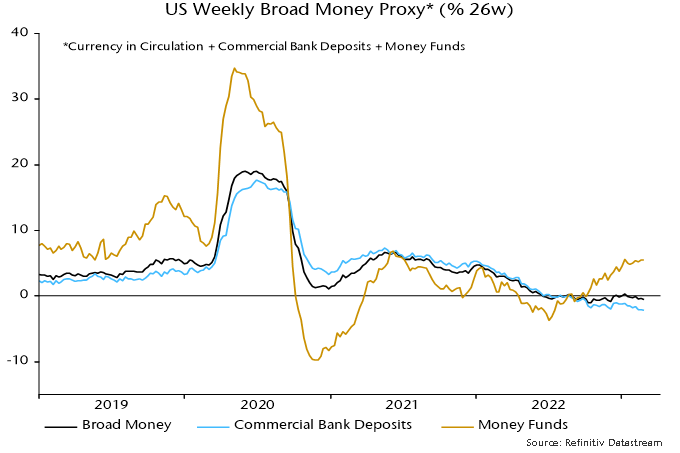
The drain of deposits from commercial banks has been magnified by competition from money market funds, which are able to place overnight funds with the Fed at an interest rate (currently 4.55%) within the Fed’s target range for the Fed funds rate (4.5-4.75%). 

Balances in retail and institutional money funds grew by 5.5% (11.3% at an annualised rate) in the latest 26 weeks, while commercial bank deposits contracted by 2.2% (4.4% annualised) – chart 2. 

Chart 2

Chart 2 showing US Weekly Broad Money Proxy* (% 26w) *Currency in Circulation + Commercial Bank Deposits + Money Funds

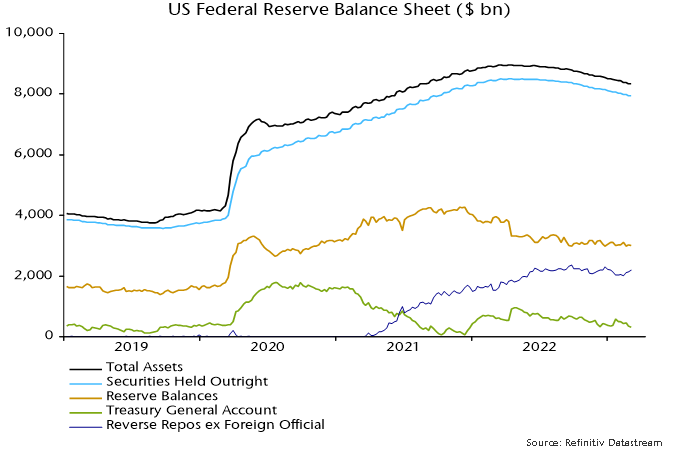
In combination, Treasury overfunding, QT and outflows to money funds have resulted in a 30% decline in banks’ reserve balances at the Fed from a peak in December 2021 – chart 3. 

Chart 3

Chart 3 showing US Federal Reserve Balance Sheet ($ bn)

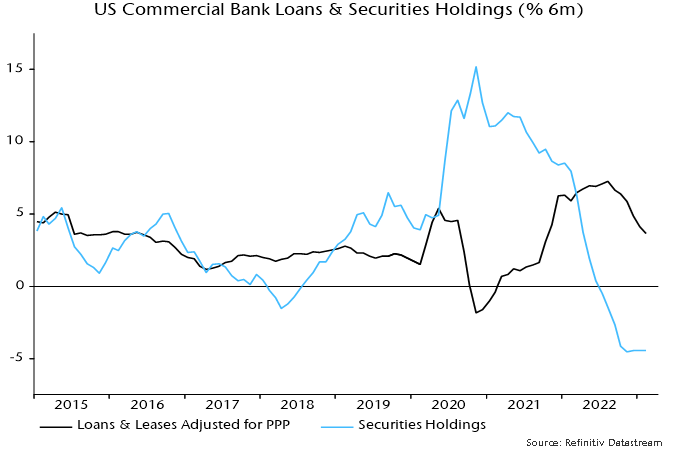
The deposits / reserves drain has caused banks to sell securities and, more recently, restrict loan supply – chart 4. 

Chart 4

Chart 4 showing US Commercial Bank Loans & Securities Holdings (% 6m)

The new Bank Term Funding Program will allow banks to avoid selling securities at a loss but fails to address the system-wide loss of deposits due to QT. The Fed facility, moreover, is more expensive than the deposits it may replace. 

Fortuitously, downward pressure on broad money has recently been relieved by a run-down of the Treasury’s cash balance at the Fed, reflecting the debt ceiling impasse. The decline, indeed, may have been accelerated to inject liquidity into the banking system – the balance fell from $345 bn to $247 bn between Wednesday and Friday last week. 

Such relief, however, is temporary. The authorities’ actions to date may be sufficient to avert another bank collapse but the banking system will remain under pressure, with negative economic implications via rising deposit / lending rates, until QT-driven monetary contraction ends.

Luminated office buildings at Canary Wharf, London at night.

Connor, Clark & Lunn Funds Inc. (CC&L Funds) is excited to announce the recent launch of a prospectus qualified version of the NS Partners International Equity Focus portfolio, which is now available to individual Canadian investors. The NS Partners International Equity Focus Fund is based on a similar portfolio, previously available only to institutional and internal investors.

The Fund seeks to provide investors with long term capital appreciation by investing in a portfolio comprised primarily of non-North American equities, including up to 20% in emerging markets.

To manage the fund, CC&L Funds has retained NS Partners Ltd (NS Partners) a London, UK-based manager with over 30 years of experience in managing international equity portfolios, including developed and emerging markets. NS Partners combines a bottom-up quality/growth framework to analyze companies with a unique top-down global liquidity analysis to help identify regions, countries and sectors that are expected to out and underperform, as well as whether to position the portfolio for a ‘risk-seeking’ or ‘risk averse’ environment.

“For investors allocated to large-cap global equity portfolios, there is a compelling case to make a stand-alone allocation to international equities, given the valuation and concentration issues in the large-cap U.S. equity market, and the headwind of a strong U.S. dollar. By introducing our NS Partners International Equity Focus portfolio in fund format, we can offer a compelling solution for individual investors, managed by a proven, institutional caliber investment team with a differentiated approach” said Tim Elliott, President and CEO of CC&L Funds.

“We’re excited that our International Equity Focus portfolio is being made accessible to a broader group of Canadian investors. With our proven process, a strong record on the institutional side and our talented and committed investment team, we believe this portfolio will provide an attractive solution for those seeking long-term growth from international equity markets.” said Tim Bray, President and Chief Investment Officer at NS Partners.

Both CC&L Funds and NS Partners are affiliates of Connor, Clark and Lunn Financial Group (“CC&L”), whose multi-affiliate structure brings together the talents of diverse investment teams who offer a broad range of traditional and alternative investment solutions. CC&L is one of Canada’s largest independently owned asset managers, responsible for over $104 billion in assets on behalf of institutional and individual investors.

About the fund

Available in A and F Series, the fund conforms with the regulatory framework related to conventional mutual funds offered by Simplified Prospects. The fund will be offered through licensed investment dealers, priced daily, with daily liquidity, and available through FundServ.

About Connor, Clark & Lunn Funds Inc.

Connor, Clark & Lunn Funds Inc. (CC&L Funds) partners with leading Canadian financial institutions and their investment advisors to deliver unique institutional investment strategies to individual investors through a select offering of funds, alternative investments and separately managed accounts.

By limiting the offering to a focused group of investment solutions, CC&L Funds is able to deliver unique and differentiated strategies designed to enhance traditional investor portfolios. For more information, please visit www.cclfundsinc.com.

About NS Partners Ltd

NS Partners Ltd is an independent investment management firm specializing in actively managed global equity portfolios on behalf of major companies, pension funds, foundations, endowments and sovereign wealth funds. NS Partners Ltd is part of the Connor, Clark & Lunn Financial Group, a multi-boutique asset management firm. For more information, please visit www.ns-partners.co.uk.

About Connor, Clark & Lunn Financial Group Ltd.

Connor, Clark & Lunn Financial Group Ltd. (CC&L Financial Group) is an independently owned, multi-affiliate asset management firm that provides a broad range of traditional and alternative investment management solutions to institutional and individual investors. CC&L Financial Group brings significant scale and expertise to the delivery of non-investment management functions through the centralization of all operational and distribution functions, allowing talented investment managers to focus on what they do best. CC&L Financial Group’s affiliates manage over $104 billion in assets. For more information, please visit www.cclgroup.com.

Contact

Lisa Wilson
Manager, Product & Client Service
Connor, Clark & Lunn Funds Inc.
416-864-3120
[email protected]
A Eurozone recession can now be ruled out, according to the ECB and a PMI-hugging consensus. 

Someone forgot to tell the monetary data. 

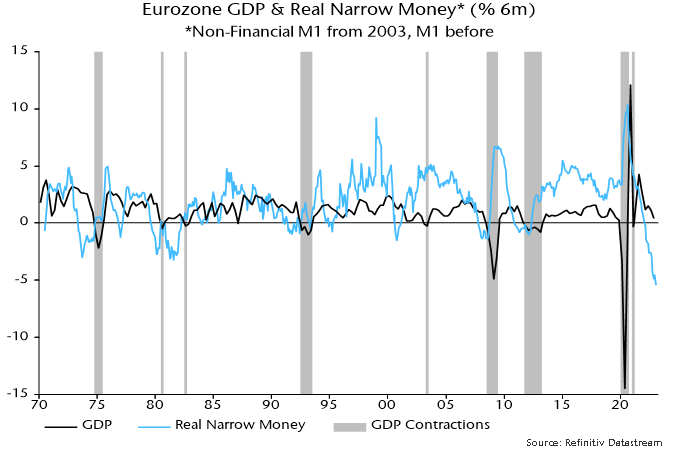
The favoured Eurozone narrow money measure here – non-financial M1 – fell for a fifth consecutive month in January, while broad money – non-financial M3 – was unchanged following marginal gains in November / December. 

With inflation data remaining hot, six-month contraction of real narrow money (i.e. deflated by consumer prices) reached a new record, of 5.4% or 10.5% annualised – see chart 1.

Chart 1

Chart 1 showing Eurozone GDP & Real Narrow Money* (% 6m) *Non-Financial M1 from 2003, M1 before

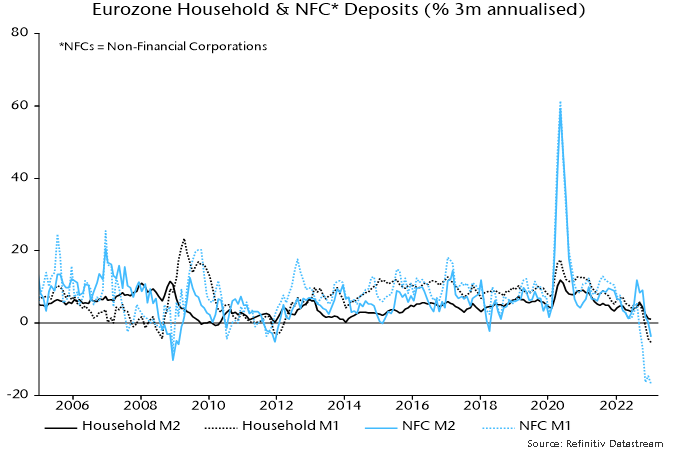
post last month noted that UK sectoral money trends were displaying a recessionary pattern: corporate broad and narrow money holdings were falling in nominal terms, suggesting a cash flow squeeze, while households were moving large sums out of time deposits into sight deposits, consistent with a shift in consumer behaviour from spending to saving. 

The same trends are now on show in the Eurozone: corporate M2 and M1 deposits fell in the three months to January, as did household M1 deposits – chart 2. 

Chart 2

Chart 2 showing Eurozone Household & NFC* Deposits (% 3m annualised) *NFCs = Non-Financial Corporations

The no-recession bandwagon gained momentum following Eurostat’s flash estimate that Eurozone GDP grew by 0.1% in Q4. Recently released national details paint an uglier picture. 

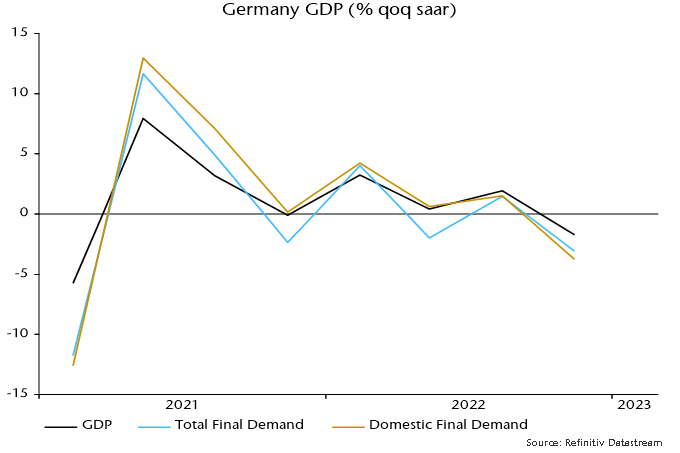
The Q4 fall in German GDP was revised from 0.2% to 0.4%, which will feed into an updated Eurozone number next week. 

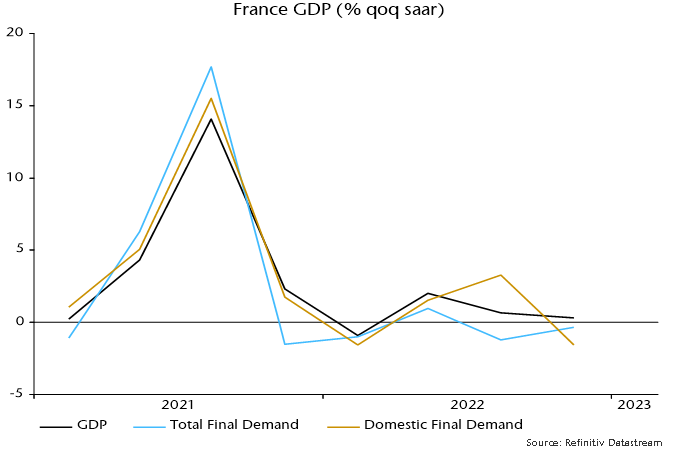
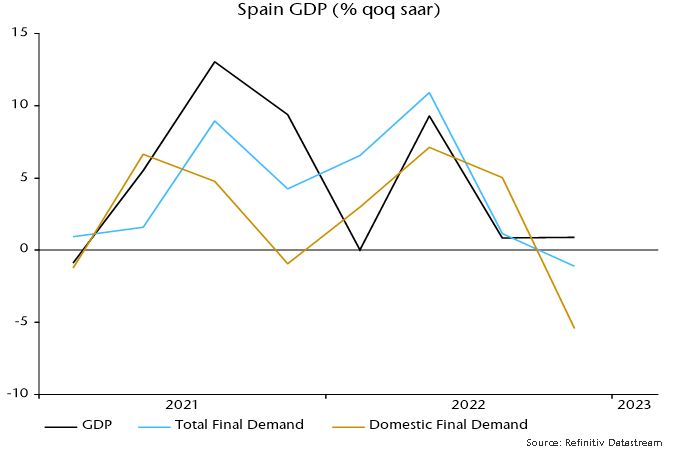
More significantly, expenditure breakdowns show that domestic final demand weakened sharply in Q4 in France, Germany and Spain – at annualised rates of 1.6%, 3.7% and 5.4% respectively. The GDP impact was cushioned by a rise in net exports driven by import weakness and a further increase in stockbuilding – charts 3-5. 

Chart 3

Chart 3 showing France GDP (% qoq saar)

Chart 4

Chart 4 showing Germany GDP (% qoq saar)

Chart 5

Chart 5 showing Spain GDP (% qoq saar)

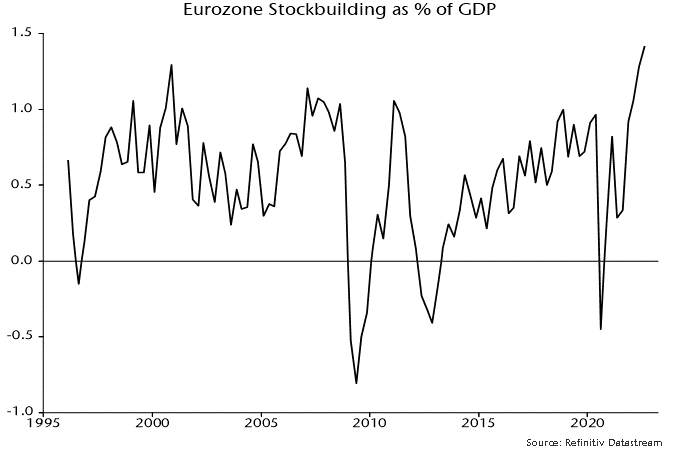
Eurozone stockbuilding, therefore, appears to have risen further from its record (in data since the mid 1990s) share of GDP in Q3 – chart 6. A violent reversal from lower peaks in 2007 and 2011 was a key driver of the 2008-09 and 2011-12 recessions. 

Chart 6

Chart 6 showing Eurozone Stockbuilding as % of GDP

The no-recession narrative was bolstered by February PMI results showing a pick-up in Eurozone services activity and new business. Manufacturing new orders, however, remained contractionary and are a better guide to the cyclical trend (since the key economic cycles – stockbuilding, business investment and housing – involve goods demand; there is no independent services cycle). 

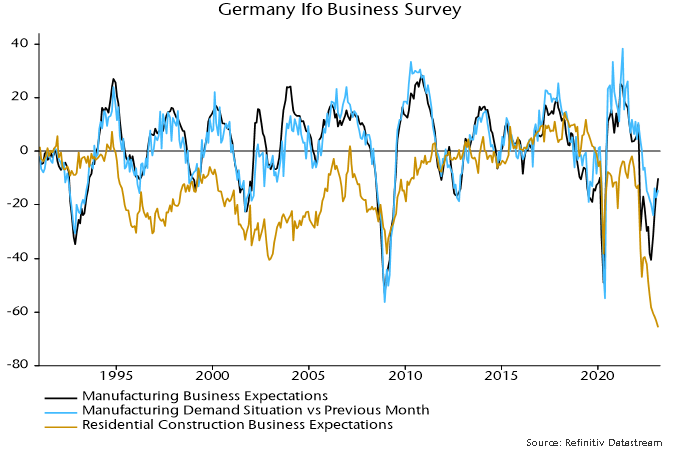
The move off the lows in manufacturing PMI results has been mirrored in the German Ifo manufacturing survey. Business expectations, however, remain weak by historical standards and an indicator of demand inflow has risen by less, stalling between December and February – chart 7. 

Chart 7

Chart 7 showing Germany Ifo Business Survey

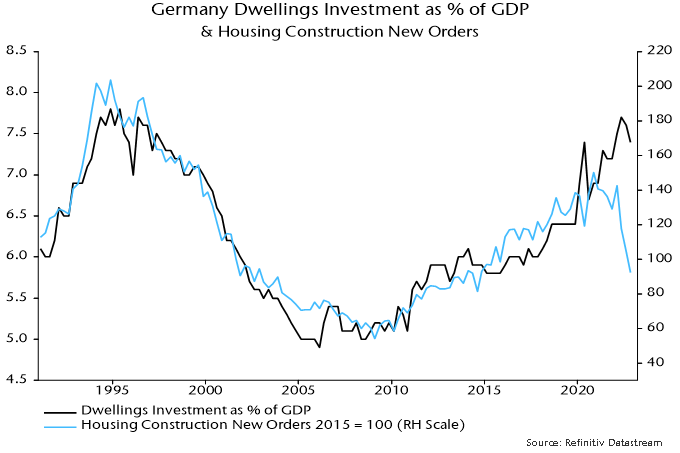
Residential construction expectations, meanwhile, plumbed another record low in February. Survey weakness has been reflected in hard data: housing construction new orders in Q4 were down 35% from Q1 and the lowest since 2014. Dwellings investment was a drag on GDP during H2 2022 but the orders plunge suggests a further big negative impact to come – chart 8.

Chart 8

Chart 8 showing Germany Dwellings Investment as % of GDP & Housing Construction New Orders
A green and yellow motorized rickshaw zips through the streets of Delhi, India.

Since the World Bank’s International Finance Corporation first coined the term emerging markets in 1981, the characteristics and composition of the markets have evolved significantly. Past concerns regarding the resilience of emerging markets during a crisis led some investors to struggle with the merits of including a direct allocation. However, with the rise of China and its leadership of global economic growth, investors are increasingly considering a dedicated allocation to emerging markets. This article reviews the evolution and the general case for investing in emerging markets.

The key attributes supporting the case for global emerging markets have been evident for some time and include:

Greater growth In the latest Global Economic Prospects report by The World Bank Group, emerging and developing economies are forecast to grow more than double that of advanced economies in 2023 and 2024.
Drivers of Innovation Many emerging markets companies have become leaders of innovation in important sectors such as internet-related technologies, electric vehicle battery manufacturing, and computer chip manufacturing.
Household names Many emerging market companies are household names such as Samsung and Hyundai, while other less recognized companies have acquired well-known global brands.
Rising returns As emerging markets shift from manufacturing to more value-added industries, there is an expectation for the ability to generate superior returns to rise.
Alpha opportunities Emerging markets are less researched by the analyst community compared with large cap developed equity markets, which creates opportunities for excess returns from independent research by active managers.


 Background

Emerging markets are characterized as countries with growing economies and a growing middle-class population. Many of these markets continue to have high rates of poverty, and often they are still experiencing significant social and political change. But despite such headwinds, the growth prospects of emerging markets can provide a strong base for investors to be rewarded.

The market capitalization of emerging markets was US$ 90,456 billion as of December 31, 2022, representing a little over 11% of the world equity capitalization. Yet many institutional investors have no direct exposure to emerging markets. Instead, investors often rely on their international and global equity managers to selectively invest in emerging markets, which can result in the allocation falling well short of its representation of the world equity market capitalization. With emerging markets representing the highest growth area of global stock markets, there is a case for investors to benefit from at least a market representation.

The MSCI Emerging Markets Index is comprised of over 1,300 stocks in 24 countries. Countries are normally grouped into three regions, Emerging Markets Asia, Emerging Markets Latin America and Emerging Markets Europe, Middle East and Africa, with the Asian region representing almost 80% of the market index.

Evolution

For the longest time emerging markets were considered similar to the Canadian equity market, with a heavy bias to commodities. Today, the combined weighting in energy and materials for emerging markets is less than 13% of the index market capitalization, compared to 30% of the Canadian equity market. Instead, emerging markets have evolved to offer opportunities different to the Canadian equity market. For example, emerging markets have experienced a steady rise in the information technology and health care sector allocations, which together represent over 20% of the market index (Figure 1). Not only that, but within the information technology sector there has also been a radical change in its composition with large and successful companies, such as Alibaba and Tencent making up an important component of the sector.

Figure 1: Index Sector Allocations

Global Industry Classification (GIC) Sector MSCI Emerging Markets (%) S&P/TSX Composite (%)
Energy 5.0 18.1
Materials 7.6 12.0
Industrials 19.4 13.3
Consumer Discretionary 12.5 3.7
Consumer Staples 4.7 4.2
Health Care 10.7 0.4
Financials 14.3 30.8
Information Technology 10.8 5.7
Communication Services 2.8 4.9
Utilities 3.2 4.4
Real Estate 8.9 2.6


Source: Thomson Reuters Datastream. Data as of December 31, 2022. Due to rounding, column percentages may not total 100%.

The financial sector represents around 14% of the index and offers a further differentiation versus developed markets, where the loan-to-deposit ratios in emerging market companies are generally lower.

However, the biggest change to the emerging market index has been with respect to country allocation, and the growing dominance of China in the index. It was not long ago that large cap China A shares represented less than 1% of the MSCI Emerging Markets Index. At the end of 2022, China accounted for over 32% of the index (Figure 2).

Figure 2: Region and Larger Country Allocations

Region and Country MSCI Emerging Markets Index (%)
Emerging Markets Asia 78.3
China 32.3
India 14.4
Taiwan 13.8
Republic of Korea 11.3
Emerging Markets Europe, Middle East & Africa 13.2
Saudi Arabia 4.1
United Arab Emirates 1.4
Qatar 1.0
Kuwait 0.9
South Africa 3.7
Emerging Markets Latin America 8.5
Brazil 5.3
Mexico 2.3


Understanding the Risks

It is important to appreciate risks associated with investing in emerging markets. While active managers can mitigate some of these risks through research and careful selection of individual stocks, investors should recognize the following.

  • Political and social risk: Political and social changes taking place in emerging market countries can lead to uncertainty due to corruption, regulations not always being rigorously enforced, or governments exhibiting an unwanted influence. The uncertainty contributes to market volatility. For example, Beijing’s actions to limit the influence of Hong Kong-listed technology companies, combined with a real estate sector crisis and the zero-COVID policies that witnessed longer strict pandemic controls relative to most other governments, contributed to a tough and volatile 2021-2022 for emerging market equities.
  • Information and liquidity risk: Although the quality of data has vastly improved, obtaining good, complete and timely information can still be challenging in emerging markets. Currency controls remaining in a small number of markets also may create liquidity concerns.

Recognizing the potential benefits

While the countries are classified as emerging, nearly all the companies in the MSCI Emerging Markets Index have a market capitalization greater than US$ 1 billion, which compares to 209 Canadian companies with a market value above US$ 1 billion. Increasingly, emerging market companies are becoming household names, whether on their own merits, or through acquisition of global branded companies, such as Samsung, Hyundai Motor and the Indian conglomerate, Tata, which is the owner of brands such as Jaguar, Land Rover and Tetley Tea.

The key benefits offered by emerging markets include:

  • Growth opportunity: The drivers of growth are wide ranging and include demographics, economic development, technology, innovation, infrastructure development, and capital market developments. While global growth is expected to moderate from 2021 levels, emerging and developing countries are expected to account for a significant component of world gross domestic product (GDP). The World Bank forecasts emerging and developing markets to grow at an average annual rate of 3.4% in 2023 and 4.1% in 2024, compared to expansion of only 0.5% and 1.6%, respectively for advanced (developed) economies.1 A significant proportion of developed market company earnings are also linked to emerging market growth, further underlining its importance.
  • Drivers of innovation: Innovation in emerging markets has contributed to its evolution, as well as China becoming an important component of the market. Innovation has allowed several emerging market countries to leapfrog the developed world in terms of business models. For example, while many farmers in India have no access to computers and landlines, smart phones have created an information and business environment that allows buyers and sellers to interact, as well as enabling e-payments.
  • Rerating opportunity: Ordinarily, high-growth assets are priced at a premium. Emerging market stocks have traditionally traded at a discount to developed world valuations, but the economic fundamentals for emerging markets as a whole have improved.
  • Improving returns: Many emerging market companies are shifting away from manufacturing for Western companies and looking to develop their own identity and growth success. To achieve this they are tapping into higher value-added areas using brands and technology, recognizing that branded firms with loyal followers can achieve more than double the margins of non-brand firms. Return on invested capital (ROIC) should rise for emerging market companies as they develop world-class brands.
  • Growing universe of opportunities: The growth of China in the emerging market index has also witnessed a growth in the universe of investment opportunities. Today, there are as many China A shares that meet the typical liquidity and market capitalization criteria as there are in the United States (US) equity market. Similarly, the number of opportunities for emerging markets excluding China is not too different from the number of opportunities for the global developed market, excluding the US.
  • Style offset opportunity: The growing opportunity set has witnessed a growth in systematic (quantitative) fund offerings, where the managers use technology to gain a breadth of understanding on a large universe of companies, compared to the depth of understanding associated with fundamental managers focused on selecting a smaller portfolio of companies. As for other equity markets, investors who can accommodate multiple managers in an asset class can benefit from the complementary approaches of systematic and fundamental styles.
  • Alpha opportunity: The external analyst community generally undertakes less research of emerging market companies compared to global developed companies. Active managers have been able to benefit from independent research with over 86% of managers in the emerging market equity universe outperforming the MSCI Emerging Market Index over the 10 years ended December 31, 2021 (based on the eVestment database).

Environmental, Social and Governance Considerations (ESG)

Despite the political and social challenges associated with emerging market countries, companies are increasingly recognizing the importance of ESG considerations. Helping this cause has been the expansion of ESG coverage of emerging markets companies by third-party providers. The importance of each ESG component varies from one country, industry or company to another. However, like the developed world, corporate governance tends to be the most material issue, followed by the steps being taken to manage the environmental impact of companies in the emerging markets.

The Case for Emerging Markets

Many investors are underweight emerging markets relative to its representation in world equity markets, yet global growth is expected to be led by emerging and other developing markets.

Canadian investors have historically shied away from emerging markets, partly due to the historical commodity bias. Today, emerging markets offer a very different opportunity set due to innovation that has seen a transformation in the type of companies and opportunities, including a significant growth in the information technology sector.

As emerging market companies shift from manufacturing to higher value-added interests using brands and technology, the number of emerging market household names will increase, and help to grow margins and ultimately the return potential from emerging markets.


1 Source: World Bank Global Economic Prospects, January 2023