The Sahm rule states that the (US) economy is likely to be in recession if a three-month moving average of the unemployment rate is 0.5 pp or more above its minimum in the prior 12 months. 

The rule identified all 12 US recessions since 1950 but gave two false positive signals based on current (i.e., revised) unemployment rate data (1959 and 2003) and four based on real-time data (additionally 1967 and 1976). 

The signal occurred after the start date of the recession in all 12 cases, with a maximum delay of seven months* (in the 1973-75 recession). 

The Sahm condition hasn’t yet been met in the US – the unemployment rate three-month average was 3.6% in June versus a 12-month minimum of 3.5%. 

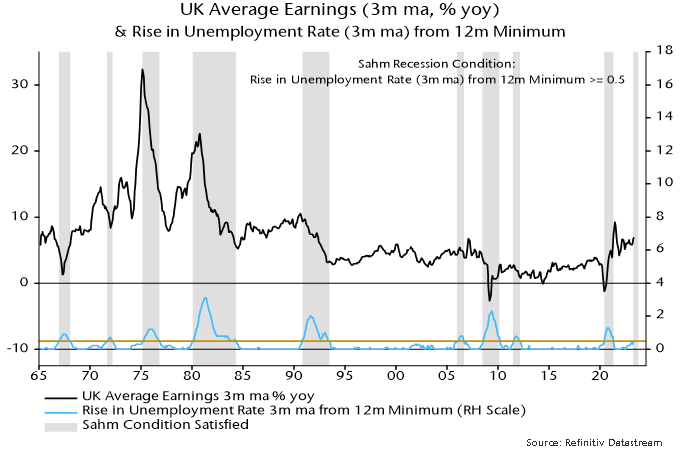
The rule has, however, triggered a warning in the UK, where the jobless rate averaged 4.0% over March-May, up from 3.5% over June-August 2022. 

UK Sahm rule warnings occurred on nine previous occasions since 1965, six of which were associated with GDP contractions. 

The Sahm signal is another indication that the UK economy is already in recession – see previous post – but a stronger message is that earnings growth is about to slow. 

Annual growth of average earnings fell after the Sahm signal in eight of the nine cases, the exception being the 2020 covid recession, when earnings numbers were heavily distorted by composition effects – see chart 1. 

Chart 1

Chart 1 showing UK Average Earnings (3m ma, % yoy) & Rise in Unemployment Rate (3m ma) from 12m Minimum

Previous generations of monetary policy-makers understood the dangers of basing decisions on the latest inflation and / or earnings data, which reflect monetary conditions 18 months or more ago. 

The current reactive approach, apparently endorsed by the economics consensus, may partly reflect mythology about a 1970s “wage / price spiral”. Rather than causing each other, high wage growth and inflation were dual symptoms of sustained double-digit broad money expansion. 

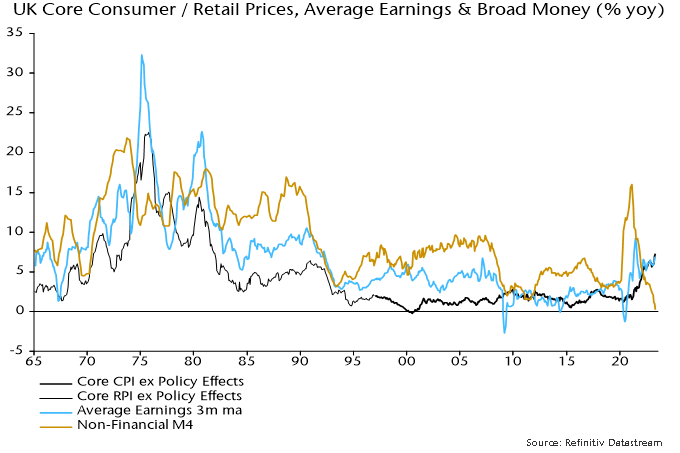
The monetarist case is summarised by chart 2, showing that earnings growth is almost coincident with core inflation whereas broad money expansion displays a long lead. (The correlations with core inflation are maximised with lags of four months for earnings growth and 24 months for money growth.) 

Chart 2 

Chart 2 showing UK Core Consumer / Retail Prices, Average Earnings & Broad Money (% yoy)

Recent monetary weakness argues that core inflation and wage growth will be much lower by late 2024; the Sahm rule signals that the decline is about to start.

*Eight months taking into account a one-month reporting lag.

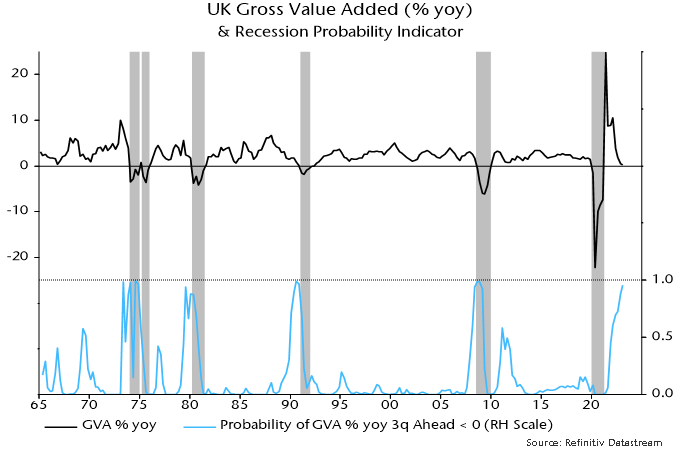
A recession likelihood gauge placing weight on monetary variables indicates a high probability of a contraction in UK GDP / gross value added (GVA) over the remainder of 2023. 

The indicator, regularly referenced in posts here, is based on a model that generates projections for the four-quarter change in GVA three quarters in advance using current and lagged values of a range of monetary and financial inputs. 

Using data up to June 2022, the model assigned a 70% probability to the four-quarter change in GVA being negative in Q1 2023. The current ONS estimate of this change is +0.2%. 

UK Gross Value Added (% yoy) & Recession Probability Indicator. Source: Refinitiv Datastream.

The probability reading rises to 96% incorporating data through March 2023, i.e. there is a 96% likelihood of the four-quarter change in GVA in Q4 2023 being negative, according to the model. 

The statistical analysis underlying the model indicates that GDP prospects are significantly influenced by movements in real narrow money (non-financial M1) and real corporate broad money (M4). Six-month rates of change of these measures have moved deeper into negative territory since mid-2022. 

The model’s increased pessimism also reflects a deepening inversion of the yield curve and falling real house prices. Other inputs include credit spreads and local share prices, which have yet to display recession-scale weakness.

DM flash results released last week suggest that the global manufacturing PMI new orders index fell sharply in June, having moved sideways in April and May following a Q1 recovery – see chart 1. 

Chart 1

Global Manufacturing PMI New Orders, & G7 + E7 Real Narrow Money (% 6m). Source: Refinitiv Datastream.

The relapse is consistent with a decline in global six-month real narrow money momentum from a local peak in December 2022. A recovery in real money momentum during H2 2022 had presaged the Q1 PMI revival. 

Real narrow money momentum is estimated to have fallen again in May, based on partial data, suggesting further PMI weakness into late 2023. 

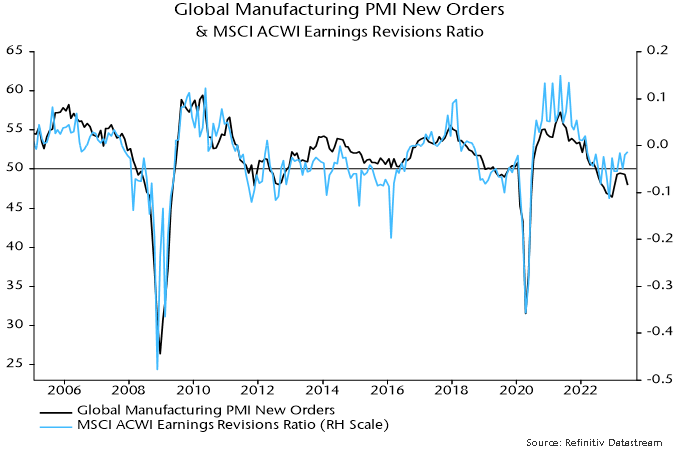
The global earnings revisions ratio has been contemporaneously correlated with manufacturing PMI new orders historically but remained at an above-average level in June, widening a recent divergence – chart 2. 

Chart 2

Global Manufacturing PMI New Orders, & MSCI ACWI Earnings Revisions Ratio. Source: Refinitiv Datastream.

Based on monetary trends, a reconvergence is more likely to occur via weaker earnings revisions than a PMI rebound. 

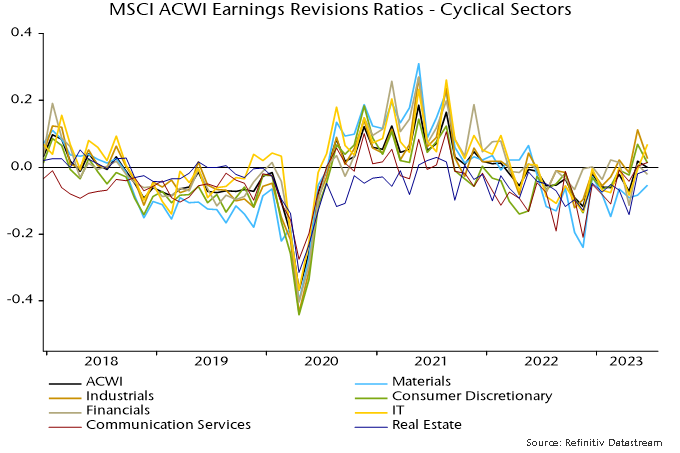
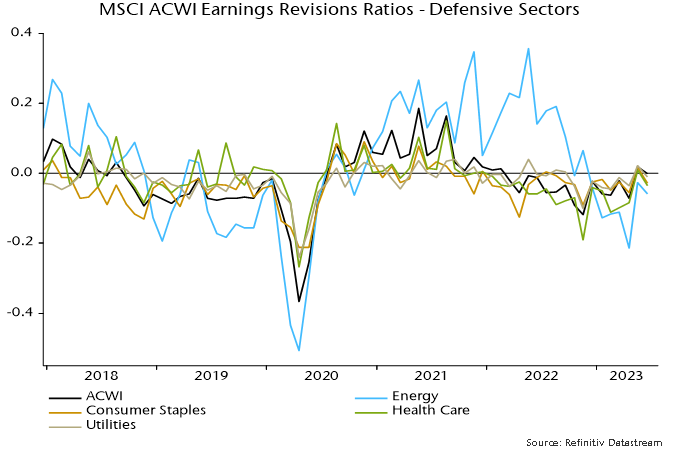
Charts 3 and 4 show that revisions resilience has been driven by cyclical sectors – in particular, IT, industrials and consumer discretionary. Notable weakness has been confined to the materials sector. Cyclical sectors may be at greater risk of downgrades if the global revisions ratio heads south. 

Defensive sector revisions have underperformed recently but are likely to be less sensitive to economic weakness. 

Chart 3

MSCI ACWI Earnings Revisions Ratios - Cyclical Sectors. Source: Refinitiv Datastream.

Chart 4

MSCI ACWI Earnings Revisions Ratios - Defensive Sectors. Source: Refinitiv Datastream.

The positive divergence of earnings revisions from the PMI may reflect firms’ ability to push through price increases to compensate for slower volumes. The deviation of the global revisions ratio (rescaled) from manufacturing PMI new orders – i.e. the gap between the blue and black lines in chart 2 – has displayed a weak positive correlation with the PMI output price index historically (contemporaneous correlation coefficient = +0.41). 

Any earnings support from pricing gains is now going into reverse: the output price index has crashed from an April 2022 peak of 63.8 to 49.8 in May, with DM flash results suggesting a further fall last month.

Why believe the “monetarist” forecast that recent G7 monetary weakness will feed through to low inflation in 2024-25? 

Monetary trends correctly warned of a coming inflationary upsurge in 2020 when most economists were emphasising deflation risk. 

The forecast of rapid disinflation is on track in terms of the usual sequencing, with commodity prices down heavily, producer prices slowing sharply and services / wage pressures showing signs of cooling. 

A further compelling consideration is that the monetary disinflation expected in G7 economies has already played out in emerging markets. 

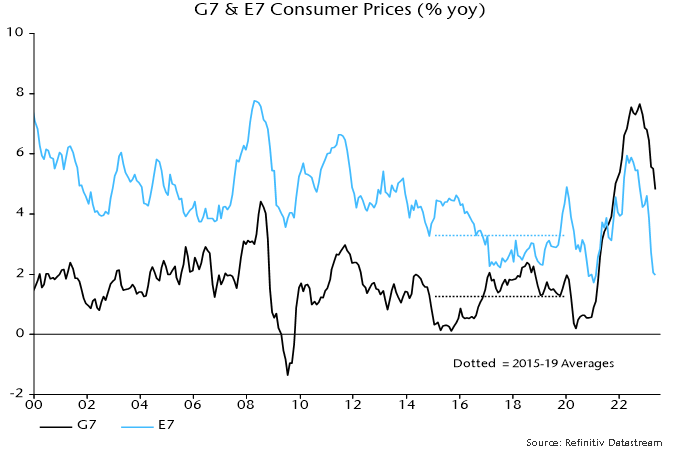
A GDP-weighted average of CPI inflation rates in the “E7” large emerging economies* crossed below its pre-pandemic (i.e. 2015-19) average in March, falling further into May – see chart 1. 

Chart 1

G7 & E7 Consumer Prices (% yoy). Source: Refinitiv Datastream.

The E7 average is dominated by China but inflation rates are also below or close to pre-pandemic levels in Brazil, India and Russia. 

Inflation rose by much less in the E7 than the G7 in 2021-22, opening up an unprecedented negative deviation that has persisted. 

The recent plunge in the E7 measure reflects a significant core slowdown as well as lower food / energy inflation. 

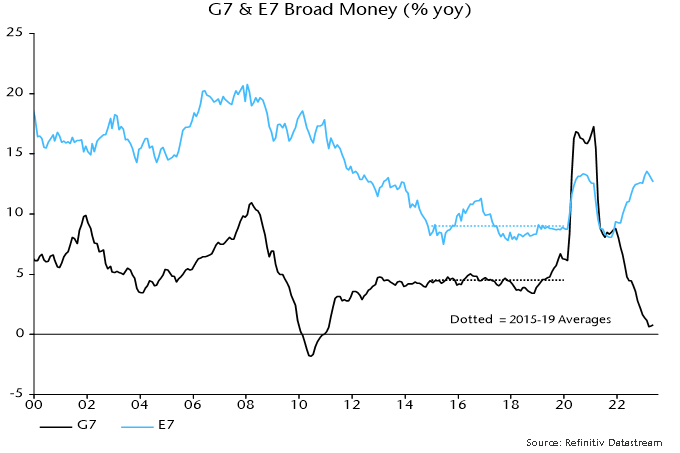
The divergent G7 / E7 experiences are explained by monetary trends. Annual broad money growth rose by much less in the E7 than the G7 in 2020 and returned to its pre-pandemic average much sooner – chart 2. 

Chart 2

G7 & E7 Broad Money (% yoy). Source: Refinitiv Datastream.

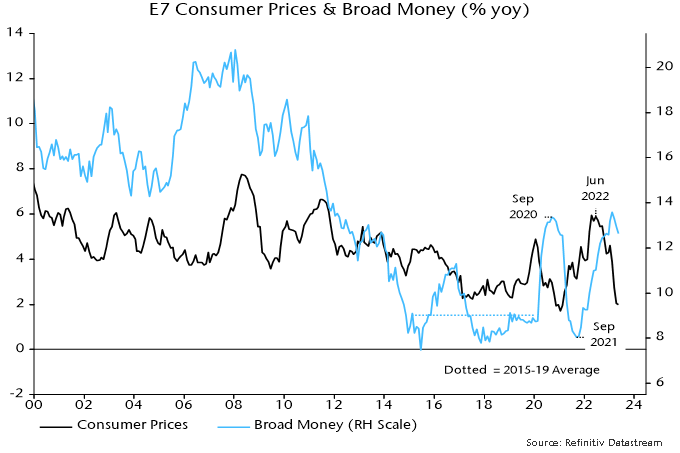
E7 broad money growth crossed below the pre-pandemic average in May 2021. CPI inflation, as noted, followed in March 2023, i.e. consistent with the monetarist rule of thumb of a roughly two-year lead from money to prices. 

G7 broad money growth crossed below its pre-pandemic average in August 2022 and has yet to bottom, suggesting a return of inflation to average in summer 2024 and a subsequent undershoot. 

E7 disinflation, however, may be close to an end. Annual broad money growth has recovered strongly from a low in September 2021, signalling a likely inflation rebound during 2024 – chart 3. Broad money acceleration has been driven by China, Russia and Brazil. 

Chart 3

E7 Consumer Prices & Broad Money (% yoy). Source: Refinitiv Datastream.

E7 annual broad money growth is around the middle of its longer-term historical range and has eased since February. Chinese numbers may have been temporarily inflated by a shift in banks’ funding mix in favour of deposits. 

The expected rise in E7 inflation may not extend far but restoration of a positive E7 / G7 differential is likely in 2024.

*E7 defined here as BRIC + Korea, Mexico, Taiwan.

Coin Stacks Sitting on A Financial Graph Background.

Institutional investors often grapple with the decision to hedge or not to hedge against currency fluctuations when investing in non-domestic investments. A common concern is the relative strength or weakness of different currencies, such as the Canadian dollar compared to the US dollar. These considerations have led to the rise of several currency myths that can influence investment decisions.

Myth 1 – Companies are equally affected by currency fluctuations.

While most companies in the global equity market have multi-currency costs and revenues, the impact is not experienced equally. The global equity market can be divided into four broad company classifications.

Multinational Natural resource Exporters Domestic focus
Coca-Cola Shell Nissan Itau
Unilever AngloGold Ashanti Swatch Unibanco
Multinational Coca-Cola Unilever
Natural resource Shell AngloGold Ashanti
Exporters Nissan Swatch
Domestic focus Itau Unibanco


Multinational companies represent the largest component and have revenues and costs in multiple currencies. The returns and volatility of individual companies will therefore respond to foreign exchange fluctuations relative to each company’s domestic currency.

For natural resource companies, such as those in the energy and mining sectors, changes in the price of the associated commodity are the biggest driver of returns and volatility.

Exporters earn most of their income outside of their home country, so a weak domestic currency can be beneficial as products will be more competitively priced, while a strong local currency can have the opposite effect.

Domestically focused companies conduct most business in their home market, so currency fluctuations have a low impact on returns and volatility.

Myth 2 – Investment managers take care of currency risk management.

Approaches to currency management vary based on individual investment managers’ style and process. The typical first consideration is stock-specific by breaking companies into broad classifications noted in Myth 1 to evaluate how each is managing the currency impact to the business, allowing the investment manager to identify the “true” currency exposure of individual companies.

Fundamental investment managers review currency overweight positions resulting from the stock and sector selection process to determine whether to hedge closer to the benchmark allocation. Such analysis does not always result in hedging.

In contrast, systematic (quantitative) managers will often perceive currency exposure different to the benchmark as an uncompensated risk and the currency differences from the stock selection process are hedged to be broadly neutral to the benchmark, after considering the costs associated with hedging.

Myth 3 – Global equities are more volatile than Canadian equities.

Over shorter-term periods (e.g. rolling three years), the returns of global equities have generally been less volatile than Canadian equities despite the currency exposure, although there are short-term periods when global equities can be more volatile. Figure 1 displays the relative volatility of returns over rolling three-year periods for Canadian equities (as represented by the S&P/TSX Index) compared to global equities (as represented by the MSCI World Index unhedged). When the volatility line is above the 0% horizontal line, Canadian equities were more volatile. Conversely, when the volatility line is below the horizontal line, global equities were more volatile. There has generally been more occasions when Canadian equities were more volatile.

Figure 1: Canadian vs. global equity relative volatility

Source: Bloomberg and MSCI

However, longer-term analysis (10-year rolling returns) highlights that global equities have almost consistently been less volatile than Canadian equities (Figure 2), benefitting from a more diversified universe of investment opportunities.

Figure 2: Canadian vs. global equity absolute return volatility

Source: Bloomberg and MSCI

Myth 4 – Hedging reduces global equity volatility.

As institutional investors often hold diversified portfolios that include global equities, currency exposure is an important consideration. Despite the common belief that hedging currency exposure is necessary to reduce volatility, research shows that this may not always be the best approach. Figure 3 illustrates how rolling three-year return volatility has generally been lower for unhedged returns, particularly since the mid-1990s. This is because currency movements can offset changes in equity returns, leading to lower overall return volatility. When the relative volatility line is above the 0% horizontal line, hedged global equity returns were less volatile. When below the 0% horizontal line, unhedged global equity returns were less volatile.

Unhedged currency exposure can offer potential benefits, such as the ability to profit from favourable currency movements. However, currency risk can also increase overall portfolio risk and should be carefully monitored and managed to ensure it remains within an acceptable level for each investor’s unique circumstances.

Figure 3: Hedged vs. unhedged global equities

Source: Bloomberg and MSCI

Myth 5 – Hedging 50% currency exposure is the optimal strategy.

Research papers often point to a 50% hedge ratio as being optimal. However, hedging decisions will vary by investor and depend on their specific currency exposure and risk perspective. For example, hedging strategies should be tailored to an investor’s specific portfolio. Figure 4 highlights that the level of hedging needed is dependent on each investor’s total currency exposure. Both Investor A and B have net 30% currency exposure, despite having very different hedging ratios.

Figure 4: Implications of 50% hedge ratio

  Currency exposure (a) Hedge ratio (b) Net currency exposure (a-b)
Investor A 60% 50% 30%
Investor B 30% 0% 30%
  Investor A Investor B
Currency exposure (a) 60% 30%
Hedge ratio (b) 50% 0%
Net currency
exposure (a-b)
30% 30%


From a risk perspective, a 50% hedge ratio can be recommended to manage “regret risk,” the potential regret that an investor may feel if they adopt an unhedged or fully hedged approach that later turns out to be the wrong decision.

Figure 5 compares the rolling three-year performance of unhedged US equity returns less fully hedged returns (orange line) and unhedged returns less a 50% hedge ratio (green line). When the rolling three-year relative return is above the 0% horizontal line, an unhedged strategy outperforms. When the relative return is below the horizontal line, a hedged strategy outperforms.

Figure 5: Regret risk currency management

Source: Bloomberg and MSCI

The 50% “regret risk” hedging approach minimizes extreme outperformance or underperformance, which can be beneficial for some investors.

In a perfect world, investors would prefer a dynamic approach to currency management, allowing them to take advantage of a weakening Canadian dollar by remaining unhedged and using hedging strategies when the Canadian dollar strengthened.

One such consideration could be to set thresholds to trigger the timing and amount of currency to hedge based on the currency’s relative strength or weakness. Figure 6 below outlines illustrative thresholds used for a US equity index portfolio.

Figure 6: Dynamic thresholds

Exchange rate (USD per 1 CAD) % of US equities to be hedged
Greater than $0.90 0%
$0.85 to $0.90 20%
$0.75 to $0.85 40%
Less than $0.75 60%
Exchange rate (USD per 1 CAD) % of US equities to be hedged
Greater than $0.90 0%
$0.85 to $0.90 20%
$0.75 to $0.85 40%
Less than $0.75 60%


Based on rolling three-year relative return analysis, Figure 7 shows the difference in returns between a fixed 50% hedge approach compared to a dynamic thresholds approach. There is no consistent benefit from the dynamic thresholds approach and in fact, the largest outperformance was from the fixed hedge strategy from 2005 to 2013. The analysis does not consider the cost of hedging. Given that the dynamic approach requires more time and governance oversight and took decades to generate a material benefit, it’s likely that it would have been discontinued in favour of other strategies with greater potential benefit.

Figure 7: Fixed vs. dynamic hedging (relative returns)

Source: Bloomberg and MSCI

Subscribe for updates
The FOMC’s updated economic forecast for the remainder of 2023 is inconsistent with Committee members’ median expectation of a further 50 bp rise in official rates during H2, according to a model based on the Fed’s past behaviour. Policy is more likely to be eased than tightened if the forecast plays out. 

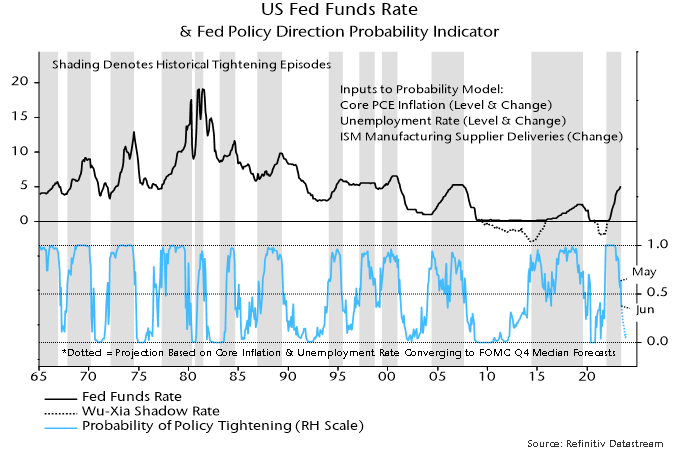
The model estimates the probability of the Fed tightening or easing each month from current and lagged values of core PCE inflation, the unemployment rate and the ISM supplier deliveries index, a measure of production bottlenecks. It provides a simple but satisfactory explanation of the Fed’s historical decision-making, i.e. the probability estimate was above 50% in most tightening months and below 50% in most easing months – see chart. 

US Fed Funds Rate & Fed Policy Direction Probability Indicator.

The probability of the Fed tightening at yesterday’s meeting had been estimated by the model at 36%, the first sub-50% reading since September 2021. (The FOMC started to taper QE at the following meeting in November.) 

The FOMC’s median forecast for core PCE inflation in Q4 was revised up to 3.9% from 3.6% previously (currently 4.7%). The unemployment rate forecast was lowered to 4.1% from 4.5% (currently 3.7%). 

The model projections shown in the chart assume that core PCE inflation and the unemployment rate converge smoothly to the Q4 forecasts, while the ISM supplier deliveries index remains at its current level. Despite the revisions, the probability estimate still falls to below 10% in Q4, consistent with the Fed beginning to ease by then. 

The projections highlight the Fed’s historical sensitivity to the rates of change of core inflation and unemployment as well as their levels. It would be unusual for policy-makers to continue to tighten when inflation and unemployment are trending in the “right” directions, especially given the magnitude of the increase in rates to date. 

One difference from the past is that Fed now forecasts its own actions. Has yesterday’s guidance that rates have yet to peak boxed policy-makers into at least one further rise? This may mean that the model’s probability estimate for July – currently 29% – is too low. Still, next month’s decision will hinge on data, with inertia plausible barring stronger-than-expected news.

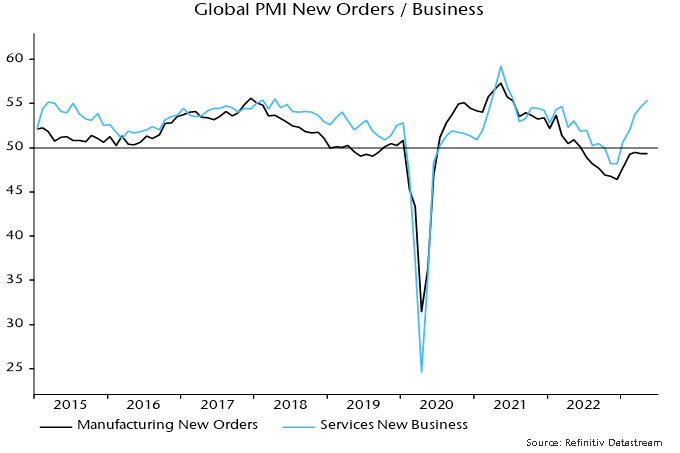
Global growth optimists expect continued solid services sector expansion to offset manufacturing weakness. PMI results for May appear, on first inspection, to support this view: services activity and new business indices rose further to 18- and 22-month highs respectively even as manufacturing new orders remained stalled below 50 – see chart 1. 

Chart 1

Chart 1: Global PMI New Orders /  Business. Chart compares manufacturing new order vs. services new business from 2015 to 2023. Source: Refinitiv Datastream.

There are, however, several reasons for discounting the strong headline services readings. 

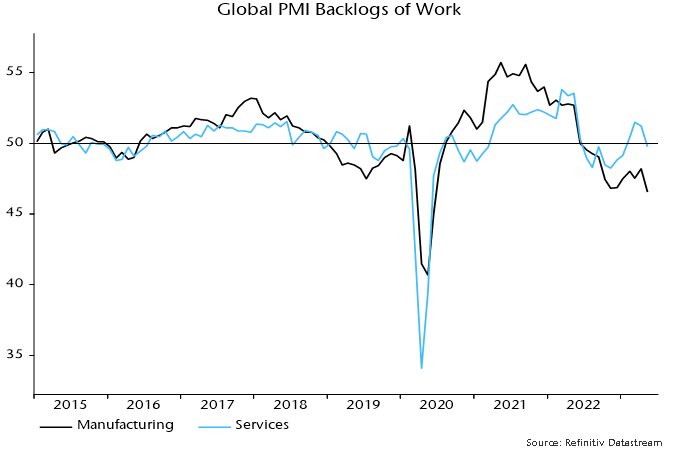
First, backlogs of services work fell sharply to a four-month low despite stronger new business – chart 2. This suggests that current output is running ahead of incoming demand, in turn implying a future adjustment lower unless demand picks up further. 

Chart 2

Chart 2: Global PMI Backlogs of Work. This chart compares manufacturing vs. Services from 2015 to 2023. Source: Refinitiv Datastream.

Manufacturing backlogs also fell sharply last month, breaking below their November 2022 low. 

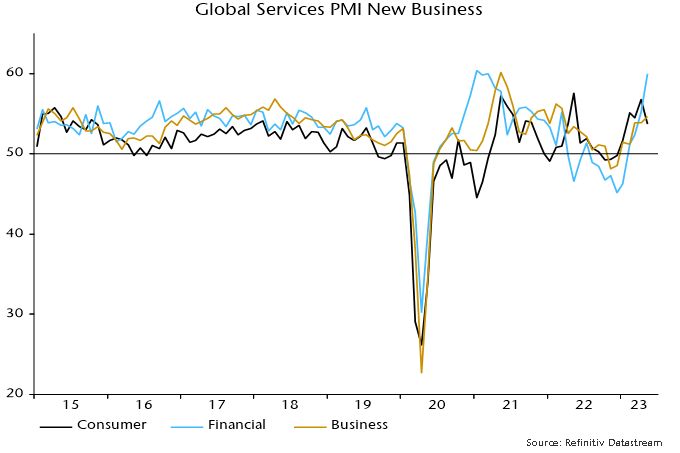
Secondly, the sectoral breakdown of the activity and new business indices shows that May rises were driven by a surge in financial services – chart 3. Consumer services indices eased on the month. Financial services strength is difficult to understand given monetary stagnation, slowing bank lending and flat trading volumes, so may prove short-lived. 

Chart 3

Chart 3: Global Services PMI New Business. This chart compares consumer, financial, and business from 2015 to 2023. Source; Refinitiv Datastream.

Thirdly, the high May readings of the global activity and new business indices reflect strong contributions from the US and Chinese components but national services surveys are significantly weaker. 

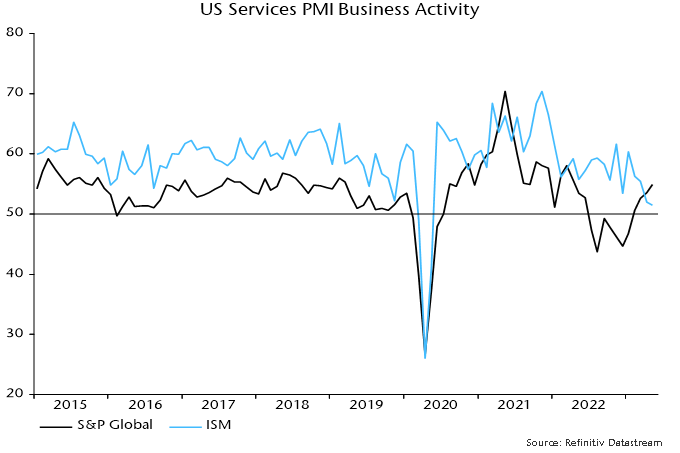
The US ISM services activity index fell to a three-year low in May even as the S&P Global equivalent series reached a 13-month high – chart 4. 

Chart 4

Chart 4: US Services PMI Business Activity. This chart compares S&P Global vs ISM from 2015 to 2023. Source: Refinitiv Datastream.

The Chinese NBS non-manufacturing new orders index moved below 50 in April and fell further in May, in puzzling contrast to the S&P Global / Caixin services new business index, which reached its second-highest level since November 2020. 

The global manufacturing new orders and services new business indices have been strongly correlated historically but statistical tests indicate a tendency for manufacturing to lead services rather than vice versa*. With global monetary trends continuing to give a negative economic signal, the current unusually wide gap is more likely to be closed by services weakness than a manufacturing revival. 

*In regressions using monthly data with three lags, lagged manufacturing new orders terms are significant in the regression for services new business, but lagged services new business terms are insignificant in the regression for manufacturing new orders.

Monetary trends continue to give a negative message for global economic prospects, suggesting that European / US weakness will outweigh resilience in major EM economies. 

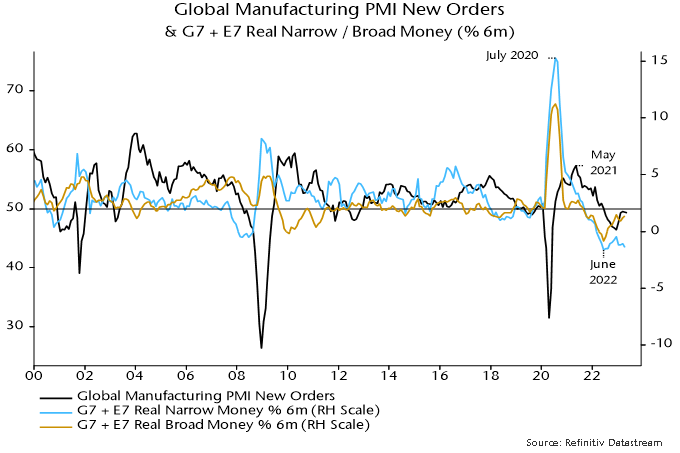
G7 plus E7 six-month real narrow money momentum fell again in April, extending a move down from a local peak in December and suggesting a decline in economic momentum through late 2023 – see chart 1. 

Chart 1

Chart 1 showing Global Manufacturing PMI New Orders & G7 + E7 Real Narrow / Broad Money (% 6m)

A revival in real narrow money momentum in H2 2022 was reflected in a recovery in global manufacturing PMI new orders between December and March. The recovery stalled in April / May and the forecast here remains for a relapse and possible retest of the December 2022 low during H2 2023. 

Narrow money has outperformed broad money as a leading indicator historically, in terms of reliability in signalling turning points in economic momentum. Narrow money usually weakens relative to broad money when interest rates rise as depositors are incentivised to shift funds to less liquid accounts. This is an important feature of the transmission mechanism and one of the reasons narrow money outperforms as a forecasting indicator. 

An argument, however, has been made that the unusual speed of the rise in interest rates over the past year, coupled with worries about deposit safety following recent bank failures and an associated switch into money market funds, may have exaggerated narrow money weakness relative to “true” economic prospects. This would suggest giving greater weight to broad money trends at present. 

As chart 1 shows, global six-month real broad money momentum recovered more strongly during H2 2002 and has stalled rather than fallen back since December. Still, the message for economic prospects is weak, suggesting no growth revival before 2024. 

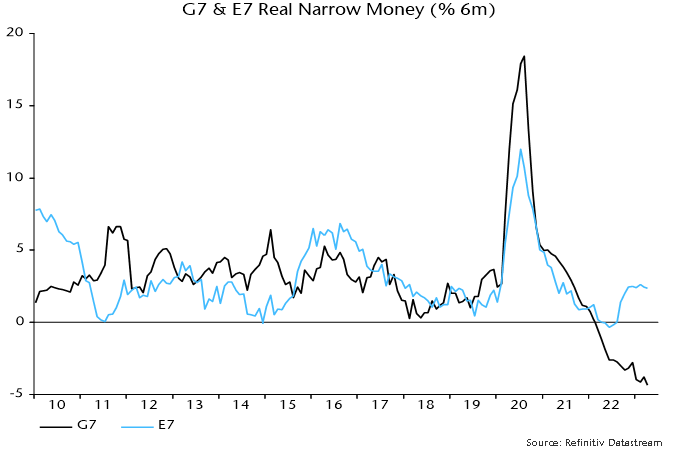
A marginal decline in global manufacturing PMI new orders in May reflected a notable weakening of the DM component offset by stronger EM results. EM resilience is consistent with recent stronger E7 real money momentum (broad as well as narrow) – chart 2. 

Chart 2

Chart 2 showing G7 + E7 Real Narrow Money (% 6m)

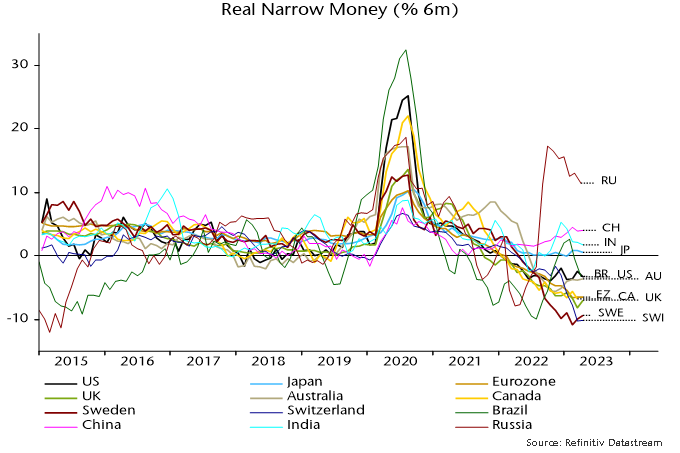
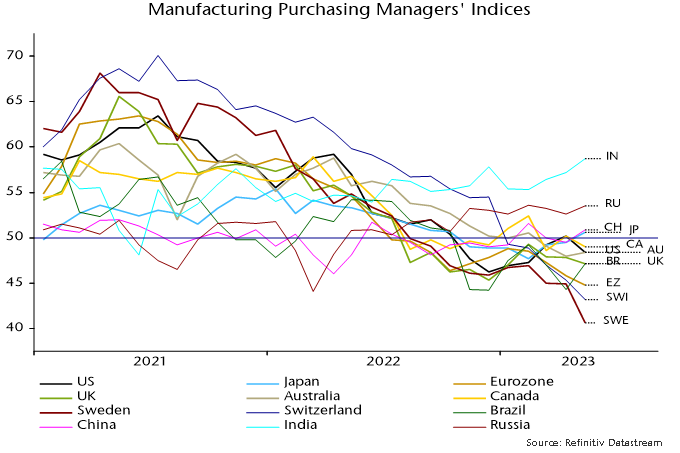
Charts 3 and 4 show six-month real narrow money momentum and manufacturing PMIs in selected major economies. Russia, China and India top the real money momentum ranking with weakness focused on Europe – particularly Switzerland and Sweden. The latest PMI results mirror the real money ranking (rank correlation coefficient = 0.85), with recessionary readings in the Eurozone, Switzerland and Sweden contrasting with Indian / Russian strength. 

Chart 3

Chart 3 showing Real Narrow Money (% 6m)

Chart 4

Chart 4 showing Manufacturing Purchasing Managers’ Indices

The stockbuilding cycle is on course to bottom soon and upturns have historically been associated with a procyclical shift in market behaviour. Several considerations, however, argue for caution about positioning for such a shift now. 

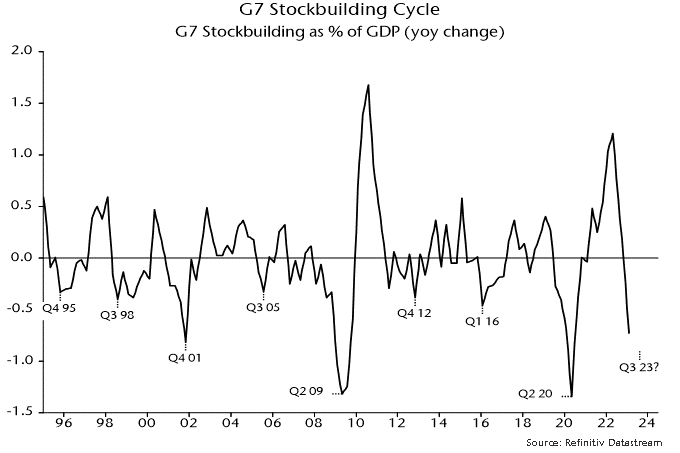
The key indicator used to monitor the cycle here is the annual change in G7 stockbuilding expressed as a percentage of GDP, shown in chart 1. Lows were reached every 3 1/3 years on average, which matches the 40-month periodicity reported by the “discoverer” of the cycle, Joseph Kitchin, in 1923. 

Chart 1

Chart 1 showing G7 Stockbuilding Cycle G7 Stockbuilding as % of GDP (yoy change)

The stockbuilding cycle is a key driver of industrial fluctuations: the correlation coefficient of the above series and contemporaneous G7 annual industrial output growth over 1965-2019 was 0.75.

The last cycle low was in Q2 2020 so the next could occur in H2 2023, based on the average cycle length. Partial Q1 information – an estimate is included in chart 1 – indicates that the downswing is well advanced, consistent with the cycle entering a window for a low. 

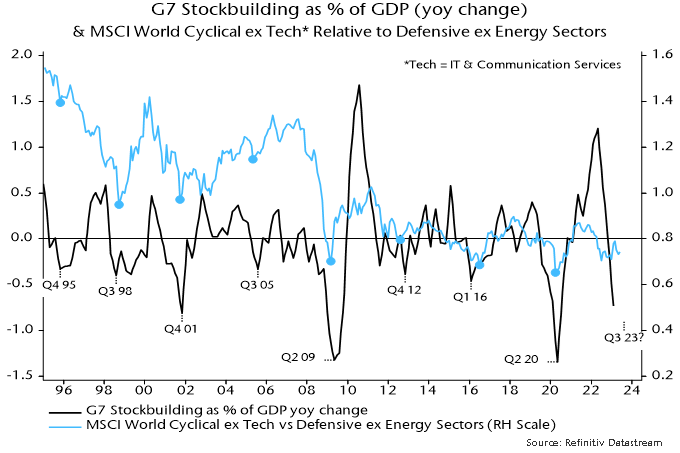
Cycle lows often mark a change in the market environment from risk-off / defensive to risk-on / cyclical, e.g. the price relative of cyclical equity market sectors versus defensive sectors has bottomed around the same time as the cycle historically – chart 2. 

Chart 2

Chart 2 showing G7 Stockbuilding as % of GDP (yoy change) & MSCI World Cyclical ex Tech* Relative to Defensive ex Energy Sectors *Tech = IT & Communication Services

So should investors start adding cyclical exposure? There are several reasons for caution. 

First, stockbuilding has fallen sharply but only to a “normal” level by historical standards. Further weakness seems likely given the extent of overaccumulation in 2021-23. 

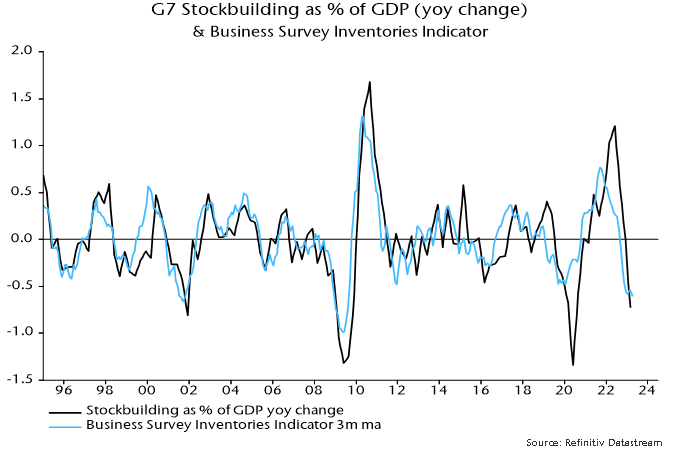
Second, a monthly inventories indicator derived from business surveys, which is more timely and usually leads by several months, has yet to signal a turning point – chart 3. 

Chart 3

Chart 3 showing G7 Stockbuilding as % of GDP (yoy change) & Business Survey Inventories Indicator

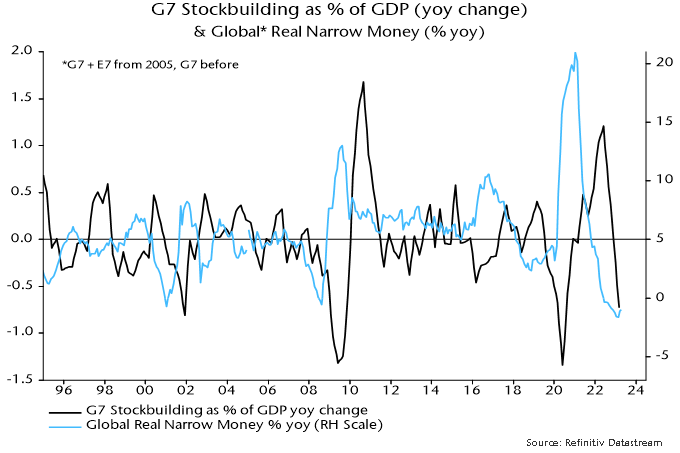
Third, and most importantly, stockbuilding cycle recoveries historically were preceded by a pick-up in real narrow money momentum, which remains very weak – chart 4. 

Chart 4

Chart 4 showing G7 Stockbuilding as % of GDP (yoy change) & Global* Real Narrow Money (% yoy) *G7 + E7 from 2005, G7 before

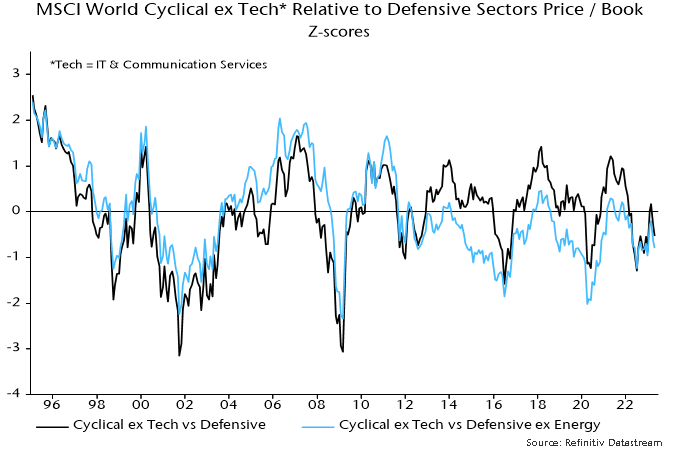
The price to book relative of non-tech cyclical sectors versus defensive sectors is below its long-run average but the divergence is smaller than at most recent stockbuilding cycle lows – chart 5. 

Chart 5

Chart 5 showing MSCI World Cyclical ex Tech* Relative to Defensive Sectors Price / Book Z-scores *Tech = IT & Communication Services

There is a risk of another bout of market weakness / cyclical underperformance as the stockbuilding cycle moves into a trough. The judgement here is that a revival in real money momentum is necessary to signal that a cycle low will be followed by a sufficiently solid recovery to boost cyclical assets.

The global manufacturing PMI new orders index – a timely indicator of global goods demand – was little changed below 50 (49.4) in April, a weaker result than had been suggested by DM flash results. 

Inventories indices for finished goods and production inputs, meanwhile, rose further to their highest levels since November. Accordingly, new orders / inventories differentials – which often lead at turning points – fell for a second month. 

These results are consistent with the forecast here that a recovery in PMI new orders since December 2022 would fizzle out in H1 and reverse into H2, with a possibility of a break below the December low. The basis for the forecast was a relapse in global (i.e. G7 plus E7) six-month real narrow money momentum around end-2022. Real money momentum moved sideways in March at around its June 2022 low – see chart 1.

Chart 1

Chart 1 showing Global Manufacturing PMI New Orders & G7 + E7 Real Narrow Money (% 6m)

A downswing in the stockbuilding cycle was a key driver of earlier PMI weakness. A further drag is in prospect but the down phase of the cycle is well advanced, with incoming data and average cycle length suggesting a low during H2. 

Business capex is emerging as a new source of global goods demand weakness. The capital goods component of PMI new orders reached a new low in April – chart 2. 

Chart 2

Chart 2 showing Global Manufacturing PMI New Orders

A contraction in business investment is consistent with a squeeze on real profits in late 2022 – chart 3 – and weak corporate money trends: business broad money holdings have fallen in nominal terms recently in the US, Eurozone and UK – chart 4. 

Chart 3

Chart 3 showing G7 Business Investment (% yoy) & Real Gross Domestic Operating Profits (% yoy)

Chart 4

Chart 4 showing Broad Money Holdings of Business / Corporations (% 6m)

Other evidence of a capex downturn includes: 

  • Weak capex intentions in regional Fed manufacturing surveys (and the NFIB small firm survey) – chart 5.  
  • Weak enterprise loan demand for fixed investment in the ECB bank lending survey – chart 6.  
  • Falling capital goods / machinery orders in the US, Japan and Germany – chart 7.

Chart 5

Chart 5 showing US Non-Residential Fixed Investment (% yoy) & Regional Fed Expected Capex Average* *Average of Dallas, Kansas, New York, Philadelphia & Richmond

Chart 6

Chart 6 showing Eurozone Non-Residential Fixed Investment (% yoy) & ECB Bank Lending Survey, Loan Demand from Enterprises for Fixed Investment

Chart 7

Chart 7 showing Capital Goods Orders January 2015 = 100

Capex retrenchment is usually accompanied by a fall in labour demand. Adjusted for negative revisions to the prior two months, the addition to US non-farm payrolls in April was 104,000, the smallest since January 2021 – chart 8. Revisions in the last three reports cumulate to -200,000, a level rarely reached outside recessions – chart 9.

Chart 8

Chart 8 showing US Non-Farm Payrolls Change (000s) First Estimate Actual & Adjusted for Revisions to Prior 2 Months

Chart 9

Chart 9 showing US Non-Farm Payrolls Change Revisions to Prior 2 Months (000s)