Connor, Clark & Lunn Financial Group (CC&L Financial Group) is pleased to announce that through the CC&L Foundation, we have pledged $150,000 over three years as part of a partnership with the Centre for Addiction and Mental Health (CAMH).

Through this partnership, CC&L Financial Group becomes a founding member of CAMH’s Business Leaders for Mental Health Action. CAMH’s Business Leaders for Mental Health Action is a community of leaders committed to improving the psychological health and safety of employees and advocating for businesses to take action.

“This partnership aligns with CC&L Financial Group’s overarching health and wellness strategy. We are committed to supporting the health and wellness of both the people who work here and the people in the communities in which we do business,” said Michael Walsh, Managing Director, CC&L Financial Group. “As a firm, we are committed to providing our employees with support and resources to help them manage their mental health.”

The announcement coincided with the launch of CAMH’s Mental Health week, which ran from May 3 – 9, 2021. Mental Health Week aims to shift societal beliefs and perception about mental health and promotes behaviours and attitudes that foster well-being, support good mental health, and create a culture of understanding and acceptance. More information on Mental Health Week can be found at mentalhealthweek.ca.

Global automobile sales decreased by 15% in 2020, amid the ongoing COVID-19 pandemic. Meanwhile, sales of battery electric vehicles (BEVs) and plug-in hybrid electric vehicles (PHEVs) were more resilient to the crisis, growing by 43% to more than 3 million. The global market share of BEVs and PHEVs increased from 2.5% in 2019 to 4.2% in 2020, and is expected to reach 38% by 2030. The growth is attributed to tightening emission regulations, favourable government incentives, improved technology, and better affordability. Europe and China have been leading the way in EV adoption, each accounting for over 40% of global EV shipments in 2020. Germany is now the second largest market after China, with 394,943 units sold in 2020.

Tesla was the best-selling brand in 2020, delivering half a million units, up roughly a third from its 2019 results. German carmaker Volkswagen Group (VW) is still trailing Tesla for EV sales, but the gap is closing fast. VW delivered 231,600 BEVs in 2020, tripling its deliveries in 2019, and is expected to surpass Tesla to be the biggest EV maker by 2025, if not sooner. In fact, VW has already become the number one EV maker in Europe in 2020. On its first Power Day held in mid-March 2021, VW laid out its plan to expand its e-mobility business by 2030, including building six gigafactories in Europe, using unified cell technology to lower battery costs by 30-50%, and expanding its global fast-charging network. The company targets 70% of all the cars sold by VW Group to be pure electric by 2030. Many other traditional carmakers have similar targets. BMW, for example, projects that fully electric models will account for at least 50% of their global deliveries by 2030; Renault-Nissan-Mitsubishi expects half of its EU launches will be pure-electric by 2025; Honda aims for 100% of its EU auto sales to be electric by 2025. It is estimated that the number of EVs sold will rise to 30 million in 2028, and EVs will represent nearly half of all passenger cars sold globally by 2030.

Increasing adoption of EVs also means growing demand for metals. The demand for copper, for example, is expected to increase tenfold between 2019 and 2030. Copper is used throughout electric vehicles and in charging stations and supporting infrastructure, due to the metal’s durability, high conductivity and efficiency. On average, an internal combustion engine (ICE) car contains 23kg of copper. Conversely, a BEV takes around 83kg of copper, about three times more. On top of this, several other secular trends are also driving demand for copper, including the increased consumer use of electronics and clean energy transition. In fact, copper is used in nearly all green technologies, particularly solar PV, wind, and energy storage. Fitch Solutions forecasts a shortfall of 489,000 tons of copper in 2024, and a shortfall of 510,000 tons in 2027. Recycling is an important part of the solution to meet future copper demand, as copper can be recycled as often as desired without a loss of quality. Currently, around 35% of global copper use comes from recycled copper, and this rate is expected to go higher.

Aurubis AG, one of the companies we own in our portfolios, is the largest copper producer in Europe, the second largest in the world, and one of the largest copper recyclers worldwide. The company produces over 1 million tons of copper cathodes annually, and they produce copper cathodes with a roughly 40% smaller CO₂ footprint than the global average for copper smelters. This is due to their high level of recycling and more efficient production methods.

Price, range, charge time, and charging infrastructure are among the main challenges to mainstream EV adoption. Enhancements to battery technology is the key to reducing the cost and improving EV’s performance. Gentherm Inc., a global leader of thermal management technologies and a holding of Global Alpha, provides a battery thermal management system. The system improves the performance of the battery packs in hybrid electric vehicles by heating the battery during cold conditions and cooling it during warm conditions, which increases the life of a battery pack. They also have a cell connecting system to provide a reliable and continuous flow of temperature and cell voltage information during the charging and discharging process, ensuring performance and safety. Horiba Ltd., another company we own in the portfolios, provides analytics and measurement equipment. While Horiba’s mainstay business is its automotive emission testing system, they also provide test and diagnostic systems for fuel cells and batteries through its subsidiary — Horiba FuelCon. The demand for fuel cells and battery testing was very strong and Horiba FuelCon tripled its production capacity in 2020. On the other hand, the demand for emission testing will not disappear any time soon, given tightening emission regulations, and the fact that emission testing is still needed for hybrid electric vehicles.  

The increasing charging demand will put significant pressure on the aging grid, especially during peak charging hours. The smart grid is the key to support this demand. With a smart grid, utilities can predict and manage EV charging. It also enables utilities to provide consumers with greater insights into their EV experience, including better understanding the cost of charging, and helping users set optimal charging preferences. Landis+Gyr Group, a holding we talked about in the weekly commentary on May 22, 2020, is a leading global provider of smart meters and smart grid solutions. Although there are delays with regulatory project approvals and installations of smart meters due to COVID-19, the mid- to long-term growth prospect remains intact. In addition to providing smart meters, Landis is making active investment in software development to add more higher-margin and less volatile revenue streams. In December 2020, Landis signed a partnership with Google Cloud to innovate the next generation cloud-based energy management solutions, which is the first partnership of this kind for the energy management industry. With a solid balance sheet, Landis is in a good position to make investments and benefit from the global megatrend.

The Environmental, Social & Governance (ESG) revolution reached a long-awaited turning point in 2020. Responsible investment assets experienced explosive growth around the world, and the issues and developments in ESG are becoming increasingly complex and diverse. In this commentary, we provide you with a few highlights on the following: growth of global sustainable assets; government initiatives on climate change; and Global Alpha’s ESG progress.

Growth of global sustainable assets

According to Bloomberg, governments, corporations and other groups raised a record $490 billion in 2020, selling green, social and sustainability bonds. A further $347 billion was poured into ESG-focused investment funds – an all-time high. More than 700 new funds were launched globally.

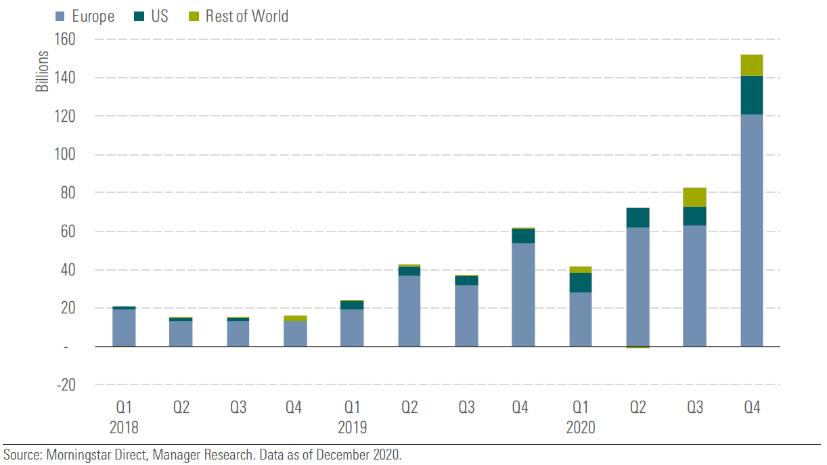
Based on Morningstar’s report on sustainable open-end funds and ETFs, there were a total of 4,153 sustainable funds as of December 2020[1]. The total sustainable fund assets hit a record $1.65 trillion in 2020. In Q4 alone, the inflow surpassed $150 billion, led by Europe.

Quarterly Global Sustainable Fund Flows (USD Billion)

New ESG fund launches accelerated into year-end, with a record of 196 in Q4. Again, the increase was driven by Europe, which launched 147 funds, while the United States (US) and rest of the world launched 12 and 37, respectively. According to the Institutional Shareholder Services (ISS) ESG Asset Manager’s survey conducted in Q3 2020, 37.5% of asset managers reported plans to hire more ESG-related staff to manage the expected increase in workload[2].

Government initiatives on climate change

Europe has consistently been a leader on the ESG front. The European Green Deal aims to make the European Union (EU) climate neutral by 2050. It plans to increase the EU’s greenhouse gas emission reductions target for 2030 to at least 50% and towards 55%, compared with the 1990 level.

Several pieces of sustainable finance legislation will come into force soon. The most mentioned is the EU Taxonomy Regulation, which is intended to ensure that designated environmentally sustainable economic activities genuinely contribute to climate change mitigation and adaption, and thus to the transition to a low-carbon economy.

In the US, the Biden administration plans to invest $1.7 trillion to achieve 100% clean energy and net-zero emissions by 2050. Meanwhile in South America, Amazon rainforest fires resulted in enhanced measures to protect biodiversity in Brazil. The Brazilian government faces a threat of divestment by major European investors if ESG risks facing Amazon rainforest regarding deforestation, mining and beef production are not addressed.

Asia is a latecomer in terms of ESG development, but is catching up rapidly. Japan is committed to becoming carbon neutral by 2050, and plans to spend $2 trillion in green business and investment. China also announced the carbon neutral target by 2060 and will implement mandatory environmental reporting by companies in 2021. The Hong Kong Stock Exchange already set up mandatory ESG disclosure rules regarding board disclosure, climate change and ESG reporting.

Global Alpha’s ESG progress

Principles for Responsible Investment (PRI) Reporting

The assessment of our PRI Reporting in 2020 demonstrated a clear improvement in comparison to 2019. Three reporting modules were applicable to us:

  1. Strategy & Governance: Our score was A+ (A in 2019)
  2. Direct & Active Ownership: Listed Equity – Incorporation: Our score was A (B in 2019)
  3. Direct & Active Ownership: Listed Equity – Active Ownership: Our score was B (same as in 2019)

Proxy Voting

While acknowledging the slow progress in active ownership, in 2020 we enhanced our engagement efforts by implementing a detailed Proxy Voting Policy with stricter guidelines. When we considered voting against a company’s proposal, we would engage with them first.

In 2020, we voted against 21% of proposals, versus 10% the previous year. The biggest disapproval was related to executive compensation, where we voted against 39% of proposals, versus 23% a year earlier. Other common issues were about board independence and board diversity.

Our Proxy Voting Policy in some cases is more stringent than ISS’s recommendations. In 2020, we voted against ISS for 14% of proposals, versus 3% in 2019.

Diversity & Inclusion

In October 2020, we became one of the founding signatories to the new Canadian Investor Statement on Diversity & Inclusion. Subsequently, we updated our ESG questionnaire to companies to enhance engagement on this topic. We work with several brokerage firms that are owned by women or minorities.

Within Global Alpha we also promote diversity & inclusion:

  • One of the three co-founders is female;
  • Three of the six partners at the firm are minorities, and two of the six are female;
  • Seven of the eleven team members were immigrants to Canada;
  • The team speaks many languages, including English, French, Spanish, Mandarin, Japanese, Vietnamese, Hindi, Gujarati, Memoni, Konkani and Marathi.

It is our strong belief that diversity of team and thought are key contributors to successful investing. It has been a deliberate practice at the firm to build a team of investment professionals with different backgrounds and experiences. Collectively, the team has worked across a number of industries, and in a variety of capacities. In particular, the team believes that having professional experience outside of the finance industry provides an added perspective when evaluating a company and understanding its growth potential.

Carbon Footprint Analysis

Based on the Climate Impact Assessment reports provided by ISS, the carbon footprint analysis of our Global Small Cap and EAFE Small Cap portfolios have consistently beaten benchmarks since the adoption of the reports in 2017.

Over the years, our Global Small Cap portfolio has been 30-40% less emissions intense than the benchmark, and our EAFE Small Cap portfolio 60-70% less intense.

Examples of ESG Leaders

Many of our holdings demonstrate excellent ESG practices. Here we would like to highlight two.

Vitasoy International Holdings (345 HK) was listed in 2020 Corporate Knights’ Global 100 Most Sustainable Corporations in the World. Among the 8,080 listed companies being rated worldwide, it ranked 62nd, up from 90th in 2019. Vitasoy is a leading food and beverage company in Asia, known for its soy-based products. It has been a holding since inception in 2008.

DMG Mori Co. Ltd. (6141 JP) announced recently that it aims to achieve carbon neutrality in all its operation bases across the world in 2021. DMG Mori AG, its European subsidiary, already achieved carbon neutrality in 2020, by offsetting the carbon emissions from its business activities through the investment in certified sustainable and climate protection projects. DMG Mori is the largest machine tool company in the world.

Outlook

Without a doubt, responsible investment assets will continue to grow rapidly, as more investors turn to ESG, not only for their personal values, but also for better risk management and investment return.

However, the world of responsible investment is not all rosy. The lack of company disclosure, different ESG approaches, sometimes contradictory ESG ratings, and fears of ‘greenwashing’ have created a maze for many people. Covid-19 also caused more concerns around social issues, such as workplace safety, treatment of employees, diversity and inclusion, and supply chain labour dynamics.

As a responsible investor, we are conscious that our role carries renewed purpose.


[1] Global Sustainable Fund Flows: Q4 2020 in Review, Morningstar, January 28, 2021

[2] ESG Themes & Trends 2021 – Volatile Transitions: Navigating ESG in 2021, Institutional Shareholder Services

FOR IMMEDIATE RELEASE

CONNOR, CLARK & LUNN INFRASTRUCTURE CLOSES
U.S. RENEWABLE POWER INVESTMENT

TORONTO, JANUARY 11, 2021

Connor, Clark & Lunn Infrastructure (CC&L Infrastructure) is pleased to announce that it has completed its previously announced acquisition of an 80% equity interest in a U.S. wind and solar portfolio.

This transaction, which was completed alongside Régime de Rentes du Mouvement Desjardins and Desjardins Financial Security Life Assurance Company (together, Desjardins Group), included the purchase of four operating wind projects and one construction-stage solar project located in Indiana, Wisconsin, Oklahoma, and Ohio. Each asset is fully contracted through long-term power purchase agreements with high-quality offtakers, and the portfolio provides geographically diversified exposure to three distinct U.S. electricity markets. Construction of the solar facility began in December 2020 and is expected to be operational later this year or early in 2022.

“Completing this investment achieves an exciting milestone for our business,” said Matt O’Brien, President of CC&L Infrastructure. “The addition of these projects increases the total capacity of our renewable power portfolio well past a gigawatt globally. We look forward to operating these high-quality projects alongside our partners over the coming years.”

CC&L Infrastructure now owns approximately 1.4 GW of renewable power globally, with more than 1GW in operation. On a combined basis, these operating facilities are expected to produce approximately 4 million MW hours of clean energy each year – enough energy to power more than 320,000 homes and offset the equivalent greenhouse gas emissions of more than 600,000 passenger vehicles for a year.

About Connor, Clark & Lunn Infrastructure

CC&L Infrastructure invests in middle-market infrastructure and infrastructure-like assets with highly attractive risk-return characteristics, long lives and the potential to generate stable cash flows. CC&L Infrastructure is a part of Connor, Clark & Lunn Financial Group Ltd., a multi-boutique asset management firm whose affiliates collectively manage over CAD$85 billion in assets. For more information, please visit www.cclinfrastructure.com.

Contact

Kaitlin Blainey
Director
Connor, Clark & Lunn Infrastructure
(416) 216-8047
[email protected]