In last week’s commentary we discussed how green hydrogen can help reach net-zero carbon by 2050. This week, we focus on decarbonization within the aviation sector and how technological evolutions will help reduce carbon emissions.

The transportation sector is a huge contributor to carbon emissions, and is responsible for 29% of the total carbon dioxide (CO2) emissions in the United States (US) and close to 27% in Europe. Compared to the aviation sector, the road transportation sector is far ahead on its decarbonization path.

While other sectors decarbonize quicker, the commercial aviation sector is under pressure to show greater transparency and start establishing greater initiatives in order to cut down its carbon emissions. Two weeks ago, the International Air Transport Association announced that its member airlines, which represent 82% of the world’s airlines, agreed to achieve net-zero carbon emissions by 2050.

The road map to decarbonization will essentially be driven by newer and greener technologies, and by increasing the mix of sustainable aviation fuel. Sustainable aviation fuel would certainly be part of the solutions, but that cannot be the only one. Current availability of sustainable aviation fuel represents only 0.1% of the total fuel supply needed.

Technology, which will continue to evolve, will also help reduce the sector’s carbon emissions. Pratt & Whitney designed GFT engines, which is one of the most sustainable engines in service for single-aisle planes. The GFT engine family, as an example, allows the reduction of up to 20% fuel burn and carbon emissions, while reducing the noise footprint by 75%. Today, more than 1,000 airplanes are equipped with that engine. When considering there are approximately 26,000 airplanes in service globally, the carbon footprint of this sector would be improved as older airplanes get replaced with newer and more efficient aircraft programs.

Another means of transportation for regional and urban travel could emerge in the coming years. Electrical Vertical Take-off and Landing (eVTOL) is a new type of light commercial aircraft currently under flight testing or prototyping. This new transport mode is potentially disruptive to other modes of transportation but should not be a threat to commercial airlines or the automotive sector. Conversely, it represent a sustainable alternative for inner city, short regional travels, air ambulance, and cargo transport.

Thanks to sizable investments made over the past two years, the odds of having eVTOL operating in the future has increased significantly. Since 2019, the eVTOL sector benefited from a capital inflow of approximately $10 billion.

The eVTOL market opportunity could be massive but at this time, it is hard to assess what could be an accurate figure. Lilium, one of the leading original equipment manufacturers (OEM) in that space, estimates that eVTOL could be worth $500 billion by 2040. When taking the cargo market under consideration, this market size expectation could reach $1 trillion. Other experts believe this sector could become an even bigger addressable market. It is no surprise that established aircraft manufacturers announced their own eVTOL programs, or co-investments. Last month, Airbus launched its new CityAirbus Next Gen program to address the urban air mobility market.

Joby Aviation and Volocopter are amongst the leading OEMs that could be the first to obtain their type certification between 2022 and 2024. Other interesting emerging eVTOL developers include Archer Aviation, Lilium, Vertical Aerospace, and Kitty Hawk. Note, the aforementioned companies are not part of Global Alpha’s holdings. Every manufacturer has its own design, propulsion technology, and characteristics, but all of them want to address the future of urban air mobility, focusing on a transportation range of 0-300 miles.

There are several positive advantages to support the eVOTL development over traditional transportation modes:

  • Reduced travel time and the cost of congestion: Lilium anticipates a short distance trip, like JFK airport to New York City could take approximately five minutes, while a longer regional trip between NYC and Boston could take approximately 1hour and 15 minutes. Joby Aviation estimates that there are 4.6 billion hours wasted in traffic in the top 15 U.S. cities every year.
  • Sustainable transportation mode: Lilium estimates that its eVTOL emission footprint would represent 18g CO2 per passenger kilometers. That compares with 189g for commercial aircraft, 142g for gasoline cars, and 31g for electric cars. This is assuming the batteries are produced with renewable energy.
  • Noise reduction: Some models of eVTOLs are expected to generate less than 70 decibels, which is comparable to the noise level of a dishwasher.
  • Lower cost of operation: McKinsey estimates that the cost of operating eVTOL could drop rapidly to $2.5 per seat mile. In comparison, the cost of operating a helicopter today is around $6-$8 per seat mile.
  • Simpler infrastructure needs: The urban air mobility network would require an infrastructure that would likely be much less costly than traditional transportation infrastructure, such as airports. Many of the existing infrastructure could be converted into landing/take-off pads (rooftop buildings, gas stations, parking areas). McKinsey estimates that the cost for 10 landing/take-off pads could reach up to $24 million, which includes the cost of operations.

We understand that a new ecosystem needs to be created, and with that, comes many challenges. The success of the eVTOLs will depend on several factors, such as technical challenges, regulatory approval, the pace of adoption from clients and passengers, and the infrastructure required to accommodate this new transportation mode.


Connor, Clark & Lunn Infrastructure (CC&L Infrastructure) today announced the formation of a strategic partnership with Hy Stor Energy LP (Hy Stor Energy), which will develop, commercialize and operate green hydrogen production, storage, and distribution at scale.

Hy Stor Energy is developing a portfolio of large-scale, fully integrated green hydrogen projects in the United States. The projects will include the on-site production, storage, and delivery of green hydrogen as both a
zero-carbon fuel and a means of storing and producing electricity on demand. This combination of storage and scale will be critical in accelerating the green hydrogen economy in the United States and will support the nation’s transition to a net zero carbon emissions future.

Hy Stor Energy is already permitted for hydrogen storage at multiple locations in the U.S. Gulf Coast, which together will form the backbone of a regional hub. This hydrogen hub will have co-located production, transmission, pipeline, rail and other infrastructure, linking these components to add value while driving economies of scale and attracting end-users. The hub is also expected to attract intellectual capital, spur innovation, create jobs and stimulate the local economy. It will deliver a major source of safe, reliable and 100% carbon free energy that is flexible and available on demand.

“CC&L Infrastructure is excited to further participate in the global energy transition with this partnership,” said Matt O’Brien, President of CC&L Infrastructure. “We believe that the green hydrogen sector is nearing an important inflection point and that its growth will contribute meaningfully to the achievement of net zero carbon emissions targets over the coming decades. The partnership with Hy Stor Energy is a natural evolution of our long-term investment strategy that builds upon our existing expertise in renewable energy. Through this partnership, CC&L Infrastructure and its clients will gain access to a number of attractive investments in a rapidly growing renewable sub-sector as well as technical expertise in green hydrogen and energy storage.”

“Hy Stor Energy is solving the unique challenges of a world transitioning to renewable energy, and we’re developing a model for producing, storing and delivering 100% carbon-free green hydrogen reliably, consistently – and at scale,” said Laura Luce, CEO of Hy Stor Energy. “Our partnership with CC&L Infrastructure will enable us to advance the large-scale development and commercialization of green hydrogen and long-duration storage.”

Green hydrogen is a zero-carbon fuel source and an energy storage mechanism. It is created using renewable energy and a process called electrolysis. Electrolysis uses only two inputs – water and renewable electricity – to produce hydrogen with zero emissions and with oxygen as the only byproduct. Green hydrogen is expected to play a critical role in the global shift away from fossil fuel based sources of energy. Specifically, it can enable the decarbonization of sectors where direct electrification is not practical, offering a viable path towards zero emissions for many industries and jurisdictions.

CC&L Infrastructure’s investment mandate targets traditional and energy infrastructure assets and companies, including power generation, electricity transmission and distribution, and energy storage, among other projects. The firm is an active investor and owner of renewable energy assets and has a current portfolio totaling 1.4 GW of clean energy generating capacity globally. The majority of these assets were acquired during development and the CC&L Infrastructure team has significant experience in both construction oversight and ongoing asset management. The partnership with Hy Stor Energy will build upon this expertise to support further decarbonization efforts and the global energy transition.

About Connor, Clark & Lunn Infrastructure

CC&L Infrastructure invests in middle-market infrastructure assets with highly attractive risk-return characteristics, long lives and the potential to generate stable cash flows. The firm has been an active investor and owner of renewable energy assets for more than 15 years. Its portfolio includes more than 60 hydro, solar, and wind facilities totaling 1.4 GW of clean energy generating capacity globally. CC&L Infrastructure is a part of Connor, Clark & Lunn Financial Group Ltd., a multi-boutique asset management firm whose affiliates collectively manage over CAD$100 billion in assets. For more information, please visit www.cclinfrastructure.com.

About Hy Stor Energy

Hy Stor Energy is facilitating the transition to a fossil-free energy environment by developing and advancing green hydrogen at scale through the development, commercialization, and operation of green hydrogen hub projects. Large, fully integrated projects produce, store, and deliver 100% carbon-free energy, providing customers with safe and reliable renewable energy on-demand. Developed as part of an integrated hub, these projects couple on-site green hydrogen production with integrated long-duration storage and distribution – using scale to reduce costs. Hy Stor Energy, led by energy storage industry and hydrogen technology veteran Laura L. Luce, has an innovative team with deep expertise and is positioned as a leader in the green hydrogen revolution. For more information, please visit www.hystorenergy.com.

Contact:

Kaitlin Blainey
Director
Connor, Clark & Lunn Infrastructure
(416) 216-8047
[email protected]

Connor, Clark & Lunn Financial Group (CC&L Financial Group) is pleased to announce it has become a Founding Participant in Climate Engagement Canada (CEC). CEC is a Canadian finance-led collaborative initiative that aims to drive dialogue between the financial community and Canadian corporations on climate-related risks, opportunities and transition to a net zero economy.

The CEC program is launching with over 25 investors as Founding Participants, collectively managing over $3 trillion in assets. CC&L Financial Group represents its three Canadian equity affiliates, Connor, Clark & Lunn Investment Management Ltd., PCJ Investment Counsel Ltd., and Scheer, Rowlett & Associates Investment Management Ltd. 

“Connor, Clark & Lunn Financial Group looks forward to collaborating with other institutional investors to address climate risk in the Canadian economy and the transition to net zero,” said Michael Walsh, Managing Director, Connor, Clark & Lunn Financial Group. “All CC&L Financial Group affiliates spend significant time researching the ESG risks and opportunities of their investments and engaging with company management teams on ESG topics, so we view CEC as an important opportunity to speak with a stronger, unified voice on the issue of climate change.”

The CEC initiative is coordinated by several investor networks including the Responsible Investment Association (RIA), Shareholder Association for Research and Education (SHARE), and Ceres. The UN-backed Principles for Responsible Investment (PRI) is also supporting the program.

The CEC’s development was inspired by Canada’s Expert Panel on Sustainable Finance, which in 2019 made a series of recommendations to align Canada’s financial system with a low carbon future. One of the Expert Panel’s recommendations was to establish a national engagement program, akin to the global Climate Action 100+ initiative, to drive a broader and more consistent dialogue with Canadian issuers around climate risks and opportunities. Climate Engagement Canada is that program.

More information regarding this initiative can be found on the CEC website at www.climateengagement.ca.

About Connor, Clark & Lunn Financial Group Ltd.

Connor, Clark & Lunn Financial Group Ltd. (CC&L Financial Group) is a multi-boutique asset management firm that provides a broad range of investment management products and services to institutional investors, high net worth individuals and advisors. We bring significant scale and expertise to the delivery of non-investment management functions through the centralization of all operational and distribution functions, allowing our talented investment managers to focus on what they do best. With offices across Canada, and in Chicago and London, CC&L Financial Group’s affiliates manage over $100 billion in assets. For more information, please visit www.cclgroup.com.

Contact:

Blythe Clark
Manager, Stewardship & Engagement
Connor, Clark & Lunn Financial Group
(604) 891-2601
[email protected]

In recent weeks there has been a power crisis in China, brought about by the increase in coal prices. Over the last six months, prices have more than doubled and utility companies have been unable to pass on the increase on users (consumers and industry).

In Europe, a similar crisis is unfolding with the cost of electricity reaching all-time highs, driven by a spike in natural gas prices up 400% since the spring. Earlier in the year, we saw electric grids from Texas to California suffer major outages. Those outages have been used by some commentators to blame the investments made in renewable energy.

Green hydrogen is the best and the only solution to solve many of our energy problems as well as getting to net-zero, even though producing it today is quite expensive. Green hydrogen refers to electrolysis systems in which hydrogen is produced from water using electricity provided by renewable energy. It can also be produced from waste such as biogas, municipal solid waste, and industrial waste.

Electric vehicles may help to reduce our carbon emissions, assuming the electricity to charge them comes from renewables and that the grid can handle millions of vehicles plugging in. Steel, shipping, aviation, and trucking account for 40% of our carbon footprint, to which these are industries that batteries cannot fix.

Hydrogen can serve many objectives beyond decarbonization. Its ability to substitute for natural gas would go a long way to secure a country’s energy independence, something Europe would envy given its dependence on gas imports from Russia. Hydrogen is even exportable by pipeline or ship unlike other renewables limited by electrical grids.

Within the next decade, the scaling up of electrolyzer production and the deployment of fueling infrastructure will bring costs down to a level that is lower than fossil fuels and does not have the limitations of batteries.

The legislative framework

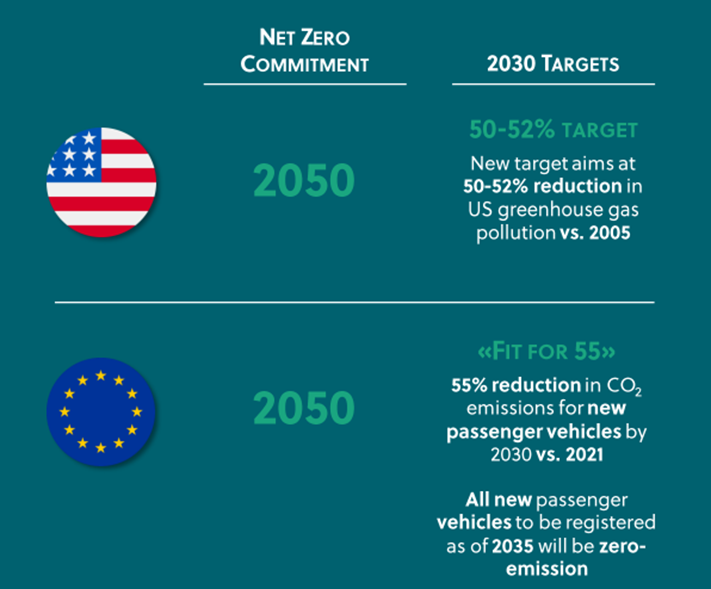
The 2021 United Nations Climate Change Conference (COP26) will take place at the end of October. After a historic year of extreme weather, and following a grim report published in August, we can expect a real sense of urgency and more concrete and measurable commitments following the conference. Major economies have already made commitments; we highlight a few below.

Source: Hexagon Purus Investor presentation

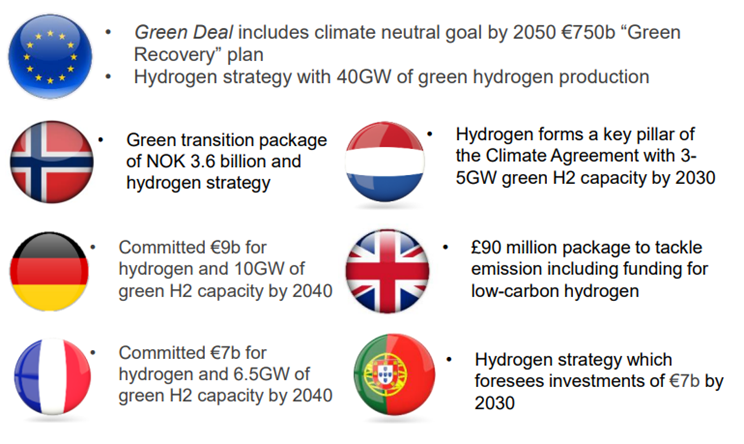
In terms of the hydrogen economy, below are a few of the initiatives that have been announced in Europe:

Source: Ballard Power investor presentation

China is widely recognized as a global leader in clean-energy technology: it controls 60% of the solar supply chain; is home to five of the top 10 wind turbine manufacturers; and leads the world in lithium-ion batteries. In September 2020, Chinese leaders pledged to reach carbon neutrality by 2060. It is no surprise that China wants to become a leader in hydrogen as well. 

Looking at the success of Tesla and the massive investments incumbent automakers are making to electrify their vehicles, we might think that adopting electric vehicles (EV) will be the solution to our problems. As we noted above, car and light trucks are only part of the emissions crisis, accounting for less than 20% of total emissions. But, staying with transportation, let us compare hydrogen with other technologies, as hydrogen is most competitive in heavy-duty motive applications.

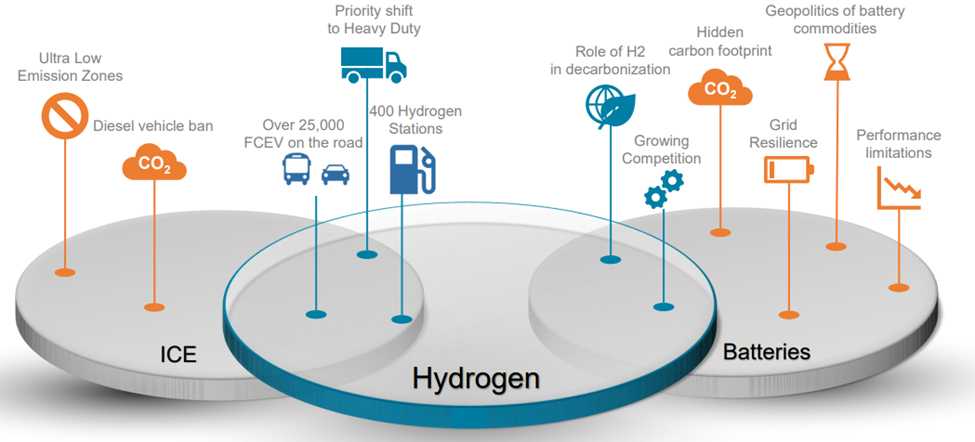
The following chart shows the intersection of different technologies.

Source Ballard Power investor presentation.

The addressable market for hydrogen as a transportation fuel is huge, even excluding SUVs and cars:

  • 450,000 buses and intercity coaches,
  • Four million medium/heavy-duty trucks,
  • 8,500 Electric hybrid trains,
  • 8,000 freight ships, and
  • Off-highway vehicles.

However, even if we were to solve the problem of infrastructure (fueling stations), hydrogen for cars and light trucks presents many advantages:

  • They are lighter;
  • They can fill up in just a few minutes; and
  • Their components are more easily recyclables.

A 2017 survey of 1,000 global auto executives concluded that hydrogen fuel cell technology will dominate battery-powered vehicles. More recent comments from Toyota, Honda, Hyundai, BMW, and Mercedes Benz go in the same direction.

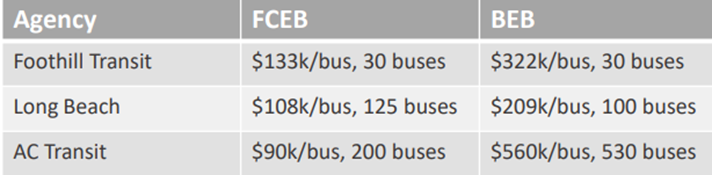
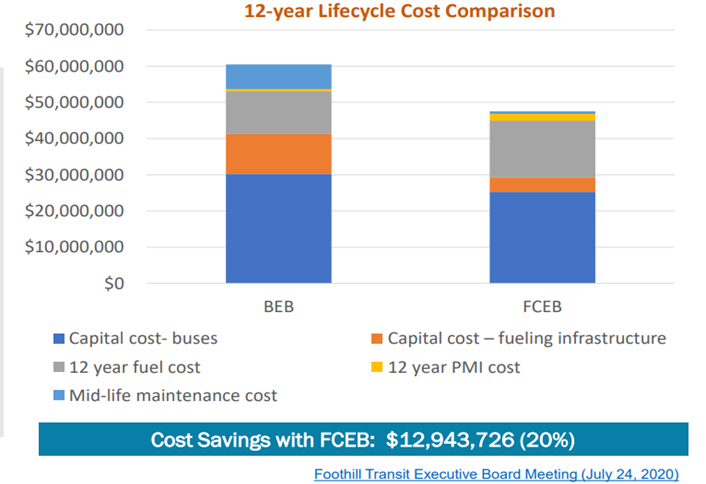
One market that is rapidly adopting zero-emission technology is the transit bus market. Although there have been many announcements about electric buses, many studies show that Fuel Cell buses have an advantage in terms of total cost of ownership, even at current prices.

For buses, an ICT study with data collected by the California Air Resources Board (CARB) showed the advantage of hydrogen as fleet size increases:

The Foothill transit study compared the cost of deploying twenty zero-emission buses on a 42-mile roundtrip route. Due to the range limitations of electric buses, it was determined the line would require 34 battery buses versus 23 hydrogen buses.

Orange County Transportation Authority plans to transition 100% of its fleet of 500+ buses to hydrogen.

“The 100 percent FCEBs scenario showed a slightly lower overall cost than the mixed technology fleet given current vehicle, fuel, and support infrastructure pricing. FCEBs offer an extended range and better match to OCTA’s current operating parameters. In comparison, the current range of BEBs may require more vehicles and drivers to meet similar service levels.” Orange County Transportation Authority.

How does Global Alpha participate in the hydrogen economy?

Iwatani (8088 JP)
www.iwatani.com/hydrogen-fueling 


Iwatani is a Japanese company founded in 1930 and a leader in the field of energy, industrial gases and machinery, materials, agri-bio and foods. Since 1941, the company has engaged in initiatives to encourage the widespread use of hydrogen, the ultimate clean energy source as stated in the company’s mission. Iwatani is Japan’s only fully integrated supplier of hydrogen, and presently supplies its base of light and heavy-duty hydrogen-refueling stations and industrial customers via five liquid and 10 gaseous hydrogen production plants throughout the country. In addition, Iwatani is a steering member of the Hydrogen Council, a global initiative of leading energy, transportation, and industry companies, with a united vision and long-term ambitions for hydrogen to foster the energy transition. Iwatani is developing hydrogen-refueling stations with the aim of stimulating new hydrogen demand and supporting the widespread distribution of Fuel Cell Electric Vehicles (FCEV). It currently has 64 refueling stations, a number that doubled in the last three years.

Hexagon composites (HEX NO)
www.hexagongroup.com


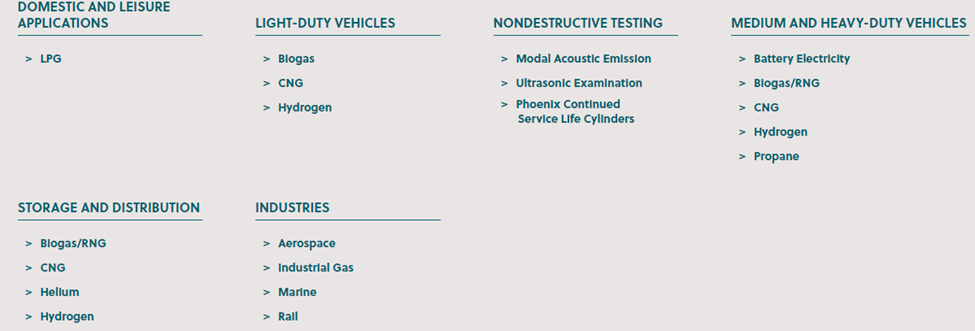
This Norwegian company has 1100 employees across 23 global locations. Its solution enables the storage, transport, and conversion to clean energy in a wide range of mobility, industrial, and consumer applications:

From Hexagon composites website

Clean Energy Fuels (CLNE US)
www.cleanenergyfuels.com


We profiled Clean Energy Fuels in an earlier commentary, on May 6, 2021.

Although we discussed hydrogen, renewable natural gas, which can then be reformed to produce hydrogen, is the only transportation fuel today that offers a negative carbon footprint.

Thanksgiving is the time of year when we reflect on the fortunate aspects of our lives and show our appreciation for friends, family and those who support us. At CC&L, we are thankful for our local food banks and the support that they continue to provide in the communities in which we live and work.

Food banks have come to play a vital role in many people’s lives, particularly as COVID-19 has created additional food insecurity for more families across the country. Since the start of the pandemic, food banks have seen a rise of more than 50% in the number of people requiring their services. If the current trend continues, Toronto food banks will see 1.4 million visits by the end of 2021.1

The CC&L Foundation has donated to the Daily Bread Food Bank in Toronto for a number of years and has recently furthered support with a multi-year commitment. The Daily Bread Food Bank was founded in 1983 and has become one of Canada’s largest food banks. It believes no one should go hungry or face barriers to accessing food. Its nearly 200 food programs across Toronto aim to provide healthy and nutritious meals to people experiencing food insecurity.

“Although a sense of normalcy is returning to our city, for tens of thousands of individuals living in poverty, the reality is very different. In August 2021, there were over 113,000 visits to Daily Bread member food banks – a 67% increase compared to the same time last year,” says Neil Hetherington, CEO, Daily Bread Food Bank. “We are deeply grateful to CC&L for stepping forward this Thanksgiving season with a generous donation that will help ensure that the right to food is realized for our adults, seniors and children experiencing food insecurity in our city.”

About the Connor, Clark & Lunn Foundation

Created in 1999, the CC&L Foundation is supported by CC&L Financial Group and its affiliates and it responds to requests from clients, staff and others to fund programs and not-for-profit organizations that help promote a better environment, improvements to education, advances in science and medicine, stronger communities and the arts.

1 Dailybread.ca

To enact change, more and more investors expect their money managers to hold companies accountable on environmental, social, and governance (ESG) issues. It aligns with a backdrop of social discourse from climate change and carbon emissions to equality and racism, alongside an outspoken, socially conscious, millennial generation that has integrated ESG into investment decisions and client portfolios.

There is a lot of conflicting information about what ESG investing is and why it should matter to investors – not to mention many misconceptions around whether ESG factors help or hinder investment performance. 

This article highlights how ESG investing has evolved and what it means today, shares our embrace of ESG factors in decision-making, and shows how to make your investments matter without sacrificing return potential.

How has the concept of ESG investing evolved?

Making investment decisions based on ESG-related factors is not new, although it has evolved significantly over the past 25 years. Early on, many ESG-related investment approaches took an exclusionary stance. They avoided investments in specific industries or companies that were associated with negative environmental or human impacts or had a reputation for poor or dangerous work conditions.  

In recent years, such investment approaches have matured and now align with different investors’ unique needs and objectives. At CC&L Private Capital, we typically break ESG-related investment approaches into three categories: 

  • ESG investing: Considering environmental, social, and governance issues as risk factors and integrating each into our investment process. This analysis and decision-making criteria informs our discipline when evaluating a stock, bond, or alternative investment in order to drive better risk-adjusted returns
  • Socially responsible investing (SRI): Use environmental, social, and governance risk factors to screen and filter specific risk exposures. These screening criteria are clearly defined but remain secondary to the primary objective of maximizing risk-adjusted investment returns. 
  • Impact Investing: An approach that takes the concept of SRI one step further, where all investments have a dual purpose: achieving a positive ESG impact and generating investment returns.

ESG investing, as defined above, should be relevant to all investors because it focuses on value. It is another important tool used to evaluate potential investments and determine return potential.

We embrace ESG factors in decision-making

At CC&L Private Capital, we integrate ESG factors into all of our investment processes, including traditional and alternative asset classes. This process identifies good environmental stewards that pay strong attention to health, safety, and social issues, and are well-governed.

By integrating ESG factors into our investment approach, we indirectly reward companies who embrace good corporate citizenship and provide the impetus to change for those that may be lagging. We are able to hold companies accountable and help them improve their own ESG activities. 

We also use a ”positive screen” approach – recognizing the best-in-class players in an industry or sector and encouraging others to make similar changes. For example, we might invest in a leading oil & gas company that takes environmental issues seriously, builds strong relationships with indigenous communities, and embraces diversity within their governance structures. 

In a world where ESG issues are growing in importance, we believe in working with clients and discussing an approach that better aligns with their values. It will help to generate improved risk-adjusted investment returns over the long term while contributing to the betterment of Canada and the world. 

Making investments that matter

ESG investing does not mean investors must choose between making socially-conscious investments and maximizing return potential. You can achieve both. Research has shown that, all else being equal, companies with sustainable business practices and a strong attention to corporate governance are likely to have less risk and perform better financially than those companies without. Investing in such companies leads to long-term value creation and contribute to building a better world. 

Find out more

In today’s investment environment, getting the returns you want can be difficult. To learn how you can build a diversified portfolio that achieves your financial goals while managing risk, please read our Portfolio Guide – Beyond Stocks and Bonds.

If you would like to find out more about our approach to ESG investing or learn how we can help you achieve your investment goals, please contact us.

This post is for information only and is not intended as investment advice. The views expressed are those of the author at the time of publication and are subject to change at any time.

Among companies globally, which country accounts for the highest percentage of companies that are over 100 years old? The answer is Japan, with about 33,000 companies at least a century old (approximately 40% of total companies). These companies tend to prioritize values such as commitment, quality, community, and tradition over financial logic.

Business longevity is one of the benefits of sustainability, a concept that is deeply rooted in Japan. Japanese culture also has a profound appreciation of nature. Corporations and individuals have a strong attachment to their community and wider society. Many companies promote lifelong employment, environmentally-friendly processes, product safety, and harmonious relationships among stakeholders.

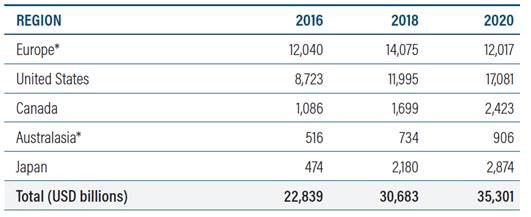
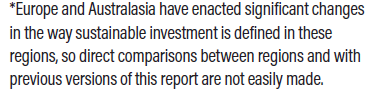
Regarding ESG investing, a concept developed in Europe, Japan is a late starter, but has made impressive leaps thanks to joint efforts from the government, the financial regulator, and key market players. According to the Global Sustainable Investment Review 2020, Japan’s sustainable assets increased by 34% from 2018, six times the 2016 level, now standing at US$2.9 trillion.

Global Sustainable Investment Assets

Source: Global Sustainable Investment Alliance

Japan’s ESG journey officially started in 2014 when it adopted a Stewardship Code to encourage investors to promote sustainable returns and growth by using shareholder voting and engagement. In 2015, Japan issued its first Corporate Governance Code. In the same year, its Government Pension Investment Fund (GPIF) became a signatory to the Principles for Responsible Investment (PRI). GPIF, the largest pension fund in the world, started investing in ESG assets in 2017. As of March 31, 2020, it had 151 trillion yen (US$ 1.37 trillion) in total assets under management (all with ESG integration), of which 5.7 trillion yen (US$ 52 billion) was invested in tracking ESG indexes and 440 billion yen (US$3.6 billion) in green bonds.

In October 2020, Japan pledged to achieve carbon neutrality by 2050. A month later, the Japanese House of Representatives and the House of Councilors declared a climate emergency, indicating that tackling climate change is not a partisan issue. We believe such policy continuity builds a solid foundation for Japan to execute its Green Growth Strategy.

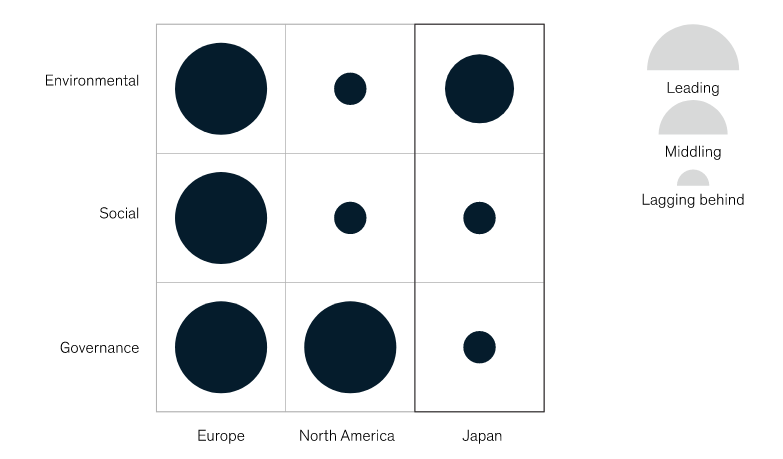
Currently, Japan’s ESG performance is lagging behind Europe and North America. McKinsey assessed the ESG performance of 621 companies in Europe, Japan, and North America from 2019 to 2020, based on 120 third-party ESG indicators, from carbon emissions to community relations to shareholders’ rights.

ESG Performance (Large and Smaller Companies Combined)

Source: McKinsey analysis 2021

We believe the above results are more or less expected, considering Japan’s late start. The good news is that from governments to corporations, the topic of ESG is now front and center.

In a recent survey conducted by the GPIF, the 6th annual survey of Japanese listed companies regarding institutional investors’ stewardship activities, the results showed continuous progress in ESG activities.

  1. Many companies pointed out the following common issues as the major themes in their ESG activities: corporate governance (71.7%), climate change (63.6%), and diversity (43.2%).
  2. Themes that surpassed the ratio in the previous survey include climate change (+9.7%), health and safety (+8.0%), and environmental opportunities (+3.8%).
  3. Companies are more proactively working on information disclosure, not only through integrated reports, but also through new disclosure criteria, such as the Task Force on Climate-related Financial Disclosures (TCFD); 31% of respondents have endorsed the TCFD.

Japan has been making regular revisions to strengthen the ESG guidelines. Last April, a new proposal was published by the Council of Experts regarding the revision of Corporate Governance Code and Guidelines for Investor and Company Engagement. We are glad to see more stringent guidelines than before to enhance board independence, diversity, ESG reporting and many other areas. Japan is also expected to announce its 6th basic energy plan to lay out details towards carbon neutrality.

As a long-term investor in Japan, we’ve definitely witnessed companies improving ESG practices since 2015. With many new initiatives coming, we believe Japanese companies have great potential to improve their ESG practices and create more value.

VANCOUVER, July 21, 2021 – Connor, Clark & Lunn Investment Management (CC&L Investment Management) is pleased to announce its endorsement of the recommendations of the Task Force on Climate Related Financial Disclosures (TCFD). As stewards of the assets entrusted to the firm by clients, CC&L Investment Management recognizes its responsibility and leadership role in advocating for capital market integrity. CC&L Investment Management will actively encourage investee companies to incorporate the TCFD recommendations in their future disclosures.   

“CC&L Investment Management is committed to reporting to our clients and other interested parties on our approach as we take steps to adopt these measures into our own business over time,” said Martin Gerber, President & Chief Investment Officer, CC&L Investment Management. “CC&L Investment Management has a robust Responsible Investing (RI) policy that encompasses our overall approach to the integration of environmental, social, and governance (ESG) issues into our investment processes. Fundamental to our approach is our belief that our portfolios and engagement activities must reflect the reality that the global economy is in the midst of a large-scale transition to lower carbon emissions.”

Through its endorsement of the TCFD, CC&L Investment Management commits to undertaking certain activities and reporting on these activities within the recommended TCFD framework. The four pillars of the TCFD framework include: Governance, Strategy, Risk Management, and Metrics and Targets.

CC&L Investment Management believes that the management teams of the companies it invests in have a duty to be transparent in their disclosures, and accountable to all stakeholders. Further, better disclosures will allow CC&L Investment Management’s investment teams to reflect on the risks that are inherent in companies that are slow to transition, as well as uncover opportunities related to earlier adoption of new technologies and innovation.  Finally, CC&L Investment Management believes the firm has a duty to be transparent, and its TCFD report will be available to stakeholders in the near term.

About Connor, Clark & Lunn Investment Management Ltd.

Connor, Clark & Lunn Investment Management Ltd. (CC&L Investment Management) is one of the largest independent partner-owned investment management firms in Canada with $55.9 billion in assets under management. Founded in 1982, CC&L Investment Management offers a diverse array of investment services including equity, fixed income, balanced and alternative solutions including portable alpha, market neutral and absolute return strategies. CC&L Investment Management is a part of Connor, Clark & Lunn Financial Group Ltd.

Contact

Lori Satov
Portfolio Manager, Client Solutions
Connor, Clark & Lunn Investment Management
(604) 643-5819
[email protected]

The Connor, Clark & Lunn Foundation (CC&L Foundation) is pleased to announce it has donated $25,000 to the Canadian Red Cross in support of India’s COVID-19 relief efforts. Funds will be directed from the Canadian Red Cross to the Indian Red Cross. The recent surge of COVID-19 cases in India caused a shortage of supplies and a strain on the health care system. Funds directed to the Indian Red Cross support COVID-19 response and recovery activities in India, as well as preparedness and resiliency activities for future pandemic and/or emergency events. Many employees at Connor, Clark & Lunn Financial Group and its affiliates call India home and have family and friends located in the hot spot areas. As the pandemic continues to create various uncertainties during these challenging times, we must continue to support those affected by COVID-19.

About the Connor, Clark & Lunn Foundation

Created in 1999, the CC&L Foundation is supported by CC&L Financial Group and its affiliates and it responds to requests from clients, staff and others to fund programs and not-for-profit organizations that help promote a better environment, improvements to education, advances in science and medicine, stronger communities and the arts.

On April 22 and 23, 2021, United States (US) President Joe Biden convened 40 world leaders for a virtual Leaders Summit on Climate, to rally the world in combatting the climate crisis.

Many countries announced ambitious new climate targets, ensuring that nations accounting for half of the world’s economy are now committed to the emission reductions needed globally to keep the goal of limiting global warming to 1.5 degrees Celsius within reach. For example:

  • The US submitted a new “nationally determined contribution” (NDC) under the Paris Agreement, setting an economy-wide emissions target of a 50-52% reduction below 2005 levels in 2030. 
    • Japan will cut emissions by 46-50% below 2013 levels by 2030, with strong efforts toward achieving a 50% reduction, a significant acceleration from its existing 26% reduction goal.
    • Canada will strengthen its NDC to a 40-45% reduction from 2005 levels by 2030, a significant increase over its previous target to reduce emissions 30% below 2005 levels by 2030.
    • The United Kingdom will embed in law a 78% greenhouse gas reduction below 1990 levels by 2035.
    • The European Union is putting into law a target of reducing net greenhouse gas emissions by at least 55% by 2030, and a net zero target by 2050.
    • China and Russia also reaffirmed commitments to reduce emissions, and agreed to cooperate with the US on climate change despite division on issues like trade and human rights.

During one of the sessions, Unleashing Climate Innovation, world leaders urged investment in mitigation and adaptation technologies, which include clean fuels such as hydrogen; renewables such as offshore wind and geothermal energy; energy storage; clean desalination; carbon capture; advanced mobility; sustainable urban design; and monitoring technologies to verify emissions and stop deforestation.

At Global Alpha, sustainability is one of our five major investment themes. The energy transition towards a low-carbon society provides long-term growth opportunities. We look for niche market leaders who will benefit from this secular growth trend. A few current holdings include:

  • Clean Energy Fuels (CLNE US), based in the US, designs, builds and operates natural gas filling stations for vehicle fleets. It has 550+ stations in North America. Its primary fuel is Renewable Natural Gas (RNG), the only fuel available for heavy-duty vehicles that can have carbon-negative emissions (RNG avoids more emissions than it generates).
  • Ormat Technologies (ORA US), based in the US, is a leading renewable energy provider globally with a 932 megawatt portfolio. Its business expands from geothermal to recovered energy and energy storage.
  • Hexagon Composites (HEX NO), based in Norway, is a global market leader in a carbon fiber gas containment system used in the transportation industry. It operates in Norway, Germany and the US. Hexagon’s products are mostly used for clean alternatives, such as RNG, hydrogen, and propane.

We also invest in companies related to electric vehicles (EV) and waste management but this week, we would like to profile one of our new holdings, Iwatani Corporation (8088 JP), which is the largest distributor of hydrogen, LPG, and helium in Japan.

Business Overview

Founded in 1930, Iwatani is a leading distributor of gases for industrial and household use in Japan. It has several business areas. The industrial gases segment includes hydrogen, oxygen, nitrogen, helium, semi-conductor material gas and medical gas. The energy segment distributes a wide range of gases such as LPG, LNG, kerosene, and gasoline. The company also manufacturers machinery and environmental-friendly materials, such as biomass fuels, eco PET resin and EV-related battery materials.

Iwatani is the only fully-integrated supplier of hydrogen in Japan, with a nation-wide network, including manufacturing, transportation, storage, supply, and security.

Target Market

Iwatani has a steadily growing product portfolio led by LPG, but the new growth driver is hydrogen.

Japan was the first country to adopt a “Basic Hydrogen Strategy” as early as in 2017. Japan aims to increase the number of fuel cell vehicles (FCVs) to 40,000 units by 2020, to 200,000 units by 2025 and to 800,000 units by 2030. It also aims to increase the number of hydrogen stations to 160 by 2020, to 320 by 2025, and to 900 by 2030.[1]


The Japanese hydrogen market is expected to grow 56-fold to JPY 408.5 billion by 2030, according to the market research company Fuji Keizai.

Competitive Advantages

  • Top market shares in Japan
    • #1 in hydrogen sales volume with 70% market share
    • #1 hydrogen stations network with 33% market share
    • #1 in helium sales with 50% Japan market share, and 8% global market share
    • #1 in LPG sales in the retail market with 4.1% market share
    • #1 in LPG sales in the wholesale market with 13.1% market share
    • #1 in the portable gas cooking stoves market with 80% market share
    • #1 in the cassette gas canisters with 60% market share
  • Close relationship with government as the industry leader
    • High entry barriers: a highly regulated industry because safety is of the utmost importance when handling industry gases.

Growth Strategy

  • Distribution: expand distribution network for hydrogen and LPG
  • Consolidation : 
  • To acquire smaller LPG competitors
  • To acquire companies into its organized Marui Gas network


Management

Akiji Makino has been Iwatani’s Chairman and CEO since 2012. He joined the company in 2000 and has rich industry experience. Insiders own about 16%, including the Iwatani Naoji Foundation.


ESG

Iwatani has been an industry leader in energy transition. Its sustainability report is very comprehensive. Iwatani’s major offices are ISO14001 certified. The company is focused on eco-friendly products and promotes eco-efficient use of energy. At its workplace, Iwatani promotes diversity, employee development, and provides support for child care and nursing care.

Regarding corporate governance, Iwatani has met all the requirements of the Tokyo Stock Exchange. However, at Global Alpha, we apply more stringent requirements in line with western standards. For example, we encouraged the company to have at least one-third of board directors be independent, with a separate board chair and CEO, and at least one female board director.


Risks

  • Delay in the rollout of FCV commercialization ad FC technology development
  • Decline in LPG price
  • Low industrial production

[1] https://www.meti.go.jp/english/press/2017/pdf/1226_003a.pdf