Artist studio in Tbilisi old town. Art-filled interior with supplies, handmade signs, posters & framed paintings.

Ever thought of opening your own escape room or theme park?

Or maybe you’re thinking of contacting SpaceX to launch a satellite of your own?

It could be that you simply have a piece of art or expensive jewelry at home.

What if you’re trying to make it as an influencer where your online reputation is your most important asset?

To address all the above, and more, there is a niche segment within insurance called “specialty insurance.” As the name would suggest, specialty insurers attempt to cover risks that are too unusual, complex or volatile for standard insurers to price correctly. Examples of specialty insurance coverage include:

  • cyber insurance,
  • marine, aviation and energy risks,
  • kidnap and ransom,
  • directors’ and officers’ (D&O) risk, and
  • niche businesses or properties.

Standard versus specialty insurance: What’s the difference?

The line between standard and specialty insurance is not always straightforward. A small office building in the suburbs is more standard while a chemical manufacturing facility of the same size would fall well under specialty. The more unusual the asset, the environment and potential loss, the more likely you are to use a specialty underwriter.

The most significant difference from standard insurers is that specialty insurers do not rely on scale and mass data the to underwrite risk, but instead use specialized knowledge and models to support their underwriter’s judgement. Often, specialist underwriters grow a very specific set of knowledge around their segment: engineering intricacies, political risk, weather models, etc. The policies themselves are much less standardized, with more levers around maximum paid, duration, repricing, conditions to be met or excluded events.

The benefits of investing in specialty insurers can be significant.

What makes specialty special?

The building of detailed knowledge in niche areas is its own self-reinforcing moat. An insurer that has been covering political risk for decades will have more claims data, stronger broker relationships and increasingly better understanding of the risks to avoid. Because these risks are harder to assess, pricing is generally less commoditized. As such, customer retention rates and margins tend to be higher.

Specialty insurers also have more flexibility to respond to changing environments. They can reduce the amount of coverage offered, increase deductibles, add exclusion clauses or just reduce their overall exposure.

A good example is the beginning of the conflict with Iran, when insurance contracts on ships were repriced every 72 hours for the first few weeks, with the ship/cargo coverage going from roughly 0.25% of the ship’s value to several percentage points more. In some cases, quotes were increasing by more than tenfold.

Lloyd’s of London, the world’s largest marketplace for specialty insurance, wrote over GBP57.9 billon of gross premiums in 2025 and reported a combined ratio of 87.6% (implying an operating margin of 12.4%). Combined with investment incomes, it generated a return on capital of 22%. This level of profitability also points to competition flowing in with new money, leading pricing to degrade by 3.7% as insurers compete for growth. Price weakness was especially elevated in corporate property and global reinsurance, with the latter seeing unprecedented influx of new alternative capital. Life and middle-market insurance are still seeing a hard market (a positive pricing environment).

This is typical of the ebb and flow of the insurance cycle. Strong profit attracts new capital, which creates more competition and pushes prices down. Returns eventually deteriorate or a major loss removes capital from the market, leading pricing to improve again. With a highly diversified specialty insurance market, different segments will be at different points in the cycle at different times. The best insurers are not those that grow the fastest; they are the ones that are willing to shrink their exposures to segments where pricing doesn’t adequately compensate for the risk taken, while identifying when to get back in for the right price. Seems a bit like equity investing.

What else differentiates specialty insurers? One thing is that in some segments, claims can take years to emerge, particularly in casualty, professional liability and D&O insurance. This can lead to current profits and underwriting quality looking good at the expense of future profitability. As such, firms need to strike a fine balance between maintaining enough insurance reserves for future claims, while also not over-penalizing short-term profit.

How do we have exposure?

One of the specialty insurers we own is Hiscox Ltd. (HSX LN), a Bermuda-based Lloyd’s insurer with a strong retail specialty presence. The company operates in three segments:

  • Retail: specialty products to individuals and small businesses in the UK, Europe and the United States.
  • London market: underwrites complex risk through the Lloyd’s market, with a strong focus on marine, energy, aviation, terrorism and political risk.
  • Reinsurance: reinsurance for other insurers and insurance-linked capital supplied by outside investors.

In 2025, Hiscox wrote around $5.0 billion of contracts and has a reputation of excellent underwriting culture along with a best-in-class brand in the insurance world and among high-net-worth individuals.

Another name we own is US-based RLI Corp. (RLI US). It operates through a decentralized underwriting model and is a consistent top performer within the industry given its conservative underwriting and reserving. RLI focuses on the segments of niche properties, casualty and surety markets.

RLI has produced an underwriting profit for 30 consecutive years and increased its dividend for 50 consecutive years, an anomaly within the industry.

The specialty space is getting smaller

Within the sector, one of the big topics recently has been M&A. Twenty years ago, there were more than ten publicly listed Lloyd’s of London specialty insurers. Now only three remain, with the largest one – Beazley – in the process of being acquired by Zurich Insurance.

Given the attractive characteristics described above, it is easy to see why the large composite insurers would want to gain exposure to specialty insurers. Large composite insurers have significant capital to deploy and global distribution relationships, but lack the underwriting culture and specialist data required to enter these niche markets organically. Similarly for investors, specialty insurers can be compelling investments when they have the discipline to avoid bad risks and the expertise to price difficult risks better than competitors.
Chair Warsh has stressed the Fed’s commitment to delivering 2% inflation. Current monetary trends are inconsistent with this goal.

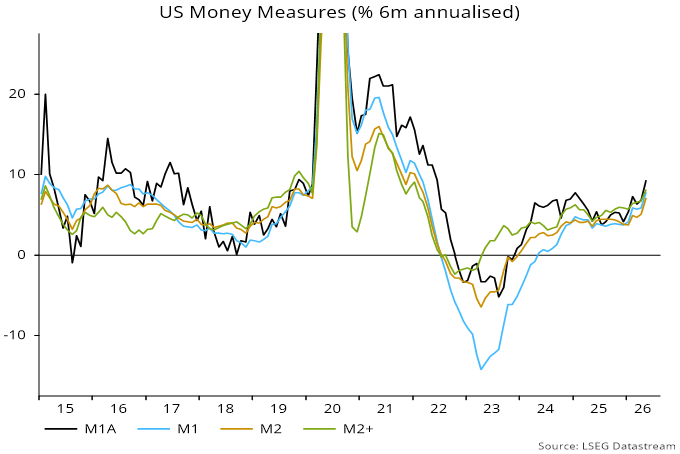
Official M2 rose by an annualised 7.3% between December and June, the strongest six-month increase since March 2022. The broader M2+ measure calculated here – which additionally includes large time deposits and institutional money funds – expanded by 8.5% over the same period. Growth of narrow money M1A (currency plus demand deposits) was faster still, at 10.6% – see chart 1.

Chart 1

US Money Measures (% 6m annualised)

Money growth is reflected in some combination of real GDP expansion, inflation and falling velocity. Even optimists would doubt that current potential GDP growth is more than 3% pa. Broad money expansion of more than 8%, therefore, requires a contraction in velocity of at least 3% pa to be consistent with 2% inflation. Such a decline is implausible on a trend basis: M2+ velocity fell by an average 0.8% pa over 1960-2025.

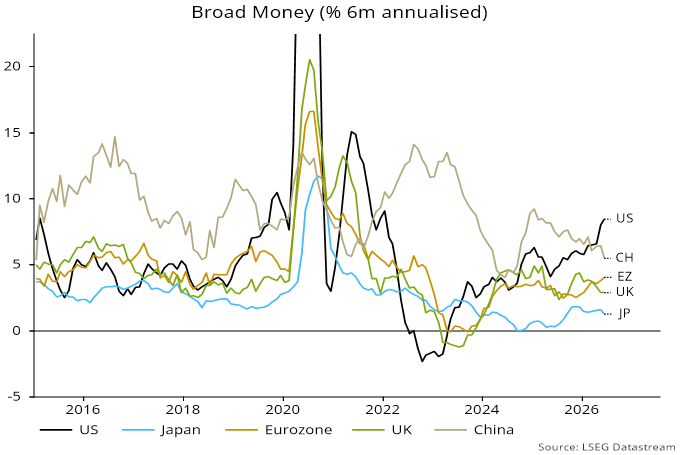
US monetary acceleration contrasts with weakness or slowdowns in other developed economies. Six-month broad money growth in June was 4.1% annualised in the Eurozone (non-financial M3), 2.9% in the UK (non-financial M4) and 1.3% in Japan (M3) – chart 2.

Chart 2

Broad Money (% 6m annualised)

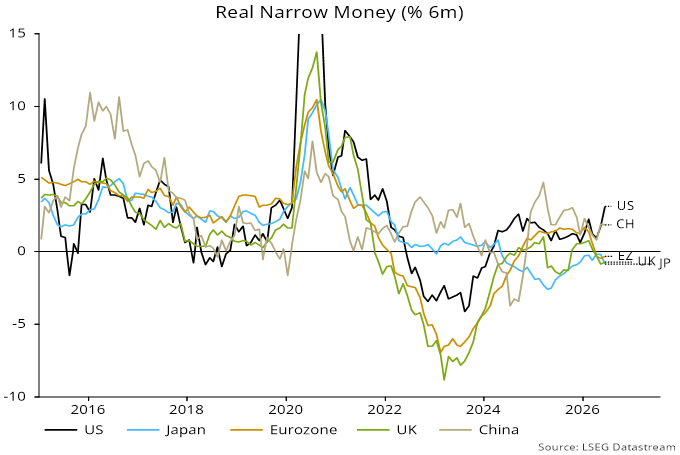
Six-month real narrow money momentum remains negative in the Eurozone, UK and Japan even as US growth moves above a 2024 high – chart 3.

Chart 3

Real Narrow Money (% 6m)

The scale of the monetary divergence goes beyond signalling a stronger case for US policy tightening, suggesting that other central banks should be moving in the opposite direction to the Fed.

What explains US acceleration? Unlike other central banks, the Fed has never published a “counterparts” analysis of broad money. However, the key drivers are likely to have been stronger bank lending – commercial bank loans and leases grew by 8.2% annualised in the six months to June, up from 6.3% in the prior half-year – and the Fed’s resumption of QE (“reserve management purchases”) from December. External flows may also have contributed, reflecting strong foreign buying of US equities.

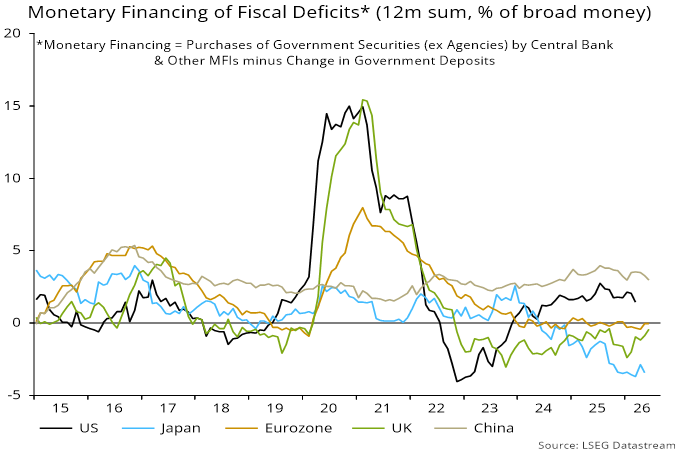
“Monetary financing” is a broader concept than QE, encompassing purchases of Treasury bills and notes by commercial banks and money funds as well as QE and changes in the Treasury’s balance at the Fed. The level of money growth in the US continues to be inflated relative to other developed economies by monetary financing of a much larger fiscal deficit – chart 4.

Chart 4

Monetary Financing of Fiscal Deficits (12m sum, % of broad money)

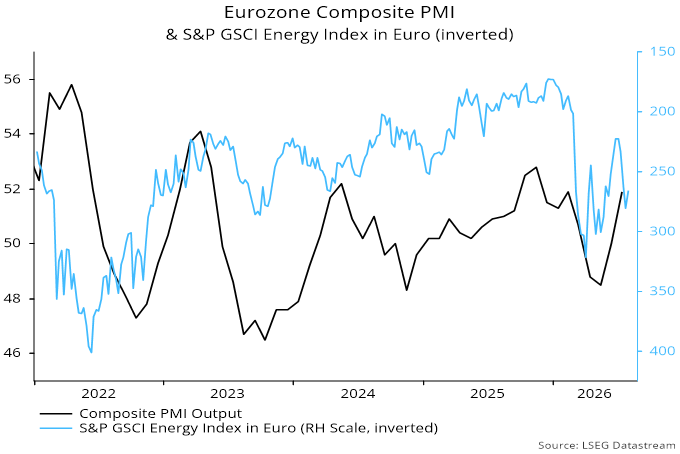
A June / July rebound in the composite PMI output index has raised hopes that Eurozone growth is picking up pace. Monetary trends continue to send a cautious message.

The PMI rebound may reflect a boost to sentiment from a May / June fall in energy prices, which has since reversed – see chart 1.

Chart 1

Eurozone Composite PMI & S&P GSCI Energy Index in Euro (Inverted)

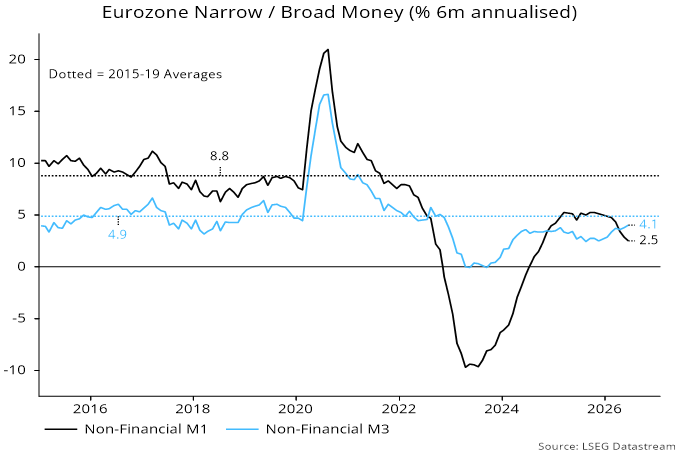
Money trends were soft even before June’s rate hike. The preferred broad measure here – non-financial M3, comprising holdings of households and non-financial corporations (NFCs) – rose by an annualised 4.1% in the six months to June, below a pre-pandemic (i.e. 2015-19) average of 4.9%. Narrow money developments are more worrying, with six-month growth of non-financial M1 falling to 2.5% last month, having peaked at 5.2% in September 2025 – chart 2.

Chart 2

Eurozone Narrow / Broad Money (% 6m annualised).

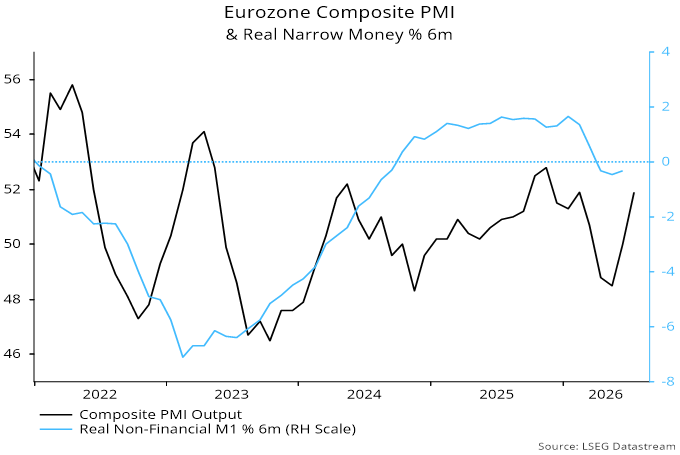
The sector breakdown shows similar weakness in household and NFC M1 components. Meanwhile, six-month real narrow money momentum, which led the PMI recovery over 2023-25, turned negative in April, remaining so in May-June – chart 3.

Chart 3

Eurozone Composite PMI & Real Narrow Money % 6m

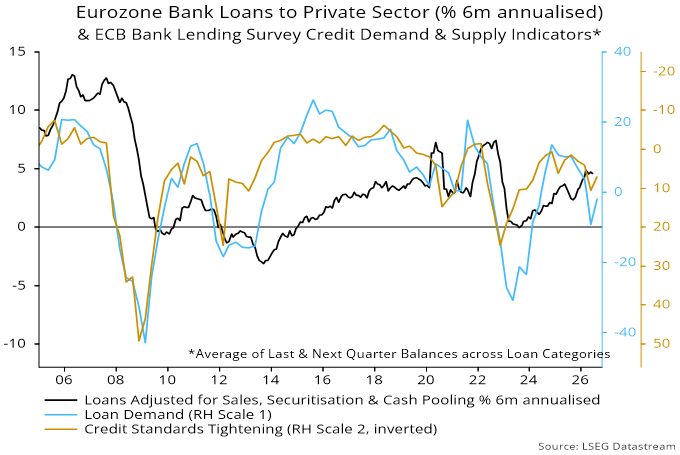
Optimists cite respectable bank loan growth, of 4.6% annualised in the latest six months. Statistical studies, however, have long shown that lending is a coincident or lagging economic indicator, whereas money leads. Six-month loan growth may have peaked at 4.9% in March. The latest ECB quarterly bank lending survey, while less downbeat that the previous poll conducted at the height of Gulf hostilities, suggests a slowdown – chart 4.

Chart 4

Eurozone Bank Loans to Private Sector (% 6m annualised) & ECG Bank Lending Survey Credit Demand & Supply Indicators

Téléphone intelligent fixé au tableau de bord d’une voiture, affichant une carte avec un itinéraire de navigation.

Personne n’est naturellement à l’aise avec l’incertitude. Nous préférons avoir une certaine idée de la direction à prendre, par exemple au moyen d’un ensemble d’attentes ou d’une carte qui nous aide à comprendre ce qui pourrait nous attendre et la façon dont nous pourrions réagir. Pensons à une commande de voiture Uber. Nous choisissons le type de véhicule souhaité, voyons une heure d’arrivée estimative, puis suivons sur une carte le trajet du chauffeur. La carte ne fait pas arriver la voiture plus rapidement, mais elle réduit l’anxiété liée à l’incertitude quant au moment où le chauffeur arrivera.

Malheureusement, le placement n’est pas accompagné du même type de carte. Les marchés financiers sont complexes, en constante évolution et façonnés par des forces qu’il est impossible de prévoir avec certitude. Or, la réussite en placement ne consiste pas à éliminer l’incertitude. Elle repose plutôt sur la capacité à s’y retrouver en prenant des décisions réfléchies malgré celle-ci. Le présent article examine un ensemble de principes décisionnels conçus pour aider les investisseurs à naviguer dans l’incertitude avec davantage de discipline, de confiance et de recul.

Principes de prise de décision

La prise de décision est souvent perçue comme un choix entre différentes options, mais sa véritable valeur réside dans le processus qui précède ce choix. Une prise de décision efficace exige des objectifs clairs, une compréhension des options disponibles et une évaluation rigoureuse des conséquences possibles. Il s’agit moins de trouver la « bonne » réponse que de faire des choix capables de résister à l’évolution des circonstances. Un processus robuste permet de distinguer les mesures qui semblent simplement attrayantes aujourd’hui de celles qui demeureront résilientes au fil du temps.

Dans le domaine du placement, l’incertitude est inévitable. La réussite ne découle pas de la capacité à prévoir l’avenir avec précision, mais plutôt de la prise de décisions susceptibles de produire de bons résultats dans un éventail de scénarios. En appliquant des principes rigoureux en matière de prévisions, de prise de risque, de diversification, de conscience des biais comportementaux et de gestion de la pensée de groupe, les investisseurs peuvent bâtir des portefeuilles et des cadres décisionnels mieux outillés pour faire face à tout ce que l’avenir pourrait réserver. L’incertitude ne disparaît jamais, mais un processus décisionnel solide peut transformer l’inconnu, qui pourrait autrement constituer une menace, en un facteur pouvant être géré.

Principe 1 – Comprendre le rôle des prévisions

Chaque décision de placement constitue une prévision. Que nous en soyons conscients ou non, toute affectation de capitaux reflète une opinion sur la façon dont l’avenir pourrait évoluer. Le défi tient au fait que l’avenir est inconnaissable. C’est pourquoi l’objectif des prévisions n’est pas la précision en soi, mais l’amélioration de la prise de décision. Les prévisions aident les investisseurs à évaluer les possibilités, à soupeser les probabilités et à faire des choix plus éclairés dans un monde incertain.

L’essentiel est de reconnaître que le placement est une affaire de probabilités, et non de certitudes. Plutôt que de se demander « Que va-t-il se produire? », les investisseurs devraient se demander « Que pourrait-il se produire, et comment devrais-je m’y préparer? ». Ce changement de perspective peut favoriser des portefeuilles plus résilients et de meilleurs résultats à long terme.

Principe 2 – Prendre des risques de façon réfléchie

Les investisseurs les plus prospères comprennent que l’incertitude est une caractéristique permanente des marchés et qu’éviter entièrement le risque constitue souvent le plus grand risque de tous. Ils prennent plutôt des risques de façon réfléchie, en privilégiant les occasions où la récompense potentielle justifie l’incertitude et en construisant des portefeuilles capables de résister à un éventail de résultats. Les prévisions jouent un rôle essentiel, non pas parce qu’elles révèlent l’avenir, mais parce qu’elles aident les investisseurs à évaluer les probabilités, à remettre en question les opinions consensuelles et à repérer les situations où les attentes pourraient être mal fondées. La gestion des risques prend ensuite le relais afin de veiller à ce que le portefeuille demeure robuste, même lorsque ces prévisions s’avèrent erronées. La combinaison de ces deux éléments crée un cadre puissant pour naviguer dans l’incertitude. On peut voir les prévisions comme un moyen de réduire l’incertitude, tandis que la gestion des risques vise à réussir malgré celle-ci.

Principe 3 – La diversification doit en faire davantage

La diversification est importante, mais elle ne peut être mise en place puis oubliée. La récente période de hausse de l’inflation et des taux obligataires nous a rappelé que les actions et les obligations peuvent reculer simultanément, et que les obligations peuvent offrir une protection lorsque la croissance faiblit, mais pas lorsque les attentes inflationnistes augmentent. De nombreux investisseurs ont dépassé le cadre traditionnel des actions et des obligations en ajoutant une composante de placements non traditionnels, mais ceux-ci présentent également leurs propres défis en période de tensions. L’objectif n’est pas de détenir un peu de tout. Il s’agit plutôt de comprendre pourquoi chaque exposition est détenue, quel rendement elle procure ou quel risque elle atténue, et si l’investisseur est toujours adéquatement rémunéré pour y affecter des capitaux.

Principe 4 – Comprendre l’influence des émotions

Les investisseurs consacrent beaucoup de temps à tenter de comprendre les marchés, les économies et les sociétés. Pourtant, certains des facteurs les plus importants qui influencent les résultats de placement proviennent de l’intérieur. La peur peut amplifier les risques. L’optimisme peut les occulter. La confiance peut renforcer la conviction, mais elle peut aussi engendrer de la complaisance. Comprendre ces forces émotionnelles constitue un élément essentiel d’une prise de décision réussie.

L’objectif n’est pas d’éliminer les émotions du processus de placement, mais d’en reconnaître l’influence. Les investisseurs qui développent leur conscience émotionnelle et leur discipline sont souvent mieux placés pour prendre des décisions cohérentes, rester fidèles à leurs objectifs à long terme et naviguer dans l’incertitude sans se laisser diriger par elle. C’est ainsi que l’intelligence émotionnelle peut contribuer à de meilleurs résultats de placement.

Principe 5 – Se méfier de la pensée de groupe et de l’excès de confiance

La qualité des décisions d’un comité dépend souvent moins de la rapidité avec laquelle il parvient à un accord que de l’efficacité avec laquelle il remet en question ses propres hypothèses. La pensée de groupe et l’excès de confiance peuvent apparaître lorsque l’optimisme n’est pas mis à l’épreuve. Le contraste mental offre un antidote pratique. En demandant aux membres du comité d’envisager à la fois le résultat réaliste le plus souhaitable et les obstacles qui pourraient empêcher sa réalisation, la discussion passe de la confirmation à l’exploration. Cette approche améliore non seulement la qualité des décisions, mais encourage également la dissidence constructive, renforce la gouvernance et favorise une culture dans laquelle la remise en question des idées est perçue comme une contribution plutôt que comme une critique.

Principe 6 – Reconnaître les avantages de l’adaptabilité

Dans la pratique, l’adaptabilité peut prendre de nombreuses formes : réévaluer les hypothèses relatives aux marchés financiers, raffiner le positionnement du portefeuille, revoir les besoins de liquidité ou mettre à jour les processus de gouvernance à mesure que les conditions évoluent. L’adaptabilité constitue souvent le pont entre une stratégie solide et des résultats fructueux. Même si aucun investisseur ne peut prévoir chaque changement économique ou chaque perturbation des marchés, ceux qui demeurent souples dans leur réflexion et rigoureux dans leur prise de décision sont mieux préparés à réagir à l’évolution des conditions. Dans un monde incertain, la capacité d’adaptation peut être aussi précieuse que la capacité de prévision.

Naviguer dans l’incertitude

L’avenir sera toujours incertain. La réussite appartient non pas à ceux qui le prévoient avec le plus de précision, mais à ceux qui sont les mieux préparés aux nombreuses façons dont il pourrait évoluer. L’incertitude n’est pas une situation temporaire que les investisseurs doivent endurer jusqu’à ce que les marchés deviennent plus clairs. Elle constitue une caractéristique permanente du placement. Le défi n’est pas de l’éliminer, mais de prendre de bonnes décisions malgré elle.

Les prévisions, les modèles et les analyses peuvent améliorer notre compréhension de ce qui pourrait nous attendre, mais ils ne peuvent offrir de certitude quant à l’avenir. Les investisseurs les plus prospères reconnaissent que la réussite en placement repose sur l’établissement de processus décisionnels robustes qui tiennent compte de l’incertitude, évaluent les probabilités et demeurent adaptables à mesure que de nouvelles informations deviennent disponibles. Cela exige de prendre des risques de façon réfléchie, de diversifier avec discernement, de remettre en question les hypothèses, d’encourager les débats constructifs et de conserver la discipline nécessaire pour s’adapter lorsque les faits changent.

Ankur Saxena et Diana Bartolic.

L’intelligence artificielle (IA) est souvent présentée comme un défi technologique, mais son adoption réussie repose avant tout sur le leadership et la transformation des activités.

Dans un récent article de Human Resources Director, Ankur Saxena, directeur, Stratégie technologique, et Diana Bartolic, chef des Ressources humaines, expliquent pourquoi l’adoption de l’IA exige bien plus que de nouveaux outils et de nouvelles technologies. Elle nécessite un leadership dédié, une gouvernance efficace, une gestion du changement réfléchie et un engagement à aider les employés à s’adapter à l’évolution des rôles et des façons de travailler.

Comme le souligne Ankur, l’IA est « en grande partie une initiative de transformation des activités, plutôt qu’une initiative technologique ». Diana insiste pour sa part sur l’importance de soutenir les employés pendant cette période de transformation importante du milieu de travail et de veiller à ce que les organisations disposent des structures nécessaires pour gérer le changement de façon responsable.

Au Groupe financier CC&L, nous croyons que la création de valeur à long terme grâce à l’IA exige d’investir non seulement dans la technologie, mais aussi dans le capital humain, les processus et le leadership nécessaires pour en assurer une adoption efficace, responsable et conforme aux objectifs d’affaires.

Lire l’article complet : AI enablement officer: the new sheriff in transformation town (en anglais seulement)

A stunning view of the Beijing Phoenix Center and CBD skyline.

Investor views on China have become increasingly polarized, creating both challenges and opportunities for active managers. While concerns about economic growth, geopolitical tensions and market regulation continue to shape sentiment, China’s scale and importance within the emerging markets universe make it difficult for investors to ignore.

In a recent interview with Benefits and Pensions Monitor, Michael Mortimore discusses the factors influencing China’s investment outlook and why a selective, fundamentals-driven approach remains essential in today’s environment. He explores the structural challenges facing the Chinese economy, the implications for investors and the developments that could help support a more sustainable path forward.

As Michael explains, « If China was able to reinvigorate domestic demand and also curb the incentives that basically fuel all this excess capacity, we think that that would be a really, really positive development and really bullish for long term prospects for China as a whole and the sustainability of its economic model. »

Read the full article for Michael’s perspective on navigating uncertainty, evaluating risk and identifying long-term opportunities in one of the world’s most consequential investment markets: Is China still worth the risk for emerging market investors?

The Fed and Bank of England have included references to money in recent reports. The suspicion is that this represents tokenism and money trends still have no influence on policy decisions.

The Fed’s latest semi-annual Monetary Policy Report to Congress contains a paragraph discussing recent trends in the M2 money measure, included, apparently, at the behest of Chair Warsh.

In follow-up Q&A, Chair Warsh explained that he is not a “monetarist” but nevertheless holds the “old-fashioned view that monetary policy has something to do with money”.

Meanwhile, perhaps not coincidentally, former Fed Governor Miran has co-authored a paper that attempts to rehabilitate the P* monetarist approach to inflation forecasting.

P* is the level of prices implied by the current money stock, incorporating assumptions about trend GDP and velocity. The gap between P* and the prevailing price level P is a measure of future inflationary (or disinflationary) pressure. Miran et al present estimates of the price gap based on M2 and other (Divisia) money measures, showing that these gaps exhibit a statistically significant relationship with future inflation.

Both the Fed report and the Miran paper suggest that current monetary trends are non-inflationary. The former notes that annual M2 growth averaged 4.7% in the first five months of the year, which is “closer to the range typically observed in the 2010s”, when inflation undershot the 2% target.

Similarly, the current price gap estimates presented by Miran et al are all around zero, implying that “the stance of monetary policy is quite close to neutral right now, putting neither upward nor downward pressure on the inflation rate”.

A cynic might wonder if the appearance of these references to monetary trends has been motivated by a search for arguments to push back against a strengthening case for policy tightening based on conventional economic data (reflected in the Fed policy direction model discussed in previous posts).

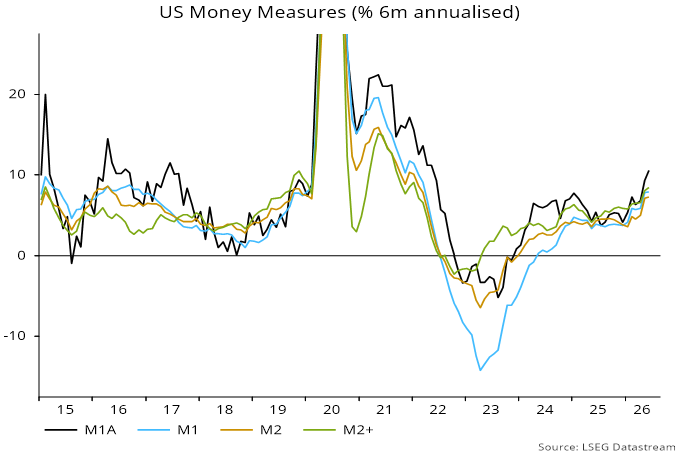
In any case, the assessment that current trends are unthreatening may soon be out-of-date. Year-to-date annual M2 growth of 4.7% conceals a pick-up in six-month expansion to a 7.1% annualised pace in May. The broader M2+ measure calculated here rose by 8.2% over the same period – see chart 1.

Chart 1

26 July August Muldowney Wright

The recent acceleration suggests that the Miran et al price gap estimates are now positive.

By contrast, six-month growth of the Bank of England’s M4ex broad money aggregate was 4.4% annualised in May, with the non-financial M4 measure preferred here rising by just 2.8%.

The Bank’s quarterly Monetary Policy Report (or Inflation Report before November 2019) contained no mention of money between May 2019 and May 2023, a period during which annual non-financial M4 growth reached 16.0%. A reappearance in August 2023 coincided with the annual rate of change turning negative. Editions in May 2024 and May 2025 included boxes discussing broad money developments in detail.

Still, there is no evidence from the minutes that monetary considerations have played a role in any decisions of any MPC member. Regular references to money trends are, it appears, little more than a box-ticking exercise. The same will likely be true at the Fed.

SE_COMM_2026-07-20_Images_03

Peter Muldowney a corédigé, pour Plans & Trusts, un guide pratique à l’intention des administrateurs de régimes de retraite et d’avantages sociaux. L’article présente des mesures concrètes pour cerner, évaluer et gérer les risques, tout en protégeant la réputation des régimes, en renforçant leur résilience et en préservant leur valeur à long terme.


Veuillez noter que cet article est écrit en anglais.

La ligne d'horizon de Shanghai au crépuscule, avec le Garden Bridge, en Chine.

La Chine vaut-elle toujours le risque pour les investisseurs des marchés émergents?

Dans une récente entrevue accordée à Benefits and Pensions Monitor, Michael Mortimore explique comment les investisseurs devraient envisager le rôle de la Chine dans les portefeuilles de marchés émergents, les risques qui y sont associés et l’importance de maintenir une approche de placement rigoureuse.

Michael souligne que, même si les mesures de relance annoncées par la Chine à la fin de 2024 ont brièvement stimulé les actions liées à la consommation, cet élan s’est rapidement essoufflé et la conviction que Pékin soutiendra les dépenses des ménages s’est affaiblie. Il déclare à ce sujet : « La demande et la confiance des consommateurs semblent extrêmement faibles, dans un contexte déflationniste. »

 
Lire l’article complet (en anglais seulement)

Vibrant tulip fields and modern wind turbines in Flevoland, Netherlands.

What is the Sustainable Finance Disclosure Regulation?

The Sustainable Finance Disclosure Regulation (SFDR) was introduced by the EU Commission as a core component of its 2018 Sustainable Finance Action Plan. As a key pillar of the EU Sustainable Finance agenda, SFDR aims to improve transparency, prevent greenwashing and help investors make informed sustainable investment decisions. To do so, the SFDR introduced mandatory disclosure requirements around environmental, social and governance (ESG) metrics at both the entity and the product levels.

An imperfect system

Since taking effect in March 2021, the SFDR has faced implementation challenges and criticism from market participants. In a 2023 consultation, the EU Commission found that 83% of respondents believed the regulation was being used as a product label and marketing tool, rather than solely as a disclosure framework. Respondents highlighted several concerns, including greenwashing risks linked to inconsistent product classifications, unclear definitions, limited ESG data availability and higher compliance costs. Together, these challenges have made implementation more difficult and limited SFDR’s ability to provide transparent, comparable information on sustainable investments.

This has prompted the EU Commission to consider revisions to the framework, culminating in the draft SFDR 2.0 proposal.

Is it the end of Article 8 and 9?

Not quite. Rather than eliminating these categories altogether, the proposal replaces the existing Article 6/8/9 disclosure framework with a revised product classification system that introduces clearer definitions, eligibility criteria and sustainability thresholds.

What might change?

Contribution requirement

  • One of the most significant proposed changes is that at least 70% of a fund’s assets would need to satisfy the sustainability criteria of its chosen category, whereas the current SFDR provides managers with greater flexibility to determine the applicable threshold.

Transition (Article 7)

  • This entirely new proposed category, Transition, is intended for funds investing in companies that are on a credible pathway towards improved sustainability performance.

ESG Basics (Article 8)

  • To qualify under the category of ESG Basics, investments would generally need to satisfy at least one of several sustainability tests such as: outperforming the benchmark on ESG ratings or key sustainability indicators, demonstrating improved sustainability characteristics or meeting minimum sustainability standards. This marks a significant shift from the current framework, replacing the broad flexibility currently afforded to managers with more standardized qualification criteria.

Sustainable (Article 9)

  • The Sustainable category remains the highest sustainability classification and is expected to be subject to the most stringent eligibility criteria. Although there is broad support for maintaining this as the highest sustainability category, negotiations continue around how sustainable investments should be defined in practice.

Mandatory exclusion criteria

  • Under the current regulation, investing in an ESG or sustainable fund does not necessarily prevent exposure to controversial sectors, such as fossil fuels, tobacco or prohibited weapons. Under the proposed SFDR 2.0 framework, mandatory exclusion criteria would apply across all sustainability categories, with the scope and stringency of exclusions increasing for higher-ambition categories.

These proposed changes would work to ensure that a fund could substantiate its sustainability claim with clearly measurable criteria, assuaging greenwashing risks.

Where do negotiations stand?

The legislative process is progressing rapidly. The EU Council published its negotiating position in June, while the European Parliament is expected to adopt its position shortly. Once both institutions have finalized their positions, trilogue negotiations with the European Commission will begin alignment on the final SFDR 2.0 framework.

Implementation timeline

The trilogue negotiations are expected to begin this autumn. While the timing remains uncertain, the legislative process is likely to extend through 2027, followed by a transition period before the new rules apply. Based on the current timetable, SFDR 2.0 is unlikely to become applicable before 2029, although the exact implementation date will depend on the pace of negotiations and the final transition period.

What does this mean for investors?

While the final rules are still being negotiated, the overall direction is becoming increasingly clear: sustainability claims will need to be supported by more objective and measurable criteria. An analysis by Clarity AI estimates that around 40% of current Article 9 funds would not meet the proposed exclusion rules of the highest sustainability category. 80% of Article 8 funds would experience the same challenge.

For asset managers and investors, these reforms could materially affect how sustainable funds are designed, marketed and compared, making the final outcome particularly relevant for investment strategies with ESG objectives. Funds currently designated as sustainable under Article 8 or 9 may need to be strategically revisited with portfolio or policy adjustments if the intent is to maintain the same designation levels.

At Global Alpha, we are following these developments closely. While SFDR 2.0 remains subject to negotiation, the direction is clear: sustainability claims will increasingly need to be supported by objective, measurable criteria. We will continue to monitor the legislative process and its implications for the sustainable investment landscape as the final framework takes shape.