The ECB and Bank of England have signalled an expectation of policy tightening, while the latest Fed statement maintained an easing bias. Economic / monetary conditions argue for the opposite relative positions.

Eurozone core inflation is lower than in the US, labour market indicators softer, money growth slower and credit conditions weaker. The UK resembles the Eurozone in most of these respects.

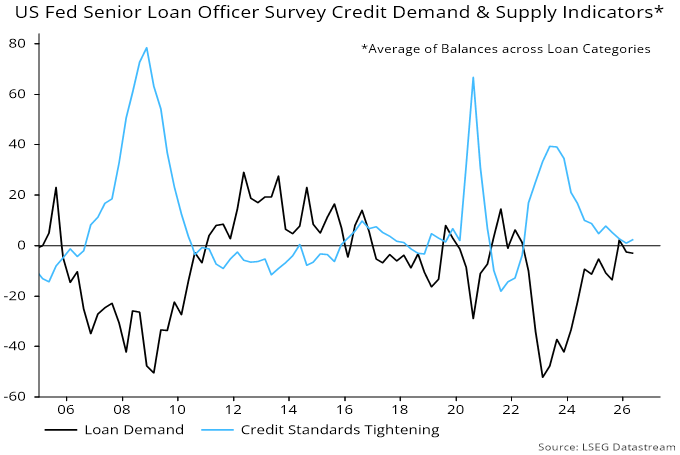
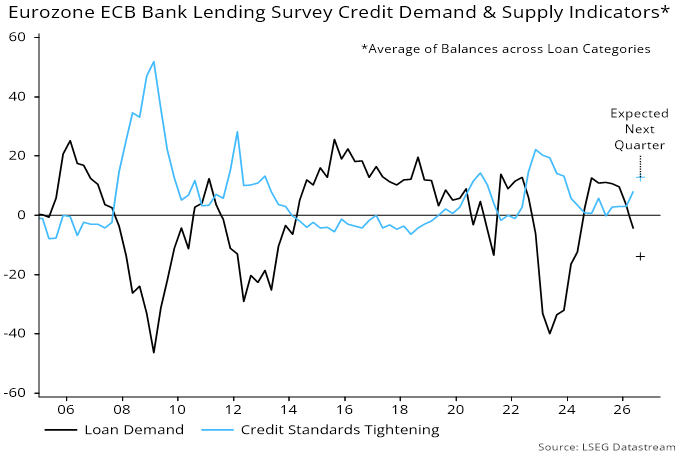
Last week’s ECB bank lending survey signalled tighter credit standards and notably weaker loan demand – see previous post and chart 1. The corresponding Fed survey this week, by contrast, shows little change from last quarter – chart 2. (Note that the Fed survey asks about current conditions, while the ECB survey additionally canvasses expectations.)

Chart 1
NSP-WeeklyBulletin-20260420-Chart13-1024×889-1.png

Chart 2

NSP-WeeklyBulletin-20260420-Chart12-1024×888-1.png

The last Bank of England credit conditions survey, released on 9 April, was benign but partly pre-dated Gulf hostilities.

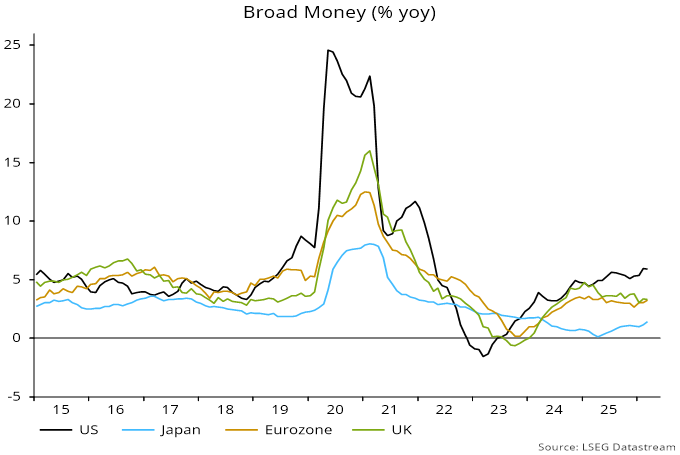
US annual broad money growth – as measured by “M2+”* – was 5.9% in March versus an increase of 3.3% in both Eurozone non-financial M3 and UK non-financial M4 – chart 3.

Chart 3
NSP-WeeklyBulletin-20260420-Chart12-1024×888-1.png

US annual core PCE inflation rose to 3.2% in March versus a Eurozone core CPI increase of 2.2% in both March and April. UK core CPI inflation was 3.1% in March but the number still incorporates a boost from large rises in water bills and vehicle excise duty last April – the policy-adjusted measure calculated here was 2.7%.

The US trimmed mean PCE inflation measure preferred by incoming Fed Chair Warsh was 2.4% in March but there are no Eurozone / UK numbers for comparison. The calculation excludes 31% and 24% respectively of the top and bottom “tails” of the distribution, i.e. included items have a combined weight of only 45%.

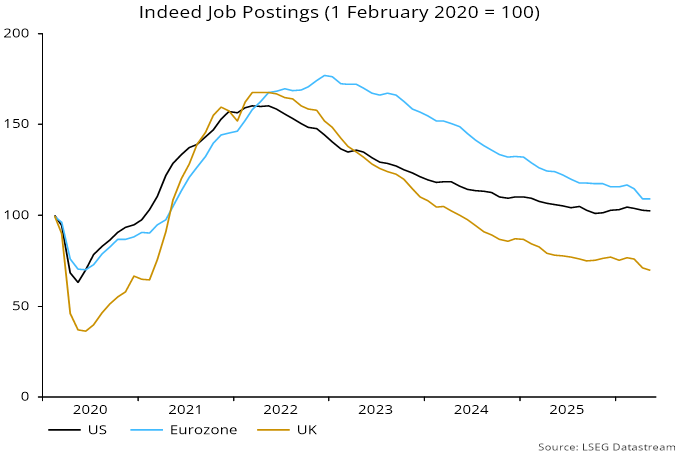
Labour demand is weaker in the Eurozone / UK than the US, with Indeed job postings making new lows versus US stability – chart 4.

Chart 4
NSP-WeeklyBulletin-20260420-Chart13-1024×889-1.png

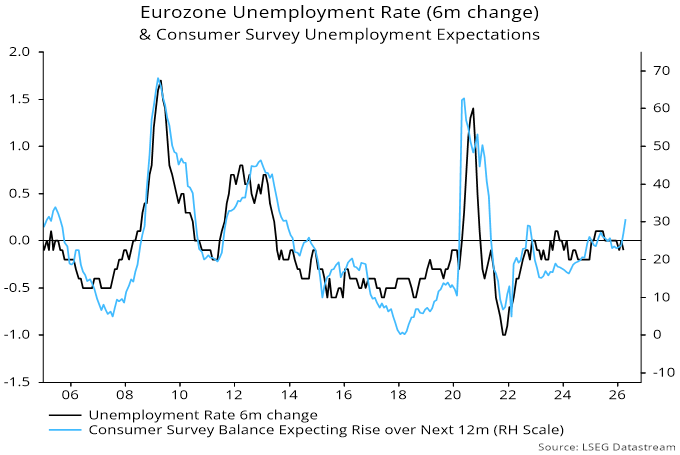
Unemployment expectations have picked up in the EU Commission consumer survey, suggesting a rise in the official jobless rate – chart 5.

Chart 5
NSP-WeeklyBulletin-20260420-Chart14-1024×850-1.png

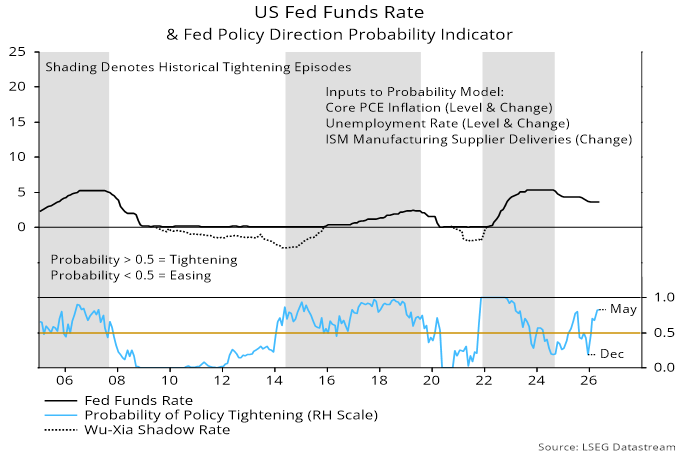
The Fed model used here predicts policy direction based on current and lagged values of annual core PCE inflation, the unemployment rate and the ISM manufacturing delivery delays index. A rise in the latter has pushed the model estimate further into the tightening zone – chart 6.

Chart 6
230426c1.png

*M2+ adds large time deposits at commercial banks and institutional money funds to the official M2 measure.
A rise in the ISM manufacturing new orders index was expected to be short-lived even before the outbreak of Gulf War III.

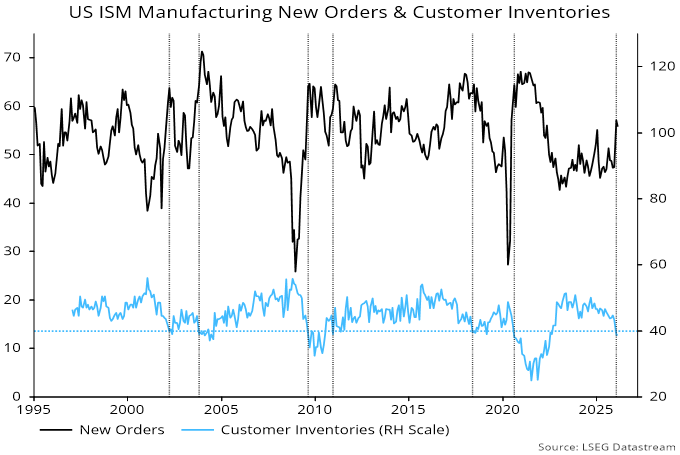
The index jumped from 47.4 in December to 57.1 in January, with a small retreat to 55.8 in February. The January reading was the strongest since 2022.

The ISM rise, along with a parallel increase in global manufacturing PMI new orders, boosted hopes of a sustained industrial upswing with an associated earnings-driven broadening of equity market gains.

The interpretation here, by contrast, has been that the ISM / PMI rises reflect the global stockbuilding cycle moving into a peak. The cycle was expected to begin a downswing by mid-2026 into a H1 2027 low.

The ISM customer inventories index supports this interpretation. The jump in new orders has been accompanied by a sharp fall in customer inventories to below 40. Previous declines to sub-40 occurred around peaks in new orders – see chart 1.

Chart 1

040326c3.png

This seems, on first consideration, perverse. The customer inventories index is a gauge of whether stock levels are too high or low. Falling / low readings might be expected to signal future restocking, resulting in a rise in new orders.

The explanation for the opposite relationship is that, by the time they report lower inventories, customers are already placing restocking orders, i.e. the additional demand is reflected in current not future new orders. The next phase of the cycle involves customers reducing demand as inventories return to a comfortable level. This phase marks the new orders peak.

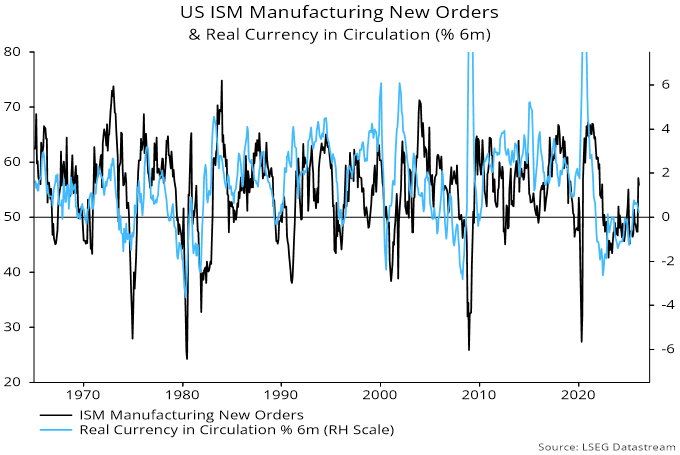
An imminent ISM new orders reversal is also implied by a recent decline in six-month growth of real currency in circulation, which has led the orders index by an average eight months historically and peaked most recently in August – chart 2.

Chart 2

040326c3.png

The suggested explanation for this relationship is that currency demand is influenced by retail spending plans, with such spending driving orders placed by retailers / wholesalers. The currency slowdown may indicate that spending prospects were deteriorating before the energy price shock.

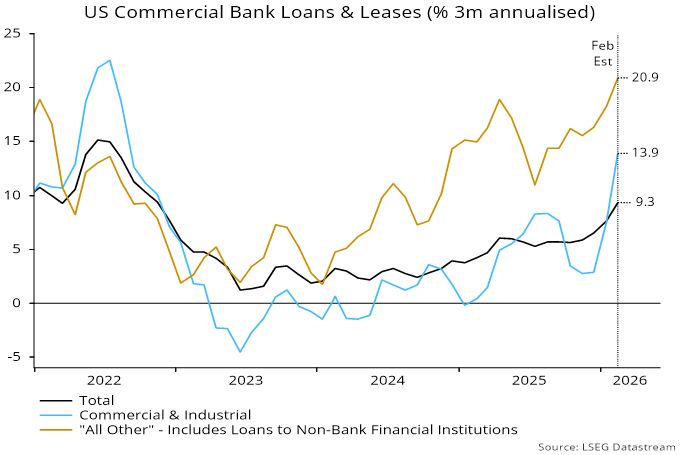
A recent pick-up in commercial bank loan growth is unlikely to be a positive signal for economic prospects.

Commercial banks’ loans and leases are estimated to have risen at a 9% plus annualised rate in the three months to February, up from 5.9% in the prior three months, based on weekly data through mid-month – see chart 1.

Chart 1

250226c3.png

Unlike money measures, bank loans are a coincident or lagging indicator of economic activity. Commercial and industrial (C&I) loans and consumer installment credit are components of the US Conference Board lagging economic index.

The recent acceleration has been driven by two categories: C&I loans, which account for 21% of total loans and leases; and “all other”, accounting for 23%, which includes loans to non-bank financial institutions.

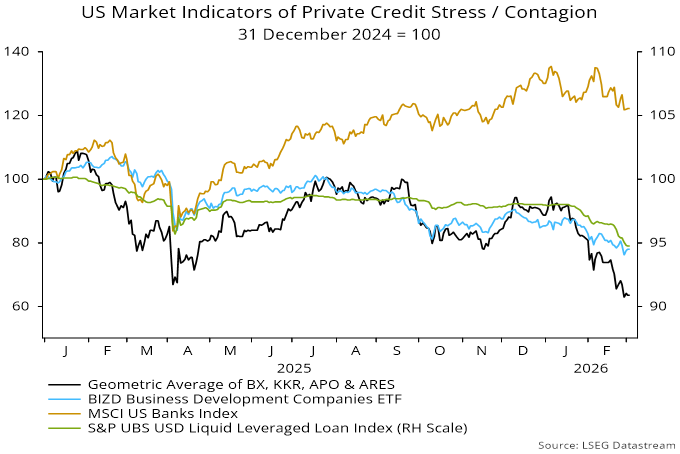
Growth of the latter category rose strongly over 2024-25 as banks contributed funding to a boom in private credit. Worries about credit quality and illiquidity have ended this boom, with market indicators signalling rising stress – chart 2. The recent further strength in “all other” loan growth may reflect private lenders drawing down bank credit lines as other sources of funding dry up.

Chart 2

250226c5.png

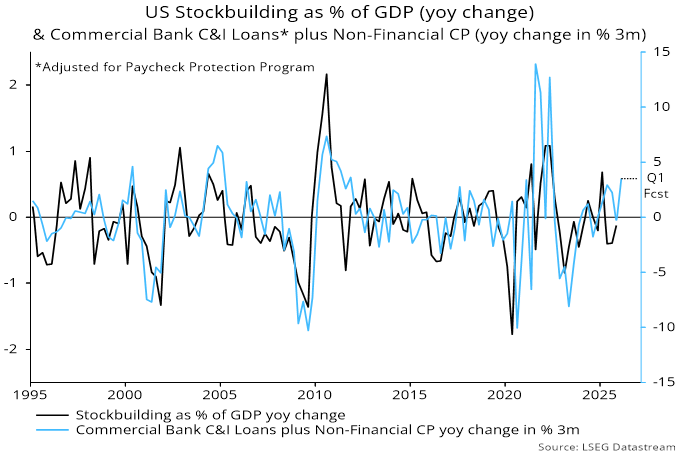
Reduced availability of private credit probably partly explains the pick-up in demand for C&I bank loans. However, such demand is also influenced by the stockbuilding cycle – chart 3. Stronger growth suggests that stockbuilding has rebounded in early 2026, supporting concurrent economic activity but with payback likely later in the year.

Chart 3

250226c2.png

To the extent that bank loan acceleration reflects a “reintermediation” of credit demand due to a bust in private credit, it is likely to cause banks to tighten lending standards, with negative monetary and economic implications. Such tightening may be confirmed in the April Fed senior loan officer opinion survey released in early May – chart 4.

Chart 4

250226c3.png

The historical Fed would be shifting to a tightening bias in response to recent economic news, according to a simple model.

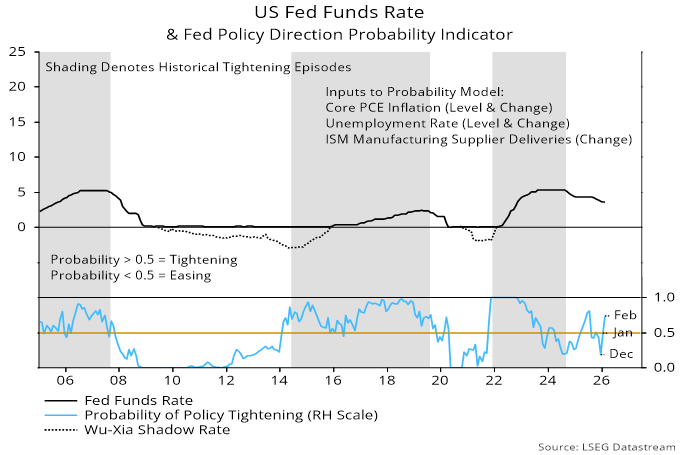
To recap, the model classifies the Fed as being in tightening or easing mode depending on whether a probability estimate is above or below 0.5. The estimate is based on currently reported and lagged values of annual core PCE inflation, the unemployment rate and the ISM manufacturing delivery delays index. Despite the small number of inputs, the model does a satisfactory job of “explaining” the Fed’s past actions.

The model reading moved below 0.5 in August ahead of the September / October rate cuts, falling further in December, when the Fed delivered another reduction while signalling an expectation of additional moves in 2026 – see chart 1.

Chart 1

US Fed Funds Rate & Fed Policy Direction Probability Indicator

The reading, however, rebounded to around neutral in January and has climbed above 0.7 in February. The turnaround has been driven by a combination of a fall in the unemployment rate from 4.54% in November to 4.28% in January, a rebound in the ISM deliveries index from a November low and slightly firmer annual core PCE inflation (3.0% in December).

Additional data points for all three series will be available before the March FOMC meeting.

The January model shift is consistent with minutes of last month’s meeting, showing a strong consensus in favour of a hold with “several” participants viewing interest rate risks as two-sided.

US demand deposits surged by 17% between October and December. A previous post argued that this was likely to reflect a reporting change, rather than a flow of money between accounts. The Fed’s Public Affairs office has confirmed this interpretation in response to a query:

“The large swings in demand deposits and other liquid deposits in November and December 2025 on the H.6 were due to a reclassification of deposits.”

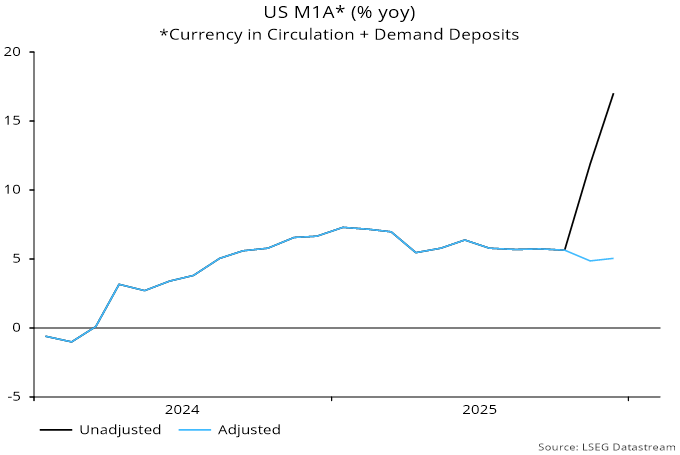
The reclassification has not affected the official M1 and M2 aggregates, which include both deposit categories. It has, however, distorted the M1A measure tracked here – comprising currency in circulation and demand deposits – as well as narrow money indicators constructed by other analysts.

The procedure adopted here has been to “correct” the M1A numbers by assuming that growth of demand deposits in November and December would have equalled that of total liquid deposits in the absence of the distortion. Chart 1 compares annual growth rates of the unadjusted and adjusted series.

Chart 1

110226c1

Claims have been circulating that US narrow money growth surged into end-2025, feeding narratives of excess liquidity and dollar debasement. Such claims appear not to account for the deposit data distortion and should be discounted.

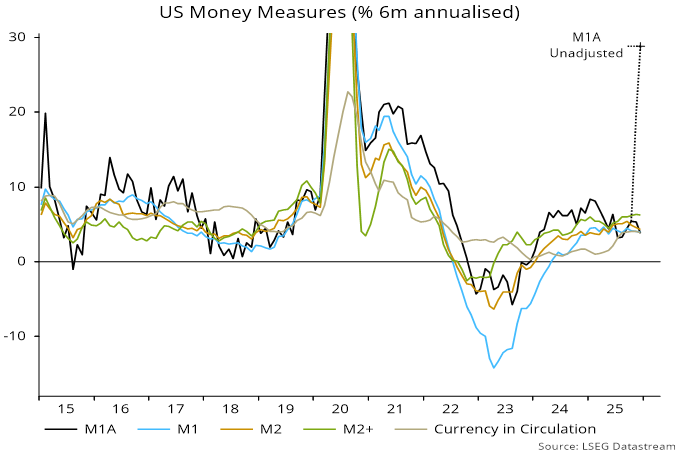
US narrow money is growing slowly, casting doubt on expectations of economic strength. Broad money growth is faster but still within a normal range (and has been less informative about near-term economic prospects historically).

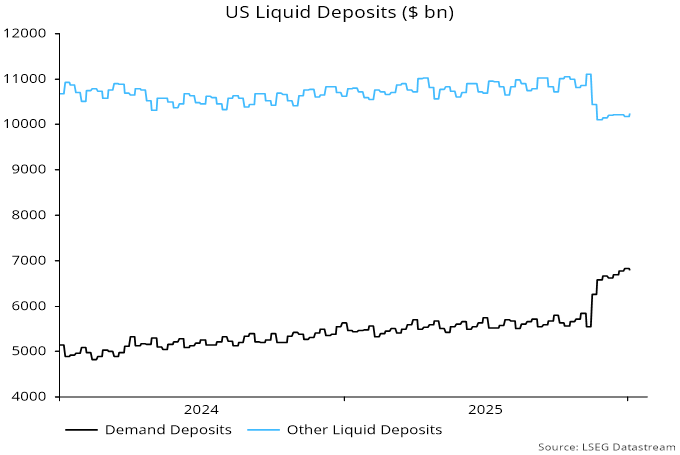
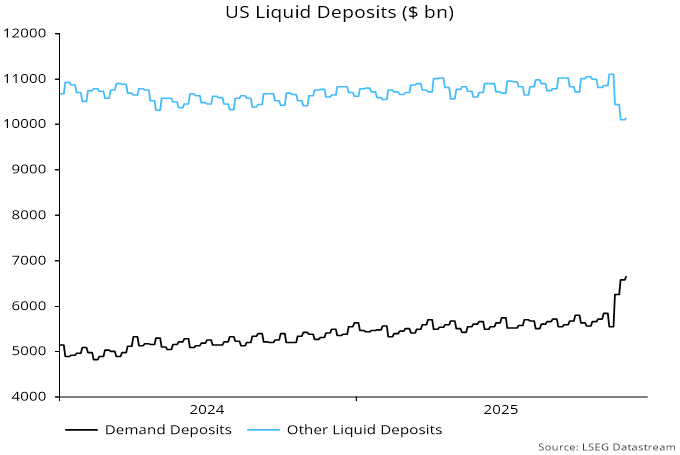
December numbers support the contention in a previous post that the Fed series for demand deposits has been distorted by the inclusion in mid-November of accounts previously classified as savings deposits. Weekly figures show a large jump over two weeks*, with a corresponding drop in “other liquid deposits”, which includes savings deposits. Demand deposits have since returned to weak expansion – see chart 1.

Chart 1

280126c1

The distortion has affected the M1A narrow money measure calculated here, comprising currency in circulation and demand deposits. Similar reclassifications appear to have occurred in several months over 2020-22, following removal of reserve requirements in March 2020, which effectively equalised the treatment of demand and savings deposits. The procedure adopted then was to assume that monthly growth of demand deposits would have matched that of total liquid deposits in the absence of the distortion.

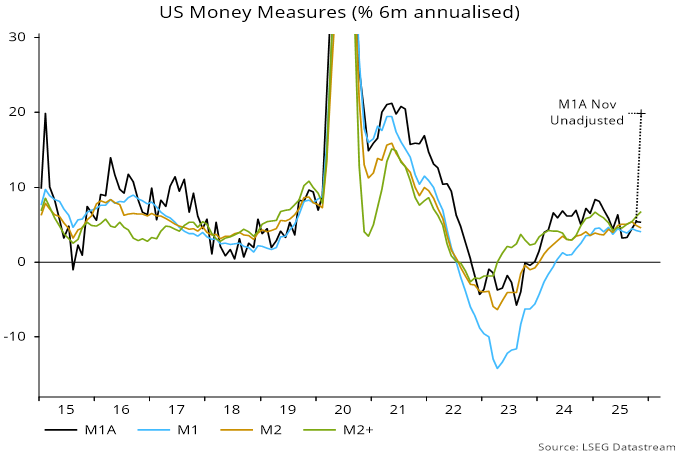
Applying the same adjustment now suggests “true” six-month growth of M1A of 3.8% annualised in December, down from 5.3% in November. This is very similar to growth rates of the official M1 and M2 measures, as well as currency in circulation (3.9%, 4.3% and 3.9% respectively) – chart 2.

Chart 2

280126c2i

A broader “M2+” aggregate rose by 6.2% annualised over the same period, reflecting strong expansion of institutional money funds. (Official M2 includes retail but not institutional money funds.) Still, this growth rate is within an acceptable range of a suggested 5% pa “target” – the average over 2015-19, a period of moderate economic growth and inflation quiescence.

*The inclusion would have occurred on a single day but weekly numbers are averages, so the impact of a mid-week change would be spread over two weeks.

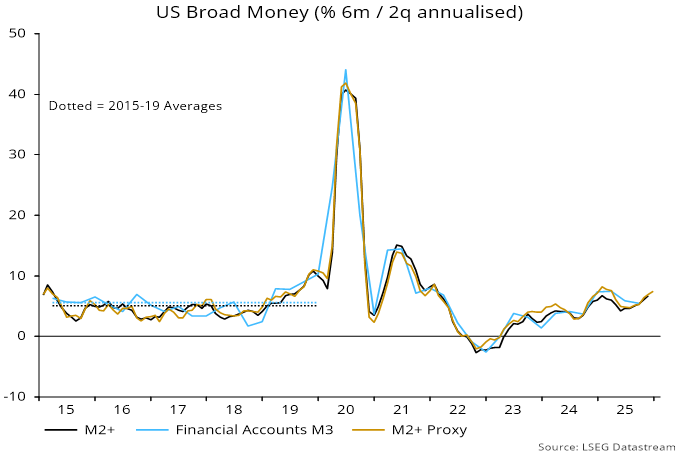
A measure of US broad money M3 derived from data in the Fed’s quarterly financial accounts grew at a 5.5% annualised rate in the two quarters to end-September. This exactly equals the average over the non-inflationary five years to end-2019 – see chart 1.

Chart 1

160126c1

The growth rate is also close to a 5.4% six-month annualised increase in the monthly M2+ measure calculated here. M2+ adds large time deposits and institutional money funds to official M2. M3 additionally includes repos.

M2+ growth rose to 6.7% in November, with available information suggesting a further increase in December. This could signal a future rise in inflation, though probably not before H2 2027. However, a similar pick-up a year ago reversed in H1 2025.

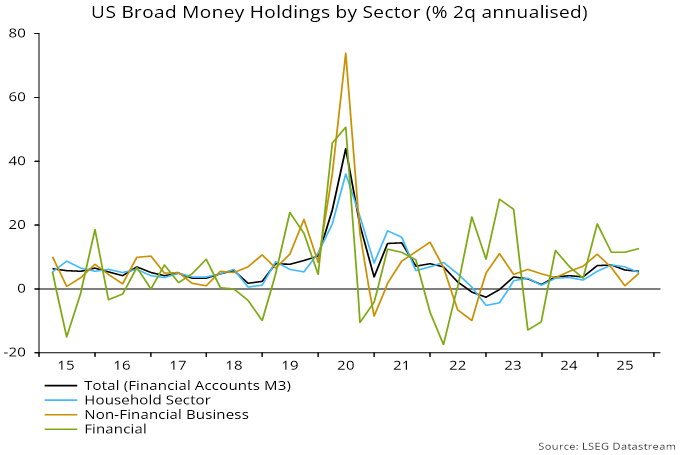
An advantage of the financial accounts measure is that a sectoral breakdown is available. M3 holdings of the household and non-financial business sectors rose at similar rates in the two quarters to September (5.2% and 5.0% annualised respectively), with stronger growth (12.7%) in financial sector money (i.e. held by insurance companies, pension funds and GSEs) – chart 2.

Chart 2

160126c2i

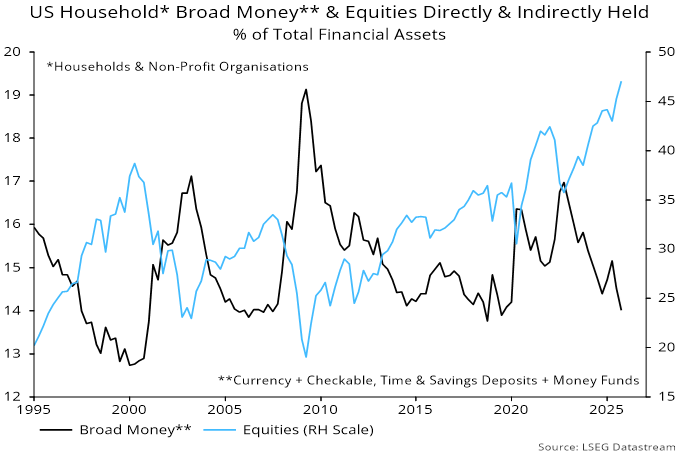
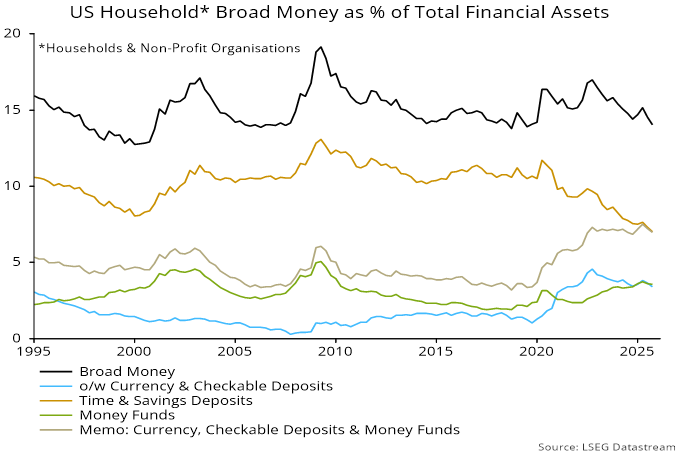
While household broad money continues to grow respectably, it has lagged far behind financial wealth. Money accounted for 14.0% of total financial assets at end-September, the lowest share since Q2 2019 – chart 3.

Chart 3

160126c3

The equity share of financial wealth, meanwhile, reached another post-WW2 record of 47.1%.

The fall in the broad money share since 2022 has been driven by time and savings deposits, with the combined weighting of currency, checkable deposits and money funds stable – chart 4.

Chart 4

160126c4

A chart recently doing the rounds shows only the latter measure (i.e. excluding time and savings deposits) to support a claim that household cash levels are high. Such selective use of data is regrettable.

(Note that the share of time and savings deposits has also been reduced by the reclassification of some savings deposits as demand – i.e. checkable – deposits.)

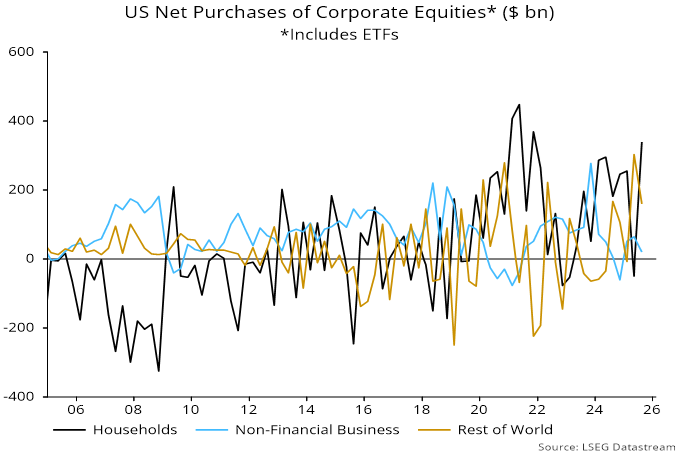
The rise in the equity share mostly reflects price appreciation but households have also been buying into strength.

The rally from the October 2022 low was initially driven by corporate demand but this fell off after H1 2024, with household and foreign purchases taking up the slack – chart 5.

Chart 5

160126c5

The broad money share reached a similar level before the GFC bear market and corrections in 2015 and 2018, as well as the 2020 covid sell-off.

The share fell below the current level in the late 1990s but equity exposure was then significantly lower, peaking at 38.7%. Put differently, the higher beta of the balance sheet now makes a similar cash undershoot less likely.

A sharp rise in US demand deposits in November probably reflects a statistical distortion. Monetary trends overall remain consistent with moderate nominal economic expansion.

The narrow money measure tracked here – M1A, comprising currency and demand deposits – jumped by 6.8% in November, pushing six-month growth up to 19.9% annualised from 5.4% in October – see chart 1.

Chart 1

291225c1

This surge, if genuine, would suggest a significant pick-up in economic growth during H1 2026, with associated upward pressure on interest rates.

The assessment here, however, is that the November jump likely reflects a statistical distortion cause by a bank or banks reclassifying savings deposits as demand deposits on the FR2900 reporting form.

Weekly unadjusted data show a large rise in demand deposits in the third and fourth weeks of November, with a corresponding drop in “other liquid deposits”, which include savings deposits – chart 2.

Chart 2

291225c2

The weekly numbers are averages of daily figures. The hypothesis of a reclassification is consistent with the demand deposit increase being spread over two weeks of data, assuming that the day of the change was after the start of the first week, resulting in a carry-over to the average for the following week.

A genuine surge in demand deposits would be expected to play out over multiple weeks. The change in the latest week – ending 1 December – returned to “normal”. Data for the remainder of December will be important for confirming the reclassification hypothesis.

Similar reclassifications appear to have occurred in several months over 2020-22, following removal of reserve requirements in March 2020, which effectively equalised the treatment of demand and savings deposits. The procedure adopted then was to assume that monthly growth of demand deposits would have matched that of total liquid deposits in the absence of the distortion.

Applying the same adjustment now suggests “true” six-month growth of M1A in November of 5.3% annualised, little changed from October.

The official M1 and M2 aggregates, as well as the broader M2+ measure calculated here, include savings deposits so are unaffected by such reclassifications. Six-month growth rates of the three measures were 4.1%, 4.6% and 6.7% annualised respectively in November – chart 1.

These growth rates are in a range consistent with trend economic expansion and inflation around the 2% target. Current money trends, in other words, give no strong grounds for monetary policy changes in either direction.

Credit tightening in private markets may mark the end of a boom in US bank lending to shadow banks, with negative monetary implications.

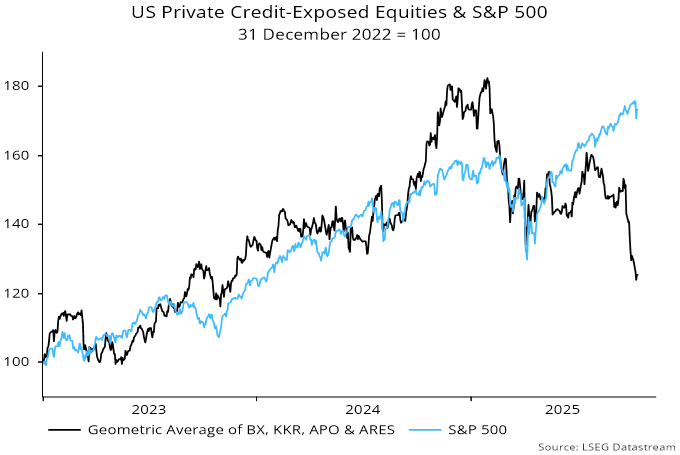
Equity prices of major players in private credit have fallen sharply in the wake of the Tricolor / First Brands bankruptcies, with an average down by 31% from a January peak – see chart 1.

Chart 1

141025c1

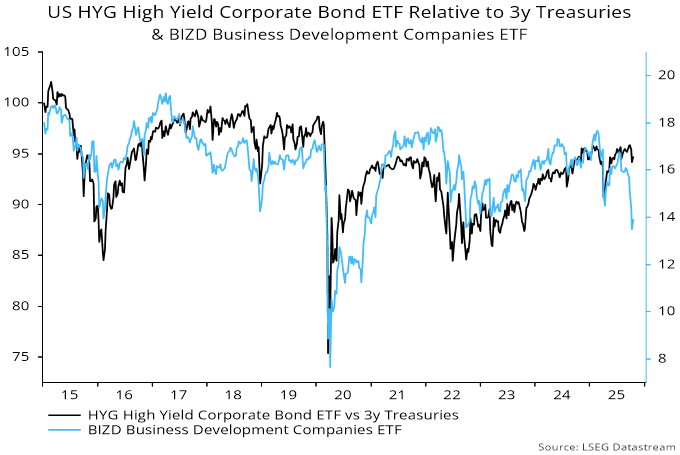
Increased risk aversion is also evident in lower prices / higher yields of traded private credit instruments, such as the VanEck Business Development Companies ETF (BIZD), which usually mirrors moves in high yield spreads but has opened up a wide gap – chart 2.

Chart 2

141025c2

Commercial bank lending to shadow banks / private credit has been booming, with the “all other” category containing loans to non-bank financial institutions up by 14.5% in the year to September, accounting for 2.9 pp of overall bank loan growth of 4.9% – chart 3*.

Chart 3

141025c3

Traditional loan categories – C&I, real estate and consumer – grew by only 2.5% over the same period.

Lending to shadow banks is likely to slow as private credit players rein in activity and loan officers tighten standards. A normalisation could cut 2 pp or more from annual loan growth, implying weaker broad money expansion unless offset by other “credit counterparts”**.

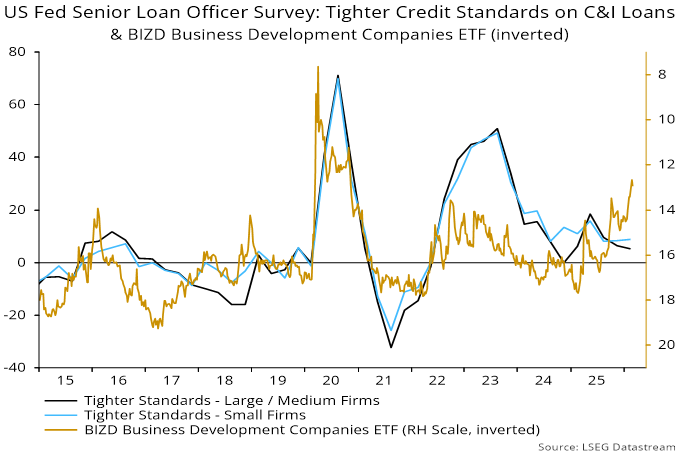
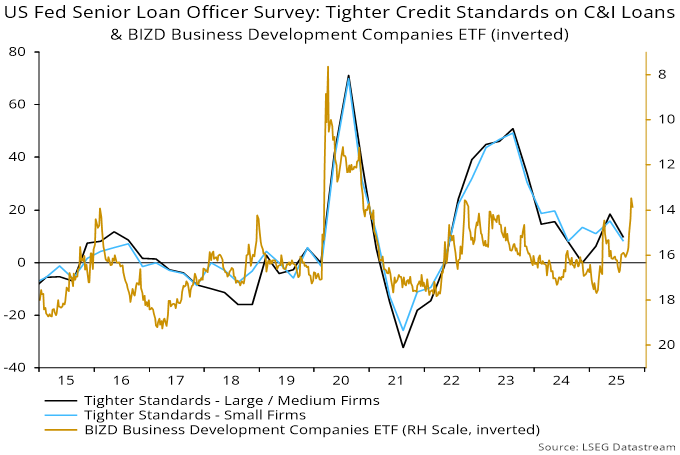
Credit tightening could extend to other loan categories unless private markets recover – chart 4. (Note that the reporting window for the October Fed senior loan officer survey, to be released in early November, may already have closed, so the results may not fully reflect recent developments.)

Chart 4

141025c4

*Growth numbers are break-adjusted – levels series have been distorted by recent reporting changes.

**Some combination of increased monetary deficit financing, a stronger basic balance of payments or reduced non-deposit funding.

A simple model of the Fed’s historical behaviour suggests that the window for rate cuts will close in early 2026 if the economy evolves in line with the median FOMC forecast.

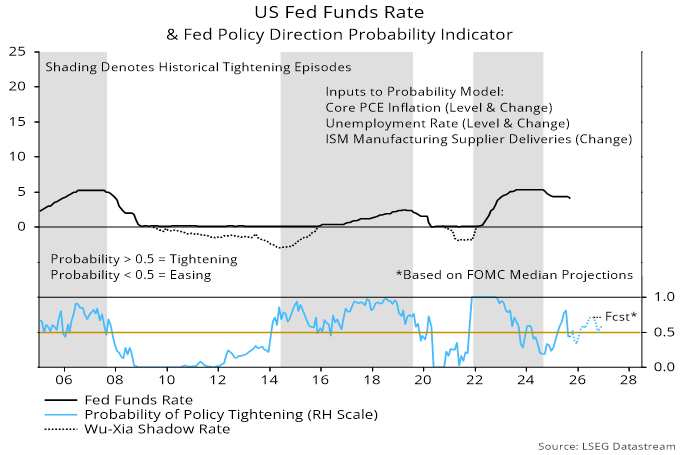
The model classifies the Fed as being in tightening or easing mode depending on whether a probability estimate is above or below 0.5. The estimate is based on currently reported and lagged values of core PCE inflation, the unemployment rate and the ISM manufacturing delivery delays indicator. Despite the small number of inputs, the model does a satisfactory job of “explaining” the Fed’s past actions*.

The probability estimate rose above 0.5 in March, confirming that the Fed was no longer in easing mode. It moved back below that level in August / September ahead of last week’s rate cut – see chart 1.

Chart 1

240925c1i

The September reading of 0.44 would also have been consistent with a hold, suggesting that easing was partly precautionary and / or influenced by Trump administration pressure.

The median FOMC projections for 2026 have shifted hawkishly since June. Annual core PCE inflation is now 2.6% in Q4 2026 from 2.4% previously, while the unemployment rate declines from 4.5% to 4.4% between Q4 2025 and Q4 2026.

The model forecast shown in the chart is based on quarterly paths for core inflation and the jobless rate interpolated from the FOMC Q4 projections, along with an assumption that the ISM deliveries index stabilises at its August level.

The probability estimate edges back above 0.5 in October, returns to the easing zone over November-January but then embarks on a sustained rise above 0.5.

The shift into the tightening zone is unsurprising given the forecast of sustained above-target core inflation and a firming labour market.

The suggestion of a short window for further rate cuts is at odds with market expectations of an extended easing cycle. The market path presumably reflects a more dovish economic view but may also incorporate some probability of a change in the Fed’s reaction function under a new Chair.

*A previous post contained a chart showing a 60-year history.