Global money trends suggest that major economic weakness will be deferred until later in 2026.

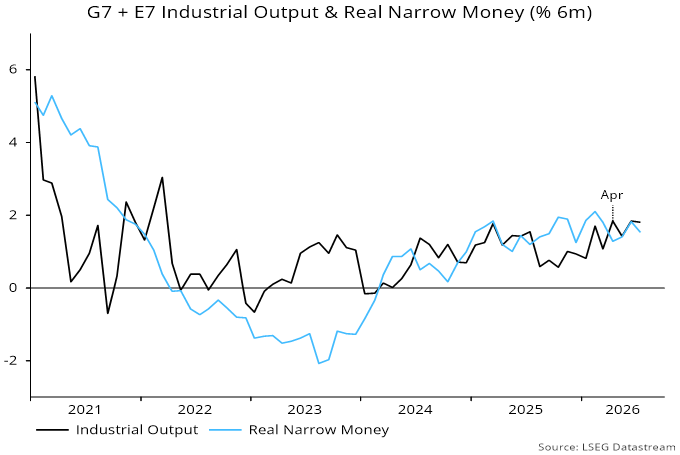
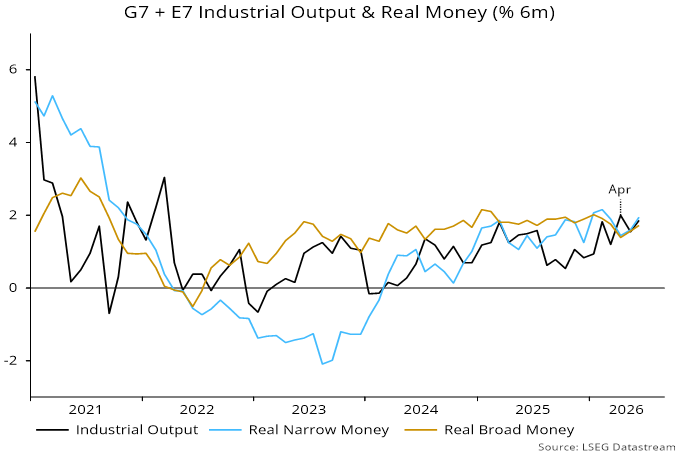
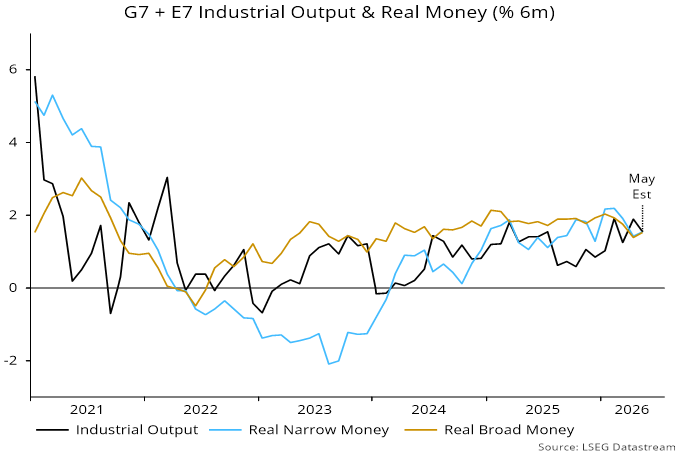
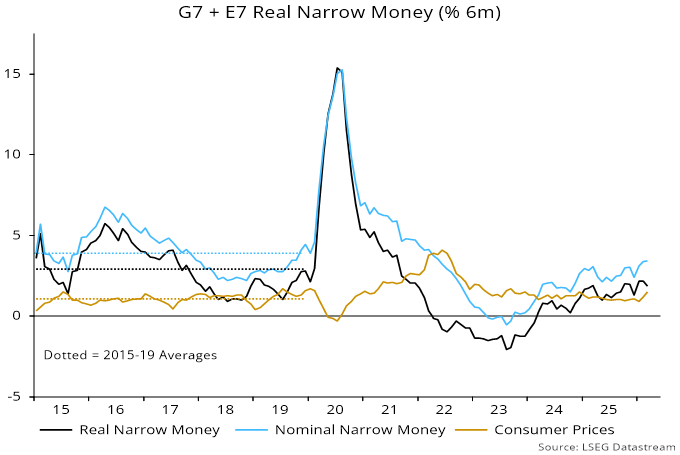
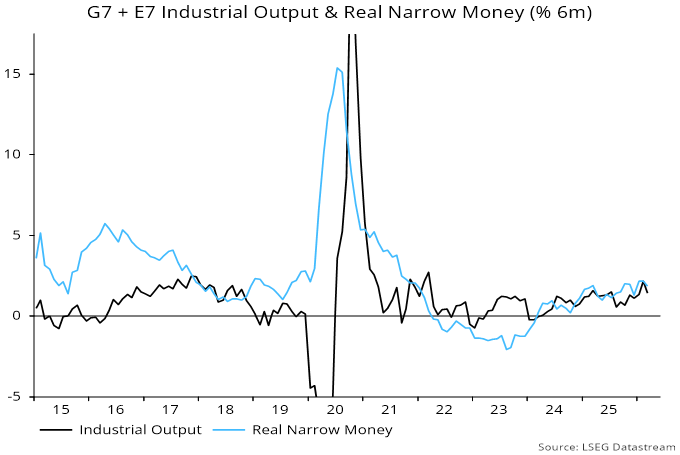
Six-month real narrow money momentum in the G7 and seven large emerging economies recovered further in October, almost returning to its March high – see chart 1.

Chart 1

Chart 1 showing G7 + E7 Real Narrow Money (% 6m) Six-month real narrow money momentum in the G7 and seven large emerging economies recovered further in October, almost returning to its March high – see chart 1.

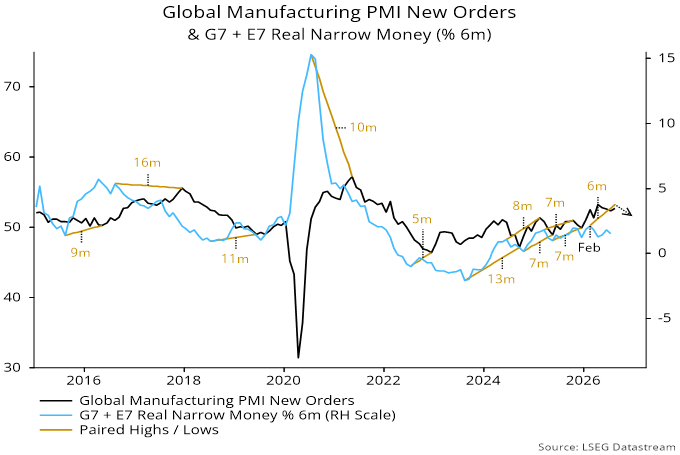
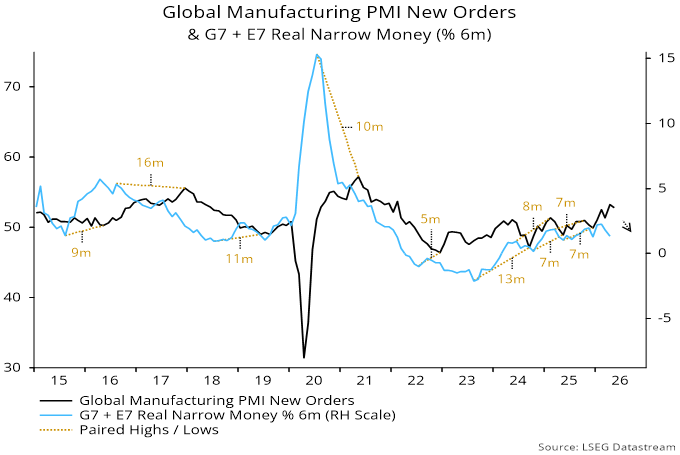
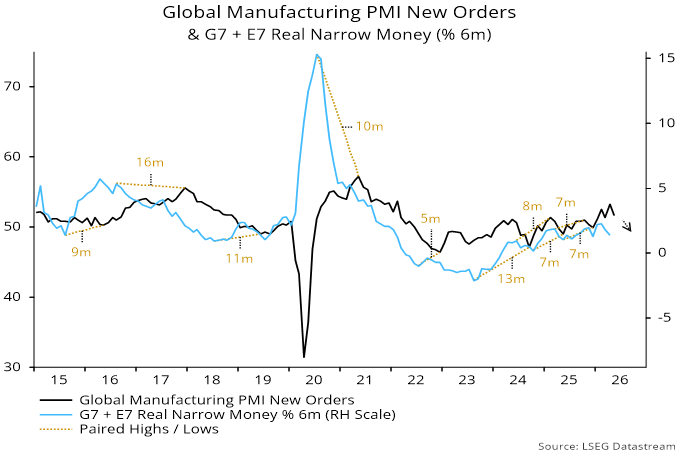
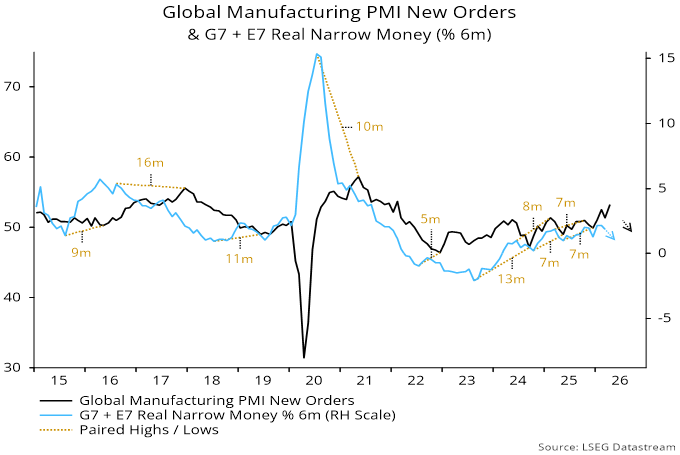
The fall from March into the summer is expected here to be reflected in a slowdown in industrial momentum – as proxied by global manufacturing PMI new orders – into late Q1 2026. The recent money growth recovery suggests a partial PMI rebound in Q2 – chart 2.

Chart 2

Chart 2 showing Global Manufacturing PMI New Orders & G7 + E7 Real Narrow Money (% 6m)

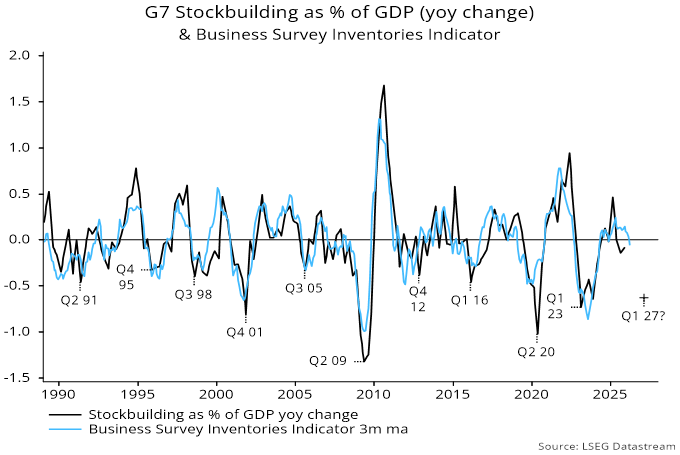
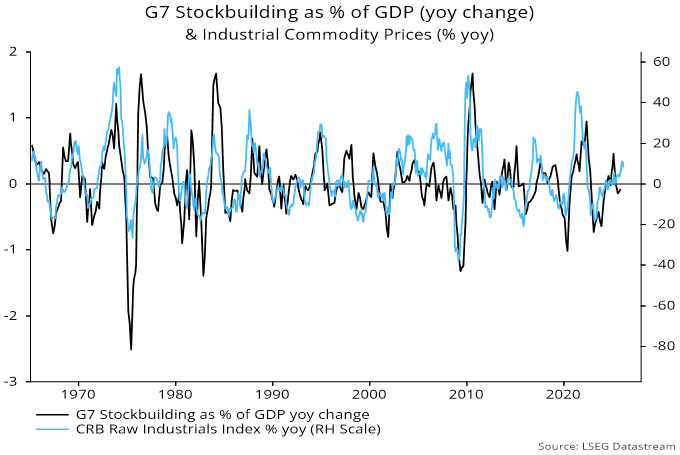
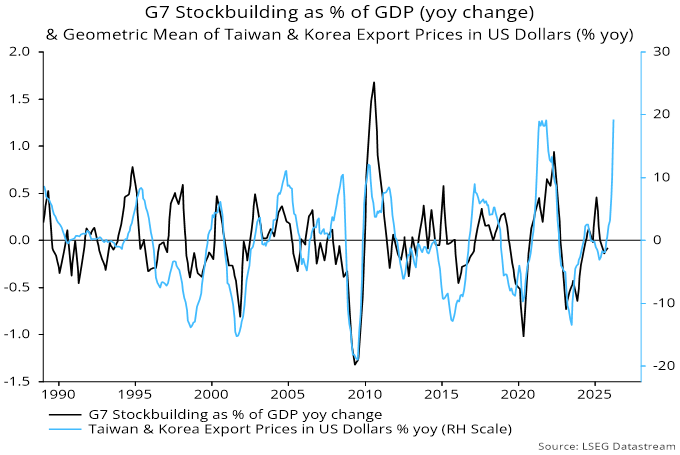
The cyclical framework used here implies rising recession risk, with the stockbuilding and housing cycles in time windows to begin downswings. Monetary weakness would signal that a negative scenario is crystallising. The latest numbers appear to signal a delay.

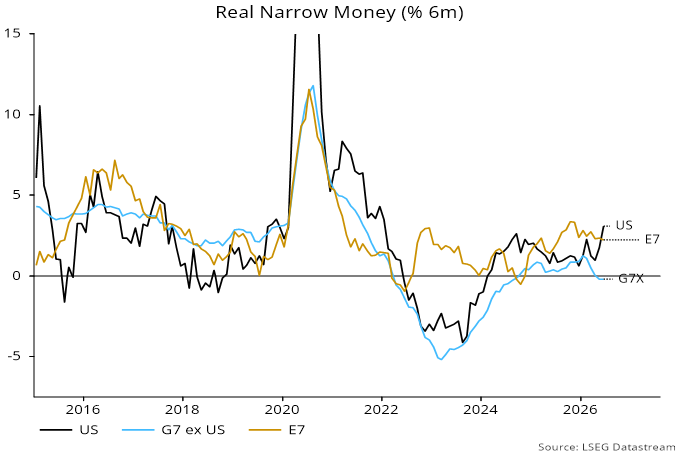
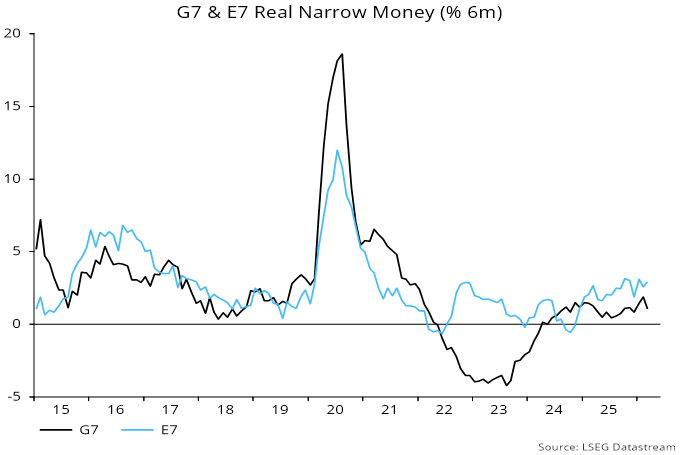
The composition of the money growth rebound gives pause. The return towards the March high has been driven by further strength in the E7 component, with G7 real money momentum lagging significantly – chart 3.

Chart 3

Chart 3 showing G7 + E7 Real Narrow Money (% 6m) The composition of the money growth rebound gives pause. The return towards the March high has been driven by further strength in the E7 component, with G7 real money momentum lagging significantly – chart 3.

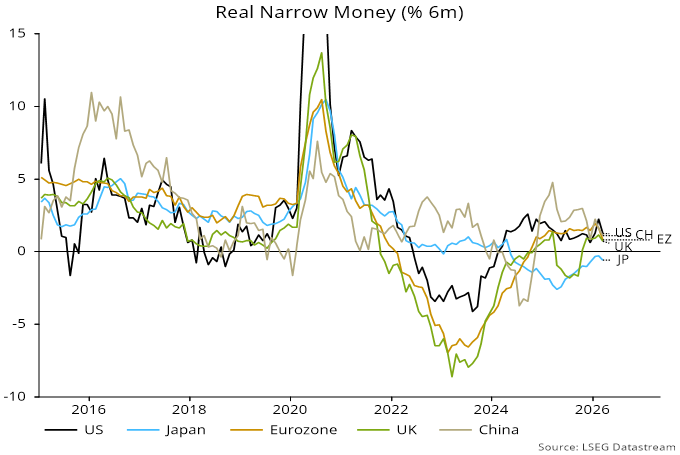
Narrow money trends are respectable or strong across major EMs, with the exception of Brazil – chart 4.

Chart 4

Chart 4 showing Real Narrow Money (% 6m) Narrow money trends are respectable or strong across major EMs, with the exception of Brazil – chart 4.

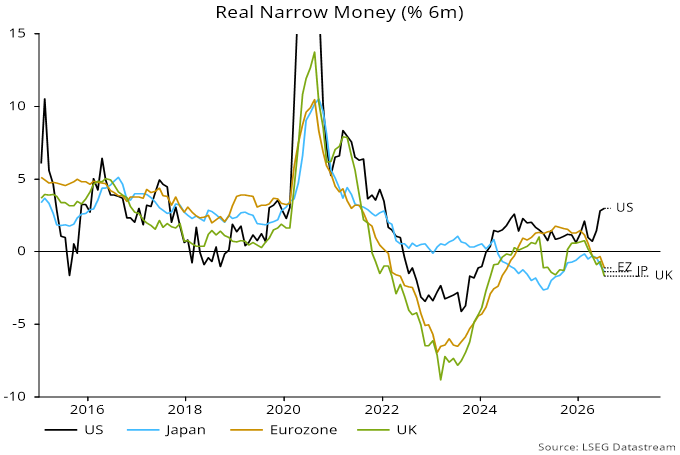
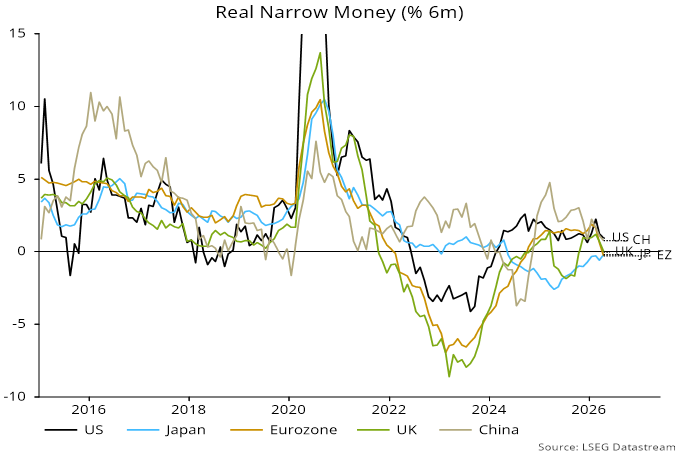
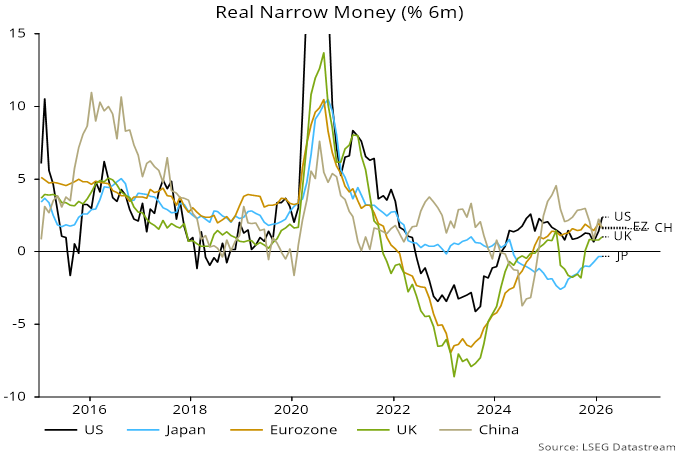
Soft G7 growth reflects a slowdown in the US and continued – though moderating – weakness in Japan and the UK. Eurozone momentum rose further last month, though remains unexceptional.

Chart 5

Chart 5 showing Real Narrow Money (% 6m) Soft G7 growth reflects a slowdown in the US and continued – though moderating – weakness in Japan and the UK. Eurozone momentum rose further last month, though remains unexceptional.

The forecast that global manufacturing PMI new orders will inflect weaker from a Q4 peak is supported by the “internals” of the October survey.

While new orders rose on the month, the increase was smaller than had been suggested by DM flash surveys, reflecting an EM decline led by China and Korea – often global bellwethers.

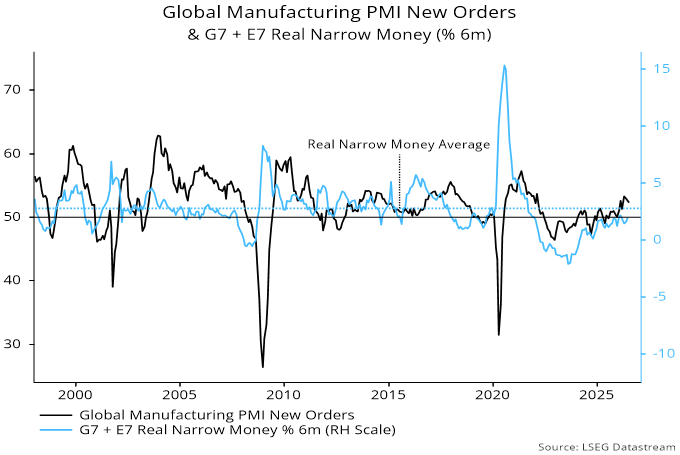
Firms were gloomier despite the orders uptick, with the future output index falling to its lowest since April in the wake of the “Liberation Day” shock. In contrast to new orders, this component is below its post-2015 average – see chart 1. (So is the corresponding services gauge.)

Chart 1

051125c1

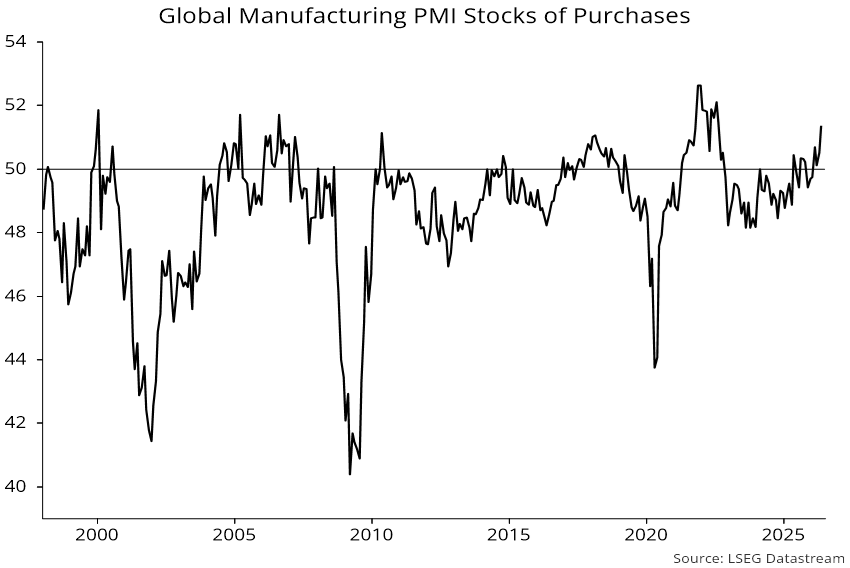
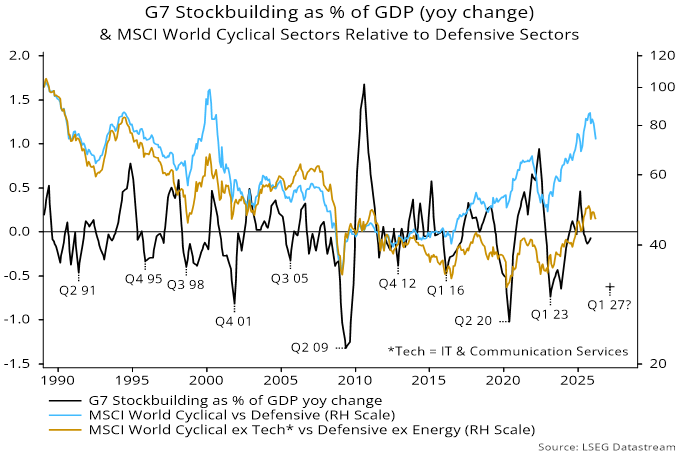
Pessimism may partly reflect an inventory overhang: indices measuring additions to stocks of purchased inputs and finished goods were in the 82nd and 97th percentiles of their long-run ranges (i.e. since 1998) respectively last month – more evidence that the global stockbuilding cycle is peaking.

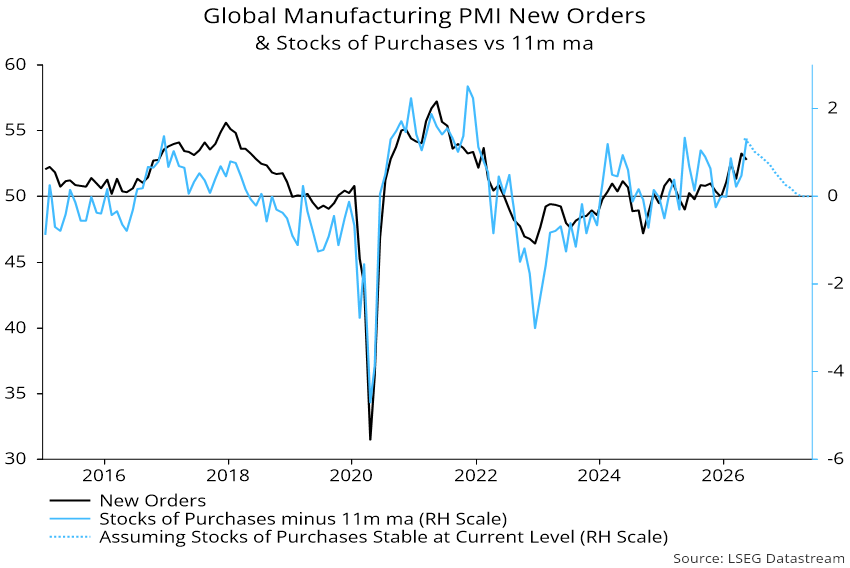
Purchases of inputs boost orders of supplier firms. Accordingly, the new orders index is positively correlated with changes in the stocks of purchases index. The latter is likely to fall from its currently extended level. Even a stabilisation would imply a decline in the rate of change, in turn suggesting softer new orders – chart 2.

Chart 2

051125c2

Global manufacturing deceleration is often associated with underperformance of cyclical equity market sectors. The price relative of MSCI World non-tech cyclical sectors versus defensive sectors ex. energy is below a September peak – chart 3.

Chart 3

051125c3

Cyclical earnings are more at risk when pricing power is weak. The output price index has fallen back and is close to its 2010-19 average, while delivery delays remain below the corresponding average, suggesting excess capacity and / or inventories – chart 4.

Chart 4

051125c4i

The suggestion from cycle analysis of significant economic weakness in 2026-27 has yet to receive confirmation from monetary trends.

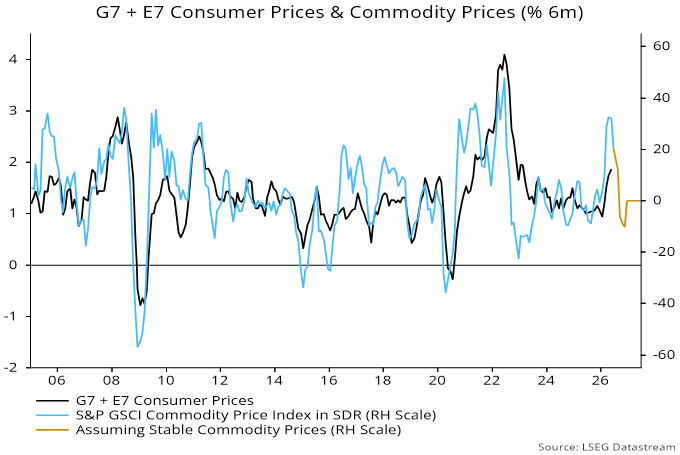
Global six-month real narrow money momentum recovered for a second month in September, though remains below a March peak. Nominal money growth firmed in August-September, offsetting a small rise in six-month consumer price momentum – see chart 1.

Chart 1

CCLFG_Holiday Party_2025-12-11_Toronto_WP-Header Video_v1.1

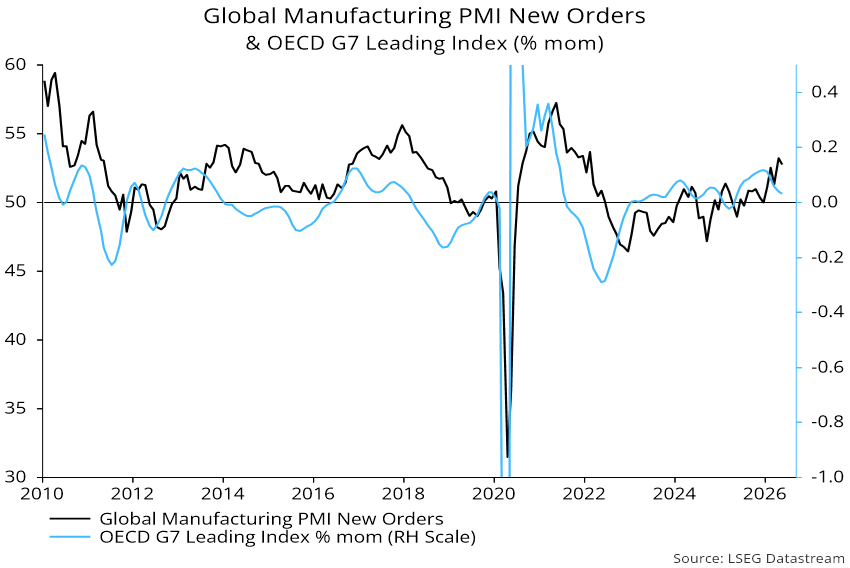
The March peak was expected here to be reflected in a peak in global manufacturing PMI new orders around October. DM flash results are consistent with a further rise in the orders index this month – chart 2.

Chart 2

CCLFG_Holiday Party_2025-12-11_Toronto_WP-Header Static Mobile_138w300h_v1.1

The latest monetary numbers suggest that the expected PMI fall will be contained, at least through Q1 2026. This is compatible with cycle analysis: the stockbuilding cycle is judged to be at the start of a downswing, so the maximum negative impact could be delayed until H2 2026 or even later.

The minor recovery in global real narrow money momentum since July has been driven by China and Japan, with US, Eurozone and UK readings little changed and Indian growth moderating – chart 3.

Chart 3

Auto Draft

Real money momentum remains below its long-run average – chart 4.

Chart 4

CCLFG_Holiday Party_2025-12-11_Toronto_WP-Header Video_v1.1

Could recent / prospective central bank easing sustain monetary reacceleration, extending economic cycles? While possible, there are also reasons for expecting renewed monetary weakness.

First, policy stances are mostly still restrictive, and real rates may fall by less than nominal as inflation declines further.

Secondly, recent issues in private credit may cause banks to slow lending to shadow banks and tighten standards more generally, dampening (broad) money growth.

Thirdly, money trends reflect as well as influence economic cycles. Stockbuilding cycle downswings are associated with reduced demand for short-term business credit, which could contribute to monetary weakness.

Finally, the demand to hold narrow money is related to consumer / business confidence and spending intentions. Labour market weakness could lead to greater consumer caution, while ongoing trade dislocation and policy uncertainty may dampen business animal spirits.

Global six-month real narrow money momentum – a key leading indicator in the forecasting approach used here – is estimated to have fallen to its lowest since November / December in July, based on monetary data for countries with a combined 88% weight.

The resumption of a decline from a March peak reflected both a slowdown in nominal money growth and a small rise in six-month CPI momentum (which, however, remains slightly below its 2015-19 average) – see chart 1.

Chart 1

280825c1

A rise in real money growth between October 2024 and March suggested that the global economy would regain momentum in H2 2025 after a weak start to the year. Tariff effects cloud interpretation but PMI results are consistent with this forecast, with August DM flash numbers reading across to a rise in global manufacturing PMI new orders to a six-month high – chart 2.

Chart 2

280825c2

An alternative indicator calculated here using national survey data has been lagging the PMI but may also have increased in August. US regional Fed manufacturing surveys are pointing to stronger ISM results.

Still, the slowdown in real money momentum since March suggests that survey strength, if confirmed, will prove short-lived, with another inflection weaker before year-end – chart 3.

Chart 3

280825c3

The July decline in global real money momentum mainly reflected a US fall to its lowest since March last year – chart 4. US money growth may have been supported in H1 by a run-down of the Treasury’s cash balance at the Fed. With the debt ceiling now raised, the balance stabilised in July and has increased in August, with financing plans targeting a further rise, i.e. Treasury cash-raising may drain money from private accounts.

Chart 4

280825c4

Real money momentum rose slightly in China and the Eurozone but remains below recent peaks, with Japan little changed in negative territory and UK July numbers yet to be released.

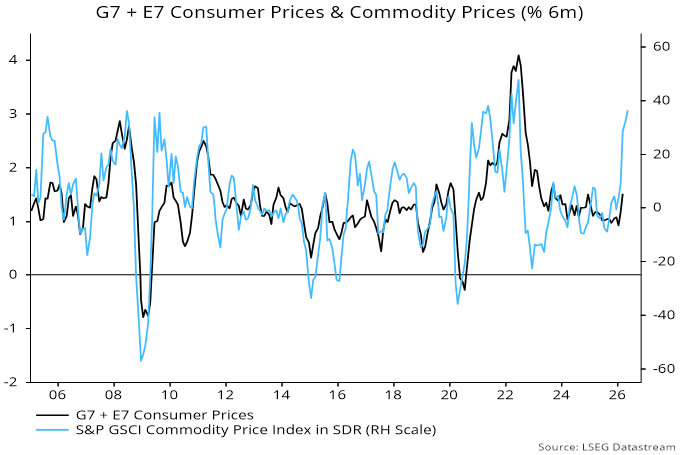
Global (i.e. G7 plus E7) six-month real narrow money momentum – a key indicator in the approach followed here – recovered in June but remains below a multi-year high reached in March.

The June rise reflected a small rebound in nominal money growth combined with a further fall in six-month consumer price momentum, to its lowest since 2020 – see chart 1.

Chart 1

310725c1

CPI momentum is now below its 2015-19 average, vindicating the « monetarist » forecast that global inflation would fully reverse its 2021-22 spike once the ridiculous – but thankfully temporary – policy-driven money growth surge of 2020-21 had passed through the system.

The rise in six-month real narrow money momentum into March suggested that global economic growth would strengthen into late 2025, following a weak start to the year related to a monetary slowdown into October 2024.

Front-running of US tariffs, however, may have supported growth during H1, with H2 payback liable to dampen the expected pick-up. The March peak in real money momentum, meanwhile, suggests economic deceleration from late 2025.

The June rise in global real money momentum was driven by a further pick-up in India following a dovish RBI shift coupled with a surprise rebound in the US. By contrast, Eurozone momentum slowed for a third month while UK contraction intensified, almost catching down to Japan – chart 2.

Chart 2

310725c2

Interpretation of recent US money numbers is clouded by disruption to fiscal financing from the delay in lifting the debt ceiling. An associated run-down of the Treasury’s cash balance at the Fed may have supported H1 money growth, suggesting a drag as the balance is restored to its prior level.

(“Austrian” measures of the money stock include government deposits, on which basis US six-month narrow money momentum was negative in June. Such an approach is not endorsed here, for the obvious reason that – unlike for private sector agents – government money holdings are unrelated to future spending.)

Still, recent sideways movement of US six-month real narrow money momentum versus a slowdown in the Eurozone and outright weakness in Japan / the UK suggests improving US relative economic prospects while casting doubt on forecasts of further equity market underperformance.

The latest signal from monetary data is that global economic momentum will inflect weaker from around late 2025. Cyclical considerations suggest that this will mark the beginning of a sustained downswing into 2027.

Lagged money trends argue that underlying inflation will fall further and remain low through 2026. Nevertheless, central banks may be slow to offset economic weakness with additional policy stimulus because of concerns about tariff effects and fiscal indiscipline, as well as scarring from the 2021-22 inflation surge.

The suggestion is that equity markets face rising headwinds, with another sustained bull phase unlikely before 2027, when key cycles are scheduled to bottom. An appropriate strategy may be to underweight markets where monetary trends are relatively weak – Japan and the UK currently – while overweighting sectors with lower earnings sensitivity to expected cyclical weakness.

Elaborating on the above, global six-month real narrow money momentum – a key leading indicator in the approach followed here – reached a local high in March, falling sharply in April / May – see chart 1.

Chart 1

080725c1

The rise from October 2024 into March suggested that the global economy would regain some momentum from around mid-2025, based on the recent average lag. A June rise in manufacturing PMI new orders could mark the start of such a shift, although results from national (as opposed to S&P Global) surveys were mixed. Still, April / May monetary weakness argues that any near-term recovery will be short-lived, with economic indicators likely to deteriorate again from around late 2025 – chart 2.

Chart 2

080725c2

The latest fall in real money growth has been broadly based across countries, reinforcing the negative signal. Momentum is notably weak in Japan and the UK, arguing for economic underperformance. Eurozone growth has held up but hasn’t yet crossed above the US, cautioning against “europhoria” – chart 3.

Chart 3

080725c3

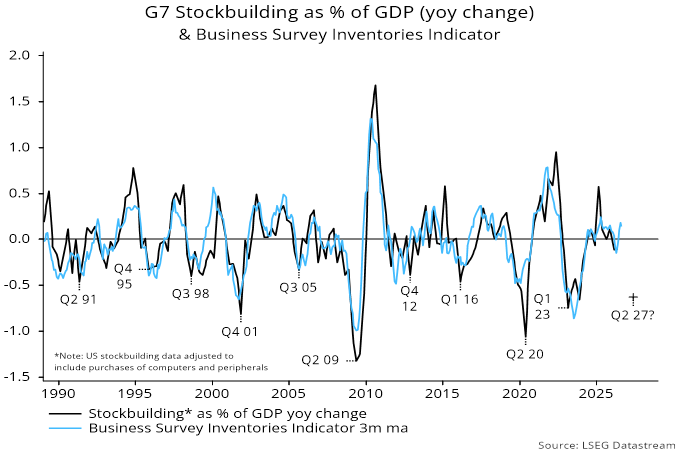
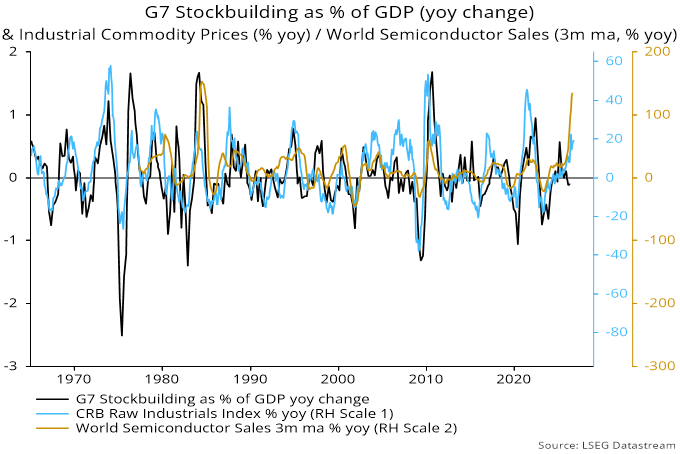
From a cyclical perspective, the stockbuilding cycle is in the window for a peak in terms of both time since the last low (Q1 2023) and the contribution of inventory accumulation to annual G7 GDP growth – chart 4. The latter has been boosted by front-loading to avoid tariffs, which appears to have continued in Q2.

Chart 4

080725c4

The cycle should turn down by early 2026 at the latest and the baseline assumption here remains for a low in H1 2027, implying that the current cycle will be slightly longer than the 3.5 year historical average, balancing a shorter-than-average prior cycle. Stockbuilding cycle downswings are usually associated with significant slowdowns (or worse) in global economic growth and underperformance of risk assets.

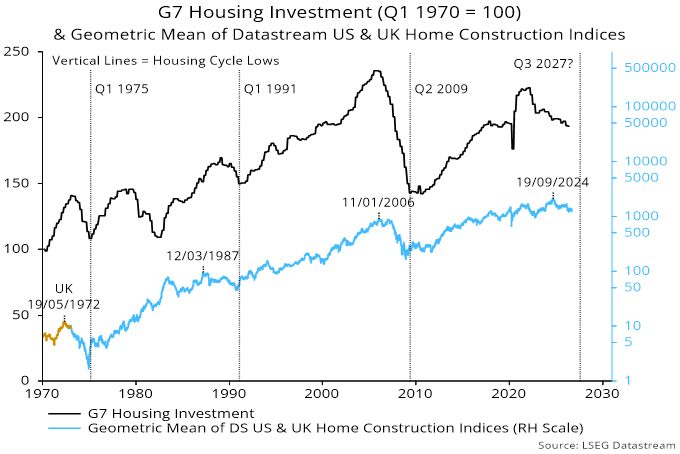
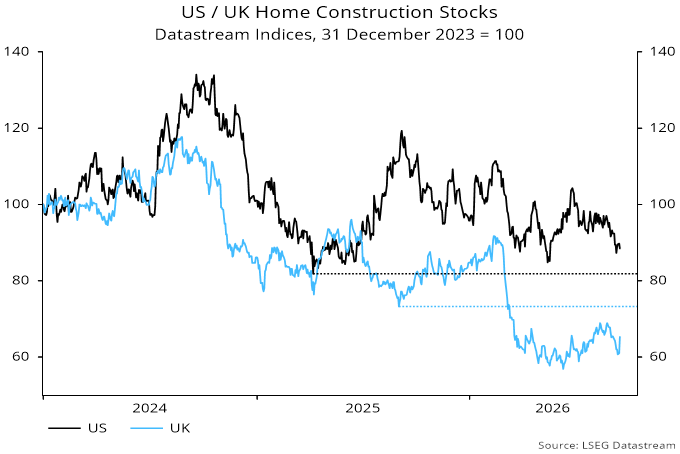
A key question is whether the coming downswing will be accompanied by weakness in the housing and / or business investment cycles, in which case a 2026-27 recession becomes the baseline. A housing downturn is more likely, given the maturity of the current cycle (16 years versus an 18-year average) and downward pressure from elevated longer-term interest rates. The business investment cycle is less advanced (year five versus a nine-year average), with corporate financial balances still healthy and AI deployment providing a tailwind.

Close attention, therefore, should be paid to housing indicators. The six-month rate of change of G7 housing permits / starts recently turned negative, suggesting a darkening outlook – chart 5.

Chart 5

080725c5

Inflation follows money growth with a roughly two-year lag, according to the simplistic monetary rule, which outperformed every other forecasting approach in 2021-22. Annual broad money growth bottomed in mid-2023 in the G7 and a year later globally, with limited subsequent recoveries. The suggestion is that underlying inflation will fall further and remain low through 2026.

On the analysis here, therefore, central banks could limit economic weakness by delivering timely additional policy stimulus while still meeting, or even undershooting, their inflation objectives. The US Fed, however, may continue to drag its feet amid uncertainty about near-term tariff effects and counterproductive political pressure, with a knock-on effect on the pace of easing elsewhere.

Both global “excess” money flow indicators used here to assess equity market prospects are currently negative, having been mixed three months ago. Specifically, global six-month real narrow money momentum has crossed back below industrial output momentum, while 12-month real money momentum remains beneath its long-run average – chart 6.

Chart 6

080725c6

The indicators were misleadingly negative in 2023-24 because of a stock overhang resulting from the 2020-21 money growth surge. The assessment here is that there is no longer any excess relative to current levels of nominal GDP and asset prices.

Global manufacturing PMI new orders – a timely coincident indicator of industrial momentum – fell for a third month in May. The decline from a February peak is consistent with a slowdown in global six-month real narrow money momentum between June and October 2024 – see chart 1.

Chart 1

050625c1

The PMI fall started slightly earlier than had been expected here. The eight-month interval between the June peak in real money momentum and the February PMI peak compares with an average lag of 11 months at prior turning points since 2015.

Monetary considerations alone would suggest that the PMI will decline further into mid-year before recovering to another local high around end-2025 – the dotted arrows in the chart show a possible path.

The US trade policy shock, however, is likely to impart a negative skew to this profile, as recent demand front-loading reverses and spending decisions remain on hold until tariff uncertainty abates.

Accordingly, the current PMI decline could extend further than indicated with only a minor H2 recovery. Weak April money numbers, moreover, suggest darkening prospects for end-2025 – see previous post.

Global (i.e. G7 plus E7) six-month real narrow money momentum – a key leading indicator in the approach followed here – fell sharply in April, to its lowest level since December. The relapse douses hope generated by a pick-up into March, which suggested a bounce-back in the global economy later in 2025, assuming no further negative “shocks”.

The April fall was driven by a slowdown in nominal money growth to its weakest since November. Six-month consumer price momentum eased slightly further to match its 2024 low (2.0% annualised) – see chart 1.

Chart 1

040625c1

To recap, a fall in real narrow money momentum between June and October 2024 was expected here to be reflected in a global economic slowdown in Q2 / Q3 2025, which the US trade policy shock will amplify.

Subsequent monetary reacceleration into March held out the hope of an economic recovery in late 2025, by which time negative tariff effects could be starting to fade.

The April money growth fall, however, suggests that a negative feedback loop is developing, with reduced confidence due to US policies resulting in increased risk aversion and a tightening of monetary conditions, despite most central banks remaining on an easing path.

The April decline reflected falls across major economies, reinforcing the negative signal – chart 2.

Chart 2

040625c2

Economic momentum has been supported by demand front-loading but payback is arriving.

A surge in US goods imports boosted GDP in the rest of the world by 0.25-0.5% in Q1 but April advance numbers suggest a full reversal – chart 3.

Chart 3

040625c3

Inventory accumulation isn’t just a US story. Stockbuilding as a percentage of GDP rose similarly or by more in major European economies in the year to Q1 – chart 4.

Chart 4

040625c4

Economic growth depends on the change in stockbuilding, so even a stabilisation at its recent pace would suggest a significant loss of output momentum.

Three indicators that signalled the 2021-22 global inflation spike and reversal continue to suggest a favourable outlook.

G7 annual broad money growth led the rise and fall in annual consumer price inflation by about two years, consistent with the rule of thumb suggested by Friedman and Schwarz.

The global manufacturing PMI delivery times index – a measure of supply constraints / shortages – led by about a year.

The annual rate of change of commodity prices – as measured by the energy-heavy S&P GSCI – led by nine months.

Chart 1 overlays the three series, with respective leads applied, on G7 annual inflation.

Chart 1

090525c1

The latest readings of all three are below their averages over 2015-19. Those averages were associated with average headline and core inflation of below 2% (i.e. allowing for the stated lead times).

Directionally, the suggested influence of the three indicators over their respective forecast horizons is down for commodity prices, sideways for delivery times and up for broad money growth. The latter recovery, however, is from extreme weakness.

In combination, the level and directional signals suggest that inflation will move down into early 2026, with limited recovery over the following year.

Tariffs may affect the profile but are unlikely to change the story. A mechanical boost to US prices in Q2 / Q3 will drop out of the annual inflation rate a year later. The effect may be to push out the inflation low from early 2026 to later in the year.

Tariffs could have a larger and more sustained impact by snarling up supply chains and disrupting production, resulting in delivery delays and shortages.

The global manufacturing PMI delivery times index currently remains below its long-run historical average, as well as its average over 2015-19 – chart 2.

Chart 2

090525c2

Delivery times have risen in the US but the ISM manufacturing supplier deliveries index is only back to its average.

Reduced exports to the US will increase excess supply in the rest of the world, depressing delivery times and pricing power, balancing upward pressure in the US.

Any tariff boost to inflation will persist over the medium term only if associated with a rise in broad money growth. This could occur if central banks ease policies excessively, because of actual or feared economic weakness, or perhaps to limit upward pressure on currencies. Alternatively, inflation worries could deter non-bank purchases of government debt, resulting in banks being required – voluntarily or otherwise – to fund a larger proportion of (wide) fiscal deficits, creating money in the process.

Such scenarios are plausible but the inflationary effects of any broad money acceleration would be unlikely to appear before 2027.

Global monetary trends suggest demand support for economic activity in late 2025 / early 2026. Such support could offset the negative impact of the US trade policy shock. Growth could bounce back solidly should tariffs be scaled back.

Global (i.e. G7 plus E7) six-month real narrow money momentum is estimated to have risen further in March, reaching its highest level since August 2021, based on monetary data for countries accounting for three-quarters of the aggregate. Nominal money growth appears to have ticked up in March while six-month consumer price momentum slowed – see chart 1.

Chart 1

230425c1

A fall in global real money momentum between June and October 2024 was expected here to be reflected in an economic slowdown in spring / summer 2025 – chart 2. The US policy shock, therefore, is occurring at an inopportune time, threatening a much more serious downturn.

Chart 2

230425c2

Real money reacceleration since late 2024, however, suggests a short, sharp hit to economic activity rather than a sustained recession. A recovery in domestic demand could outweigh net export weakness by late 2025, particularly if the tariff regime that eventually emerges is less onerous than currently feared, or at least allows businesses to plan with less uncertainty.

The estimated March rise in global six-month real narrow money momentum was driven by China and India, with the US little changed and Japanese weakness becoming more extreme – chart 3. (Eurozone and UK March numbers will be released next week.)

Chart 3

230425c3

Could the monetary pick-up reverse? US broad – and possibly narrow – money growth has been supported by an enforced run-down of the Treasury’s cash balance at the Fed, which will be rebuilt if / when agreement on lifting the debt ceiling is reached.

Tariffs will have a temporary impact on CPI numbers, squeezing real money momentum. Still, effects should be small outside the US and offset by recent weakness in energy prices.

The trade shock, meanwhile, is resulting in faster monetary policy easing outside the US, reflecting both economic fears and US dollar weakness.

Prospective influences, therefore, are mixed and a further rise in global real money momentum appears as likely as a relapse.