Une vue aérienne du réseau autoroutier vital de la Thaïlande.

Les investisseurs canadiens privilégient depuis longtemps les actions canadiennes et y consacrent une plus grande part de leurs portefeuilles que ne le laissent croire les indices de référence des actions mondiales. Malgré la solide performance du marché boursier canadien en 2025, la récente remontée des marchés américains (alimentée par la progression des géants des technologies de l’information ou « sept magnifiques ») a incité certains investisseurs à repenser cette approche. Les investisseurs canadiens affichent une préférence semblable pour leurs titres nationaux à celle de leurs homologues à l’échelle mondiale. Même si certains investisseurs misent entièrement sur les actions mondiales, il y a plusieurs avantages à privilégier les actions canadiennes.

Biais domestique

Le biais domestique consiste à construire un portefeuille de placement qui privilégie instinctivement les actions de votre propre pays, une tendance commune chez les investisseurs à l’échelle mondiale. Même si les actions canadiennes ne représentent que 3 % à 4 % des marchés boursiers mondiaux, le confort de ce qui est connu fait qu’une place beaucoup plus importante leur est accordée dans les portefeuilles d’actions. Il est courant pour les investisseurs canadiens de consacrer entre 20 % et 40 % de leur exposition totale aux actions canadiennes.

De nombreux investisseurs surpondèrent largement les actions de leur marché domestique par rapport au poids réel de leur pays dans le marché mondial. Selon l’étude Global Pension Assets Study 2025 du Thinking Ahead Institute de WTW sur les actifs des régimes de retraite mondiaux, cette préférence est particulièrement forte du côté des investisseurs dans les caisses de retraite australiennes, japonaises et britanniques, qui investissent entre 20 % et 45 % de leur exposition totale en actions dans des sociétés de leur pays d’origine. Bien que les investisseurs des régimes de retraite américains affichent généralement la plus forte allocation domestique, celle-ci reflète en grande partie le poids important du marché américain au sein du marché mondial.

Les arguments en faveur d’une approche axée sur le pays d’origine plutôt que sur la capitalisation boursière mondiale viennent aussi avec leurs propres défis, notamment une certaine concentration sectorielle. Toutefois, chaque approche offre une perspective unique sur la façon de gérer le risque et les occasions.

Caractéristiques des différentes approches

Le tableau suivant présente les caractéristiques des différentes approches de gestion du total des actifs en actions.

Préférence pour les actions canadiennes Actions mondiales seulement
Monnaie Investir dans des actifs libellés en dollars canadiens permet aux investisseurs institutionnels, comme les caisses de retraite, les fonds de dotation et les fondations, de contourner le risque de change. Ainsi, la valeur des actifs suit l’évolution des éléments de passif, ce qui élimine les fluctuations de valorisation causées par les écarts de change. Investir à l’échelle mondiale n’est pas seulement une question de géographie; c’est aussi une question de monnaie. Les actions mondiales offrent une exposition à plusieurs devises, offrant une protection naturelle si le dollar canadien subit un choc lors d’un repli mondial ou d’une chute des prix des produits de base.
Caractéristiques des indices Le marché boursier canadien se démarque à l’échelle mondiale grâce à sa concentration dans les secteurs des ressources et de la finance, ce qui façonne son profil risque-rendement unique. Pendant les périodes de forte hausse des prix des produits de base, par exemple, les actions canadiennes peuvent offrir des avantages sur le plan de la diversification par rapport aux marchés mondiaux. Sur le plan sectoriel, le marché mondial est davantage axé sur les occasions de croissance, comme les secteurs des technologies de l’information et de la santé, comparativement au Canada.
Diversification Bien que le marché canadien soit plus petit et plus concentré, ce qui accroît la volatilité des rendements, il peut consolider les rendements totaux des actions lorsqu’il est jumelé aux actions mondiales dans une stratégie misant sur une certaine diversification. La diversification à l’échelle mondiale évite aux investisseurs de mettre tous leurs œufs dans le même panier d’actions. Selon l’indice mondial adopté, elle donne accès à de nombreux pays développés et émergents.
Potentiel d’alpha Le potentiel de valeur ajoutée provenant de la gestion active a été plus constant pour les actions canadiennes que pour les actions mondiales et a constitué une importante source de rendement supplémentaire. La gestion active dans les portefeuilles d’actions mondiales a généré de la valeur ajoutée, malgré les récents obstacles attribuables à la solide performance des sociétés technologiques.


Pourquoi privilégier les actions canadiennes?

Les portefeuilles qui privilégient les actions canadiennes offrent la possibilité d’obtenir de meilleurs rendements boursiers globaux ajustés au risque que les portefeuilles exclusivement mondiaux. Ils présentent l’avantage d’un potentiel de valeur ajoutée plus constant grâce à une gestion active, ainsi qu’à un contexte économique favorable au Canada qui amplifie leur potentiel de croissance.

Perspective de rendement

L’analyse du rendement historique relatif des actions canadiennes (indice S&P/TSX) par rapport aux principaux indices boursiers mondiaux (indice MSCI Monde tous pays et indice MSCI Monde) met en évidence la résilience et les avantages que peuvent procurer une préférence pour les actions canadiennes. Même si les indices mondiaux se retrouvent souvent à l’avant-plan, on ne peut désigner un seul gagnant clair et constant. À l’exception de la dernière décennie, les actions canadiennes ont surpassé les actions mondiales pendant de longues périodes, selon leurs rendements sur des périodes mobiles de quatre ans, en dollars canadiens, par rapport aux indices mondiaux (Figure 1). Bien que les manchettes mettent l’accent sur les sept magnifiques qui alimentent les gains des actions américaines et mondiales, les actions canadiennes ont discrètement suivi le rendement des actions mondiales au cours des dernières périodes mobiles de quatre ans.

Figure 1 – Rendements des indices boursiers mondiaux par rapport à ceux des indices boursiers canadiens
Graphique linéaire illustrant les rendements sur quatre ans pour l'indice MSCI ACWI, l'indice MSCI World et l'indice S&P/TSX de 1996 à 2025.
Sources : MSCI, FTSE et Bloomberg

Lorsque l’on analyse la volatilité des indices boursiers canadiens et mondiaux, le portrait se précise, car les actions canadiennes sont généralement plus volatiles que les actions mondiales non couvertes (Figure 2). Cet état de fait concorde avec la concentration plus élevée du marché canadien par rapport au marché boursier mondial.

Figure 2 – Volatilité des rendements des indices boursiers mondiaux et canadiens
Graphique linéaire illustrant la volatilité sur quatre ans pour l'indice MSCI ACWI, l'indice MSCI World et l'indice S&P/TSX de 1998 à 2025.
Sources : MSCI, FTSE et Bloomberg

Fait surprenant : les portefeuilles qui privilégient les actions canadiennes, plus que la capitalisation boursière de celles-ci, ont généralement connu une volatilité globale inférieure à celle d’un portefeuille strictement mondial, comme l’illustre un portefeuille composé à 70 % d’actions mondiales (indice MSCI Monde tous pays) et à 30 % d’actions canadiennes (Figure 3). Si l’on tient également compte du rendement sur une période mobile de quatre ans (Figure 4), cela signifie que les rendements ajustés au risque sont plus élevés dans une stratégie centrée sue le pays d’origine.

Figure 3 – Volatilité des rendements des indices boursiers mondiaux et canadiens
Graphique linéaire illustrant la volatilité sur quatre ans de l'indice MSCI ACWI par rapport à l'indice MSCI ACWI/S&P/TSX de 1998 à 2025.
Sources : MSCI, FTSE et Bloomberg

Figure 4 – Rendements des indices boursiers mondiaux et nationaux
Graphique linéaire illustrant le biais entre les actions mondiales et les actions nationales : rendements sur 4 ans pour l'indice MSCI ACWI par rapport à l'indice MSCI ACWI/S&P/TSX de 1998 à 2025.
Sources : MSCI, FTSE et Bloomberg

Potentiel d’alpha

La gestion active offre la possibilité d’obtenir un rendement supplémentaire. Même si l’influence des actions liées aux technologies de l’information a récemment laissé entrevoir des difficultés pour les gestionnaires actifs en général, les gestionnaires d’actions canadiennes ont en moyenne dégagé une valeur ajoutée plus constante au fil du temps que les gestionnaires d’actions mondiales (Figure 5).

Figure 5 – Valeur ajoutée médiane des actions canadiennes par rapport aux actions mondiales

Graphique à barres illustrant les actions canadiennes par rapport aux actions mondiales : valeur ajoutée médiane sur 4 ans du troisième trimestre 2011 au troisième trimestre 2025.
Remarque : Selon l’univers de gestion et l’indice MSCI Monde tous pays pour les actions mondiales.
Sources : eVestment, Groupe financier Connor, Clark & Lunn

Contexte économique actuel

Le Canada est bien placé pour offrir à la fois de la valeur et de la croissance aux investisseurs. Le pays entre avec confiance dans une nouvelle ère de croissance économique, stimulée par un programme favorable aux entreprises. Sous la direction du premier ministre Mark Carney, le pays adopte des réformes qui éliminent les barrières commerciales interprovinciales, simplifient la réglementation et accélèrent le développement des ressources et des infrastructures. Les mesures politiques, comme l’assouplissement de la taxe sur le carbone, témoignent d’un engagement plus large à faire du Canada un pays plus attrayant pour les entreprises. Parallèlement, les réductions vigoureuses des taux d’intérêt décrétées par la Banque du Canada et l’accent que met le gouvernement sur les mesures de relance budgétaire contribuent à stimuler la croissance intérieure.

Les riches réserves canadiennes de matières premières qui seront essentielles dans le futur, comme le cuivre, l’uranium, l’or, les terres rares et le gaz naturel, devraient jouer un rôle crucial dans la transition énergétique mondiale. Par exemple, l’installation de nouveaux terminaux d’exportation de gaz naturel liquéfié sur la côte Ouest ouvre les portes aux marchés asiatiques. Le secteur bancaire du pays, réputé pour sa stabilité et sa réglementation rigoureuse, est un autre atout résilient dans un monde imprévisible.

Tirer parti des forces locales et des occasions mondiales

Bien que les actions mondiales offrent de nombreuses occasions de placement, une préférence accordée aux actions canadiennes dans la répartition totale des actions offre des avantages stratégiques, en particulier pour les investisseurs qui recherchent une stabilité en matière de devises, une exposition à un marché unique, une plus grande part de gestion active ainsi qu’une gestion plus efficace du risque. Une approche optimale pour la structure d’ensemble d’un portefeuille d’actions est une combinaison réfléchie d’actions canadiennes et d’actions mondiales qui affiche une préférence pour le pays d’origine.

The analytical approach used here is giving mixed messages for 2026 prospects. Global monetary trends appear modestly supportive of economic growth and markets, but the stockbuilding cycle remains on course to enter a downswing this year, with the housing cycle also in a time window for weakness.

Further considerations are likely suppression of labour demand from AI deployment and the unusual magnitude of gains in risk asset prices during the upswing phase of the current stockbuilding cycle.

The judgement here is to give greater weight to cyclical influences and plan for a negative shift in the investment environment during 2026, with caution to be reinforced in the event of deterioration in monetary indicators and / or data confirmation that a stockbuilding downswing is under way.

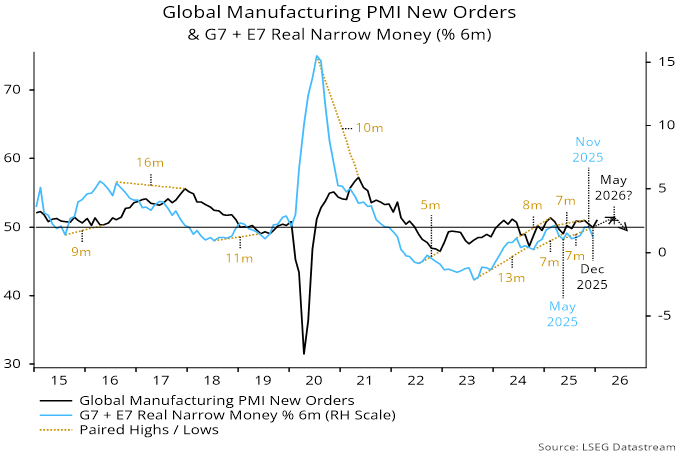
Global six-month real narrow money momentum – the key monetary leading indicator employed here – fell between March and July 2025 but recovered into November. The decline and rebound were driven by nominal money trends, with global CPI momentum stable at around its pre-pandemic pace (vindicating the monetarist forecast of full retracement of the 2021-22 inflation spike) – see chart 1.

Chart 1

060125c1

The earlier fall in real money momentum has been reflected in a decline in global manufacturing PMI new orders – a timely indicator of economic momentum – from an October peak. Based on recent lead times, however, the monetary rebound suggests that the PMI will bottom out in early 2026, with a recovery into mid-year – chart 2.

Chart 2

060125c2

While global growth may hold up in H1, it may not be strong enough to prevent a further rise in unemployment rates, partly reflecting AI job displacement – chart 3.

Chart 3

060125c3

Meanwhile, the stockbuilding cycle – averaging 3.5 years in length historically – remains on course to enter a downswing in 2026, with a possible low in H1 2027. The focus here is on the survey-based indicator shown in chart 4, which has been moving sideways at a level consistent with a cycle peak – a decline into negative territory would confirm a phase shift.

Chart 4

060125c4

Global inflation is expected to be little changed in 2026, with downside risk judged greater than upside. A key consideration is that G7 annual broad money growth, while recovering further over the past year, remains below its pre-pandemic average – chart 5.

Chart 5

060125c5

A downside surprise could arise from AI job displacement depressing wage growth. One upside risk is a near-term burst of commodity price strength before the stockbuilding cycle moves into a downswing. Industrial commodity prices rose by less than usual earlier in the upswing and a catch-up could be in progress – chart 6.

Chart 6

060125c6

The expected transition in the stockbuilding cycle coincides with the housing cycle – averaging 18 years, with a previous trough in 2009 – being in a time window for weakness. G7 housing investment moved sideways between 2023 and H1 2025 but fell to a new low in Q3 – chart 7.

Chart 7

060125c7i

Cyclical hopes rest on further strength in business investment, which follows an average 9-year cycle, with a previous low in 2020. While tech capex is booming, however, it accounts for only one-third of US business investment (and less than 5% of GDP), with other segments weak – chart 8.

Chart 8

060125c8i

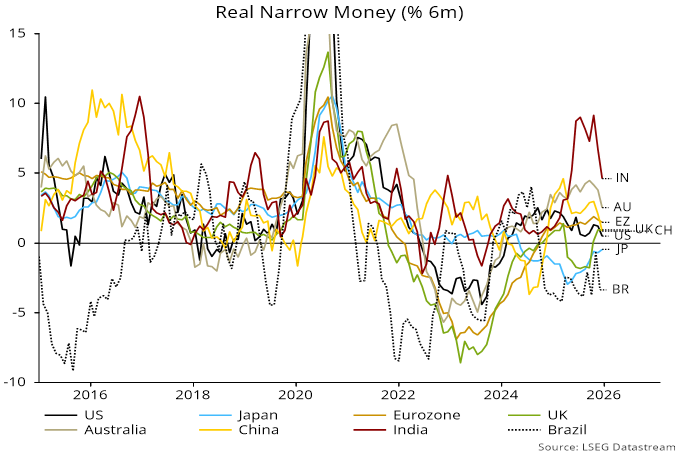
The dispersion of real narrow money momentum across countries has narrowed – chart 9. Adjusted for a recent apparent data distortion, US momentum remains slightly below the Eurozone level. Japan is still a negative outlier but the UK has returned to mid-range. Strength in Australia / Canada suggests upside economic and rates risk, with an opposite message from a Swedish move into contraction.

Chart 9

060125c9

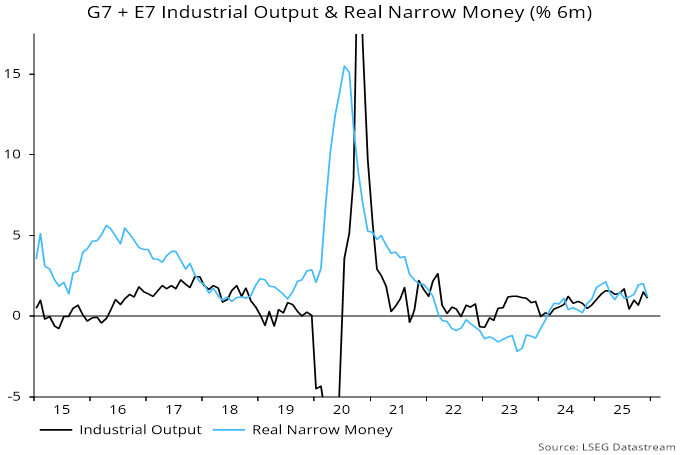
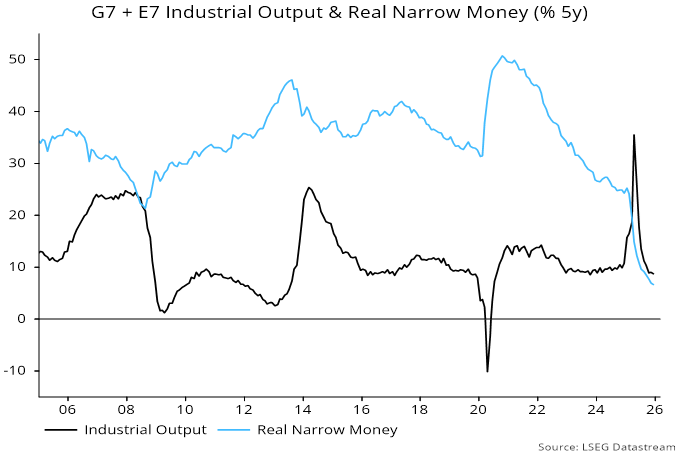
Global real narrow money momentum remains below its long-run average but is nevertheless above weak industrial output momentum, suggesting “excess” money support for markets – chart 10.

Chart 10

060125c10

Against this, risk assets have usually corrected – or worse – in the 18 months leading up to stockbuilding cycle troughs, with another such window now open on the analysis here. Table 1 compares moves in selected asset prices in the current cycle with averages across the previous nine cycles, with the mean maximum rise from the beginning of the cycle in column 1 and the subsequent fall into the cycle trough in column 2.

Table 1

060125t1

Global / US equities, tech and other cyclical sectors, and precious metals have significantly outperformed their average gains in the current cycle, suggesting larger-than-normal reversals into the cycle trough. By contrast, European equities, EM, small caps and industrial commodity prices are lagging their respective averages, so may have more upside potential while a positive environment persists and / or prove more resilient in a subsequent risk-off phase.

A fall in the US dollar boosted risk appetite in 2025. The timing of the decline echoes the last three housing cycles, in which the dollar trended lower from an overvalued level in the years preceding and beyond the cycle trough – chart 11.

Chart 11

060125c11

US currency weakness could become market-negative if a decline becomes disorderly, resulting in upward pressure on longer-term rates, for example in the event of further fiscal profligacy or unwarranted additional rate cuts by a politically controlled Fed. Alternatively, a negative market shift could be triggered by a temporary dollar rebound, if US economic news surprises positively and the Fed remains orthodox. Dollar sentiment and positioning were contrarian-bearish at the start of 2025 but current signals are neutral / positive.

Lonsdale, Vancouver, Colombie-Britannique.

Investissements immobiliers Crestpoint Ltée. est ravie d’annoncer une transaction visant l’acquisition de toutes les parts de fiducie émises et en circulation de la FPI Minto, à l’exception des parts détenues directement ou indirectement par Minto et certains cadres supérieurs. Le portefeuille de FPI d’appartements Minto comprend 28 propriétés réparties sur cinq millions de pieds carrés à Ottawa, Toronto, Montréal, Calgary et Vancouver, ainsi que deux projets de développement multifamiliaux dans la région du Grand Toronto. Crestpoint, au nom de la stratégie immobilière de base plus Crestpoint, conclura cette coentreprise avec le groupe Minto. L’acquisition devrait prendre fin cet été. Les propriétés initiales et futures du portefeuille appartenant à ce partenariat seront gérées conjointement par Crestpoint et Minto, Minto fournissant des services de gestion immobilière et d’aménagement.

Pour en savoir plus sur cette transaction, veuillez lire le communiqué de presse (en anglais seulement).

CCLIM_NEWS_2025-01-05_Banner

Nous sommes heureux d’annoncer que Gestion de placements Connor, Clark & Lunn a reçu le prix Coalition Greenwich 2025 : Meilleur gestionnaire d’actifs pour les investisseurs institutionnels au Canada*!

Ce prix reflète l’excellence pour ce qui est du rendement des placements et du service à la clientèle, selon l’indice de qualité Greenwich. Ce succès est une grande fierté pour l’ensemble de notre équipe, notamment nos professionnels des placements, nos équipes des Solutions clients et nos équipes opérationnelles, dont le dévouement rend possibles de telles réalisations.

« Cette reconnaissance témoigne de la force de notre équipe et de la confiance de nos clients, affirme Martin Gerber, président et chef des placements de Gestion de placements Connor, Clark & Lunn. Nous nous efforçons chaque jour d’offrir des résultats et un service exceptionnel, et ce prix vient renforcer cet engagement. Je tiens à remercier tous les membres de notre équipe pour leur dévouement et leur excellent travail, qui ont permis d’obtenir cette reconnaissance. »

Nous sommes fiers d’avoir reçu quatre fois au cours des cinq dernières années le prix d’excellence décerné par Coalition Greenwich dans différents volets de la gestion des placements institutionnels au Canada, et nous restons déterminés à offrir le meilleur service à nos clients pour les années à venir.

En savoir plus

* Tout au long de 2025, Crisil Coalition Greenwich a mené des entrevues auprès de 147 des plus grands régimes de retraite privés et publics, institutions financières, fonds de dotation et fondations au Canada et dans d’autres régions du monde. Des gestionnaires de fonds chevronnés ont été invités à fournir des évaluations détaillées de leurs gestionnaires de placement, des évaluations des gestionnaires qui sollicitent leurs services et des renseignements sur les tendances importantes du marché. Gestion de placements Connor, Clark & Lunn n’a versé aucune rémunération à Crisil Coalition Greenwich pour ce sondage.

Pour obtenir de plus amples renseignements sur le rendement, veuillez nous écrire à l’adresse [email protected].

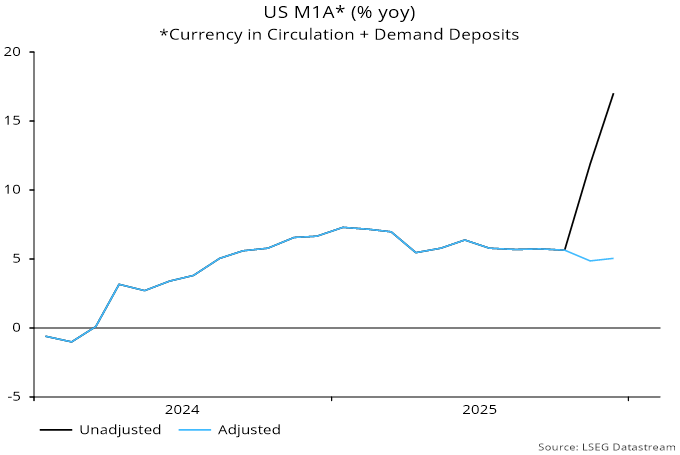
A sharp rise in US demand deposits in November probably reflects a statistical distortion. Monetary trends overall remain consistent with moderate nominal economic expansion.

The narrow money measure tracked here – M1A, comprising currency and demand deposits – jumped by 6.8% in November, pushing six-month growth up to 19.9% annualised from 5.4% in October – see chart 1.

Chart 1

291225c1

This surge, if genuine, would suggest a significant pick-up in economic growth during H1 2026, with associated upward pressure on interest rates.

The assessment here, however, is that the November jump likely reflects a statistical distortion cause by a bank or banks reclassifying savings deposits as demand deposits on the FR2900 reporting form.

Weekly unadjusted data show a large rise in demand deposits in the third and fourth weeks of November, with a corresponding drop in “other liquid deposits”, which include savings deposits – chart 2.

Chart 2

291225c2

The weekly numbers are averages of daily figures. The hypothesis of a reclassification is consistent with the demand deposit increase being spread over two weeks of data, assuming that the day of the change was after the start of the first week, resulting in a carry-over to the average for the following week.

A genuine surge in demand deposits would be expected to play out over multiple weeks. The change in the latest week – ending 1 December – returned to “normal”. Data for the remainder of December will be important for confirming the reclassification hypothesis.

Similar reclassifications appear to have occurred in several months over 2020-22, following removal of reserve requirements in March 2020, which effectively equalised the treatment of demand and savings deposits. The procedure adopted then was to assume that monthly growth of demand deposits would have matched that of total liquid deposits in the absence of the distortion.

Applying the same adjustment now suggests “true” six-month growth of M1A in November of 5.3% annualised, little changed from October.

The official M1 and M2 aggregates, as well as the broader M2+ measure calculated here, include savings deposits so are unaffected by such reclassifications. Six-month growth rates of the three measures were 4.1%, 4.6% and 6.7% annualised respectively in November – chart 1.

These growth rates are in a range consistent with trend economic expansion and inflation around the 2% target. Current money trends, in other words, give no strong grounds for monetary policy changes in either direction.

Wooden number blocks changing from 2025 to 2026 on a table against a golden bokeh background.

As we close out another year, we acknowledge it has been a difficult one for fundamental investors focused on quality companies.

How does Global Alpha define “quality”?  We mean companies with:

  • Revenue growth with a high portion of recurring revenues
  • Healthy profit margins
  • Strong balance sheet
  • Dividend paying
  • Fair valuation, ideally below the market multiples

Instead of quality, the market has been fixated on size (the bigger, the better), liquidity (the more liquid, the better) and momentum (what goes up will continue to go up).

In other words, it’s a very speculative market.

Are we in a bubble?

Ruchir Sharma, Chair of Rockefeller International, asked that exact same question in his piece in Financial Times – The four ‘O’s that shape a bubble. He described four characteristics that define a bubble, “four Os”: overvaluation, over-ownership, overinvestment and over-leverage. In our view, today’s market checks all four boxes.

Overvaluation

Consider the S&P 500 price-to-sales ratio. It is currently at an all-time high, well above the peak reached during the tech bubble in 2000. The market is paying record prices for each dollar of revenue.

Line graph illustrating the all-time high of the S&P 500 price-to-sales ratio.
Source: Bloomberg

Over-ownership

US household stock ownership, as a share of financial assets, is also at record levels. According to Gallup, about 165 million Americans – roughly 62% of US adults – own stocks, an all-time high.

On top of that, foreign investors now hold a record share of US equities. The market has rarely, if ever, been this “crowded.”

Bar graph showing the percentage of stock ownership of US households and non-profits from 1952 to 2024.
Source: Federal Reserve

Line graph illustrating the record-high foreign ownership of the US stock market.
Sources: Federal Reserve, Macrobond, Apollo Chief Economist

Overinvestment

Technology investment has recently surpassed 6% of US GDP, eclipsing the previous record set in 2000. But the ultimate return on these investments is still uncertain, and there are signs that adoption is slowing rather than accelerating.

Graph illustrating private domestic investment in information technology as a share of GDP, comparing computers and peripheral equipment, software, and other information processing equipment.

Over-leverage

We often hear about the enormous cash balances of the “Magnificent Seven.” However, much less attention is paid to the other side of their balance sheets: liabilities.

Amazon, Meta, and Microsoft are now net debtors, and they are increasingly financing capital expenditures with debt.

So, all four Os suggest a bubble. But who are we to know?

Surely, this time, it’ll be different! Right?

We recently looked at some assumptions underpinning the current enthusiasm and valuations.

The general consensus is that global semiconductor sales will grow at an annualized rate in the mid- to high-20% range over the coming decade.

During the strongest period until now – the 1990s, with the advent of the personal computer and the internet – annualized growth in semiconductor sales was about 15%.

Once again, the narrative is that “it’s different this time.”

What could deflate this bubble?
If we had to name one catalyst, it would be Nvidia, now the largest company in the world by market value, the most owned and traded stock globally, and the poster child for the AI wave.

What could go wrong with Nvidia?

In a word: Competition. More competition would likely mean lower market share, lower prices and lower profit margins.

Lessons from Novo Nordisk

The chart below shows the stock price of Novo Nordisk, which was the largest European company by market value just over a year ago. As a leader in GLP-1 “miracle drugs” used for weight loss and other health benefits, Novo Nordisk became the market’s favourite story.

As competition intensified and prices came under pressure, Novo Nordisk experienced a dramatic shift: its market value has dropped by 68% since its peak in June 2024.

What happened to this market leader?

Simple: more competition and lower prices. In 2024, Novo Nordisk earned €24.48 per share, up 29% from 2023. By mid-2024, analysts were expecting earnings of €30 per share in 2025, implying another 23% growth.

Line graph showing the stock price of Novo Nordisk from 2018 to present.
Source: Bloomberg

Line graph comparing the 12/2025 and 12/2026 mean concensus for Novo Nordisk.
Source: Bloomberg

Instead, according to Bloomberg consensus estimates, earnings for 2025 will be around €23.38, a decline of approximately 4.5%, with a further decline expected in 2026. Novo Nordisk remains a great company, investors have just overpaid for it.

Lessons from Cisco

At the peak of the dot-com era, Cisco Systems was the company that defined the Internet age. It was the most valuable company in the world at the start of 2000, supplying the routers needed to handle internet traffic that was doubling every few months.

Despite that dominant position, Cisco’s stock only just regained its 2000 peak price last week – more than two decades later.

Line graph illustrating the stock price of Cisco Systems from the early 1990s to present.
Source: Bloomberg

Looking at past trends, we do not expect Nvidia to maintain the market share and pricing power implied in current analyst forecasts. In our view (shaped by history that competition, regulation and changing narratives eventually catch up with even the most celebrated leaders), it is more prudent to diversify and pivot back to high-quality, reasonably valued companies with durable earnings and strong balance sheets

Lastly, we encourage you to read our previously published piece on quality: Time to take out the trash – Why high ROE matters in the long run. We breakdown how quality outperforms in the long-run and why it matters as an allocator.

We wish you a happy holiday season to you and your loved ones.

May 2026 bring peace and happiness to the world.

Hand holding a magnifying glass over a stock market chart.

Outlook

Emerging market equities have outperformed developed markets for the first time in five years, and by the most since 2017. The backdrop for the asset class is the most positive we have seen for the last decade or more. We expect the monetary backdrop to remain disinflationary for the first half of 2026, with treasury yields and the US dollar expected to continue declining.

Money growth in China is supportive, strong in India, and weak in Brazil, Mexico and South Africa. EM earnings growth is forecast to be 20.5% in 2026, nearly double this year at 10.4% according to Jefferies. On a more cautious note, global money trends suggest an economic slowdown into the end of Q4 and through Q1 2026 making us cautious on cyclical exposure.

Quality investing by first principles

In investing, there is a fine line between discipline and rigidity, or between conviction and stubbornness. Any resilient investment process must be nimble and adaptable enough to weather different market regimes. Investors relying too heavily on static profitability or valuation metrics in their investment process risk getting caught out when structural change takes place.

Screening for returns on equity, low leverage and earnings growth will give you only a very limited snapshot of investment value. Our aim is to paint a far richer picture of the businesses we are analysing.

We are trying to think about value creation in the stock market from first principles. Economic value added (EVA) stock analysis is one of the key tools we use for this. For those who missed it, we wrote about the core elements of EVA investing in a previous monthly, with highlights from that piece below.

Our approach to stock picking – focus on economic value added (EVA)

Made famous by Stern Stewart & Co., the approach homes in on the spread between the rate of return on a company’s invested capital and its cost of capital; economic value added, or EVA for short.

Why? We know that over the medium to long term, EVA is directly tied to the intrinsic value of any company and the fuel that fires up a company’s stock price.

Stock prices reflect how successfully a company has invested capital in the past and how successful it is likely to be at investing new capital in the future. EVA is the best methodology to measure the value that management has added to, or subtracted from, the capital it has employed over time.

How can management create value?

Bennett Stewart in his book The Quest for Value boils it down to three drivers:

  1. The rate of return earned on the existing base of capital improves; that is, more operating profits are generated without tying up more funds in the business.
  2. Additional capital is invested in projects that return more than the cost of obtaining new capital.
  3. Capital is liquidated from, or further investment is curtailed in, substandard operations where inadequate returns are being earned.

We are looking for companies that can be expected to generate high or improving returns on the capital employed in their businesses. These are companies run by management teams laser-focused on making investments that earn more than the cost of capital, and undertaking all positive net present value projects, while rejecting or withdrawing from all negative ones.
Menu of investment opportunities available within a single company.

Source: Bennett Stewart (1991), The Quest for Value

Understand what drives returns

Value creation is not enough for long run success. We need to know whether it can be sustained. Our process is focused on identifying the drivers of these returns and assessing:

  • whether there are historic changes or potential catalysts for improved value creation that are yet to be reflected in market prices; and
  • the sustainability of those returns – are there enduring competitive moats that will protect excellent returns on invested capital?

Our approach identifies highly productive and capital-efficient companies pursuing value creation in a variety of ways. It also focuses on whether that value creation is sustained via competitive moats.

Moats can take a number of forms, from differentiation via proprietary tech, brands or prime locations, to high switching costs, network effects, cost leadership, economies of scale or minimum efficient scale.

EVA helps to cut through the noise and home into whether a business is creating real economic value, and whether the trend of that value creation is strengthening or weakening. Crucially for emerging markets with weaker governance and opaque accounting, headline earnings can mask poor capital efficiency or inflated asset values. EVA cuts through these distortions by focusing on true economic profitability, drilling into the underlying economic strength of a business.

By emphasising value creation rather than headline earnings, EVA highlights when incremental investments fail to cover their capital charge – often an early warning sign of eroding competitive advantage. Further, this approach naturally draws attention to cyclical or structural changes impacting margin compression, rising capital intensity or declining asset productivity, which traditional metrics might obscure.

Below is a rough sketch of how EVA can provide a more robust check of company economics than an approach focused on accounting profitability.

Example: EM Real Estate Development Co.

Accounting view (P/E)
Reported net income: $100m
Shares outstanding: 50m
EPS: $2
Current price: $20
P/E ratio: 10x

On the surface, ABC Realty looks attractively valued at 10x earnings, suggesting a cheap stock relative to peers trading at 12–15x.

Economic value added view
NOPAT (Net operating profit after tax): $120m
Invested capital: $1.5bn
Weighted average cost of capital (WACC): 12%
Capital charge: $180m (1.5bn × 12%)
EVA = $120m – $180m = –$60m

Despite positive accounting profits, the company is destroying economic value, earning less than its cost of capital. This signals that growth funded by debt and equity is not creating shareholder wealth, even though the P/E ratio looks attractive.

In this case, the EVA approach provides a better assessment of whether a company’s moat remains intact and whether its strategic positioning continues to justify its valuation.

Below is a brief example of what we love to see from an EVA perspective.

Stock example – Vivara: market leader in Brazil’s jewellery industry, vertically integrated and expanding aggressively

Vivara is the dominant retail jewellery brand in Brazil, controlling more than 20% of the market.

A slide from the Vivara Investor Relations presentation. On the left is a promotional image of a woman wearing Vivara jewellery. On the right is a circle chart illustrating that Vivara holds 20.1% market share, while 74.0% of the market is held by players with less than 1.0% share each.
Source: Vivara Investor Relations 2025

The business is improving its returns on capital through new store openings, sweating assets and maintaining cost control through scale as the only domestic player which manufacturers its own products.

Sweating the assets harder than peers
Retail space productivity (EUR 000s for sale/m2) correlates with EBIT margin (%) – Global players
Line graph illustrating the retail space productivity per square metre of global luxury brands.

Retail space productivity (R$ 000/sqm) correlates with EBIT margin (%) – Local players
Line graph illustrating the retail space productivity per square metre of local Brazil brands including Vivara.
Source: BTG Pactual 2024

Value creation highlights:

  • Opening 50–70 stores per year, focus on aspirational Life brand, forecast 40% of sales by 2026.
  • 2-year sales CAGR of c.18% and EBITDA CAGR c.19%. Same-store sales growth consistently positive.
  • E-commerce 23% of total sales, headroom for further growth.
  • Plans to enter new markets Mexico and Panama, leveraging scalable business model.

Return drivers and competitive advantage:

  • Vertical integration: Vivara controls the entire value chain from design to production and distribution, enabling cost efficiency and rapid response to market trends.
  • Brand strength and market position: Strong brand recognition and customer loyalty, 75% retention rate and a broad product range catering to multiple segments.
  • Scale and retail network: Extensive retail network with 40% penetration in premium malls and significant opportunities for further expansion.

Our kind of business – this all translates into an attractive EVA profile

Vivaras ROIC charts
Line graph comparing EVA to ROIC and ROIC/WACC.
Source: NS Partners and Bloomberg

As emerging markets show renewed strength, our approach remains rooted in first principles: seeking resilient, capital-efficient companies positioned for long-term value creation that should drive stock prices.

A measure of UK annual core CPI inflation excluding direct policy effects fell further to 2.6% in November, the lowest since July 2021 – see chart 1.

Chart 1

171225c1

The measure adjusts for the imposition of VAT on school fees and bumper one-off rises in water bills and vehicle excise duty. It does not strip out the indirect impact of government actions, including national insurance and minimum wage rises.

Indirect policy effects continue to fade from shorter-term rates of change. The adjusted core measure rose at a 1.9% annualised pace in the three months to November from the previous three months, and by 1.8% between August and November – chart 2.

Chart 2

171225c2

Favourable news, on the “monetarist” view, reflects the lagged impact of persistent monetary weakness.

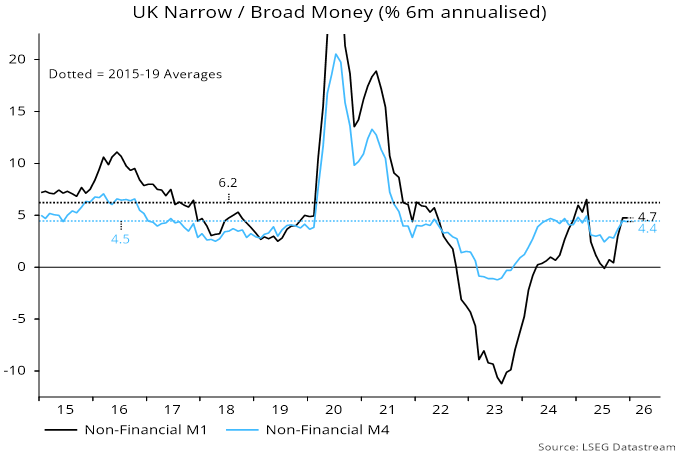
Broad money – as measured by non-financial M4 – rose by an average 2.6% pa in the four years to October. Simple monetarism suggests that 4-5% growth is needed to support 2% inflation and trend economic expansion of about 1.5% pa, allowing for a trend velocity decline.

The rule of thumb is that money trends feed through to inflation with a roughly two-year lag. As previously documented, the median lead time with respect to core inflation in the UK has been longer, at about 2.5 years.

Transmission may have been further delayed on this occasion by 1) a monetary overhang from the 2020 money growth surge and 2) cost-push pressures from government policies.

A post last month suggested that annual CPI inflation would fall to c.2.25% in Q2 2026 (versus a November Bank forecast of 2.9%) and return to target during H2. Budget measures warrant a lowered profile. Inflation is now expected to reach 2.0% in Q2 and undershoot in H2.

Annual broad money growth remains weak (3.3%), so low inflation is likely to be sustained through 2027 barring an external shock or exchange rate collapse.

A slowdown in food, alcohol and tobacco accounted for half of the drop in annual CPI inflation between October and November. The previous post suggested that UK food inflation would break lower in 2026, based partly on an unusually wide UK / Eurozone gap. The differential remains at 2.2 pp (4.0% versus 1.8%), having been negative on average over 2015-19 – chart 3.

Chart 3

171225c3

Photo de plusieurs voies ferrées et de trains en correspondance.

Connor, Clark & Lunn Infrastructure (CC&L Infrastructure) et Alpenglow Rail (Alpenglow) ont le plaisir d’annoncer la clôture réussie d’un financement de placement privé inaugural de plus de 280 millions de dollars canadiens. Le processus a suscité l’intérêt d’un groupe diversifié d’institutions financières nord-américaines de premier plan, de sorte que la transaction a été largement sursouscrite. Les billets de placement privé ont reçu une cote de catégorie investissement.

Le partenariat stratégique entre CC&L Infrastructure et Alpenglow a été établi en 2019 en vue de développer et exploiter un portefeuille diversifié d’entreprises ferroviaires en Amérique du Nord. Le portefeuille d’Alpenglow comprend six terminaux ferroviaires, soit trois terminaux au Canada sous la marque VIP Rail (Sarnia et Corunna en Ontario et Alberta Midland en Alberta) et trois terminaux aux États-Unis sous la marque USA Rail (Port Allen en Louisiane et Port Arthur et Orange au Texas). Alpenglow offre entre autres une gamme complète de solutions ferroviaires à ses clients, y compris l’entreposage des wagons, la commutation, le transbordement et le nettoyage des wagons.

Ryan Lapointe, directeur général de CC&L Infrastructure, a déclaré : « CC&L Infrastructure est ravie de mener à bien ce financement, qui souligne la force de notre partenariat avec Alpenglow et la qualité de la plateforme ferroviaire que nous avons construite ensemble. Dès le début de notre partenariat, notre vision commune était de créer une entreprise ferroviaire sécuritaire, évolutive et axée sur le client, et ce financement nous permet de continuer à réaliser cette vision. Notre approche d’investissement à long terme offre une proposition de valeur solide au sein du secteur ferroviaire. Nous sommes impatients de soutenir la prochaine phase de croissance et de création de valeur dans l’ensemble du portefeuille. »

Henning von Kalm, chef des finances d’Alpenglow, a ajouté: « Avec CC&L Infrastructure, nous restons déterminés à détenir et à exploiter des actifs ferroviaires de haute qualité sur le long terme. Ce placement privé témoigne de la résilience de notre modèle d’affaires et de la confiance que les investisseurs accordent à notre plateforme. Les terminaux ferroviaires d’Alpenglow sont stratégiquement situés dans les principaux centres de raffinage et de pétrochimie d’Amérique du Nord – le Centre de l’Alberta, la côte du golfe des États-Unis et le sud-ouest de l’Ontario. Grâce à cette présence établie dans de multiples marchés, nous sommes enthousiaste à l’idée de tirer parti de nos réussites et de continuer à produire de solides résultats. »

Marchés des capitaux CIBC (CIBC) a agi à titre de conseiller financier exclusif et d’agent de placement principal de CC&L Infrastructure et d’Alpenglow. Banque Nationale Marchés des capitaux et Desjardins Marché des capitaux ont agi à titre d’agents de placement supplémentaires, et Torys LLP a agi à titre de conseiller juridique de l’émetteur.

À propos de Connor, Clark & Lunn Infrastructure

CC&L Infrastructure investit dans des actifs d’infrastructure du marché intermédiaire présentant des caractéristiques de risque et de rendement attrayantes, une longue durée de vie et la possibilité de générer des flux de trésorerie stables. À ce jour, CC&L Infrastructure a accumulé plus de sept milliards de dollars d’actifs sous gestion, diversifiés dans une variété de régions géographiques, de secteurs et de types d’actifs, avec plus de 100 installations sous-jacentes dans approximativement 40 placements individuels. CC&L Infrastructure fait partie de Connor, Clark & Lunn Financial Group Ltd., une société indépendante de gestion d’actifs multiaffiliés qui offre une vaste gamme de solutions de gestion de placements traditionnelles et alternatives aux investisseurs institutionnels et individuels. Les sociétés affiliées de Connor, Clark & Lunn Financial Group gèrent plus de 167 milliards de dollars canadiens d’actifs. Pour de plus amples renseignements, veuillez consulter le site www.cclinfrastructure.com.

À propos d’Alpenglow Rail

Alpenglow Rail développe et gère des entreprises de transport ferroviaire de marchandises et des actifs de transport connexes partout en Amérique du Nord. Alpenglow Rail possède et exploite actuellement six terminaux ferroviaires stratégiquement situés dans les principaux marchés industriels du Canada et de la côte américaine du golfe du Mexique. Alpenglow Rail a été fondée par une équipe de dirigeants de compagnies de chemin de fer chevronnés possédant une vaste expérience de l’acquisition, de l’exploitation, du développement et de la croissance de chemins de fer d’intérêt local en Amérique du Nord. Pour de plus amples renseignements, veuillez consulter le site www.alpenglowrail.com.

Coordonnées

Kaitlin Blainey
Directeur général
Connor, Clark & Lunn Infrastructure
(416) 216-8047
[email protected]

Henning von Kalm
Dirigeant principal des finances
Alpenglow Rail
(917) 293-2351
[email protected]

A little boy playing on a tablet at night.

Of the five senses, vision is regarded as the most important as it allows us to navigate our environment, recognize the faces of our loved ones and read and watch to learn and entertain. But a good number of us do not have healthy eyes. According to the World Health Organization (WHO), at least 2.2 billion people globally suffer from near or distant vision impairment. The organization recognizes myopia as a significant public health concern given its rising prevalence around the world. A review of 276 studies (involving more than 5.4 million children from 50 countries across six continents) by the British Journal of Ophthalmology revealed that global prevalence of myopia among children and adolescents increased from 24% in 1990 to 36% in 2023 – one in three of all children and teens are nearsighted today. What is even more concerning is that myopia is starting earlier in children than before.

Prevalence of myopia by age group in 2000 vs. 2050, % of world population
Line graph comparing the projected prevalence of myopia by age group in 2000 vs. 2050, as a percentage of the world population.
Source: American Academy of Ophthalmology, BofA Global Research

The study predicted that approximately 740 million children and teens (more than half globally) will be myopic by 2050. American Academy of Ophthalmology in its 2016 article forecasted that by 2050, myopia would affect nearly half of global population. A more conservative projection this year puts the number at ~40% of global population – but it is clear that the world 25 years from now will have more than the 2.2 billion people in need of corrective lenses today.

Prevalence of myopia is not even across the world. Asia sees a higher prevalence (close to 40%) that is two to four times higher than that of other regions. East Asian countries – China, Taiwan, South Korea, Japan and Singapore – see much higher myopia rates, exceeding 80–90%, in their adolescent populations.

Bar graph comparing the projected prevalence of myopia by global regions as a percentage of regional population.
Source: ScienceDirect, Global perspectives on myopia and pathologic myopia: From environmental drivers to precision medicine

Primary drivers of myopia are genetics, near-work activities and lack of outdoor activities. A recent article in Progress in Retinal and Eye Research journal linked the high prevalences in the East Asian countries to educational systems characterized by intense academic competition, prolonged school hours and substantial homework assignments which significantly reduce opportunities for outdoor activities.

The WHO estimated that vision impairment cost the global economy an estimated USD411 billion in productivity loss, with only 36% of people with myopia having access to an appropriate intervention. Shanghai Conant Optical Co. Ltd. (2276 HK) in our Emerging Markets Small Cap Strategy seeks to address this global myopia pandemic. SCO, a sub-USD3 billion market cap company, is the second largest resin (plastic) optical lens maker in the world after EssilorLuxottica in terms of production volume. At its manufacturing locations across China and Japan, the company produced 209 million pieces to serve customers in over 90 countries around the world in 2024.

We believe SCO’s customer value proposition of value for money is especially effective in the product category of optical lenses. SCO’s high-index lenses (such as 1.74 and 1.67) are approximately half the price of comparable lenses from EssilorLuxottica, Hoya and Zeiss whilst providing the same level of vision correction. On product quality, SCO is an ODM (original design manufacturer) for all the previously mentioned global brands with various lens-coating options available. For the brand-conscious, it is “fortunately” very difficult to tell which brand of lens one is wearing. We are not surprised that the company is especially seeing strong demand in developing countries where its customer value proposition would be stronger. As a person who has been wearing glasses for the past three decades, I have found myself switching from the expensive Hoya and Nikon to much more affordable brands (including Asahi-Lite which is now owned by SCO), which have provided an identical visual experience – I have not looked back since.

China offers a significant room for growth, having entered the world’s largest short-sighted country in 2018, two decades after the company was established. Over 700 million people or roughly half the population in China are diagnosed with myopia. The prevalence of myopia is especially high in school-aged children – roughly 40%/70%/80% of students in elementary/middle/high school suffered from myopia according to a 2022 study published in Investigative Ophthalmology & Visual Science. Laser eye surgery is not an option for these youths, and they must rely on glasses for vision correction until they are older. SCO’s sales in China focus on higher-index lenses where competition is more limited and penetration is lower, and 80% of those sales are of its own brand. The company’s growth in China has been margin accretive given the higher mix of own brand and higher-index lenses.

The company is also involved in the development of AI/AR glasses with leading technology companies in North America and China. SCO as a partner to the technology companies makes sense, given SCO’s scale and cost competitiveness. We appreciate that SCO is trying to solve the problem of the global myopia pandemic, but do not doubt that AI/AR glasses offer the next leg of growth for the company.