Eurozone CPI numbers for July were deemed disappointing because annual core inflation – excluding energy, food, alcohol and tobacco – stalled at 5.5%. 

Or did it? The annual rise in the ECB’s seasonally adjusted core series slowed to 5.3%, below the consensus forecast of 5.4% for the Eurostat unadjusted measure. The two gauges rarely diverge to this extent (they both recorded 5.5% inflation in June). 

The six-month rate of increase of the ECB series eased to 4.7% annualised in July, the slowest since June 2022 and down from a December peak of 6.2%. Six-month headline momentum was lower at 3.4%. 

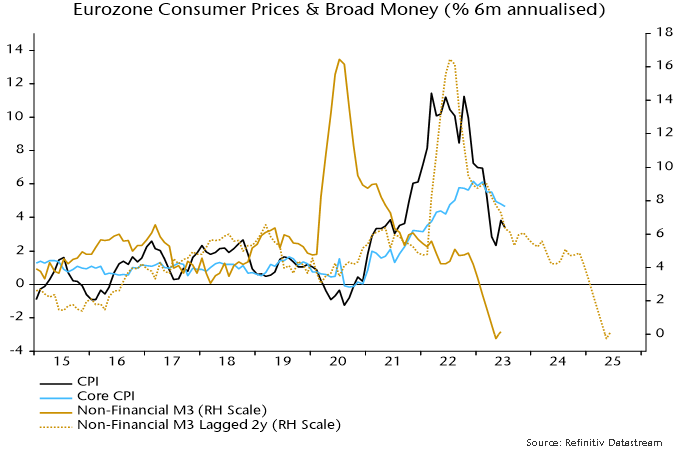
As in the UK, six-month headline inflation is tracking a simplistic “monetarist” forecast based on the profile of broad money momentum two years earlier – see chart 1. This relationship suggests that six-month CPI momentum will be back at about 2% in spring 2024, with the annual rate following during H2. 

Chart 1

Chart 1 showing Eurozone Consumer Prices & Broad Money (% 6m annualised)

The projected return to 2% next spring is a reflection of a fall in six-month broad money momentum below 5% annualised in spring 2022. A subsequent decline in money momentum to zero suggests an inflation undershoot or even falling prices in 2025. 

The shocking implication is that monetary trends were already consistent with a return of inflation to target before the ECB started hiking rates in July 2022. The 425 bp rise since then represents grotesque overkill, confirmed by recent monetary stagnation / contraction. 

The corollary is that a huge and embarrassing policy reversal is likely to be necessary over the next 12-24 months, unless some other factor causes broad money momentum to recover to a target-consistent pace. 

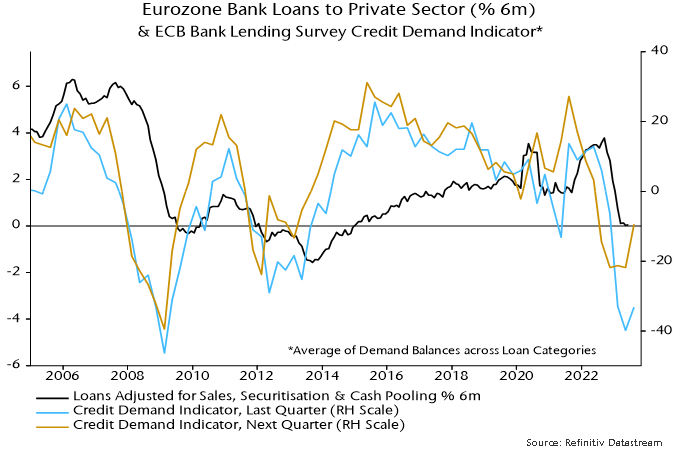
That seems a remote possibility, based on consideration of the “credit counterparts”. Loan demand balances in the latest ECB bank lending survey were less negative but still suggestive of negligible private credit expansion – chart 2. 

Chart 2

Chart 2 showing Eurozone Bank Loans to Private Sector (% 6m) & ECB Bank Lending Survey Credit Demand Indicator* *Average of Demand Balances across Loan Categories

Credit to government may contract given QT, withdrawal of TLTRO funding and inverted yield curves. (Banks previously used cheap TLTRO finance to buy higher-yielding government securities.) Redemptions of public sector debt held under the ECB’s Asset Purchase Programme amount to €262 billion over the next 12 months, equivalent to 1.6% of M3. 

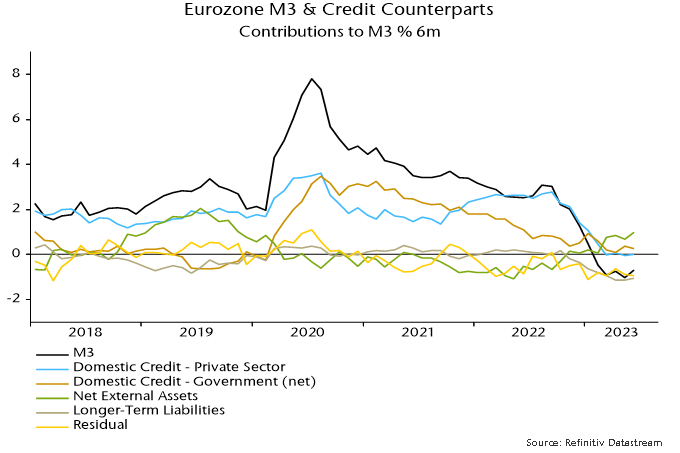
Broad money momentum has been supported recently by an increase in banks’ net external assets, reflecting a strengthening basic balance of payments (current account plus non-bank capital flows) – chart 3. This could accelerate as a Eurozone recession swells the current account surplus but is unlikely to outweigh domestic credit weakness. 

Chart 3

Chart 3 showing Eurozone M3 & Credit Counterparts Contributions to M3 % 6m
Oil pumpjacks in silhouette at sunset.

Much of the initial spike in inflation that the Federal Reserve (the Fed) is now working so hard to curb came from strong energy prices. After WTI crude crossed $120 a barrel, energy prices are back in the $70 range. Today’s bear case for oil is widely discussed – from an impending recession to China’s tepid economic rebound and the eventual transition to EV vehicles. These are sensible arguments, but the oil and gas industry has undergone some structural changes. The seeds of these changes can be traced back to the last big run up in oil prices in 2008 when oil peaked at close to $140 a barrel.

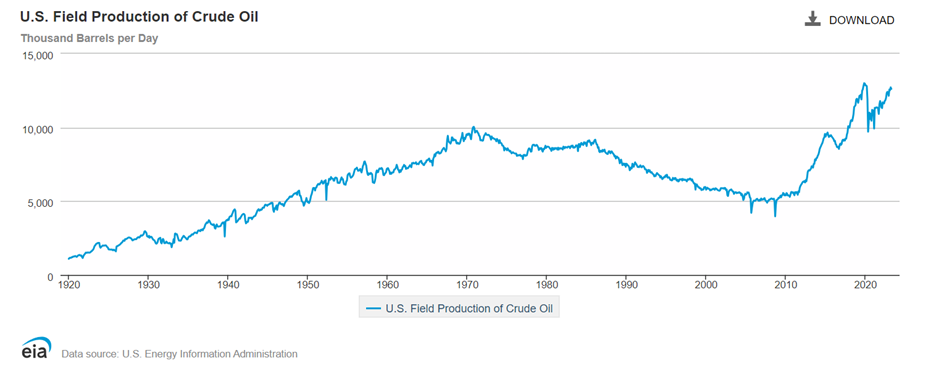
After the demand-driven boom that peaked in 2008, encouraged by the recent high prices oil, drillers in the US began exploring ways to reach previously untouchable deposits using fracking and horizontal drilling. While fracking and horizontal drilling had been around since 1998, the spike in oil prices incentivized US producers to leverage this technology. The result was a shale boom with US production that had been in terminal decline since the 1960s, doubling from about five million barrels per day in 2008 to 10 million per day over the next 10 years.

Line graph illustrating growth in US field production of crude oil, 1920 to today.

With OPEC unwilling to cede market share to a new generation of American drillers, elevated rates of supply eventually led to a fall in prices in 2014-15. In retrospect, this marked the beginning of the end of the US shale boom. Then came the one-two punch of slowing demand from China (the largest driver of incremental demand for oil) and COVID-related lockdowns that caused oil prices to hit lows of $20 per barrel in 2020 after a brief reprieve in 2018-19.

The two price shocks that occurred over a short period led to two changes in behaviour that we think has structurally changed the industry.

  • First, a new base of conservative investors replaced the more growth-oriented cohort from the shale boom. The new investor base now pushed for an end to risky new projects, instead focusing on debt reduction and returning excess cash in the form of buybacks and dividends.
  • Second, taking a cue from their investor base, management of companies that survived this boom-bust cycle vowed to be conservative with their capital expenditure programs and promised to divert their future capex to more renewable projects.

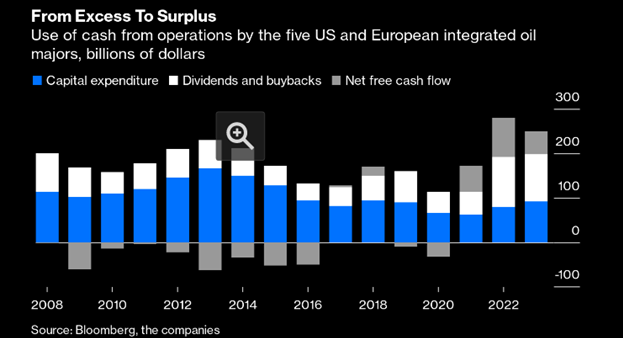
In the past, for every dollar of dividends and buybacks, oil companies would reinvest $3 to $4 back in the business. Now as we can see in the following chart, every $1 of reinvestment is matched by $1 of buybacks and dividends.

Bar graph illustrating decline in level of share buybacks by oil companies since 2008.

The result of this structural change in the market is that big oil producers will continue to be conservative with projects that take a decade or more to earn returns on investment. We are now in a situation where supply is tight due to both long-term factors, such as limited new exploration projects, and short-term factors like replenishment of the Strategic Petroleum Reserve (SPR) by the US, increasing from current levels of 350 million barrels to 650 million barrels. Adding to this, OPEC has committed to restricting supply until the end of 2023 by cutting 1.16 million barrels per day.

On the demand side, we are seeing record demand in 2023 at 101.9 million barrels per day, an increase of two million barrels from last year. While we anticipate an eventual transition away from oil, the combination of tight supply and persistent rising demand could lead to a messy transition with price spikes near-term volatility.

We think this new normal allows small and nimble players to quickly respond to a stronger pricing environment with ramped up spending. A good example of such a player is Parex Resources (PXT CN), which is part of our emerging markets portfolio.

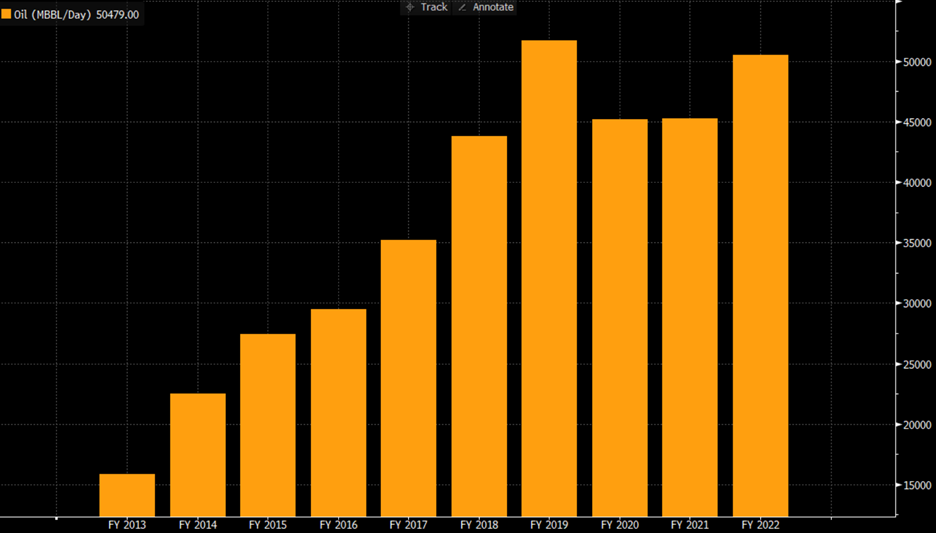
Parex is the largest independent oil and gas exploration company in Colombia sitting on over 200 million barrels of reserves and exploration opportunities. In 2023, it added 18 new blocks and expanded its exploration land by four million acres over the last five years. Currently, it produces 60,000 barrels of oil equivalent (BOE) per day and its production has grown at an 8% CAGR over the last five years, as seen in the following chart. Absolute proved developed producing (PDP) reserves have registered a 10% CAGR over the same period.

Consistent growth in oil production (barrels per day)

Bar graph illustrating growth in CAGR of Parex Resources, 2013 to 2022.

If we were to sum up our thesis on Parex, it would be capital efficiency with best-in-class execution. All of this in a country that has faced its fair share of curveballs with natural disasters, political uncertainty and infrastructure bottlenecks. To elaborate further:

  • We like Parex’s transition from a single-asset operator to a countrywide operation, with new asset acquisitions and an MOU with state giant EcoPetrol.
  • This had led to product diversity, moving from heavy oil to adding light oil, gas and condensates.
  • Parex has a track record of using of proven exploration technologies from the West to tap into easy-to-produce reservoirs with low risk.
  • We appreciate the management team’s commitment to adding shareholder value while maintaining strict cost control.
  • Finally, Parex has shown consistent growth that has been self-funded, with zero debt on the balance sheet.

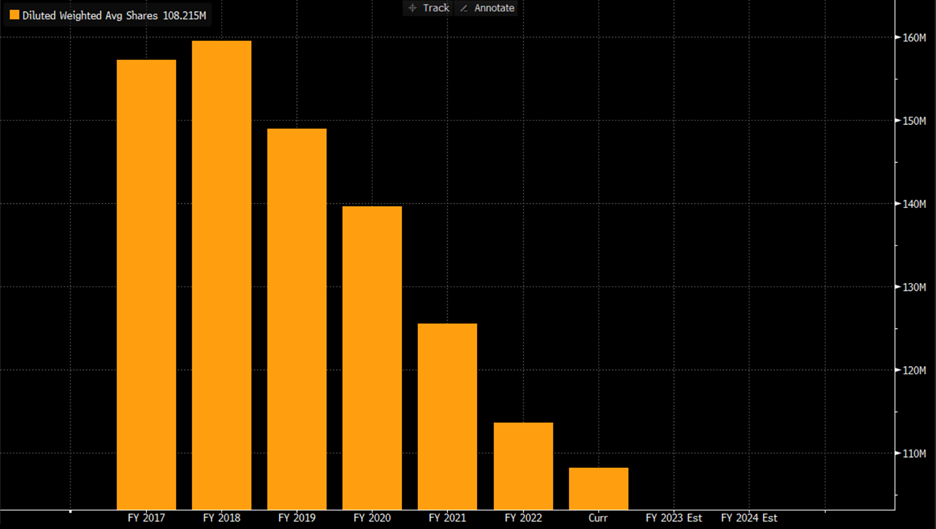
Parex has maintained a simple and consistent capital allocation framework. A full two-thirds of its funds from operations are reinvested into the business, while the remaining one-third is returned to shareholders. As seen in the chart below, Parex has reduced its free float of shares by 33% over last five years and returned $1.3 billion back to shareholders. In 2021, it announced a dividend policy to further reward shareholders, with the company offering a 5% dividend yield at current prices.

33% reduction in shares outstanding

Bar graph illustrating 33% reduction in free float of Parex Resources shares since 2017.

Parex also scores well on our ESG framework. It has reduced GHG intensity by 43% since 2019, linked executive compensation to ESG metrics and has a diverse and independent board. With a low cash cost, Parex has performed well even at today’s subdued oil prices. If a sustained period of high oil prices does materialize as we anticipate, we expect Parex to continue delivering shareholder value from a position of strength.

A bottoming out of the global stockbuilding cycle could be associated with a near-term recovery in manufacturing survey indicators. Money trends suggest that any revival will be modest / temporary and offset by wider economic weakness. 

Economic news has been unusually mixed since end-2021, with GDP weakness contrasting with labour market strength and manufacturing deterioration offset by services resilience. Confusing signals have contributed to market hopes of a “soft landing”. 

Sectoral and regional divergences may persist in H2 2023. The expectation here is that manufacturing survey weakness will abate but labour market data will worsen significantly. Money trends continue to cast strong doubt on soft landing hopes. Europe is likely to underperform the US. 

The US ISM manufacturing new orders index – a widely watched indicator of industrial momentum – hit a low of 42.5 in January and retested this level in May before recovering to 45.6 in June. 

Reasons for expecting a further rise include: 

  • The index has been in the 40s since September 2022 and the mean duration of sub-50 periods historically was eight months (ignoring episodes of three months or less). 
  • The global stockbuilding cycle remains on track to bottom out during H2 2023 and lows historically were usually preceded by a recovery in US / global manufacturing new orders. 
  • Recent price falls for raw materials and other production inputs may further incentivise firms to step up purchasing to maintain or replenish inventories.

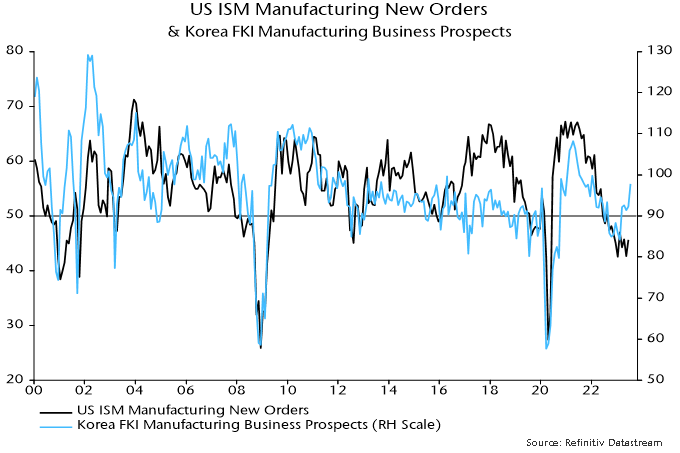
Korean manufacturing is a bellwether of US / global trends and the latest Federation of Korean Industries survey reported a marked improvement in optimism, consistent with ISM new orders moving back above 50 – see chart 1. 

Chart 1

Chart 1 showing US ISM Manufacturing New Orders & Korea FKI Manufacturing Business Prospects

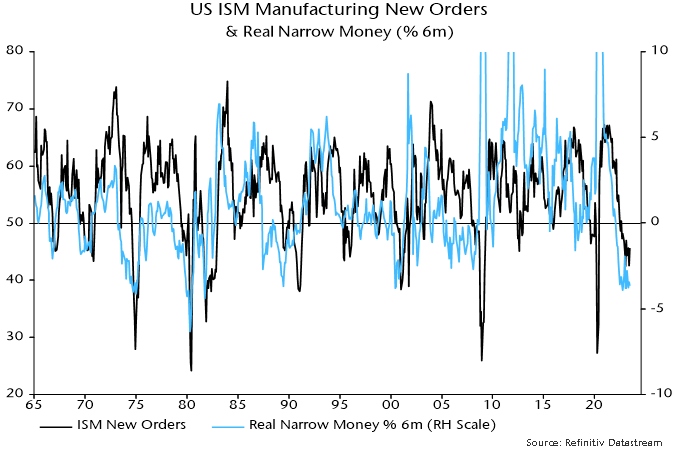
Sustained recoveries in ISM new orders from the mid 40s into expansionary territory historically occurred against a backdrop of positive and / or rising six-month real narrow money* momentum. Current trends are unfavourable, with momentum still significantly negative and moving sideways – chart 2. 

Chart 2

Chart 2 showing US ISM Manufacturing New Orders & Real Narrow Money (% 6m)

Examples of recoveries to above 50 without a supportive monetary backdrop include 1970 and 1989-90. In both cases the rise was modest (peaking below 55), short-lived and followed by a decline to a lower low. The recovery in 1970 occurred within an NBER-defined recession and in 1989-90 just before one. 

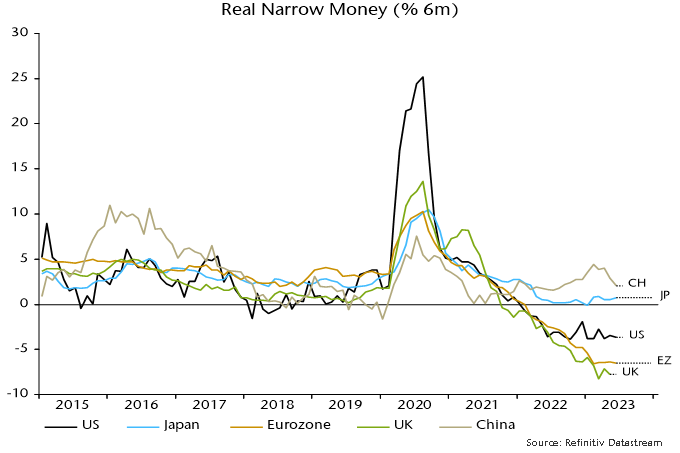
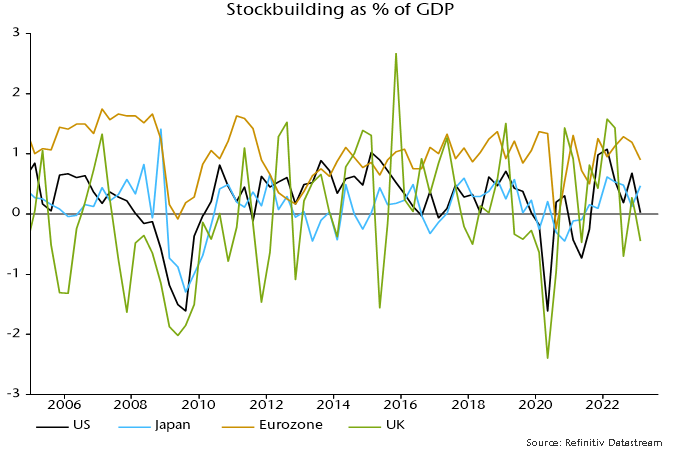
An ISM rebound might not be mirrored by much if any revival in European manufacturing surveys. Money trends are even weaker than in the US, while the stockbuilding adjustment started later in the Eurozone and probably has further to run – charts 3 and 4. 

Chart 3

Chart 3 showing Real Narrow Money (% 6m)

Chart 4

Chart 4 showing Stockbuilding as % of GDP

*Narrow money definition used here = M1A = currency + demand deposits.

Young professional looking concerned while working at her desk late at night.

Même si nous évoluons toujours en période d’incertitude lorsque nous prenons des décisions en matière de placement, certaines périodes, comme 2022, sont beaucoup plus difficiles que d’autres. Cet article présente cinq lignes directrices essentielles pour aider les comités de placement à gérer l’incertitude et à limiter les influences négatives dans le processus décisionnel.

Comprendre l’incertitude

Dans son livre Thinking in Bets, Annie Duke aborde le sujet de l’incertitude. Annie Duke est titulaire d’un doctorat en psychologie. Elle a été l’une des meilleures joueuses de poker au monde. S’appuyant sur son expérience de joueuse de poker, elle souligne à quel point les bons joueurs de poker et les bons décideurs sont à l’aise avec l’incertitude mondiale. Au lieu de se concentrer sur la prise de décision, ils tentent de déterminer leur degré d’incertitude, ce qu’Annie Duke suggère de faire pour prendre de meilleures décisions.

Le risque et l’incertitude vont de pair. Pour David Hillson, consultant international en gestion du risque, tous les risques peuvent être qualifiés d’incertains, mais les incertitudes ne sont pas toutes des risques. » Par exemple, si les prévisions météorologiques laissent entrevoir un risque de pluie, cela suppose une incertitude plutôt qu’un risque, que l’on peut régler simplement en apportant un parapluie.

Selon David Hillson, le risque est une incertitude qu’il ne faut pas négliger. Cela nous amène naturellement à nous demander comment reconnaître ce à quoi il faut accorder de l’importance. L’important est de comprendre la probabilité que le risque se concrétise et à quel point les conséquences pourraient être importantes si les choses ne se déroulent pas comme prévu. Si un événement a une forte probabilité de se produire et que le risque est important, il faudra certainement y accorder de l’importance et s’y attaquer.

Gérer l’incertitude

Que peut-on faire pour gérer l’incertitude? La première ligne directrice est de reconnaître qu’il existe de l’incertitude, tandis que les autres lignes directrices présentent une approche claire pour s’y retrouver efficacement.

Ligne directrice 1 : Prendre des décisions en gardant les yeux ouverts.

Cette ligne directrice est cruciale et dépend de la reconnaissance de la nature imprévisible des décisions pour lesquelles il existe des risques qui peuvent – ou non – être contrôlés. Il est également nécessaire d’évaluer le niveau et la probabilité du risque. Par exemple, si on s’attend à ce qu’un risque associé à un portefeuille de placement ait une incidence minimale et une faible probabilité de se produire, un comité peut décider qu’il s’agit d’un risque acceptable à assumer. Toutefois, pour les risques importants et dont la probabilité est plus élevée, un comité cherchera à atténuer le risque, notamment en améliorant la diversification du portefeuille.

Two purple onions, one is halved revealing its layers.

Ligne directrice 2 : Décomposer le problème pour le rendre plus gérable.

Cette ligne directrice s’appuie sur l’analogie avec les pelures d’oignon. En décomposant un problème en éléments plus petits, on le rend plus facilement gérable. Comme lorsqu’on épluche un oignon, l’évaluation des diverses couches d’une situation peut fournir des renseignements utiles qui n’étaient peut-être pas évidents à première vue.

L’un de ces éléments est le cadre, qui reconnaît qu’il existe des types distincts d’incertitude qui sont parfois considérés comme identiques. Par exemple, une connaissance limitée peut être attribuable à l’imprévisibilité d’un résultat, comme l’incidence de la volatilité des marchés boursiers. Par ailleurs, une connaissance limitée pourrait s’expliquer par le fait qu’un comité dispose de peu d’information sur un nouveau sujet, comme le rôle des marchés privés. La réponse serait différente pour chacun.

Une autre couche consiste à apprécier les différents groupes, personnes et organisations liés à la décision et à identifier les parties prenantes qui ont une influence sur la décision, celles qui ont l’expertise nécessaire pour la soutenir et celles qui seront touchées par celle-ci.

Il est également important de faire la distinction entre les faits et les hypothèses. Par exemple, une hypothèse de rendement annualisé de 7 % à long terme est simplement la meilleure estimation du rendement attendu et pas nécessairement le rendement qui sera réalisé.

Ligne directrice 3 : Être conscient des avantages et des limites des modèles.

La gestion de l’incertitude peut comprendre l’appréciation des avantages et des contraintes des modèles utilisés pour faciliter la prise de décisions. Voici ce que dit le statisticien britannique George Box :

« Tous les modèles sont erronés; certains modèles sont utiles. »

L’un des avantages les plus utiles des modèles est qu’ils peuvent favoriser une meilleure compréhension. Dans la construction d’un nouvel immeuble, un modèle architectural à petite échelle sert de représentation visuelle de la conception finale du bâtiment. En donnant une image plus claire et une impression générale du projet, on peut aider à repérer et à corriger les défauts de conception potentiels, ce qui permet de réduire les coûts des matériaux pendant la construction.

Les modèles statistiques sont souvent utilisés pour examiner la répartition de l’actif à long terme des investisseurs. Le rôle de ces modèles est de favoriser une meilleure compréhension des avantages relatifs des différentes répartitions de l’actif possible avant de les appliquer au portefeuille en tant que tel. Bien que ces types de modèles statistiques soient utiles pour regrouper des renseignements très complexes afin de faciliter la prise de décisions, ils ne sont que des outils et ne fournissent aucune garantie quant au résultat réel.

Ligne directrice 4 : Ne pas se laisser berner par les biais comportementaux.

Au moment de prendre des décisions, il est important d’être conscient des biais comportementaux qui peuvent influencer inconsciemment ses choix. Ces biais posent souvent des défis aux comités de placement.

Biais courants dans la prise de décision

Appel aux probabilités 
Être trop axé sur les résultats
Cadrage serré 
Ne pas envisager toutes les options
Ancrage 
Difficulté à se départir de sa première impression
Biais de confirmation 
Tendance à rechercher l’information qui confirme sa manière de penser
Fatigue décisionnelle 
Détérioration de la qualité des décisions
Émotion à court terme 
Les émotions peuvent influer sur les décisions
Appel à la mémoire 
Tirer parti des expériences passées
Excès de confiance 
Tendance à trop croire en un résultat

Dans leur livre, Decisive, Chip et Dan Heath font référence à quatre de ces biais qu’ils désignent comme les « quatre vilains » en expliquant comment ils peuvent influencer les décisions et les façons de réduire leur incidence.

  • Cadrage serré : Ce biais limite notre point de vue en concentrant notre attention sur un domaine précis, comme un projecteur qui éclaire une partie d’une scène tout en laissant tout le reste dans le noir. Un cadrage serré peut nous amener à négliger des possibilités et des points importants. Pour surmonter ce biais, il est important d’élargir nos perspectives, en éclairant différentes parties de la scène afin de découvrir de nouvelles idées et de nouvelles possibilités.
  • Biais de confirmation : Ce biais nous amène à rechercher et à privilégier l’information qui confirme nos convictions. Il peut en résulter une collecte de renseignements qui vont dans le même sens que nos convictions et une sous-estimation des risques associés à la décision. Pour contrer le biais de confirmation, il est utile de tester la réalité de nos hypothèses. Une façon d’y arriver est de demander à quelqu’un de se faire l’avocat du diable, de remettre en question nos idées et de formuler des critiques constructives avant de prendre la décision.
  • Émotion à court terme : Ce biais fait référence à l’influence des émotions immédiates sur la prise de décision. Cela peut nous amener à faire des choix impulsifs sans tenir pleinement compte des conséquences à long terme. Pour atténuer l’incidence de l’émotion à court terme, il peut être avantageux de conceptualiser les répercussions de nos décisions dans un avenir rapproché. En imaginant ce qu’on pourrait ressentir au sujet de la décision six mois plus tard, on peut réduire l’influence des émotions immédiates.
  • Excès de confiance : Ce biais consiste à avoir trop confiance dans l’issue probable de nos décisions. Nous avons tendance à croire que nos jugements et nos prévisions sont plus exacts qu’ils ne le sont. Pour remédier à l’excès de confiance, il faut reconnaître l’incertitude inhérente à la prise de décisions. Il faut être prêt à accepter que l’on a peut-être tort et à comprendre les risques de baisse potentiels associés à ses choix.

Être conscient de ces biais et mettre en place des stratégies pour les éviter peut aider à prendre des décisions éclairées et rationnelles.

Ligne directrice 5 : Obtenir la contribution de tout le monde.

La dernière ligne directrice pour gérer l’incertitude souligne l’importance de faire participer toutes les parties prenantes au processus décisionnel. Lorsqu’une nouvelle idée est présentée lors d’une réunion, il est courant de ne pas l’accueillir immédiatement et de résister à ce qui est proposé. Les nouvelles idées font souvent l’objet de réactions négatives, peu importe la qualité de l’information présentée.

Il est utile de déterminer les moments où il y a de la résistance et de permettre aux parties prenantes d’exprimer leurs préoccupations et, ce faisant, d’établir un lien de confiance avec les différentes parties prenantes. La communication est également essentielle pour provoquer des changements. En s’assurant qu’il y a une discussion à chaque étape de l’examen, on peut éviter d’arriver à la fin pour découvrir que l’on a perdu l’avis de décideurs clés en cours de route.

Comment être un décideur plus efficace

Aussi décourageant que cela puisse être, il est nécessaire de prendre des décisions en matière de placement en période d’incertitude. En suivant un processus rigoureux et en étant conscient des influences qui peuvent faire dérailler le processus, on peut être un décideur plus efficace.

Se démarquer face à l’inconnu

  • Être à l’aise avec l’incertitude associée aux placements.
  • Prioriser les risques les plus pertinents pour ses objectifs.
  • Reconnaître et accepter la nature imprévisible des décisions.
  • Décomposer les décisions complexes en éléments gérables pour en faciliter l’analyse.
  • Utiliser les modèles comme outils pour mieux comprendre les options possibles, tout en sachant qu’ils ne garantissent pas un résultat réel.
  • Être attentif aux biais comportementaux qui peuvent influer sur la prise de décision et prendre des mesures pour gérer leur influence.
  • Favoriser une communication efficace pour faciliter le changement et assurer une prise de décision éclairée.

Lorsqu’on doit prendre des décisions en matière de placement, il faut savoir maintenir le cap en période d’incertitude en gardant le contrôle de soi, appliquer des stratégies rigoureuses, avoir une communication ouverte et gérer les biais de façon à faire des choix éclairés et de réussir malgré la complexité.

Abonnez-vous aux mises à jour
Several boats along the coast line of the fishing village of Jamestown, Accra, Ghana.

While the headline returns were negative for the quarter, there were several encouraging signals in the underlying performance drivers that give us confidence in the future:

  1. The strategy’s Africa portfolio has finally contributed positively to returns after being the main drag on returns over the past 18 months.

    While there are still high levels of uncertainty looming over the economies of Egypt, Kenya, and Ghana, the prices of the securities we own there appear to have stabilised. We attribute this to valuations (a lot of bad news is in the price, in our opinion), apparent flushing out of forced foreign sellers, and early signs that these countries are emerging from their respective economic crises. We observed a tightening of credit spreads across the three African countries amid a weaker US dollar, moderating food and energy inflation, and signs that policy makers are starting to address some of the structural issues that have plagued their countries’ balance sheets and impaired the functioning of their foreign currency markets. We did not mention Morocco in the above list of countries, despite it being the strategy’s largest African country exposure. Morocco’s diverse economy helped it navigate the challenges that most countries in the continent have been dealing with, and so has not been a source of drag on the strategy’s returns.   
  2. The negative quarterly returns were generated from two core holdings that we remain fundamentally bullish on in the medium to long term.

    In our previous letters, we discussed our investment thesis on Wilcon Depot (the leading Philippines-based home improvement retailer), and Indonesia’s Sido Muncul (an herbal medicine manufacturer). While the share prices of both companies were under pressure in the quarter, we see no fundamental reason to change our constructive view on these businesses. In other words, we are more bullish on these investments at current levels.
  3. Our companies continue to invest in their markets, and insiders are buying stock.

    Across most of the portfolio, capital spending is growing at a faster rate than inflation and depreciation, and management teams are hiring and adding new products and services to further their value proposition to customers.

    A good example of this is HPS, the Morocco-listed payments technology company, which has just released version 4.0 of its flagship payment software product, PowerCard. Another example is Abdullah Al Othaim Markets, the Saudi discount grocery retailer that is winning the ~$40 billion size market by doubling down on its value-for-money proposition through the opening of 10 store a quarter, to take advantage of weakening competition, a shift in shopping behaviour to more value-for-money options, and the general growth in population in the central region, to which Al Othaim is over-indexed.

    In Malaysia, we were pleased to see buying by Tan Yu Ye, the founder and executive chairman of MRDIY, the value variety store chain that has seen a weakness in share price year-to-date on a souring of consumer stocks in the country, and a technical overhang from previous private equity ownership.

After nearly two years of unprecedented dislocation in frontier and certain emerging markets, we are seeing early signs that the opportunity set for the strategy is opening again. While these are early days, we are encouraged by the IMF’s approval of a $3 billion stand-by arrangement for Pakistan, Sri Lanka’s domestic debt restructuring, Egypt’s state asset sale program, Turkey’s market-friendly appointments at the Ministry of Finance and Central Bank, and its backing of Sweden’s NATO membership bid. In Nigeria, the abrupt removal of the crippling fuel subsidies and the liberalisation of the dislocated FX market by newly elected President Bola Tinubu are necessary remedies on the long road to restoring credibility with the market. These policy developments, along with early signs of a macroeconomic bottoming in the strategy’s core markets, and historically low valuations on a few portfolio companies, bode well for our ability to deploy capital, and for the strategy to seize on the long-term growth opportunities that these markets offer.

Vergent Asset Management LLP

Beautiful morning sunrise in seaside Dammam, Saudi Arabia.

Gulf equity markets broke a streak of four consecutive negative quarterly returns in the second quarter of 2023, and materially outperformed the MSCI Emerging Markets Index.  

In Saudi, the market performed impressively, with the MSCI Saudi Index posting a 5.5% gain in the second quarter, despite the backdrop of softer oil prices and lower production through OPEC+, muted earnings expectations from the banking sector (~35% of the Saudi index), and weak Chinese data that tempered hopes of a recovery in petrochemical earnings (~15% of the Saudi index).  

The mid-cap run in Saudi that we highlighted in our last letter continued to gain strength in the second quarter, with the MSCI Saudi Midcap Index up 9.9%, building on a 7.7% gain in the first quarter. The Saudi mid-cap space has been responsible for a significant proportion of the market’s year-to-date returns, as large index sectors like banks and materials underperformed. The sustainability of the mid-cap rally is currently the subject of intense debate. On the one hand, the bar for earnings to meet the expectations embedded in the price of many mid-cap securities has meaningfully risen. On the other hand, there is increasing evidence that the opportunity for multi-year earnings growth underpinned by Vision 2030 reforms – is most visible in mid-cap sectors such as education, healthcare, tourism, transport, and technology. This setup is a challenge for our investment process, as we aim to balance growth expectations with a price at which we believe this growth will generate attractive returns on our cost basis. 

We talked in our previous letter about our willingness to make bold decisions to preserve a relatively attractive return profile for the strategy. During the second quarter, this involved the following actions: 

  1. Continuing to back companies that trade at high near-term multiples, but that we believe will grow into those multiples over time. The best example of this is Abdullah Al Othaim Markets, the discount grocery retailer that is capturing significant share of its ~$40 billion market by doubling down on its value-for-money proposition to take advantage of weakening competition, a shift in shopping behavior to more value-for-money options, and the general growth in population in the central region, to which Al Othaim is over-indexed.
  2. Reducing or exiting positions where we believe valuations have all but caught up with the blue-sky scenario in our forecasts. This is a painful but necessary decision, as it often means parting ways with companies (and management teams) we admire, but which we can no longer justify owning at current valuations. A good example here is National Company for Learning and Education, a K-12 owner/operator with a market capitalisation of $1.2 billion based on an operating income of less than $30 million. 
  3. Buying companies with highly defensive characteristics, or those where we believe the market has left valuation room for earnings to surprise to the upside in the next six to 12 months. A good example of the former is Qatar Gas Transport, the sole distributor of Qatari liquified natural gas exports, whose vessels are chartered on long-term fixed-rate contracts, with growth optionality from Qatar’s North Field expansion project. While we will refrain from sharing examples of the latter at this stage, our focus is on high-quality businesses where near-term growth rates are moderate, but whose characteristics support a high level of free cash-flow generation relative to market capitalisation.   

Our outlook statement from the last letter remains largely unchanged, but we have introduced new language in the last paragraph regarding our thinking around valuations. We continue to see favourable opportunities for the strategy. The macroeconomic backdrop remains supportive, with healthy FX reserves and balance-of-payments positions across most of the Gulf. While still early days, the Saudi-Iranian reproachment is a key event that warrants our attention, as any progress there can lead to a lower geopolitical risk premium on regional assets. OPEC+ remains committed to maintaining high oil prices to support government spending plans, which could benefit equity markets. We also note that positioning from global emerging market funds remains light and governments in the region are intent on growing their share in the emerging market capitalization, which we believe will end up manifesting itself in a quasi-short squeeze on those funds.  

We believe that valuations in the region – particularly in Saudi – will continue to remain elevated relative to their historic levels. The political will to push through an unprecedented and transformative socioeconomic agenda, coupled with enormous financial capacity, is likely to unlock significant growth opportunities for public market companies for years to come in our view. Furthermore, governments in the region have never been more vocal about the role that their stock markets will play in crystalising their growth agendas. This is a powerful combination that, if successful, can reduce the historical oil price-induced economic and asset price volatility that has long been a characteristic of investing in the region, and consequently underpins above-average valuations through cycle. We do not, however, believe this is a tide that will lift all boats. Adhering to our investment principles will be key to identifying winning companies that can deliver attractive returns to our investors.

Vergent Asset Management LLP

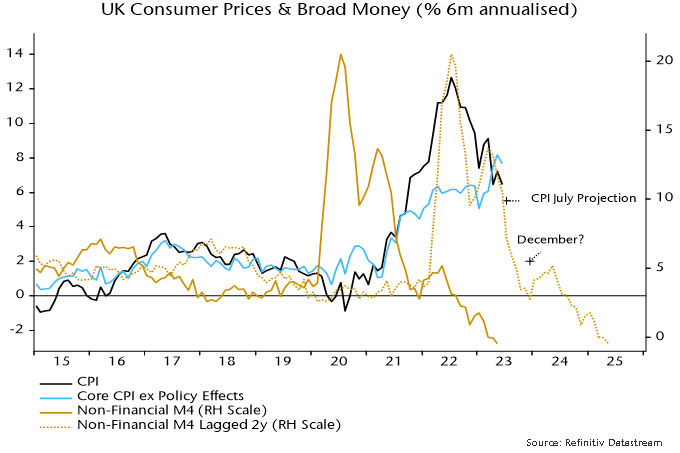
UK headline CPI momentum continues to track a simplistic “monetarist” forecast based on the profile of broad money momentum two years earlier. 

Six-month growth of headline prices, seasonally adjusted, peaked at 12.7% annualised in July 2022 and had halved to 6.5% as of June. This mirrors a halving of six-month broad money momentum from a peak of 20.5% annualised in July 2020 to 10.5% in June 2021 – see chart 1. 

Chart 1

Chart 1 showing UK Consumer Prices & Broad Money (% 6m annualised)

Broad money continued to slow sharply during H2 2021, with six-month momentum down to 2.7% by December, suggesting a fall in six-month CPI momentum to 2% annualised or lower by late 2023 / early 2024. 

A 2% rate of increase of prices during H2 2023 could be achieved by the following combination: 

The energy price cap falling by a further 10% in October, in line with current estimates based on wholesale prices, following the 17% July reduction. 

Food, alcohol and tobacco prices slowing to an 8% annual inflation rate by December from 14.9% in June. 

Core prices rising at a 4% seasonally adjusted annualised rate during H2 2023, down from 7.7% in H1. 

The latter two possibilities are supported by producer output price developments – annual inflation of food products is already down from a 16.8% peak to 8.7%, while core output prices flatlined during H1, following a 6.4% annualised rise during H2 2022. 

A 2% annualised CPI increase during H2 2023 would imply a headline annual rate of about 4% by year-end, well with PM Sunak’s target of a halving from 10%+ levels, although he will have made no contribution to the “success”. 

Why has UK CPI inflation exceeded US / Eurozone levels, both recently and cumulatively since end-2019? 

The assessment here is that the divergence reflects relatively weak UK supply-side economic performance and a larger negative terms of trade effect, rather than more egregious monetary excess. 

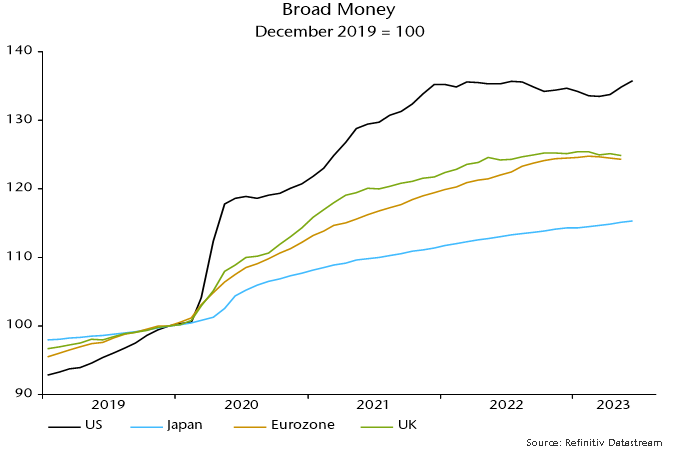
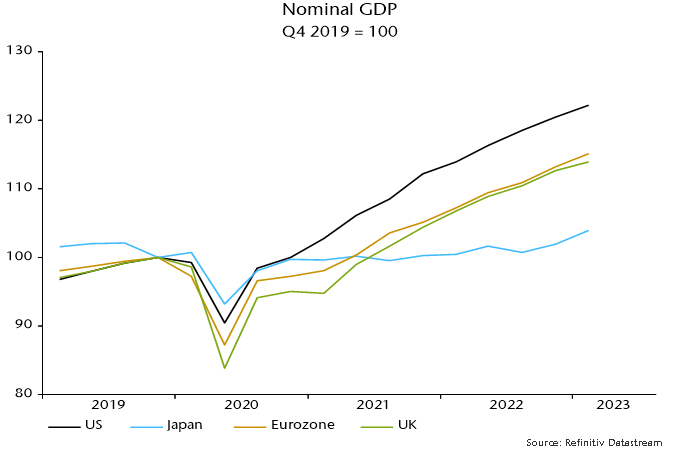
Charts 2 and 3 show that UK / Eurozone broad money expansion since end-2019 has been similar and less than in the US, with the relative movements mirrored in nominal GDP outcomes. 

Chart 2

Chart 2 showing Broad Money December 2019 = 100

Chart 3

Chart 3 showing Nominal GDP Q4 2019 = 100

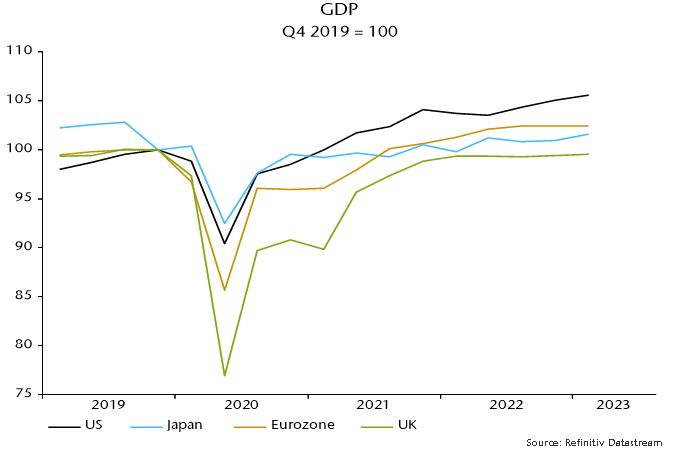
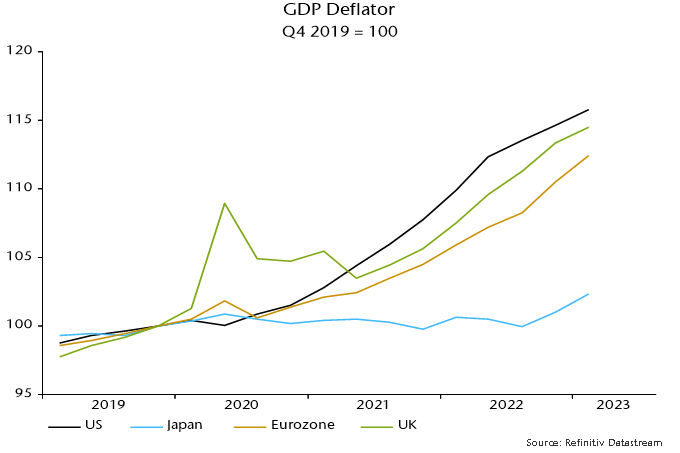
The UK has, however, underperformed the US and Eurozone in terms of the division of nominal GDP expansion between real GDP and domestically-generated inflation, as measured by the GDP deflator – charts 4 and 5. 

Chart 4

Chart 4 showing GDP Q4 2019 = 100

Chart 5

Chart 5 showing GDP Deflator Q4 2019 = 100

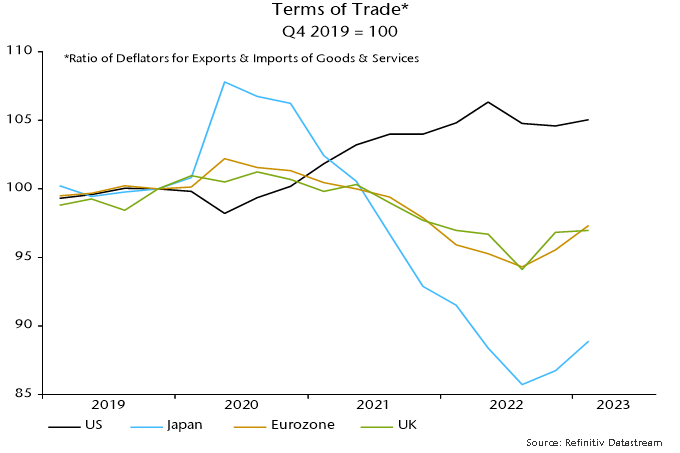
UK consumer prices were additionally boosted relative to the US by opposite movements in the terms of trade (i.e. the ratio of export to import prices), reflecting different exposures to energy prices as well as currency movements (i.e. a strong dollar through last autumn) – chart 6. 

Chart 6

Chart 6 showing Terms of Trade* Q4 2019 = 100 *Ratio of Deflators for Exports & Imports of Goods & Services

UK supply-side weakness may be structural but monetary and terms of trade considerations suggest an improvement in UK relative inflation performance – annual broad money growth is now similar to the US and below the Eurozone level, while sterling appreciation since late 2022 may extend a recent recovery in the terms of trade.

Beautiful view of a Puerto Vallarta beach on the Pacific coast of Mexico.

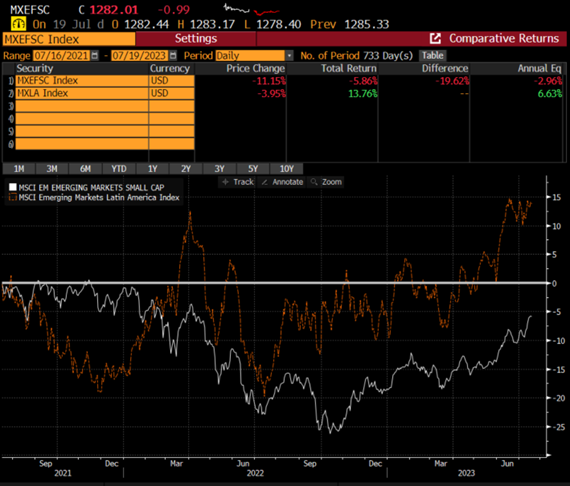
Latin America has outperformed other emerging markets over the past two years and this positive performance can be attributed to several key factors. However, the challenge lies in sustaining this momentum and ensuring it is not merely temporary.

MSCI World Small Cap Index vs MSCI Emerging Markets Latin America Index, 2021 to 2023

Graph showing the outperformance of the Latin America small cap index relative to its global peers between June 2021 and June 2023.

Source: Bloomberg

Notably, the combination of currency rallies among some Latin American countries and an emerging markets rally is uncommon. Reasons for this mismatch include:

  • Latin America leads the way in interest rate hikes worldwide. Starting in the first half of 2021, Chile and Brazil raised rates, helping control inflation levels, although they are still high but manageable. Chile will likely start its easing process next week, followed by Brazil within the year. This has boosted their respective stock markets, which were already undervalued in our view.
  • Additionally, Mexico has benefitted from the “nearshoring” theme. Nearshoring is nothing new to local investors, having been present in the region for decades. What is new is the level of intensity and amount of investment expected over the next three to five years. This has resulted in increased earnings per share (EPS) of 15% to 20% CAGR in the near term for some Mexican companies, outperforming the MSCI Emerging Markets Small Cap Index and contributing to higher valuations in Mexico’s market compared to its Latin American peers. However, there are questions about whether Mexico’s growth is comparable to its peers or to countries like Indonesia or Vietnam that are also heavily dependent on US imports.
  • Commodities also play a significant role in the region’s performance. Despite a global slowdown, certain commodities, like copper, have maintained high prices due to supply constraints. We believe the anticipated electric vehicle (EV) boom will further drive copper demand, ensuring a deficit in the market from 2026 onwards. For example, every EV, which weigh approximately two tons each, consumes around 60 additional kilos of copper.
  • Furthermore, the region has demonstrated better fiscal discipline, with countries like Chile and Mexico ending 2022 with fiscal surpluses or manageable deficits, respectively. This responsible fiscal approach has also supported their currencies. There is always the potential for Brazil to surprise on the downside due to its high fiscal spending and debt levels; however, the country has seen no “disruptive” events lately.
  • US rates hikes have favoured value over growth factors in emerging markets, benefitting markets like Latin America’s over countries perceived as growth-driven, such as Korea or India.
  • Innovation has not been a main driver for Latin America, but that is starting to slowly change. Moreover, the market has begun recognizing and crediting good companies with sustained growth expectations, which has historically been uncommon in the region. This trend in recognizing innovation and good companies is crucial for bottom-up investors like us who prioritize companies with solid balance sheets, strong cash flow generation and sustained competitive advantages. More Latin American companies have started to share these characteristics.

Latin America is still a small region relative to the rest of the world and it is dominated by, and benefits from, global trends, even though its politics are not always market friendly. However, sustained positive factors like the commodities momentum and nearshoring may make global investors more indifferent to the region’s internal dynamics.

What needs to happen for long-term compounder growth stories to emerge, like Nestle in India or TSMC in Taiwan? To maintain sustainable growth, we believe the region needs to align with external factors and foster strong domestic sectors and companies that promote growth. Improving innovation and adapting to rapidly changing environments are also key. For example, the financial sector in Mexico and Chile remains solid, while the transport-logistics sector in Mexico offers interesting opportunities. Brazil’s large population presents significant potential for emerging middle-class growth, creating opportunities in various sectors.

Latin America has growth engines and the key is to identify the best companies capable of maintaining a sustained differentiation over time. By focusing on these opportunities, our portfolio is well-positioning to capture their potential growth.

Company example

JSL (JSLG3 BZ) has the largest portfolio of logistics in Brazil, with long expertise operating in a variety of sectors and a nationwide scale of services. The company has long-lasting business relationships with clients that operate in several economic sectors, including pulp and paper, steel, mining, agribusiness, automotive, food, chemical and consumer goods, among others. JSL also has a unique position in the Brazilian highway logistics market, as leader for 19 years and much larger than its nearest competitor.

The logistics industry in Brazil is highly fragmented, with a high level of informality and low capitalization among players. This creates opportunities for further consolidation, especially for companies with structured businesses. According to Citibank, the top 10 companies have close to a 2% market share. JSL has roughly 1% market share (almost 5x the second-largest player) and is well placed to continue consolidating the industry. JSL also has a favourable M&A track record, which has been a growth driver in recent years. JSL has acquired seven companies since its re-IPO in October 2020 implying c20% annual organic growth and c60% EBITDA growth considering the acquisitions, maintaining strong returns. 

We also expect JSL to continue expanding its ROIC going forward, driven by the ongoing consolidation of new acquisitions into JSL’s financials, the company’s strategy to becoming a less capital intensive, asset light business, and strong revenue growth to maintain gaining scale and operating leverage. The logistics industry offers a lot of opportunities to implement tech-driven innovation, and we see JSL well-positioned to use its sector platform and status as a leading tech player. The stock has performed very well this year, partially driven by rate cut expectations and also strong earnings. We expect the company to continue delivering good results in upcoming quarters amid a highly fragmented sector, creating both organic and inorganic growth engines.

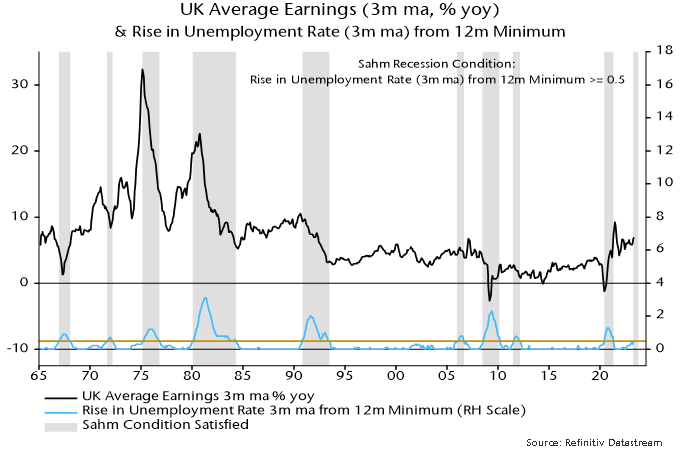
The Sahm rule states that the (US) economy is likely to be in recession if a three-month moving average of the unemployment rate is 0.5 pp or more above its minimum in the prior 12 months. 

The rule identified all 12 US recessions since 1950 but gave two false positive signals based on current (i.e., revised) unemployment rate data (1959 and 2003) and four based on real-time data (additionally 1967 and 1976). 

The signal occurred after the start date of the recession in all 12 cases, with a maximum delay of seven months* (in the 1973-75 recession). 

The Sahm condition hasn’t yet been met in the US – the unemployment rate three-month average was 3.6% in June versus a 12-month minimum of 3.5%. 

The rule has, however, triggered a warning in the UK, where the jobless rate averaged 4.0% over March-May, up from 3.5% over June-August 2022. 

UK Sahm rule warnings occurred on nine previous occasions since 1965, six of which were associated with GDP contractions. 

The Sahm signal is another indication that the UK economy is already in recession – see previous post – but a stronger message is that earnings growth is about to slow. 

Annual growth of average earnings fell after the Sahm signal in eight of the nine cases, the exception being the 2020 covid recession, when earnings numbers were heavily distorted by composition effects – see chart 1. 

Chart 1

Chart 1 showing UK Average Earnings (3m ma, % yoy) & Rise in Unemployment Rate (3m ma) from 12m Minimum

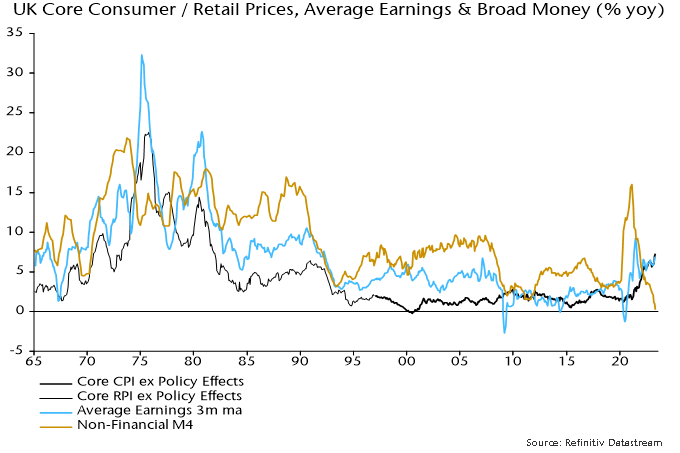
Previous generations of monetary policy-makers understood the dangers of basing decisions on the latest inflation and / or earnings data, which reflect monetary conditions 18 months or more ago. 

The current reactive approach, apparently endorsed by the economics consensus, may partly reflect mythology about a 1970s “wage / price spiral”. Rather than causing each other, high wage growth and inflation were dual symptoms of sustained double-digit broad money expansion. 

The monetarist case is summarised by chart 2, showing that earnings growth is almost coincident with core inflation whereas broad money expansion displays a long lead. (The correlations with core inflation are maximised with lags of four months for earnings growth and 24 months for money growth.) 

Chart 2 

Chart 2 showing UK Core Consumer / Retail Prices, Average Earnings & Broad Money (% yoy)

Recent monetary weakness argues that core inflation and wage growth will be much lower by late 2024; the Sahm rule signals that the decline is about to start.

*Eight months taking into account a one-month reporting lag.

Business woman looking at data on a computer at night. The coding is reflecting off of her glasses.

It seems like it happened overnight. Artificial Intelligence (AI) went from something distant that would not typically come up in small talk between colleagues (unless you work in the field, maybe), to the next great game changer that promises to transform the way everything is done. ChatGPT is now already a household name that can write homework for students, find bugs in programmers’ code or even draft a basic contract according to your specification. Just two months after the release of ChatGPT by OpenAI in November 2022, it had already become the fastest-growing software application in history with well over 100 million users. Subsequently this led to massive investments by Google, Baidu, Meta and many others to develop competing technologies to maintain their market shares.

Every time a new technology or concept is the subject of such interest, the media spends an incredible amount of resources theorizing all the different ways in which the world will be made different by this new shiny thing. Yet very few of these promised changes end up making a lasting impact. Blockchain was supposed to revolutionize the world of finance and decentralize the entire system, yet it remains a niche technology with a damaged reputation from the crypto craze.

The metaverse was sold as something that would be part of our everyday life with most households having their own VR headset, much like everyone had their own PC. We’re not quite there yet, although Apple now seems to believe this is the next big thing.

Finally, 5G was meant to unlock so many opportunities with promised better connectivity, low latency and no pocket loss. Every company was mentioning some opportunities from the internet of things to cloud gaming. All these frenzies had something in common: actors that overpromise and underdeliver in spectacular fashion, at least in the short term.

Then comes the new buzzword: generative AI. Between the Q4 2022 and Q1 2023 earnings season, the mention of AI in earning calls more than doubled among S&P500 companies. Nvidia rallied almost 200% in 2023 as one of the most obvious potential beneficiaries and is now worth over $1 trillion while trading at 40x revenues. For reference, these are dotcom bubble multiples.

Artificial intelligence as a field of research goes back to the late 1950s, 15 years after the famous Turing test was first put forward. So how did it become all the rage overnight over 60 years later? Long story short, significant advances in Large Language Models (LLM) in the last decade paved the way to commercial use of generative AI. In a context where the global economy has needed new productivity catalysts to prevent GDP deceleration and to help reduce inflationary pressure in the post-COVID era, ChatGPT seems to be filling the void almost too perfectly. As a new productivity tool that could potentially impact almost every aspect of the service economy, it’s no wonder everyone is jumping on the hype train. Nonetheless, if the commercialization of the internet is any reference, and assuming the impact of AI is of a similar size, we are still at the beginning of the dotcom/AI bubble where euphoria is high, and every company is set to either benefit from AI or disappear into irrelevance. Seasoned investors who lived through the internet bubble may offer one or more of the following pieces of advice:

  • Your internet/AI stock pick will likely prove wrong in the long term, as it will take years to fully realize the impact of the technology, while regulations can hinder companies’ plans.
  • Your stock pick could be the right one, yet the current valuation may still not make sense.
  • There are solid companies outside the tech/AI bubble that are being unfairly penalized as investors sell them to buy into the new hype stock.

Within this speculative environment, we identified an opportunity to initiate a position in a company that had been on our radar for a long time: Keywords Studios (KWS LN). Based in Ireland, Keywords is the dominant player in the fragmented market of video game outsourcing. With studios in over 26 countries, across eight different lines of business and three development divisions, Keywords operates at an unmatched scale three times larger than its closest competitor, yet with a market share of only 6%. The company offers services covering a wide range of developer requirements, including audio services, customer support for live games, marketing and social media management and bug testing.

Keywords had long been a darling in the video game small-cap space, commanding a valuation that made it challenging for us to justify an investment, despite its strong niche positioning and business model. However, near the end of April, the company appeared on an AI loser basket built by Bank of America, based on the belief that most of Keywords’ services would eventually be brought back in-house by game developers due the reduced need for labour caused by new AI technologies. This triggered a downward spiral in the share price. From that point on, negative momentum continued to feed on itself driven by index weight adjustments, loss cutting, quant signals and so on.

On closer examination, it became clear to us that the story was being misunderstood and that investors were selling services companies like Keywords indiscriminately. In fact, Keywords had already been making acquisitions and investments in AI technologies for at least a year before ChatGPT became a household name. It was already using this technology to enhance its localization services (Kantan AI), customer support business line (Helpshift), and to improve on its quality testing expertise (Mighty Games), among other things. Furthermore, Keywords is uniquely positioned to benefit from exposing its machine learning systems to a variety of games, languages and codes. It has a scale advantage that individual video game developers cannot match.

So why did we choose to invest in Keywords and not a game developer that owns its own intellectual property (IP)? The global video game market is highly hit-driven, which introduces risks and revenue lumpiness for developers, especially in the small-cap space where the number of IPs a company holds is usually limited and few games are released each year. Additionally, there is a significant ramp-up time when a new project is undertaken, as the game developer’s workload is not consistently aligned with that of the audio or functional testing teams, meaning employees may not always have the necessary workload to keep them on payroll.

In this environment, it is easy to understand why video game companies of all sizes are increasingly turning to outsourcing various stages of development. This is where Keywords excels. By working with virtually all the top gaming companies in the world, the company can leverage its scale to provide a consistent workload to its studios. Furthermore, by working across an unparalleled variety of games, Keywords builds a unique breadth of expertise without the need to manage its own IP or take on the risks associated with the release of a single title. Keywords is a great way of betting on the growth of the video game industry without making a call on specific titles or the medium on which it is consumed. The company represents most of what we would look for in a core portfolio holding: a leader in a niche market with pricing power, strong secular tailwinds and a good track record. And we got to buy it at a discount to its average valuation, thanks to investors that fell for this new AI mania.