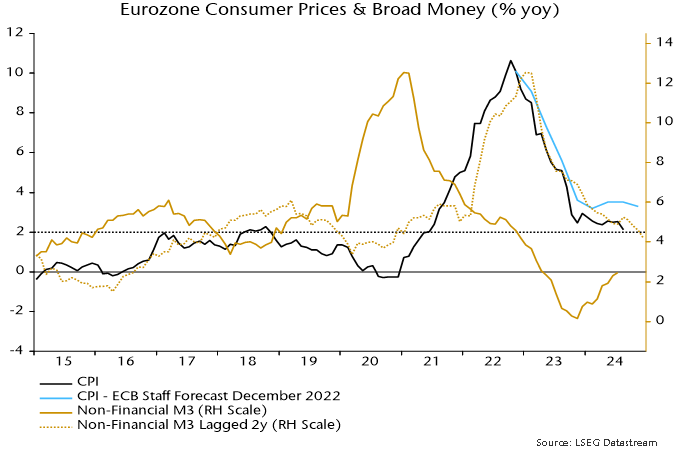
Monetary considerations argue that the ECB’s latest inflation forecast, like earlier projections, will be undershot.

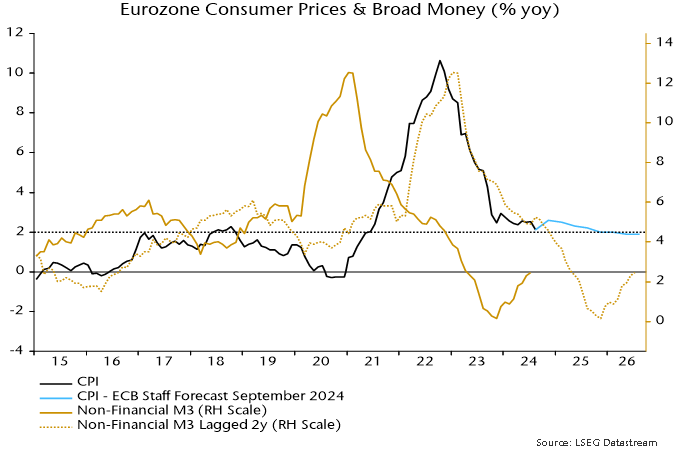
Annual growth of broad money – as measured by non-financial M3 – returned to its pre-pandemic (i.e. 2015-19) average of 4.8% in October 2022. Allowing for a typical two-year lead, this suggested that annual CPI inflation would return to about 2% in late 2024 – see chart 1. The August reading was 2.1% (ECB seasonally-adjusted measure).

Chart 1

20240918_NSP_MMM_C1_EurozoneConsumerPricesBroadMoney

The ECB staff forecast in December 2022 was more pessimistic, projecting annual inflation of 3.3% in Q4 2024. The forecast for that quarter was still up at 2.9% in June 2023 after natural gas prices had collapsed.

Annual broad money growth continued to plunge in 2023, reaching a low just above zero in November, since recovering to a paltry 2.5%. Simplistic monetarism, therefore, suggests that inflation will move below target in 2025 and remain there into 2026 – chart 2.

Chart 2

20240918_NSP_MMM_C2_EurozoneConsumerPricesBroadMoney

The September 2024 ECB staff forecast, by contrast, shows inflation rising in Q4 and remaining above 2% until Q4 2025.

The monetarist relationship, taken at face value, implies a period of annual price deflation in H2 2025 / H1 2026. The judgement here is to downplay this possibility and regard the current monetary signal as directional rather than giving strong guidance about levels.

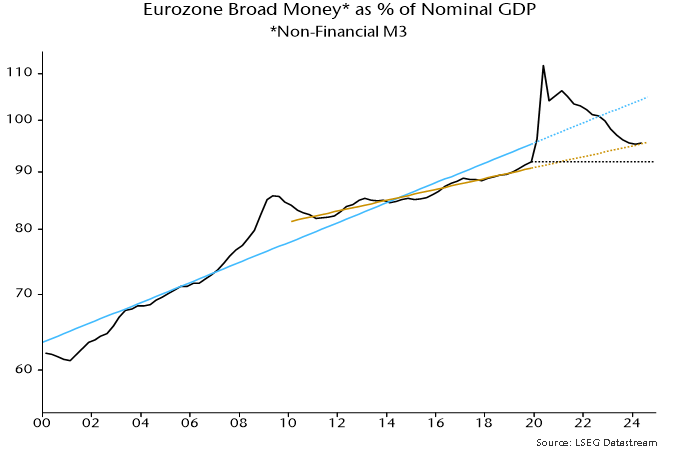
It is possible that the stock of money is still above an “equilibrium” level relative to nominal GDP. The current ratio is below its 2000-19 trend but in line with the 2010-19 trend, and higher than at end-2019 – chart 3. There may still be “excess” money to act as a deflation cushion.

Chart 3

20240918_NSP_MMM_C3_EurozoneBroadMoneyasofNominalGDPNon-FinancialM3

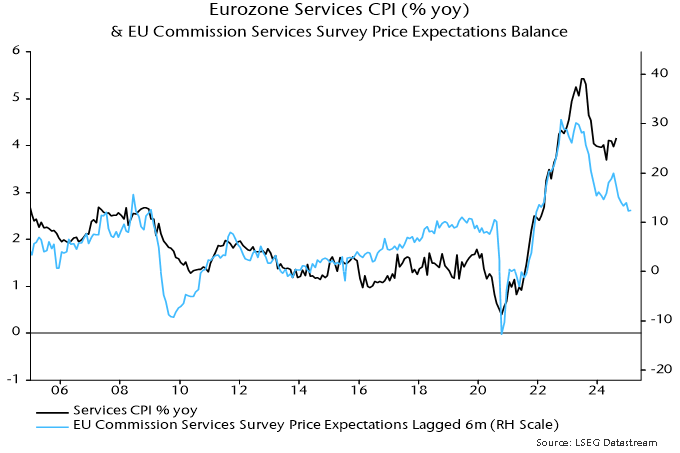
The forecast of a target undershoot requires services inflation – an annual 4.2% in August – to break lower. The price expectations balance in the EU services survey has displayed a (loose) leading relationship with annual services inflation historically, with the current reading consistent with a move down to about 2.5% in H1 2025 – chart 4.

Chart 4

20240918_NSP_MMM_C4_EurozoneServicesCPIEUCommissionServicesSurveyPriceExpectationsBalance

GACM_COMM_2024-09-12_Banner

Decarbonization continues in parts of the world, although there is a long way to go. Ongoing use of coal amid rising energy demand somewhat negates the transition to natural gas and/or the implementation of carbon capture technologies. On average, coal-fired power plants emit about 2.2 to 2.5 tons of CO2 per megawatt-hour (MWh) of electricity produced. By contrast, natural gas-fired power plants emit about 0.4 to 0.5 tons of CO2 per MWh.

But the good news is that we are making strides in other areas. Consider green steel.

Traditional steelmaking emits approximately 3 billion tons of CO2, mostly from smelting which turns iron ore into steel. This process is very energy intensive and is a top-3 CO2 emitter, with electricity production at number one and cement number two. However, metallurgical processes to turn iron ore into steel are now converting from traditional furnace smelters, which emit 2 tons of CO2, to low-energy Electric Arc Furnaces (EAF), which emit 0.5 tons per ton of steel.

Historically, new metallurgical processes have been difficult to scale. Fortunately, the steel industry, as it moves towards greener production methods, has been borrowing proven technology from its aluminum counterparts. EAF today play a crucial role in the global steel industry, with around 2,500 to 3,000 units in operation and a combined capacity of approximately 500 to 600 million tons per year. The share of EAFs in global steel production is around 5% and growing, reflecting their expanding importance in the industry and in a (slowly) decarbonizing world.

Major steel-producing regions like North America, Europe, China, and India are enhancing their EAF capacities to improve sustainability and reduce carbon emissions. Recent EAF investments include Nucor, $2.7 billion for 3 million tons of steel in 2024, and Steel Dynamics, $1.9 billion for 3 million tons in 2024. Cleveland Cliff, Arcelor and Gerdau are also transforming to EAF.

Transforming the entire supply chain will produce green steel, which represents a transformative shift in the steel industry towards significantly reduced CO2 emissions and more sustainable practices. Key technologies in this greening process include hydrogen-based steelmaking, EAFs powered by renewable energy, and advanced methods like molten oxide electrolysis. While there are challenges, including high costs and technical feasibility, green steel holds promise for a more sustainable future in steel production.

One company benefiting from EAF is Australian-based iron ore producer Champion Minerals (CIA:AU). By acquiring a distressed Canadian asset from Cleveland Cliff in 2017, Champion revitalized the asset towards producing over 12 million tons of iron ore per year. This North American asset represents the main value of the company, as it has received over USD$4.8 billion of investments over the years from past and present owners. Its products receive a premium to market, justified by the quality of its iron ore.

Champion has multiple catalysts on the horizon. For example, they are adding transportation links to help reach nameplate production of 16 million tons, and start-up of its EAF material processing facility will soon commence. As well, any further steel tariffs on Chinese steel will help bolster demand for its production, particularly among the new EAF North American steel mills. Indeed, Champion expects its exports to China to decrease from 70% to 30% in the coming years as the firm switches to markets closer to home.

This client diversification has many positive implications for Champion, and savings on cross-ocean transit costs are worth the EAF investment alone. It is important to note that all the electricity used in Champion Minerals operations are from hydropower except for the mobile fleet. It is therefore a definite leader in green steel branding.

There are other methods of reducing CO2 emissions while producing steel. We own a small position in Aperam (Apam.NA), which produces steel from its facilities in Brazil, Belgium and France. Aperam was spun out of ArcelorMittal at the start of 2011. Their Brazilian facility uses charcoal from a series of eucalyptus forests owned and managed by the group, rather than coking coal. Their European facilities use EAF furnaces fed with scrap.

(EAF requires scrap steel, as it is does not work well with high contaminant iron ore. Producers of iron ore have adjusted and are now producing high-quality ore, as well as metal bars instead of contaminated iron powder.)

We are also exposed to EAF in other commodities, specifically copper. The copper market is 10 times smaller than steel, so CO2 headlines have been less prolific. Yet copper CO2 emissions are still fairly elevated, at 3 tons of CO2 per ton.

Aurubis AG (NDA.GY) is a leading global provider of non-ferrous metals, particularly copper, and it operates several key assets and facilities across the globe. The company’s assets include smelting and refining facilities in Germany, Bulgaria and Finland. The Helsinki and Luebeck facility are flash smelting furnaces, which emit around 1.5 to 2.5 tons of CO2 per ton of copper produced. This is lower compared to traditional furnaces. Aurubis also operates EAF facilities at different production sites.

Aurubis has leading recycling operations in Europe, especially for copper, and it is developing the copper recycling market in North America. The company recently opened a new smelting facility in Richmond, British Columbia.

The days of complete green steel are likely years away, but they are within view. We continue to follow developments in these areas so as to participate in important decarbonization investment themes going forward.

The “double dip” downturn in global manufacturing continued last month.

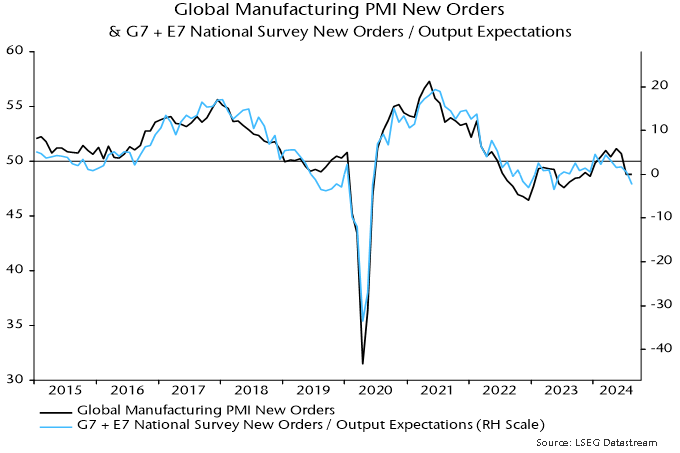
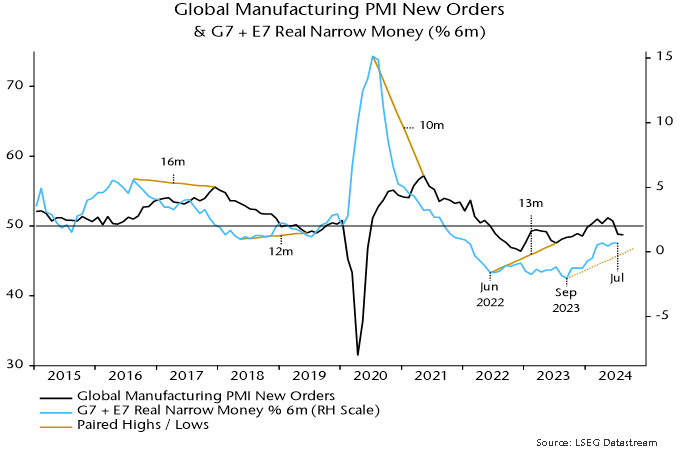
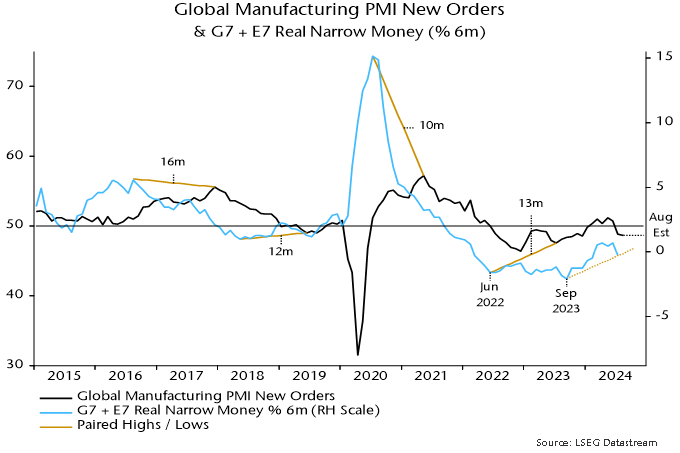
Global manufacturing PMI new orders fell steeply from a peak in May 2021 to a trough in December 2022 (first dip), with a subsequent recovery ending in May 2024. The second dip was confirmed by a sharp fall to below 50 in July, with the index unchanged in August – see chart 1.

Chart 1

20240910_NSP_MMM_C1_GlobalManufacturingPMINewOrdersG7E7NationalSurveyNewOrdersOutputExpectations

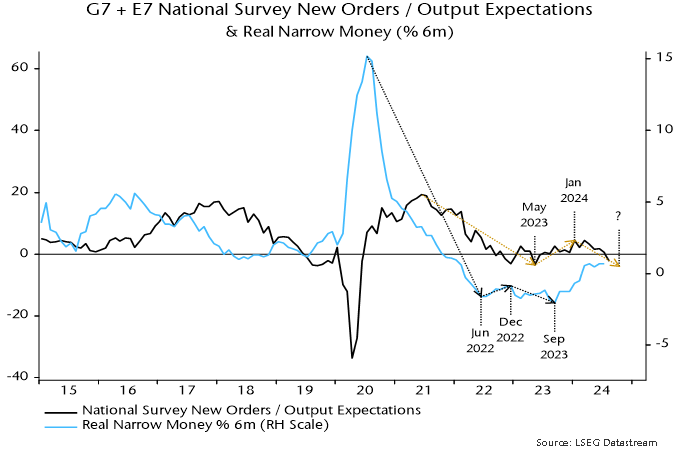
As the chart shows, an alternative global indicator based on national surveys weakened further last month.

The alternative indicator implies a shorter interim recovery between the two dips than the PMI, starting from May 2023 and ending in January 2024. These timings align better with turning points in global six-month real narrow money momentum (low in June 2022, high in December 2022) – chart 2.

Chart 2

20240910_NSP_MMM_C2_G7E7NationalSurveyNewOrdersOutputExpectationsRealNarrowMoney

The September 2023 low in real money momentum suggests that the double dip will bottom out by end-2024.

A key issue is whether manufacturing weakness will now transfer to services.

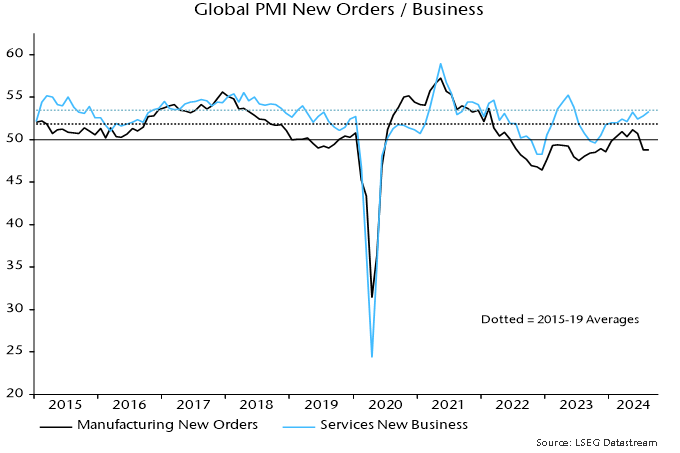
Services indicators remain mixed. The global services PMI new business index regained its May high last month and is close to the pre-pandemic average – chart 3.

Chart 3

20240910_NSP_MMM_C3_GlobalPMINewOrdersBusiness

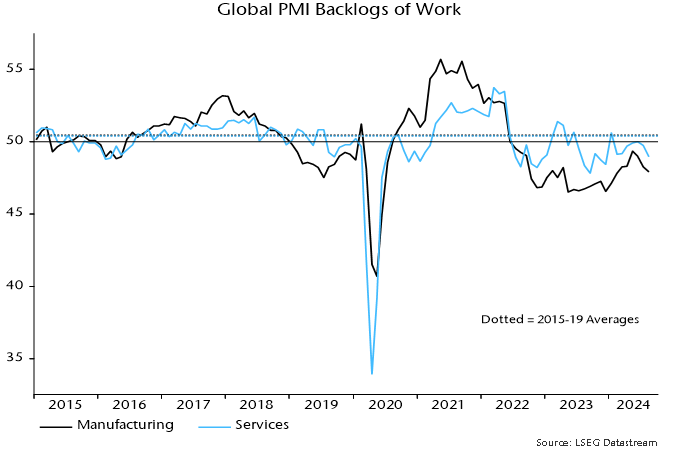
Order backlogs, however, fell further and are well below the corresponding average, as they are in manufacturing – chart 4. The decline suggests that current output is running above the (increased) level of incoming demand.

Chart 4

20240910_NSP_MMM_C4_GlobalPMIBacklogsofWork

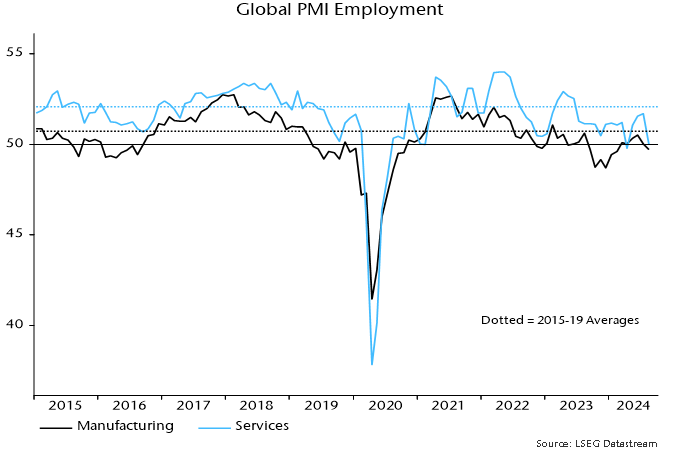
Accordingly, services firms are curbing hiring, with the sector employment index falling sharply in August and almost as weak as in manufacturing – chart 5.

Chart 5

20240910_NSP_MMM_C5_GlobalPMIEmployment

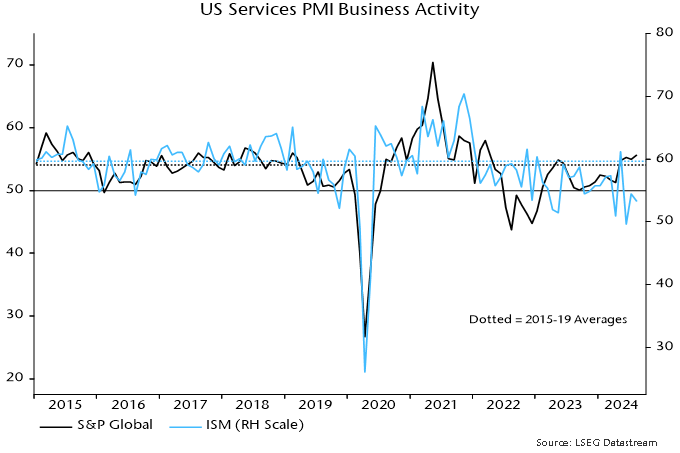
Rises in the global services PMI activity and new business indices last month partly reflected further strength in US components. The corresponding measures in the US ISM services survey are weaker, however, especially relative to pre-pandemic averages – chart 6.

Chart 6

20240910_NSP_MMM_C6_USServicesPMIBusinessActivity

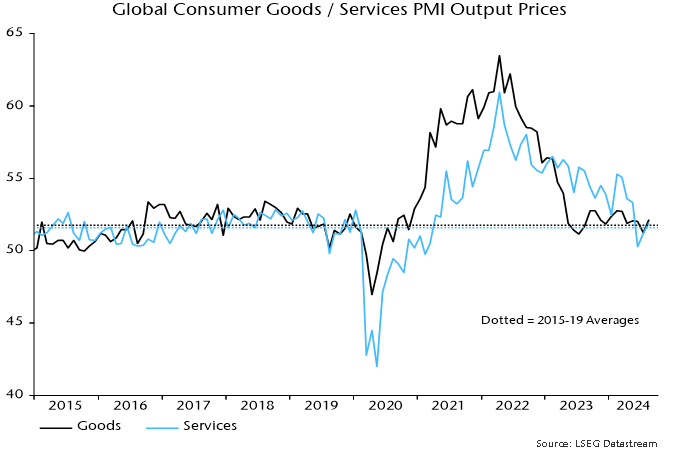
The PMI surveys continue to support the expectation here of rapid easing of services price pressures and likely inflation undershoots by H1 2025. Output price indices for consumer goods and services remain close to their 2015-19 averages, a period when G7 annual core CPI inflation averaged 1.6% – chart 7.

Chart 7

20240910_NSP_MMM_C7_GlobalConsumerGoodsServicesPMIOutputPrices

Crest-News-20240905-Loblaws-banner

Investissements immobiliers Crestpoint Ltée (Crestpoint) a annoncé aujourd’hui l’acquisition d’une participation de 50 % dans un portefeuille à trois composantes (le Portefeuille) de Loblaw Properties Limited et de Shoppers Realty Inc. La transaction d’acquisition a été conclue dans le cadre d’une coentreprise à parts égales avec une société affiliée de Choice Properties Real Estate Investment Trust (Choice Properties).

Le portefeuille est composé d’un centre de distribution et de deux immeubles commerciaux. Le centre de distribution est une installation de distribution à double chargement de 711 000 pieds carrés située à Mississauga, en Ontario. Les deux immeubles de détail comprennent un Real Canadian Superstore de 150 000 pieds carrés à Winnipeg, au Manitoba, et une participation dans le titre de copropiété au rez-de-chaussée du 60 Carlton Street à Toronto, en Ontario, anciennement Maple Leaf Gardens. Construit à l’origine en 1931, cet immeuble emblématique était l’aréna principal des Maple Leafs de Toronto jusqu’en 1999, mais il abrite maintenant 95 000 pieds carrés d’espace de commerce de détail, y compris une épicerie vedette de Loblaws, un comptoir de la LCBO, un emplacement Joe Fresh et 150 espaces de stationnement souterrains. La Toronto Metropolitan University conservera la propriété de l’étage supérieur de la propriété qui abrite le Mattamy Athletic Centre.

Le portefeuille est entièrement loué depuis plus de 15 ans et est appuyé par la société mère de catégorie investissement de Loblaw et de Shoppers, Loblaw Companies Limited. Crestpoint, au nom de Stratégie immobilière de base plus Crestpoint (son fonds à capital variable), a conclu cette coentreprise avec Choice Properties (TSX : CHP.UN), la plus importante FPI au Canada, qui compte plus de 700 immeubles évalués à 16,7 G$ et dont la capitalisation boursière est d’environ 10,6 G$.

La conclusion de cette acquisition porte l’actif sous gestion total de Crestpoint à environ 10,4 milliards de dollars et de 38,3 millions de pieds carrés.

À propos de Crestpoint

Investissements immobiliers Crestpoint Ltée est une société de gestion de placements immobiliers commerciaux qui cherche à fournir aux investisseurs un accès direct à un portefeuille diversifié d’actifs du secteur immobilier commercial. Crestpoint est membre du Groupe financier Connor, Clark & Lunn, une société de gestion de placements dotée d’une structure multientreprise qui offre des produits et des services de gestion de placements à des clients institutionnels et à valeur nette élevée. Comptant des bureaux au Canada, aux États-Unis, au Royaume-Uni et en Inde, le Groupe financier Connor, Clark & Lunn et ses sociétés affiliées gèrent collectivement un actif d’environ 133 milliards de dollars. Pour obtenir de plus amples renseignements, veuillez consulter le site www.crestpoint.ca.

Personne-ressource

Elizabeth Steele
Directrice, Relations avec les clients
Investissements immobiliers Crestpoint Ltée
416-304-8743
[email protected]

GACM_COMM_2024-09-05_Banner

When global investors think of opportunities in Taiwan, the first thought that often comes to mind is its technology sector, particularly its world-leading semiconductor cluster. This tendency is understandable given that the semiconductor industry is a cornerstone of Taiwan’s economy, directly contributing more than 15% to the nation’s GDP. The relevance of the country’s semiconductor capabilities extends far beyond its borders. Taiwan produces over 60% of the world’s semiconductors, and more than 90% of the most advanced, leading-edge integrated circuits. Most of these advanced chips are manufactured by a single company – Taiwan Semiconductor Manufacturing Corporation (TSMC) – giving it a critical role in the global technology supply chain. From smartphones to most advanced AI accelerators, most of the tech advancements we see today would not be possible without the world leading foundry. Jensen Huang of Nvidia has repeatedly praised the indispensable role of TSMC in driving global innovation.

TSMC’s dominance has a significant influence on decisions of investors in emerging markets (EM). As of July 2024, TSMC accounted for 9.3% of the MSCI EM Index, while Taiwan as a whole made up 18.5%. Such concentration can pose challenges for investors who are trying to diversify their portfolios. Being heavily exposed to a single, cyclical company, even one as dominant as TSMC, can increase risk, especially during periods of high market volatility. This is where the benefits of small-cap equities come into play.

We believe that small-cap stocks offer a unique mix of growth potential and diversification. While the MSCI EM Index is heavily weighted toward large-cap tech giants like TSMC, Tencent, Samsung, Alibaba and SK Hynix, the MSCI EM Small Cap Index provides a more balanced exposure. As of July 2024, no single constituent represented more than 0.5% of the total weight. More than 350 companies from Taiwan accounted for 21.4% of the MSCI EM Small Cap Index. This broad distribution reduces the risk associated with any single company, making small-cap equities an attractive choice for those looking to diversify while still tapping into Taiwan’s economic strengths.

Nien Made is a perfect example of the opportunities available in Taiwan beyond the technology sector. Founded in 1974, Nien Made has become one of the world’s largest manufacturers of window coverings, including blinds, shutters and shades. The company has successfully harnessed Taiwan’s advanced manufacturing and commitment to innovation to maintain its global competitive edge. Nien Made has invested heavily in production automation, allowing the company to achieve significant cost efficiencies while upholding the highest quality standards. Nien Made has developed proprietary machines used in its production process, further enhancing its operational efficiency and product consistency. Another key factor in Nien Made’s success is its high level of vertical integration, with 90% of window covering components produced in-house.

Nien Made’s success is also driven by its strong portfolio of brands, each recognized for quality and innovation in the window coverings industry. The company’s flagship brands, including Norman and Veneta, cater to diverse market segments ranging from premium, custom-made products sold primarily through professional designers to more affordable, ready-made options available at big-box retailers like Home Depot and Walmart. These brands have helped Nien Made establish a significant presence in markets across North America, Europe and Asia. Operations outside of Taiwan account for more than 95% of Nien Made’s business, underscoring its global reach.

Innovation is a core element of Nien Made’s growth strategy. The company continuously invests in research and development to enhance its product offering and improve production efficiency. Nien Made has been a pioneer in developing motorized window coverings catering to the growing demand for smart home solutions. These products offer the convenience of automation while preserving the familiar look of traditional window coverings. One of Nien Made’s most significant innovations is the development of cordless window coverings. This initiative was driven by new US regulations aimed at improving child safety by eliminating cords in window coverings, which pose a danger to young children. Nien Made’s proactive response to these regulations not only ensured compliance with safety standards but also strengthened its reputation as an industry leader.

Nien Made’s ability to navigate global challenges has further solidified its market position. The COVID-19 pandemic, geopolitical tensions, rising raw material costs and global supply chain disruptions have all presented significant operating challenges. However, Nien Made’s strategic investments in expanding production capacity in Vietnam, Cambodia, Mexico and the US have enabled it to navigate these challenges, ensuring undisrupted customer satisfaction and product quality and availability.

The company’s commitment to sustainability and corporate responsibility enhances its investment appeal. It has implemented environmentally friendly practices in its manufacturing processes, reducing waste and lowering its carbon footprint.

We appreciate Nien Made’s product quality, competitive lead times, extensive service network, cost advantages and broad client reach. All these factors contribute to its high level of profitability, with net profit margins exceeding 20% and returns on capital ranging from 20% to 30%. Nien Made is run by the second generation of the founding family, who maintain substantial ownership in the company. The management team demonstrates a prudent capital allocation strategy, supported by a strong balance sheet with a net cash position, allowing it to weather economic cycles over time.

For investors looking for opportunities in Taiwan, Nien Made offers a compelling case. While the technology sector remains a major driver of Taiwan’s economy, companies like Nien Made offer a less conventional path to capitalize on the island’s broader success story. With its competitive advantages, clear growth strategy, robust financial position and capable management team, we believe that Nien Made stands out as an attractive investment opportunity.

Global six-month real narrow money momentum is estimated to have moved sideways for a fourth month in July at a weak level by historical standards – see chart 1.

Chart 1

20240904_NSP_MMM_C1_GlobalManufacturingPMINewOrdersG7E7RealNarrowMoney

The baseline scenario here remains that global economic momentum – proxied by the global manufacturing PMI new orders index – will move down into late 2024, echoing a fall in real money momentum into September last year. Based on more recent monetary data, a subsequent recovery may prove limited, with weakness persisting well into H1 2025.

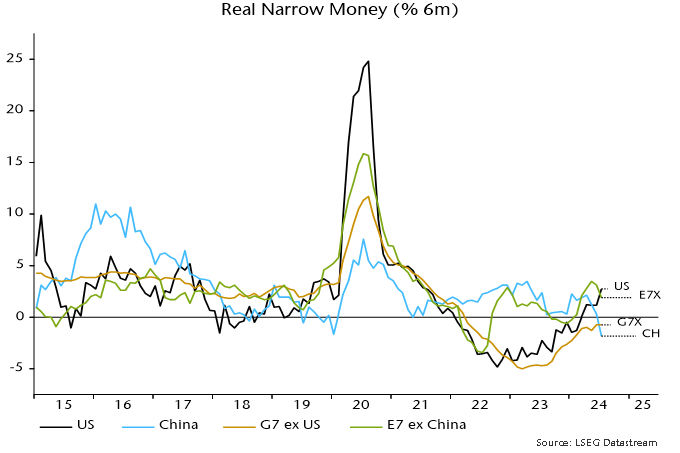
The unchanged July global real money momentum reading conceals a rise in the US offset by further weakness in China. The E7 ex. China component also cooled, while G7 ex. US momentum remained negative, moving sideways – chart 2.

Chart 2

20240904_NSP_MMM_C2_RealNarrowMoney

The Chinese series incorporates an adjustment* for a recent portfolio shift by non-financial enterprises from demand to time deposits in response to a regulatory change (a clampdown on payment of supplementary interest by banks). Chinese momentum would be significantly more negative without this adjustment, while the global series would be at its weakest level since February. (The adjustment may, however, underestimate the negative distortion to Chinese narrow money.)

Chart 3 shows additional DM detail. Real narrow money momentum is relatively strong in Canada and Australia as well as the US.

Chart 3

20240904_NSP_MMM_C3_RealNarrowMoney

Japan moved deeper into negative territory but recent weakness partly reflects f/x intervention, so may abate.

Real money momentum is higher in the UK than the Eurozone but the difference is small, with both still negative. Recent UK economic outperformance is unlikely to last.

The pick-up in US real narrow money momentum suggests improving economic prospects but confirmation is required and lags should be respected.

The US July reading was boosted by a favourable base effect – narrow money contracted by 0.6% month-on-month in January. The base effect remains favourable for August but turns significantly negative in September / October.

Six-month growth of US broad money is weaker than for narrow and has edged lower since May, though hasn’t yet fallen to the extent suggested by a contractionary shift in the joint influence of Treasury financing operations and Fed QT, discussed previously. The latest Treasury financing projections imply that this influence will turn expansionary again in Q4.

For perspective, US six-month real narrow money momentum had recovered to the current level in September 2008 as the financial crisis was reaching a crescendo with the recession having nine more months to run. In the prior 2001 recession, the current level was reached three months before the economy hit bottom. In both cases, the NBER business cycle dating committee had yet to determine that a recession had begun.

*The adjustment assumes that the share of demand deposits in total bank deposits of non-financial enterprises would have been stable at its March level in the absence of the regulatory change. The adjustment does not take into account any shift from bank deposits to non-monetary instruments (e.g. wealth management products) or effects on other money-holders.

Vue aérienne des gratte-ciels et des routes du quartier de Mong Kok, au centre-ville de Hong Kong.

Les investisseurs sont depuis longtemps attirés par les actions des marchés émergents en raison de leur potentiel de croissance et des occasions uniques de placement qu’elles offrent. Toutefois, cette prise en compte est moins courante lorsqu’il s’agit des occasions de placement dans des titres à revenu fixe des marchés émergents. Vous pourriez être surpris par les arguments en faveur des titres de créance des marchés émergents et par la façon dont ils pourraient contribuer à la diversification de votre portefeuille et à l’amélioration des rendements, comme le décrit le présent article.

Les titres de créance des marchés émergents désignent les titres d’emprunt émis par des sociétés et des entités souveraines domiciliées dans des économies émergentes. La dette est libellée dans la monnaie locale de l’émetteur ou dans la monnaie d’un marché développé, comme le dollar américain, et est appelée titre de créance en monnaie externe ou en « monnaie forte ». À l’instar de leurs homologues des marchés développés, une note de crédit est attribuée pour faire la distinction entre les titres de créance de premier ordre et les titres de créance de qualité inférieure (à rendement élevé).

Voici quelques-unes des principales caractéristiques des marchés émergents :

  • Catégorie d’actif importante et diversifiée : la valeur marchande combinée des émetteurs souverains et des sociétés des marchés émergents libellée en monnaies locales et externes est supérieure à celle du marché des obligations du Trésor américain.
  • Rendements plus élevés : les marchés émergents peuvent offrir une prime de rendement par rapport aux titres comparables des marchés développés.
  • Endettement moins élevé : les emprunteurs sont généralement moins endettés que les emprunteurs des marchés développés ayant une cote de crédit similaire.
  • Taux de défaillance inférieur : le taux de défaillance est inférieur à celui des titres comparables des marchés développés.
  • Avantages de la diversification : la faible corrélation avec les titres de créance des marchés développés, due aux différences de cycles économiques et de conjoncture par rapport aux marchés développés, procure des avantages sur le plan de la diversification.

Taille du marché

Le volume des émissions de titres de créance des marchés émergents pourrait surprendre de nombreux investisseurs, surtout si l’on tient compte du marché des obligations souveraines et des obligations de sociétés libellées en monnaies locales et externes, dont la valeur marchande est supérieure à celle des obligations du Trésor américain (figure 1).

Figure 1 – Principaux marchés des titres à revenu fixe

Principaux marchés des titres à revenu fixe Occasions de placement (G$)
Obligations du Trésor américain 23 900 $
Titres souverains des autres marchés développés 14 700 $
Titres souverains des marchés émergents libellés en monnaies locales 11 100 $
 Obligations de sociétés des marchés émergents libellées en monnaies locales 10 700 $
Titres adossés à des créances hypothécaires émis par des organismes des États‑Unis 8 400 $
Titres de créance de premier ordre des États‑Unis 7 800 $
Obligations de sociétés des marchés émergents libellées en monnaies externes 2 500 $
Titres souverains des marchés émergents libellés en monnaies externes 1 500 $
Obligations américaines à rendement élevé 1 400 $

Source : JP Morgan


Les obligations souveraines et de sociétés des marchés émergents libellées en monnaies locales présentent la plus forte valeur marchande. Du point de vue de l’emprunteur, l’émission de titres de créance libellés en monnaies locales signifie que si un pays est fortement endetté, par exemple en dollars américains, et que sa monnaie chute par rapport au dollar américain, le remboursement de la dette deviendra plus coûteux. Cependant, l’émission de titres de créance libellés en monnaies externes peut aider à diversifier les sources de financement en permettant aux pays émergents de profiter des marchés financiers internationaux.

Du point de vue du gestionnaire d’actifs, l’avantage supplémentaire d’investir dans des titres de créance des marchés émergents libellés en monnaies externes, tant d’entités souveraines que de sociétés, est que cela peut aider à gérer les risques associés aux fluctuations des taux de change locaux. De plus, les titres de créance des marchés émergents en monnaies externes sont généralement régis par le droit de New York ou du Royaume-Uni, tandis que les titres de créance des marchés émergents libellés en monnaies locales sont assujettis aux lois spécifiques du pays émetteur. Les titres de créance des marchés émergents libellés en monnaies externes offrent également un univers plus diversifié d’occasions de placement. Le reste du présent article portera donc sur les titres de créance des marchés émergents libellés en monnaies externes.

Transformation du contexte de placement

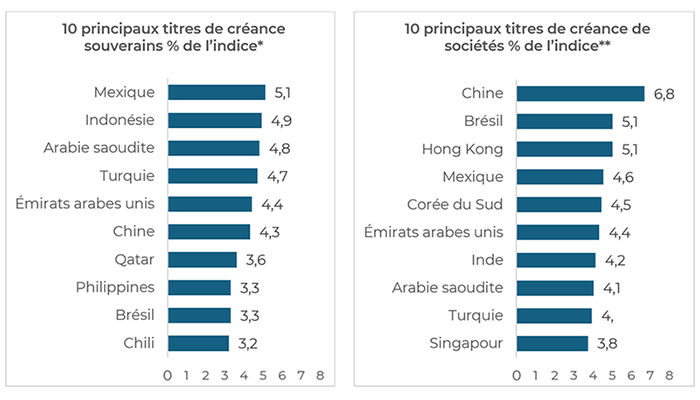
Le marché des titres de créance des marchés émergents a subi une importante transformation. Au début des années 1990, les indices se composaient de seulement 10 pays et privilégiaient fortement les économies d’Amérique latine. Aujourd’hui, l’univers des pays est beaucoup plus sain et, contrairement aux indices boursiers dont la capitalisation boursière est dominée par un petit nombre de pays, les indices des obligations souveraines et de sociétés sont beaucoup plus diversifiés sur le plan des pays (figure 2).

Figure 2 – Indice des obligations souveraines et de sociétés des marchés émergentsFigure 2 démontre les 10 principaux titres de créance et de créance de sociétés de l’indice JP Morgan EMBI Global Diversified et de l’indice JP Morgan CEMBI Broad Diversified.*Indice JP Morgan EMBI Global Diversified           **Indice JP Morgan CEMBI Broad Diversified
Source : JP Morgan, Bloomberg


Le volume annuel des titres de créance émis par les marchés émergents a également été vigoureux, les émissions de titres de créance de sociétés ayant tendance à être plus importantes que celles des titres de créance souverains (figure 3).

Figure 3 – Émission des titres de créance des marches émergents
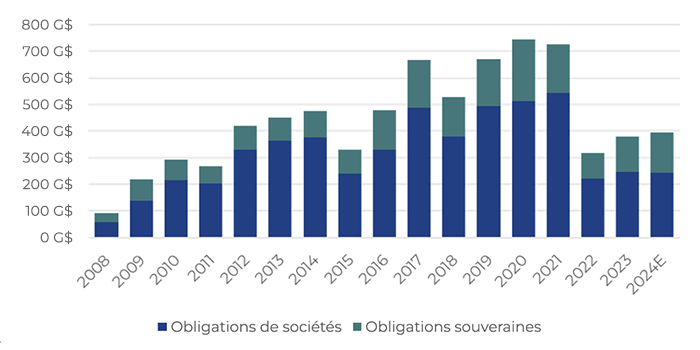
Figure 3 démontre la répartition des émissions des titres de créance de sociétés et des titres de créance souveraines dans le marché des titres de créance des marchés émergents de 2008 à 2024 (estimé), basée sur les données de JP Morgan et FortWood Capital.Source : JP Morgan & FortWood Capital


Principaux avantages des titres de créance des marchés émergents

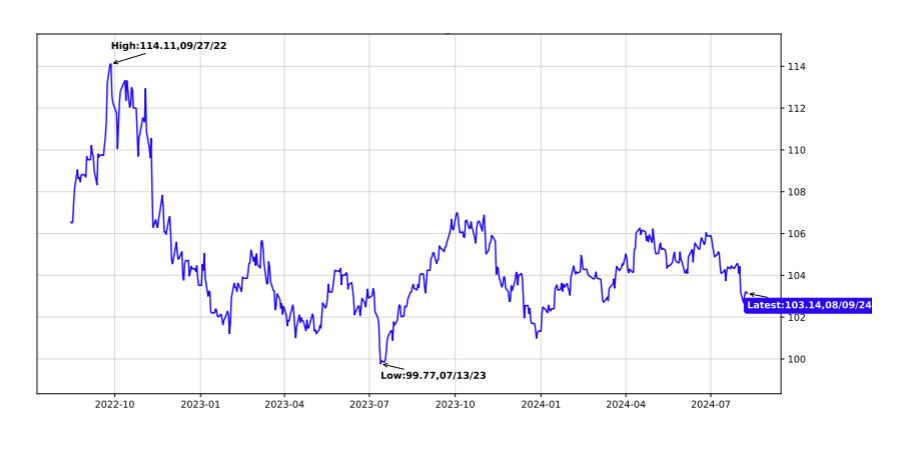
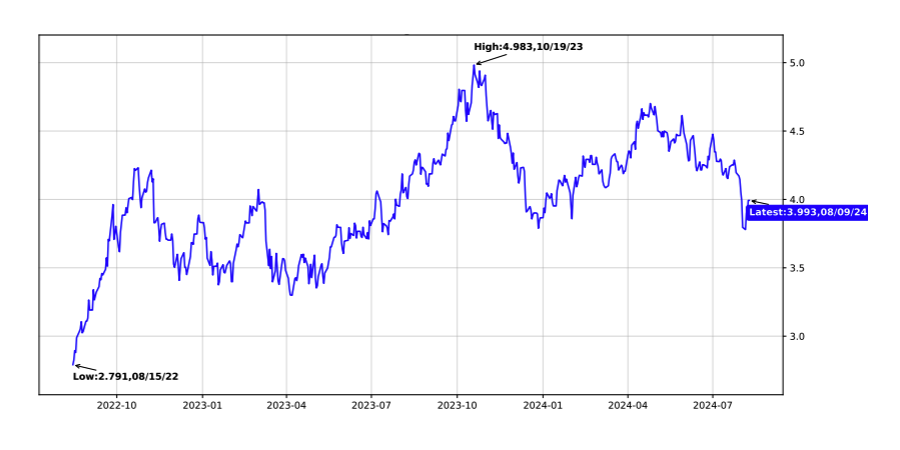
Rendement plus élevé : le marché des titres de créance des marchés émergents offre une prime de rendement par rapport aux marchés développés comparables en raison des risques plus élevés perçus. À l’heure actuelle, les marchés émergents offrent certains des taux les plus élevés depuis la crise financière mondiale (figure 4).

Figure 4 – Rendement des titres de créance des marchés émergents par rapport aux obligations du Trésor américain à 10 ans
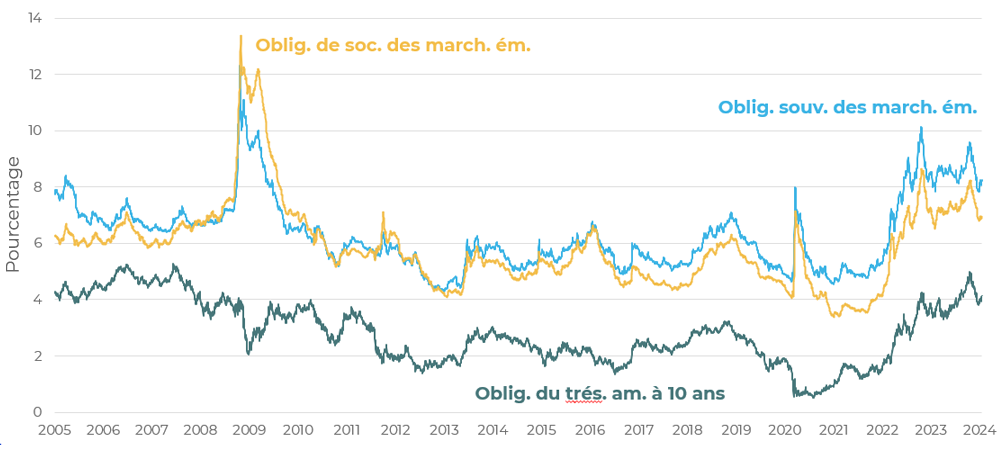
Figure 4 démontre le rendement des titres de créance des marchés émergents par rapport aux obligations du Trésor américain à 10 ans basé sur les données de JP Morgan et Bloomberg.Remarque : Indice des obligations souveraines des marchés émergents – EMBI Global Diversified, indice des obligations de sociétés des marchés émergents – CEMBI Broad Diversified
Source : JP Morgan, Bloomberg


Les marchés émergents sont souvent sensibles à la volatilité politique et économique. Les changements de gouvernement et de politique ainsi que les tensions géopolitiques peuvent avoir une incidence sur la solvabilité des émetteurs. Les titres de créance souverains ont aussi tendance à avoir une durée plus longue (sensibilité aux fluctuations des taux d’intérêt) et, lorsqu’ils sont combinés, ces facteurs font que les titres de créance souverains des marchés émergents offrent généralement des rendements plus élevés que les titres de créance de sociétés des marchés émergents.

Endettement moins élevé : le risque perçu lié aux titres de créance des marchés émergents n’est pas toujours justifié, malgré les taux de rendement plus élevés. Par exemple, les émetteurs d’obligations de sociétés des marchés émergents, qu’ils soient de premier ordre ou à rendement élevé, sont moins endettés par rapport à leur capacité de générer des flux de trésorerie pour rembourser cette dette et sont moins endettés que les emprunteurs des marchés développés ayant la même cote de crédit (figure 5). Malgré un endettement moindre, les obligations des marchés émergents ont généralement procuré aux investisseurs des taux de rendement plus élevés pour la même cote de crédit.

Figure 5 – Comparaison de l’endettement net
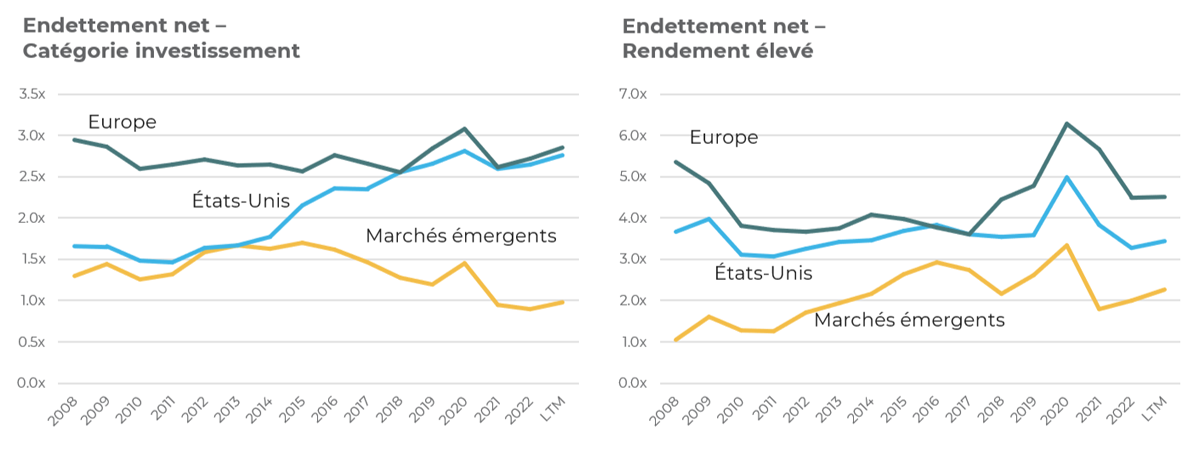
Figure 5 démontre une comparaison de l’endettement net des émetteurs d’obligations des titres de créance des marchés émergents de catégorie investissement et de rendement selon JP Morgan en 2023.Source : JP Morgan (en date de 2023) et FortWood Capital


Taux de défaillance inférieur : le taux de défaillance des émetteurs des marchés émergents est historiquement plus bas que celui de leurs homologues des marchés développés possédant une cote comparable (figure 6). De nombreux marchés émergents affichent une solide croissance économique qui peut soutenir la solvabilité des émetteurs. Par exemple, une croissance économique plus forte peut accroître les revenus des sociétés, facilitant ainsi le remboursement de la dette.

Figure 6 – Le taux de défaillance des sociétés des marchés émergents est inférieur à celui des sociétés des marchés développés
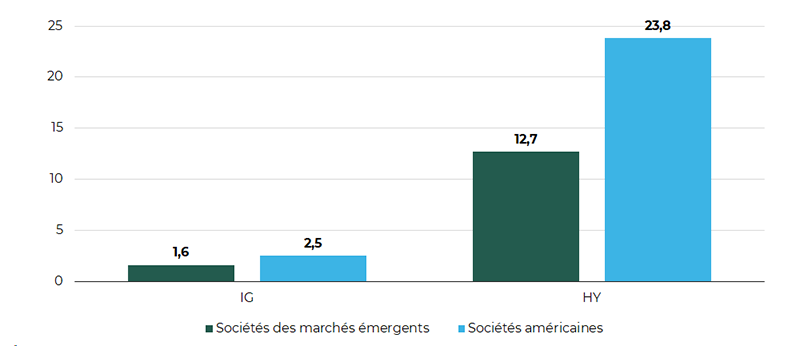
Figure 6 démontre le taux de défaillance cumulé moyen sur 10 ans des sociétés des marchés émergents aux sociétés américaines selon les recherches de SP Global Ratings.Source : S&P Global Ratings Research et FortWood Capital


Avantages de la diversification : les cycles économiques et les conjonctures des marchés émergents diffèrent souvent de ceux des marchés développés. Cette expérience différente réduit la corrélation, offrant ainsi une source de diversification du portefeuille. Investir dans différents pays, secteurs et émetteurs peut réduire l’incidence des problèmes locaux et améliorer la résilience globale du portefeuille.

Facteurs à prendre en compte lors de la construction du portefeuille

Gestion des devises : pour permettre aux investisseurs canadiens de gérer toute incidence défavorable des fluctuations de change entre les titres de créance des marchés émergents libellés en dollars américains et le dollar canadien ($ CA), le portefeuille est habituellement couvert en dollars canadiens, ce qui procure des rendements plus prévisibles. Le gestionnaire de placement de la stratégie peut obtenir cette couverture de façon rentable en ayant recours à des contrats à terme sur le change ou à d’autres instruments de change.

Liquidité : les titres de créance des marchés émergents sont généralement une catégorie d’actifs liquides. Par exemple, la liquidité des obligations de sociétés des marchés émergents est généralement comparable à celle des obligations de sociétés des marchés développés dans des conditions normales de marché.

Gestion active : il existe de nombreux cycles économiques et politiques idiosyncrasiques dans les différents pays, qui peuvent contribuer à des occasions de valeur ajoutée pour les gestionnaires actifs. De plus, comme pour les actions des marchés émergents, le nombre de spécialistes de la recherche sur les titres de créance des marchés émergents est moins élevé que celui des titres de créance des marchés développés, ce qui crée des occasions de recherche indépendante. Les gestionnaires actifs compétents peuvent déceler les nuances du marché, repérer des occasions intéressantes et ajuster les placements en fonction de l’évolution des conditions.

Investissement responsable : malgré les problèmes politiques et sociaux liés aux pays émergents, les gouvernements et les sociétés reconnaissent de plus en plus l’importance des facteurs environnementaux, sociaux et de gouvernance (ESG).

Une occasion à saisir

Les titres de créance des marchés émergents offrent des occasions de placement intéressantes, avec un potentiel de taux plus élevés, des avantages sur le plan de la diversification et une exposition à des économies à forte croissance. Les titres de créance des marchés émergents peuvent constituer un ajout précieux à un portefeuille de placement bien équilibré.

The assessment here remains that the global economy has entered a “double dip” currently focused on manufacturing but likely to extend to services / labour markets, reigniting worries about a hard landing. Economic weakness is expected to be accompanied by an inflation undershoot into H1 2025.
DM flash manufacturing PMI results for August were mixed across countries but on balance weak, suggesting a further small reduction in global manufacturing PMI new orders following a July plunge to below 50 (assuming no change for China and other non-flash countries) – see chart 1.

Chart 1

20240823_NSP_MMM_C1_GlobalManufacturingPMINewOrdersG7E7RealNarrowMoney

Services results were again much stronger than for manufacturing but there are hints of emerging weakness in a fall in output expectations since May and a drop in US / Eurozone employment indices to below 50 this month.

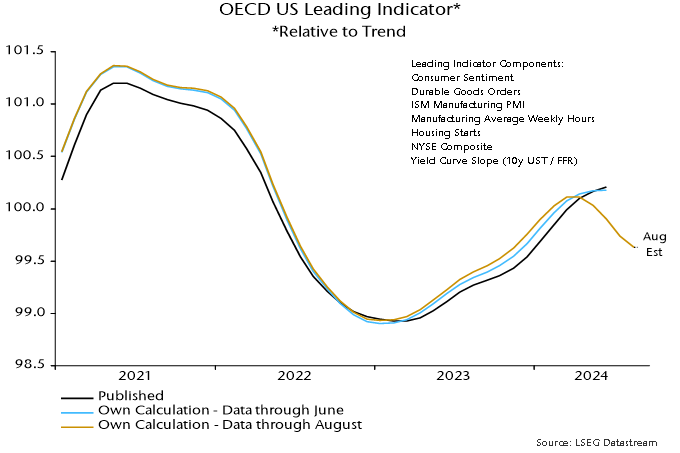
A previous post suggested that the OECD’s US composite leading indicator has reversed lower since publication of the last official data point, for June. An update based on partial data points to a further decline in August – chart 2. The OECD will release July / August data for its indicators on 5 September.

Chart 2

20240823_NSP_MMM_C2_OECDUSLeadingIndicatorRelativetoTrend

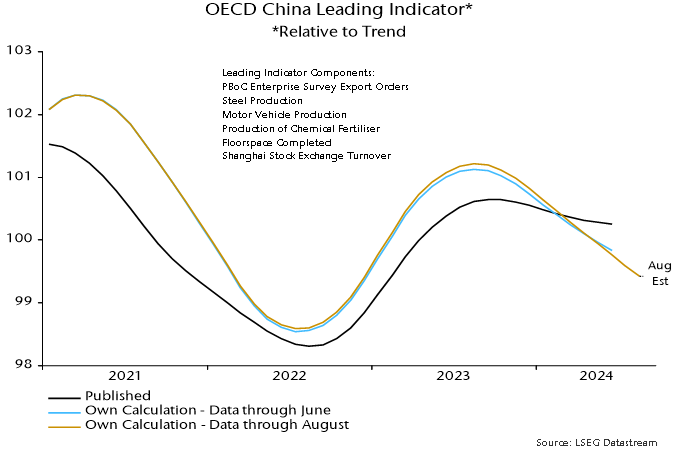
The OECD’s Chinese leading indicator has been falling since late 2023 and the decline is estimated to have continued in July / August – chart 3.

Chart 3

20240823_NSP_MMM_C3_OECDChinaLeadingIndicatorRelativetoTrend

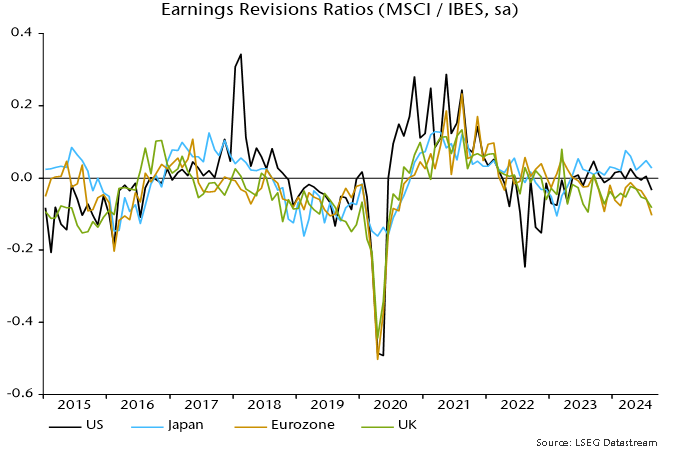
Weaker economic momentum and pricing power are feeding through to company earnings. Revisions ratios have turned down since April in the US, Eurozone and UK, with the August Eurozone reading the weakest since 2020 – chart 4.

Chart 4

20240823_NSP_MMM_C4_EarningsRevisionsRatios

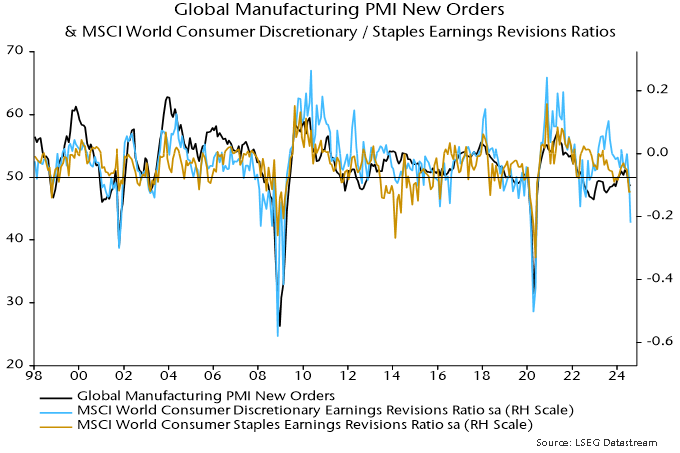
By MSCI World sector, August revisions ratios were most negative in consumer discretionary followed by energy, consumer staples and materials. The ratios for consumer discretionary and staples were the weakest since 2020, suggesting that a fall-off in consumer demand has been a key driver of the renewed downturn in manufacturing – chart 5.

Chart 5

20240823_NSP_MMM_C5_GlobalManufacturingPMINewOrdersMSCIWorldConsumerDiscretionary

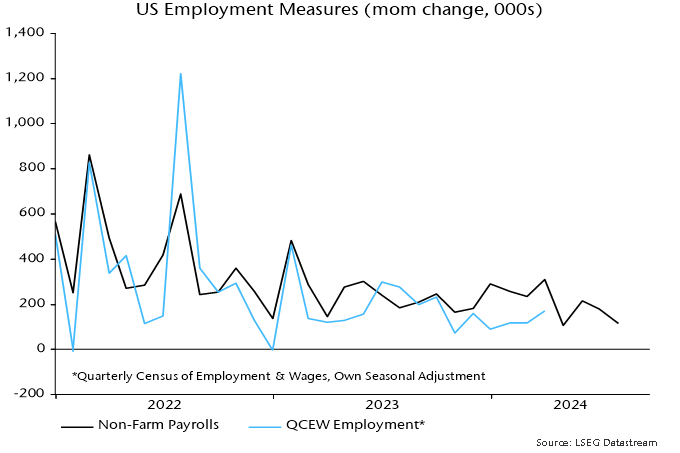
This week’s announcement by the BLS of a preliminary 818,000 or 0.5% downward revision to the March 2024 level of non-farm payrolls, meanwhile, raises the possibility that US employment has already stalled.

The revision is based on the comprehensive Quarterly Census of Employment and Wages (QCEW). A monthly QCEW employment series is available through March but is not seasonally adjusted. Chart 6 compares the monthly change in non-farm payrolls, as currently reported before incorporating the revision, with the change in a seasonally-adjusted version of the QCEW measure.

Chart 6

20240823_NSP_MMM_C6_USEmploymentMeasures

The increase in non-farm payrolls was 133k per month higher than growth of the seasonally-adjusted QCEW series during Q1. If overstatement of this magnitude has continued since Q1, reported growth of 108k and 114k in non-farm payrolls in April and July could imply small declines in “true” employment in those months.

GACM_COMM_2024-08-22_Images_WP-Banner

On May 15, 2024, Singapore swore in its first new prime minister in 20 years. Lawence Wong, at the age of 51, previously the deputy prime minister, succeeded Lee Hsien Loong.

While Lee Hsieng Loong is the son of Lee Kuan Yew (the founding father of Singapore), Lawence Wong was born to a family he described as ordinary, growing up in a public housing flat. He started his career as an economist at the Ministry of Trade and Industry (MTI), and later held several important positions in energy, culture, national development, education, healthcare and finance, among other departments.

Last week, Wong delivered his maiden National Day Rally speech and called for major reset of policies and attitudes. He is expected to keep the city-state as open as possible, maintaining independence through a wide network of bilateral and regional free-trade agreement. He pledged to look after various groups of Singaporeans, including the elderly, families and lower-income households. A few highlighted policy changes from his speech include: more paid paternity leave and shared paternity leave; temporary financial help for lower and middle-income workers who lose their jobs; discontinuation of the Gifted Education Program in primary schools; increasing support for affordable housing; and strengthening of the sporting culture.

A top-5 country by GDP per capita

Once known as one of the four Asian Tigers, Singapore experienced rapid economic growth thanks to exports and industrialization between 1960s and the Asian Financial Crisis of 1997. The 2000s were a tumultuous period for the country, however. Faced with the dot.com bust, SARS and the global financial crisis, Singapore restructured and diversified its economy. It began to bounce back, and is now the fifth richest country in the world based on GDP per capita, according to The Economist.

Resilient economic growth

2024 Q1 GDP growth of 3.0% and Q2 of 2.9% were both better than expected. Last week, MTI raised Singapore’s annual GDP growth forecast in 2024 to 2-3%, adding that external demand outlook is expected to be resilient for the rest of the year. Growth sectors will be manufacturing (especially electronics related to smartphones, PC, and AI-related chips), chemicals, tourism, aviation, finance and insurance.

A home to multinationals

Singapore and Hong Kong have traditionally been viewed as rivals, attracting many international companies and talents to work and live there. But Hong Kong’s ever-closer ties with mainland China have raised increasing concern among some people about democracy and safety, causing more and more foreign companies and foreign nationals to leave Hong Kong for Singapore. While Hong Kong’s standard corporate tax rate is as low as 16.5%, Singapore’s 17% tax rate can be cut to 13.5% or less for some activities. As a matter of fact, Singapore was regional headquarters to 4,200 multinational companies in 2023, compared to 1,336 in Hong Kong. A list of such companies includes FedEx Corp., Microsoft Corp., Google, TikTok, Shein and General Motors Co., etc. The often-cited reasons for this big gap are better relations with the West, a broader talent pool, diversified economy, and tax incentives.

Asia’s top financial center

According to the latest 2024 Global Financial Centres Index, Singapore overtook Hong Kong for the third year in a row to become Asia’s top financial center, ranking third globally, behind New York and London. Singapore has also become an attractive asset management hub. Wealth overseen has doubled in the past six years, to about US$4 trillion, and about 80% of that is foreign. Government initiatives are the key driving forces. For example, in 2020, the government introduced a new legal structure called a variable capital company that provides tax and legal incentives to hedge funds, venture capital and private equity firms to set up in Singapore, comparable to Cayman Islands and Luxembourg.

Singapore’s economic backyard is Association of Southeast Asian Nations (ASEAN), a 10-nation region with a population of 680 million and an economy of US$3.6 trillion. Singapore’s stable political climate and high living standards make it an ideal destination for high-net-worth individuals and global financial professionals.

Our portfolio holding in Singapore – Raffles Medical Group

Founded in 1976, Raffles Medical is Singapore’s largest homegrown private healthcare provider and the first member in Asia to join the Mayo Clinic Care Network. It owns four hospitals and over 100 clinics in five countries including Singapore, China, Japan, Vietnam and Cambodia. It has over 7,000 corporate clients and 2.2 million patients.

Covid impacts on the company were mixed. On the one hand, hospital development in China was seriously delayed. On the other hand, Singapore business accelerated thanks to government-related Covid services.

Like many stocks that benefited from upticks in Covid-related revenue, Raffles Medical experienced tough comps following the pandemic. However, we are very confident about its growth potential thanks to its strong reputation in the industry, net cash position and consistent growth strategy in Asia.

Since February 2024, Dr. Loo Choon Yong, the owner and founder of Raffles Medical, has spent almost S$35 million of his own money to buy back shares in his company.

New chapter for Singapore

Although Singapore came into being only in 1965, it has developed from a red dot to a shining star in Asia. Looking ahead, Lawrence Wong, the fourth Prime Minister, will have to navigate through a challenging time with increasing geo-political tension, weak global economy and deglobalization. His party’s popularity will be tested, as will his personal popularity, in the general election to be held no later than November 2025. Let’s hope Singapore’s best years are ahead of us.

NSP_COMM_2024-08-15_Banner

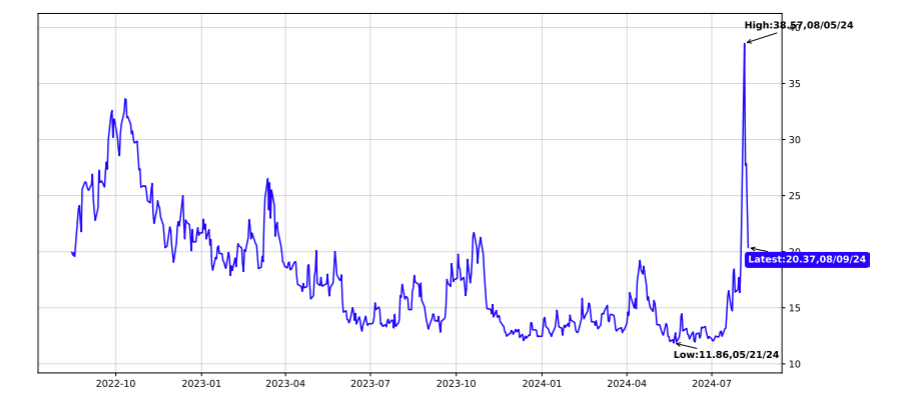
The questioning of the no/soft economic landing narrative and the partial unwind of the yen carry trade have seen equity markets whipsaw in recent weeks. While we are always scrutinising the fundamentals of the companies we own, and the wider investment universe, it is in periods of high uncertainty like this where our incorporation of macro analysis is vital. This helps us navigate the risks, opportunities and regime change which can occur when volatility skyrockets.

VIX Index explodes as US recession fears rise and yen carry reverses
NSP_COMM_2024-08_Chart01
Source: NS Partners & Bloomberg


Goldilocks thinking unravelling

Last October we published a piece warning against complacency in markets, given a poor monetary backdrop signalling economic weakness ahead – Is this a Wile E. Coyote moment for markets?

Our view was that central banks were maintaining policy that was unnecessarily tight and that a rosy consensus on the macro outlook appeared misguided:

The delayed impact of vertiginous rate hikes across DMs on all maturing debt is now hitting consumption and investment. Yet central banks continue to talk tough and market pundits fret over the implications of “higher for longer rates.” It feels like we are in a critical juncture for markets and the economy. Resilience of assets outside of fixed income appear out of step with the reality of higher rates and a weakening global economy, as illustrated by global PMIs falling for a fourth consecutive month.

Poor money numbers globally suggest that further economic contraction is likely. Despite this, central banks continue to talk tough on rates and many investors cling to hopes of a no landing/immaculate disinflation scenario unfolding, despite the cracks emerging in the global economy.

This underpinned a shift to a more defensive portfolio exposure in the expectation that economic growth was set to surprise to the downside over the next “3-6 months.”

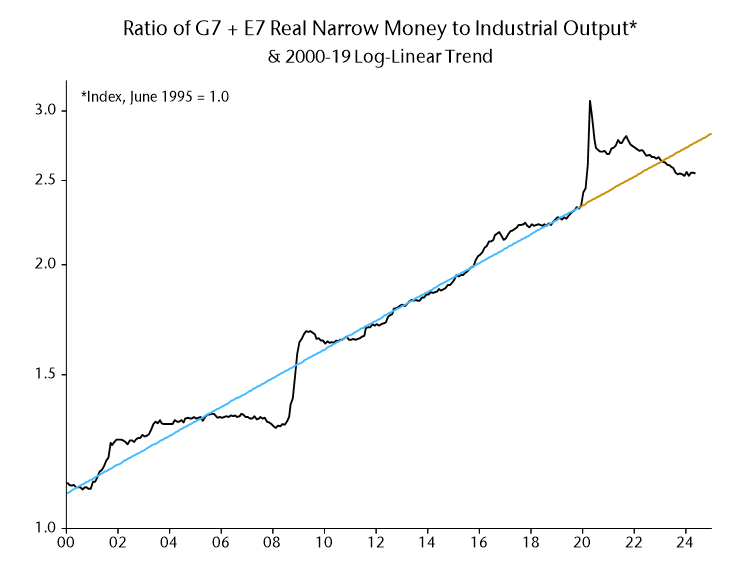
In hindsight this was slightly early. What we missed was the buffer provided by the huge stock of money built up during the pandemic, cushioning the economy from rapid monetary tightening.

However, as you can see in the chart below, this stock has been burnt down below the pre-pandemic trend.

Money stock below trend
NSP_COMM_2024-08_Chart02
Source: NS Partners & LSEG Datastream

 
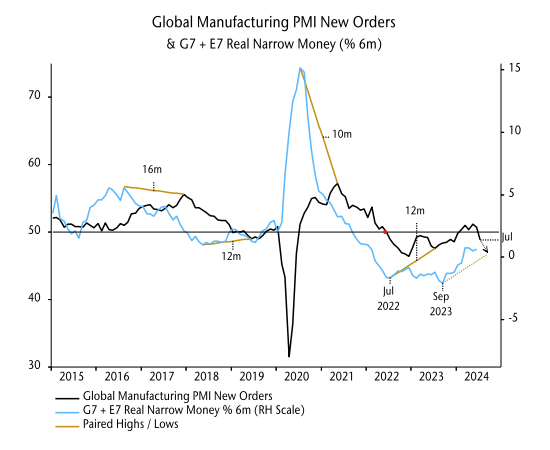
The effects of tighter liquidity are now flowing through to the real economy, with global manufacturing PMIs falling sharply in July.

PMI dip corresponds to low in six-month real narrow money momentum a year earlier
NSP_COMM_2024-08_Chart03
Source: NS Partners & LSEG Datastream

 
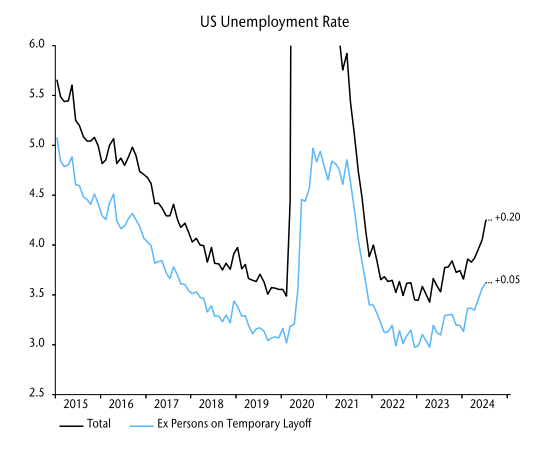
Investors panicked in late July as deteriorating US employment data set off calls for the Fed to deliver an emergency rate cut before the September FOMC meeting.

Unemployment boosted by a sharp rise in temporary layoffs (ex-temp rate is also trending higher)
NSP_COMM_2024-08_Chart04
Source: NS Partners & LSEG Datastream


Japan’s attempt to exit zero interest rate policy (ZIRP) roils markets

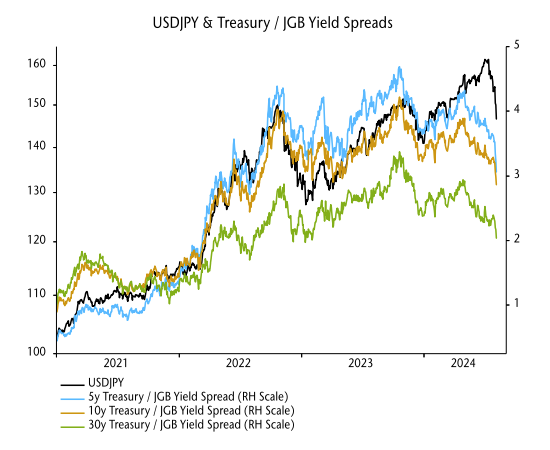
Meanwhile in Tokyo, the Bank of Japan announced that it would take steps to end decades of unconventional monetary policy by raising rates, with an eye to acting against signs of inflation and currency weakness. The hawkish turn saw the yen surge relative to the USD, blowing up speculators shorting the yen. It also forced the unwind of some carry trades exploiting lower interest rates in Japan by borrowing in yen, and then investing in currencies with high rates such as the USD, Mexican peso or Brazilian reai.

JPY surge leaves it still lagging collapsing yield spreads
NSP_COMM_2024-08_Chart05
Source: NS Partners & LSEG Datastream

 
Japan’s decades-long deflationary trap has been the basis for BOJ monetary experiments going back to the 1990s, which gave rise to the yen carry trade phenomenon. Financial historian Russell Napier recounts the “rise of carry” in his book The Asian Financial Crisis, emphasising its tendency to yank liquidity from markets in response to shifts in monetary policy:

What has changed to turn global equity markets bearish? The only surprise over the past few weeks has come from Japan. In the United States, the bond market has been well behaved, the shape of the yield curve unchanged and Greenspan’s comments supportive. Earnings growth in the United States has been ahead of expectations. However, in a three day period, the yen rallied 3.1% against the US dollar on speculation that Japanese interest rates would rise. This currency movement would appear to be the catalyst for the sell-off.

The sudden strength of the yen is indicating that the flow of excess liquidity out of Japan had been the source of liquidity which had been driving the US equity and bond markets. The reason that the flows overseas are probably abating is that the economic recovery in Japan is requiring these funds. The period of history when an accommodative stance by the BOJ drove markets is over.

The experience of July 1996 that Napier recounts rhymes with today’s volatility, fed by speculators who had borrowed yen to finance investments in the US and other markets forced to liquidate positions to buy yen and reduce yen borrowings.

Tech names routed

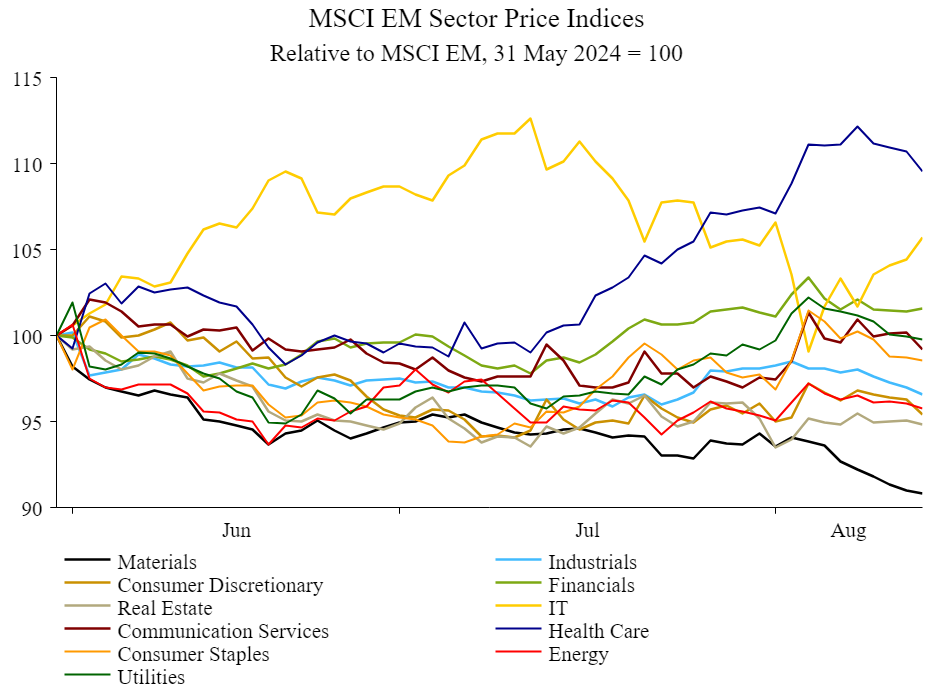
When liquidity drains out of a market, it is often the “speculations of choice” which are hit hardest, as investors sell profitable trades to raise cash. Names with exposure to the boom in enthusiasm for AI technology were among the victims of the unwind, an example of where liquidity can overwhelm even stellar fundamentals.

July pullback for tech as defensive sectors such as healthcare outperform
NSP_COMM_2024-08_Chart06
Source: NS Partners & LSEG Datastream


Buy the dip or steer clear?

In the lead up to July, we had been steadily reducing our above-benchmark exposure to IT names in the GEM strategy, and now maintain a modest overweight. Much of this shift has been through selling down more niche semiconductor names which rallied hard on demand for AI chips. The highest quality names such as TSMC were hammered through July despite posting outstanding results, and look attractive at these levels.

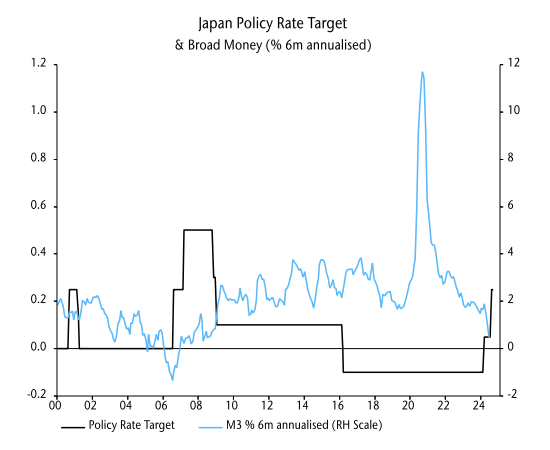
Our view is that the risks of carry trade unwind will ultimately be constrained by economic realities in Japan (despite the domestic unpopularity of yen weakness).

Broad money weakness suggests that the BoJ’s latest attempt to exit ZIRP will be no more successful than previous efforts in 2000 and 2006
NSP_COMM_2024-08_Chart07
Source: NS Partners & LSEG Datastream

 
The monetary backdrop in Japan suggests that all is not well in the economy, and that raising rates will make the situation worse. However, it is entirely possible the BOJ will look to push its luck again. In addition, while speculative bets against the yen have been reduced significantly, JGB yield spreads versus US Treasuries suggest potential for further yen strength. Given this backdrop, our bias is to avoid reflexively buying dips here.

Implications for EM

Last month’s commentary made the case that the vicious cycle weighing down emerging market equities was coming to an end: Are emerging markets on the cusp of a “virtuous circle”?

It emphasised the importance of a weak dollar and supportive liquidity as key drivers of EM outperformance. While the slowing economy and carry trade volatility warrant some caution over the next few months, they may also support a shift to a backdrop more supportive of EM equities in the long run.

Big move down in the USD on slowing US economy and carry trade unwind
NSP_COMM_2024-08_Chart08
Source: NS Partners & Bloomberg

 
It argued that the balance of factors we monitor to assess prospects of EM vs DM equities (relative money growth, global excess money, valuations, earnings, industrial momentum, commodity prices and USD strength/weakness) favours EM for the first time in years. Recent downward moves in Treasury yields and the dollar support the positive trend. Although global money growth has slipped with poor numbers in China and Japan.

Favour liquidity sensitive exposure

The tech cycle upswing and the story of India’s rise up the development ladder have dominated EM returns in recent years. While these trends remain intact, a falling dollar and Fed cuts are likely to see other winners emerge. This easing is set to take pressure off EM central banks forced into tight monetary policy to stabilise their currencies. This should boost the prospects of more liquidity sensitive economies, which are typically open, trading economies with managed exchange rates.

Indonesia is a potential winner in this respect. Its central bank surprised investors with a Q2 rate rise to support the rupiah, leading to a market selloff. US Fed cuts and a dollar bear market should allow for a shift to monetary easing in Indonesia to prevent excessive appreciation of the currency that would harm the competitiveness of its exporters.

US Treasuries yields falling
NSP_COMM_2024-08_Chart09
Source: NS Partners & Bloomberg

 
As well as rate cuts, easing would likely involve the central bank buying US dollars from Indonesian commercial banks, crediting the banks’ reserve accounts in payment. Additional reserves would encourage bank lending and money creation, with positive follow-through to asset prices, economic growth and corporate earnings, consistent with the virtuous circle sketched out below. While fundamentals matter, we think it pays to understand how liquidity can often act to shape these fundamentals, particularly in emerging markets which are highly sensitive to the monetary backdrop.

Virtuous liquidity circle
NSP_COMM_2024-08_Chart10
Source: NS Partners