Palacio de Bellas Artes building in Mexico City's downtown at twilight.

The recent push by Mexico’s ruling Morena Party to undermine the country’s judiciary is a perfect example of why relying on company fundamentals alone in emerging markets can leave investors exposed to being whipsawed by macro factors.

We covered election risks across EM In July – Political risks in EM spike as Indian, South African and Mexican elections surprise – and flagged that outgoing president AMLO and president-elect Claudia Sheinbaum threaten to undermine Mexico’s institutional quality through a series of regressive reforms. The most damaging of these is the proposal to overhaul the country’s judicial system through having all judges elected by popular vote, along with relaxing the term limits and age/experience hurdles for Supreme Court justices.

As the Financial Times put it in September (FT: Mexico’s retrograde path on the rule of law):

Mexico is barrelling ahead with one of the world’s most radical shake-ups of a legal system, alarming investors and citizens alike. In his final month in office, President Andrés Manuel López Obrador is using his coalition’s congressional supermajority to ram through constitutional changes to change the entire supreme court and several thousand state, federal and appeal court judges with replacements elected by popular vote. Candidates for some posts will need only a law degree, five years of undefined “legal experience” and a letter of recommendation from anyone in order to run.

 Lawmakers have been on strike in recent months protesting the move, but to no avail. In September, Morena wielded supermajorities in both the lower house and Senate to push the reform through, which will see thousands of judicial positions up for election over the next three years. Rather than officials working their way up the legal hierarchy, the judiciary will now be exposed to the corruption, bribery and intimidation of Mexico’s cartels, according to critics.

Snatching defeat from the jaws of victory

Mexico should be in prime position to benefit from supply chain reshoring following the pandemic and ratcheting-up of the Sino-US dispute. Indeed, FDI (much of it from China – Why Chinese Companies Are Investing Billions in Mexico – The New York Times (nytimes.com) was pouring into the country to pursue a bright trade story. We saw this in the sharp appreciation of the Mexican peso and a bull market in Mexican equities through 2023 (MSCI Mexico up 42% in USD terms) with the market a favourite among foreign investors.

US imports from Mexico have outpaced imports from the rest of the world
US imports, index Jan. 2017 = 100

NSP_COMM_2024-09-16_Chart01

Source: GBM Nearshoring Barometer, August 2024.


Mexico a favourite for foreign equity investors through 2023

NSP_COMM_2024-09-16_Chart02

Source: EPFR


 Sentiment soured on deterioration in the political outlook as Morena’s dominant performance in Mexican elections in June emboldened the party to pursue a series of regressive policies. As we noted in June:

Investors fear that a strengthened mandate will allow Sheinbaum (or even an outgoing AMLO) to undermine judicial independence and pursue plans to eliminate autonomous government agencies overseeing telecoms, energy and access to information, as well as weaken electoral supervisory bodies.

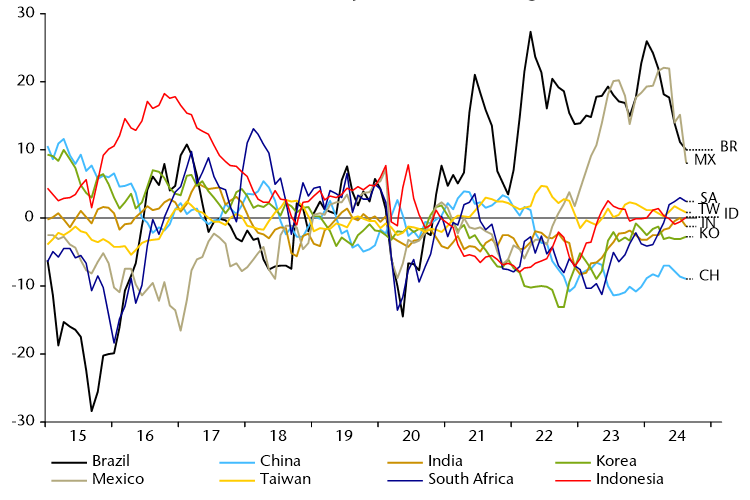
Currency overvaluation correcting in Mexico and Brazil
Real broad effective exchange rates, % deviation from 5y ma

NSP_COMM_2024-09-16_Chart03

Source: NS Partners and LSEG Datastream


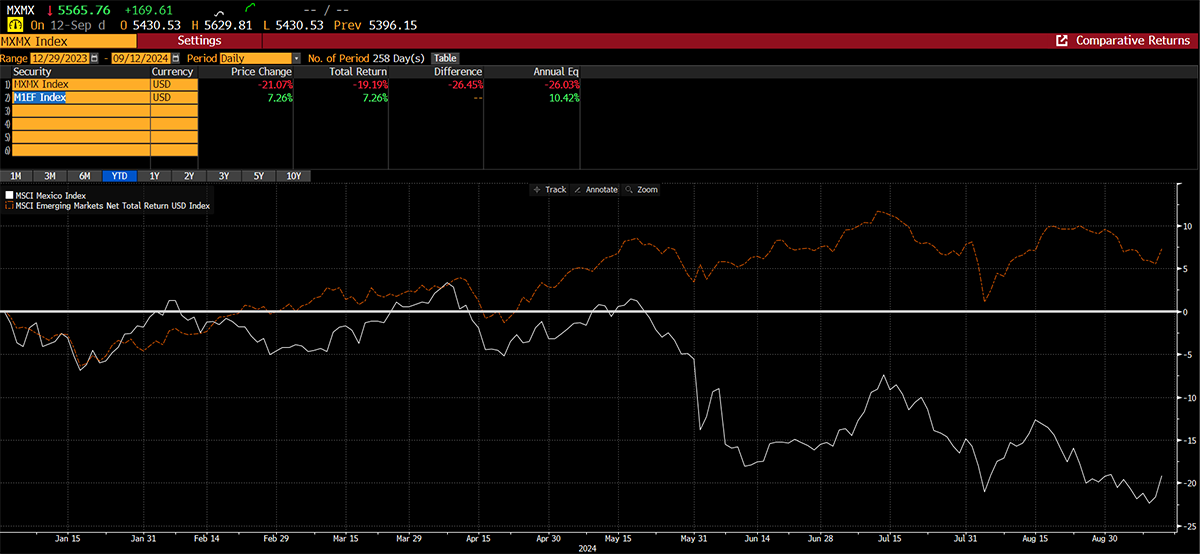
From being one of the consensus overweights among EM investors last year, Mexican equities have been hammered in 2024. MSCI Mexico is down 21% in USD terms to mid-September, while the broader index is up 7%.

NSP_COMM_2024-09-16_Chart04

Source: Bloomberg


Losing the FDI beauty pageant

As one trade official explained to us on a recent research trip in India, competing for FDI is a beauty contest where participants must maximise their appeal relative to their competition to attract those seeking to deploy capital. China’s retrogressive turn to favour state-owned enterprises rather than the entrepreneurs that fuelled its economy’s meteoric rise is a golden opportunity for ambitious leaders in other emerging markets to step up and attract capital and supercharge development. We are seeing this across ASEAN and in India, eastern Europe and the GCC.

But none have Mexico’s advantage of geographic proximity to an economic juggernaut in the US. President-elect Sheinbaum has talked up Mexico’s nearshoring potential and support for private investment in recent months. However, the rhetoric belies an agenda to undermine Mexico’s institutions, which has unnerved key trade partners and investors.

Nothing scares investors and compromises progress up the development ladder more than attacks on key institutions such as the judiciary. In August, the US Chamber of Commerce warned the Mexican government that the reforms would be likely jeopardise trade relations:

 “The U.S. Chamber of Commerce respectfully calls on the sovereign Government of Mexico to continue deliberations with the private sector, academics and legal experts on the package of reforms the new Mexican Congress intends to consider in September. This dialogue is essential to ensure that the proposed reforms contribute to strengthening the rule of law and conditions for economic growth in Mexico.

 Given our longstanding commitment to Mexico’s growth and prosperity, the U.S. business community is an important stakeholder in the reform process. American companies represent by far the largest source of foreign direct investment in Mexico and provide good jobs to millions of Mexicans. Whether operating in the U.S., Mexico or anywhere else in the world, American businesses depend on respect for the rule of law as the foundation of a vibrant investment climate, sustainable development, and job creation.

 While there is a broad consensus about the need to strengthen Mexico’s judicial system, we strongly believe that certain constitutional and legal reforms currently proposed by the Mexican government – in particular, the judicial reform and the proposed elimination of independent regulatory agencies – risk undermining the rule of law and the guarantees of protection for business operations in Mexico, including the minimum standard of treatment under the U.S.-Mexico-Canada Agreement. The reforms also put at risk Mexico’s obligations under other international treaties to provide all with the right to a competent, independent, and impartial judicial system.

 Further deliberation to address these concerns is needed to avoid jeopardizing the incoming Mexican government’s ability to generate shared prosperity and to tap into the potential of nearshoring to strengthen the country’s economic growth and development.”

Macro matters – downgrading Mexico

Our process involves scoring the level of team conviction for every emerging market each month and includes an assessment of the direction of travel for politics in the short run and institutional quality in the long run. The trajectory is negative on both counts, and we think souring sentiment could have some way to run.

We have been underweight and defensively positioned in Mexico for well over a year, on a view that a slowing US economy would be an economic drag for Mexico. The deteriorating political backdrop flows through to a downgrade of our conviction rating for Mexico, and consequently a reduction in exposure. The market is already trading at a significant valuation discount to the 10-year average, but we think it can get cheaper still.

Portfolio activity

We sold our defensive staple Walmex last month, in favour of shale oil producer Vista Energy. While listed in Mexico, Vista is actually an Argentinian company boasting a growing production profile. Its shale assets in the Vaca Muerta (Spanish for Dead Cow) geologic formation are some of the best in the world. In contrast to Mexico, there are also some signs that the political backdrop in Argentina is improving under libertarian president Javier Milei, including efforts to deregulate the oil and gas sector which could provide an additional tailwind for Vista.

The race is on

As Mexico falters, we expect competition to reap the fruits of reshoring to heat up. ASEAN, the GCC and India are all banging on the door for foreign investment flows. Political stability, as well as safeguarding and improving institutional quality, will be the keys to success.

Vue aérienne des gratte-ciels et des routes du quartier de Mong Kok, au centre-ville de Hong Kong.

Les investisseurs sont depuis longtemps attirés par les actions des marchés émergents en raison de leur potentiel de croissance et des occasions uniques de placement qu’elles offrent. Toutefois, cette prise en compte est moins courante lorsqu’il s’agit des occasions de placement dans des titres à revenu fixe des marchés émergents. Vous pourriez être surpris par les arguments en faveur des titres de créance des marchés émergents et par la façon dont ils pourraient contribuer à la diversification de votre portefeuille et à l’amélioration des rendements, comme le décrit le présent article.

Les titres de créance des marchés émergents désignent les titres d’emprunt émis par des sociétés et des entités souveraines domiciliées dans des économies émergentes. La dette est libellée dans la monnaie locale de l’émetteur ou dans la monnaie d’un marché développé, comme le dollar américain, et est appelée titre de créance en monnaie externe ou en « monnaie forte ». À l’instar de leurs homologues des marchés développés, une note de crédit est attribuée pour faire la distinction entre les titres de créance de premier ordre et les titres de créance de qualité inférieure (à rendement élevé).

Voici quelques-unes des principales caractéristiques des marchés émergents :

  • Catégorie d’actif importante et diversifiée : la valeur marchande combinée des émetteurs souverains et des sociétés des marchés émergents libellée en monnaies locales et externes est supérieure à celle du marché des obligations du Trésor américain.
  • Rendements plus élevés : les marchés émergents peuvent offrir une prime de rendement par rapport aux titres comparables des marchés développés.
  • Endettement moins élevé : les emprunteurs sont généralement moins endettés que les emprunteurs des marchés développés ayant une cote de crédit similaire.
  • Taux de défaillance inférieur : le taux de défaillance est inférieur à celui des titres comparables des marchés développés.
  • Avantages de la diversification : la faible corrélation avec les titres de créance des marchés développés, due aux différences de cycles économiques et de conjoncture par rapport aux marchés développés, procure des avantages sur le plan de la diversification.

Taille du marché

Le volume des émissions de titres de créance des marchés émergents pourrait surprendre de nombreux investisseurs, surtout si l’on tient compte du marché des obligations souveraines et des obligations de sociétés libellées en monnaies locales et externes, dont la valeur marchande est supérieure à celle des obligations du Trésor américain (figure 1).

Figure 1 – Principaux marchés des titres à revenu fixe

Principaux marchés des titres à revenu fixe Occasions de placement (G$)
Obligations du Trésor américain 23 900 $
Titres souverains des autres marchés développés 14 700 $
Titres souverains des marchés émergents libellés en monnaies locales 11 100 $
 Obligations de sociétés des marchés émergents libellées en monnaies locales 10 700 $
Titres adossés à des créances hypothécaires émis par des organismes des États‑Unis 8 400 $
Titres de créance de premier ordre des États‑Unis 7 800 $
Obligations de sociétés des marchés émergents libellées en monnaies externes 2 500 $
Titres souverains des marchés émergents libellés en monnaies externes 1 500 $
Obligations américaines à rendement élevé 1 400 $

Source : JP Morgan


Les obligations souveraines et de sociétés des marchés émergents libellées en monnaies locales présentent la plus forte valeur marchande. Du point de vue de l’emprunteur, l’émission de titres de créance libellés en monnaies locales signifie que si un pays est fortement endetté, par exemple en dollars américains, et que sa monnaie chute par rapport au dollar américain, le remboursement de la dette deviendra plus coûteux. Cependant, l’émission de titres de créance libellés en monnaies externes peut aider à diversifier les sources de financement en permettant aux pays émergents de profiter des marchés financiers internationaux.

Du point de vue du gestionnaire d’actifs, l’avantage supplémentaire d’investir dans des titres de créance des marchés émergents libellés en monnaies externes, tant d’entités souveraines que de sociétés, est que cela peut aider à gérer les risques associés aux fluctuations des taux de change locaux. De plus, les titres de créance des marchés émergents en monnaies externes sont généralement régis par le droit de New York ou du Royaume-Uni, tandis que les titres de créance des marchés émergents libellés en monnaies locales sont assujettis aux lois spécifiques du pays émetteur. Les titres de créance des marchés émergents libellés en monnaies externes offrent également un univers plus diversifié d’occasions de placement. Le reste du présent article portera donc sur les titres de créance des marchés émergents libellés en monnaies externes.

Transformation du contexte de placement

Le marché des titres de créance des marchés émergents a subi une importante transformation. Au début des années 1990, les indices se composaient de seulement 10 pays et privilégiaient fortement les économies d’Amérique latine. Aujourd’hui, l’univers des pays est beaucoup plus sain et, contrairement aux indices boursiers dont la capitalisation boursière est dominée par un petit nombre de pays, les indices des obligations souveraines et de sociétés sont beaucoup plus diversifiés sur le plan des pays (figure 2).

Figure 2 – Indice des obligations souveraines et de sociétés des marchés émergentsFigure 2 démontre les 10 principaux titres de créance et de créance de sociétés de l’indice JP Morgan EMBI Global Diversified et de l’indice JP Morgan CEMBI Broad Diversified.*Indice JP Morgan EMBI Global Diversified           **Indice JP Morgan CEMBI Broad Diversified
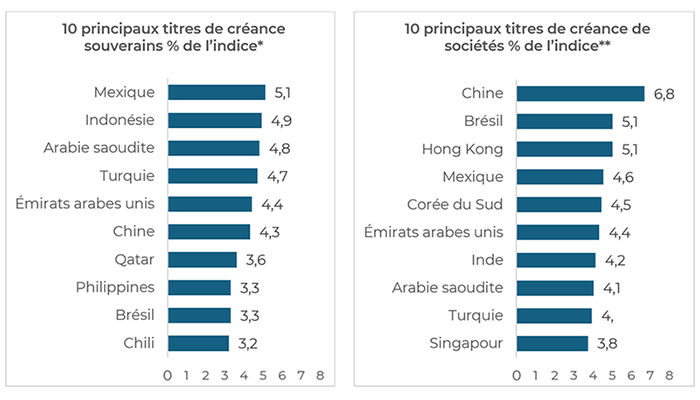
Source : JP Morgan, Bloomberg


Le volume annuel des titres de créance émis par les marchés émergents a également été vigoureux, les émissions de titres de créance de sociétés ayant tendance à être plus importantes que celles des titres de créance souverains (figure 3).

Figure 3 – Émission des titres de créance des marches émergents
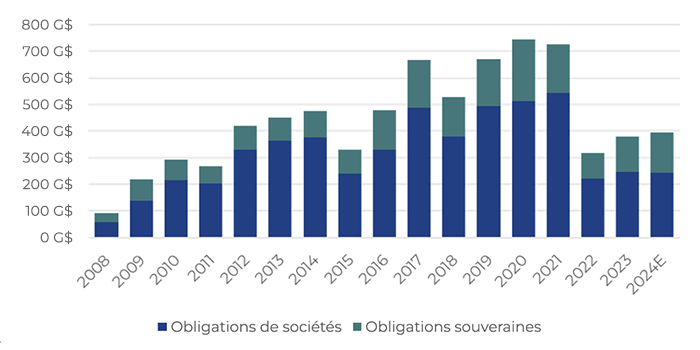
Figure 3 démontre la répartition des émissions des titres de créance de sociétés et des titres de créance souveraines dans le marché des titres de créance des marchés émergents de 2008 à 2024 (estimé), basée sur les données de JP Morgan et FortWood Capital.Source : JP Morgan & FortWood Capital


Principaux avantages des titres de créance des marchés émergents

Rendement plus élevé : le marché des titres de créance des marchés émergents offre une prime de rendement par rapport aux marchés développés comparables en raison des risques plus élevés perçus. À l’heure actuelle, les marchés émergents offrent certains des taux les plus élevés depuis la crise financière mondiale (figure 4).

Figure 4 – Rendement des titres de créance des marchés émergents par rapport aux obligations du Trésor américain à 10 ans
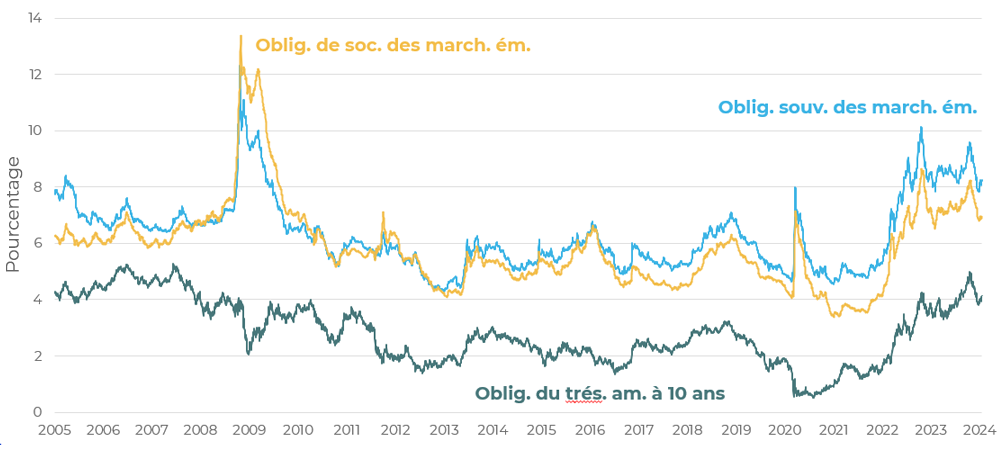
Figure 4 démontre le rendement des titres de créance des marchés émergents par rapport aux obligations du Trésor américain à 10 ans basé sur les données de JP Morgan et Bloomberg.Remarque : Indice des obligations souveraines des marchés émergents – EMBI Global Diversified, indice des obligations de sociétés des marchés émergents – CEMBI Broad Diversified
Source : JP Morgan, Bloomberg


Les marchés émergents sont souvent sensibles à la volatilité politique et économique. Les changements de gouvernement et de politique ainsi que les tensions géopolitiques peuvent avoir une incidence sur la solvabilité des émetteurs. Les titres de créance souverains ont aussi tendance à avoir une durée plus longue (sensibilité aux fluctuations des taux d’intérêt) et, lorsqu’ils sont combinés, ces facteurs font que les titres de créance souverains des marchés émergents offrent généralement des rendements plus élevés que les titres de créance de sociétés des marchés émergents.

Endettement moins élevé : le risque perçu lié aux titres de créance des marchés émergents n’est pas toujours justifié, malgré les taux de rendement plus élevés. Par exemple, les émetteurs d’obligations de sociétés des marchés émergents, qu’ils soient de premier ordre ou à rendement élevé, sont moins endettés par rapport à leur capacité de générer des flux de trésorerie pour rembourser cette dette et sont moins endettés que les emprunteurs des marchés développés ayant la même cote de crédit (figure 5). Malgré un endettement moindre, les obligations des marchés émergents ont généralement procuré aux investisseurs des taux de rendement plus élevés pour la même cote de crédit.

Figure 5 – Comparaison de l’endettement net
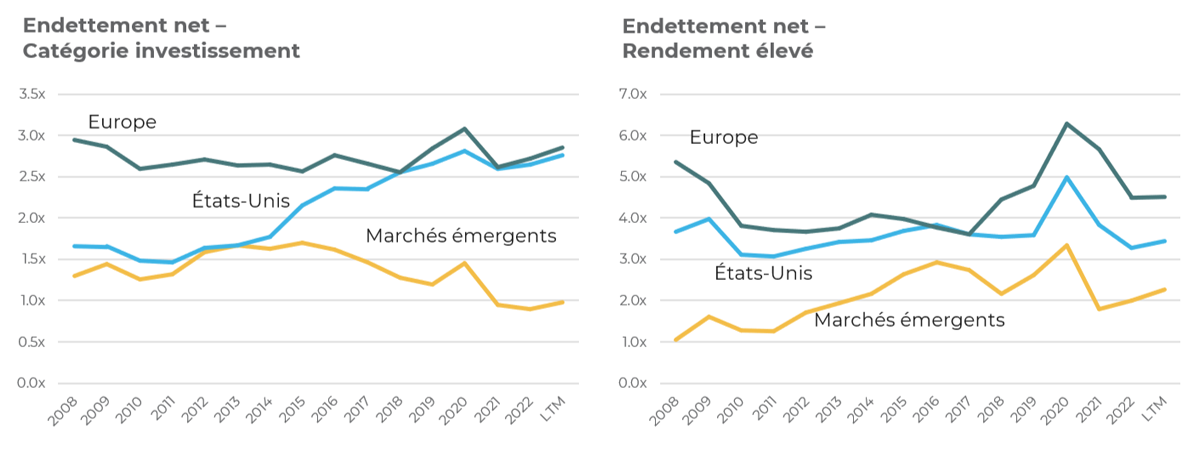
Figure 5 démontre une comparaison de l’endettement net des émetteurs d’obligations des titres de créance des marchés émergents de catégorie investissement et de rendement selon JP Morgan en 2023.Source : JP Morgan (en date de 2023) et FortWood Capital


Taux de défaillance inférieur : le taux de défaillance des émetteurs des marchés émergents est historiquement plus bas que celui de leurs homologues des marchés développés possédant une cote comparable (figure 6). De nombreux marchés émergents affichent une solide croissance économique qui peut soutenir la solvabilité des émetteurs. Par exemple, une croissance économique plus forte peut accroître les revenus des sociétés, facilitant ainsi le remboursement de la dette.

Figure 6 – Le taux de défaillance des sociétés des marchés émergents est inférieur à celui des sociétés des marchés développés
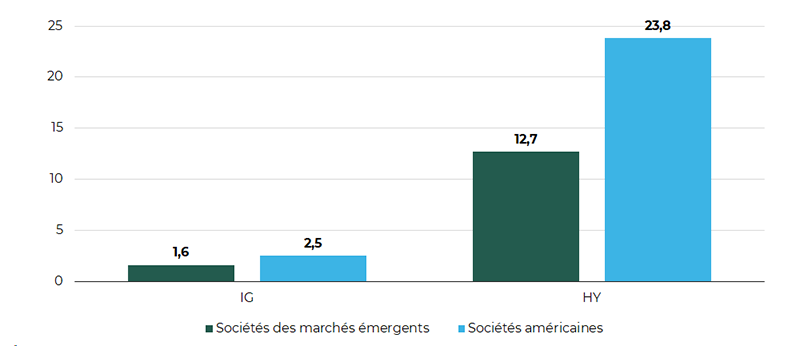
Figure 6 démontre le taux de défaillance cumulé moyen sur 10 ans des sociétés des marchés émergents aux sociétés américaines selon les recherches de SP Global Ratings.Source : S&P Global Ratings Research et FortWood Capital


Avantages de la diversification : les cycles économiques et les conjonctures des marchés émergents diffèrent souvent de ceux des marchés développés. Cette expérience différente réduit la corrélation, offrant ainsi une source de diversification du portefeuille. Investir dans différents pays, secteurs et émetteurs peut réduire l’incidence des problèmes locaux et améliorer la résilience globale du portefeuille.

Facteurs à prendre en compte lors de la construction du portefeuille

Gestion des devises : pour permettre aux investisseurs canadiens de gérer toute incidence défavorable des fluctuations de change entre les titres de créance des marchés émergents libellés en dollars américains et le dollar canadien ($ CA), le portefeuille est habituellement couvert en dollars canadiens, ce qui procure des rendements plus prévisibles. Le gestionnaire de placement de la stratégie peut obtenir cette couverture de façon rentable en ayant recours à des contrats à terme sur le change ou à d’autres instruments de change.

Liquidité : les titres de créance des marchés émergents sont généralement une catégorie d’actifs liquides. Par exemple, la liquidité des obligations de sociétés des marchés émergents est généralement comparable à celle des obligations de sociétés des marchés développés dans des conditions normales de marché.

Gestion active : il existe de nombreux cycles économiques et politiques idiosyncrasiques dans les différents pays, qui peuvent contribuer à des occasions de valeur ajoutée pour les gestionnaires actifs. De plus, comme pour les actions des marchés émergents, le nombre de spécialistes de la recherche sur les titres de créance des marchés émergents est moins élevé que celui des titres de créance des marchés développés, ce qui crée des occasions de recherche indépendante. Les gestionnaires actifs compétents peuvent déceler les nuances du marché, repérer des occasions intéressantes et ajuster les placements en fonction de l’évolution des conditions.

Investissement responsable : malgré les problèmes politiques et sociaux liés aux pays émergents, les gouvernements et les sociétés reconnaissent de plus en plus l’importance des facteurs environnementaux, sociaux et de gouvernance (ESG).

Une occasion à saisir

Les titres de créance des marchés émergents offrent des occasions de placement intéressantes, avec un potentiel de taux plus élevés, des avantages sur le plan de la diversification et une exposition à des économies à forte croissance. Les titres de créance des marchés émergents peuvent constituer un ajout précieux à un portefeuille de placement bien équilibré.

NSP_COMM_2024-08-15_Banner

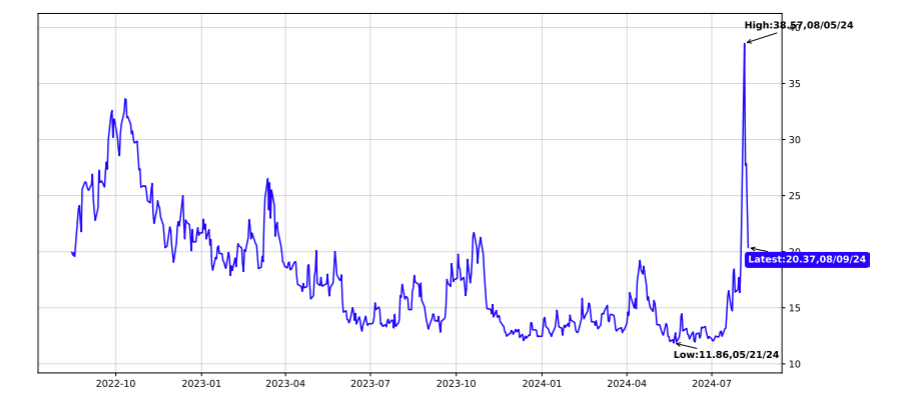
The questioning of the no/soft economic landing narrative and the partial unwind of the yen carry trade have seen equity markets whipsaw in recent weeks. While we are always scrutinising the fundamentals of the companies we own, and the wider investment universe, it is in periods of high uncertainty like this where our incorporation of macro analysis is vital. This helps us navigate the risks, opportunities and regime change which can occur when volatility skyrockets.

VIX Index explodes as US recession fears rise and yen carry reverses
NSP_COMM_2024-08_Chart01
Source: NS Partners & Bloomberg


Goldilocks thinking unravelling

Last October we published a piece warning against complacency in markets, given a poor monetary backdrop signalling economic weakness ahead – Is this a Wile E. Coyote moment for markets?

Our view was that central banks were maintaining policy that was unnecessarily tight and that a rosy consensus on the macro outlook appeared misguided:

The delayed impact of vertiginous rate hikes across DMs on all maturing debt is now hitting consumption and investment. Yet central banks continue to talk tough and market pundits fret over the implications of “higher for longer rates.” It feels like we are in a critical juncture for markets and the economy. Resilience of assets outside of fixed income appear out of step with the reality of higher rates and a weakening global economy, as illustrated by global PMIs falling for a fourth consecutive month.

Poor money numbers globally suggest that further economic contraction is likely. Despite this, central banks continue to talk tough on rates and many investors cling to hopes of a no landing/immaculate disinflation scenario unfolding, despite the cracks emerging in the global economy.

This underpinned a shift to a more defensive portfolio exposure in the expectation that economic growth was set to surprise to the downside over the next “3-6 months.”

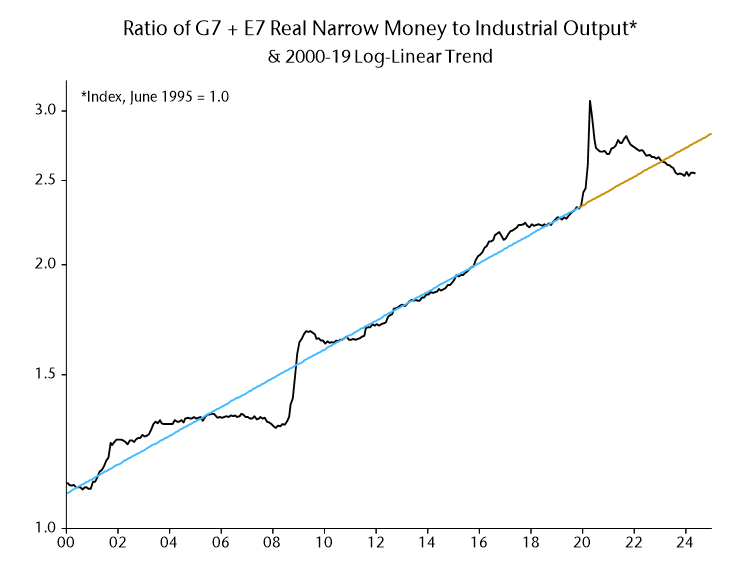
In hindsight this was slightly early. What we missed was the buffer provided by the huge stock of money built up during the pandemic, cushioning the economy from rapid monetary tightening.

However, as you can see in the chart below, this stock has been burnt down below the pre-pandemic trend.

Money stock below trend
NSP_COMM_2024-08_Chart02
Source: NS Partners & LSEG Datastream

 
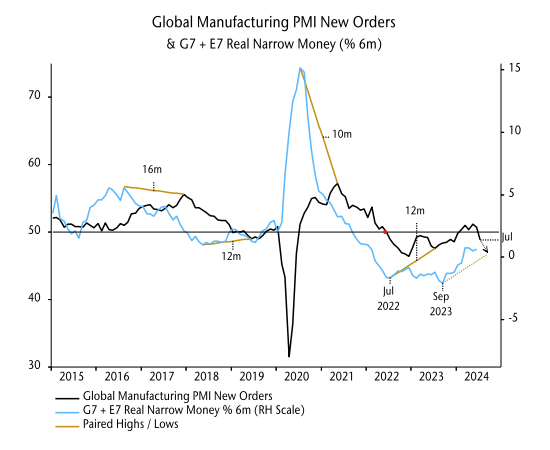
The effects of tighter liquidity are now flowing through to the real economy, with global manufacturing PMIs falling sharply in July.

PMI dip corresponds to low in six-month real narrow money momentum a year earlier
NSP_COMM_2024-08_Chart03
Source: NS Partners & LSEG Datastream

 
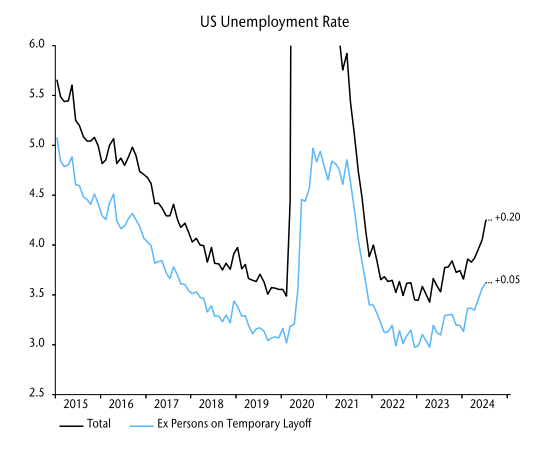
Investors panicked in late July as deteriorating US employment data set off calls for the Fed to deliver an emergency rate cut before the September FOMC meeting.

Unemployment boosted by a sharp rise in temporary layoffs (ex-temp rate is also trending higher)
NSP_COMM_2024-08_Chart04
Source: NS Partners & LSEG Datastream


Japan’s attempt to exit zero interest rate policy (ZIRP) roils markets

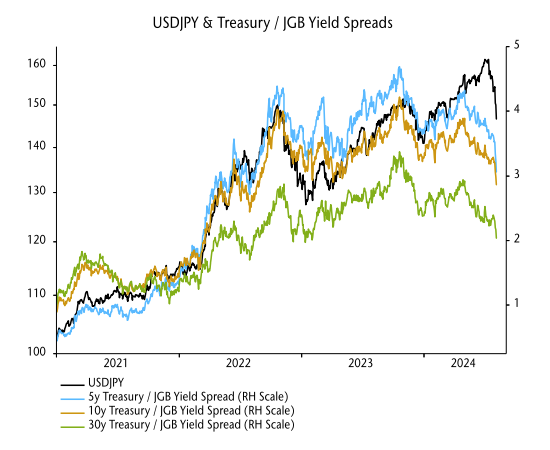
Meanwhile in Tokyo, the Bank of Japan announced that it would take steps to end decades of unconventional monetary policy by raising rates, with an eye to acting against signs of inflation and currency weakness. The hawkish turn saw the yen surge relative to the USD, blowing up speculators shorting the yen. It also forced the unwind of some carry trades exploiting lower interest rates in Japan by borrowing in yen, and then investing in currencies with high rates such as the USD, Mexican peso or Brazilian reai.

JPY surge leaves it still lagging collapsing yield spreads
NSP_COMM_2024-08_Chart05
Source: NS Partners & LSEG Datastream

 
Japan’s decades-long deflationary trap has been the basis for BOJ monetary experiments going back to the 1990s, which gave rise to the yen carry trade phenomenon. Financial historian Russell Napier recounts the “rise of carry” in his book The Asian Financial Crisis, emphasising its tendency to yank liquidity from markets in response to shifts in monetary policy:

What has changed to turn global equity markets bearish? The only surprise over the past few weeks has come from Japan. In the United States, the bond market has been well behaved, the shape of the yield curve unchanged and Greenspan’s comments supportive. Earnings growth in the United States has been ahead of expectations. However, in a three day period, the yen rallied 3.1% against the US dollar on speculation that Japanese interest rates would rise. This currency movement would appear to be the catalyst for the sell-off.

The sudden strength of the yen is indicating that the flow of excess liquidity out of Japan had been the source of liquidity which had been driving the US equity and bond markets. The reason that the flows overseas are probably abating is that the economic recovery in Japan is requiring these funds. The period of history when an accommodative stance by the BOJ drove markets is over.

The experience of July 1996 that Napier recounts rhymes with today’s volatility, fed by speculators who had borrowed yen to finance investments in the US and other markets forced to liquidate positions to buy yen and reduce yen borrowings.

Tech names routed

When liquidity drains out of a market, it is often the “speculations of choice” which are hit hardest, as investors sell profitable trades to raise cash. Names with exposure to the boom in enthusiasm for AI technology were among the victims of the unwind, an example of where liquidity can overwhelm even stellar fundamentals.

July pullback for tech as defensive sectors such as healthcare outperform
NSP_COMM_2024-08_Chart06
Source: NS Partners & LSEG Datastream


Buy the dip or steer clear?

In the lead up to July, we had been steadily reducing our above-benchmark exposure to IT names in the GEM strategy, and now maintain a modest overweight. Much of this shift has been through selling down more niche semiconductor names which rallied hard on demand for AI chips. The highest quality names such as TSMC were hammered through July despite posting outstanding results, and look attractive at these levels.

Our view is that the risks of carry trade unwind will ultimately be constrained by economic realities in Japan (despite the domestic unpopularity of yen weakness).

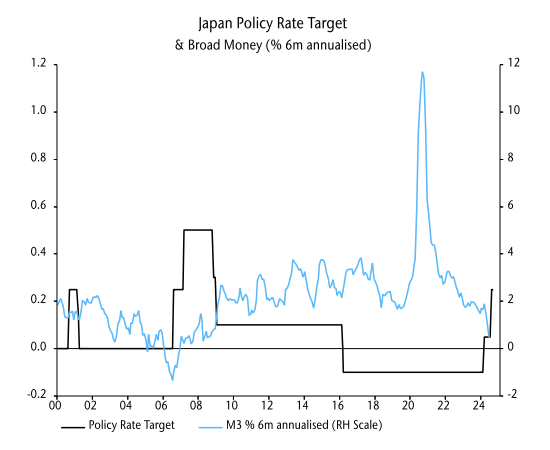
Broad money weakness suggests that the BoJ’s latest attempt to exit ZIRP will be no more successful than previous efforts in 2000 and 2006
NSP_COMM_2024-08_Chart07
Source: NS Partners & LSEG Datastream

 
The monetary backdrop in Japan suggests that all is not well in the economy, and that raising rates will make the situation worse. However, it is entirely possible the BOJ will look to push its luck again. In addition, while speculative bets against the yen have been reduced significantly, JGB yield spreads versus US Treasuries suggest potential for further yen strength. Given this backdrop, our bias is to avoid reflexively buying dips here.

Implications for EM

Last month’s commentary made the case that the vicious cycle weighing down emerging market equities was coming to an end: Are emerging markets on the cusp of a “virtuous circle”?

It emphasised the importance of a weak dollar and supportive liquidity as key drivers of EM outperformance. While the slowing economy and carry trade volatility warrant some caution over the next few months, they may also support a shift to a backdrop more supportive of EM equities in the long run.

Big move down in the USD on slowing US economy and carry trade unwind
NSP_COMM_2024-08_Chart08
Source: NS Partners & Bloomberg

 
It argued that the balance of factors we monitor to assess prospects of EM vs DM equities (relative money growth, global excess money, valuations, earnings, industrial momentum, commodity prices and USD strength/weakness) favours EM for the first time in years. Recent downward moves in Treasury yields and the dollar support the positive trend. Although global money growth has slipped with poor numbers in China and Japan.

Favour liquidity sensitive exposure

The tech cycle upswing and the story of India’s rise up the development ladder have dominated EM returns in recent years. While these trends remain intact, a falling dollar and Fed cuts are likely to see other winners emerge. This easing is set to take pressure off EM central banks forced into tight monetary policy to stabilise their currencies. This should boost the prospects of more liquidity sensitive economies, which are typically open, trading economies with managed exchange rates.

Indonesia is a potential winner in this respect. Its central bank surprised investors with a Q2 rate rise to support the rupiah, leading to a market selloff. US Fed cuts and a dollar bear market should allow for a shift to monetary easing in Indonesia to prevent excessive appreciation of the currency that would harm the competitiveness of its exporters.

US Treasuries yields falling
NSP_COMM_2024-08_Chart09
Source: NS Partners & Bloomberg

 
As well as rate cuts, easing would likely involve the central bank buying US dollars from Indonesian commercial banks, crediting the banks’ reserve accounts in payment. Additional reserves would encourage bank lending and money creation, with positive follow-through to asset prices, economic growth and corporate earnings, consistent with the virtuous circle sketched out below. While fundamentals matter, we think it pays to understand how liquidity can often act to shape these fundamentals, particularly in emerging markets which are highly sensitive to the monetary backdrop.

Virtuous liquidity circle
NSP_COMM_2024-08_Chart10
Source: NS Partners

GACM_COMM_2024-08-08_Banner

Can the Japanese bubble of the 80s serve as a warning for the US real estate and stock markets today?

The mid to late-80s were the years of Japan’s “bubble economy”. A time when the country was at its economic peak. A time when everything was made in Japan and Japanese companies would conquer the world. A time when the US put tariffs on Japanese goods and engineered a currency accord that meant a rapid appreciation of the yen.

Consider a few historical economic facts about Japan around that time.

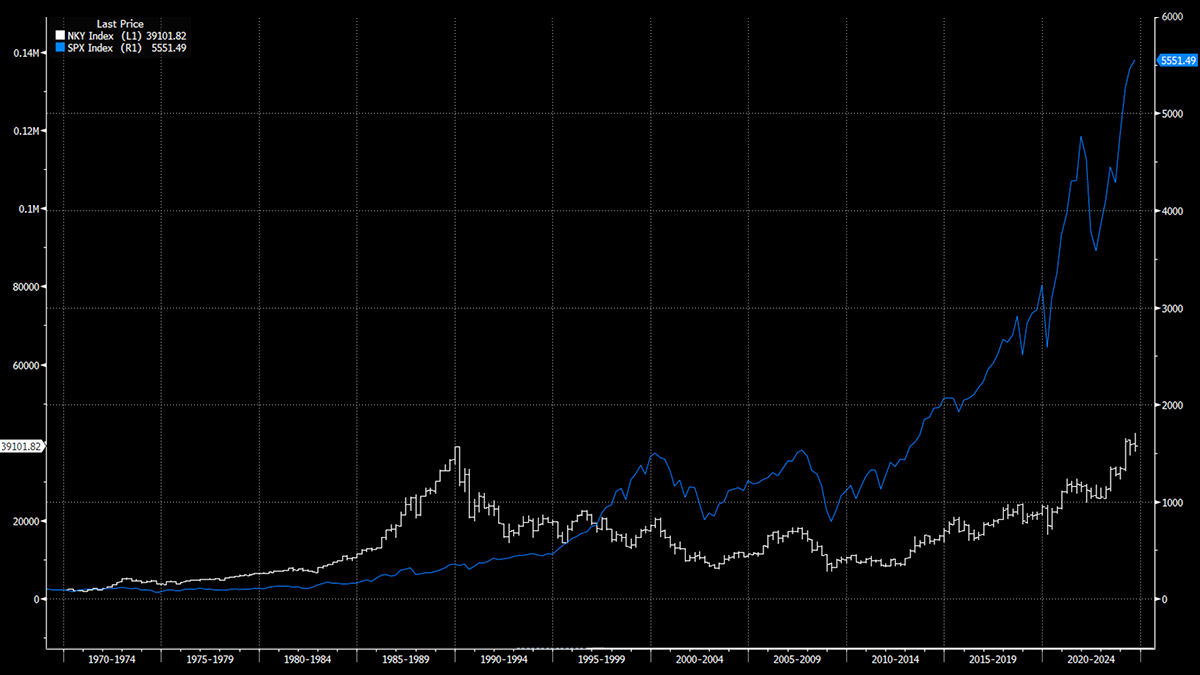
  • At the end of 1989, the Nikkei 225 stock market reached 39,000, a historic high it would only see again in 2024.
  • The Japanese property market was worth four times more than the US property market. It was rumoured (although not for sale) that the land on which the Japanese emperor’s imperial palace sits was worth more than the entire state of California.
  • By 1989, the market capitalization as a percentage of GDP was 151%, while it was 62% in the US.
  • Over the same time period, Japan represented 42% of global equity markets. This was almost 18% of the global economy, or approximately 71% of that of the United States.

Those were the heydays for Japan. And then came the decline.

So, what caused the crash of both real estate and stock market? There are several reasons, but two stand out:

  • First was the Bank of Japan (« BOJ ») was too slow in tightening, creating an asset bubble. One reason given for the reluctance of the BOJ was the US stock market crash in October 1987 (aka Black Monday).
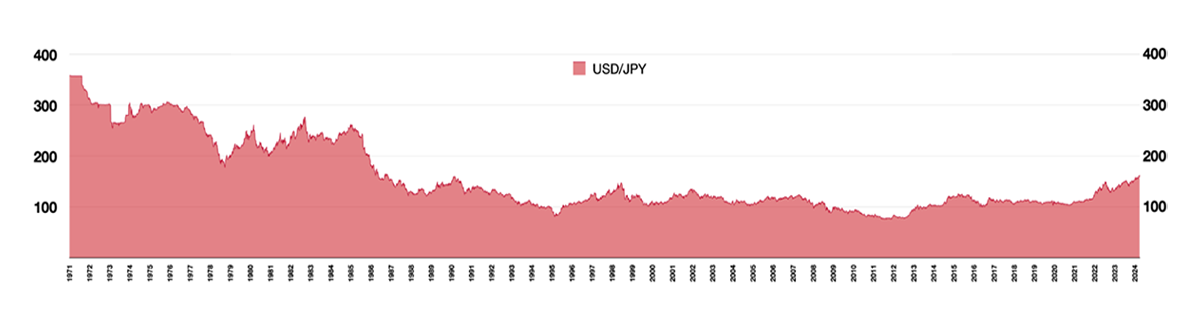
  • Second was the rapid appreciation of the yen following the Plaza Accord of September 1985 when most major economies agreed to depreciate the US dollar.

US dollar / Japanese yen exchange rate
GACM_COMM_2024-08-08_Chart01Source: Bank of Japan

Now, let’s look at the US in the 2020s.

The relentless rise and outperformance of the US stock market(s) over the last few years has led many to believe it is entirely justified and pointless to diversify beyond the US market – but that narrow perspective comes at a cost.

Let’s review a few facts, keeping in mind our description of Japan’s bubble economy:

  1. The US stock market is now 65% of the MSCI ACWI (All Country World Index), while the US economy is only 25% of the global economy.
  2. By sharp contrast, the second largest country in MSCI ACWI is Japan, with a weight of 5%. Its economy is about 4.5% of the global economy.
  3. The weight of China, the second largest economy with 18% of global GDP, is only 2.6% of the MSCI ACWI. That is less than the market cap of Alphabet (Google). Indeed, the individual market cap of Apple, Microsoft and Nvidia are all higher than any single stock market in the world, except Japan.

So, is the US market in a bubble at the moment?

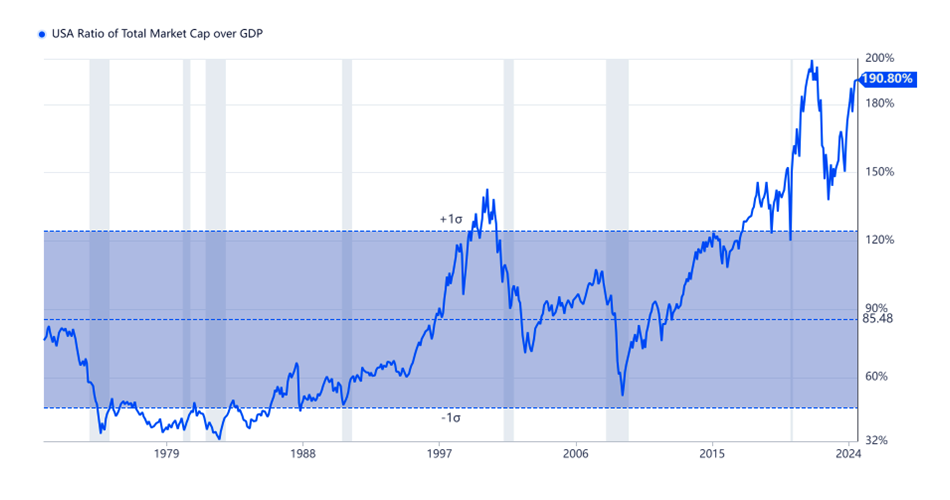
A favourite bubble indicator used by Warren Buffet, is the ratio of the US total market cap over GDP. As seen in the following chart, that ratio is currently around 190% (and helps explain Warren’s approximate $300B cash pile).

US ratio of total market cap over GDP
GACM_COMM_2024-08-08_Chart02Source: public

As a comparison, the same market-to-GDP metric applied to China is 61%, 48% for Germany, and 71% for the UK.

Japanese vs US stock market: 1975-2024

GACM_COMM_2024-08-08_Chart03
Source: Dallas Federal Reserve

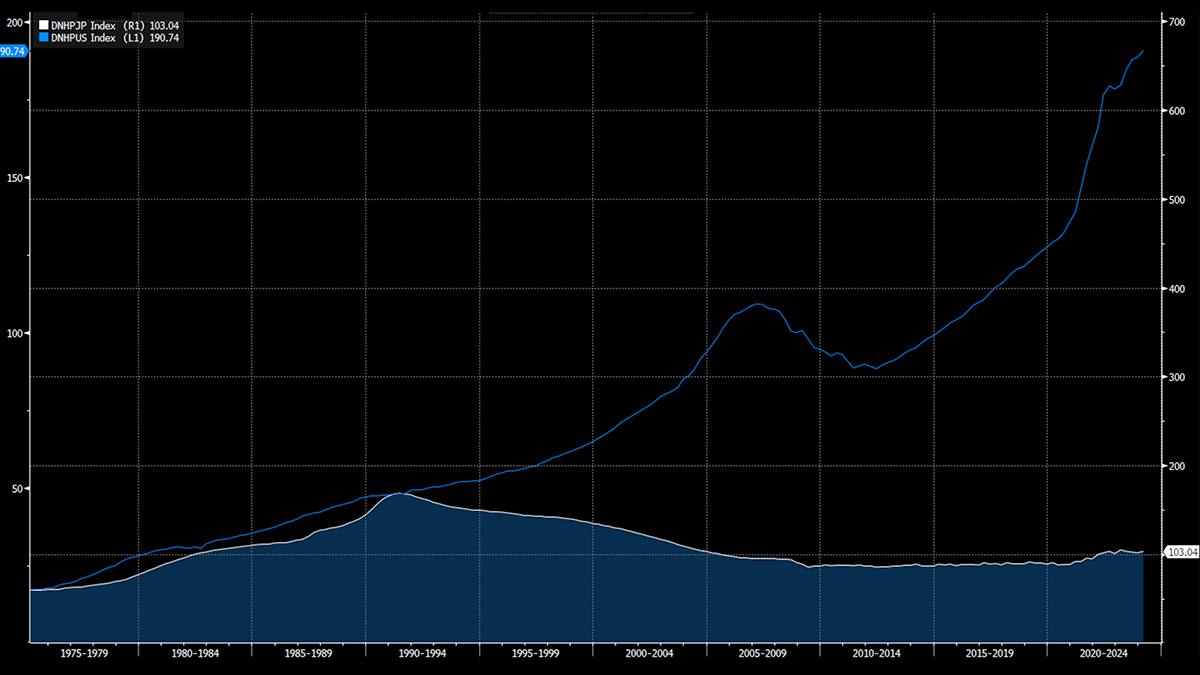
Moving to real estate, US housing prices are at an all-time high, and housing affordability has hit the lowest level on record this month.

US vs Japanese housing prices: 1975-2024

GACM_COMM_2024-08-08_Chart04
Source: Dallas Federal Reserve

This commentary is not meant to signal an imminent crash of US house prices or stock market. Rather, it is just meant to show how we are in uncharted territory, and how looking at what happened to the Japanese economy could help navigate the present US economy.

Consider some events from the past few years:

  • Did the decision to raise rates come too late, potentially lead to an inflated asset bubble?
  • Has the US dollar shown signs of strengthening against other currencies?
  • Is the fiscal deficit in the US inflationary?
  • Is the US resorting to tariffs?

Arguably, the answers to all the above would be “Yes”. This begs the question – should we consider the similar historical context of both economies?

Given what I’ve said earlier on the narrow perspective of investors flooding the US market in the last year, there are many troubling signs on the horizon, while there is continued growth in the US market, it would be prudent to consider diversification – now more than ever.

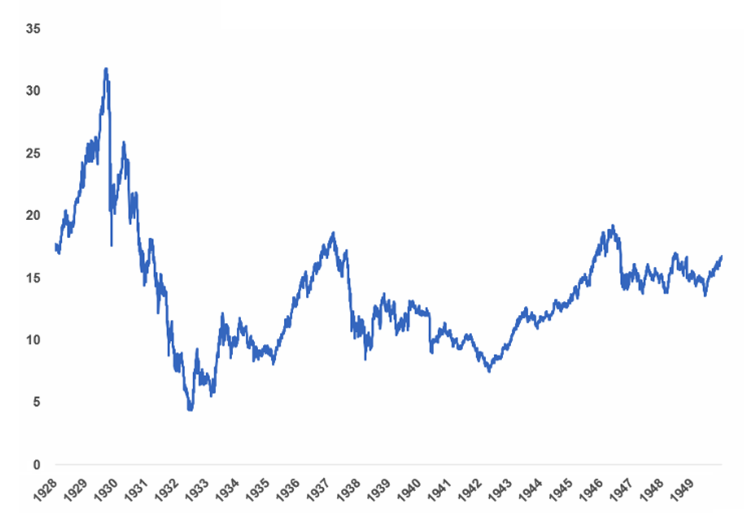
And as a conclusion, here is a graph of the S&P 500 in a past period.

S&P 500 Index: 1928-1949

GACM_COMM_2024-08-08_Chart05Source: public

VERGENT_COMM-FEM_2024-08-06_Banner

The strategy focuses on investing in frontier and emerging market companies that our team expects will benefit from demographic trends, changing consumer behavior, policy and regulatory reform, and technological advancements.

Below, we explore several key factors influencing returns and share observations on the portfolio and the markets.

Retail Portfolio

The strategy saw healthy returns during the period from the ASEAN retail portfolio, led by Philippines Seven Corp. (the master franchisee of 7-11 stores in the Philippines) and Mr. DIY Group (the multi-price point value retailer in Malaysia).

Our investment in Philippines Seven Corp. (SEVN) is premised on its first-mover advantage in convenience store (CVS) retailing in the country. As of the end of March 2024, SEVN has a network of 3,829 stores, ~9x that of its closest competitor. The magnitude of SEVN’s scale advantage is perhaps best captured by the fact that its annual store openings nearly match the entire store network of its closest competitor. Scale and location are key success factors in convenience retail, especially in an archipelago where an efficient and agile supply chain requires significant capital and operating investment.

From a top-down perspective, the Philippines’ large and young population (+100 million people with a median age of 25), expanding cities, and growing tourism sector should provide a long growth runway for CVS retail, resulting in a narrowing of the penetration gap (measured in CVS stores per capita) with neighboring countries like Malaysia and Thailand.

In addition to scale, location, and market opportunity, SEVN’s management team has proven over the years to be formidable operators and good stewards of shareholder capital.

Our team turned more bullish on SEVN at the end of last year, encouraged by evidence of an inflection point in store productivity, resilient operating margins, and an acceleration in store openings. Unusually, the stock was trading at all-time low multiples despite the company reporting three consecutive quarters of strong results. The team also identified a catalyst for the shares in the form of an expectation that SEVN will resume paying dividends after a three-year hiatus due to an SEC (the Philippines Capital Markets Regulatory Agency) mandated technicality. This technicality resulted from the implementation of IFRS 16 accounting standards in the Philippines in 2019. For SEVN, the capitalization of leases mandated by IFRS 16 standards created a large, deferred tax asset which, according to SEC rules, is deducted from the retained earnings base from which the company can pay dividends. On a recent earnings call, management estimated that the company is sitting on twice the amount of cash it needs to run and grow the business due to its inability to pay out excess cash. As SEVN’s operations accumulated cash (reaching ~20% of its market capitalization), retained earnings finally exceeded the regulatory hurdle above which dividends can be paid, and management was able to recommend a dividend to its board. Furthermore, management announced it is in the process of crafting a dividend policy that will entail distributing excess cash on an annual basis, a positive step.

Mr. DIY Group’s (MDIY) shares benefited from the anticipation of a recovery in demand from the B40 group of Malaysian households (B40 refers to the bottom 40% income group). This optimism stemmed from the restructuring of the Employee Provident Fund (EPF), which created a new “flexible” sleeve that allows for early withdrawals from beneficiaries below the age of 55 (previously, early withdrawals were only possible for critical needs like healthcare, housing, and education). The expectation is that this new feature (effective from May 11, 2024) will support disposable incomes and lead to a boost in spending among the B40 group.

MDIY is well-positioned to benefit from this given it is over-indexed to shoppers from the B40 group. For context, the company operates 1,283 stores in Malaysia (as of the end of March 2024) and has been expanding stores at a net rate of ~150 per year since 2017. This rapid expansion in stores has been internally funded by a highly cash-generative business model characterized by fast breakeven periods on new stores (2-3 years), reflected in industry-leading returns.

This profitability is supported by a virtuous cycle of supply chain optimization and store-level operating efficiency that enables the company to invest in price and offer shoppers value-for-money across the +10k SKUs it carries on its shelves. Low prices and new store expansion drive demand and larger volumes, which the company uses to negotiate with suppliers and unlock further discounts. Overlaying that cycle is a highly scientific approach to SKU management, which ensures optimized inventory turnover and minimizes drags on operations and the shopping experience. MDIY has also become more progressive with dividends in the last twelve months, with a quarterly payout policy of 50-65% of earnings, an appropriate level that balances the company’s strong cash position and growth requirements.

Internet and Technology Portfolio

Investments that the team made and wrote about in previous letters, including Vietnam’s FPT Corporation (FPT) and Turkey’s Logo Yazilim Sanayi (LOGO), performed well in the quarter.

We are especially pleased to see that FPT’s early foray into the AI space through global partnerships and acquisitions is helping it sustain a robust growth profile in global IT services. This was evident in the first half 2024 results, wherein global IT services revenue grew at ~30% in the first half of 2024 and is showing no signs of slowing down. FPT’s global IT services business exceeded $1bn in revenue in 2023, and recent underlying trends are positive with a larger proportion of higher-value digital transformation projects in the mix (47%), a diversified and growing geographical revenue stream across APAC, US, and Europe, and an increase in the number of contract wins in excess of $5m. FPT is also reinforcing its human resource advantage by adding AI and other technology modules to its university curriculum, which will help its own workforce and supply future skilled workers for other technology companies in Asia and around the world. For example, FPT University is expected to admit 1,000 students for the first batch of its semiconductor major, specializing in integrated circuit design.

LOGO shares performed well in the period as investor confidence in Turkey’s outlook strengthens. The government seems intent on pursuing macroeconomic policy orthodoxy that started a year ago. This policy goodwill is reflecting itself in Turkish assets, with the BIST 30 index up ~30% in the first half of 2024, and Moody’s upgrading its credit rating of the country by two notches from B3 to B1 in July. While it is early days and inflation remains stubbornly high (a staggering 75% in May 2024), Moody’s forecasts that inflation will begin to moderate from elevated levels and exit the year with a print of 45%.

If the economy does indeed turn a corner and business confidence grows, this will reflect positively on LOGO, which has so far underperformed the broader market (on a twelve-month basis) due to margin pressure from wage inflation and headcount investments, softness in its core SME segment in Turkey, and drag from its EUR-denominated low-margin business in Romania. Nevertheless, we remain confident in LOGO’s position as the leading enterprise resource planning (ERP) provider for Turkey’s large SME corporate market and are constructive on management’s initiatives to improve product flexibility through Software-as-a-Service (SaaS), and expand the product suite to new segments of the market (large retail customers, micro SMEs, e-government services, and HR). This should drive the penetration of ERP software in the country and position the company for strong earnings growth as business confidence returns.

Outlook

We continue to be constructive on the opportunity set for the strategy for the second half of the year. We believe we positioned the portfolio to be considerate of changes in the interest rate cycle, political environment, and portfolio company valuations. As always, the ultimate objective of our decision-making process is to express our best research opinions through a diversified portfolio of high-quality businesses that we believe will help us deliver on the strategy’s return promise to investors.

We look forward to continuing to update you on the strategy over the rest of the year.

Panoramic view of Kuwait city at sunset.

MENA equity markets had a weak second quarter of 2024 with returns of -4.2% (for the S&P Pan Arabian Index Total Return), trailing the MSCI Emerging Markets Index which was up 5% in the same period. For the first half of 2024, MENA equity markets are up 3.0% compared to 7.5% for the MSCI EM index.

The performance drag in the quarter can be partly attributed to a surge in equity capital market activity that led investors to sell existing positions to fund a long list of initial public offerings and secondary sales. Top of the list was the $12bn secondary share sale of Saudi Aramco, which drew strong demand from foreign and local investors and was reportedly multiple times oversubscribed. For context, the Saudi Aramco equity raise is equivalent to 5.5x the average daily traded value for the entire Saudi market in the second quarter of 2024 and resulted in an increase of ~3% in the market’s aggregate free float market capitalisation. (Note: much more money was actually drained out of the market given oversubscription levels).

In November 2019, when Saudi Aramco first listed, foreign investors were demonstrably absent from the deal, as many viewed both the company and the country as non-core and even un-investable. Less than five years later, foreign investors are reported to have accounted for over 60% of the $12bn Aramco share placement. This is a strong vote of confidence in the Saudi market, and an indication of the credibility that it has deservedly earned with foreign investors in a short period of time. Excluding Aramco, seven other transactions concluded in Saudi and the UAE in the second quarter, with an aggregate amount raised of $3.4bn. While this pace of capital raising is typically associated with a rich valuation environment (i.e., a low cost of equity and high multiples), we believe it serves the strategy well as it strengthens our long-term thesis on capital market development in the region.

As discussed in previous letters, we believe the region’s share of global market capitalisation will steadily increase over time and we have expressed that theme through an investment in Saudi Tadawul Group, the country’s stock exchange holding company. Moreover, the combination of new listings and higher free floats is deepening the strategy’s investable universe and opening opportunities for the strategy to invest in strong businesses in healthcare, technology, and infrastructure, sectors that have not been well represented in MENA public markets historically.

Two key, related events in the quarter were the dissolution of the Kuwaiti National Assembly and the suspension of certain articles in the Constitution related to legislative powers in the country. This surprise announcement was made in a televised speech on Friday May 10th by Kuwait’s Emir Sheikh Meshal Al Ahmad Al Sabbah. The Emir came to power in December 2023 after the passing of his predecessor. His televised speech demonstrated clear intentions to break the cycle of policy paralysis and deadlock that has plagued the country due to the hostile and volatile relationship between parliament and government.

Kuwait has had four elections in the last five years and its economy has suffered from very low economic growth, a bloated public sector, rising levels of corruption, and crumbling infrastructure (most recently on display in late June when the country announced power cuts due to peak seasonal demand in the summer). The decision by the Emir to strip parliament of nearly all its powers and transfer control to the government will likely mean that stalled and much-needed economic policy legislations like the debt and mortgage laws, approval of national development plans, and fiscal reforms will now see the light of day.

This is a significant development for Kuwait that we expect will unlock a capex cycle that will have to catch up on nearly twenty years of significant under-investment. To position for this, the strategy invested in National Bank of Kuwait (NBK), the country’s largest corporate bank with over 30% share of system loans. We believe NBK’s strong deposit franchise and market leadership puts it in a strong position to benefit from a multi-year loan growth cycle that we expect will commence in the second half of 2025.

Our team spent some time in Morocco this quarter meeting with portfolio and prospective companies. The primary objective of this trip was to validate the strategy’s investment in Aktidal Group (AKT), a leading healthcare provider in the country with ~15% of the private bed capacity in the country. (Note: the private sector accounts for ~30% of total bed capacity). AKT operates 2,532 beds in 23 sites spread across 11 cities. The clinics managed by AKT are reputed for their quality of care and are known for the strength of their oncology department (~30% of consolidated revenue). The Moroccan healthcare market is severely under-served, with bed and physician per 1,000 persons below regional averages and well below WHO recommended levels. (A WHO study ranks Morocco 79th of 115 countries in doctors per capita). To address this shortage, the Moroccan government embarked on a series of reforms including the rolling out of a universal healthcare scheme and the removal of a restriction that allowed only doctors to invest in the sector. AKT is at the forefront of the growth in the sector, as has been validated in its 2023 results which showed revenue and operating profit growth of 84% and 86% respectively. Site visits and meetings with Moroccan doctors and competitors of AKT during our trip validated the company’s brand and reputation in the market, and highlighted the growth opportunity that lies ahead for the company.

We look forward to continuing to update you on the strategy in the next letter.

NSP_COMM_2024-07-17_Images_WP-Banner

The underperformance of emerging markets equities relative to the US has tested the patience of even its most diehard advocates of the asset class over the past few years. While EM equities posted a respectable 9.9% return in USD terms in 2023, this looks anaemic next to a roaring 26.3% for the S&P 500.

The disparity between the US and EM over the past decade tempts investors into the behavioural trap of building conviction for future returns based on what has performed well in the recent past. It is easy to forget that the annualised returns from 2000 to end-2023 for EM were 7.6% versus 7.8% for the US, both outpacing 6.2% for MSCI World. The risk here is that a pro-cyclical mindset can lead to perverse thinking where conviction strengthens for a popular asset class as the likelihood of a good result decreases, and vice versa.

US equities outperformed on a decade of stronger economic growth out of the GFC, fed by a new credit cycle and strong fiscal deficits fuelling stronger corporate earnings and a dollar bull market, along with multiple expansion. On the flipside, EM moved through a painful deleveraging compounded by foreign reserve managers chasing US exceptionalism and buying dollars which choked EM further.

Several contrarian market commentators have recently pointed out that the fundamental picture in EM in many ways looks more compelling than in the US – lower valuations, trough earnings, cheap currencies, lower inflation, as well as greater fiscal and monetary discipline.

So what explains the continued underperformance, and is there anything that can break this cycle?

Vicious and virtuous circles in EM equities

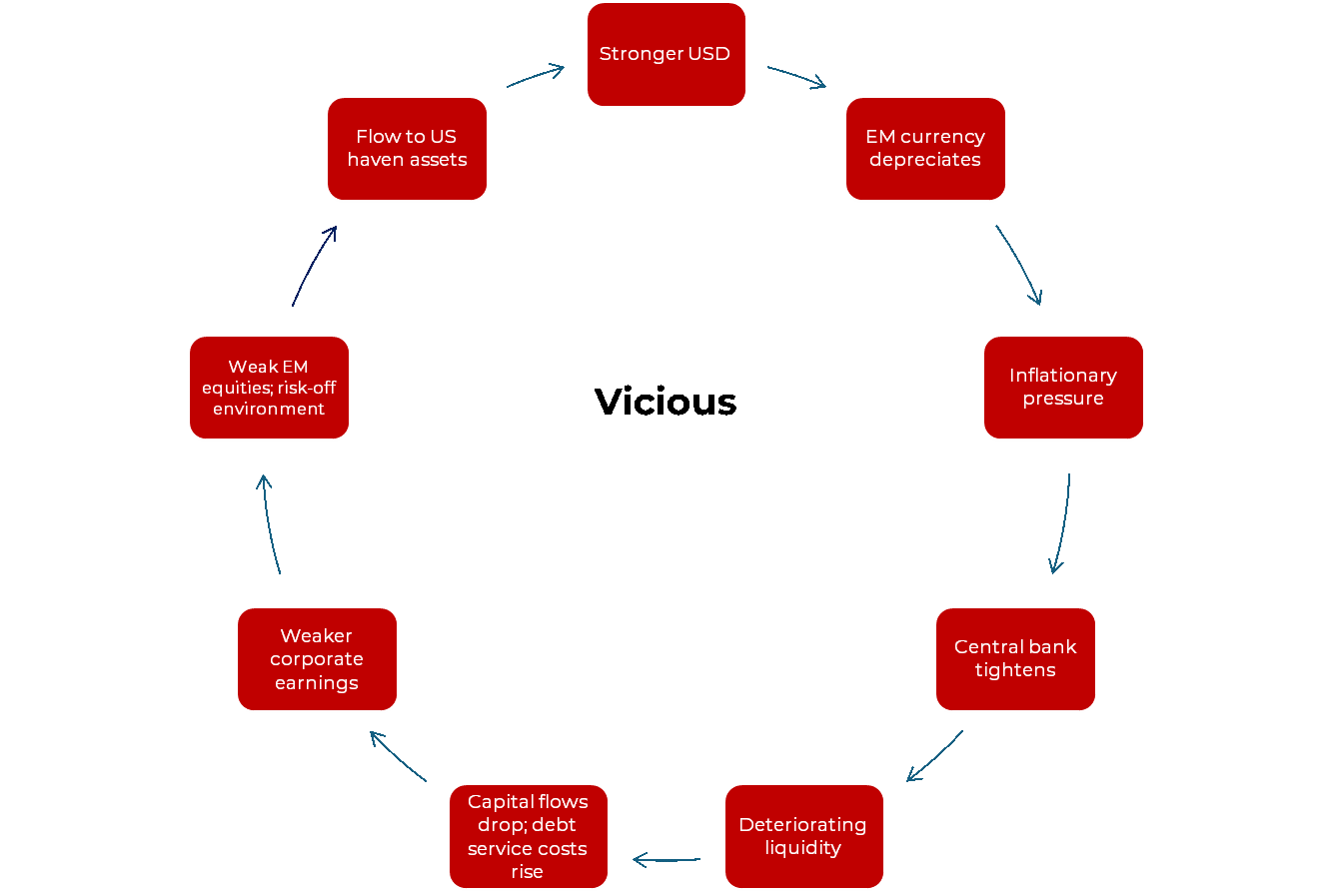
George Soros’s theory of Reflexivity provides an explanation for how biases and preconceptions interacting with economic reality can distort market pricing and create extended periods of disequilibrium. For EM, the combination of weaker fundamentals coupled with a perception of US exceptionalism has led to the formation of a self-reinforcing feedback loop which has been a major headwind for the asset class. Below is a rough schematic for how this loop has played out.

NSP_COMM_2024-07-17_Chart01Source: NS Partners.

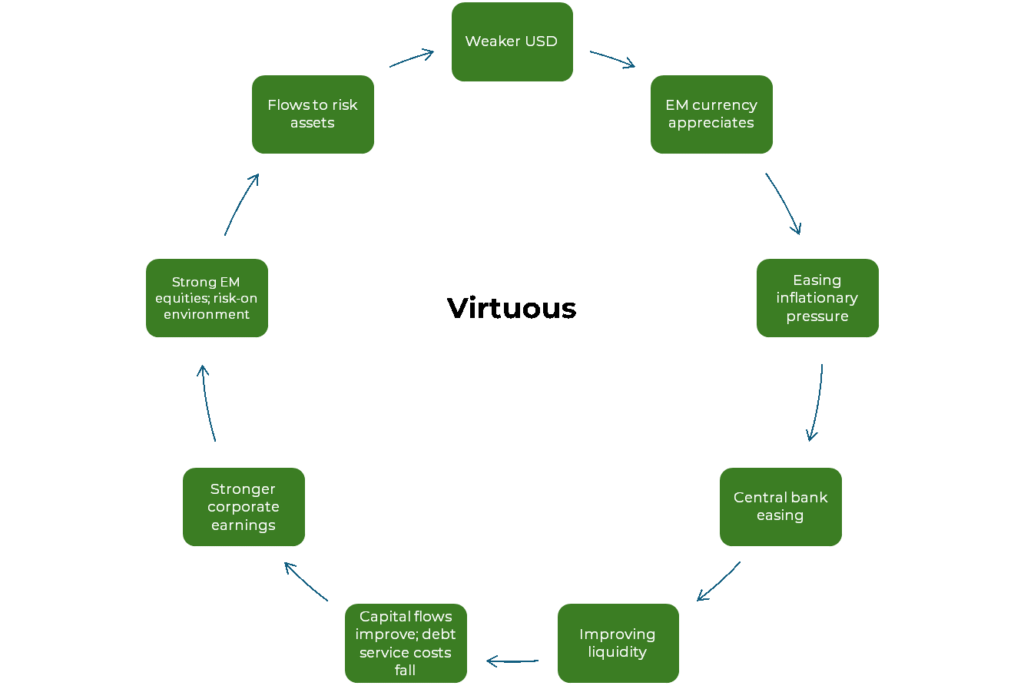
Our view is that this cycle is coming to an end. Indeed, we believe that there is potential for a shift into a “virtuous circle” for EM, outlined below.

NSP_COMM_2024-07-17_Chart02Source: NS Partners.

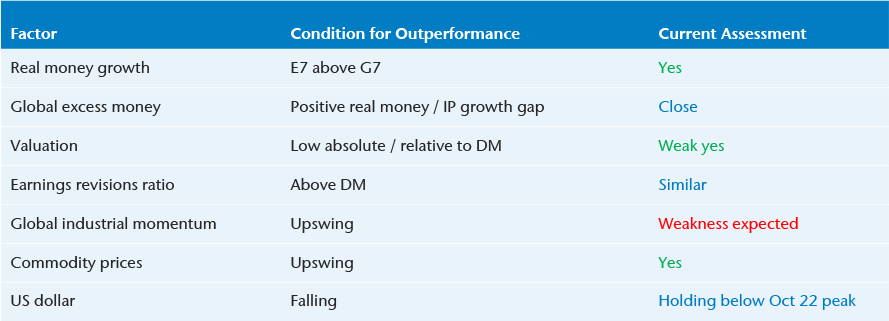
This outlook is based on a set of signals which we have used to advise clients invested in our DM and EM strategies looking to tweak the balance of exposure between the two. For context, our checklist is based on the idea that EM equities are a cyclical asset class and so tend to outperform when the global economy is strengthening (industrial cycle, commodity prices) and there is liquidity to chase the EM story (excess money, falling USD). They should also do better when economic prospects and earnings momentum are stronger than in DM (real money growth gap, revisions gap) and valuations are attractive.

Our latest update to the checklist (as of June 30, 2024) is below.

EM versus DM checklist
Microsoft PowerPoint – EM checklist 200524 (002) – Read-OnlySource: NS Partners.

The balance of factors we monitor now favours emerging market equities for the first time in years.

Our two cents – don’t wait around until everything goes green, as you will have missed the sharpest part of the rally.

Two checklist factors deserve special attention, given their historical usefulness in signalling an improving environment for EM equities.

Liquidity

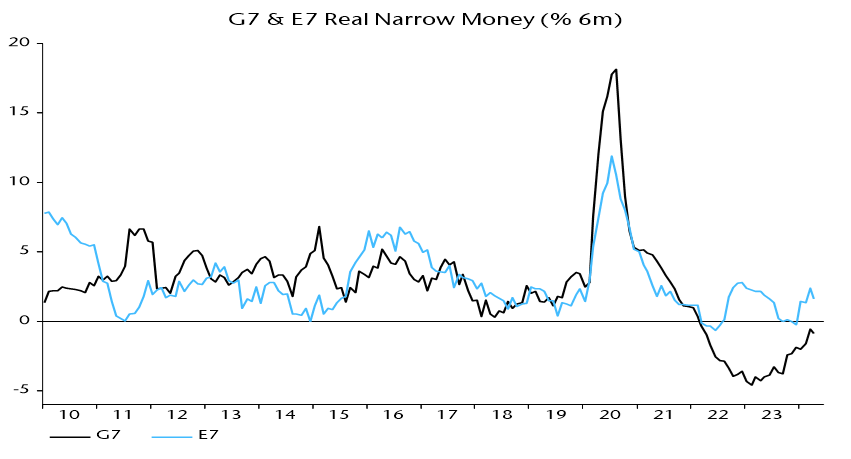
The E7 / G7 real money growth gap has been in favour of EM for some time, underpinned by better monetary policy making since 2020. This was reflected in better relative inflation performance for EM over DM, which has meant less need to tighten aggressively through the inflationary upswing, and potentially plenty of room to cut as the Fed eases.

Positive E7-G7 real money growth gap
NSP_COMM_2024-07-17_Chart04Source: NS Partners and LSEG Datastream.
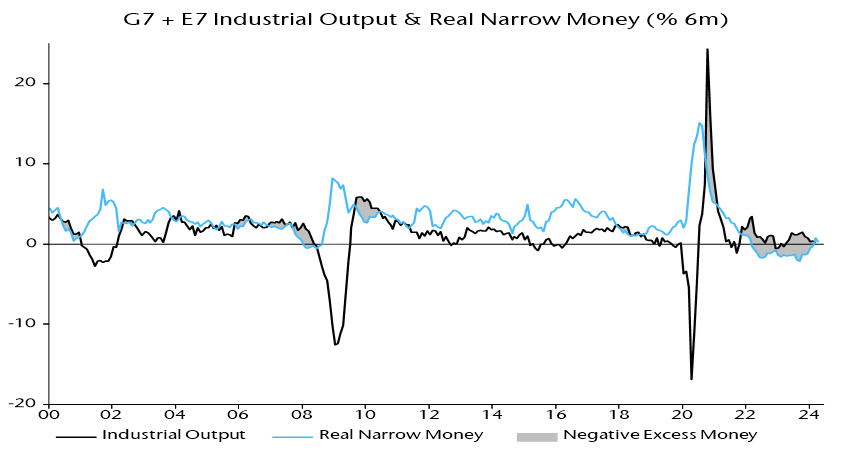
Additionally, the global excess money backdrop – proxied by the gap between real money and industrial output growth – may now be entering positive territory because of inflation peaking and industrial momentum weakening. The surplus liquidity can find its way into unloved financial assets, including EM equities. Prospective central bank pauses / reversals will sustain the trend.

Global “excess” money turning positive?
NSP_COMM_2024-07-17_Chart05Source: NS Partners and LSEG Datastream.
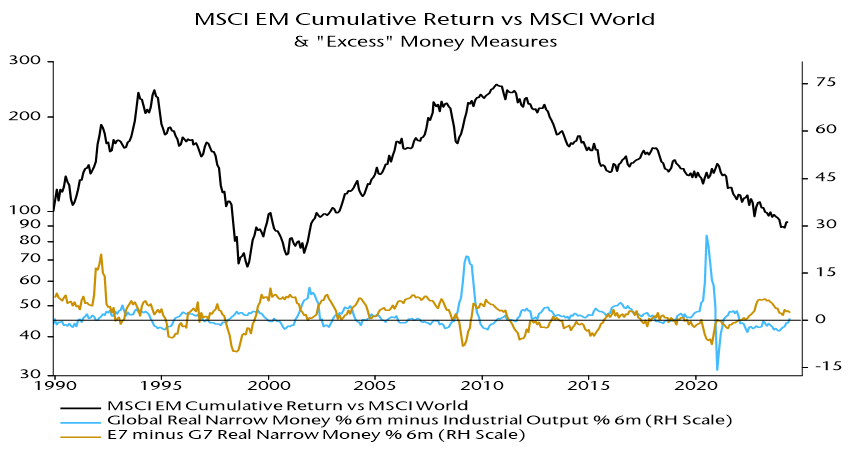
This is what we call a “double positive” liquidity environment, and could signal improving prospects for EM equities. In periods where these two monetary indicators have lined up this way, EM equities have outperformed MSCI World by an average of 10.5% per annum. Periods of EM outperformance are indicated in the shaded areas of the chart below. They line up nicely with the double positive.

EM relative performance & monetary indicators
NSP_COMM_2024-07-17_Chart06Source: NS Partners and LSEG Datastream.
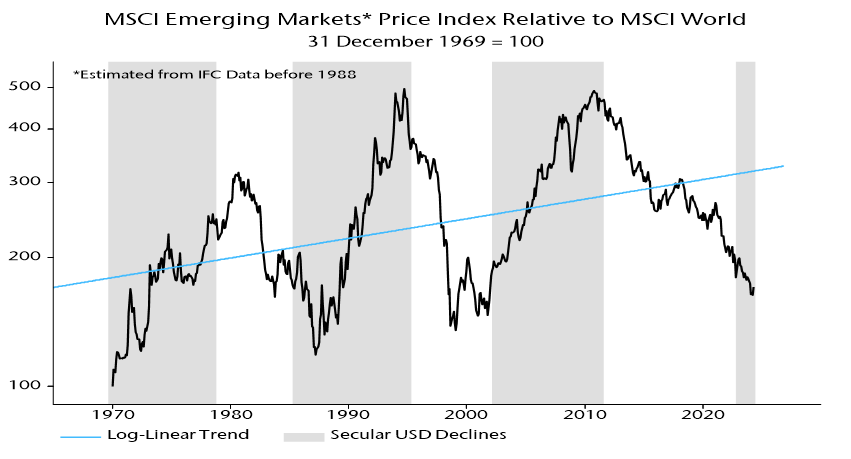
King Dollar

The vicious and virtuous cycle diagrams above hint at just how important the dollar is as a driver of price and fundamental momentum in emerging markets.

The chart below illustrates just how large a tailwind or headwind the dollar can be for the asset class.

EM outperformance during secular USD declines
NSP_COMM_2024-07-17_Chart07-revSource: NS Partners and LSEG Datastream.
The relative performance drawdown for EM versus global equities during the last dollar bull market is in line with previous dollar bull markets, but the period over which this has occurred is roughly twice as long. The risk for investors fatigued from such an extended period of relative underperformance is capitulation right as the asset class is primed to outperform.

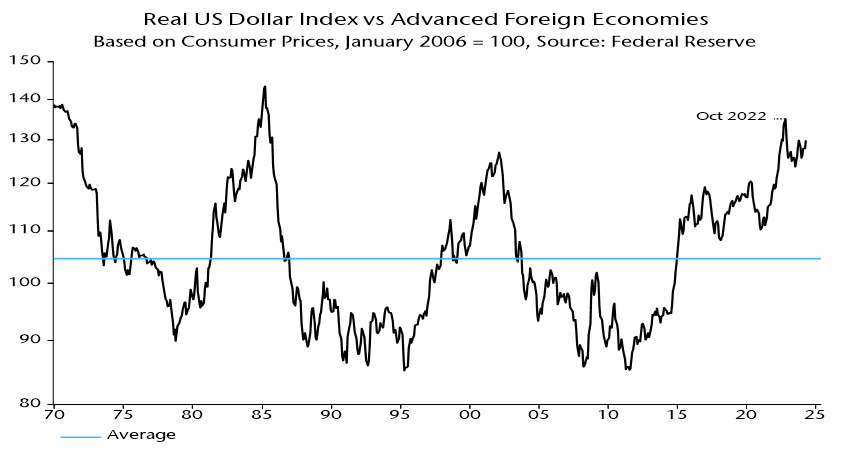
The real trade-weighted dollar is far above its long-run average and may have reached another secular peak in October 2022 – recent strength has failed to take out this high.

October 2022 USD peak?
NSP_COMM_2024-07-17_Chart08-revSource: NS Partners and LSEG Datastream.

The combination of monetary easing as inflation falls coupled with a weaker US dollar would provide a favourable backdrop for the outperformance of EM equities. Likely easing by the US Federal Reserve later this year will provide further scope for emerging market central banks to cut rates, allowing the credit cycle to move from stabilisation/recovery into expansion, providing support to economic and corporate earnings growth.

Such a pick up would encourage allocators oversaturated with US exposure to send marginal flows to emerging markets. With positioning at such extreme relative lows, even a small shift would be significant and another potential catalyst for entry into a virtuous cycle.

New Parliament House in New Delhi, at night.

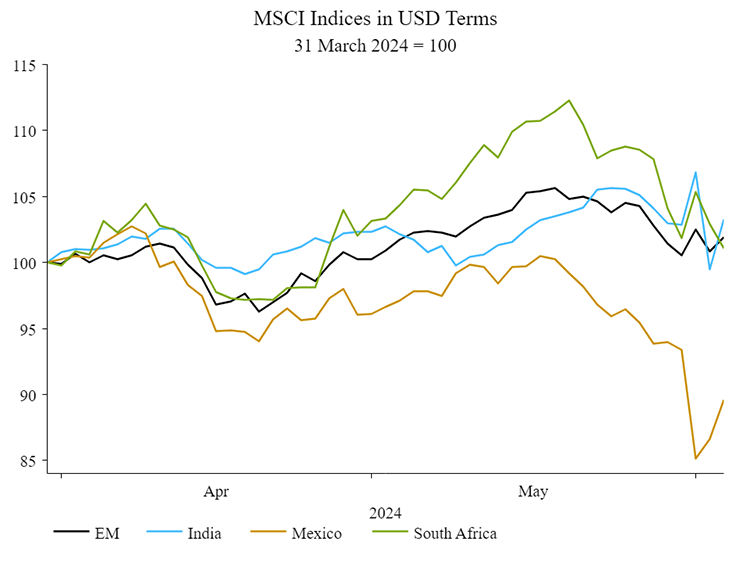
The futility of pollsters was on full display in India, Mexico and South Africa this month. Prime Minister Narendra Modi’s BJP fell short of expectations for a landslide in India. In Mexico left-wing party Morena took the presidency as expected, but came surprisingly close to a supermajority in Congress. In South Africa, the dismal performance of ruling party ANC opens up a new era of coalition politics.

Political risk spiking in these countries has fuelled some wild swings in their stock markets.

All three markets took a hit on election uncertainty through May-June
Line graph showing index performance across India, Mexico and South Africa compared to Emerging Markets, from May to June 2024.
Source: NS Partners and LSEG Datastream.
Political risk is a factor that we consider as part of our macro analysis, which we know is crucial in EM investing. Fundamentals alone will not save you when the macro is headed south and the risk premium spikes. Outperforming in EM is about finding the right stock in the right country.

India

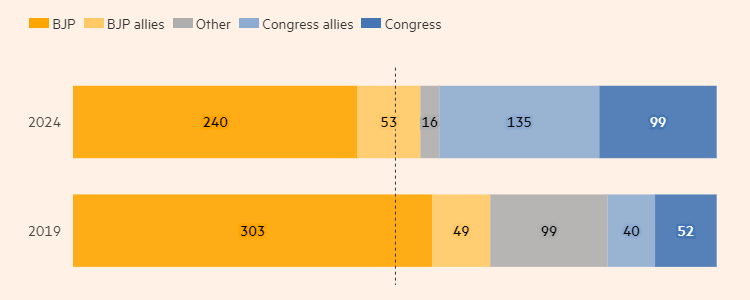
India’s Modi is set to become the first Prime Minister to serve three consecutive terms since the first post-colonial leader, Jawaharlal Nehru (Congress Party). Early June exit polls sent expectations (and stocks) soaring for Modi’s BJP to storm home to victory and claim as many as 400 hundred seats out of 543 in India’s lower house. Stocks exposed to infrastructure led the way on the expectation that a strong mandate would allow Modi to pursue a growth/investment-focused manifesto.

Instead, the BJP failed to claim a majority on its own and will have to rely on the support of regional allies to form government.

Seats won in the 2024 and 2019 elections
Bar graph comparing India election results in 2019 to 2024.
Source: Financial Times & Indian Electoral Commission, June 2024.

BJP strongholds crumble

The BJP ran on a record of positive reform over the past decade which has fuelled economic growth that has lifted millions out of poverty, cracked down on corruption, and built out electrification and sanitation access across the country. Tax reform also led to a doubling of tax revenue that has been reinvested into developing critical infrastructure, including freight railway lines and ports. Personalised rule and a presidential-style campaign positioned Modi as the figurehead of such rapid progress. At the outset of the campaign, approval ratings for the Indian PM were among the highest for any major democracy in the world.

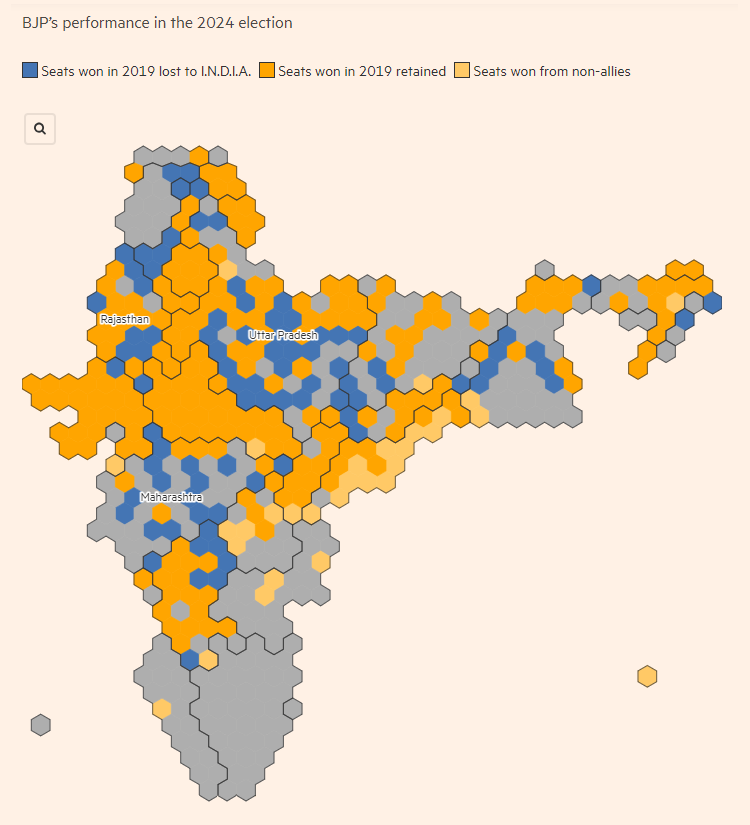
Yet the damaging swing against the BJP came from the party’s Hindi-speaking northern heartland. The opposition INDIA alliance was able to peel away BJP supporters by targeting poorer rural communities feeling the effects of high inflation and unemployment.

Loses in Uttar Pradesh were pivotal
Decorative.
Source: Financial Times, June 2024.

Positive structural story intact

Modi nevertheless claimed victory in a coalition with regional allies known as the National Democratic Alliance. Despite the surprise verdict, it is unlikely that Modi will be prevented from pursuing his agenda barring a few tweaks likely to increase social spending. This may dilute business sentiment and infrastructure spending in the near term, while consumption should remain robust.

One positive is that the result should alleviate fears Modi would use a supermajority to pursue regressive constitutional changes.  On the other hand, there also is a higher risk that a diminished Modi, a pro-growth moderate within the BJP, could cede influence to nationalist elements who will have more sway over a leadership transition.

Overall, our expectation for markets is some profit taking in the short term, while the long term structural story remains very positive.

South Africa

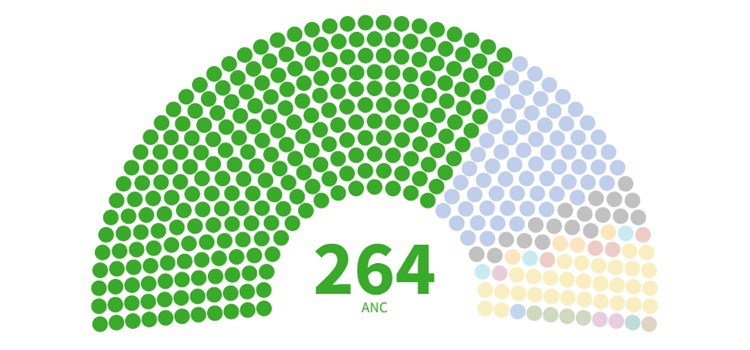
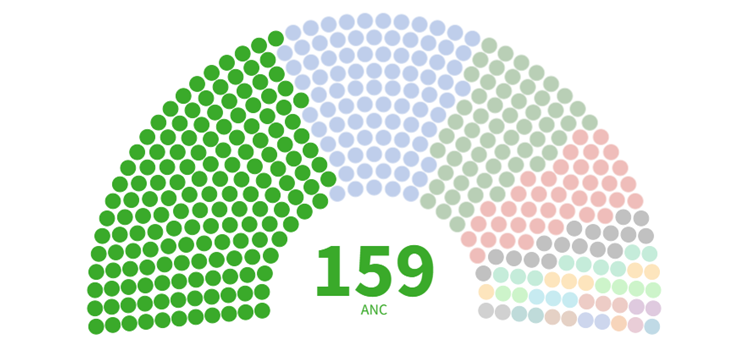
The African National Congress (ANC), South Africa’s dominant political party having governed since 1994, was rebuked by voters for having presided over a polycrisis in the economy, energy and law and order. The scale of the result was the surprise, while uncertainly looms over the make-up of a governing coalition.

The ANC fell a long way short of a majority, commanding only 159 seats of the 400 in the National Assembly. The graphics below illustrate just how sharply ANC support has fallen from a once commanding position.

2009 ANC National Assembly share
Decorative.

2024 ANC National Assembly share
Decorative.
Source: Daily Maverick, May 2024.

The result could mark the beginning of a new era of politics in South Africa. Much like with the decades-long decline of the Congress party in India, the ANC as a post-colonial liberation movement finds itself out of step with the challenges that confront the country today.

Uncertainty and opportunity

The horse trading to form a coalition government within the next two weeks is now underway. The worst outcome, a deal with a radical breakaway party such as disgraced former president Zuma’s MK, who wants to ditch South Africa’s constitution, is off the table, while a direct deal with Julius Malema’s socialist EFF won’t command a majority.

A coalition between ANC and the second largest party Democratic Alliance (DA) is clearly the outcome markets are cheering for, the most likely outcome is for the ANC to kick the can down the road through a multiparty alliance that should disintegrate within 12 months. The result of this may well be a broader re-alignment of South African politics. No doubt this will be a time of high uncertainty, but there is also a chance that some political creative destruction will act as a catalyst for positive change.

Mexico

While the election of Claudia Sheinbaum to Mexico’s presidency was widely expected, the surprise was her left-wing Morena party running close to a parliamentary supermajority. Mexican stocks tumbled 12% and the peso fell on the result as investors fret that a stronger mandate for Morena will allow Sheinbaum to carry on with the agenda of outgoing president Andrés Manuel López Obrador (AMLO).

AMLO’s chequered legacy

AMLO leaves office with high approval ratings owing in part to large cash transfers from the state and minimum wage hikes that lifted over five million Mexicans out of poverty during his term (The Economist (November 2023): Andrés Manuel López Obrador has reduced poverty in Mexico, but he could have done better). In contrast to India’s Modi alleviating poverty through reform-driven economic growth, critics argue AMLO achieved this by diverting funds away from education and healthcare.

Is Morena a threat to Mexico’s democratic institutions?

Crucially for investors, AMLO and Morena are pursuing policies that could threaten Mexico’s institutions. Institutional quality is a key factor in determining whether a country moves up the economic development ladder. Throughout his term, AMLO threatened to attack institutions on the notion that they have been corrupted by neoliberal partisans. His term also saw the military play a growing role in domestic affairs, becoming involved in major infrastructure projects, tourism and customs oversight, and the militarisation of domestic security as a response to rising cartel violence (which proved ineffective).

Investors fear that a strengthened mandate will allow Sheinbaum (or even an outgoing AMLO) to undermine judicial independence, and pursue plans to eliminate autonomous government agencies overseeing telecoms, energy and access to information, as well as weaken electoral supervisory bodies.

Hopes for fiscal discipline

Finance Minister Ramírez de la O has been credited with steering AMLO away from the fiscal profligacy characteristic of so many socialist leaders in Latin America. Markets have welcomed his return in Sheinbaum’s cabinet, with the leader tweeting a series of pledges concerning the economy following a recent meeting with the Minister:

  1. A fiscal consolidation in 2025 of 3% of GDP to stabilize public finances and the overall debt/GDP ratio;
  2. Maintain an open dialogue with the investor community and rating agencies to reiterate the new government’s priorities: economic stability, fiscal prudence and feasible fiscal targets.
  3. Work closely with Pemex [state-owned oil company] and take advantage of the government’s support in Congress to “optimize the use of public resources.”
  4. Reiterate to international organizations and private investors that the government’s project is based on fiscal discipline, preserving and protecting Banco de México’s independence, a commitment to the rule of law, and incentivising domestic and international private investment.

We are encouraged that the incoming administration is clearly looking to soothe frayed market nerves.

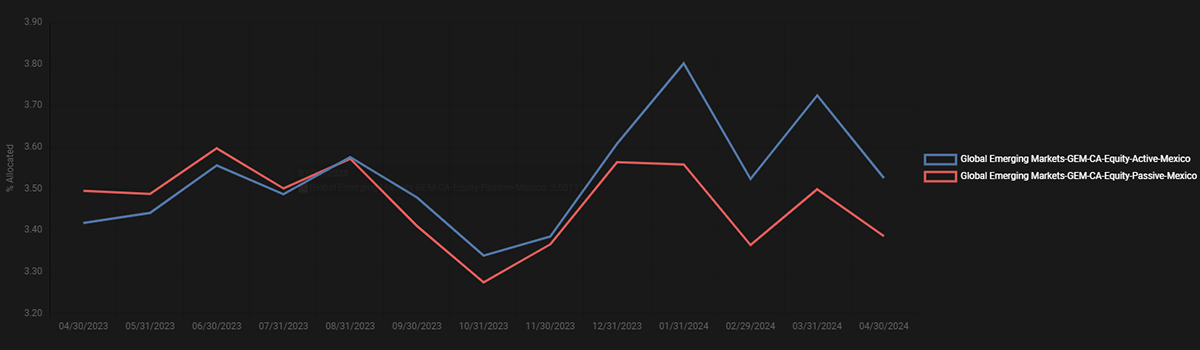
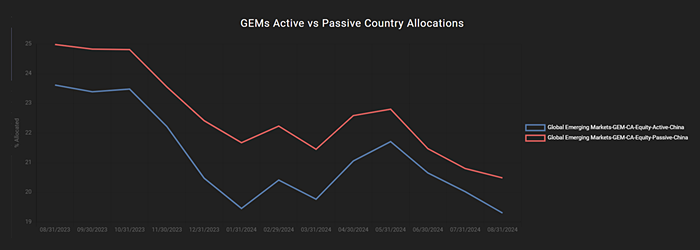
Mexico has been a favourite for most GEM managers

We have been in the minority of GEM investors to remain underweight the market on concerns over political risk, an overvalued currency and exposure to a US slowdown.

GEMs active vs. passive country allocations
Line graph comparing global emerging markets active and passive index country allocations from April 30, 2023 to April 30, 2024.
Source: EPFR, June 2024.

That’s not to say there isn’t real potential – the trend of global supply chain reshoring and Mexico’s geographic proximity to the powerhouse economy of the US leaves it well-positioned to harness a major structural tailwind in the years ahead.

However, making the most of this opportunity hinges on the dynamism of Mexico’s private entrepreneurs, supported by strong institutions. The question is whether Morena under Sheinbaum can resist their worst instincts.

Female engineer using a tablet computer at an electronics factory, monitoring the progress through online software.

Profiting as an investor occurs in the delta between expectations and reality. One example is the boom in enthusiasm for AI stocks being fuelled by blockbuster earnings of industry monopolies such as Nvidia consistently outpacing consensus forecasts.

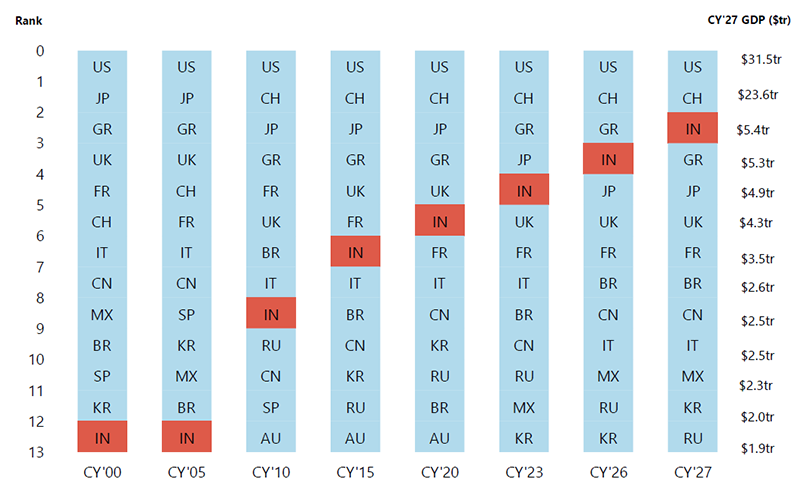
In emerging markets, India’s bull market stands out as the obvious example of this. India has long appeared perpetually expensive to investors relying on mean reversion tables. The problem with this approach is that expectations may be out of kilter with reality when there is structural change occurring – much like in the new AI frontier and the domain of the economy is expanding. The chart from Jefferies below illustrates this structural shift.

India is climbing the development ladder – on track to be the 3rd-largest economy globally
Bar graph showing India’s GDP growth from 2000 projected to 2027.
Source: Jefferies, Q1 2024.

A succession of reforms in Modi’s India is unlocking a virtuous circle of development, including:

  • Sanitation in every village empowering women in rural areas to become economic agents.
  • Establishing a nationwide digital payments network accessed through biometric identification, allowing even the illiterate to transact and access welfare payments.
  • That network allows the government to accurately calculate what taxes citizens owe, which has seen the state tax take double in around five years.
  • Higher government revenues alongside private investment are helping to fuel a new capex cycle, targeting electrification, ports, freight and telecommunications infrastructure.

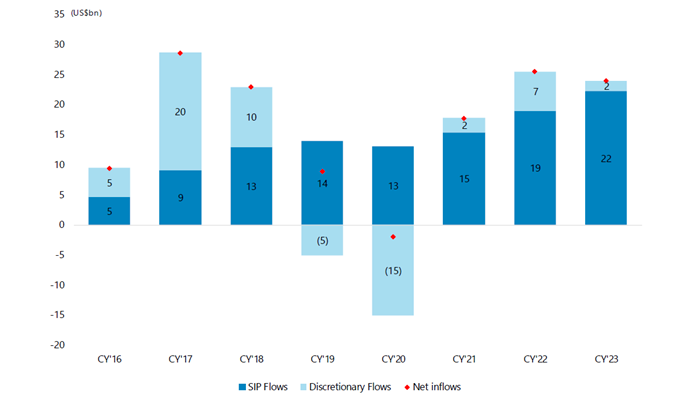
The self-reinforcing nature of these reforms fuels the growth of what will become an enormous Indian middle class, whose consumption habits will evolve as they become wealthier. This surge in new wealth is also fuelling the rise of domestic pension funds, which are biased to equities given India’s young population and long investment horizon.

Careful relying on mean reversion when there is structural change
Bar graph showing net inflows into equity mutual funds from 2016 to 2023.
Source: Jefferies, Q1 2024.

Local allocators are more incentivised than foreigners to drive Indian corporates to improve corporate governance and returns for minority shareholders. This feeds into improving domestic liquidity, where it is increasingly local allocators that set the price in Indian equities, not fund managers in London or New York.

As investment strategist Keith Woolcock pointed out a few months ago commenting on the AI boom, there are times when valuation is the “alpha and omega of investing but most often it is not.” The same applies to India, where simple mean reversion can mean that investors miss the potential for upside surprise when positive structural change is occurring.

Is the bear market over in China?

China presents us with the flipside of the above – 1) longer-run structural risks as institutional quality deteriorates under Xi Jinping, which risks the country getting stuck in the middle-income trap; 2) this deterioration depressing the animal spirits of consumers and entrepreneurs who are less confident about the future; and 3) the rigid commitment of authorities to fiscal and monetary orthodoxy even at the risk of a deflationary bust.

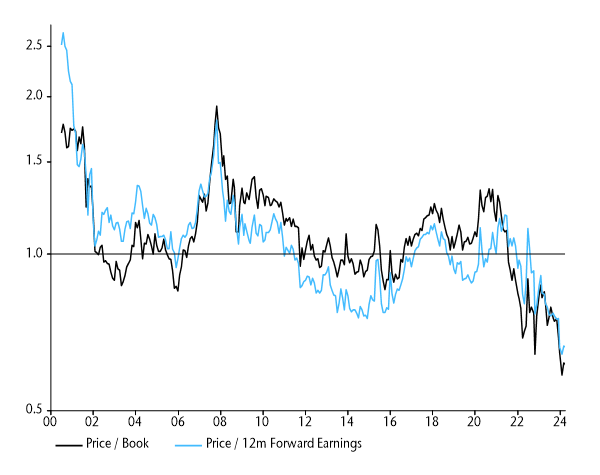
This gloomy backdrop has seen foreign investors abandon the market, with Chinese equities halving since 2021. At 10x CAPE, China now trades at a record discount to the rest of EM, pricing in a dire economic outlook.

China now trades at a record discount to the rest of EM
Line graph comparing the MSCI China Index price/book and forward P/E ratios to the MSCI EM ex China Index from 2000 to 2024.
Source: NS Partners, LSEG Datastream.

However, prices being driven to such depressed levels eventually exhausts the sellers to the point that a market can rebound even before a recovery in the economy or corporate earnings gain real steam.

Are we starting to see this in China?

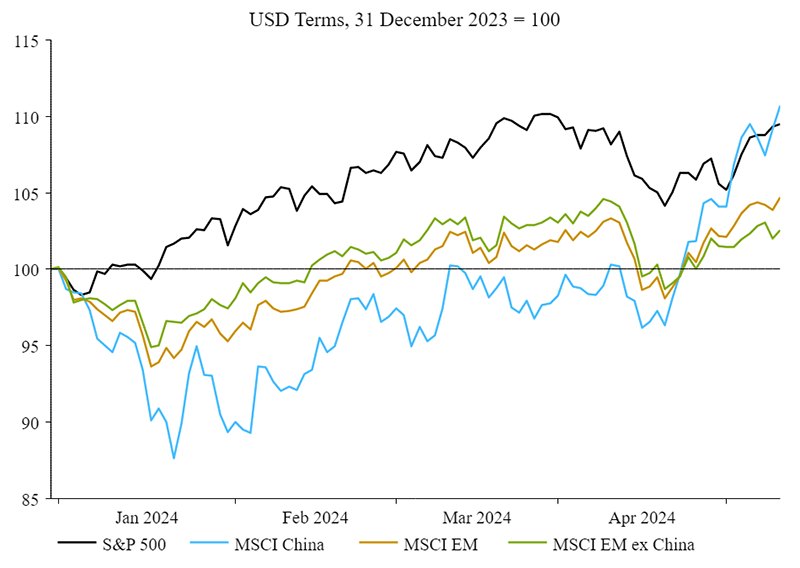
Chinese equities have outpaced even the S&P500 this year
Line graph comparing the performance of the S&P 500 Index, MSCI China Index, MSCI EM Index and MSCI EM ex China Index from January to May 2024.
Source: NS Partners, LSEG Datastream.

Chinese equities have so far outpaced even the US, including an S&P500 Index dominated by the Magnificent-7 tech giants.

We have been writing to our investors for some time about the gradual economic recovery taking place in China, the steady improvement in earnings growth among corporates, and ratcheting up of fiscal and monetary support (but without the stimulus bazooka). Animal spirits remain broadly depressed, and risks lurk within property and the banks. However, with much of this pain priced in and with positioning in China at such depressed levels, all it takes is for a slight pick up ahead of expectations to ignite a rally.

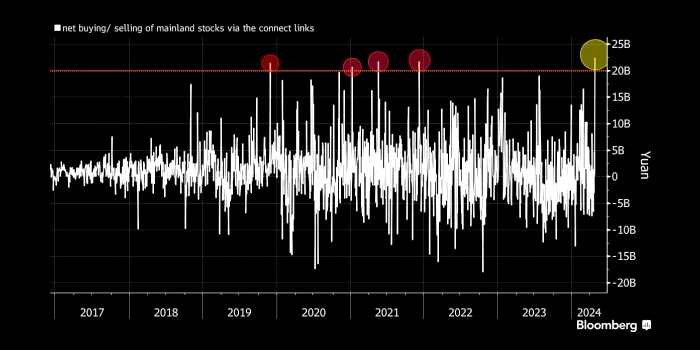
Short positioning in Chinese equities has begun to unwind (falling by a third in China A-shares over the period), while GEM managers tentatively reduce underweight positioning. Indeed, April was a record month for foreign flows into Chinese equities.

Foreign buying of China stocks tops record

Foreign flows into China equities from 2017 to 2024.
Source: Bloomberg.

There are a number of reasons to think that the rally can be sustained:

  • Positioning across GEM and global equity portfolios remains light, leaving plenty of headroom for allocators to add exposure and chase the positive momentum (forming a virtuous circle).
  • Policymakers, and most importantly Xi Jinping, have acknowledged the severity of the economic malaise and have pledged more aggressive measures to avoid a bust.
  • Company earnings are strengthening across several industries including travel, exporters and names aligned with key policy aims such as energy security, automation and import substitution.
  • The market is (finally) beginning to reward earnings beats.

This rally could carry on for some time. However, in contrast to India where we are more willing to run winners given the positive structural tailwinds driving the market, our bias is to be more conservative in China as the longer-term structural story remains negative.

China risks getting stuck in the middle-income trap so long as Xi continues to favour greater state control over rekindling the animal spirits and creative dynamism of entrepreneurs. However, much like in Japan’s lost decades, there were opportunities to take advantage of that delta between reality and depressed expectations, which precipitated sharp trading rallies. Also much like Japan, China’s deep universe of companies will offer up a rich opportunity set for active managers to generate alpha, even when running structurally lower exposure to the market.

Image alt text: Upper left: Old Town Warsaw, Poland during sunset. Lower right: Sunrise over The Blue Mosque, Istanbul, Turkey.

In March, our team embarked on a two-week trip to two of the most dynamic economies within Emerging Markets: Poland and Turkey. During our visit, we engaged with companies spanning a variety of industries – from construction and renewable energy to waste management, IT, commercial services, airlines and airport operators. Also, we gained insights into the consumer sector, meeting with leaders in production and distribution for a wide range of consumer products, including confectionery, fast food, denim, automotive, electronics, soft drinks and beer. The trip’s objective was not only to check up on existing holdings but also to identify nascent opportunities and understand the challenges these businesses face.

Poland’s optimistic outlook

It has been a year since our previous visit to Poland. During that visit, we observed consumers struggling with high inflation, wage growth continuing to decline, public concerns around the upcoming parliamentary elections and hopes for a swift resolution to the war in Ukraine, which would bring peace and vast opportunities for Polish companies.

We were happy to see a rise in optimism regarding these concerns during our latest visit. Most of our interviewees were more bullish this time around. Post the parliamentary elections, we sensed a renewed optimism as a pro-European Union (EU) coalition regained power. The new Polish government seems committed to mending relations with the EU, having successfully unblocked the first tranche of €76 billion frozen by the European Commission due to legal concerns after judicial reforms by the former government. Since joining the union, Poland has been a significant beneficiary of EU funds, receiving approximately €164 billion from 2004 to 2020. For context, Poland’s GDP was €750 billion last year. These substantial financial inflows have contributed to various crucial projects across the country, enhancing infrastructure and improving structural economic growth and overall wellbeing​. No wonder these EU funds are expected to drive economic growth for several years to come. Coming in the form of grants and low-interest loans, this financing is mainly for funding infrastructure and renewable energy projects.

Contrary to last year, this time we saw consumers in Poland enjoying strong real wage growth of around 10%, with no labour market slowdown. With inflation easing to low single digits in the first quarter of 2024, these factors create a conducive backdrop for the robust recovery of Polish consumers. Growing disposable income is likely to not only rebuild their savings but also drive rebound in consumption.

However, the road ahead may be bumpy due to potential inflation spikes in the second half of 2024 on the back of higher energy prices, a VAT hike on groceries, fulfillment of costly pre-election commitments, domestic political tensions and the potential escalation of the ongoing war in Ukraine. The war remains one of the major risks to the region and was a frequent topic in our conversations, not only with corporate executives but also with ordinary citizens. Centuries of conflict between Poland and Russia have left deep scars in the psyche of the average Polish citizen.

Turkish economic reforms and investor confidence

In Turkey, a surprising pivot to orthodox monetary policy last year reignited hopes for economic normalization, buoyed the local stock market and turned foreigners in net buyers for the first time since 2019. Committed to controlling escalating inflation, the central bank raised its key policy rate from 8.5% in June 2023 to a staggering 50% in March 2024. Moreover, the monetary authority signaled its readiness for further rate hikes if necessary. Investors welcomed the government’s adoption of market-friendly measures, which drove the Turkish stock market higher by over 30% in US-dollar terms since the first hike last summer. Simultaneously, foreign reserves have started to recover, sovereign credit spreads have tightened to multi-year lows and the current account balance is expected to get meaningful support from the tourism season starting in May.

Although the recent municipal elections marked a significant defeat for the current leadership, President Erdogan reiterated policy continuity and his commitment to an economic turnaround program in the second half of the year. With no elections for the next four years, the government has time to tackle inflation and achieve long-awaited results. However, this requires the implementation of further austerity measures, including fiscal ones. Current market expectations see inflation peaking in May above 70% before declining to 30%-40% by year-end. However, potential new rounds of minimum wage hikes, premature rate cuts and higher energy prices continue to threaten the turnaround policy and could derail efforts to reduce inflation and improve the trade balance.

Nearshoring opportunities

Despite being influenced by very different forces, Poland and Turkey share some commonalities. In the last few years, the term “nearshoring” has become strongly associated with Mexico and Vietnam. We explored the impact on the Mexican economy in a previous commentary. However, Poland and Turkey have turned out to be underappreciated beneficiaries of supply chain shifts toward near- or friendshoring as a way to reduce reliance on China. Nearshoring opportunities repeatedly came up in our discussions with corporates in both countries. We see Poland as a launching pad for opportunities into Western Europe and hard-to-access markets in the east like Hungary, Romania and Bulgaria. Similarly, Turkey offers a gateway to explore opportunities in CIS countries and less liquid frontier markets. We highlight one such opportunity below.

As bottom-up investors, we focus our macroeconomic analysis primarily on enhancing the risk management aspect of our portfolio management. When investing in highly turbulent economies, we prefer to stick to companies that we believe can succeed even when their domestic economies face challenges. Additionally, we look to benefit from a possible decline in country risk premiums in the event of macro normalization.

Investment spotlight: Coca-Cola Icecek and Mo-BRUK

Our largest position in Turkey is Coca-Cola Icecek (CCOLA TI), a coke bottler. In the last 20 years, the company has evolved from a single-country operator to the third-largest coke bottler globally, with a footprint spanning 12 countries and 600 million people. Icecek generates less than 30% of its EBITDA in Turkey, with Pakistan, Kazakhstan, Uzbekistan and another eight countries in the Middle East and Central Asia accounting for the major part of the business. Robust strategic alignment with The Coca-Cola Company, combined with Icecek’s proven record of successful integration, positions it as the preferred partner for further consolidation of Coca-Cola’s bottling operations in the region.

Bangladesh is the recent addition to Icecek’s portfolio. It is a country with over 170 million people and a heavily underpenetrated non-alcoholic beverage industry poised for double-digit volume growth over the next decade. This positions Icecek well to replicate its successful strategy of distribution network enhancement to ensure product availability, build infrastructure and enrich merchandise offerings. Leveraging its leading brand portfolio and a highly experienced management team, Icecek is set to continue capitalizing on the vast potential of its markets.

Mo-BRUK (MBR PW) is a waste management company in Poland specialized in processing hazardous waste. The founding family established the business more than 30 years ago and has built a strong franchise in an industry characterized by high entry barriers. The company does not operate landfills and focuses solely on processing waste. EU regulations on waste management create significant tailwinds for the industry in Poland, as the country must undertake considerable efforts to meet EU objectives. Due to its specialization in hazardous waste and limited competition due to entry barriers, Mo-BRUK enjoys superior business economics. High margins are driven by volume growth and technology improvements, as well as price hikes due to limited capacities in the country. In terms of growth strategy, the company is conducting several expansion projects within available permits. At the same time, it is filing for new permits. Remediation of the illegal landfills or so-called ecological bombs represents an attractive business for Mo-BRUK, but it is highly dependent on the budget allocation by municipalities. The cadence of such projects is erratic, but the company intends to participate in all tenders as they are announced. Additionally, the management team sees multiple consolidation opportunities in the country. In late-2023, Mo-BRUK acquired two independent operators that not only provided the company with scarce permits but also expanded its footprint in northern Poland.