The planet is 70% covered by water. Freshwater, which is what we drink and irrigate our farm fields with, represents 3% of the world’s water; two thirds of that number tucked away in frozen glaciers.

According to the World Health Organization (WHO), 33% of the global population finds water scarce for at least one month of the year, exposing them to diseases such as cholera, typhoid fever, and other waterborne illnesses, resulting in two million fatalities. At the current consumption rate, 66% of the world’s population may face water shortages by 2025. As these changes occur, water consumption will further become a strategic asset negotiated for agriculture, industrial use, and personal consumption.

Many coastal agglomerations have been able to plan personal water consumption with natural gas fueled desalination. This strategy can be onerous given the ongoing present energy crisis. Inland rural developments, which have exploded with COVID-19, are more affected by severe droughts. Australia is the poster child for this situation. Australians have been dealing with economy-changing droughts for decades and are already experts at rationing water. Rural expansion continues to be an important growth driver that further stresses the effects of droughts.

On August 16, the United States (US) federal government declared a Colorado River water shortage for the first time as water basins reached critical levels. This will have a material impact on agricultural goods in North America as the region produces a large percentage of winter crops. Companies with better water strategies will outperform.

Global Alpha holds Limoneira (LMNR:US), a leading citrus grower in California, a state that uses an excess portion of its share of the Colorado River. Their plantings are located in Ventura, Tulare, San Bernardino, and San Luis Obispo Counties in California and Yuma, Arizona and La Serena, Chile. The plantings consist of approximately 5,000 acres of lemons, 900 acres of avocados, 1,600 acres of oranges, and 1,000 acres of specialty citrus and other crops.

Unlike many growers, Limoneira owns important water rights, including rights on 17,000 acre-feet of water in California and 11,700 acre-feet of water sourced from the Colorado River, of which only 8,600 acre-feet are currently used for irrigation. The majority are categorized as priority rights, and these rights will increase in value as we start to restrict the usage of the Colorado River outflow.

Other North American Global Alpha holdings that play an important role in water distribution include Lindsay (LNN:US). The company pioneered crop irrigation with the Zimmatic pivot irrigation systems. We also own Primo Water Corporation (PRMW:US), the leading distributor of non-disposable drinking water in North America.

Continuing on crop performance, Global Alpha holds Sakata Seeds (1377 JT), an agriculture seed developer based in Japan. One of their leading technology efforts is developing seeds that can grow in arid environments. We also hold Horiba (6856 JT), which makes testing equipment, part of their environmental franchise. Also, water testing is set to grow in their portfolio of products.

Droughts not only affect crops but also hydroelectricity generation, which is notably 17% of China’s energy generation, 65% of Brazil’s, and 60% of Canada’s. Norway reached 95% of internal electrical generation (Statista 2021), enough for the country to recently complete large hydro export investments (PowerTechnology, 2021).

Norway had a grand scheme of being the green battery of Europe with its abundant water reservoirs to export electricity. These plans are on hold as droughts has dwindled the Norwegian water supply enough to exacerbate the European energy crisis. Hydroelectric power is critical to base load power.

Global Alpha holds Landys and Gear (LAND SW). The company is a key player in smart metering with the largest install base outside of China. We expect regulations to increase drastically in the future as water and electricity output become highly managed resources. Landys and Gear markets should continue to grow at an above-average rate.

More than a quarter of Australian homes collect and store rainwater for domestic use. It will become interesting how dry countries, such as Australia and Israel, can transfer their expertise to regions who are now experiencing droughts such as Western Europe.

According to a January 2020 report by Markets and Markets, the global smart water management market size is expected to grow to USD 21.4 billion by 2024, at a compound annual growth rate (CAGR) of 12.9%.

Desalination represents a potential solution to many water issues despite its negative environmental footprint from energy usage and residual effluent. Reverse osmosis is also reaching its limits in terms of performance. Inexpensive green power and desalination technologies are therefore required. The use of wastewater has also reduced the cost of desalination to $1,500 per acre-foot from $2,500. By comparison, a San Diego agglomeration needs to pay $1,200 per acre-foot for fresh water from the Colorado River.

Globally, more than 300 million people now get their water from desalination plants, from the Southwest US to China. The Middle East accounts for 47% of all desalination, while East Asia Pacific and North America hold 15% of desalination capacity.[3]

As we can clearly see, water consumption, agriculture, and electricity generation are key interlinked industries that can provide important growth drivers in our investment universe. As always, Global Alpha remains keen to benefit from these growing trends.

Have a nice day.

The Global Alpha team
The forecasting approach employed here – relying on monetary and cycle analysis – turned positive on the global economy and risk markets in early Q2 2020 but is giving a more cautionary message at the start of 2021. The suggestion is that underlying economic momentum will slow temporarily while monetary support for markets has diminished, together raising the risk of a correction. The central view remains that global growth will be strong over the course of 2021 as a whole but with the adverse corollary of a significant pick-up in inflation into 2022.

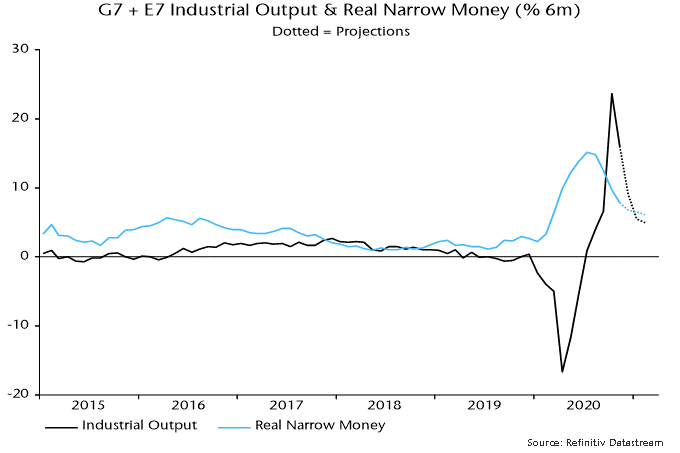
The monetary aspect of the forecasting approach can be summarised as “real money leads the economy while excess money drives markets”. Six-month growth of real (i.e. inflation-adjusted) narrow money in the G7 economies and seven large emerging economies (the “E7”) was weak at the start of 2020 but surged from March, correctly signalling a strong rebound in global economic activity during H2.

Real money growth, however, peaked in July, falling steadily through November, the latest data point – see chart 1. Turning points in real money growth have led turning points in the global manufacturing PMI new orders index – a key coincident indicator – by 6-7 months on average historically, suggesting that the PMI will move lower in early 2021. The level of money growth remains high, arguing against economic weakness (except due to “lockdowns”), but a directional shift in activity momentum could act as a near-term drag on cyclical assets.

Chart 1

“Excess” money refers to an environment in which actual real money growth exceeds the level required to support economic expansion, with the surplus likely to be invested in markets. Two gauges of excess money are monitored here: the gap between six-month growth rates of G7 plus E7 real narrow money and industrial output, and the deviation of year-on-year real money growth from a long-run moving average. Historically, global equities performed best on average when both measures were positive, worst when they were negative, and were lacklustre when they gave conflicting signals.

Following a joint positive signal (allowing for data release lags) at end-April 2020, the measures became conflicting again at end-December – year-on-year real money growth remains well above its long-run average but six-month growth fell below that of industrial output in October / November. Markets, therefore, may no longer enjoy a monetary “cushion” against unfavourable news, including the expected PMI roll-over.

The expectation here is that markets will become more volatile but risk assets are unlikely to be outright weak – any sizeable set-back would probably represent another buying opportunity. As noted, real money growth remains at an expansionary level and may stabilise soon, while the cycle analysis is giving a positive economic message for the next 12+ months, as explained below.

The cross-over of six-month real narrow money growth below industrial output growth, moreover, could prove short-lived, with output momentum about to fall back sharply as positive base effects fade. Assuming a stabilisation of monthly money growth, a positive differential could be restored as early as January – see chart 2 – in which case the assessment of the monetary backdrop for markets would shift back to favourable from Q2.

Chart 2

The cycle analysis provides a medium-term perspective and acts as a cross-check of the monetary analysis. There are three key economic activity cycles: the stockbuilding or inventory cycle, which averages 3.5 years (i.e. from low to low); a 9-year business investment cycle; and a longer-term housing cycle averaging 18 years. These cycles are essentially global in nature although housing cycles in individual countries can sometimes become desynchronised.

The cycle analysis was cautionary at the start of 2020, reflecting a judgement that the stockbuilding and business investment cycles were in downswings that might not complete until mid-year. The covid shock magnified but ended these downswings, with both cycles bottoming in Q2 and entering a recovery phase in H2. With the housing cycle still in an upswing from a 2009 low, all three cycles are now acting to lift global economic momentum.

The next scheduled cycle trough is a low in the stockbuilding cycle, due to be reached in late 2023 if the current cycle conforms to the average 3.5 year length. The downswing into this low would probably start about 18 months earlier, i.e. around Q2 2022. The cycle analysis, therefore, is giving an “all-clear” signal for the global economy for the next 15-18 months, implying that any data weakness – such as suggested by monetary trends for early 2021 – is likely to be minor and temporary.

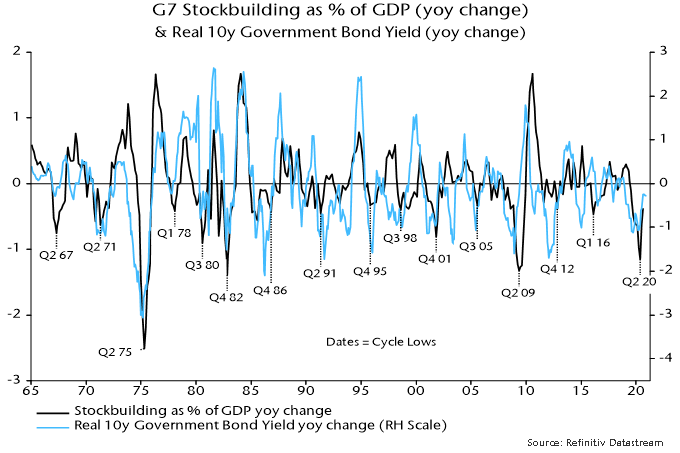
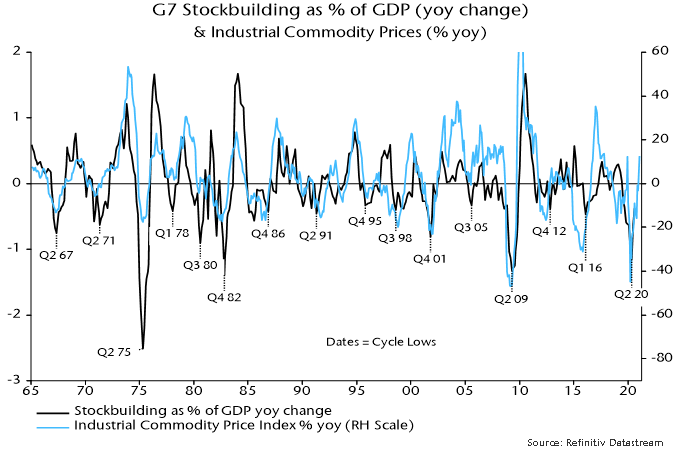
Financial market behaviour is strongly correlated with the stockbuilding cycle in particular. Cycle upswings are usually associated with rising real government bond yields and strong commodity markets – see charts 3 and 4 – as well as low / falling credit spreads and outperformance of cyclical equity sectors. The latter three of these trends, of course, were in place during H2 2020 and may extend during 2021 after a possible Q1 correction. A surprise to the consensus in 2021 could be a rebound in real bond yields, which would challenge current equity market valuations and could favour “value”.

Chart 3

Chart 4

To sum up, monetary data in early 2021 will be important for the strategy assessment here. The current monetary backdrop and possible weaker near-term economic data suggest reducing cyclical exposure relative to H2 2020 but a stabilisation or revival in real money growth would support the positive message from the cycle analysis, arguing for using any setback in cyclical markets to rebuild positions in anticipation of a strong H2.

Consumer price inflation rates are widely expected to rise during H1 2021, reflecting recent commodity price strength, a reversal of temporary tax cuts (Germany / UK) or subsidies (Japan), and base effects. The policy-maker and market consensus is that this will represent a temporary “cyclical” move of the sort experienced regularly in recent decades. The suspicion here is that it will prove more lasting and significant, because the monetary backdrop is much more expansionary / inflationary than before those prior run-ups.

Broad rather than narrow money trends are key for assessing medium-term inflation prospects. This is illustrated by Japan’s post-bubble experience: narrow money has grown strongly on occasions but annual broad money expansion never rose above 5% over 1992-2019, averaging just 2.1% – the monetary basis for sustained low inflation / mild deflation. Similarly, G7 annual broad money growth averaged only 3.7% in the post-GFC decade (i.e. 2010-19).

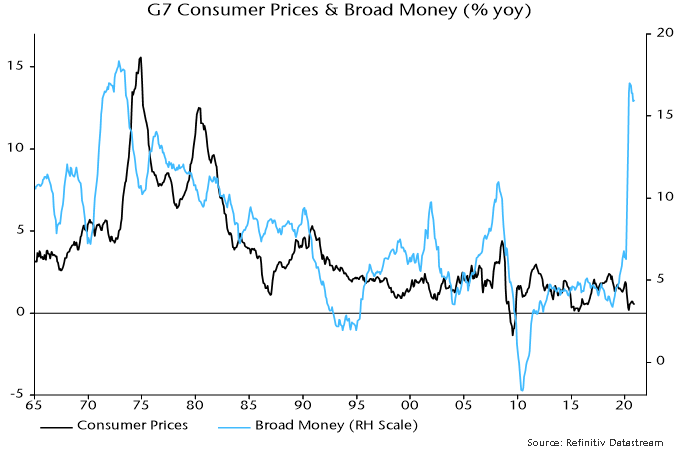
2020 may have marked a transformational break in monetary trends. G7 annual broad money growth peaked at 17.0% in June, the fastest since 1973 – see chart 5. Monthly growth has subsided but there has been no “payback” of the H1 surge. At the very least, this suggests a larger-than-normal “cyclical” upswing in inflation in 2021-22. Ongoing monetary financing of large fiscal deficits may sustain broad money growth at well above its levels of recent decades, embedding the inflation shift.

Chart 5

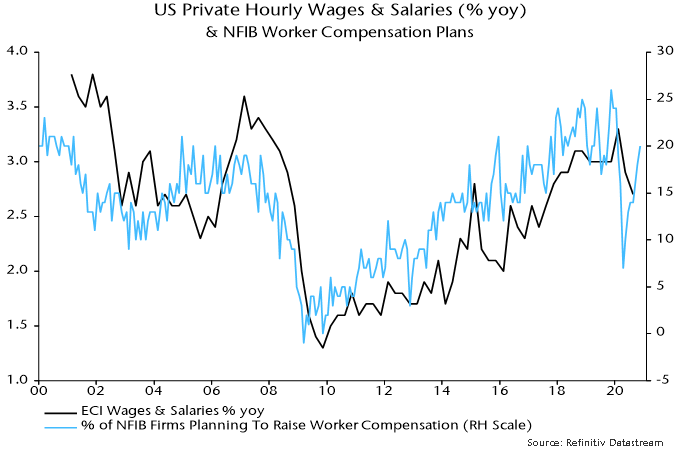
The consensus view that an inflation pick-up will prove temporary rests on weak labour markets bearing down on wage growth. Unemployment rates adjusted for short-time working / furlough schemes, however, fell sharply as the global economy rebounded in H2 2020 and structural rates have probably risen – labour market “slack”, therefore, may be less than widely thought and much lower than after the 2008-09 recession. The slowdown in wages to date has been modest and some business surveys are already hinting at a rebound – see chart 6.

Chart 6

Commentators who take seriously the prospect of a sustained inflation rise often argue that real bond yields would take the strain by moving deeper into negative territory, the view being that central banks will cap nominal yields. Such a scenario would be bullish for risk assets but probably overstates the power of the policy emperors. Pegged official rates and a QE flow currently running at about 10% of the (rapidly rising) outstanding stock of G7 government bonds per annum could prove insufficient to offset selling by existing holders in the event of an unexpected inflation surge.

While the focus of inflation is typically centered on rising raw material costs and wage increases, we are seeing transportation costs become an additional and significant part of the inflation problem, and one that is not as easily passed on to consumers.

Transportation affects every aspect of a company’s supply chain and the rising costs are unavoidable. Further, it has been a recent topic of conversation for our own holdings, as well as some of the largest companies in the world. At a recent conference, Molson Coors, the fifth largest brewer in the world, said transportation costs are the main contributing factor to inflation, while Proctor and Gamble warned that an announced price increase will not be enough to offset higher commodity and transportation costs due to not only the size, but the speed of the increases. Multinational conglomerate 3M is a good barometer, as it is seeing “a lot of pressure on logistics costs.” Dollar Tree is one of the largest retail importers in the United States (US) and at their recent quarterly earnings presentation, they spent a considerable amount of time discussing the global supply chain and higher freight costs, saying they were “not counting on material improvements in 2022, especially in the first portion of the year.”

The recovery from the pandemic has seen a huge increase in demand, but with continued quarantine controls, distancing measures at ports and labour shortages are causing severe backlogs. The Suez Canal blockage and summer typhoons off the Chinese coast did little to ease the problem. Another consideration is the consolidation of ocean shipping lines’ key shipping routes being dominated by a handful of companies, causing fewer vessels in general to be travelling between ports.

The ocean carriers have responded to the high demand by increasing container capacity by 22%, but this does not solve the problem of logjams and the waiting lines reaching record levels at some of the ports.[1] The order book for container ships has doubled in 2021, but the majority won’t be delivered until 2023.

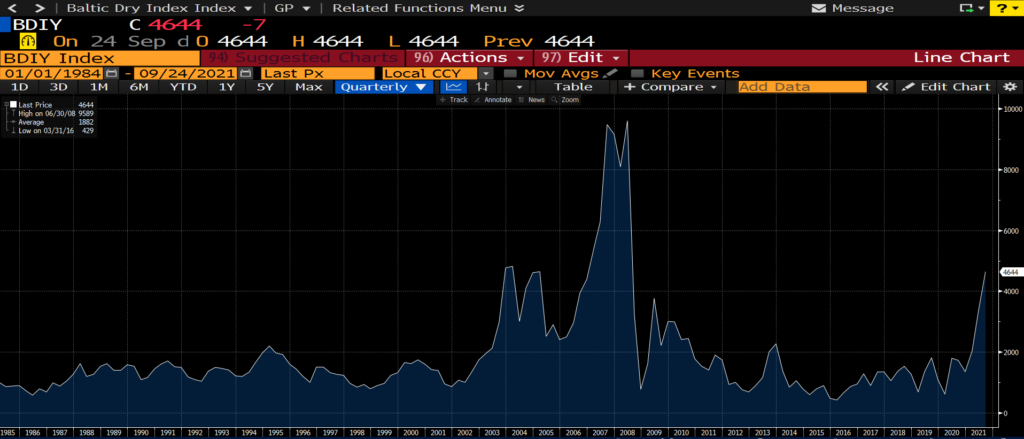
So what does all this mean? Container rates seem to be stabilizing, yet remain extremely elevated. Freightos, a digital booking platform for international shipping, published containerized freight rates. The cost of a container from Asia to the US East Coast is over $20,000, an increase of 415% compared to last year. Shipping from Asia to the US West Coast is slightly less, but the cost is up 452% in comparison to a year ago. Shipping from Asia to North Europe has seen the largest year-over-year increase, up 714% to $13,855. Freight rates from Northern Europe to the US East Coast have been the least affected, up “only” 238% from the period last year to $5,929. In view of these rates, shipping companies are focusing on the most profitable trade routes, meaning reduced volumes crossing the Atlantic. The Baltic Dry Index is a benchmark for the price of shipping major raw materials by sea and is at its highest level since before the Great Financial Crisis.

Source: Bloomberg

The majority of companies are struggling to solve this logistical headache, but our portfolios contain two names that have been natural beneficiaries.

Clipper Logistics (CLG.LN) is a leading provider of value-added logistics solutions, e-fulfilment, and returns management services to the retail sector, primarily in the United Kingdom (UK), but with an expanding presence in Europe. Sales are comprised of the following: 60% of sales come from e-fulfilment and returns management, supporting the online activities of customers; 28% of sales come from non e-fulfilment businesses, supporting traditional brick and mortar customers; and the remaining 12% of sales comes from commercial vehicles sales. Of the logistics related revenues, 85% comes from the UK. Over 90% of Clipper’s contracts are on an open book basis (i.e. cost plus), or hybrid contract, protecting them from increasing costs. However, they are not immune to labour shortages, as they recently flagged the impact that a shortage of HGV drivers is having.

Kerry Logistics (636.HK) is a third-party logistics service provider based in Hong Kong with global exposure. The company provides many supply chain solutions, including integrated logistics, international freight forwarding (air, ocean, road, rail, and multimodal), industrial project logistics, cross-border e-commerce, last-mile fulfilment, and infrastructure investment. Revenue mainly comes from Asia-Pacific, which accounts for 74% of sales (Mainland China 32%, Hong Kong 13%, Taiwan 7%, and other Asia 21%). The Americas accounts for 16% and Europe about 10%. Their customers are mainly big multinational companies, across many industries, including fashion, electronics, food and beverages, FMCG, industrial, automotive, and pharmaceutical.

Perhaps the best advice we could give readers is that with supply chain and transportation issues showing little signs of abating, you would be wise to start your holiday shopping sooner, rather than later.


[1] https://splash247.com/more-than-40-ships-waiting-outside-la-and-long-beach-setting-new-record/

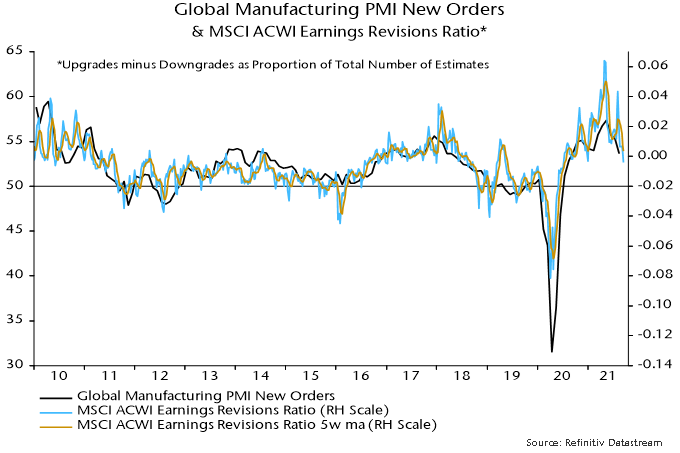
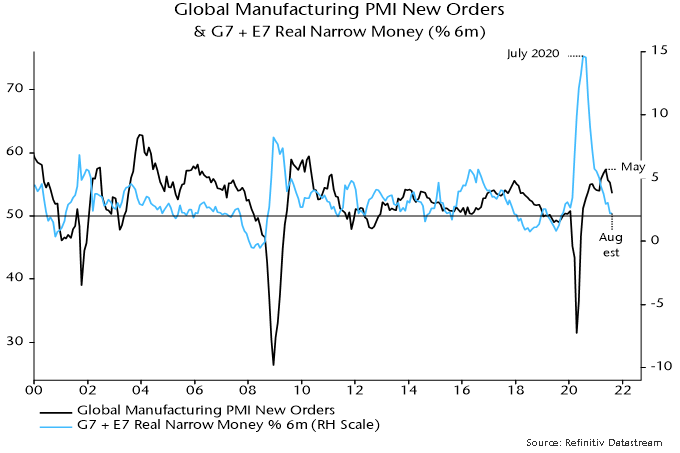
The global industrial slowdown signalled by a fall in manufacturing PMI new orders over June-August is now being reflected in a loss of earnings momentum.

The MSCI All Country World Index (ACWI) weekly revisions ratio, seasonally adjusted, fell below zero last week to its lowest level for more than a year – see chart 1.

Chart 1

With global real narrow money trends suggesting a further decline in manufacturing PMI new orders through early 2022, the revisions ratio is likely to remain in negative territory for the foreseeable future.

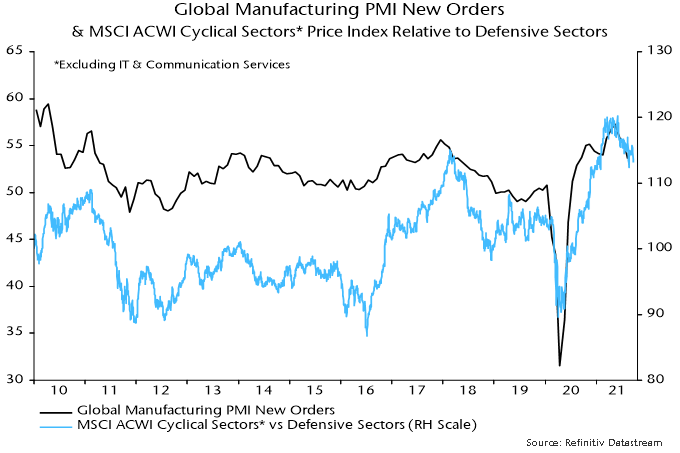
A falling PMI / weakening earnings momentum is typically associated with underperformance of non-tech cyclical equity market sectors (i.e. materials, industrials, consumer discretionary, financials and real estate) versus defensive sectors (consumer staples, health care, utilities and energy). The MSCI ACWI non-tech cyclical / defensive sector price relative has moved down in recent days, though remains above an August low – chart 2.

Chart 2

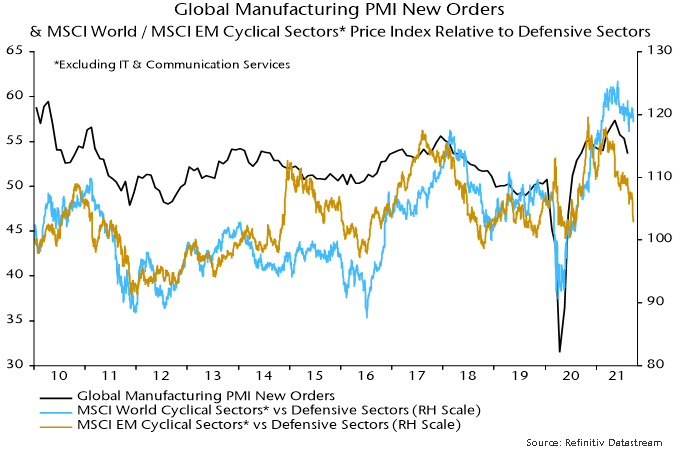
The latest decline, of course, reflects macro risk aversion due to the Evergrande crisis. The MSCI Emerging Markets non-tech cyclical / defensive sector price relative has crashed to a new low, with more modest weakness in the corresponding MSCI World (i.e. developed markets) relative – chart 3.

Chart 3

As the chart shows, the EM relative led moves down into lows in 2011-12, 2016 and 2018 (all associated with stockbuilding cycle downswings). The current wide divergence raises the possibility of a breakdown of the MSCI World relative; alternatively, the EM relative may have greater recovery potential.

Street research is discussing whether a looming Evergrande default represents a Minsky / Lehman moment (i.e. a tipping point into a financial crisis) or a Volcker moment (i.e. a policy decision to punish inflationary / speculative excess despite harsh macroeconomic consequences). The consensus is neither and that the authorities will be able and willing to contain the fallout.

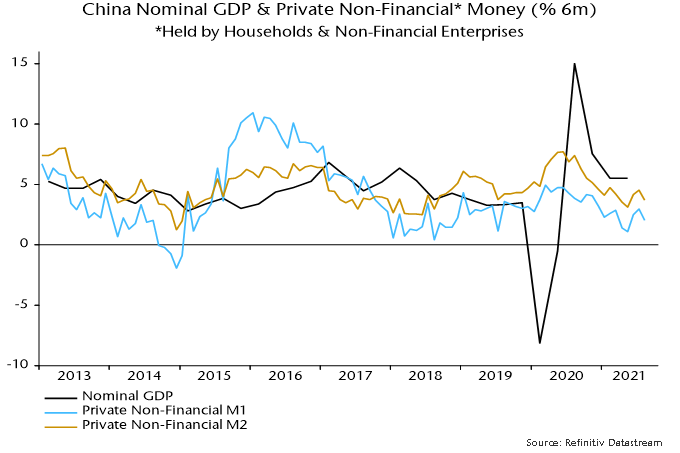
The key issue, from a monetarist perspective, is whether tighter financial conditions due to the crisis persist and invalidate the previous central case scenario of a recovery in monetary trends in response to recent and prospective policy easing. Six-month growth rates of the private sector money measures calculated here fell back in August but remain above May lows – chart 4.

Chart 4

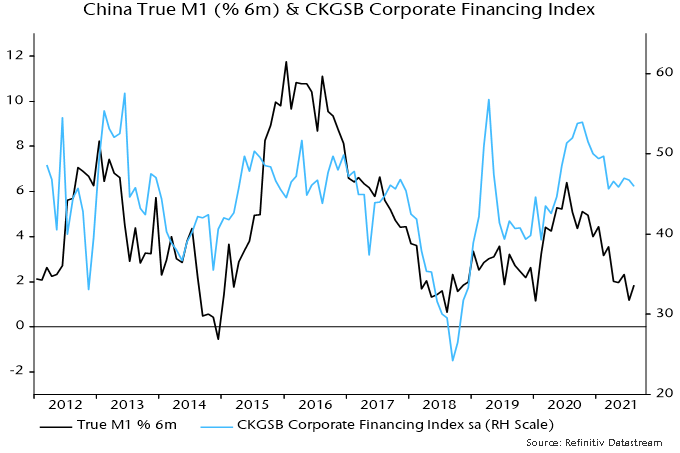
A useful indicator for assessing the potential monetary fallout is the corporate financing index from the Cheung Kong Graduate School of Business survey of private sector firms, a gauge of ease of access to credit. The index loosely correlates with money growth and has moved sideways (after seasonal adjustment) in recent months – chart 5. A sharp fall in the upcoming September survey would be a clear warning signal.

Chart 5

An FTarticle lists “Five big questions facing the Bank of England over rising inflation”. The most important one is missing: will broad money growth return to its pre-covid pace?

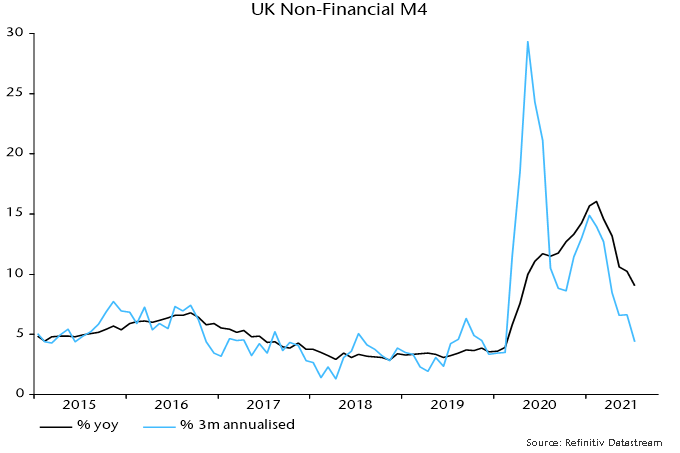
The current inflation increase, from a “monetarist” perspective, is directly linked to a surge in the broad money stock starting in spring 2020. Annual growth of non-financial M4 – the preferred aggregate here, comprising money holdings of households and private non-financial corporations (PNFCs) – rose from 3.9% in February 2020 to a peak of 16.1% a year later.

The monetarist rule of thumb is that money growth leads inflation with a long and variable lag averaging about two years. This is supported by research on UK post-war data previously reported here – turning points in broad money growth preceded turning points in core inflation by 27 months on average.

The lead time is variable partly because of the influence of exchange rate variations. For example, the disinflationary impact of UK monetary weakness after the GFC was delayed by upward pressure on import prices due to sterling depreciation.

The exchange rate has been relatively stable recently but the rise in inflation has been magnified by pandemic effects, which may mean that a peak occurs earlier than suggested by the February 2021 high in money growth and the average 27 month lag. The working assumption here is that core inflation will peak during H1 2022.

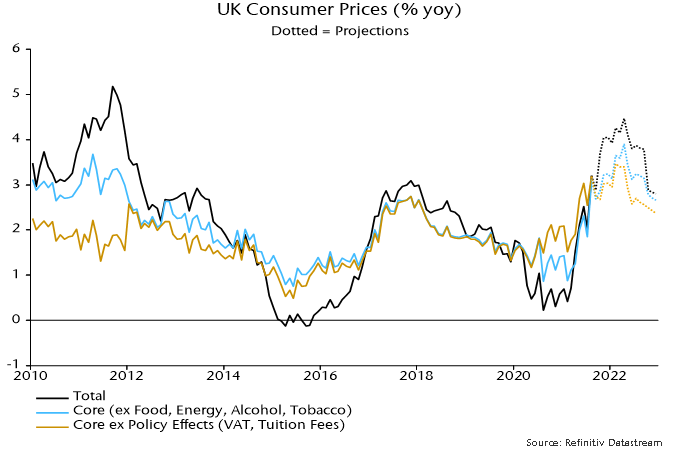
CPI inflation, however, is likely to overshoot the current Bank of England forecast throughout 2022 – chart 1 shows illustrative projections for headline and core rates.

Chart 1

The past mistakes of monetary policy are baked in. The MPC should focus on current monetary trends in assessing how to respond to its current / prospective inflation headache.

Annual broad money growth has fallen steadily from the February peak but, at 9.0% in July, remains well above the 4.2% average over 2010-19, a period during which CPI inflation averaged 2.2%. So monetary data have yet to support the MPC’s assertion that the inflation overshoot is “transitory”.

The pace of increase, however, slowed to 4.4% at an annualised rate in the three months to July – chart 2. Household M4 rose by 5.8% with PNFC holdings little changed. In terms of the credit counterparts, bank lending to households and PNFCs grew modestly (4.1%) while a continued QE boost was offset by negative external flows, suggesting balance of payments weakness.

Chart 2

With QE scheduled to finish at end-2021 (if not before), and a temporary boost to mortgage lending from the stamp duty holiday over, money growth couldbe gravitating back to its pre-covid pace.

An early interest rate rise, on the view here, is advisable to reinforce the recent monetary slowdown and push back against rising inflation expectations. It is premature, however, to argue that a sustained and significant increase in rates will be needed to return inflation to target beyond 2022 – further monetary evidence is required.

It would be unfortunate if, having fuelled the current inflation rise by questionable policy easing, the MPC were now to raise expectations of multiple rate hikes at a time when monetary growth could be returning to a target-consistent level.

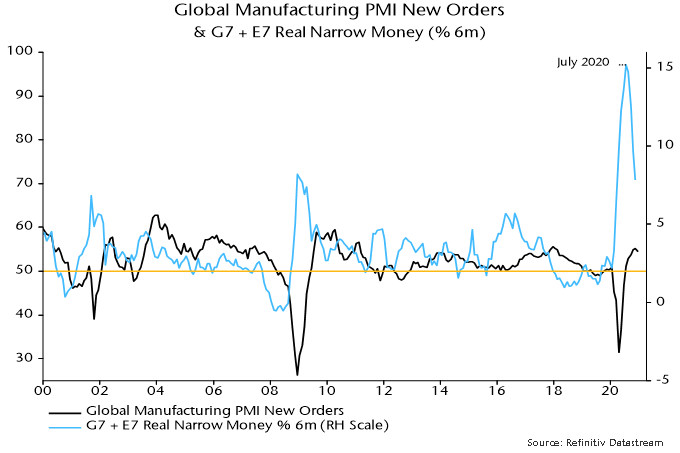
Partial data indicate that global six-month real narrow money growth was little changed in August, following July’s fall to a 22-month low. Allowing for the usual lead, the suggestion is that the global economy will continue to lose momentum into early 2022, with no reacceleration before late Q1 at the earliest.

Global PMI results for August were consistent with the slowdown forecast, with the manufacturing new orders index falling for a third month – see chart 1.

Chart 1

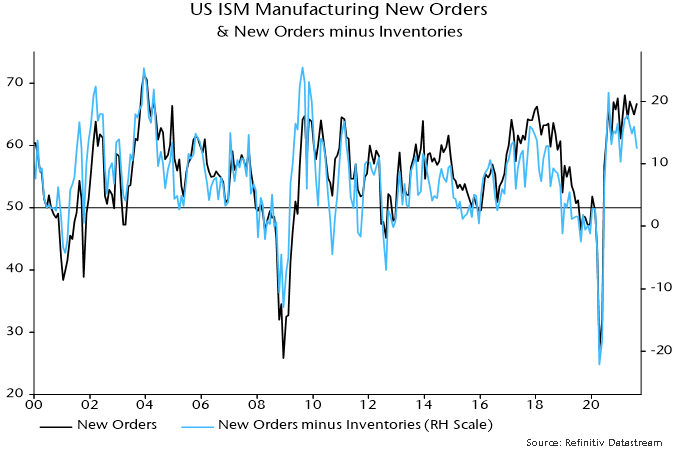
The US ISM manufacturing new orders index unexpectedly rose in August but this appears to have been driven by a rise in inventories: the new orders / inventories differential, which often leads, fell to its lowest since January – chart 2.

Chart 2

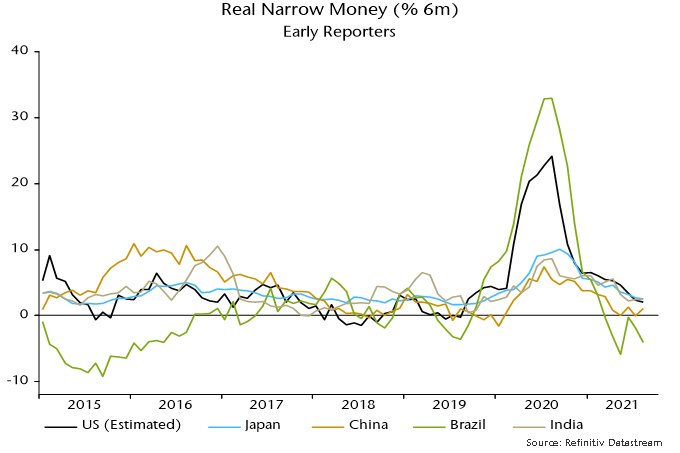
The US, China, Japan, Brazil and India have released monetary information for August, together accounting for 70% of the G7 plus E7 aggregate calculated here*. CPI data are available for all countries bar the UK and Canada.

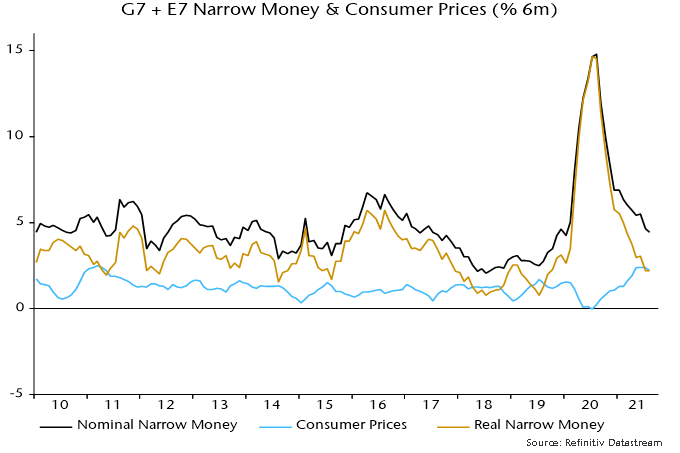
The stability of six-month real narrow money growth in August conceals a further slowdown in nominal money expansion offset by a small decline in CPI momentum – chart 3.

Chart 3

Previous posts discussed the possibility that real money growth would rebound during H2 2021, warranting optimism about economic prospects for 2022 and supporting another leg of the “reflation trade”. The monetary data have yet to validate this scenario.

The real money growth rebound scenario depended importantly on a pick-up in China in response to recent and prospective policy easing. Chinese six-month real narrow money growth does appear to have risen slightly in August** but there were offsetting declines in the US, Japan and Brazil – chart 4.

Chart 4

*The US number is estimated from weekly data on currency in circulation and commercial bank deposits.
**The household demand deposit component is estimated pending release of full data.

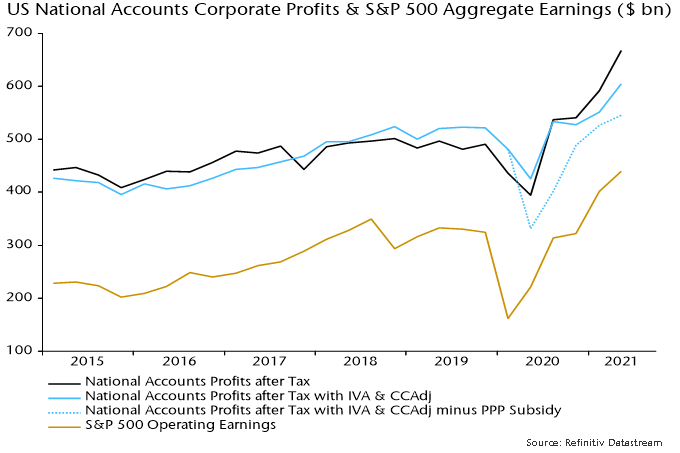
National accounts profits numbers for Q2 released last week mirror recent strength in company earnings reports. The concept closest to S&P 500 earnings – corporate profits after tax – rose by 13% in Q2 to stand 36% above its level in Q4 2019. The national accounts series covers all corporations but S&P 500 operating earnings also grew by 36% between Q4 2019 and Q2 this year – see chart.

The national accounts analysis additionally contains a measure of “economic profits”, i.e. excluding inventory gains and adjusted for the difference between reported and economic depreciation*. Reflecting commodity price strength, inventory profits have been significant in recent quarters, while overreporting of depreciation (to minimise tax bills) fell in 2020 and has remained at a lower level in H1 2021.

This economic profits measure, therefore, has performed less impressively than “headline” earnings, rising by 10% in Q2 to stand 16% above its Q4 2019 level.

This measure, however, still overstates underlying profits strength because it includes government subsidy payments to corporations under various pandemic response schemes, the most significant of which has been the now-closed Paycheck Protection Program. The subsidy payment to corporations under this scheme accounted for 10% of economic profits in Q2 but will fall to zero over coming quarters**.

Q2 profits were also supported by payments under the Employee Retention Tax Credit scheme and grants to air carriers, among other emergency measures.

Excluding only the PPP subsidy, growth of economic profits between Q4 2019 and Q2 this year falls to just 4%.

The level of headline national accounts profits was 22% higher than this adjusted economic profits measure in Q2. A reasonable base case assumption is that this overshoot will be eliminated by Q2 2022.

The consensus forecast is for S&P 500 operating earnings to rise by a modest-sounding 3% in the year to Q2 2022. For national accounts profits to grow at the same pace, underlying profits – i.e. excluding inventory gains, subsidies etc. – might have to increase by more than a quarter. Such strength is implausible, requiring the unlikely combination of rapid economic growth with no associated downward pressure on margins from a tightening labour market.

*Profits after tax with inventory valuation adjustment (IVA) and capital consumption adjustment (CCAdj).
**The subsidy payment is recorded as occurring over the term of the loan, not when it is forgiven.

Eurozone monetary trends have been suggesting an economic slowdown through end-2021. A recent moderation of consumer price momentum, however, has stabilised six-month real narrow money growth, hinting at a bottoming out of business surveys and other coincident indicators in early 2022.

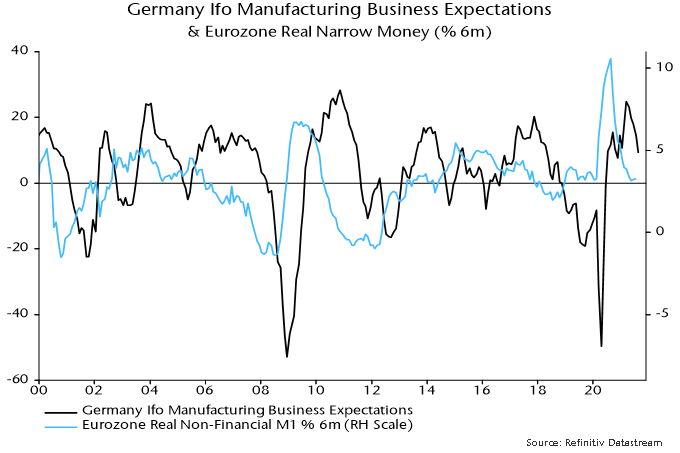
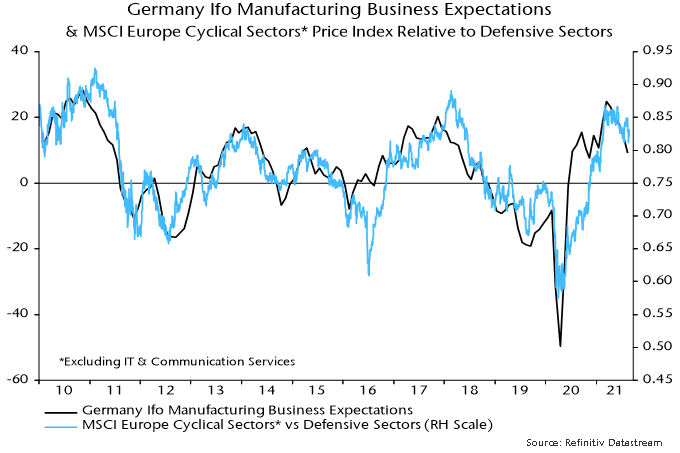
The Ifo manufacturing survey is a timely indicator of German / Eurozone industrial momentum, displaying a strong contemporaneous correlation with German / Eurozone manufacturing PMIs (but with a longer history). The business expectations component peaked in March, falling for a fifth month in August – see chart 1.

Chart 1

The March peak is consistent with an August 2020 peak in Eurozone six-month real narrow money growth. The implied seven-month lead is slightly shorter than the historical average – the correlation between Ifo business expectations and Eurozone real money growth is maximised by applying a nine month lag to the latter.

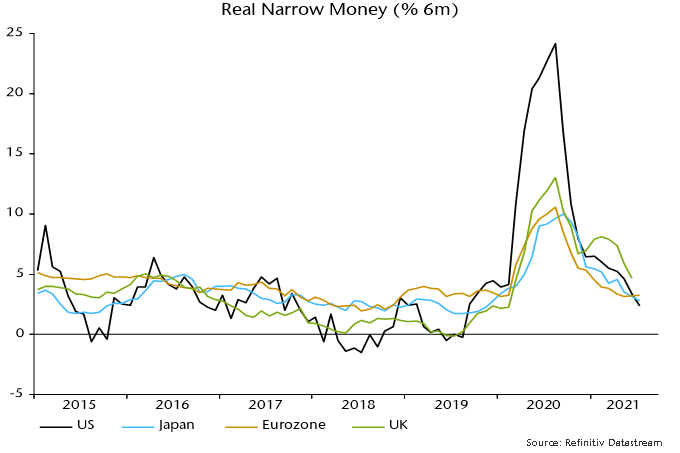
Real narrow money growth, however, has moved sideways since May (July money numbers were released yesterday). The suggestion is that the Ifo indicator – along with PMIs and other business surveys – will weaken further during H2 but bottom out in early 2022.

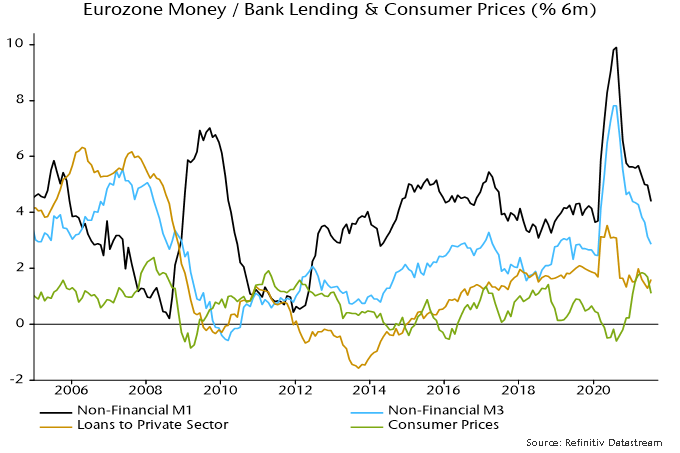
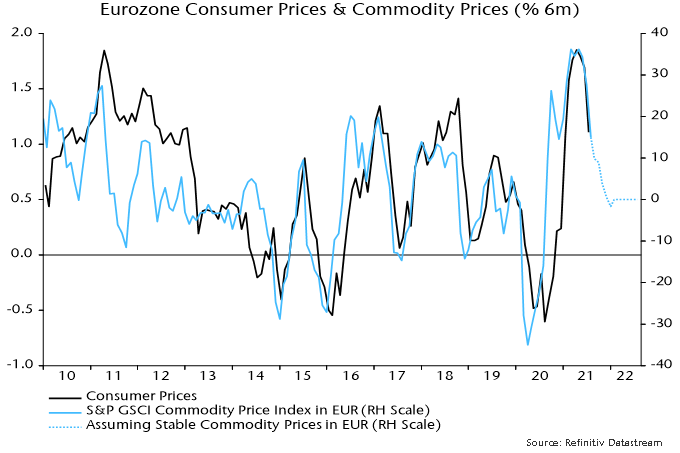
The recent stabilisation of real money growth is not entirely convincing: nominal money trends continued to weaken in June / July but this was offset by a slowdown in six-month consumer price momentum – chart 2.

Chart 2

The inflation slowdown, however, could extend, assuming that commodity prices (in euro terms) stabilise at their current level – chart 3.

Chart 3

A recovery in nominal money growth is required to warrant shifting to a positive view of economic prospects. Such a signal would relate to H1 2022 – earlier real money weakness has “baked in” likely economic disappointment over the remainder of 2021.

What could lift money growth? The most likely candidate is a pick-up in bank lending. Six-month growth of loans to the private sector recovered in July – chart 2 – while the most recent ECB bank lending survey reported the strongest expectations for credit demand since 2016.

The recent stabilisation of Eurozone six-month real narrow money growth contrasts with a further slowdown in the US – chart 4. The divergence / cross-over suggests improving Eurozone relative economic and equity market prospects, although US real growth could benefit from a faster inflation slowdown over coming months.

Chart 4

A further fall in Ifo manufacturing business expectations and other survey indicators during H2 would probably be associated with underperformance of European non-tech cyclical sectors relative to defensive sectors – chart 5.

Chart 5

Every now and then, we remind ourselves why we enjoy our work. To us, global small cap is a wonderful asset class that offers the widest array of companies in terms of style, valuations, and growth profiles. This helps us develop a philosophy and process that fits our investment background, without having to take unnecessary market-related risks and having too much of a narrowed spectrum of investment candidates. Moreover, this investment universe is comprised of many companies that are strongly impacted by secular themes, especially the technology-driven ones.

Technologically driven secular themes usually appear in our universe following a start-up phase where venture capital, serial entrepreneurs, and bankers play god with other people’s money, through conceptual and research-driven business plans. Following that phase, we start seeing the themes when more established companies decide the technology is mature enough to turn into real products.

Artificial Intelligence (AI) is a prime example. The market is already big and getting bigger. If we were to list all of the companies in our portfolio impacted by utilizing AI, the list would be long. In healthcare alone, the AI market is expected to reach USD 58.6 billion by 2028.[1]

Let’s dig deeper and look at a field that will greatly benefit – radiology. Radiology features a high degree of specialty mixed with high throughput that fits AI’s problem-solving capabilities. As a key part of medical practice and research, radiology interprets most human biological ailments. Its complexity has skyrocketed due to biomarkers that are now available to radiologists, especially in the field of oncology.

Radiology and machine learning will prosper in many markets, such as prostate cancer diagnostics, thanks to greater precision in comparison to the conventional PSA test. New AI-assisted markers are set to help radiologists read CT scans for colon cancer. In addition, AI is expected to increase radiology productivity (volume of readouts performed per hour) and the amount of new products (volumes from new diagnostic initiatives).

Speaking of new products, radiology and AI will be a key part of the new Alzheimer treatment paradigm, representing an estimated USD 10 billion market in 2026. The recently approved Alzheimer’s drug Aduhelm, from biotech company Biogen, requires a specialized CT confirmation scan, as well as monthly scans during treatment. As a market, radiology has an above-average growth rate of 5.2%, with a substantial market size of USD 20 billion.[2]

Raffles Medical (RFMD: SP)

Raffles Medical (RMG) is a private healthcare provider operating in 14 cities across Asia, including Singapore, China, Japan, Vietnam, and Cambodia. In China, RMG is present in eight cities.

Hospitals are core users of radiology in the majority of departments. Radiology productivity is linked to efficiency with most procedures, especially in the private sector where RMG operates. With EBITDA margins already at 21% versus mid-teens for its hospital peers, RMG remains a first-mover when it comes to technology driven productivity. Radiology AI will have an important impact on the sustained growth in profitability going forward. RMG operates two hospitals, the 380-bed Raffles Hospital Singapore, which opened in 2003, and the 700-bed Raffles Hospital Chongqing, which opened in 2020. RMG also just opened its third hospital, the 400-bed Raffles Hospital Shanghai. According to management, the new hospitals in Shanghai and Chongqing are starting with 100-150 operational beds.

In Singapore, RMG operates the Raffles Specialist Centre, adjoined to Raffles Hospital, and it has a total bed capacity of 380. Centers of excellence in the Chongqing hospital include gastrointestinal surgery, obstetrics & gynecology, pediatrics, cardiovascular surgery, neuroscience, and oncology, which all feature significant radiology practices.

Our next holding corroborates the kind of AI productivity gains that Raffles could be able to obtain in the near future.

Radnet (RDNT: US)

RadNet is the largest provider of outpatient imaging services in the United States, with 346 centers nationwide.

The company has an AI subsidiary called DeepHealth, which focuses on developing machine-learning applications for the radiology industry. RadNet recently announced the FDA’s approval of its AI mammography triage software. This software acts as a screening tool, enabling radiologists to more effectively manage their mammography cases using AI. DeepHealth’s powerful new AI technology automatically identifies suspicious screening exam results that may need priority attention, allowing radiologists to optimize their workflow for efficiency and effectiveness.

According to the company, RadNet’s first AI approval should translate to a 25% gain in productivity covering its two million annual mammography scans. This should therefore enable the company to expand its capacity and grow without having to hire additional staff.


[1] Market Insight Reports, July 28, 2021

[2] Grandview Research, December 2020