Chinese money trends suggest a continuation of sluggish economic growth, negligible inflation and a supportive liquidity environment for markets.

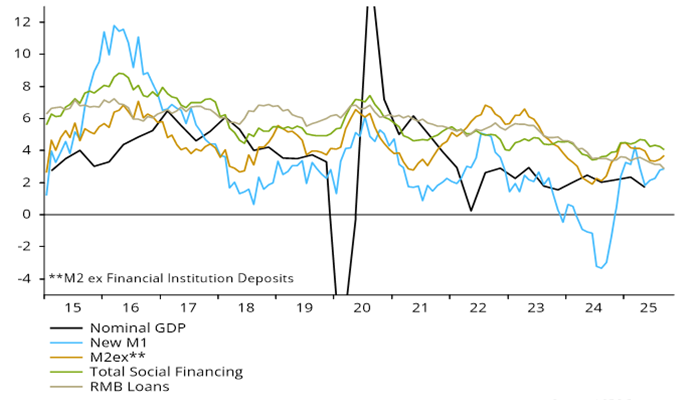
Six-month growth of narrow money – as measured by the new M1 definition incorporating household demand deposits – rose slightly in September, extending a recovery from a May low. Broad money momentum also edged higher. Both series are around their average levels in recent years – see chart 1.

Chart 1

171025c1

Credit trends remain weak, with six-month growth of bank lending reaching another record low, although numbers have been suppressed by bond swaps. Monetary expansion, however, continues to be boosted by China’s version of QE, conducted via the state banks. Monetary financing of the government, including bond swaps, accounted for 3.8 pp of M2 growth of 8.4% in the year to September – chart 2.

Chart 2

171025c2

Money growth remains above nominal GDP expansion, arguing against a debt deflation scenario and suggesting “excess” money support for asset prices. With the housing market still weak and longer-term bond yields recently moving up from record lows, equities could remain the default beneficiary.

Two scientists looking through microscopes.

The foundation of traditional Chinese medicine is Qi – the life force or energy that flows through a body. If, for any reason, the Qi in your body was to go out of balance or get blocked, one would end up falling ill. A wide range of plant- and animal-based medicines would then be used to unblock those pathways and to restore the balance of Yin and Yang in the body.

While traditional Chinese medicine techniques like cupping and acupuncture gain popularity both at home and abroad, China has been quietly making giant strides in the traditional pharmaceutical and biotechnology sectors. In the past, it applied the principles of scale and an integrated supply chain to manufacture inexpensive generics faster and cheaper than its competitors.

Cut to present day, China’s pharmaceutical industry is on the cusp of becoming a global leader in both drug discovery and development. According to Morgan Stanley, annual revenues from drugs originating in China could reach USD$34 billion by 2030 and USD$220 billion by 2040. Currently, drugs from China account for only 5% of all USFDA approvals, but that is estimated to rise to 35% by 2040. So how did China go from a middling pharma player to the hot house of innovation and manufacturing that we see today?

Broadly, we can trace three key factors that are fueling this boom:

  1. Reforms – The comprehensive series of reforms needed to move the needle in this space did not happen overnight. Over the last decade, China has made a deliberate push to move from a large-scale generics manufacturer to an innovation powerhouse by pushing through the following reforms.
    • Increasing innovative drug approvals – In 2017, measures were introduced to reduce the review timeline of innovative drugs to 60 days, increasing the efficiency of the drug development process. The result has been a record 93 drugs receiving first approval from the National Medical Products Administration (NMPA) in China in 2024 with China surpassing Europe and Japan as the second largest country to receive first approvals.
    • Investment inflows – Funding is crucial for innovation and reforms such as 18A listing rules in Hong Kong and the launch of STAR Market (touted as Shanghai’s equivalent to NASDAQ) allowed pre-revenue biotech companies to list and raise money.
    • Globalization – In response to intense competition at home, Chinese pharmaceutical companies have started to spread their wings abroad through strategic partnerships. This is being executed by applying for global approvals for drugs developed in China and through so called out-licensing agreements, where Chinese companies further the development of their unique IP by leveraging the R&D and commercialization network of western pharma giants.
  1. Speed – To accelerate development of novel drugs, China’s regulator is proposing to further cut the clinical trial review period from 60 to 30 working days, matching the time line of USFDA. The presence of large pools of patients in Chinese cities further expedites the go-to-market process.
  2. Talent – China graduates around five million science, technology, engineering and mathematics (STEM) graduates every year. The recent crackdown in immigration in the United States has led many talented Chinese scientists and professionals (nicknamed “sea turtles”) to return home. The recent announcement by the Chinese government of the K visa program could further accelerate this trend.

This combination of speed, abundance of talent and structural reforms could throw up multiple opportunities in the Chinese pharma space. It is next to impossible to predict which company could win the next out-licensing deal. Similarly, picking the next big biopharma product requires a high degree of technical expertise. Hence our investment in Sunresin New Materials Co. Ltd. (300487 CH) takes a picks and shovel approach to this space.

Sunresin is a specialty resin manufacturer, making more than 200 different types of resin for a variety of applications from purifying water, extracting lithium to serving as an enzyme carrier for drug development including GLP-1 drugs. While its life sciences business makes up about a fourth of its revenue, given the trends discussed above, the growth opportunities and potential runway could be enormous.

The consumables that Sunresin manufactures have high barriers to entry, more stable risk profiles vs. betting on winning drugs and underlying high growth in total addressable market. Its products are used both for upstream synthesis of various active pharmaceutical ingredients (APIs) and for downstream separation and purification that determines the final quality of the drug.

Key trends that underpin Sunresin’s growth include:

  1. Growth of the biologics (large molecules) market that is growing faster than the chemical drug (small molecules) market. Biologics production has an upstream API synthesis phase that requires carriers and a downstream purification phase that requires chromatographic media (CM) to capture target molecules.
  2. Sunresin produces both upstream carriers (for both large and small molecules) and downstream chromatographic media. Entry barriers are high as both products can make up 15–40% of production cost and are crucial to the final quality of the drug. Switching suppliers by commercial drug makers can be costly and time consuming.
  3. Rise of import substitution in China and rise of overseas opportunities from out-licensing deals could further underpin growth.
  4. Build out of new high-end life sciences capacity that could support 10x of current sales.

Between its proven products, new capacities and tailwinds from the growth of biologics and the larger China bio pharma sector, we see Sunresin as a key winner in the race to find the new blockbuster drugs on the back of China’s booming pharmaceutical sector.

Credit tightening in private markets may mark the end of a boom in US bank lending to shadow banks, with negative monetary implications.

Equity prices of major players in private credit have fallen sharply in the wake of the Tricolor / First Brands bankruptcies, with an average down by 31% from a January peak – see chart 1.

Chart 1

141025c1

Increased risk aversion is also evident in lower prices / higher yields of traded private credit instruments, such as the VanEck Business Development Companies ETF (BIZD), which usually mirrors moves in high yield spreads but has opened up a wide gap – chart 2.

Chart 2

141025c2

Commercial bank lending to shadow banks / private credit has been booming, with the “all other” category containing loans to non-bank financial institutions up by 14.5% in the year to September, accounting for 2.9 pp of overall bank loan growth of 4.9% – chart 3*.

Chart 3

141025c3

Traditional loan categories – C&I, real estate and consumer – grew by only 2.5% over the same period.

Lending to shadow banks is likely to slow as private credit players rein in activity and loan officers tighten standards. A normalisation could cut 2 pp or more from annual loan growth, implying weaker broad money expansion unless offset by other “credit counterparts”**.

Credit tightening could extend to other loan categories unless private markets recover – chart 4. (Note that the reporting window for the October Fed senior loan officer survey, to be released in early November, may already have closed, so the results may not fully reflect recent developments.)

Chart 4

141025c4

*Growth numbers are break-adjusted – levels series have been distorted by recent reporting changes.

**Some combination of increased monetary deficit financing, a stronger basic balance of payments or reduced non-deposit funding.

Des hommes d'affaires travaillant au bureau.

Depuis des décennies, le processus de répartition stratégique de l’actif fournit aux investisseurs institutionnels un cadre de gestion de portefeuille structuré et axé sur les indices de référence. Cette approche, fondée sur la recherche universitaire et la théorie moderne des portefeuilles, a aidé d’innombrables conseils d’administration et comités de placement à aller au-delà de la répartition classique 60 % actions/40 % titres à revenu fixe en faveur d’une composition plus diversifiée.

À l’heure où le monde des placements change, certains des plus grands investisseurs du monde en sont à transformer leurs processus, au profit d’une approche de portefeuille global novatrice qui considère le portefeuille comme une entité unique et dynamique plutôt que comme un ensemble de catégories d’actifs distinctes. Le présent article explore l’évolution des stratégies de composition de l’actif, les avantages et les limites de la répartition stratégique de l’actif, ainsi que les promesses et les défis de l’approche de portefeuille global.

L’évolution des stratégies de répartition de l’actif

La répartition de l’actif des investisseurs institutionnels a connu d’importants changements au fil des ans. Le modèle classique 60/40 a dominé pendant des décennies, jusqu’à ce que David Swensen et Dean Takahashi de l’université Yale opèrent une réorientation vers les placements non traditionnels à la fin des années 1980 et au début des années 1990. En ouvrant la porte au capital-investissement, aux fonds de couverture, à l’immobilier et aux ressources naturelles, ils ont révolutionné la répartition de l’actif et diversifié les portefeuilles au-delà des frontières traditionnelles.

Alors que d’autres institutions sont passées au-delà de la répartition 60/40, le cadre de la répartition stratégique de l’actif est devenu un outil essentiel pour orienter les cibles de répartition de l’actif à long terme, en fonction des objectifs de placement, de la tolérance au risque, des besoins de liquidité et de l’horizon de placement.

Les avancées technologiques et le plus grand accès aux données sont en train de modifier le fonctionnement des marchés financiers et la gestion de portefeuille. Les investisseurs peuvent maintenant mieux comprendre l’incidence de leurs décisions, ce qui permet de gérer les portefeuilles de façon plus dynamique et éclairée – et l’approche de portefeuille global en est le plus récent développement. Elle présente de précieux concepts à tous les investisseurs, même si elle demeure la spécialité des plus grandes institutions mondiales.

L’attrait durable de la répartition stratégique de l’actif

Le processus de répartition stratégique de l’actif est intuitif et constitue une méthode quantitative rigoureuse pour établir la composition de l’actif. Son attrait durable réside dans son accessibilité, où tout investisseur, quelle que soit sa taille, peut l’utiliser. Essentiellement, le processus de répartition stratégique de l’actif vise à accroître la diversification, ce qui peut réduire le risque sans sacrifier les rendements cibles, ou à générer des rendements plus élevés tout en maintenant le risque sous contrôle.

Les premières étapes du processus sont la définition des objectifs de placement, l’horizon de placement, la tolérance au risque et les besoins de liquidités. À partir de ces mesures, les investisseurs analysent le rendement et la volatilité attendus pour déterminer les répartitions potentielles, mais en accordant une priorité générale aux rendements relatifs. La décision finale en matière de répartition de l’actif dépend souvent des catégories d’actif avec lesquelles un conseil d’administration ou un comité de placement est le plus à l’aise.

Une fois les catégories d’actif sélectionnées, la répartition est raffinée. À cette étape, de nouvelles catégories d’actif ou d’autres gestionnaires de placement peuvent être ajoutés au portefeuille. La répartition des catégories d’actif et des gestionnaires peut également être modifiée. Le portefeuille est surveillé en regard de ses objectifs et de ses indices de référence. Il fait donc l’objet d’une vigilance soutenue et est ajusté à mesure qu’évoluent les conditions du marché.

Limites et décalages de la répartition stratégique de l’actif

Même si le cadre de la répartition stratégique de l’actif a résisté à l’épreuve du temps, il n’est pas sans failles. L’une des critiques les plus fréquentes à l’égard de cette approche est le décalage entre la conception de la répartition de l’actif et la sélection des titres par les gestionnaires. Des inefficiences peuvent survenir lorsque ces étapes sont gérées séparément, ce qui réduit les avantages de la diversification. Cette séparation peut également faire en sorte que le profil risque-rendement du portefeuille s’écarte du profil prévu, surtout lorsque l’accent est mis sur le rendement passé lors de la sélection des gestionnaires et l’on fait abstraction du risque.

L’ajout de nouvelles catégories d’actif et de gestionnaires de placement exige habituellement un examen officiel, ce qui ralentit la capacité de réagir à l’évolution des conditions du marché. Les hypothèses relatives aux marchés financiers à long terme guident les décisions de répartition stratégique de l’actif, mais leur fiabilité n’est pas garantie. Selon certaines études, les prévisions de rendement sont souvent inexactes, alors que les prévisions de risque ont tendance à être plus conformes aux résultats réels. Cela donne à penser qu’il peut être plus sage de mettre l’accent sur la gestion du risque plutôt que sur la quête de rendements.

Qu’est-ce qu’une approche de portefeuille global?

Contrairement au modèle de répartition stratégique de l’actif traditionnel, dans le cadre duquel les catégories d’actif sont gérées en vase clos, l’approche de portefeuille global considère le portefeuille comme un ensemble unifié. Chaque décision de placement est évaluée en fonction de son incidence sur le risque et le rendement du portefeuille dans leur ensemble, et une attention particulière est prêtée au risque. Cette approche globale et souple tire parti de l’expertise en matière d’actifs de différentes équipes et permet à ces dernières de réagir rapidement à l’évolution de la dynamique des marchés.

Toutefois, l’adoption d’une approche de portefeuille global n’est pas simplement un changement de processus de placement; il s’agit d’une transformation culturelle. Les organisations doivent aller au-delà de la gestion cloisonnée des catégories d’actif pour adopter un modèle de portefeuille unifié. Cette transformation nécessite des changements audacieux sur le plan de la culture et de la gouvernance. Les conseils d’administration et les comités de placement doivent déléguer une plus grande part de leur pouvoir décisionnel et donner davantage de libertés aux chefs des placements et aux équipes de placement internes. Dans le cadre de l’approche de portefeuille global, la collaboration entre les spécialistes et l’harmonisation des incitatifs sont essentielles au succès du portefeuille dans son ensemble.

Qui mène le bal?

L’approche de portefeuille global a d’abord été adoptée par les plus grands investisseurs du monde, comme l’Australian Future Fund, Investissements RPC au Canada, le New Zealand Superannuation Fund et GIC, le fonds d’investissement souverain de Singapour. Ces institutions ont l’envergure nécessaire pour intégrer des équipes de placement et créer les environnements de collaboration nécessaires à la mise en œuvre d’une approche de portefeuille global. La philosophie de l’approche de portefeuille global a commencé à prendre forme officiellement vers 2006. Ses origines remontent toutefois plus loin, notamment au début des années 1990 lorsque Bob Hamje, chef des placements de TRW, a délaissé les mandats individuels au profit du rendement total des portefeuilles, récompensant ainsi les gestionnaires pour leur collaboration et leur succès global.

Répartition stratégique de l’actif et approche de portefeuille global : perspective comparative

Le tableau ci-dessous présente les principales différences entre la répartition stratégique de l’actif et l’approche de portefeuille global :

Caractéristique Répartition stratégique de l’actif (RSA) Approche axée sur le « portefeuille total » (APT)
Rendement évalué par rapport à : Indices de référence des catégories d’actif Objectifs du fonds et portefeuille de référence
Le succès est mesuré comme suit : Valeur ajoutée relative Rendement total du fonds
Les occasions de placement sont définies comme suit : Catégories d’actif Contribution au rendement total du portefeuille
Diversification obtenue grâce à : Catégories d’actif Facteurs de risque
Répartition de l’actif déterminée par : Processus axé sur le conseil d’administration Processus axé sur le chef des placements
Portefeuille mis en œuvre par : Plusieurs équipes, qui se disputent des capitaux Une équipe qui collabore entre les différentes stratégies

Source : Thinking Ahead Institute

Le passage de la répartition stratégique de l’actif à l’approche de portefeuille global représente une transformation importante. Dans le cadre de la répartition stratégique de l’actif, le succès est déterminé en fonction du rendement obtenu par rapport à un indice de référence global, qui correspond à la moyenne pondérée des indices de référence de chaque catégorie d’actif. En revanche, l’approche de portefeuille global mesure le succès par rapport aux objectifs du fonds, habituellement en fonction d’un portefeuille de référence.

Pour ce qui est de la répartition stratégique de l’actif, chaque catégorie d’actif est choisie en fonction de son rôle dans l’atteinte des objectifs en matière de rendement, de risque, de diversification et de liquidité. En ce qui concerne l’approche de portefeuille global, on tente avant tout de saisir la façon dont chaque occasion de placement contribue au résultat global du portefeuille. De plus, les facteurs et les primes de risque guident à la fois la manière dont est élaborée la stratégie et sont déterminés les résultats. Cette approche permet d’effectuer des simulations de crise plus robustes dans différents régimes macroéconomiques, ce qui permet de mieux cerner la résilience d’un portefeuille.

Le changement le plus important lié à l’approche de portefeuille global est probablement celui apporté à la culture et à la gouvernance. Le processus décisionnel n’est plus principalement du ressort du conseil d’administration, mais plutôt du chef des placements et de l’équipe de placement, ce qui favorise la collaboration et la responsabilité à l’égard des résultats globaux du portefeuille.

Les défis de l’approche de portefeuille global

Bien que l’attrait de l’approche de portefeuille global soit évident, la mise en œuvre de cette stratégie peut être difficile. Les défis ne sont pas seulement de nature technique, mais ils ont aussi trait à la culture et à la gouvernance. L’approche de portefeuille global confère au chef des placements un plus grand pouvoir discrétionnaire en matière de placement, ce qui ouvre la voie à une gestion de portefeuille plus dynamique. De nombreux fonds qui adoptent l’approche de portefeuille global utilisent, en guise de référence supplémentaire, un portefeuille généralement composé d’actions et de titres à revenu fixe. Cette méthode peut toutefois donner lieu à un raisonnement erroné et à des préoccupations mal fondées si le portefeuille plus diversifié qui se fonde sur l’approche de portefeuille global est devancé par le portefeuille de référence à court terme.
L’approche de portefeuille global exige également d’importants investissements dans les données et les infrastructures aux fins de l’analyse du risque, ce qui complique la tâche des petits fonds. De plus, l’évaluation de l’apport des gestionnaires individuels devient plus nuancée. Dans le cadre de l’approche de portefeuille global, le succès est mesuré en fonction de l’incidence sur les résultats globaux du portefeuille plutôt que par rapport aux indices de référence des catégories d’actif. Il est donc plus difficile d’évaluer l’apport de chaque personne ou de chaque équipe.

Leçons pratiques pour tous les investisseurs

L’approche de portefeuille global complète est hors de la portée de la plupart des investisseurs, mais certains de ses aspects peuvent renforcer la prise de décisions et améliorer les résultats, notamment :

  • La reformulation des objectifs pour mettre l’accent sur les résultats globaux du portefeuille et accorder moins d’importance aux rendements relatifs;
  • Une plus grande souplesse en matière de placement grâce à la formation sur la gouvernance, en vue de faire appel au conseil au début du processus d’examen afin qu’il soit à l’aise avec un plus vaste éventail de placements;
  • L’accent mis sur les prévisions relatives au risque plutôt qu’au rendement, car les données donnent à penser que les prévisions de risque ont tendance à être plus fiables que les prévisions de rendement;
  • L’amélioration du processus de mise en œuvre au moyen de portefeuilles complémentaires afin que le portefeuille global garde le cap sur ses objectifs à long terme.

Conclusion

Même si l’approche de portefeuille global a été adoptée par les fonds de plus grande envergure jusqu’à maintenant, les leçons qu’on peut en tirer sont pertinentes pour tous les investisseurs. L’accent mis sur le risque, l’arrimage aux objectifs à long terme et une gouvernance plus souple ouvrent la voie à une façon plus durable et réactive de gérer les portefeuilles.

Même si les petits investisseurs ne peuvent trouver leur compte dans une approche de portefeuille global complète aujourd’hui, il s’avère très utile d’adopter certains éléments d’une telle stratégie et d’intégrer sa philosophie dans les discussions du conseil d’administration ainsi que les processus de répartition de l’actif au fil du temps.

Vue plongeante d'une réunion avec 6 personnes assises à une table.

Peter Muldowney, premier vice-président et chef, Stratégie institutionnelle et multiactifs, s’entretient avec Plans & Trusts sur le rôle de l’intelligence émotionnelle (IE) dans le façonnement de la culture des conseils d’administration et améliorer la performance.


Veuillez noter que cet article est écrit en anglais.

Cycle analysis suggests economic and market weakness in 2026-27. A recent monetary slowdown is consistent with this perspective but needs to extend to confirm a negative scenario.

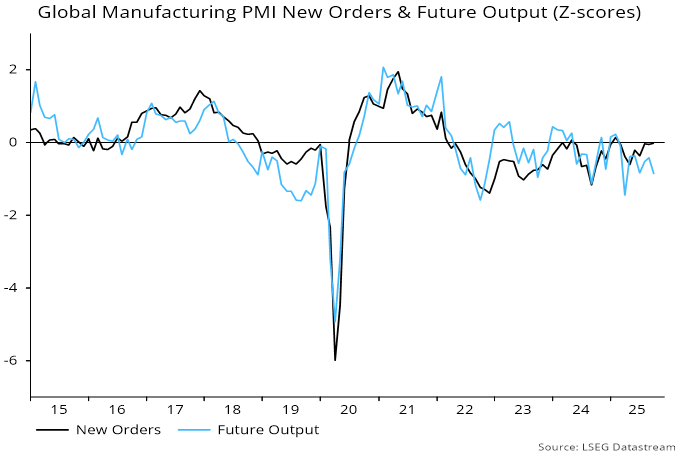
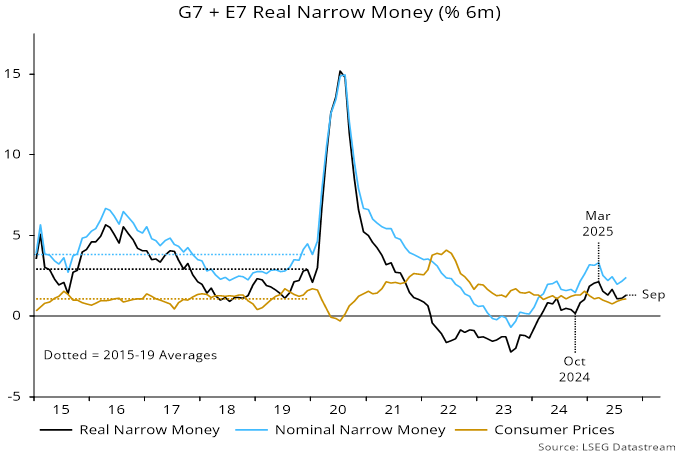
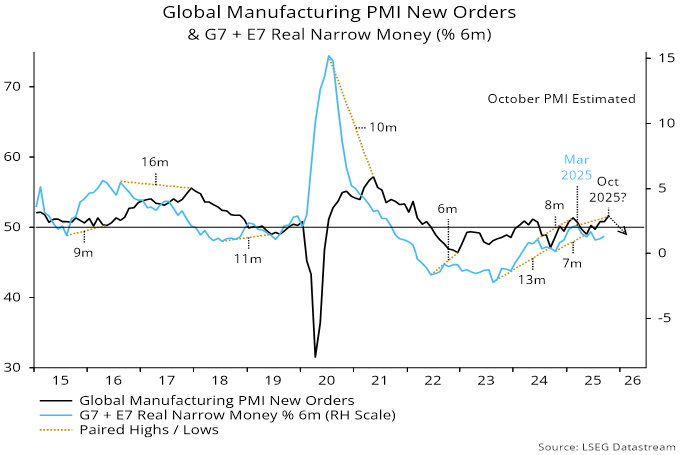
Global (i.e. G7 plus E7) six-month real narrow money momentum moved sideways in August, following a March-July fall. The previous low in real money momentum in October 2024 was reflected in a low in global manufacturing PMI new orders in May. Accordingly, the monetary slowdown since March could be mirrored by a peak and reversal in PMI new orders from around October – see chart 1.

Chart 1

031025c1

The fall in real money momentum has been modest but an expected economic slowdown could become more serious than others in recent years, for two reasons. First, the stockbuilding and housing cycles have entered time windows to begin downswings. Secondly, labour markets are showing signs of weakness for the first time since the pandemic recession, raising the risk of self-reinforcing negative dynamics.

The working assumption here has been that the stockbuilding cycle will reach another low in Q1 2027, implying a four-year current cycle versus a 3.5-year historical average. Recent G7 national accounts stockbuilding data as well as an indicator based on business surveys are consistent with the cycle being at or near a peak – chart 2.

Chart 2

031025c2

The housing cycle bottomed in 2009 and has ranged between 15 and 25 years historically, averaging 18 years. The pandemic-related money growth surge of 2020-21 appears to have resulted in the current cycle peaking early, in 2022. G7 housing starts or permits have been range-bound since early 2023 but rising unemployment could be the trigger for a break lower.  China has been leading in the current cycle and starts are still falling – chart 3.

Chart 3

031025c3

The suggestion that unemployment is on a rising trend is supported by consumer surveys, with a composite G7 indicator of negativity recently reaching a four-year high – chart 4.

Chart 4

031025c4

Monetary policy easing, if sufficiently dramatic, could short-circuit negative cyclical dynamics. A dramatic move could occur conventionally if additional evidence of labour market weakness is accompanied by a downside inflation surprise, or unconventionally if the Trump administration succeeds in gaining control of the Fed. A large cut in US rates would magnify US dollar weakness, forcing other central banks to follow.

Inflation prospects are judged here to be favourable, at least through early 2027. G7 annual broad money growth remains subdued (4.3% in August versus a 2015-19 average of 4.5%), while stockbuilding cycle downswings are usually associated with weakness in commodity prices – chart 5.

Chart 5

031025c5

Near-term US inflation numbers, however, will continue to reflect tariff effects. Elsewhere, central bankers focused on fighting the last war may be slow to respond to favourable surprises. As an example of hawkish bias, the ECB has gone on hold despite forecasting below-target inflation.

The alternative route to a large near-term fall in rates – a take-over of the Fed by the executive branch – still seems far-fetched, with the administration lacking scope to push through personnel changes on the necessary scale.

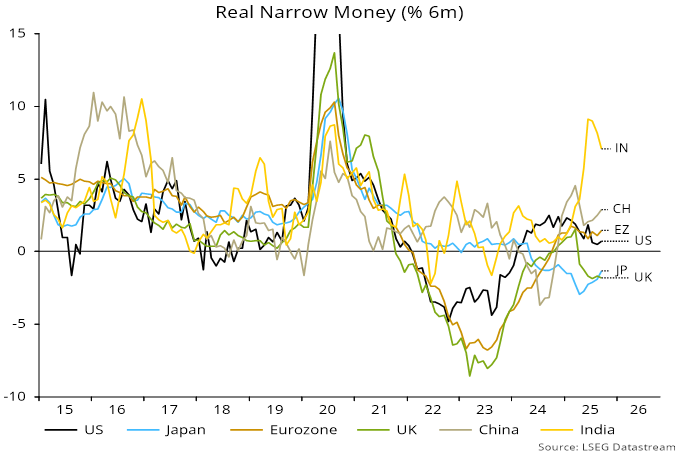
Among major economies, six-month real narrow money momentum is weakest in Japan and the UK, suggesting over-restrictive monetary policies and downside economic risk. Momentum is similar in the US and Eurozone but the US has slipped to a 17-month low, while a Eurozone recovery has stalled since Q1 – chart 6.

Chart 6

031025c6

The Eurozone story seems to be that higher bond yields triggered by fiscal loosening along with a stronger euro have offset ECB easing. Optimists argue that German fiscal stimulus is only now arriving but the impact could be balanced by an early stockbuilding downswing – the stockbuilding share of GDP rose by 0.7 pp in the year to Q2 and is above its long-run average.

The recent decline in global six-month real narrow money momentum has been driven by the G7 component. Chinese momentum fell back in April-May but has recovered since, giving a modestly favourable signal for economic prospects.

The assumption of a Q1 2027 trough implies that the current stockbuilding cycle has entered its final 18 months. The 18-month windows before previous lows were usually negative for risk assets and marked by credit events or “crises” – chart 7. The possibility of simultaneous housing cycle weakness, as well outsized gains in the upswing phase of the current cycle, suggests greater-than-normal downside.

Chart 7

031025c7

These 18-month windows were usually associated with cyclical equity market sectors underperforming defensives, following outperformance during the upswing (unusually strong in the current cycle). Stylewise, there was a weak tendency for quality to outperform, while momentum lagged its upswing gains significantly. The recent drawdown in relative performance of the MSCI EAFE Quality index versus MSCI EAFE was exceeded in magnitude and duration only in the early 1980s – chart 8.

Chart 8

031025c8

Six-month growth rates of global real narrow money and industrial output have been tracking closely with a small monetary excess on the latest readings – chart 9. The strength of markets appears to reflect a rise in the financial velocity of money more than ample liquidity, suggesting reversibility in the event of a cyclical deterioration in sentiment.

Chart 9

031025c9

The two monetary conditions historically favouring EM equities – E7 real money growth above the G7 level and global real money growth above industrial output expansion – are currently in place, suggesting EM outperformance in the event of a near-term further rise in markets.

Brazil and Mexico flags.

During a research trip to São Paulo this summer, our team met with the management teams of some of our holdings, with prospective investments and with local investors. We observed that consumer demand in Brazil is stronger than expected, particularly in higher-end categories. Companies we like such as Vivara Participações S.A. (VIVA3 SA) and Track & Field Co S.A. (TFCO4 SA) benefit from this consumer strength and offer a compelling risk reward given where these stocks traded during beginning of the year.

Local market behaviour remains distinctly short term, with high turnover and a focus on the next-quarter results. This is largely driven by the elevated Selic policy rate, currently at 15%, which leads investors to assess opportunities on an absolute-return basis rather than seeking alpha. With inflation near 5%, real yields approach 10%, creating a persuasive risk-free alternative that diverts capital from equities. In turn, local equity managers are adjusting their styles to retain AUM.

Banco Central do Brasil Target for Federal Funds rate (Selic)
A bar graph illustrating Central Bank of Brazil target for federal funds rate (Selic) over the last decade.
Source: Banco central do Brasil

These dynamics reinforce our long-term approach: concentrating on high-quality businesses with durable earnings power and consistent EPS expansion. Looking ahead, with elections approaching and potential rate cuts on the horizon, we expect a reallocation of flows from fixed income back into equities, benefiting companies with strong fundamentals and clear earnings visibility.

Key players in Brazil’s political landscape

Brazil’s political landscape is already taking shape as the country heads toward the 2026 elections. One of the most significant developments is the exclusion of Jair Bolsonaro from contention. His ineligibility through 2030, reinforced by a conviction earlier this month, effectively removes the most polarizing figure on the right. In his absence, the centre-right governor of São Paulo, Tarcísio de Freitas, is emerging as the most likely challenger to President Luiz Inácio Lula da Silva (also known as “Lula”) in a potential second-round runoff. This dynamic sets up a more conventional contest between a centre-left incumbent and a pragmatic, reform-minded conservative.

For Lula, the current year has been a test of political resilience. His approval ratings hit a low point of around 24% in February 2025, but have since rebounded modestly, reaching roughly 33% by September according to Datafolha surveys. The recovery suggests some stability, though his support remains fragile, reflecting persistent dissatisfaction with the pace of economic recovery and concerns about fiscal policy. Nevertheless, the directional improvement offers the president some breathing room as he navigates the second half of his term.

From the perspective of markets, the electoral outlook carries important implications. A Lula re-election would imply continuity in the Workers’ Party approach: a more active state role in economic management, coupled with efforts to demonstrate adherence to Brazil’s new fiscal framework. Investor reaction would likely hinge on whether the government can maintain a credible path to primary balance and on its stance toward state-controlled enterprises such as Petrobras, where governance remains a focal concern. By contrast, a victory for a centre-right figure like Freitas would be interpreted as a more reformist and privatization-friendly outcome. Such a scenario could lower perceived political risk, reduce risk premia and prove supportive for equities and local rates markets.

Mexico rates, USMCA and tariffs

Headline inflation in Mexico remained relatively stable, with the Consumer Price Index (CPI) registering a 3.57% year-over-year increase in August. Preliminary mid-September data suggests a slight acceleration to approximately 3.7%. Inflation expectations continue to trend downward. The Bank of Mexico’s (Banxico) August private-sector survey shows a further decline in median inflation forecasts for both 2025 and 2026, signaling growing confidence in price stability.

On September 25, Banxico lowered its policy rate to 7.50%, executing a 25 basis point cut. The decision was not unanimous, reflecting differing views within the board. Forward guidance remains cautious, as core inflation is decelerating only gradually. Reuters notes that while the easing cycle supports domestic demand and longer-term fixed income instruments, external factors – particularly the pace of US Federal Reserve rate cuts or potential tariff shocks – will ultimately drive risk premiums in Mexican assets.

In 2026, the United States–Mexico–Canada Agreement (USMCA) is scheduled for its first mandatory joint review. At that point, the three countries must decide whether to extend the agreement for another 16 years, renegotiate its terms or allow it to transition into annual reviews. The outcome will directly affect trade certainty and tariff exposure in North America. Currently, approximately half of Mexico’s exports to the United States do not qualify under USMCA’s origin requirements and are therefore vulnerable to a 25% US tariff. Goods meeting the agreement’s rules of origin continue to benefit from duty-free treatment, but non-compliant products face higher costs and stricter enforcement.

In parallel, Mexico has recently imposed tariffs of between 10–50% on a wide range of imports from China, including auto parts, textiles, steel and consumer goods. This move underscores Mexico’s effort to shield domestic industries from low-cost Chinese competition, but also adds a layer of complexity to supply-chain strategies for companies operating across the region.

The 2026 review will thus be a critical inflection point: it could either reaffirm the stability of North American trade or introduce uncertainty through renegotiation and tariff escalation.

Image aérienne des éoliennes du projet éolien de Bornish en Ontario, Canada.

Toronto (Ontario), le 29 septembre 2025 – Connor, Clark & Lunn Infrastructure (CC&L Infrastructure) est heureuse d’annoncer l’acquisition d’une participation de 49 % dans un portefeuille de trois projets éoliens en exploitation en Ontario, totalisant environ 235 mégawatts (MW) de la capacité brute de NextEra Energy Resources, LLC (Energy Resources). Grâce à cet investissement, le portefeuille d’énergie renouvelable de CC&L Infrastructure représente maintenant près de 2,4 gigawatts (GW) de capacité brute, y compris plus de 1,2 GW de capacité éolienne sur 10 actifs distincts diversifiés selon le marché, la contrepartie, la juridiction et le régime éolien.

Adelaide Wind, Bornish Wind et Goshen Wind (les projets) sont situés dans le sud de l’Ontario et ont une capacité brute d’environ 60 MW, 73 MW et 102 MW respectivement, produisant ensemble une énergie équivalente à la consommation annuelle de plus de 200 000 ménages ontariens. Toute l’énergie générée par les projets est vendue en vertu de conventions d’achat d’électricité (CAE) d’une durée de 20 ans à la Société indépendante d’exploitation du réseau d’électricité (SIERE) (cotée Aa3 par Moody’s). Energy Resources conservera une participation de 51 % dans les projets et continuera de gérer et d’exploiter les actifs à l’avenir.

« Cette acquisition fait progresser notre stratégie visant à bâtir un portefeuille d’actifs d’infrastructure résilient et à long terme, soutenu par des contreparties solides et des flux de trésorerie stables », a déclaré Matt O’Brien, président de CC&L Infrastructure. Ces projets renforcent notre présence sur le marché des énergies renouvelables de l’Ontario et démontrent notre engagement à investir de façon responsable dans des projets qui offrent des rendements ajustés au risque attrayants. »

Les projets apportent des contributions économiques importantes à long terme aux collectivités dans lesquelles ils sont menés grâce aux impôts fonciers et au financement direct. Les projets sont également à la base d’ententes sur les retombées locales avec plusieurs groupes autochtones locaux.

« Cette transaction reflète à la fois les solides données fondamentales que nous continuons de voir sur le marché canadien des énergies renouvelables et la capacité de notre équipe à réaliser des acquisitions complexes avec des partenaires de premier plan de l’industrie », a déclaré Eric Reidel, directeur général de CC&L Infrastructure. Nous sommes heureux d’avoir travaillé en collaboration avec Energy Resources pour conclure cette transaction, qui met en évidence notre approche axée sur les relations pour trouver des occasions qui ajoutent de la valeur à long terme à notre portefeuille. »

Marchés des capitaux CIBC a agi à titre de conseiller financier de CC&L Infrastructure pour la transaction et Torys LLP a agi à titre de conseiller juridique.

À propos de Connor, Clark & Lunn Infrastructure

CC&L Infrastructure investit dans des actifs d’infrastructure du marché intermédiaire présentant des caractéristiques de risque et de rendement attrayantes, une longue durée de vie et la possibilité de générer des flux de trésorerie stables. À ce jour, CC&L Infrastructure a accumulé environ 7 milliards de dollars d’actifs sous gestion diversifiés dans une variété de régions géographiques, de secteurs et de types d’actifs, avec plus de 100 installations sous-jacentes dans plus de 35 placements individuels. CC&L Infrastructure fait partie de Connor, Clark & Lunn Financial Group Ltd., une société de gestion d’actifs multiboutique dont les sociétés affiliées gèrent collectivement des actifs d’une valeur approximative de 154 milliards de dollars.

Personne-ressource

Kaitlin Blainey
Directrice générale
Connor, Clark & Lunn Infrastructure
(416) 216-8047
[email protected]

Group bicycle ride at dawn.

If you want to go fast, go alone. If you want to go far, go together. – African proverb

At Global Alpha, we truly believe in having strong, connected teams because we’ve seen how it translates into better performance at work. When team members trust each other, we can push boundaries, test new ideas and endure more uncertainty. So, when we’re looking for team-building activities we look for unique activities that feel relevant, challenging and outside of the box.

This year we did a couple of truly extraordinary events that brought our team together in new ways – like a crash course in sailing with future Olympians! – but the real standout was our participation in the Grand défi Pierre Lavoie. It’s an epic annual four-day, 1000 km relay race that unites thousands of cyclists to promote healthy living and fundraise to support research into rare diseases.

No one person completes the défi alone, just as no one person can run a successful investment firm alone. It takes a cohesive group of skilled team members who can trust and count on each other, especially in volatile times – this challenge was not only a test of physical endurance and teamwork, but also a metaphor for the long-haul journeys that define our success as investment professionals.

Building strength through trust and teamwork

Picture the starting line of the Grand défi Pierre Lavoie: the sun rising, nerves jangling, teammates poised for the first pedal stroke of a 1,000 km adventure. It’s daunting. The finish feels distant, almost impossible. But there are steady wheels on all members of this team – the kind of company that makes every bitter wind lighter and every small victory sweeter.

When you’re part of a team, you’re working toward achieving a common goal, whether it be crossing a finish line 1,000 km away or producing positive returns at the end of a volatile year. As with any team, there are different strengths to be found in each of its members. For the Grand défi Pierre Lavoie, some riders were fast on the straightaways, some were strong up the hills, some were daring through the turns. In our investment team, there are curious researchers, strong risk managers, detailed analysts and more, each of whose skills differ from the others.

On the race path or in the office, the Global Alpha team leans into the grind together, trading stories, picking each other up, finding the opportunities in setbacks. Making these journeys together, especially when there are struggles, builds grit. Over time, the team learns how to support the other members and how to play to their strengths.

There are challenges – sore legs, broken chains, missed targets, sour news, a string of rough quarters or market turmoil, but because of the trust within the team, these are not seen as failures. Instead, the team regroups. An injection of humour gives that second wind that pulls the team through a headwind; one rider’s encouragement or a colleague’s fresh perspective is the spark that keeps everyone moving forward.

But in both environments, there’s an important lesson to be learned: real breakthroughs come after being stretched to the limit.

Going the distance together

During a tough market or a rough patch in life, it can be easy to doubt the journey. During the Grand défi Pierre Lavoie, there are long, quiet stretches where progress feels invisible. Despite pedaling hard, the scenery barely changes. In investing, some days are just as sluggish – despite strong investment principles and proven strategies, the returns can still seem lacklustre.

But these stretched-out moments are where the magic actually happens.

Short-term lulls aren’t proof that nothing’s working – they’re part of playing the long game. It’s easy to chase quick wins or get spooked by setbacks. But by trusting the process, working as a team and continuing to move – one kilometre, one quarter, one decision at a time – perseverance and endurance will deliver quiet rewards and lasting success that go well beyond numbers or market cycles.

Endurance is at the heart of long-term investing because the real rewards come to those who stay disciplined through every market storm and quiet patch. Team endurance wins in investing by combining diverse strengths, steady encouragement and a shared commitment – making it possible to persist, adapt and thrive when others might falter or give up.

Here’s the heart of it: the real win isn’t found at the finish line, but in the journey itself.

  • Riding together, sailing together, investing together – it’s never just about the numbers.
  • It’s the camaraderie, shared resilience and group celebration after the slog, when you see how far you’ve come, thanks to each other.
  • Teams carry everyone through the silent, invisible stretches when progress is slow and doubt is loud.

It’s not about quick wins or epic heroics. It’s about the discipline to show up, the courage to trust the team and the humility to lean on each other for a reset. After every breakdown – on the bike, on the water, in a tough portfolio review – the team draws closer. What once felt like a failure becomes a shared memory, a lesson, a source of strength.

Final thoughts and what we’re doing next

Global Alpha Capital Management stands out because the same teamwork, grit and appetite for challenge that drive us in events like the Grand défi Pierre Lavoie also fuel our investment success. Our edge lies in superior stock picking, shaped by deep, bottom-up research and a thematic, fundamental approach to finding quality companies with real growth potential.

We’re equally relentless in risk management, applying robust analytical frameworks to ensure every investment is weighed wisely no matter how uncertain the market gets. Just as our team perseveres together through endurance events – adapting, supporting and trusting the collective process – we do the same for our clients, aiming for long-lasting performance in turbulent times.

What’s up next for Global Alpha team members? A 30 km trail run on Mont Tremblant – another chance for us take on an uphill challenge and cross a finish line, together.

The UK primary fiscal balance is in sizeable deficit, while the effective interest rate on debt is above a trend level of nominal GDP growth consistent with the 2% inflation target. These conditions, if sustained, imply an explosive path for the debt to GDP ratio.

Central government interest payments in the 12 months to August were equivalent to 3.4% of the gross debt stock, according to the latest public finances release.

The Bank of England’s Asset Purchase Facility (APF), however, still owned about a fifth of the debt at the end of the period, so received a significant portion of these payments.

The Bank bought its gilts at much higher prices, so is earning an average interest rate of only 2.0% on the purchase cost of its holdings.

It financed its purchases by creating bank reserves on which it pays Bank rate, currently 4.0%.

Accounting for this carry cost of QE, which the Treasury is obliged to cover, the effective interest rate on government debt over the last 12 months was 4.0%.

This is unexceptional by historical standards but well above an average of 2.7% over 2010-19, when QE was delivering an interest gain – see chart 1.

Chart 1

250925c1

Achievement of the 2% inflation target over the medium term implies nominal GDP growth of no more than about 3.5% pa, assuming trend economic expansion of about 1.5% pa. An effective interest rate above this level requires the government to run a primary surplus to avoid a trend rise in debt to GDP.

The OBR projected a significant decline in the primary deficit in 2025-26 but the 12-month rolling gap has continued to widen – chart 2. A worse starting position, policy retreats and expected changes to the OBR’s economic assumptions cast strong doubt on the previous forecast of a medium-term return to surplus.

Chart 2

250925c2

The effective interest rate is subject to conflicting influences and may remain above trend nominal GDP growth. Cuts in Bank rate and QT are reducing the APF net interest loss. On the other hand, the current redemption yield on the stock of gilts, of 4.6%, is well above the interest yield of 3.4% on the stock of debt. Unless the yield curve shifts down, the interest yield will trend higher as existing gilts mature and are refinanced.

The Chancellor’s fiscal rules place emphasis on the current budget but the primary balance is key for stabilising the debt to GDP ratio. Budget measures need to deliver an early return to a primary surplus to calm fears of a fiscal doom loop.