It has been a year since COVID-19 emerged, and the world is still struggling to contain the virus. In the past year, the nations and regions that had better control over the virus have seen faster economic recovery. China, for example, announced that their 2020 Q4 GDP grew by 6.5% year-on-year, which has surpassed the GDP growth of 6% in Q4 2019. This brings China’s 2020 GDP growth to a total of 2.3%. By comparison, the United States (US), Eurozone, and Japan are forecasted to contract by 3.6%, 7.4%, and 5.3%, respectively.

For China, industrial production was the growth engine, increasing by 2.8% in 2020, as global demand for medical equipment, home improvement products, and home office electronics was strong. Despite overall consumption lagging production, online retail sales posted a solid 15% growth. Online channels accounted for one quarter of total retail sales, up from just 4% in 2019. Companies we hold in our portfolios also benefited from the strong online retail growth in China. L’Occitane, for example, is a maker of natural and organic ingredient-based cosmetics and well-being products. Their online sales in China grew by 83.5% in the six months ending September 2020, and accounted for approximately 32% of their total China sales. It was ranked the number 1 brand for body care and hand care on T-mall, the largest ecommerce platform in China. Similarly, online sales of Asics, a manufacturer of sports shoes and sports apparels, more than doubled in the nine months ending September 2020, and accounted for over 30% of its sales in China. Also, profits of the beverage manufacturer Vitasoy increased by 27%, as online and home channels delivered strong results.

The fast growth of ecommerce also boosted logistics demand. According to the State Post Bureau, China’s total express delivery volume rose by 37% in December 2020, following the 37% and 43% growth in November and October 2020, respectively. Kerry Logistics, a third-party logistics service provider we own in our portfolios, has benefited from the surging domestic and cross-border shipping volume. The number of cross-border ecommerce consignments they handled in the first half of 2020 increased by 24% compared to last year. In addition, the strong overseas demand has driven the cost of shipping from China to Europe and the US to triple or quadruple in recent weeks. As one of the few Asia-based global freight forwarders, Kerry Logistics has leveraged its unique market position to capture the growing demand. Its international freight forwarding segment profits increased by 40% in the first half of 2020. Another positive update on Kerry Logistics is the completion of the spin-off of its subsidiary, Kerry Express Thailand, in late December. The listing was well received by investors, with its shares rising as much as 161% from the IPO price in debut. In addition to ecommerce, the potential distribution of COVID-19 vaccines could also help drive the company’s revenue and profit growth. Kerry Logistics has nearly one million square feet of cold chain facilities in Hong Kong, and is well equipped to handle drugs, including vaccines, antibiotics and insulin.

China has been leading the world on the digital payment front, with the highest mobile payment penetration rate of 32.7%, versus 15% in the US. The Chinese government has taken a step further to start testing the use of its own digital currency, Digital Currency Electronic Payment (DCEP), which is a digital version of its official currency, Yuan. Pilot projects have been ongoing in Shenzhen, Xiong’an, Chengdu, and Suzhou since August 2020. The official rollout could be as early as 2022. DCEP’s share of China’s digital payment market is expected to reach 9% in 2025, and 15% in 2030. To be launched domestically first, the digital Yuan will help smooth monetary policy transmission and help policymakers regain control over money flow and consumer spending data from Alipay and WeChat Pay. Eventually, it could be used to promote the Yuan’s global status and become China’s preference for cross-border payments, bypassing the Swift network amid rising tension with the US.  

On the political front, we don’t expect the US-China relationship to improve significantly under the Biden administration, although the two countries might collaborate on matters such as fighting climate change and COVID-19. Meanwhile, the delisting of Chinese stocks in the US seems to have had a positive impact on the Hong Kong stock exchange, as investors in mainland China are shifting attention to the cheaply valued Hong Kong listed stocks. This helps the Hang Seng Index to be among the best performers in the region so far this year. This trend is expected to continue, with investors shifting out of A-shares to H-shares. We continue to have high convictions that the companies we hold in this region will outperform, supported by their competitive product and offerings, and solid balance sheet. 

In the game Monopoly, the property names all come from real places in Atlantic City, New Jersey. You might remember that four of the properties are railroads, and that one is the “Short Line Railroad”. This name is an exception because there was no Short Line Railroad in Atlantic City. The name is a contraction of “Shore Fast Line”, a railroad that did run there in the first half of the twentieth century.

In the business world, short-line railroads are the small stretches of track that spur off the main national networks. Typically, they provide first- and last-mile rail transportation and storage for their customers. There are about 550 of these short lines in the US and 60 or so in Canada, and they are usually privately owned. In 2019, the Private Client Infrastructure Portfolio joined with a team of seasoned operators in this space and purchased its first short-line rail asset in Sarnia, Ontario. Early experience in operating this asset has been positive, with financial results exceeding base case expectations.

In August 2020, the portfolio bought its second and third short-line rail assets in Louisiana and Texas, expanding the Private Client Infrastructure Portfolio’s geographic scope and further diversifying its overall portfolio of infrastructure investments. 

Short-line rail assets occupy entrenched positions with their customers and produce strong and stable cash profits. Rail is also a business that requires active management and, in return, can experience growing profits over time as well as provide protection against inflation. 

Even with the challenges of running a business during the COVID-19 pandemic, the short-line rail assets have proven to be resilient investments, due in part to short-line rail’s persistent, defensible characteristics. These include providing essential services to well-established, large-scale customers; operating in resilient markets with high barriers to entry; and having strong customer relationships, often with contracted revenues.

Infrastructure, along with real estate and private loans, are alternative assets that, where appropriate, comprise a modest part of our clients’ well-diversified investment portfolios. They can help improve the balance between the returns achieved by the portfolios and the risk required to generate those returns—which can be even more rewarding than playing monopoly and winning second prize in a beauty contest.

This post is for information only and is not intended as investment advice. The views expressed are those of the author at the time of publication and are subject to change at any time.

Early reports about COVID-19’s impact on marriages in the United States (US) indicate that marriage rates were lower than expected in 2020. Recent trends show that the opposite has been true for corporations, with the second half of the year seeing an unprecedented surge in corporate merger and acquisition (M&A) activity. This surge comes after M&A volumes dried up by more than 50% following the initial lockdowns in the spring of 2020, causing executives to re-evaluate opportunities, given the uncertainty.

Although total deal value is still down 6% to $3.5 trillion for 2020, more than two-thirds of the activity happened between July and December[1]. The fourth quarter of 2020 alone saw a 39% year over year increase in announced M&A deals from 2019. Further, December was the fourth strongest month in history for M&A revenue. It is not just a high volume of small transactions; mega deal announcements have been all over the news. Such examples include the S&P Global acquisition of IHS Markit for $39 billion, the Salesforce acquisition of Slack for $27 billion, and AON’s acquisition of Willis Towers Watson for $30 billion.

So, how is 2021 looking, compared to the second half of 2020? It appears unlikely to be any different. As management teams begin reflecting on what a post-COVID future looks like, we expect that companies will reposition themselves to adjust to shifting consumer behaviour, created by COVID. A quarterly survey of global CEO confidence reached a high of 64 in Q3 2020, after bottoming to 36 at the beginning of the year (like with Purchasing Managers’ Index (PMI), ratings above 50 are positive and below are negative)[2]. That same report highlighted that of the CEOs surveyed, 36% plan to increase their capital spending over the next 12 months, compared to their previous expectations. Given the recent political changes in the US, it appears likely that the next CEO confidence survey will show even more optimism.

Furthermore, many industries, such as travel, entertainment and energy, are still near their multi-year low; this makes companies attractive targets at their current valuation. While the initial expectation was that many names in these industries would go bankrupt, all-time low interest rates and massive liquidity injections made it so that they only had to load their balance sheet with more debts to stay afloat. These factors make it likely that the record high of $1.5 trillion cash that private equity funds currently hold will be put to work during the year. As opportunities become clearer, we will see a record year for M&A and other investment banking activities.

As for the important question on everyone’s mind: how is Global Alpha getting exposure to this? We own Rothschild & Co (ROTH PA), among other names. Founded in 1838 by the famous Rothschild family, Rothschild & Co is one of the world’s largest independent financial advisory groups, with headquarters in Paris, France. The company provides M&A, strategy and financing advice, as well as investment and wealth management. With 50 offices and 3,500 employees, the company has a foothold in over 40 countries, and it is still more than 60% family-owned. As a boutique firm, Rothschild also benefits from a favorable reputation in comparison to larger banks, as well as the trend of using more advisors to conduct individual deals. In 2019, boutique firms accounted for 22% of advisory deal value versus only 9% in 2000; its share is expected to keep increasing over the next decade.

Historically, the firm’s activities centered on its global financial advisory and its wealth and asset management businesses. A little more than a decade ago, Rothschild added a new private equity business that now represents 8% of their revenue, but 17% of their profit share, representing a new growth driver for them. It is also the reason that Rothschild is able to maintain a better margin profile than its peers. Additionally, this allows the firm to deploy its own capital alongside their institutional clients and incorporate strong ESG principles in its investment decisions.

Within its global financial advisory business, Rothschild employs more than 1,100 advisors, and derives two-thirds of its revenue from pure M&A, with the balance from capital markets financing. Rothschild ranks sixth in revenue globally and first in Europe for its investment banking business. We are confident that the company will be able to benefit from the current environment.

SWOT:

Strengths

  • Leader in the European Union, consistently gaining market shares
  • Best in class talent and solid reputation

Weakness

  • M&A is highly cyclical
  • High family ownership is a risk for shareholders

Opportunities

  • US market share can double in size
  • Emerging markets expansion


Threats

  • Departure of key bankers
  • Weak M&A cycle

[1] 4Q20 Independent Financial Advisor & Regional Broker Earnings Preview, Piper Sandler, January 13, 2021

Global money trends continue to suggest a near-term economic slowdown, with the caveat that interpretation of US monetary statistics is complicated by recent regulatory changes.

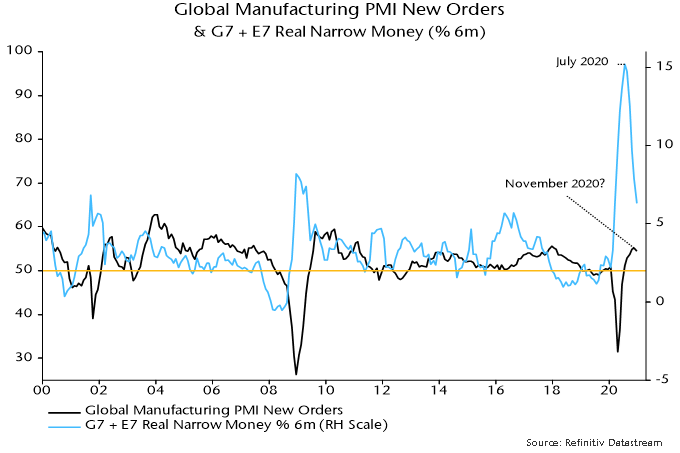
The key global monetary indicator followed here – six-month growth of real narrow money in the G7 economies and seven large emerging economies – is estimated to have fallen further in December, based on monetary data covering 70% of the aggregate. Real money growth has led the global manufacturing PMI new orders index by 6-7 months on average historically, so the continued decline from a July 2020 peak suggests that this PMI measure will move lower into Q2 – see chart 1. 

Chart 1

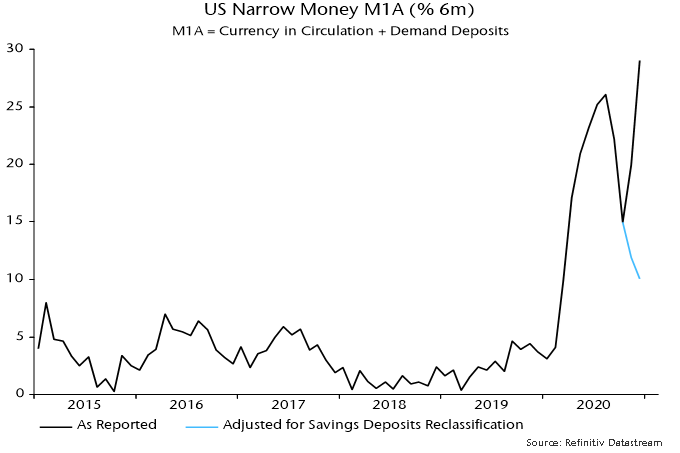
An important qualification is that the G7 plus E7 money numbers for November / December incorporate an adjustment to US data to correct for an apparent upward distortion due to some banks reclassifying savings deposits (excluded from M1 and related measures) as demand deposits (included).

Excluding this adjustment, six-month growth of US narrow money rose to a new high at year-end – see chart 2. Some monetary observers ignore or are unaware of the reclassification distortion, arguing that the narrow money surge presages a super-strong economy and sharply higher inflation.

Chart 2

Fed statisticians haven’t responded to a request for confirmation of a reclassification effect on the data. The view that the strong November / December numbers are explained by such an effect – rather than a genuine flow of money out of « inert » savings deposits into “high velocity” demand deposits – rests on three considerations. 

First, the Fed indicated that deposit reclassifications would occur following its decisions to cut reserve requirements on transactions deposits to zero and remove restrictions on withdrawals from savings deposits last spring. 

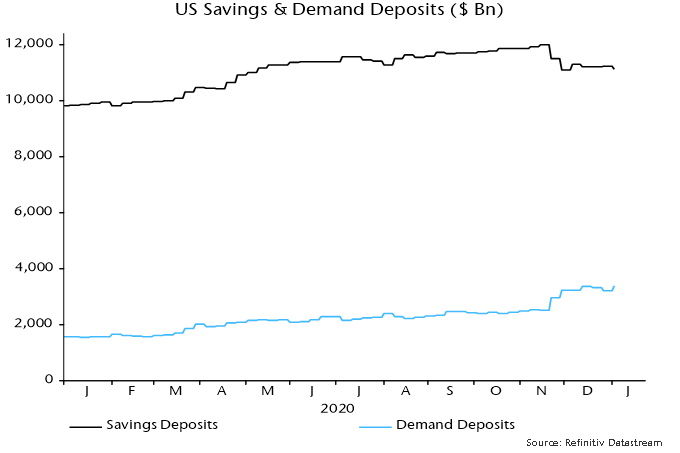
Secondly, the big fall in savings deposits and corresponding rise in demand deposits occurred between the weeks ending 16 November and 30 November – see chart 3. Movements outside this two-week window were “normal”. The weekly numbers are averages of daily data, so the reclassification is likely to have occurred during the week ending 23 November, with the effect carrying over into the following week. (The alternative view is that US election results triggered a big movement of money.) 

Chart 3

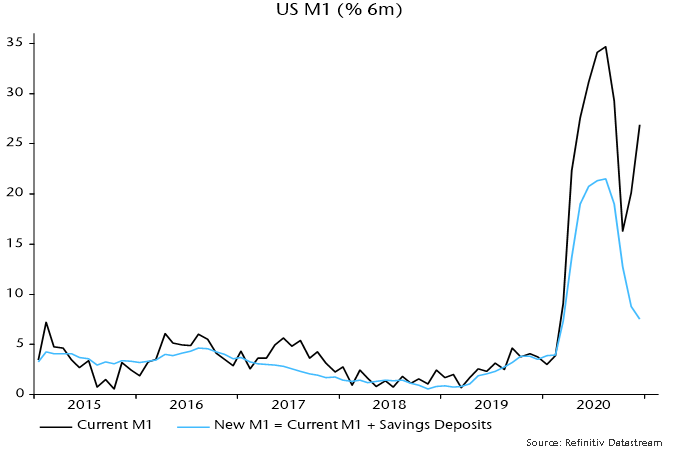
Thirdly, the Fed implicitly acknowledged that the M1 data have become distorted in its decision to redefine the aggregate to include savings deposits from next month. Six-month growth of the new M1 measure continued to slide in November / December – see chart 4. 

Chart 4

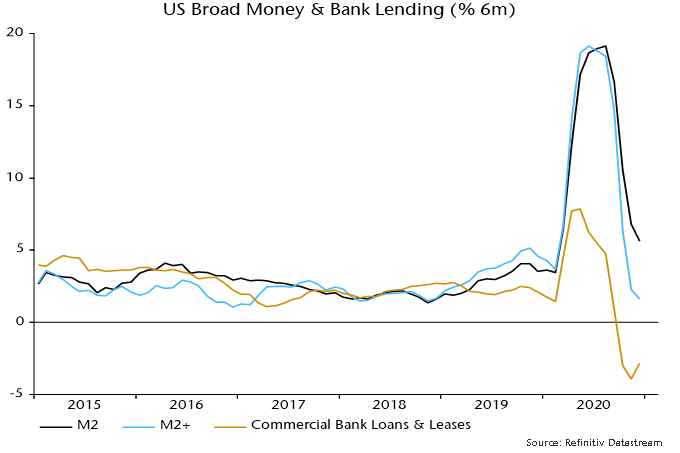
The suggestion that US monetary conditions have become less expansionary is supported by broad money trends, while bank lending continued to contract into year-end (with weakness not due to PPP loan forgiveness, which has yet to kick in) – see chart 5. 

Chart 5

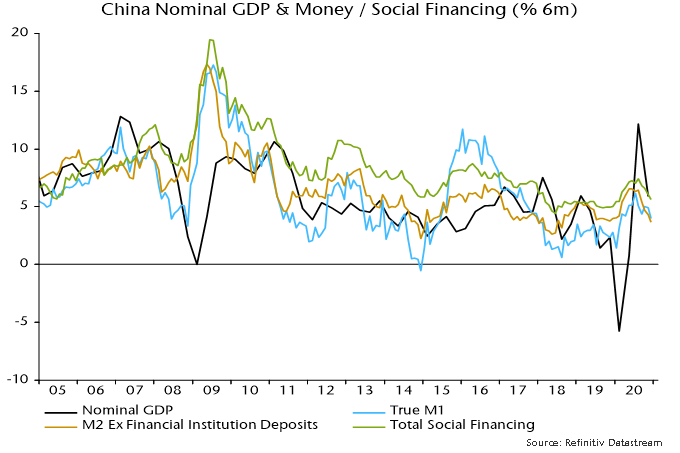
The fall in global six-month real narrow money growth in December also reflected declines in China, Japan and Brazil. The further slowdown in China – extending to broad money and credit, as shown in chart 6 – is consistent with the view here that PBoC policy is too tight and Chinese economic news is likely to disappoint in early 2021. A dovish PBoC policy shift may be needed to trigger the next leg of the global reflation trade but isn’t expected by the consensus and could be conditional on a prior market setback. 

Markets overview

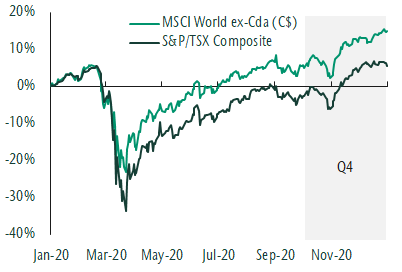
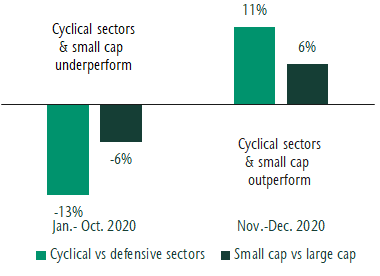
Equity market returns were strong this quarter as the global economy continued to show signs of healing in the face of rising virus cases and more shutdowns. The S&P/TSX Composite Index was up 9.0% and the MSCI World ex Canada Index (C$) advanced 8.8% this quarter. The start of November marked a significant inflection point for markets. The US election resulted in some short-term market volatility which subsided. This was followed by the clearly positive news of an approved COVID-19 vaccine. A better vaccine that is available to people faster than previously expected provides a boost to the economic outlook, even if it does take many months to distribute widely. This has allowed investors to look beyond near-term economic uncertainty to a more normal environment. A shift in market leadership followed as investors bought companies that were most negatively affected by lockdowns and stood to benefit the most from an eventual end of the pandemic. In addition, assets that are more sensitive to the economic cycle began to outperform. This includes cyclical sectors like energy and financials as well as asset classes like global small cap stocks.

Equity markets reach new highs in Q4

Source: Refinitiv

Significant shift in market leadership

Sector returns are for the MSCI World. Cyclical sectors include materials, energy, consumer discretionary, financials and real estate. Defensive sectors include consumer staples, health care and utilities. Small cap returns are based on the MSCI World Small Cap Index and large cap returns are for the MSCI World Index. All returns in Canadian dollars. Source: Refinitiv

Bond returns were mixed this quarter. Government and provincial bonds were modestly negative and corporate bonds generated positive returns. The net result was that the FTSE Canada Universe Bond Index returned 0.6% for the quarter. High yield bonds, like equities, benefited from an improved investor outlook. Despite default rates remaining elevated, demand for these investments has been strong and yields have tightened. 

Our thoughts

We have been seeing a recovery in the economy unfolding for some time and have positioned portfolios accordingly. We have maintained an overweight to equities with a bias to global stocks. We have increased our weight to asset classes that tend to do well in a recovery such as small cap stocks. This quarter we sold core bonds and bought high yield bonds as credit conditions improved. This is consistent with the beginning of a new business cycle which historically coincides with improving returns for high yield. 

Overall our equity teams continue to own resilient, stable businesses that have higher earnings growth than the market. Through the recovery we have selectively added more cyclical companies standing to benefit from an improving outlook and the start of a new business cycle. Within Canada this means increasing exposure to banks and energy companies. Within our global strategy we remain overweight emerging markets and have reduced the underweight to financials and increased positioning in select leisure companies. Within fixed income we are overweight credit and inflation-protected debt. Our positioning has benefited clients well this quarter and year.

From the desk of Jeff Guise, Managing Director, Chief Investment Officer, CC&L Private Capital.

This post is for information only and is not intended as investment advice. The views expressed are those of the author at the time of publication and are subject to change at any time.

FOR IMMEDIATE RELEASE

CONNOR, CLARK & LUNN INFRASTRUCTURE CLOSES
U.S. RENEWABLE POWER INVESTMENT

TORONTO, JANUARY 11, 2021

Connor, Clark & Lunn Infrastructure (CC&L Infrastructure) is pleased to announce that it has completed its previously announced acquisition of an 80% equity interest in a U.S. wind and solar portfolio.

This transaction, which was completed alongside Régime de Rentes du Mouvement Desjardins and Desjardins Financial Security Life Assurance Company (together, Desjardins Group), included the purchase of four operating wind projects and one construction-stage solar project located in Indiana, Wisconsin, Oklahoma, and Ohio. Each asset is fully contracted through long-term power purchase agreements with high-quality offtakers, and the portfolio provides geographically diversified exposure to three distinct U.S. electricity markets. Construction of the solar facility began in December 2020 and is expected to be operational later this year or early in 2022.

“Completing this investment achieves an exciting milestone for our business,” said Matt O’Brien, President of CC&L Infrastructure. “The addition of these projects increases the total capacity of our renewable power portfolio well past a gigawatt globally. We look forward to operating these high-quality projects alongside our partners over the coming years.”

CC&L Infrastructure now owns approximately 1.4 GW of renewable power globally, with more than 1GW in operation. On a combined basis, these operating facilities are expected to produce approximately 4 million MW hours of clean energy each year – enough energy to power more than 320,000 homes and offset the equivalent greenhouse gas emissions of more than 600,000 passenger vehicles for a year.

About Connor, Clark & Lunn Infrastructure

CC&L Infrastructure invests in middle-market infrastructure and infrastructure-like assets with highly attractive risk-return characteristics, long lives and the potential to generate stable cash flows. CC&L Infrastructure is a part of Connor, Clark & Lunn Financial Group Ltd., a multi-boutique asset management firm whose affiliates collectively manage over CAD$85 billion in assets. For more information, please visit www.cclinfrastructure.com.

Contact

Kaitlin Blainey
Director
Connor, Clark & Lunn Infrastructure
(416) 216-8047
[email protected]

Markets reached new highs in 2020 in the face of a global pandemic. This leaves some asking if this is sustainable.  Continued growth depends on improvements in the economy, company earnings and government support. The good news is that we have seen advances on these fronts over the last several months. However, markets have high expectations for 2021 and any shortfall may result in a setback. Here are three areas we are looking to see progress on in 2021:

1. Markets and the economy become more connected

The global economy had a terrible 2020 but equity markets delivered strong returns. This disconnect is quite normal when a cycle comes to an end and a new one emerges. The reason is that the economic data provides an assessment of where we were, while the market is focused on a brighter future. Looking forward we need to see continued improvements in the economy and believe market returns may be more modest- reflecting a more normal outlook as opposed to a strong recovery. Of course, these improvements don’t happen in a straight line and fluctuation in the economic recovery will cause volatility in markets.

2. Earnings will need to move above pre-pandemic levels

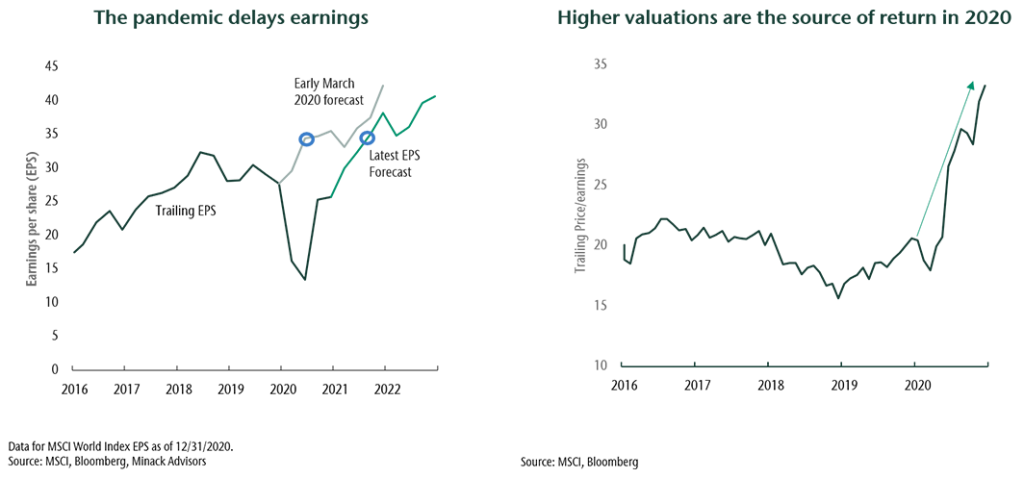
As economic activity increases in 2021, overall business earnings should continue to recover. Globally, earnings are expected to rise and surpass pre-pandemic levels in late 2021. This isn’t good for equity markets- it’s a requirement!  This is because the current market level already reflects this earnings recovery in the form of higher valuations. If this outlook falters, it may lead to a temporary decline in markets. 

3. Government support is a necessity

The recovery we have experienced has been largely the result of unprecedented government spending, zero percent interest rates and bond-buying by central banks to heal credit markets. Going forward, government spending will be the dominant tool for managing the recovery. We are looking for a continued willingness of policymakers to run sustained supportive policy until there can be a transition to private-sector spending and investment.

What does this mean for your portfolio?

An improved outlook for the economy combined with uncertainty argues for portfolio diversification. At CC&L Private Capital, we have built diversity within our asset class strategies and across our investment platform. Diversification across traditional and alternative asset classes will be even more important as we look ahead. In 2020 we increased investments in private market assets like infrastructure. We also began to offer frontier market investments to our clients and increased exposure to emerging markets. This broadens portfolio diversification and positions our clients well for the future.

Often after discussing our market outlook, a client will ask, what should I be doing? For long-term investors, sticking to your existing strategy (while we manage the rest) is almost always the best advice.  This year we would add to this sage wisdom and say now is a really good time to revisit your asset allocation to ensure that you are balancing risks while achieving the long-term return necessary to meet your financial objectives.

This post is for information only and is not intended as investment advice. The views expressed are those of the author at the time of publication and are subject to change at any time.