A traveller standing outside a cabin looking at the northern lights in Yellowknife, Northwest Territories, Canada.

In 2025, US equities were powered not just by technology companies and AI giants, but by a wider array of stocks, signaling a shift beyond the famed Magnificent Seven. Yet it was Canadian equities that stole the spotlight, propelled by a remarkable gold rally that soared over 60% this year. For investors, this marks the third straight year of robust total portfolio growth, achieved despite persistent geopolitical uncertainties and trade challenges.

Equities – Canadian equity led the charge

2025 was a banner year for Canadian equities, which charged ahead of other major markets. The S&P/TSX Capped Composite Index returned 31.7%, and Canadian small cap stocks soared more than 50%. This impressive rally was powered by the explosive growth of gold and precious metal companies, as well as the continued global momentum of AI-driven firms. Emerging and international equities also delivered stellar performances, climbing 27.3% and 25.1% respectively.

In contrast, US equities lagged, rising 12.4% for the year, a result dampened for Canadian investors by a weaker US dollar. In contrast, the S&P 500 Index gained 17.9% in US dollar terms. While a wider array of stocks drove the S&P 500 Index return in 2025, the collective influence of the Magnificent Seven – Alphabet (Google), Amazon, Apple, Meta Platforms, Microsoft, Nvidia and Tesla – saw their representation grow slightly, with Nvidia being a key contributor to that growth.

Figure 1 – 2025 calendar year equity returns (%)
Bar chart of 2025 equity returns: Canada 31.7%, EM 27.3%, Intl 25.1%, US 12.4%, others 14–17%.
Source: Bloomberg, S&P & MSCI (all returns in CAD)

While equity market indices delivered impressive gains, active managers faced a tough landscape, especially if they missed out on the surging gold and technology sectors. An exception to this experience has been quantitative (systematic) investment managers, who harness technology to analyze a vast array of global companies and maintain diversified portfolios. Quantitative-style managers have generally been able to navigate the challenging and concentrated equity markets and outperform the index over the last several years.

Fixed income – duration headwinds

2025 proved to be another challenging year for traditional fixed income markets. Emerging markets debt and US high yield stood out as top performers, driving public market fixed income returns. The Bank of Canada continued to cut rates, bringing the overnight rate down to 2.25% by year end. Once again, longer-duration bonds faced headwinds, with universe bonds invested across all maturities posting a modest 2.6% gain, while long bonds declined by 0.8%.

Figure 2 – 2025 calendar year fixed income returns (%)
Bar chart showing 2025 fixed income returns: Cash up 2.8%, universe bonds up 2.6%, long bonds down 0.8%, high yield bonds up 5.5% and emerging markets debt leading with 9.6%.
* 30% Merrill Lynch US High Yield Cash Pay BB Index (CAD$) & 30% Merrill Lynch US High Yield Cash Pay BB Index (USD$) & 30% FTSE Canada Corporate BBB Bond Index & 10% Merrill Lynch Canada BB-B High Yield Index (CAD).
** 50% P Morgan Emerging Market Bond Index, 50% JP Morgan Corp Emerging Market Bond Index (CAD).
Source: Bloomberg, Merrill Lynch, S&P & FTSE (all returns in CAD)

Private markets

Private markets in 2025 once again revealed a landscape shaped by strategy and timing. Unlike public markets – where returns are immediate and transparent – private investments require patience due to valuation and reporting lags. This year witnessed encouraging results with private credit and infrastructure strategies delivering solid returns and commercial real estate showing steady improvement.

Private equity returns, while mixed, sparked renewed optimism, especially with deal activity surging past USD300 billion in the third quarter of 2025 alone. Hedge funds demonstrated their versatility, with many strategies achieving returns that more closely rivaled global equities, a notable shift from the previous year.

Ultimately, private markets continue to play a vital role in portfolio diversification, complementing public equities and fixed income to create a more resilient asset mix.

Stronger loonie

The Canadian dollar clawed back much of the decline it experienced in 2024 relative to the US dollar. For Canadian investors holding unhedged US equities, this rebound reduced returns due to the currency effect. Figure 3 traces the history of exchange rates from 1970, capturing the modern-day experience with respect to the Canadian dollar versus the US dollar relationship. Since around 2016, the Canadian dollar has settled into a relatively narrow range, even during the recent surge in inflation. By the close of 2025, the Canadian dollar stood at around 73 US cents, marking a gain of almost 5% from the previous year’s finish.

Figure 3 – History of USD / CAD exchange rates
USD/CAD exchange rate history from 1970 to 2025, showing long-term trends and a rebound to 73 US cents by year-end 2025.
Source: Bloomberg

Opportunity knocks

Opportunity is knocking for investors in 2026. After several years of remarkable gains in equity markets, now is the perfect moment to revisit how diversified your portfolio truly is. While alternative investments may have recently lagged soaring global equities, they remain a vital tool for building resilience. By weaving alternatives into your asset mix, you can better prepare your portfolio to weather the inevitable twists and turns of the financial landscape.

A bird's eye view of Thailand's vital expressway network.

Canadian investors have long leaned toward homegrown stocks, giving Canadian equities a bigger slice of their portfolios than global equity benchmarks suggest. Notwithstanding the strong performance of the Canadian equity market in 2025, the recent surge in US markets – fuelled by the rise of the “Magnificent Seven” technology giants – has some investors rethinking this approach. Canadian investors have a similar home-country bias as some of their global peers. While some investors may go all-in on global equities, there are several advantages for having a Canadian-equity bias.

Home-country bias

Home-country bias refers to building an investment portfolio instinctively favouring stocks from your own country, which is a tendency shared by investors worldwide. Although Canadian stocks represent just 3% to 4% of world equity markets, the comfort of the familiar leads to a much larger role in equity portfolios. It is common for Canadian investors to allocate 20% to 40% of their total equity exposure to domestic equities.

Many investors globally allocate far more in local equities than their country’s actual slice of the global market. According to the WTW Thinking Ahead Institute’s Global Pension Assets Study 2025, this bias has been especially strong for Australian, Japanese and UK pension investors that allocate 20% to 45% of their total equity exposure to homegrown companies. While US pension investors typically have the largest domestic percentage allocation, it generally reflects the US market’s large representation of the global market.

The case for a home-country bias versus a more global market capitalization approach often wrestles with similar challenges, like the impact of certain sector concentration. However, each approach offers a unique lens on how to manage risk and opportunity.

Features of the different approaches

The table highlights the features of the different approaches to managing total equity assets.

Canadian-equity bias Global equity only
Currency Investing in assets denominated in Canadian dollars allows institutional investors, such as pension plans, endowments and foundations, to sidestep currency risk. This ensures that asset values move in step with liabilities, eliminating valuation fluctuations caused by currency mismatches. Investing globally is not just about geography; it is about currency too. Global equities provide exposure to multiple currencies, offering a natural hedge if the Canadian dollar takes a hit during global downturns or commodity slumps.
Index features Canada’s equity market stands out globally with its concentration in resources and financials, which gives it a unique risk-return profile. During commodity booms, for example, Canadian equities can offer diversification benefits relative to global markets. From a sector perspective, the global market is more heavily weighted to growth sector opportunities, such as information technology and health-care sectors compared to Canada.
Diversification While Canada’s market is smaller and more concentrated, leading to higher return volatility, it can strengthen total equity returns when paired with global equities by adding a layer of diversification. Diversifying globally helps avoid putting all your eggs in one equity basket. Depending on the global index adopted, it provides access to many developed and emerging market countries.
Alpha potential Added value potential from active management has been more consistent for Canadian equities compared to global equities, providing an important additional source of return. Active management within global equity portfolios has delivered added value, notwithstanding the recent headwinds due to the robust performance of technology-related companies.


Why have a Canadian-equity bias?

Portfolios with a Canadian-equity bias provide the opportunity to unlock better risk-adjusted total equity returns compared to global only, they have the benefit of more consistent added value potential from active management, as well as a supportive economic backdrop in Canada that amplifies its growth potential.

Return perspective

Analyzing relative historical performance of Canadian equities (S&P/TSX Index) versus the major global equity indices (MSCI ACWI Index and MSCI World Index), highlights the resilience and benefits that a Canadian equity bias can bring. While global indices often steal the spotlight, there is no clear, consistent winner. Except for the most recent decade, Canadian equities have outpaced their global counterparts over extended periods, when measured in rolling four-year returns and in Canadian-dollar terms for the global indices (figure 1). While the headlines focus on the “Magnificent Seven” powering US and global equity gains, Canadian equities have quietly matched global equity performance over the more recent rolling four-year periods.

Figure 1 – Global equity versus Canadian equity index returns
Line chart showing rolling 4-year returns for MSCI ACWI, MSCI World, and S&P/TSX from 1996 to 2025.
Source: MSCI, FTSE and Bloomberg

When analyzing the volatility of Canadian and global equity indices, the story is a little clearer, with Canadian equities generally being more volatile than unhedged global equities (figure 2). This experience is consistent with the more concentrated Canadian market compared to the global equity market.

Figure 2 – Global equity versus Canadian equity volatility of index returns
Line chart showing rolling 4-year volatility for MSCI ACWI, MSCI World, and S&P/TSX from 1998 to 2025.
Source: MSCI, FTSE and Bloomberg

But here is the twist: portfolios that have a tilt toward Canadian stocks, more than their market capitalization weighting would suggest, have generally experienced lower overall volatility than a purely global portfolio, as illustrated for a portfolio invested 70% in global equities (MSCI ACWI Index) and 30% in Canadian equities (figure 3). When also considering the rolling four-year return experience (figure 4), it implies stronger risk-adjusted returns for a home-country bias.

Figure 3 – Global equity versus home-country bias global equity volatility of index returns
Line chart showing global equity vs home-country bias: rolling 4-year volatility for MSCI ACWI vs MSCI ACWI/S&P/TSX from 1998–2025.
Source: MSCI, FTSE and Bloomberg

Figure 4 – Global equity versus home-country bias global equity index returns
Line chart showing global equity vs home-country bias: rolling 4-year returns for MSCI ACWI vs MSCI ACWI/S&P/TSX from 1998–2025.
Source: MSCI, FTSE and Bloomberg

Alpha potential

Active management offers the potential of an additional source of return. While the influence of technology-related stocks has recently implied headwinds for active managers in general, Canadian equity managers have on average provided more consistent added value over time compared to global equity managers (figure 5).

Figure 5 – Canadian versus global equity median added value

Bar chart showing Canadian vs global equity: rolling 4-year median added value from Q3 2011 to Q3 2025.
Note: Based on manager universe with MSCI ACWI Index benchmark for global equities.
Source: eVestment, Connor, Clark & Lunn Financial Group.

Current economic backdrop

Canada is positioned to deliver both value and growth for investors. The country is stepping confidently into a new era of economic growth, powered by a pro-business agenda. Under Prime Minister Mark Carney, the country is embracing reforms that break down interprovincial trade barriers, streamline regulations and fast-track resource and infrastructure development. Policy moves, like easing the carbon tax, signal a broader commitment to making Canada a more attractive place to do business. At the same time, the Bank of Canada’s aggressive interest rate cuts and a government focused on fiscal stimulus are working in tandem to ignite domestic growth.

Canada’s rich reserves of future-critical commodities, such as copper, uranium, gold, rare earths and natural gas, are set to play a pivotal role in the global energy transition. For example, the introduction of new liquified natural gas export terminals on the West Coast is opening the doors to Asian markets. The country’s banking sector, renowned for its stability and strong regulations, adds another layer of resilience in an unpredictable world.

Benefiting from local strengths and global opportunities

While global equities provide broad investment opportunities, a Canadian bias in total equity allocations offers strategic advantages, especially for investors seeking currency alignment, unique market exposure, greater active management contribution, as well as more efficient risk management. An optimal approach to total equity portfolio structure is a thoughtful blend of both Canadian equity and global equity that incorporates an element of home-country bias.

Lonsdale - Front, Vancouver, BC.

Crestpoint Real Estate Investments Ltd. is thrilled to announce a transaction to acquire all of the issued and outstanding trust units of Minto Apartment REIT, other than units held directly or indirectly by Minto and certain senior officers. The Minto Apartment REIT portfolio includes 28 properties across five million square feet in Ottawa, Toronto, Montreal, Calgary and Vancouver, and two multifamily developments in the GTA. Crestpoint, on behalf of the Crestpoint Core Plus Real Estate Strategy, will enter this joint venture transaction with Minto Group. The acquisition is expected to close this summer. Initial and future portfolio properties owned by this partnership will be jointly managed by Crestpoint and Minto, with Minto providing services for property and development management.

For more information about this transaction, please read the news release.

Decorative image.

We’re excited to share that Connor, Clark & Lunn Investment Management has been recognized with the 2025 Coalition Greenwich Award: Best Asset Manager for Institutional Investors in Canada!*

This award reflects excellence across both investment performance and client service, as measured by the Greenwich Quality Index. It’s a proud moment for our entire team – investment professionals, client solutions and operations teams, among many others – whose dedication makes achievements like this possible.

“This recognition is a testament to the strength of our people and the trust of our clients,” says Martin Gerber, President and CIO of Connor, Clark & Lunn Investment Management. “We strive every day to deliver exceptional results and service, and this award reinforces that commitment. I’d like to thank all of our team members for their dedication and great work that led to this recognition.”

We’re proud of having been awarded four times in the past five years by Coalition Greenwich for excellence in different areas of Canadian institutional investment management, and remain committed to delivering for our clients for years to come.

Read more

* Throughout 2025, Crisil Coalition Greenwich conducted interviews with 147 of the largest corporate pension funds, public pension funds, financial institutions, endowments and foundations in Canada and other global regions. Senior fund professionals were asked to provide detailed evaluations of their investment managers, assessments of those managers soliciting their business, and insights on important market trends. Connor, Clark & Lunn Investment Management did not provide Crisil Coalition Greenwich with any compensation for this survey.

For further information on performance, please contact us at [email protected].

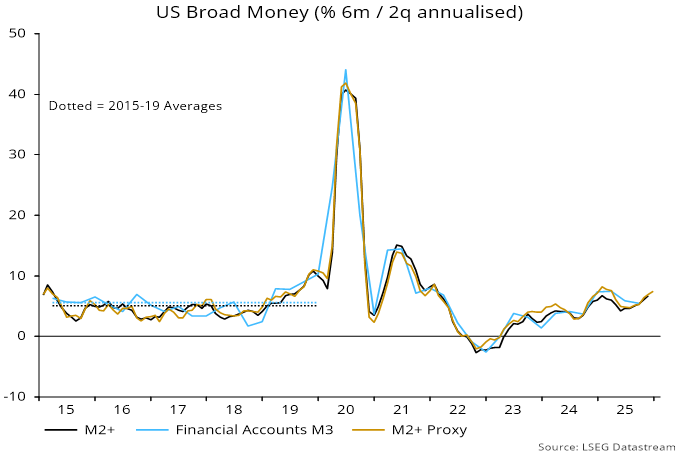
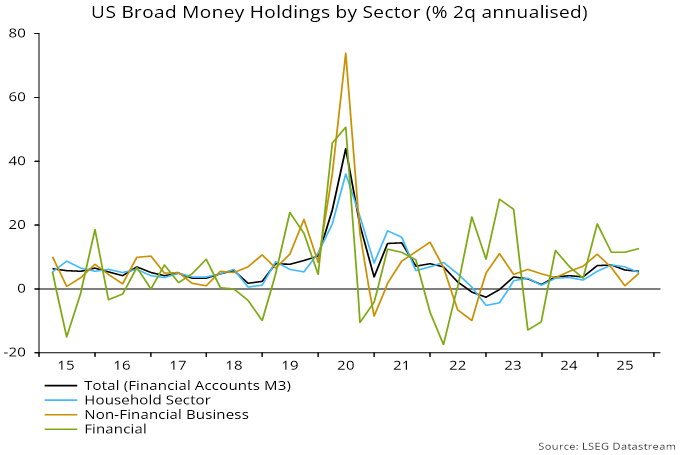
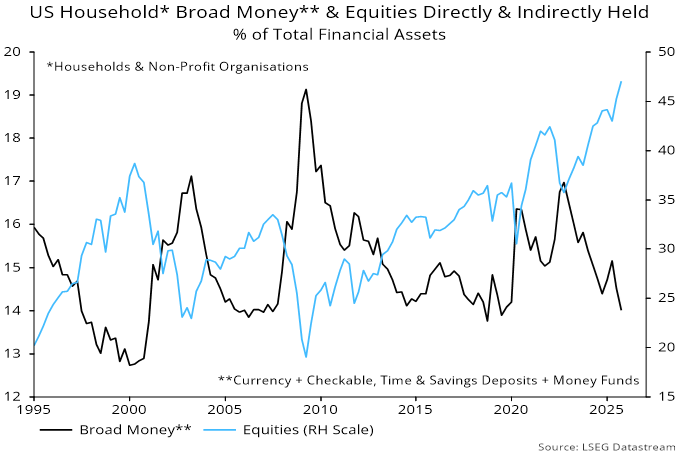
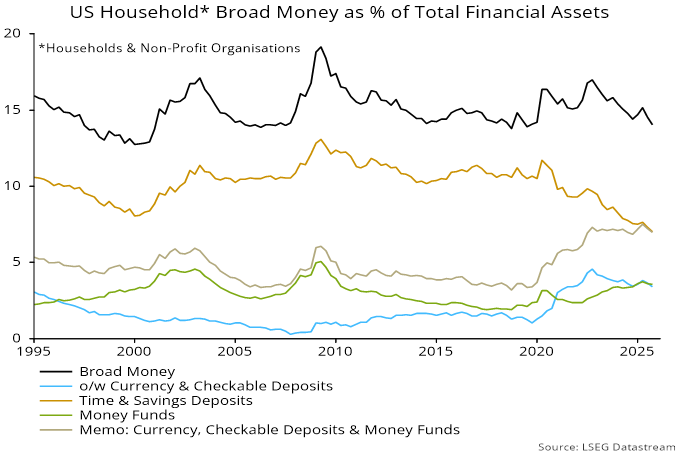
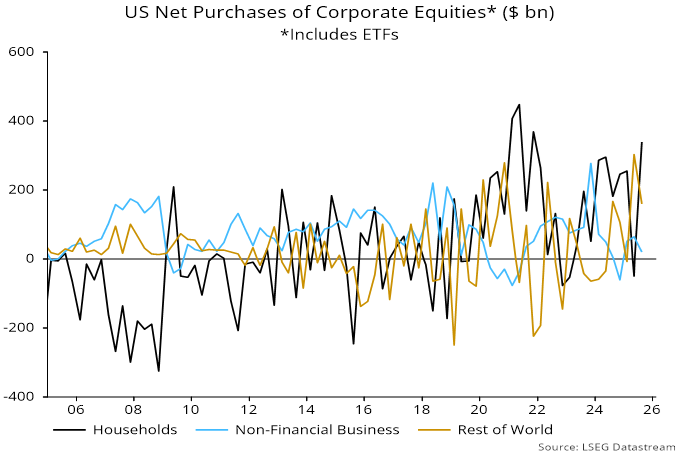
A sharp rise in US demand deposits in November probably reflects a statistical distortion. Monetary trends overall remain consistent with moderate nominal economic expansion.

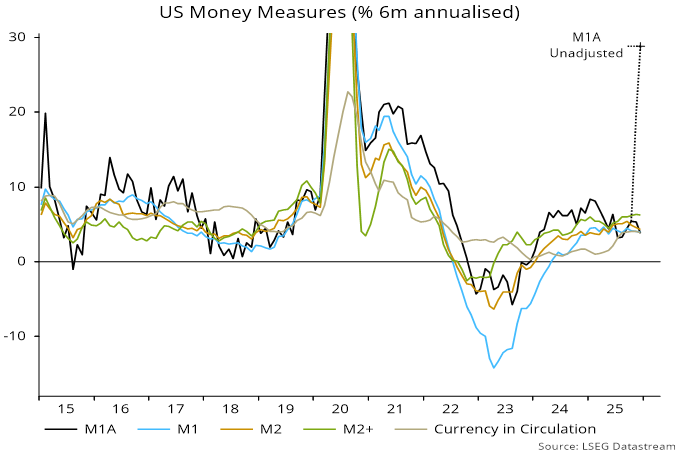
The narrow money measure tracked here – M1A, comprising currency and demand deposits – jumped by 6.8% in November, pushing six-month growth up to 19.9% annualised from 5.4% in October – see chart 1.

Chart 1

Chart 1 showing US Money Measures (% 6m annualised)

This surge, if genuine, would suggest a significant pick-up in economic growth during H1 2026, with associated upward pressure on interest rates.

The assessment here, however, is that the November jump likely reflects a statistical distortion cause by a bank or banks reclassifying savings deposits as demand deposits on the FR2900 reporting form.

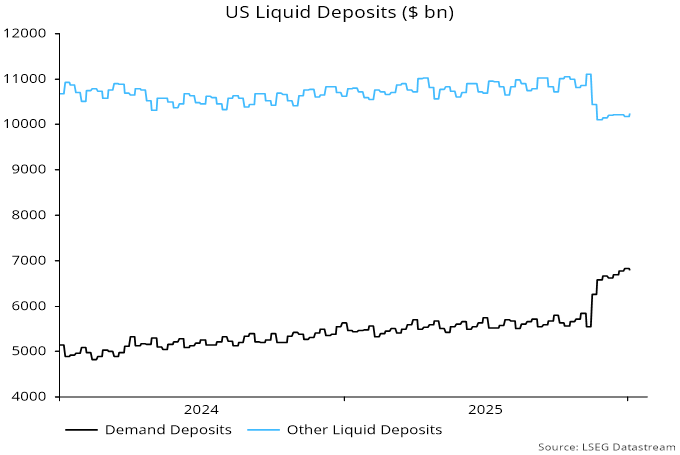
Weekly unadjusted data show a large rise in demand deposits in the third and fourth weeks of November, with a corresponding drop in “other liquid deposits”, which include savings deposits – chart 2.

Chart 2

Chart 2 showing US Liquid Deposits ($ bn)

The weekly numbers are averages of daily figures. The hypothesis of a reclassification is consistent with the demand deposit increase being spread over two weeks of data, assuming that the day of the change was after the start of the first week, resulting in a carry-over to the average for the following week.

A genuine surge in demand deposits would be expected to play out over multiple weeks. The change in the latest week – ending 1 December – returned to “normal”. Data for the remainder of December will be important for confirming the reclassification hypothesis.

Similar reclassifications appear to have occurred in several months over 2020-22, following removal of reserve requirements in March 2020, which effectively equalised the treatment of demand and savings deposits. The procedure adopted then was to assume that monthly growth of demand deposits would have matched that of total liquid deposits in the absence of the distortion.

Applying the same adjustment now suggests “true” six-month growth of M1A in November of 5.3% annualised, little changed from October.

The official M1 and M2 aggregates, as well as the broader M2+ measure calculated here, include savings deposits so are unaffected by such reclassifications. Six-month growth rates of the three measures were 4.1%, 4.6% and 6.7% annualised respectively in November – chart 1.

These growth rates are in a range consistent with trend economic expansion and inflation around the 2% target. Current money trends, in other words, give no strong grounds for monetary policy changes in either direction.

Wooden number blocks changing from 2025 to 2026 on a table against a golden bokeh background.

As we close out another year, we acknowledge it has been a difficult one for fundamental investors focused on quality companies.

How does Global Alpha define “quality”?  We mean companies with:

  • Revenue growth with a high portion of recurring revenues
  • Healthy profit margins
  • Strong balance sheet
  • Dividend paying
  • Fair valuation, ideally below the market multiples

Instead of quality, the market has been fixated on size (the bigger, the better), liquidity (the more liquid, the better) and momentum (what goes up will continue to go up).

In other words, it’s a very speculative market.

Are we in a bubble?

Ruchir Sharma, Chair of Rockefeller International, asked that exact same question in his piece in Financial Times – The four ‘O’s that shape a bubble. He described four characteristics that define a bubble, “four Os”: overvaluation, over-ownership, overinvestment and over-leverage. In our view, today’s market checks all four boxes.

Overvaluation

Consider the S&P 500 price-to-sales ratio. It is currently at an all-time high, well above the peak reached during the tech bubble in 2000. The market is paying record prices for each dollar of revenue.

Line graph illustrating the all-time high of the S&P 500 price-to-sales ratio.
Source: Bloomberg

Over-ownership

US household stock ownership, as a share of financial assets, is also at record levels. According to Gallup, about 165 million Americans – roughly 62% of US adults – own stocks, an all-time high.

On top of that, foreign investors now hold a record share of US equities. The market has rarely, if ever, been this “crowded.”

Bar graph showing the percentage of stock ownership of US households and non-profits from 1952 to 2024.
Source: Federal Reserve

Line graph illustrating the record-high foreign ownership of the US stock market.
Sources: Federal Reserve, Macrobond, Apollo Chief Economist

Overinvestment

Technology investment has recently surpassed 6% of US GDP, eclipsing the previous record set in 2000. But the ultimate return on these investments is still uncertain, and there are signs that adoption is slowing rather than accelerating.

Graph illustrating private domestic investment in information technology as a share of GDP, comparing computers and peripheral equipment, software, and other information processing equipment.

Over-leverage

We often hear about the enormous cash balances of the “Magnificent Seven.” However, much less attention is paid to the other side of their balance sheets: liabilities.

Amazon, Meta, and Microsoft are now net debtors, and they are increasingly financing capital expenditures with debt.

So, all four Os suggest a bubble. But who are we to know?

Surely, this time, it’ll be different! Right?

We recently looked at some assumptions underpinning the current enthusiasm and valuations.

The general consensus is that global semiconductor sales will grow at an annualized rate in the mid- to high-20% range over the coming decade.

During the strongest period until now – the 1990s, with the advent of the personal computer and the internet – annualized growth in semiconductor sales was about 15%.

Once again, the narrative is that “it’s different this time.”

What could deflate this bubble?
If we had to name one catalyst, it would be Nvidia, now the largest company in the world by market value, the most owned and traded stock globally, and the poster child for the AI wave.

What could go wrong with Nvidia?

In a word: Competition. More competition would likely mean lower market share, lower prices and lower profit margins.

Lessons from Novo Nordisk

The chart below shows the stock price of Novo Nordisk, which was the largest European company by market value just over a year ago. As a leader in GLP-1 “miracle drugs” used for weight loss and other health benefits, Novo Nordisk became the market’s favourite story.

As competition intensified and prices came under pressure, Novo Nordisk experienced a dramatic shift: its market value has dropped by 68% since its peak in June 2024.

What happened to this market leader?

Simple: more competition and lower prices. In 2024, Novo Nordisk earned €24.48 per share, up 29% from 2023. By mid-2024, analysts were expecting earnings of €30 per share in 2025, implying another 23% growth.

Line graph showing the stock price of Novo Nordisk from 2018 to present.
Source: Bloomberg

Line graph comparing the 12/2025 and 12/2026 mean concensus for Novo Nordisk.
Source: Bloomberg

Instead, according to Bloomberg consensus estimates, earnings for 2025 will be around €23.38, a decline of approximately 4.5%, with a further decline expected in 2026. Novo Nordisk remains a great company, investors have just overpaid for it.

Lessons from Cisco

At the peak of the dot-com era, Cisco Systems was the company that defined the Internet age. It was the most valuable company in the world at the start of 2000, supplying the routers needed to handle internet traffic that was doubling every few months.

Despite that dominant position, Cisco’s stock only just regained its 2000 peak price last week – more than two decades later.

Line graph illustrating the stock price of Cisco Systems from the early 1990s to present.
Source: Bloomberg

Looking at past trends, we do not expect Nvidia to maintain the market share and pricing power implied in current analyst forecasts. In our view (shaped by history that competition, regulation and changing narratives eventually catch up with even the most celebrated leaders), it is more prudent to diversify and pivot back to high-quality, reasonably valued companies with durable earnings and strong balance sheets

Lastly, we encourage you to read our previously published piece on quality: Time to take out the trash – Why high ROE matters in the long run. We breakdown how quality outperforms in the long-run and why it matters as an allocator.

We wish you a happy holiday season to you and your loved ones.

May 2026 bring peace and happiness to the world.

Hand holding a magnifying glass over a stock market chart.

Outlook

Emerging market equities have outperformed developed markets for the first time in five years, and by the most since 2017. The backdrop for the asset class is the most positive we have seen for the last decade or more. We expect the monetary backdrop to remain disinflationary for the first half of 2026, with treasury yields and the US dollar expected to continue declining.

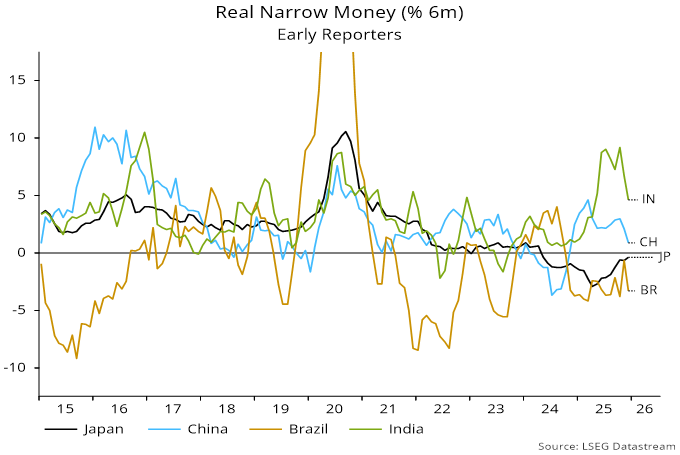
Money growth in China is supportive, strong in India, and weak in Brazil, Mexico and South Africa. EM earnings growth is forecast to be 20.5% in 2026, nearly double this year at 10.4% according to Jefferies. On a more cautious note, global money trends suggest an economic slowdown into the end of Q4 and through Q1 2026 making us cautious on cyclical exposure.

Quality investing by first principles

In investing, there is a fine line between discipline and rigidity, or between conviction and stubbornness. Any resilient investment process must be nimble and adaptable enough to weather different market regimes. Investors relying too heavily on static profitability or valuation metrics in their investment process risk getting caught out when structural change takes place.

Screening for returns on equity, low leverage and earnings growth will give you only a very limited snapshot of investment value. Our aim is to paint a far richer picture of the businesses we are analysing.

We are trying to think about value creation in the stock market from first principles. Economic value added (EVA) stock analysis is one of the key tools we use for this. For those who missed it, we wrote about the core elements of EVA investing in a previous monthly, with highlights from that piece below.

Our approach to stock picking – focus on economic value added (EVA)

Made famous by Stern Stewart & Co., the approach homes in on the spread between the rate of return on a company’s invested capital and its cost of capital; economic value added, or EVA for short.

Why? We know that over the medium to long term, EVA is directly tied to the intrinsic value of any company and the fuel that fires up a company’s stock price.

Stock prices reflect how successfully a company has invested capital in the past and how successful it is likely to be at investing new capital in the future. EVA is the best methodology to measure the value that management has added to, or subtracted from, the capital it has employed over time.

How can management create value?

Bennett Stewart in his book The Quest for Value boils it down to three drivers:

  1. The rate of return earned on the existing base of capital improves; that is, more operating profits are generated without tying up more funds in the business.
  2. Additional capital is invested in projects that return more than the cost of obtaining new capital.
  3. Capital is liquidated from, or further investment is curtailed in, substandard operations where inadequate returns are being earned.

We are looking for companies that can be expected to generate high or improving returns on the capital employed in their businesses. These are companies run by management teams laser-focused on making investments that earn more than the cost of capital, and undertaking all positive net present value projects, while rejecting or withdrawing from all negative ones.
Menu of investment opportunities available within a single company.

Source: Bennett Stewart (1991), The Quest for Value

Understand what drives returns

Value creation is not enough for long run success. We need to know whether it can be sustained. Our process is focused on identifying the drivers of these returns and assessing:

  • whether there are historic changes or potential catalysts for improved value creation that are yet to be reflected in market prices; and
  • the sustainability of those returns – are there enduring competitive moats that will protect excellent returns on invested capital?

Our approach identifies highly productive and capital-efficient companies pursuing value creation in a variety of ways. It also focuses on whether that value creation is sustained via competitive moats.

Moats can take a number of forms, from differentiation via proprietary tech, brands or prime locations, to high switching costs, network effects, cost leadership, economies of scale or minimum efficient scale.

EVA helps to cut through the noise and home into whether a business is creating real economic value, and whether the trend of that value creation is strengthening or weakening. Crucially for emerging markets with weaker governance and opaque accounting, headline earnings can mask poor capital efficiency or inflated asset values. EVA cuts through these distortions by focusing on true economic profitability, drilling into the underlying economic strength of a business.

By emphasising value creation rather than headline earnings, EVA highlights when incremental investments fail to cover their capital charge – often an early warning sign of eroding competitive advantage. Further, this approach naturally draws attention to cyclical or structural changes impacting margin compression, rising capital intensity or declining asset productivity, which traditional metrics might obscure.

Below is a rough sketch of how EVA can provide a more robust check of company economics than an approach focused on accounting profitability.

Example: EM Real Estate Development Co.

Accounting view (P/E)
Reported net income: $100m
Shares outstanding: 50m
EPS: $2
Current price: $20
P/E ratio: 10x

On the surface, ABC Realty looks attractively valued at 10x earnings, suggesting a cheap stock relative to peers trading at 12–15x.

Economic value added view
NOPAT (Net operating profit after tax): $120m
Invested capital: $1.5bn
Weighted average cost of capital (WACC): 12%
Capital charge: $180m (1.5bn × 12%)
EVA = $120m – $180m = –$60m

Despite positive accounting profits, the company is destroying economic value, earning less than its cost of capital. This signals that growth funded by debt and equity is not creating shareholder wealth, even though the P/E ratio looks attractive.

In this case, the EVA approach provides a better assessment of whether a company’s moat remains intact and whether its strategic positioning continues to justify its valuation.

Below is a brief example of what we love to see from an EVA perspective.

Stock example – Vivara: market leader in Brazil’s jewellery industry, vertically integrated and expanding aggressively

Vivara is the dominant retail jewellery brand in Brazil, controlling more than 20% of the market.

A slide from the Vivara Investor Relations presentation. On the left is a promotional image of a woman wearing Vivara jewellery. On the right is a circle chart illustrating that Vivara holds 20.1% market share, while 74.0% of the market is held by players with less than 1.0% share each.
Source: Vivara Investor Relations 2025

The business is improving its returns on capital through new store openings, sweating assets and maintaining cost control through scale as the only domestic player which manufacturers its own products.

Sweating the assets harder than peers
Retail space productivity (EUR 000s for sale/m2) correlates with EBIT margin (%) – Global players
Line graph illustrating the retail space productivity per square metre of global luxury brands.

Retail space productivity (R$ 000/sqm) correlates with EBIT margin (%) – Local players
Line graph illustrating the retail space productivity per square metre of local Brazil brands including Vivara.
Source: BTG Pactual 2024

Value creation highlights:

  • Opening 50–70 stores per year, focus on aspirational Life brand, forecast 40% of sales by 2026.
  • 2-year sales CAGR of c.18% and EBITDA CAGR c.19%. Same-store sales growth consistently positive.
  • E-commerce 23% of total sales, headroom for further growth.
  • Plans to enter new markets Mexico and Panama, leveraging scalable business model.

Return drivers and competitive advantage:

  • Vertical integration: Vivara controls the entire value chain from design to production and distribution, enabling cost efficiency and rapid response to market trends.
  • Brand strength and market position: Strong brand recognition and customer loyalty, 75% retention rate and a broad product range catering to multiple segments.
  • Scale and retail network: Extensive retail network with 40% penetration in premium malls and significant opportunities for further expansion.

Our kind of business – this all translates into an attractive EVA profile

Vivaras ROIC charts
Line graph comparing EVA to ROIC and ROIC/WACC.
Source: NS Partners and Bloomberg

As emerging markets show renewed strength, our approach remains rooted in first principles: seeking resilient, capital-efficient companies positioned for long-term value creation that should drive stock prices.

Photo of multiple railways and connecting trains.

Connor, Clark & Lunn Infrastructure (CC&L Infrastructure) and Alpenglow Rail (Alpenglow) are pleased to announce the successful closing of an inaugural private placement financing raising in excess of CAD280 million. The process attracted interest from a diverse group of leading North American financial institutions, resulting in the transaction being significantly oversubscribed. The private placement notes received an investment grade rating.

The strategic partnership between CC&L Infrastructure and Alpenglow was established in 2019 to develop and operate a diversified portfolio of rail businesses across North America. Alpenglow’s portfolio encompasses six rail terminals: three terminals in Canada under the VIP Rail brand (Sarnia and Corunna in Ontario and Alberta Midland in Alberta) and three terminals in the United States under the USA Rail brand (Port Allen in Louisiana and Port Arthur and Orange in Texas). Alpenglow offers a full suite of rail solutions to its customers, including railcar storage, switching, transloading and railcar cleaning, among others.

Ryan Lapointe, Managing Director at CC&L Infrastructure, commented: “CC&L Infrastructure is pleased to complete this successful financing, which underscores the strength of our partnership with Alpenglow and the quality of the rail platform we have built together. At the outset of our partnership, we envisioned creating a safe, scalable, customer-focused rail business and this financing positions us well to continue executing on that vision. Our long-term investment approach provides a strong value proposition within the rail sector, and we look forward to supporting the next phase of growth and value creation across the portfolio.”

Henning von Kalm, Chief Financial Officer of Alpenglow, added: “Together with CC&L Infrastructure, we remain focused on owning and operating high-quality rail assets for the long term. This private placement is a testament to the resilience of our business model and the confidence investors have in our platform. Alpenglow’s rail terminals are strategically located within North America’s leading refining and petrochemical hubs – the Alberta Heartland, the US Gulf Coast and Southwestern Ontario. With this established footprint across multiple markets, we are excited to build on our successes and continue delivering strong results.”

CIBC Capital Markets (CIBC) served as the exclusive financial advisor and lead placement agent to CC&L Infrastructure and Alpenglow. National Bank of Canada Capital Markets and Desjardins Capital Markets served as additional placement agents, and Torys LLP acted as issuer’s counsel.

About Connor, Clark & Lunn Infrastructure

CC&L Infrastructure invests in middle-market infrastructure assets with attractive risk-return characteristics, long lives and the potential to generate stable cash flows. To date, CC&L Infrastructure has accumulated over $7 billion in assets under management, diversified across a variety of geographies, sectors and asset types, with more than 100 underlying facilities across approximately 40 individual investments. CC&L Infrastructure is a part of Connor, Clark & Lunn Financial Group Ltd., an independently owned, multi-affiliate asset management firm that provides a broad range of traditional and alternative investment management solutions to institutional and individual investors. Connor, Clark & Lunn Financial Group’s affiliates manage over CAD167 billion in assets. For more information, please visit www.cclinfrastructure.com.

About Alpenglow Rail

Alpenglow Rail develops and manages freight rail businesses and related transportation assets across North America. Alpenglow Rail currently owns and operates six rail terminals strategically located in leading industrial markets within Canada and the US Gulf Coast. Alpenglow Rail was founded by a team of seasoned railroad executives with significant experience in the acquisition, operation, development and growth of North American short line railroads. For more information, please visit www.alpenglowrail.com.

Contact Information

Kaitlin Blainey
Managing Director
Connor, Clark & Lunn Infrastructure
(416) 216-8047
[email protected]

Henning von Kalm
Chief Financial Officer
Alpenglow Rail
(917) 293-2351
[email protected]

A measure of UK annual core CPI inflation excluding direct policy effects fell further to 2.6% in November, the lowest since July 2021 – see chart 1.

Chart 1

Chart 1 showing UK Consumer Prices (% yoy)

The measure adjusts for the imposition of VAT on school fees and bumper one-off rises in water bills and vehicle excise duty. It does not strip out the indirect impact of government actions, including national insurance and minimum wage rises.

Indirect policy effects continue to fade from shorter-term rates of change. The adjusted core measure rose at a 1.9% annualised pace in the three months to November from the previous three months, and by 1.8% between August and November – chart 2.

Chart 2

Chart 2 showing UK Adjusted Core Consumer Prices* *Core ex Education, Changes in VAT, Help Out to Eat Out (2020), Water Bills (2025) & Vehicle Excise Duty (2025)

Favourable news, on the “monetarist” view, reflects the lagged impact of persistent monetary weakness.

Broad money – as measured by non-financial M4 – rose by an average 2.6% pa in the four years to October. Simple monetarism suggests that 4-5% growth is needed to support 2% inflation and trend economic expansion of about 1.5% pa, allowing for a trend velocity decline.

The rule of thumb is that money trends feed through to inflation with a roughly two-year lag. As previously documented, the median lead time with respect to core inflation in the UK has been longer, at about 2.5 years.

Transmission may have been further delayed on this occasion by 1) a monetary overhang from the 2020 money growth surge and 2) cost-push pressures from government policies.

A post last month suggested that annual CPI inflation would fall to c.2.25% in Q2 2026 (versus a November Bank forecast of 2.9%) and return to target during H2. Budget measures warrant a lowered profile. Inflation is now expected to reach 2.0% in Q2 and undershoot in H2.

Annual broad money growth remains weak (3.3%), so low inflation is likely to be sustained through 2027 barring an external shock or exchange rate collapse.

A slowdown in food, alcohol and tobacco accounted for half of the drop in annual CPI inflation between October and November. The previous post suggested that UK food inflation would break lower in 2026, based partly on an unusually wide UK / Eurozone gap. The differential remains at 2.2 pp (4.0% versus 1.8%), having been negative on average over 2015-19 – chart 3.

Chart 3

Chart 3 showing UK & Eurozone CPI Food (% yoy)

A little boy playing on a tablet at night.

Of the five senses, vision is regarded as the most important as it allows us to navigate our environment, recognize the faces of our loved ones and read and watch to learn and entertain. But a good number of us do not have healthy eyes. According to the World Health Organization (WHO), at least 2.2 billion people globally suffer from near or distant vision impairment. The organization recognizes myopia as a significant public health concern given its rising prevalence around the world. A review of 276 studies (involving more than 5.4 million children from 50 countries across six continents) by the British Journal of Ophthalmology revealed that global prevalence of myopia among children and adolescents increased from 24% in 1990 to 36% in 2023 – one in three of all children and teens are nearsighted today. What is even more concerning is that myopia is starting earlier in children than before.

Prevalence of myopia by age group in 2000 vs. 2050, % of world population
Line graph comparing the projected prevalence of myopia by age group in 2000 vs. 2050, as a percentage of the world population.
Source: American Academy of Ophthalmology, BofA Global Research

The study predicted that approximately 740 million children and teens (more than half globally) will be myopic by 2050. American Academy of Ophthalmology in its 2016 article forecasted that by 2050, myopia would affect nearly half of global population. A more conservative projection this year puts the number at ~40% of global population – but it is clear that the world 25 years from now will have more than the 2.2 billion people in need of corrective lenses today.

Prevalence of myopia is not even across the world. Asia sees a higher prevalence (close to 40%) that is two to four times higher than that of other regions. East Asian countries – China, Taiwan, South Korea, Japan and Singapore – see much higher myopia rates, exceeding 80–90%, in their adolescent populations.

Bar graph comparing the projected prevalence of myopia by global regions as a percentage of regional population.
Source: ScienceDirect, Global perspectives on myopia and pathologic myopia: From environmental drivers to precision medicine

Primary drivers of myopia are genetics, near-work activities and lack of outdoor activities. A recent article in Progress in Retinal and Eye Research journal linked the high prevalences in the East Asian countries to educational systems characterized by intense academic competition, prolonged school hours and substantial homework assignments which significantly reduce opportunities for outdoor activities.

The WHO estimated that vision impairment cost the global economy an estimated USD411 billion in productivity loss, with only 36% of people with myopia having access to an appropriate intervention. Shanghai Conant Optical Co. Ltd. (2276 HK) in our Emerging Markets Small Cap Strategy seeks to address this global myopia pandemic. SCO, a sub-USD3 billion market cap company, is the second largest resin (plastic) optical lens maker in the world after EssilorLuxottica in terms of production volume. At its manufacturing locations across China and Japan, the company produced 209 million pieces to serve customers in over 90 countries around the world in 2024.

We believe SCO’s customer value proposition of value for money is especially effective in the product category of optical lenses. SCO’s high-index lenses (such as 1.74 and 1.67) are approximately half the price of comparable lenses from EssilorLuxottica, Hoya and Zeiss whilst providing the same level of vision correction. On product quality, SCO is an ODM (original design manufacturer) for all the previously mentioned global brands with various lens-coating options available. For the brand-conscious, it is “fortunately” very difficult to tell which brand of lens one is wearing. We are not surprised that the company is especially seeing strong demand in developing countries where its customer value proposition would be stronger. As a person who has been wearing glasses for the past three decades, I have found myself switching from the expensive Hoya and Nikon to much more affordable brands (including Asahi-Lite which is now owned by SCO), which have provided an identical visual experience – I have not looked back since.

China offers a significant room for growth, having entered the world’s largest short-sighted country in 2018, two decades after the company was established. Over 700 million people or roughly half the population in China are diagnosed with myopia. The prevalence of myopia is especially high in school-aged children – roughly 40%/70%/80% of students in elementary/middle/high school suffered from myopia according to a 2022 study published in Investigative Ophthalmology & Visual Science. Laser eye surgery is not an option for these youths, and they must rely on glasses for vision correction until they are older. SCO’s sales in China focus on higher-index lenses where competition is more limited and penetration is lower, and 80% of those sales are of its own brand. The company’s growth in China has been margin accretive given the higher mix of own brand and higher-index lenses.

The company is also involved in the development of AI/AR glasses with leading technology companies in North America and China. SCO as a partner to the technology companies makes sense, given SCO’s scale and cost competitiveness. We appreciate that SCO is trying to solve the problem of the global myopia pandemic, but do not doubt that AI/AR glasses offer the next leg of growth for the company.