Lower Manhattan skyline at sunset on an overcast day.

The US commercial real estate (CRE) sector is experiencing heightened concerns due to increasing interest rates and diminishing credit availability. In the third quarter, US banks faced challenges from the CRE loans in their portfolios. For instance, Morgan Stanley allocated an additional $134 million for credit losses, in addition to the $161 million provisioned in the previous quarter, attributing this to worsening conditions in the CRE sector. Bank of America saw its nonperforming loans surge by $707 million, reaching $4.8 billion in the third quarter, driven primarily by CRE.

While it might seem like the entire sector is facing turmoil, it is important to note that CRE includes a wide range of assets. Segments like industrial, retail and hotels remain relatively stable, whereas offices spaces are facing substantial difficulties.

JLL reports that the US office vacancy rate has soared to 21%, a peak not seen in over 25 years as of Q3 2023. The imbalance between supply and demand is reflected in the 18.3 million square feet of negative net absorption, contributing to an annual total occupancy loss of 51 million square feet, although the vacancy rate differs significantly between the high-quality segment of the office market and the more obsolete ones.

Furthermore, the Trepp CMBS Special Servicing Rates for offices, which tracks the share of loans at risk of default, surged to over 8%, the highest since May 2017. This increase suggests more challenges ahead.

The sector also faces a huge refinancing hurdle. From 2023 to 2025, nearly $1.36 trillion in CRE loans will mature, a quarter of which are collateralized by office properties. Even with prevailing rates, new lending rates are likely to be 3.5 to 4.5 percentage points higher than existing mortgages.

The combination of high vacancy rates and rising interest rates complicates refinancing efforts. Lenders and CMBS investors have significantly tightened underwriting standards, pushing the loan-to-value (LTV) ratio to around 53%, the lowest in 23 years, and well below the historical average of around 65%.

This shift and higher financing costs could devalue office properties by around 20% for prime buildings and over 60% for lower-quality ones. While public market valuations are resetting, the private market has been slower to respond. A narrowing valuation gap between these markets is expected as risks persist.

The increase in office landlords defaulting on loans is concerning, with some properties falling below their mortgage values, prompting landlords to surrender properties to lenders. Even leading office owners like Pacific Investment Management Co. and Brookfield defaulted on their mortgages earlier this year. Most landlords have managed to maintain their mortgages due to typically long-term office leases, but as more mortgages come up for renewal, we expect an increase in defaults.

The typical capital structure in CRE is around 30% to 40% equity and 60% to 70% debt, with banks owning around 60% of the loans. Therefore, there is concern that the challenges in the CRE, especially the office sector, may trigger another banking crisis.

The basic problem is an oversupply of office space. Solutions like converting office spaces to residential use are being discussed, but only 10% to 15% of US offices are suitable for residential conversion. Government support may be necessary to incentivize and facilitate these conversions. Cities like Boston, New York, Washington DC, Chicago, Portland, Los Angeles and the Bay Area have already started incentivizing office conversions since the pandemic.

In our portfolios, we hold a few positions with exposure to commercial real estate:

IWG, which we talked about in a recent commentary, is the world’s largest provider of workspace solutions. While the growth outlook for traditional offices is in question, demand for flexible workspace has been growing, driven by the structural growth in flexible and hybrid working. Higher vacancy rates at office buildings also allow IWG to negotiate better lease terms with landlords. With a major competitor WeWork fading out of the landscape, IWG is well-positioned to expand its network.

Savills, established in 1855, is a leading global real estate advisor with expertise in various segments including residential, office, industrial, retail, leisure, healthcare, rural and hotel property, and mixed-use development schemes. Its revenue is diversified, with 40% from transaction advisory (30% commercial, 10% residential), and 60% from stable segments like investment management and property management. Despite a decline in transaction advisory business in the first half of the year, revenue growth in property management has kept its business relatively stable. Savills generates over 85% of its revenue from the UK, Asia Pacific, Continental Europe and the Middle East, with less than 15% from North America. Office occupancy rates are higher in Asia Pacific (79%) and Europe (75%) compared to the Americas (50%), suggesting less distress in these regions. Savills has a strong balance sheet to weather the current turbulent times.

The hotel sector, while hit hard during the pandemic, is recovering faster than offices. With international borders reopening and a surge in travel demand, hotel occupancies, especially in cities like London, New York and Tokyo, are improving and contributing to a strong investment outlook supported by fundamental performance.

Melia Hotels, a major holding in our strategies, is seeing strong bookings and improvements in occupancies and RevPAR. The company operates 350 hotels, with nearly 92,000 rooms globally. Despite its quality assets, it is trading at a significant discount to its net asset value, but increasing transaction volumes in the industry at higher multiples may reduce this discount.

We recently initiated a position in Hoshino Resorts REITs (HRR). Sponsored by Hoshino Resort, HRR has an extensive hotel portfolio, including upscale resorts and city hotels. Its flagship hotels managed by Hoshino Resorts show a strong recovery, with RevPAR 20% above pre-pandemic levels.

Despite ongoing challenges in the CRE industry, we believe the resilient business models and strong balance sheets of the companies in our portfolios will help them navigate these difficulties.


Aerial view of Tam coc at sunrise in Vietnam.

The strategy focuses on investing in frontier and emerging market companies that our team expects will benefit from demographic trends, changing consumer behaviour, policy and regulatory reform, and technological advancement.

Below, we discuss some of the key factors influencing returns and share observations on the portfolio and the markets.

Information Technology

The strategy saw strong returns from the technology portfolio in the quarter. A significant contributor was Vietnam’s FPT Software (FPT), which featured prominently in agreements between Vietnam and the United States following the upgrade of their relations to a Comprehensive Strategic Partnership. This development signals that the US views Vietnam as a strategic alternative in diversifying its technology supply chain away from China. FPT’s technology-focused educational institutions are instrumental in building the human resources necessary for Vietnam to ascend the global manufacturing value chain. They also strengthen the company’s human capital advantage in its ~$1 billion annual IT outsourced services business in key global markets like Japan and the US.

We also saw strong performance from HPS Worldwide, the Morocco-based payment technology software company. Despite being in a heavy investment phase, the company maintained stable margins and grew its revenue by 17% year-over-year in 1H 2023. HPS recently won a major Canadian bank client and subsequently opened an office in Montreal to support that contract. By virtue of its global presence, HPS is a long USD business which provides a hedge against a rising US dollar.

Financial Services portfolio

The strategy experienced mixed performance from the financials portfolio in the quarter. Kazakhstan’s Kaspi.kz continues to deliver exceptional results, (~50% EPS growth in the first nine months of 2023), demonstrating the uniqueness of its super app product, which continues to record globally leading levels of engagement (65% of its 13.5 million average monthly users transact daily) driven by leadership in e-commerce, payments, and lending. We added to our investment in Kaspi at the beginning of the quarter following the company’s strong second-quarter results.

We’re also optimistic about developments at CTOS, Malaysia’s leading credit reporting agency. The company’s recent acquisitions in Indonesia and the Philippines in the area of alternative data, such as phone bill payment history, are expected to enhance the proprietary database used by its institutional lending clients. CTOS has affirmed its guidance for revenue growth of 28% and EBITDA of 23% for the lower end of the range in 2023. These acquisitions and affirmed guidance reinforced our confidence and led us to add to our investment in CTOS this quarter.

On the other hand, Kenya’s Safaricom underperformed in the quarter due to challenges related to its 2022 expansion into neighbouring Ethiopia, which have complicated the investment case at a time when its home market of Kenya is experiencing macroeconomic headwinds. While we acknowledge that Ethiopia’s 100-million-person population is a blue ocean for communication and financial services (Safaricom’s forte through the M-PESA app), the capital investment required is considerable and likely to weigh on margins for the next few years. With an enterprise value of approximately $4.5 billion and an EV/EBITDA of ~5x, we believe the shares are undervalued and reflect concerns over the Kenyan Schilling and the impact of the Ethiopia investment.

Consumer portfolio

It was a difficult quarter for the strategy’s consumer portfolio, punctuated by an earnings miss from Sido Muncul, the Indonesia-based herbal medicinal consumer company behind the Tolak Angin brand. Sido’s second-quarter results reflected a challenging environment for a large majority of Indonesian households, who are experiencing pressure on their incomes and are down trading or deferring non-essential purchases. Despite this, Tolak Angin’s market share grew in the first half of 2023 from an already high 75%, although the total profit pool for the category was down significantly. We reduced our exposure to Sido Muncul in recognition that the consumer environment is likely to remain challenging. However, we continue to own the company given its debt-free balance sheet, brand equity, and dominance in a category that is culturally entrenched. Rising health awareness post-COVID and a potential income recovery next year should eventually revive demand for its products. Indonesia will hold general elections in 2024 and we expect that economic activity and consumer demand will start picking up in the fourth quarter as election-related spending kicks in.

On the positive side, Century Pacific Food Inc., the Filipino food and beverage company, was included in the country’s main market index, reflecting its increased free float market capitalisation. This inclusion led domestic fund managers to bid up the shares, offering us an opportunity to reduce our position given the non-fundamental nature of the event, and the valuation opportunity it presented.

Healthcare portfolio

Quarterly returns were negative from the healthcare portfolio, mainly due to the weak share price performance of laboratory and diagnostics company, Integrated Diagnostics Holdings (IDH). The deteriorating outlook in Egypt is having an adverse impact on IDH’s margins, and the increased risk premium associated with Egyptian assets is also impacting the company’s valuation. That being said, we did see the CEO step in and buy shares in the market in October, a move we interpret as a positive signal regarding the valuation.

At the end of the quarter, we invested in Hermina Hospitals, Indonesia’s largest healthcare provider, which operates a chain of 47 hospitals in a country of around 250 million people. We are bullish about the healthcare reforms being implemented in Indonesia, and the large demographic opportunity that should support visible growth for years to come. While these are long-term drivers, Hermina’s investment in upgrading its operational systems through technology and improvements in patient experience is enabling significant near-term margin expansion, positioning the company for profitable growth in the next five years. Hermina was removed from the FTSE Emerging Small Cap Index in September, which resulted in selling pressure from index funds. We took advantage of this non-fundamental event and invested at what we deem to be attractive valuations.

Outlook

While the environment globally remains challenging, we see openings to deploy capital at attractive valuations. The fundamental metrics of the portfolio remain healthy: our companies are unlevered, generate high EBITDA margins of around 25%, and deliver returns on invested capital of approximately 18%. These metrics are the output of a dynamic research process that aims to identify high-quality companies exposed to secular themes that offer our chosen companies opportunities to sustain strong earnings growth over the next five years.

Vergent Asset Management LLP

Dubai marina in the evening.

MENA equity markets posted negative returns in the quarter (-1.3%) as indicated by the S&P Pan Arab Composite Index. However, they still managed to materially outperform emerging markets, which declined by -3.7% (as measured by the MSCI Emerging Markets Index). There was a high degree of performance dispersion in the quarter, with the Dubai Financial Market General Index up 11.2% and the Tadawul All Share (Saudi) Index down 3.5%. Year-to-date, the performance spread between the best-performing market (Dubai) and the worst-performing one (Kuwait) is a remarkable ~32%. This performance divergence theme is also evident within individual markets. Saudi mid caps, for example, outperformed the broader country index by a staggering ~16%, as seen in the difference between the MSCI Saudi Arabia Midcap and the MSCI Saudi Arabia Index.

This degree of performance dispersion in the region is unusual during periods of high oil price, which have typically raised all boats, so to speak. We attribute this phenomenon to several key factors that we believe will continue to influence return dispersion:

  • Banks are no longer the only conduit between fiscal surpluses and the non-oil economy. Governments are now channelling more surpluses to sovereign wealth funds and directly funding their own economic programs. This is reducing the deposit opportunity set that was historically available for the banks. This is especially apparent in Saudi, where liquidity conditions are tight, evidenced by a headline loan-to-deposit ratio (LDR) of 96%. Conversely, UAE banks are enjoying an abundance of liquidity, with a headline LDR of 75%. This marked difference in balance sheets reduces the correlation in earnings between the two countries (given banks are the largest sector in both) and is partly responsible for the ~13% performance spread between Saudi and UAE banks on a year-to-date basis in favour of the latter as evidenced by the S&P country bank indices.
  • Economic policies among Gulf countries are diverging more than ever. Kuwait’s political deadlock continues to be a drag on government spending and economic growth, a stark contrast to the Saudi pro-growth agenda that is being galvanised by a single vision and strong political will. The UAE is further solidifying its regional competitive advantage through ongoing economic liberalisation (more recently creating a federal authority to regulate the gaming industry), while Qatar appears to be experiencing stunted growth and a hangover from infrastructure investments made to prepare the country for the World Cup. These economic policy outcomes have obvious ramifications for sector-specific corporate earnings growth. At oil prices of $80 and above, earnings growth has a more pronounced impact on equity returns than sovereign fiscal health, in our opinion.
  • The structure of equity markets is changing, with liberalisation and issuance activity attracting a new investor base, mainly institutional, to the region. Consider Saudi: the number of listed issuers increased from 188 in 2017 to 228 in 2023, and its weight in the MSCI Emerging Markets Index climbed from 0% to just over 4%. The deeper opportunity set and increased foreign ownership has reduced the contribution of highly correlated sectors like banks and materials in the Index (from 56% in 2021 to 43% today according to Morgan Stanley; note: this has certainly been aided by performance), which has contributed to reducing regional intra-correlations.

Lower market intra-correlations, higher return dispersion, and a deeper and less cyclical opportunity set is a powerful combination that will make stock picking in the region even more interesting, and possibly more rewarding.

Having witnessed the evolution of MENA markets over a long period (since 2005), we are in a unique position to understand the impact of the developments the region is undergoing on equity returns. Our historical understanding complements an adaptive and disciplined investment process rooted in a clear philosophy and focused solely on fulfilling our return promise to investors.

Vergent Asset Management LLP

The angel of independence, located in Paseo de la Reforma Avenue, Mexico City.

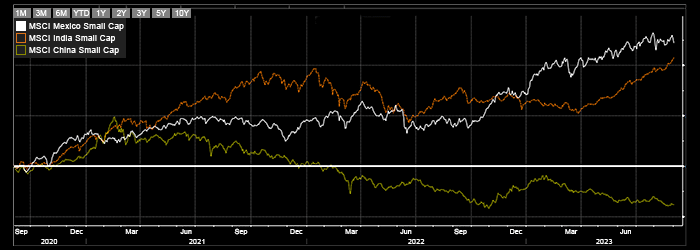
Within the emerging market universe, plenty of ink has been spilt on extreme pessimism regarding China and over-the-top optimism around India. Yet, as the following chart shows, small-cap stocks in Mexico have quietly been a top performer in the post-pandemic period.

Mexico’s unforeseen rise 

Growing tension between China and the US has positioned Mexico as an unintended beneficiary due to its geography and the trend among companies to shock-proof their supply chains through nearshoring.

Will this time be different? 

As noted in an earlier weekly, we recently met with companies across various sectors in Mexico and most of the executives we spoke to seemed convinced that the nearshoring wave was sustainable while also being realistic about the challenges ahead.

They have good reason to be pragmatic. The last time the economic stars aligned for Mexico via NAFTA (North American Free Trade Agreement) in 1994, the country delivered mediocre growth of around 2% and watched on the sidelines as China took full advantage of a shift in manufacturing from the West. The question now is if the outcome will be any different this time. 

The nearshoring challenge trifecta 

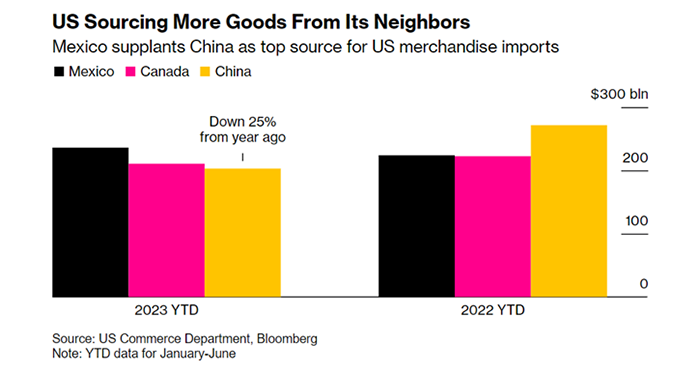
Mexico’s ascent as a key supplier to the US can be traced to three key events: Trump’s tariffs on China in 2018, the US-Mexico-Canada Agreement (USMCA) that raised the bar for North American product content requirements and pandemic-induced supply chain disruptions. These factors, coupled with deteriorating US-China relations, have led to Mexico surpassing China as a supplier to the US this year.

However, as emerging market investors, we know that structural tailwinds that are attractive and advantageous today don’t preordain good outcomes. Our conversations with Mexican executives at the recent LatAm conference gave us a good reality check on the constraints they face on the ground, from infrastructure and water supply to the political climate. 

Electric dreams, grounded realities

While Mexico generates sufficient power, it struggles with inadequate transmission infrastructure in its north that hinders industrial growth. We spoke to two industrial REIT developers that had to build their own power systems, passing those costs to customers. For perspective, Mexico’s state utility, CFE, built 150 kms of transmission lines in 2022 compared to Brazil’s Electrobras’ 8,679 kms. 

Parched prospects

Water availability is another constraint, especially in Nuevo Leon, home to the populous city of Monterrey and the large, water-hungry beverage industry that includes Heineken and Arca Continental, one of Latam’s largest Coke bottlers that extracts billions of gallons of water under federal concessions. As recently as 2022, Mexico had declared a drought in the state of Nuevo Leon and yet Tesla plans to open a factory there.

The political maze 

The final speed breaker to the nearshoring story could be politics and a volatile security situation by the US border. On the political front, Mexico’s President recently demanded that airport operators in Mexico reduce their tariffs even though they were bound by law via a concession system instituted in 1998. In terms of security concerns, the cities of Juarez and Tijuana, while strategically located across the border from California and Texas, have a history of gang violence and cartels profiting from piracy and counterfeiting.

Mexico’s unique competitive edge 

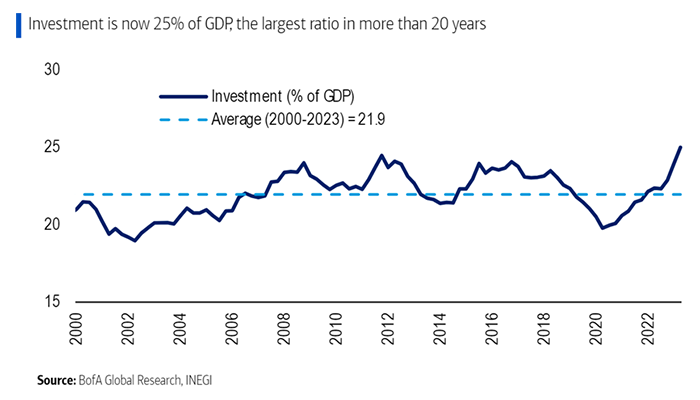
Despite these hurdles, Mexico offers several advantages, including lower labour costs compared to China, a younger workforce and significant investment in GDP, particularly in nearshoring and public infrastructure projects. 

Unlocking nearshoring potential 

With plenty of natural resources, a faster lead time and shorter distance to market, we think Mexico can continue to benefit from current trends with some policy support. Our Mexican holdings offer three different ways to access the nearshoring theme. 

Grupo Cementos de Chihuahua (GCC MM) – Primarily selling cement in the US, GCC also operates in Chihuahua. It benefits from strong volume demand generated by the region’s growing industrial sector, particularly maquiladoras and warehouses near the Texas border. Recently, GCC expanded its Samalayuca plant and now supplies cement to about 85 projects in Northern Mexico, serving clients like Foxconn, Wistron and Pegatron.

Regional SAB de CV (RA MM) – Known as “Banregio,” this Mexican bank specializes in lending to small and medium enterprises, with a strong focus in Neuvo Leon, its home state and a big beneficiary of the nearshoring trend. With about 45% of its assets in the region, Banregio is poised to benefit from the growth of industries supporting multinational corporations relocating to Mexico, thanks to low credit penetration and an expected easing cycle.

Grupo Aeroportuario Del Centro Norte (OMAB MM) – OMA, managing 13 airports in Central and Northern Mexico, sees its largest traffic accounting for nearly half of its total at Monterrey Airport. Despite recent concerns about tariff cuts, we remain positive on OMA both for its exposure to nearshoring and potential for growth in its commercial business. The company operates six airports closely tied to nearshoring, covering 33.5 million square metres of industrial gross leasable area, about 35% of Mexico’s total.

A crucial crossroads 

The real intrigue lies not in what Mexico has already achieved, but in what it could accomplish moving forward. Will it leverage its current position to create a more diversified, resilient economy, or will it repeat the patterns of the past? As global dynamics continue to shift, Mexico could be a big winner and serve as a blueprint for other emerging markets navigating the balance between risk and opportunity.

Bird's eye view of a young brunette woman and a senior woman using their devices while sharing a desk.

WeWork’s downfall and IWG’s ascent 

Last week, WeWork, once regarded as the world’s most valuable start up, declared bankruptcy. This decision followed weeks of speculation. WeWork’s mission of being the leading global co-working community came to an end due to its relentless pursuit of growth. Its initial misrepresentation as a tech company and consistent cash burn from unprofitable leases indicated overambition from the start. This development provides an interesting opportunity for one of our holdings.

With WeWork’s restructuring of its extensive 700-plus-location portfolio, IWG (IWG LN) stands to benefit from less competition and an opportunity to expand its own network. For years, WeWork imposed pricing pressures to attract members. Now, this industry-wide pressure should ease, to IWG’s benefit.

IWG, the world’s largest provider of workspace solutions, began its operations in Brussels over 30 years ago. With more than 4,000 locations across 120 countries, its early entry into the market has been advantageous. The company is currently trading at 5.44x EV/EBITDA, a notable multi-year low. It has demonstrated strong pricing power and momentum, with revenues up 14% in the first half of 2023, totaling a record £1.7 billion. The company has focused on revenue growth and free cash flow generation, which has helped strengthen its balance sheet by lowering net debt.

Several years ago, to boost its top line and margins, the company introduced a capital-light business model. This model is particularly interesting due to the lower CAPEX requirements because of sharing agreements with building landlords for office space renovations. IWG partners with landlords for management, operations and member recruitment in return for a management fee. Additionally, the model includes franchise agreements in two forms. The first involves master franchise agreements, where a partner buys out an existing IWG portfolio and commits to additional office roll outs, paying a franchise fee. The second form involves franchised locations in existing markets, where IWG partners with smaller franchise owners to open new centres in markets that IWG already has presence in. This strategy has gained traction, with 582 new centres opened this year compared to 421 in 2022.

For the last couple of years, IWG was affected by its association with WeWork, trading in parallel despite superior financial performance. Though the pandemic took a toll on the coworking sector, IWG continued to generate strong positive free cash flow and EBITDA margins consistent with the company’s historic levels. In contrast, WeWork was aiming to grow revenues, but showed negative EBITDA margins and free cash flow.

Source: Bloomberg.

Around September 2022, IWG’s stock price finally decoupled from WeWork’s as the troubles continued to brew for the latter. Following Q2 2022 results, it became evident that despite growing occupancy at WeWork offices, it continued to offer price cuts to members to contain retention rates unlike IWG that not only grew occupancy but was beginning to raise prices, a trend continuing to date.

In the current market, which still seems to favour some growth stocks with weak financials, we continue to prioritize companies with healthy balance sheets and promising profitable growth prospects.

Traditional junk boat sailing across Victoria Harbour, Hong Kong.

Summary

  • EM equities fell over the month, with the MSCI EM Index down -4% over the period.
  • Declines were led by markets with higher exposure to commodities and oil such as Latin America and the GCC.
  • Quality stocks in China outperformed, while value names dominated by State-Owned Enterprises (SOEs) continued to cool following outperformance through the first half of the year. Chinese growth stocks remain laggards.
  • Stocks in Poland rallied hard after former prime minister and European Council president Donald Tusk led a centrist coalition to victory in national elections, promising to restore ties with the European Union.
  • Weakening narrow money momentum over the period suggests downside surprises to economic growth are likely. Our portfolio exposure remains defensive given this backdrop, underweight commodities and oil, favouring high quality and sustainably growing businesses that can weather a downturn.
  • Unexpected economic weakness in the months ahead may force central banks to reconsider tight policy settings.

“It’s never too late to catch the China train – you can still ride the dragon to heaven.”
– Wang Jianjun, China vice-chair of the China Securities Regulatory Commission

Our team visited China and Hong Kong through September and October, seeing over 100 companies, policy makers, strategists and research analysts. The trip provided an opportunity to gauge sentiment on the ground and test our conviction on portfolio companies, while uncovering new risks and opportunities.

It’s safe to say that the team didn’t leave feeling quite as bullish as the vice-chair of China’s securities regulator at a conference we attended (quoted above). It remains difficult to build strong conviction for the longer-term outlook, but our sense is that a slow burn post-pandemic recovery is still in play. We were reminded by several Chinese executives that we are only a little over half a year into this recovery and that it will take time for green shoots to emerge.

Below is a summary of some key headlines which emerged over the trip.

Politics – domestic discontent evident while geopolitical risk stabilising
China’s economic slump marks the first real recession since reform and opening up under Deng Xiaoping in the late 1970s. What is notable is rising dissatisfaction spreading outside of investment circles, with frustration over a lack of visibility or conviction on economic policy direction bubbling up in the middle-class, entrepreneurs and elites. Current economic woes are increasingly blamed on policy missteps as opposed to unfavourable economic conditions.

Public mourning over the death of former premier Li Keqiang in early November provided an outlet for public venting of frustration. Mourners in Li’s home town of Hefei spoke about Li’s more moderate approach to politics, which has been interpreted by many China watchers as thinly veiled criticism of the more authoritarian turn political and economic institutions have taken under Xi.

While geopolitical risks stemming from Sino-US confrontation remain elevated, there are signs of stabilisation. Xi is set to meet US President Biden at the APEC summit in San Franciso in November. This follows dialogue between several members of the US administration and their Chinese counterparts, and an agreement between the US and China to prohibit the development of autonomous AI weaponry.

The CCP’s propaganda arm has also been hard at work. Chinese film Lover’s Grief Over the Yellow River (1999) has started airing on Chinese television recently. The plot centers on the story of a US pilot falling in love with a Chinese woman during the Second World War. It appears that the Party is seeking to keep a lid on anti-US and nationalistic sentiment ahead of the summit.

Source: Lover’s Grief Over the Yellow River, IMDB.

Consumption – fragile recovery remains intact

Trends are incrementally better than in the first half of 2023. Demand for leisure, travel and restaurants remains resilient and travel has exceeded pre-COVID levels. Tier-1/2 city shopping malls are very crowded on weekends, with long queues at popular restaurants. However, there are clear signs of consumption trade-down, e.g., fewer high-ticket item purchases, quiet high-end restaurants, and more subdued spending during online promotional seasons as we see platforms ramp up subsidies/incentives. Overall, consumption appears in line with our expectations and on track for a gradual recovery.

Property – momentum fading but the situation appears manageable
July’s Politburo meeting acknowledged the risks in the property sector and set off an improvement in the policy backdrop. The sector is looking less bearish on the relaxation of the downpayment ratio for property purchases and falling mortgage rates. These measures set off a temporary spike in secondary transaction data but it has since faded. Property prices have not yet reached a clearing price and market participants remain cautious. We found that those with more than one property are looking to sell, and those who want to buy now are only upgrading from their existing home. Speculative demand has evaporated.

Private developers are at risk of further defaults on offshore bonds but the government will not allow for onshore defaults (mainly via restructuring rather than outright capital injections). A systemic crisis appears unlikely, and the backdrop looks set to improve from here in T1/2 cities. Lower tiers will take significantly longer to recover.

Key themes
We found a lack of conviction generally among domestic investors in China, who are focused on high-frequency data and rotating quickly through sectors and stocks. Consensus buy and hold names were rare, and while the SOE reform story had been a popular trade in the first half of 2023, several portfolio managers we spoke to were broadly sceptical of these names. We agree that low valuations and a lack of momentum in other areas are unlikely to be sustainable drivers for these stocks.

While the sentiment among investors remains flat, there are several compelling trends that are likely to shape China’s investment landscape in the years to come.

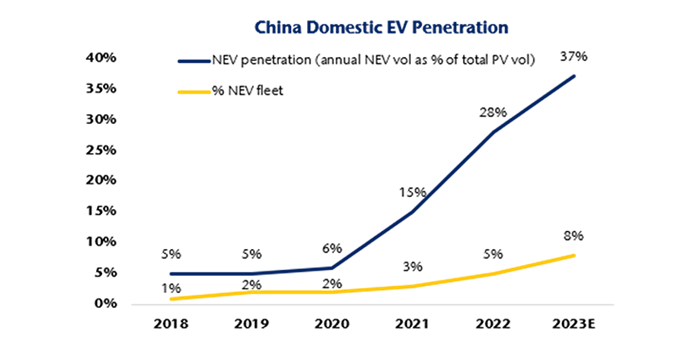
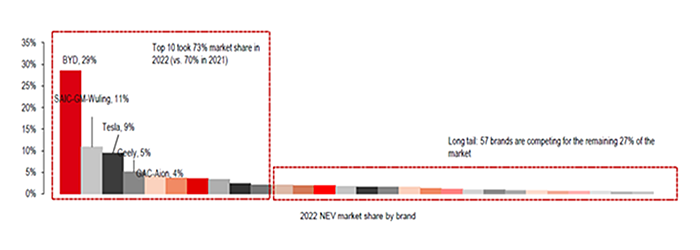
  • EVs – Chinese specialist EV makers (BYD in particular) are playing a different game to the rest. EV penetration of new car sales is already at nearly 40% in China, offering competitive pricing and the potential to go global (with the promise of higher margins in foreign markets).

Source: Bernstein Research, 2023.

  • BYD stood out as a company working so hard to play down expectations that their IR team almost seemed depressed! They are likely trying to tread softly as they push into more lucrative foreign markets, being very cautious in their communications on growth assumptions and deliberately vague on margin upside outside of China. The company is the dominant player in the mass market segment for EVs, and boasts 37% market share of NEV sales in China (Tesla in 2nd place with 10%, albeit targeting higher-end consumers).
  • Risks include intense levels of domestic competition in a market that is due significant consolidation. On current trends, BYD and Tesla are looking like winners, at the expense of traditional international OEMs that have been slow to pivot to EVs.

Consolidation is on the way

Source: HSBC Research, 2023.

Korean stocks hit by a wave of margins calls

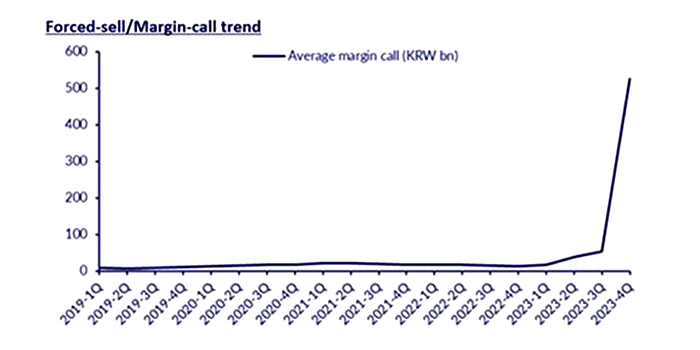
Korean stocks were also hit hard through the month, down -7% in USD terms in part due to forced selling/margin calls as brokers revised up margin loan hurdles. The margin calls exacerbated an already challenged environment for names in the battery supply chain which is working through a downcycle. Stocks favoured by retail investors such as battery materials producer Ecopro (down -31%) and steelmaker POSCO (which is investing in the battery supply chain, down -23%) unwound.

Source: CLSA, 2023.

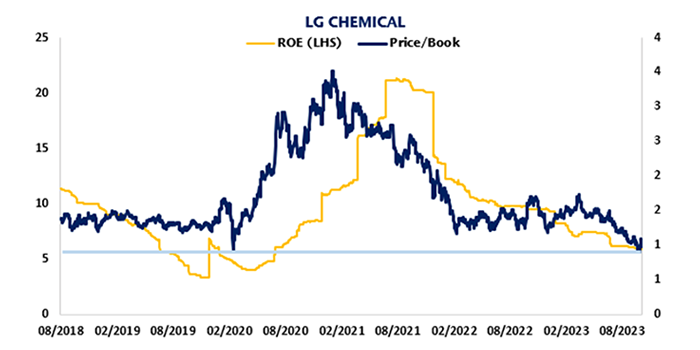
Our exposure to batteries is limited to Materials company, LG Chemical, and its subsidiary, LG Energy Solution, the world’s second-largest battery maker. While we don’t think battery makers are out of the woods just yet (especially as many of the key names are yet to make it through a full cycle since being listed), valuations in the sector are beginning to look tempting.

LG Chemical now trades at <1x price/book, which is its lowest valuation ever. According to JP Morgan, the company’s stock now trades at a 58% discount to its 82% stake in LG Energy Solution, while valuing its petrochemicals, advanced materials and biotech businesses at 0. Recent results also suggest operational performance might be approaching a bottom, with third-quarter results positively surprising. We are maintaining current levels of exposure while looking for more evidence of an upturn in batteries and petrochems.


Source: Bloomberg and NS Partners.

The oil price is telling you something

Brent crude finished October lower despite the outbreak of tensions in the Middle East following the October 7 attacks by Hamas against Israel. While risks of escalation remain, oil is looking like the dog that didn’t bark.

Does this tell us something about the global demand picture? Consumers are responding to high oil prices by curbing consumption, with demand for gasoline and diesel in the US falling.

It may also signal ample supply growth outside of the OPEC cartel. The shale boom continues in the Permian Basin, while the US is lifting embargoes on Venezuelan oil.

How much global production share will OPEC be willing to cede to competitors before abandoning supply discipline? We saw Saudi Arabia do exactly that during the COVID pandemic in response to Russia’s refusal to curb supply, which saw the oil price go negative.

This suits the US just fine, on a view that lower oil prices will squeeze opponents like Russia and Iran while easing inflationary pressures further.

Oil just one indicator of a deteriorating backdrop

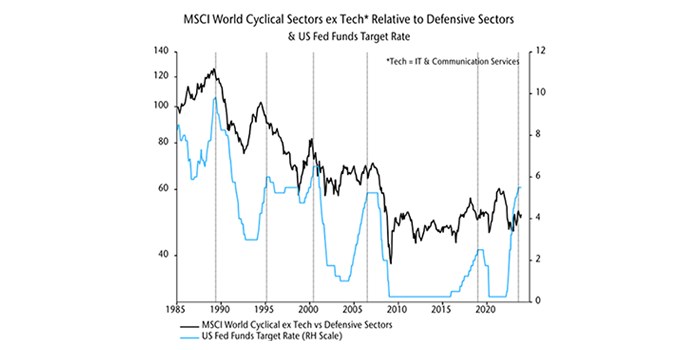
The global economy is likely to surprise to the downside while liquidity remains poor. The Materials and Energy sectors were weak through the month, in line with our view that cyclicals look vulnerable here.

Historically, while cyclical sectors can hold up over a short period following the conclusion of a hiking cycle, their underperformance over the medium term is stark. As our Chief Economist Simon Ward has pointed out, cyclical sectors underperformed following the last five US rate peaks, though not always immediately.

Source: Refinitive Datastream and NS Partners.

While the money numbers have been signalling downside risks to the economy for some time, other leading indicators, including consumer and manufacturing expectations, have slipped. Excessive tightening by central banks is now also feeding through to backward-looking data, such as unemployment and payrolls, which are starting to crack.

Are we on the cusp of central banks beginning to ease? Inflation has been rattling back globally, which is good news. However, in the absence of a financial accident (which is certainly possible given the liquidity backdrop), it has historically been the labour market that has prompted the central banks to start cutting.

Banyan Capital Partners (“Banyan”), a leading Canadian middle-market private equity firm, is pleased to announce its acquisition of Second Nature Designs Limited (“Second Nature” or the “Company”). Second Nature marks Banyan’s second platform investment through Banyan Committed Capital LP, an evergreen investment vehicle established in December 2021.

Founded in 1994, Second Nature is a manufacturer and distributor of home décor and gifting products made up of dried florals and other naturally and sustainably sourced botanicals. The Company sources materials globally and manufactures its products in Hamilton, Ontario. The Company services a recognizable customer base across Canada and the United States.

Banyan is partnering with the Company’s President and founder, Steve Koning, who has served in this role since 1994.  Along with the management team, he will retain a minority ownership in the Company.

“Banyan’s long-term investment philosophy aligns with the objectives of my team to continue to grow our business throughout North America,” said Steve Koning. “We look forward to working with a partner that shares our strategic vision and values.”

“Since founding Second Nature in 1994, Steve and his team have built a remarkable business centred on delivering exceptional products and service to customers. This investment allows Banyan to partner with an impressive team to embark on the next chapter of growth for the business,” said Simon Gélinas, Managing Director and Partner at Banyan.

About Second Nature Designs

Founded in 1994, Second Nature imports dried florals and other naturally and sustainably sourced botanicals used in design bouquets, bowl filler collections and other home décor products, serving big box stores, grocery banners, wholesalers and independent home retailers across both Canada and the US with high-quality and sustainable products.

About Banyan Capital Partners

Founded in 1998 and under current management since 2008, Banyan Capital Partners is a Canadian-based private equity firm that makes equity investments in middle-market businesses throughout North America. Through a long-term investment approach, Banyan has developed into one of Canada’s leading middle-market private equity firms with an established track record of success in providing full or partial liquidity to founders, families and entrepreneurs and helping them take their business to the next level.

Banyan is part of Connor, Clark & Lunn Financial Group Ltd., an independently owned multi-boutique asset management firm whose affiliates are collectively responsible for over $110 billion in assets under management on behalf of institutional, private and retail clients.

Canada Life Investment Management

Canada Life Investment Management, a leader in financial services, is committed to partnering with investment managers to enhance its wealth management offerings. We at CC&L Investment Management are excited to announce our collaboration as a new subadvisor for Canada Life’s wealth products.

Shop assistant using barcode reader, customer is reaching for product.

Banyan is pleased to share that Purity Life Health Products LP has completed its acquisition of the assets of Indigo Natural Foods Inc., a leading distributor of natural health products based in Toronto. This transaction broadens Purity Life’s distribution network and enhances its portfolio with numerous new brands.  

To facilitate a smooth transition for Indigo’s customers and vendor partners, two key members of its team are joining Purity Life.  

This acquisition builds on Purity Life’s strategy of growing both organically and through M&A and will strengthen Purity Life’s offering to all of its stakeholders and allow it to continue to service customers and vendors with the highest possible quality. 

Stack of folded cloths in an industrial laundry.

Investment opportunities can be found in every industry, though some may be easier to get excited about than others. However, as many astute investors, including Warren Buffett, have noted, “boring” companies and business models can be just as profitable as those flavour-of-the-month stocks. This week, we profile ELIS SA (ELIS FP), a boring company that Global Alpha got excited for.

Based in Europe, Elis specializes in renting and maintaining flat linen, workwear and hygiene appliances. Founded in 1883 in France, Elis operated as a family business for three generations before going through several leveraged buyouts and ultimately going public in 2015. The company has 440 production and distribution centres across 30 countries and a workforce of over 50,000 employees. With 75% of its revenues derived from markets where it leads, Elis is a dominant force.

Elis caters to a broad spectrum of customers, from hospitals needing linen to industrial companies needing uniforms exposed to dirt or chemicals, to small kitchens preferring not to manage towel cleaning in-house. Elis’s full-service solution relieves customers of managing inventory, ordering replacements or cleaning – handling all of the buying, renting and logistics. Customers have the option of variable pricing based on usage and service frequency or a fixed rate, typically under four-year contracts. Revenue is split almost equally between corporate and smaller businesses.

The textile rental market has seen growth, gradually replacing customer-owned textiles in the last decade, driven by cost savings, efficiency, improved hygiene standards and ESG commitments. Elis’s competitive advantage is its scale; its model is most efficient in densely populated areas, optimizing logistics and maintain margins. Elis strategically expands through acquisitions, improving its geographical presence to best utilize its distribution centres. This strategy has been paying off. In 2009, Elis derived 80% of its revenue from France, compared to less than a third today. More recently, it also started operating in Mexico through an acquisition that immediately made it the country’s largest player.

It’s worth taking a moment to explore the sustainability benefits of Elis’s solutions. As companies become increasingly mindful of their energy and resource use, they are also paying more attention to the companies they outsource to. Elis holds up very well under this scrutiny. The company has implemented various initiatives and made commitments to reduce its environmental footprint. For example, it pledged to cut water consumption per kilogram of linen processed by 50% by 2025, using 2010 as a baseline, and it has already achieved a 43% reduction by 2022. The company has also vowed to lower energy consumption by 35%, transitioning its fleet to alternative vehicles and reusing 80% of its end-of-life textiles. None of its clients have the capacity nor the inclination to manage their linen and workwear-related environmental impact as effectively. Furthermore, Elis offers ancillary services that directly help clients in reducing their own footprint, such as reusable scrubs in healthcare facilities that reduce CO2 emissions between 31% and 62% compared to disposable scrubs, or cloth roller hand towels that reduce emissions by 30% compared to disposable paper towels.

What makes Elis an appealing investment for us? It stands out with significant market share, a strong brand and a sustainable competitive advantage. It operates a resilient, non-cyclical industrial service with a business model adaptable to external disruptions. From COVID-19 and energy price shocks to wage inflation, the company has adeptly navigated recent macroeconomic events, maintaining its pricing power and protecting profits. With its strong free cashflow and flexible cost structure, we believe Elis is well-equipped to manage debt, and engage in strategic M&A and share buybacks, positioning it to excel in both bear and bull markets.

While a linen rental business may not intrigue everyone, our focus remains on identifying quality companies at reasonable valuations, no matter the industry.